Advertizing Paris

Rugby1

The above is a close-up of a new ad campaign designed to lure British visitors to Paris. According to Andy Towle,

The French tourism site, C’est So Paris, notes that the "ad uses offbeat wit and the Rugby World Cup to show the world that Paris is also the capital of humour. The Paris region will be hosting several World Cup matches, including the final at the Stade de France."

The capital of humor? You had me with the prop forward.

Obama and Conservatism

A reader writes:

You wrote:

"Sometimes, punishing a party for its betrayal of core principles is a necessary act of cleansing."

It absolutely is. The Republicans have failed conservative values lately. When they fail so miserably at upholding the values of conservatism, protecting liberty in America, and waging war in our nation’s name, they don’t deserve to be rewarded with a continuation of power. Rewarding this kind of failure is the antithesis of conservative values, and I hope more conservatives wise up.  Without the pain of failure, there will be no lesson learned.

I should probably add a further elaboration. My own view of conservatism includes the idea that part of the genius of Western democracy has been to construct viable political parties that can give voice to the two deepest themes in Anglo-American political thought: the impulse to control a society and the impulse to leave it be. It is a foolish ideology that believes that only its side of this eternal argument will for ever be relevant to changing and evolving societies. I’m a small government supporter in general, but a conservative will not make this a non-negotiable principle.

There may be times in which historical exigencies demand a bigger government, or a redress of injustice, or a collective endeavor. A true conservative will be open to these possibilities, while remaining always skeptical of them. So it seems to me, for example, that a true conservative would have backed Blair in 1997 and Clinton in 1992. They were necessary balancing administrations to the conservative wave that had preceded them. They helped balance a polity and keep it together.

A democracy, in the end, needs to bring everyone along. That means switching parties from time to time. As long as it is done either to punish one party’s deviation from its core role or to meet certain contingent practicalities, I don’t think conservatives should adopt a totalist approach. Take climate change. I have no doubt that some kind of collective action may be necessary to meet our moral obligations to the planet. That may mean higher taxes in some form, or more government action. So be it. A conservative who refuses such reforms on the basis of ideology is not really conservative. It doesn’t mean embracing every left-liberal panacea. But it does mean searching for a way forward on the basis of facts and evidence.

The greatest conservatives were not blindly partisan. Churchill was both a Tory and a Liberal and he brought socialists into his war-cabinet. Lincoln was very similar. Reagan brought many Democrats into his vision. Conservatives who may decide that Obama is our best bet for the country and the world are not necessarily betraying conservatism. They may be demonstrating its flexible, pragmatic strength.

Brooks, Bush, Tolstoy

Maybe I misread David Brooks’ column today. Several readers think I missed David’s obvious point, which is that he agrees with Tolstoy, not Bush. Given everything I know about David’s positions, that’s a fair inference. But his soft spot for Bush and for national greatness is also part of the record. I do think David’s column is devastating to Bush. It’s one thing for Ron Suskind to find Bush aides claiming theological underpinning for the Iraq war. It’s another thing for David to get Bush to say the same thing on the record. Anyway, make your own mind up. It was a memorable column.

Ron Paul – Still Defying Expectations

Paul9

So we now know that, measured in terms of financial support, Ron Paul, the one GOP candidate who actually backs individual liberty against government power, is now ahead of Huckabee, Brownback, Gilmore, Thompson (Tommy), and Tancredo. He’s the alternative to the Big Three. But guess who are among his strongest supporters? The US military, now being shamelessly coopted by the stab-in-the-back righties. Paul has a staggering 52.53 percent of all military contributions. Here’s the data:

52.53% Ron Paul
35.4% McCain
7.9% Romney
5.2% Giuliani
2.2% Hunter
2.6% Others

Big surprise: the military is complex in its politics. It belongs to no faction and no wing of any party. Soldiers backing either McCain or Paul, with their diametrically opposite views on the war, suggests diversity of opinion. But it also reflects, I think, that only Paul and McCain have proposed any serious agenda for our current plight in Iraq. The rest are grandstanding. When your lives are on the line, that kind of soundbite cynicism must pall.

Go Ron Paul!

The Messianic Maniac

Bushjimwatsonafpgetty

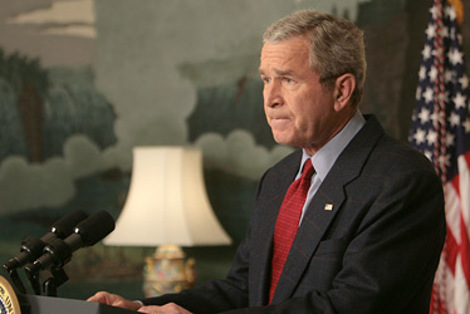
It’s more disturbing in a way than MoDo’s fantasies or Frank Rich’s tragedies. After four years of mounting, centrifugal chaos in a country he invaded on false pretenses, with no plan for victory, Bush is still "empowered" by a sense of religious mission and the aphrodisiac of the appearance of power. If you need any more convincing that Bush isn’t merely not a conservative, but a tragi-comic version of what conservatism has long opposed, then read David Brooks’s column (alas, it’s TimesDelete). Here’s a direct quote from the Decider himself:

"It’s more of a theological perspective. I do believe there is an Almighty, and I believe a gift of that Almighty to all is freedom. And I will tell you that is a principle that no one can convince me that doesn’t exist."

As a very abstract theological principle, it’s hard for a fellow Christian to disagree. But, of course, as a political or historical principle, this is dangerous, delusional hogwash. There is a distinction between Burke theology and politics, a distinction between theory and practice: a distinction at the core of the very meaning of conservatism. The notion that free will or even human freedom is destined to be humanity’s future, and that this destiny can be achieved by a Supreme Leader, is a function not of conservatism in any sense, but of a messianic, eschatological ideology. It’s the most naive form of Whiggery on half-baked evangelical steroids. It is all the more disturbing to be allied with what can only be called Bush’s attachment to the Fuhrerprinzip – the fascistic notion that all human affairs can be commanded and determined by a Great Decider. Our dumb luck, alas, is that our supreme leader is a trust-fund kid with a chip on his shoulder and zero understanding of history or war.
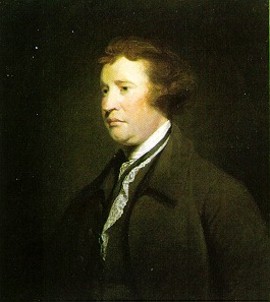
Amazingly, David appears to be taken in by this lunacy. He says that "only the whispering voice of Leo Tolstoy holds one back." Er: how about Burke? Or Aron? Or Tocqueville? Or Constant? Or Gibbon? Or any serious thinker about politics and history not infatuated with some ideology or eschatology? How about every conservative thinker who ever wrote a sentence? Tolstoy? Here’s David:

Tolstoy believed great leaders are puffed-up popinjays. They think their public decisions shape history, but really it is the everyday experiences of millions of people which organically and chaotically shape the destiny of nations — from the bottom up.

According to this view, societies are infinitely complex. They can’t be understood or directed by a group of politicians in the White House or the Green Zone. Societies move and breathe on their own, through the jostling of mentalities and habits. Politics is a thin crust on the surface of culture. Political leaders can only play a tiny role in transforming a people, especially when the integral fabric of society has dissolved.

If Bush’s theory of history is correct, the right security plan can lead to safety, the right political compromises to stability. But if Tolstoy is right, then the future of Iraq is beyond the reach of global summits, political benchmarks and the understanding of any chief executive.

But that is not enough. It implies that Bush’s ideological and theological flim-flam is, at worst, an irrelevance. But conservatives have always argued that such delusions are far, far more dangerous than they are irrelevant. This was Burke’s deepest point. Such delusions actually destroy lives, liberties, societies, civilizations. And what has this messianic maniac in the White House done? He has set loose a fantastically murderous war in Iraq, he has sacrificed thousands of young Americans with the result not of restraining but empowering our enemies, he has done incalculable long-term damage to the country’s fiscal standing, he has indirectly caused the massacre of tens of thousands of innocents, he has come close to wrecking the military of the United States, and he has robbed the United States of its long and hard-won record of humane and decent warfare.

This is not the work of a conservative statesman; it’s the mark of a delusional fanatic. If you define liberalism broadly as the belief that human society is perfectible, that heaven can be created on earth by force of will, then Bush is one of the most recklesss enemies of conservatism who has ever held high office in America. It is a conservative duty to expose and restrain him from any more mischief in his final months. He has refused every olive branch toward sanity. He has balked at every face-saver. So he must be stopped. Above all else, he cannot be allowed to determine the future of this country’s foreign policy in the Middle East. He has done enough damage already.

(Photo: Jim Watson/AFP/Getty.)

George and Mary

The president tells the daughter of his veep something he couldn’t tell his base:

"My only ask was that if his daughter doubted my tolerance to her orientation that I would hope that he would help make it clear to Mary that this is a–I was just worried about–the reason I’d federalized the issue is because I was worried about the courts’ defining the issue and that we’d end up with de facto marriage that was not traditionally defined, I guess is the best way to put it."

Bush has never, to the best of my knowledge, used the word "orientation" publicly to describe gay people in prepared remarks. (If you can prove me wrong, please do.) His base would revolt. I also wonder if anyone actually told Bush that there was no precedent in U.S. law or history for the marriage laws of one state being forcibly exported elsewhere, and that any doubts he might have had on that score were allayed by the Defense of Marriage Act. And the simple point that if his nightmare occurred, then would be a good moment to ponder a response also does not seem to have occurred to him. He had an election to win, I guess.

Notice also how he doesn’t have the courage to confront Mary Cheney directly.

He consulted no openly gay people or couples before endorsing our permanent second-class status in the constitution itself. He was willing to consign a whole class of people as forever beneath equal citizenship without even talking to one of us. His main advisers were Richard John Neuhaus and Robert P. George – two passionately anti-gay theocons. He knew what Rove instructed was wrong. But that makes it worse, not better.

Oddly, I don’t think his presidency will be seen by historians as a major obstacle to gay progress. The power of this social movement is far bigger than one president. Yes, he and his acolytes managed to strip gay couples in many states of the promise of equality for a very long time. But they couldn’t amend the constitution to stigmatize us; and they couldn’t stop our equality being achieved in one state, at least, with more on the verge, and across the rest of the civilized world. Bush also united the gay community more profoundly than at any time in my adulthood. He brought us all together – left and right – against his policies. That was an achievement. Whatever oxygen gay Republicans had before he came long he extinguished.