After We’ve Gone

"I honestly don’t think it will be apocalyptic. But it will be ugly," – retired Marine Col. Gary Anderson, who conducted war games for the Pentagon to predict what would happen in the event of a US withdrawal from central Iraq. The three main scenarios:

Majority Shiites would drive Sunnis out of ethnically mixed areas west to Anbar province. Southern Iraq would erupt in civil war between Shiite groups. And the Kurdish north would solidify its borders and invite a U.S. troop presence there. In short, Iraq would effectively become three separate nations.

Perhaps it should have happened a long time ago. More pertinent:

The games also predicted that Iran would intervene on one side of a Shiite civil war and would become bogged down in southern Iraq.

To my mind, using our exit to make life extremely hard for Tehran should be a main objective. Along with saving Kurdistan.

The Obama Option

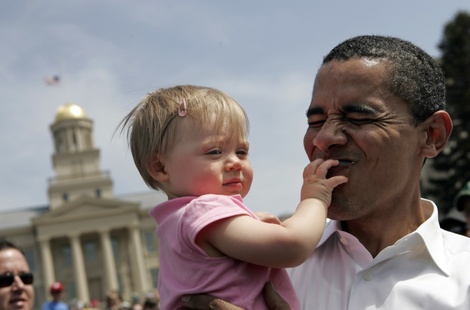
Obamascottmorgangetty

I haven’t pretended he isn’t a liberal. But a small-c conservative can consider backing a liberal if all the viable "conservatives" are corrupt, divisive, shallow, in hock to religious fanatics or palpably unserious about national security. So far, that roughly describes the GOP candidates (excepting Paul and McCain). Hell, I was forced to endorse Kerry last time. Not because I like Kerry, or even agree with him on most issues. But when you have an unhinged, incompetent fanatic in power, unable to recognize let alone govern reality, sometimes you have to pick the least worst option. And when the "conservatives" explode entitlements, lose wars, legalize torture, violate the Constitution or abuse it for electioneering, what’s a real conservative supposed to do? Sometimes, punishing a party for its betrayal of core principles is a necessary act of cleansing.

Besides, I think two parties are important to the health of a democracy, and any political commenter who rules out every candidate of one party in advance is not being open-minded. We’re in a war we have to win. We have a constitution to defend. Those are my acting premises and guiding principles. Given that, I’m not sure we can afford more of this Republican recklessness and incompetence in foreign affairs – let alone their big government nannying and trashing of the rule of law at home. I see no reason to believe that Romney or Giuliani or Thompson are serious about national security. None has told us what they’d do in Iraq now. And hyper-ventilating about "offense" and torturing our way to victory is a mark of deep, deep unseriousness. Any candidate who can pledge to "double Gitmo" has forfeited the support of informed people. If Giuliani is elected, I don’t think the Constitution will survive another terror attack. It’s really that simple.

If Clinton is the nominee, of course, a lot changes. A lot of people will be forced to return to the GOP and struggle against most odds from within. So Obama is very much on the table. He has to be, by default. I’m reading; I’ve been observing; I’m researching more. That’s all. Could any Democrat have spent and borrowed more than Bush? Could any Democrat have damaged national security more than Bush and Cheney? This guy gets my drift.

(Photo: Scott Morgan/Getty.)

Quote for the Day I

"Quite frankly, during last Thursday’s news conference, when George Bush started blathering about "sometimes the decisions you make and the consequences don’t enable you to be loved," we had to question his mental stability. If the president won’t do the right thing and end this war, the people must. The House has voted to withdraw combat troops from Iraq by April. The Senate must follow suit.

Our brave troops should take great pride that they rid Iraq of Saddam Hussein. And they should have no shame in leaving Iraq. For it will not be, in any way, an exercise in tail-tucking and running. America has done its job. It’s time for the Iraqis to do theirs," Scaife-owned, conservative paper, Pittsburgh Tribune-Review.

Something Smells, Ctd.

A longtime reader writes:

I agree with the recent reader who said that the democratization rationale for war did not really begin to get emphasis in the administration’s public statements until after the WMD rationale was revealed to be false (i.e., after the war was commenced).  I think the administration understood that the democratization rationale was never going to be very effective in getting the public on board for war.  Fear-mongering is a far more effective technique, and that is the method they relied upon most heavily. As a real motivation for war, democratization was likewise unimportant to Cheney and Rumsfeld, who were the leading policymakers in the Administration.  George Packer demonstrates clearly in his outstanding book that Cheney and Rumsfeld had an aversion to nation-building and were hoping to install Challabi or some other leader in the mold of, say, Mubarrak, to replace Sadaam.  Cheney and Rumsfeld are hardly strong advocates for democracy here in the U.S., so it would be surprising to find them willing to fight a war to implement it somewhere else.  The fact that so little planning was done for democratization, and so little resources committed to it, also decisively shows that this was not a factor in the decision to go to war.

I am surprised that you still downplay or even reject the important of oil security as a factor in the war decision.

Bush and Scowcroft’s book, "A World Transformed," identifies it as the principal factor in the decision to wage Gulf War I.  They did not want that man sitting atop not not only Iraq’s immense oil reservers, but also Saudi Arabia’s.  Why would it be the key factor in that war, but a non-factor in this war?  Don’t forget that oil security is ultimately the basis for Ken Pollack’s case for war in his book advocating war.

In my view, 9/11 simply gave Cheney and Rumsfeld the political opportunity to do what they wanted to do for reasons having very little to do with terrorism.  The only real importance of 9/11 to the war decision was that the role of Saudi nationals in the attack underscored the unreliability of the Saudis as a continuing ally on oil pricing and supply decisions.  Among the Middle East’s top oil nations (Iraq, Iran and Saudi Arabia), the Administration probably felt that we needed at least one who would be a reliable ally in OPEC, and who would not plunge the world into recession or worse (as OPEC did in the early 1970’s).  Remember, too, that Cheney and Rumseld were in office during the Arab oil embargo of 1973, and the massive macroecomomic problems caused by the embargo probably cost Gerald Ford re-election.

For me, the salient fact is that in a time of war, so many of us simply do not know what to think about the good faith of those in government who are waging it. It honestly makes me heartsick that, with such vile enemies, we are so divided by those who should be uniting us.