
For The Love Of Chocolate

dish_tuxedostrawberries

Sadie Stein investigates the practice of dipping strawberries into layers of white and milk chocolate, or the “art of dressing strawberries in tuxedos”:

As we know, chocolate-dipped strawberries have long held a cherished place in the echelons of Romantic Signifiers. Apocryphal sources from around the Internet claim that a woman named Lorraine Lorusso invented them in the sixties, when she was a candy buyer for Stop & Shop in Chicago—she used to demonstrate new products at the front of the store, and as looked at the strawberries one day, it occurred to her that they ought to be dipped, immediately, in chocolate. But who was the genius who decided to dress the strawberry in formal wear? Google yields no results, although one suspects the eighties. Like the large martini glass filled with mashed potatoes, or the bed strewn with rose petals, its origins are lost in the mists of time. Like love itself, it simply Is. In the immortal words of James Baldwin, “Love is a battle, love is a war; love is a growing up.” Love is a strawberry dressed in a chocolate tuxedo.

Meanwhile, Meg Favreau notes that “from the time Spanish explorers brought chocolate to Europe all the way until the 1900s, chocolate was considered to be more medicine and less treat”:

Even when the humoral theory of medicine faded out of fashion, people remained convinced of chocolate’s cure-all properties. In an 1845 issue of The Magazine of Science, and Schools of Art, there’s this note:

Chocolate is a very important article of diet, as it may be literally termed meat and drink; and were our half-starved artisans, over-wrought factory children, and rickety millinery girls induced to drink it instead of the innutritious and beverage called tea, its nutritive qualities would soon develop themselves in their improved and more robust constitutions.

And of course, in the 1800s and early 1900s, there were chocolate tonics to cure all ills, some more legit than others – Dr. Day’s Chocolate Tonic Laxative and Hauswaldt Vigor Chocolate, among others.

Throughout all of this, people did also consume chocolate solely for pleasure – although not nearly to the extent that they do today. By some accounts, the wives of Spanish colonists were obsessed with drinking chocolate, and in The True History of Chocolate, writers Sophie D. Coe and Michael D. Coe state that, “There is a misconception among some food writers that solid chocolate confectionery is a fairly modern invention… Yet there is evidence that such sweets were being manufactured early on in Mexico… [and] They almost certainly graced many a banquet table in Baroque Europe.” But despite all of this eating of chocolate as sweet, it wasn’t until the 1950s that chocolate was solely marketed for pleasure, no medical claims attached.

(Photo from Flickr user kimberlykv)
Wearing The Diplomas In The Family

American wives are finally better educated than their husbands:

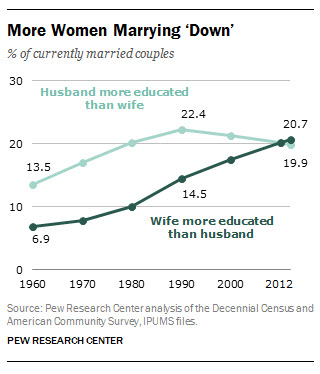
DN_Marry_DownFor the first time since Pew Research has tracked this trend over the past 50 years, the share of couples in which the wife is the one “marrying down” educationally is higher than those in which the husband has more education. Among married women in 2012, 21 percent had spouses who were less educated than they were – a threefold increase from 1960, according to a new Pew Research Center analysis of Census data. The share of couples where the husband’s education exceeds his wife’s increased steadily from 1960 to 1990, but has fallen since then to 20 percent in 2012.

The trend toward wives being more educated than their husbands is even more prevalent among newlyweds, partly because younger women have surpassed men in higher education in the past two decades. In 2012, 27 percent of newlywed women married a spouse whose education level was lower than theirs. By contrast, only 15 percent of newlywed men married a spouse with less education.

Considering how much educational attainment in general has risen over the past 50 years, you could argue record numbers of men are marrying up. But as Kelly Faircloth notes, better-educated women aren’t necessarily better-paid.

56 New Flavors

… of gender identity:

In a surprise announcement Tuesday, Facebook revealed that it is now offering custom categories in the gender selection option beyond the traditional “male” and “female” demarcations.

Unlike Google+, however, which uses “other” as a totalizing option for anybody who wants to express their gender identity outside of the male/female binary (which may help explain why only one percent of its users choose to use it), Facebook is doing its users one better: offering 50 unique terms to choose from. So now instead of just selecting either “male” or “female,” you can choose “custom,” which lets you select your preferred gender identification.

Facebook isn’t allowing users to just write whatever they want, mind you. (I just tried to enter the term “walrus” and had no luck.) But it’s giving more than 50 new options, including everything from “genderqueer” to the defiantly simple “neither.” … As for pronouns, the service is adding the vaguely neutral term “them” to the existing “him” or “her” options.

Joyner is a bit confused:

I must admit, I haven’t the slightest clue what some of these terms mean, much less the distinction between, say, Trans Female, Trans*Female, Trans*Woman, Transexual Female, and Transgender Female. For that matter, if I’m understanding the terms correctly, I’m not only male I’m also CisCis MaleCis ManCisgender, and Cisgender Male; I have no idea what advantage is created by having so many choices to describe the exact same thing.

My point isn’t to make light of this. On balance, I think this is the right move. The fact that simply choosing male was a no-brainer for me under the old category system—indeed, it never occurred to me to wonder why additional choices weren’t provided—is an indicator of privilege. Facebook may have overcompensated here. But at least they’ve inspired a useful conversation.

Paris Lees asks, “Why stop there?”:

I doubt Facebook did this as an act of pure progressiveness to cater for its transgender users and I can’t help wondering what the commercial imperative is. What money is there to be made by sorting people into ever more specific boxes? Advertisers will be wetting themselves – particularly anyone selling wigs, chest binders, or any of the other specialised products aimed at those of us who seek to change our gender. It’s the monetisation of minorities.

But – as many of my Facebook friends have pointed out, wouldn’t it be better to leave a blank box for people to dream up their own gender identities? Why choose from 56?

Update from a reader, who answers Lees’ question:

From someone in the tech field, it’s because data normalization on a free-form field is next to impossible. Where you earlier quoted someone as calling it the “monetization of minorities” (which is entirely correct), there’s no way to target them if FB doesn’t know exactly who it’s targeting. That’s why you have to choose a specific gender – so FB knows exactly what it’s targeting.

“Love In The Time Of Advertising”

That’s the name of the above animated musical short by Matt Berenty and David Bokser, which Casey Chan praises as “adorable in all the right ways” and “just as good as any Pixar short”. In an interview last November, the filmmakers spoke about their inspiration for the project:

Matt Berenty: “The project started when David Bokser and I were just about to graduate from the Savannah College of Art and Design to pursue jobs in the animation industry. We were driving to lunch one day toward the end of school and I looked up at a billboard and asked, ‘What would it be like to live in a billboard?’ This instantly sparked an interest in telling a story based around this idea.”

David Bosker: “I think what made it stick so well for us was that the field of advertising was so ripe for satire. We are constantly being bombarded by advertisements which are essentially messages that somebody, somewhere has thought up in order to influence our actions and emotions. We wanted to find a way to wrap that concept inside a traditional love story without it being too heavy handed in it’s message or too sentimental.”

A Union Vote With The Company’s Blessing

Workers at the Volkswagen plant in Chattanooga vote today on whether to join the United Automobile Workers. Lydia DePillis outlines what’s at stake:

If a majority of Volkswagen’s 1,570 hourly workers vote yes, it would mark the first time in nearly three decades of trying that the UAW has successfully organized a plant for a foreign brand in the United States. This time, the union has a powerful ally: Volkswagen itself, which is hoping the union will collaborate in a German-style “works council” and help manage plant operations.

Tennessee’s GOP leaders — along with well-funded conservative activists such as Grover Norquist — aren’t letting the UAW in without a fight.

Seth Michaels looks at the Republican campaign to stop the plant from unionizing:

Sen. Bob Corker held a press conference Tuesday specifically to ask VW employees to reject a union, claiming potential negative impact on the state’s economy. More insidiously, state legislators suggested that they might punish VW if employees vote for the union – withholding tax incentives for future expansions, for example. In addition to likely being illegal, these threats have a special kind of irony: “we’re so worried that you’ll have a negative jobs impact that we’re willing to block future jobs to prevent it.”

Waldman thinks this reveals something ugly about the Republican anti-union agenda:

Here you have a highly profitable company that wants to have a more cooperative relationship with its workers, and obviously sees a union as a path to that relationship, because they know that they can work that way with unions, since they do it already all over the world. But the Republican politicians don’t care about what the corporation wants. They are so venomously opposed to collective bargaining that they’ll toss aside all their supposed ideals about economic liberty in a heartbeat.

Rana Foroohar chimes in:

[T]he truth is that there’s little evidence that the anti-union manufacturing model (exemplified by companies like Nissan) works better than the unionized one, particularly when it incorporates Germanic work councils. VW actually credits the system with making it the largest and richest auto firm in the world. What’s more, the workers I’ve spoken with in Chattanooga say they are less interested in pay hikes than in having some say over which cars get made in the factory, what sorts of training programs they’ll have access to, etc.

Art That Really Touches You

Composer Alexis Kirke creates music that changes in response to listeners’ physical states, as tracked by biosensors. Others are working on similar experiments:

In 2011, tech firm Sensum debuted its interactive horror film Unsound at the South by Southwest festival in Austin, Texas. The firm uses galvanic skin response sensors to alter film content to heighten – or reduce – emotional reaction to it. For my own short film, Many Worlds, algorithms use brainwaves, muscle tension, perspiration and heart rate in a selection of the audience to adjust the story in real time, choosing the most appropriate of the film’s four narratives to maximize intensity.

Writing this kind of multiple narrative is a challenge, and one that science fiction author Hannu Rajaniemi has tackled with technologist Samuel Halliday for an e-book project called Neurofiction. The first short story, Snow White is Dead, has 48 different narrative paths, selected automatically based on the results of an EEG brainwave monitor attached to the computer on which the e-book is being read. “Readers have been enthusiastic – several commented that they found the story very moving,” says Rajaniemi.

Caffeinated Kids

Under-12s are drinking a lot less soda and a lot more coffee than they used to, according to a recent study in Pediatrics (pdf). Rachel Feldman investigates:

Why are kids guzzling down coffee instead of cola? Once considered part of a healthy diet, soda consumption has increasingly been tied to childhood obesity and behavioral problems. Marketers are left swinging between offering “natural” products and pushing their diet soft drinks as an alternative to calorie-heavy regular soda. But studies have found that the fake sugar in diet soda could actually make people more hungry, and wreck their bodies’ ability to react to the real thing—so kids end up packing on the pounds anyway.

Our perception of coffee has gone in the other direction. In moderation, most studies now suggest, coffee itself is actually pretty good for you. But it’s the rest of what’s in that cup that worries health experts. Coffee historian Mark Pendergrast told MarketWatch that speciality coffee shops like Starbucks have made the drink “hip and cool,” but the drinks that appeal most to kids are only distant cousins of a black cup of Joe. “The milk and added sugar [in drinks like the Starbucks Frappuccino] cut the acidity and make it more palatable for children,” he said, “and for adults, for that matter.” These fats and sugars counteract the potential benefits of drinking coffee.

Corruption On Ice

Figure Skating - Winter Olympics Day 6

Last night, Russian figure-skater Evgeni Plushenko withdrew from competition due to injury. Leonid Bershidsky provides background:

Plushenko, 31, has recently suffered one setback after another. After winning silver in Vancouver – and complaining loudly about the judging – he missed most top-level tournaments because of injuries. Last year, he crashed to the ice at the world championships and had to pull out. It took complex spine surgery to get him back on his feet, and in January, 2014, he lost to 18-year-old Maxim Kovtun at the Russian national championship. According to the Russian Figure Skating Federation’s own rules, Kovtun was supposed to travel to Sochi, but, after much debate, officials decided to send Plushenko, anyway. The 18-year-old was deemed too inexperienced and erratic, because of a woeful failure at the 2014 European championships.

The larger symbolism of Plushenko flaming out:

[T]he choice of an injured star over a talented youth and disregard for rules are typical of the way top-level sports are managed in today’s Russia. The Soviet system of selecting and training young athletes, which served as a model for the frighteningly effective Chinese sports machine of today, is gone. The few remaining stars brought up by that system, including Plushenko, are squeezed relentlessly for their few remaining drops of gold.

Julia Ioffe zooms out:

Some Russians are wondering if this isn’t just a symptom of Putin’s Russia, where connections and closeness to the power elite guarantee you positions and privileges that you might not otherwise land.

As I wrote in my cover story last week, this is why many younger, ambitious Russians feel that they’re suffocating: the old men at the top just won’t let go of their thrones and let the young’uns take a stab at things. “This is what we call, is there a path for young people, or like the vetrical of power,” one Russian tweeted tonight, referring to the Putinist power structure, referred to as the “vertical.” “People don’t rotate out until they utter the words, ‘I’m tired, I’m leaving.'” (This is what then-old man Boris Yeltsin said before handing power over to Vladimir Putin.)

She follows up:

Plushenko, despite his precarious health, talked his way onto the Russian Olympic skating team in closed-door meetings. Talked, not skated. (Plushenko is a talented skater, but he’s one hell of a diva and, during the 2010 Olymipcs in Vancouver, his public ranting and whining and complaining were virtually all I wrote about.) But Plushenko is also one of a coterie of athletes and artists that are loyal Kremlin hacks, understanding that, these days, there is pretty much only one side of the bread that’s buttered in Russia. These athletes and artists perform at official functions, they support the Kremlin line when needed, and, as a result, are wealthy, privileged people, existing in a plane far above the rest of their countrymen—and, often, the law.

Update from a reader:

Someone please explain the difference between Plushenko getting a spot on the Olympic team by pushing aside another Russian skater who qualified ahead of him and Ashley Wagner of the US who did EXACTLY the same thing. She fell in the finals but was given a spot by US authorities because she’s older and more experienced. What am I missing?

(Photo: Evgeny Plyushchenko of Russia leaves the stadium after his injury at a warm up during the Men’s Figure Skating Short Program on February 13, 2014 in Sochi, Russia. By Vladimir Rys Photography/Getty Images)