A bride arrives for her wedding ceremony at Cheongshim Peace World Center in Gapyeong-gun, South Korea on February 12, 2014. 2,500 couples from around the world exchanged vows in the wedding the Unification Church claims as one of its largest ever. By Chung Sung-Jun/Getty Images.
The Question Rubio Won’t Answer, Ctd
Saletan bashes the young Senator for refusing to confirm or deny that he ever smoked marijuana:
When you tell a child that it’s bad or unwise to do something, and the child asks you whether you’ve done it, the most important thing isn’t to persuade the child that you’re clean. The most important thing is to tell the truth. … Kids aren’t stupid. When they ask whether you’ve smoked pot, and you evade the question, they don’t conclude that it’s bad to smoke pot. They conclude that you think it’s OK to hide the truth from your kids. What they’re learning from you is deceit.
A reader sounds off:
I’m by no means a fan of Marco Rubio, but I’m not particularly upset that he won’t answer the questions. Politicians make a practice of not answering questions if they can avoid it, and certainly not questions the answers to which could potentially alienate voters. I should say that I think his refusal to answer is kind of stupid, which is par for the course with Rubio. Hardly anyone would refuse to vote for him if they knew he had smoked some pot back in the day and, in fact, his weaselly refusal to answer could lose him some votes.
But the answer that he should have given is: “None of your business”. Whether he had ever smoked pot has absolutely no bearing on his qualifications to be President. And while journalists are certainly entitled to ask him this question, I disagree with you and believe that we aren’t entitled to an answer from him. In my view, this is a purely private matter.
Update from another:
The reader you quoted is wrong. Marijuana prohibition is a matter of public policy. If a politician supports said prohibition, as we must assume Rubio does, then the public has a right to know whether or not he has smoked before. We’re not talking about Rubio’s sex life here, where privacy would be expected – and where no laws prohibit him from doing whatever he chooses in the bedroom.
Toe Tapping Among The Goose Steps, Ctd
Remembering the 1940s swing group The Harlem Kiddies – an Afro-Jewish ensemble that improbably made it big in WWII-era Denmark – Anne Dvinge examines how jazz flourished in Nazi Europe:
In the occupied territories, jazz continued to exist and even thrive. In Norway, a ban on radio jazz transmissions meant an increase in live performances, both public and underground, and in Paris the popularity of Romani jazz guitarist Django Reinhardt allowed him to avoid both racial and artistic persecution. And the war years became one of the most fruitful periods for Danish jazz. For one thing, the nightlife in Copenhagen boomed during the German occupation. Clubs and dance restaurants featured live jazz performances on a regular basis and big swing cavalcades drew audiences of up to 8,000, according to an old news clipping. … So jazz, in Denmark and in other occupied territories, became a music of resistance. It was the music of the Allied forces, a music despised by the Nazis, and a music of joy and syncopation in a time of fear and regulation. The symbolic significance of jazz during the occupation resulted in a huge rise in audiences.
Previous Dish on jazz in Nazi-occupied Europe here.
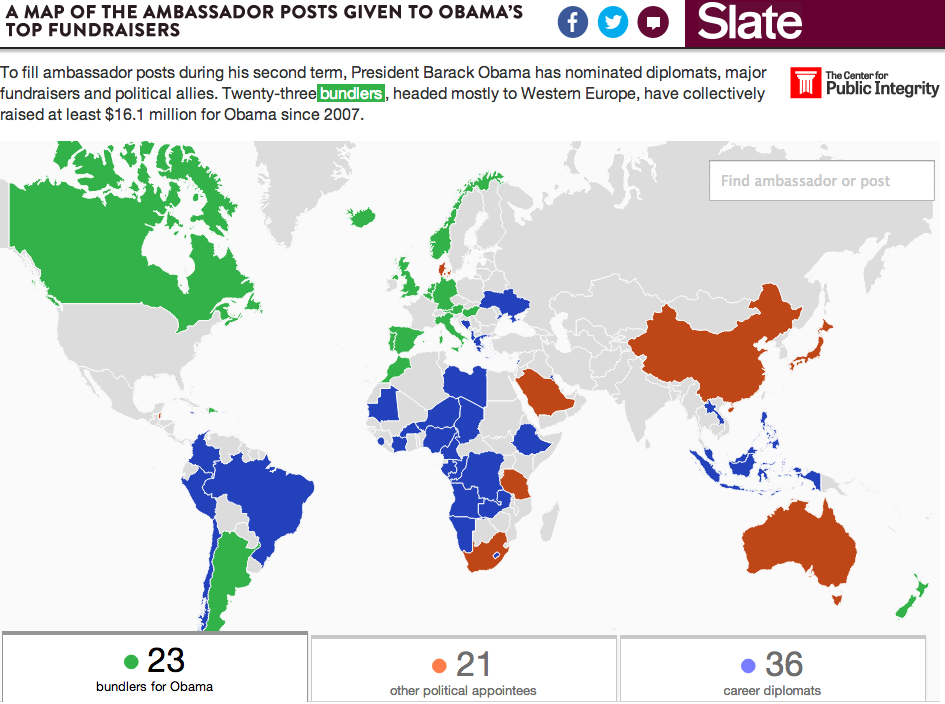
Ambassadorships For Sale
James Bruno laments that the US still hands out ambassadorial appointments as political prizes:
When hotel magnate George Tsunis, Obama’s nominee for Oslo, met with the Senate last month, he made clear that he didn’t know that Norway was a constitutional monarchy and wrongly stated that one of the ruling coalition political parties was a hate-spewing “fringe element.” Another of the president’s picks, Colleen Bell, who is headed to Budapest, could not answer questions about the United States’ strategic interests in Hungary. But could the president really expect that she’d be an expert on the region? Her previous gig was as a producer for the TV soap opera The Bold and the Beautiful. She stumbled through responses to Senator John McCain (R-Ariz.) like, well, a soap opera star, expounding on world peace. When the whole awkward exchange concluded, the senator grinned. “I have no more questions for this incredibly highly qualified group of nominees,” McCain said sarcastically. …
The reason a hotelier and a television producer, for instance, might be appealing choices is blindingly obvious: money. Bell raised $2,101,635 for President Obama’s re-election efforts. Tsunis, who flipped his affiliation from Republican to Democrat in 2009, embraced his new party with gusto, raising $988,550 for the president’s 2012 bid.
Henri J. Barkey takes Obama to task for what he calls “a disservice to diplomacy”:
The Obama administration’s appointments suggest that the president isn’t being honest when he says that diplomacy is important to him. Yet the administration clearly values diplomacy — officials, including the president, have emphasized that the ongoing negotiations with Iran are the way to resolve the nuclear impasse. Would Obama consider making Tsunis our negotiator? Of course not. Yet it’s illogical, and insulting, to presume that Norwegians are such wonderful and civilized people — and hence unlikely to cause any problems with Washington — that we can afford to send someone on a taxpayer-funded three-year junket to enjoy the fjords.
But Fisher, who passes along the above map from Slate, sees a silver lining:
There may be an upshot to all this. Career diplomats are probably, in most circumstances, also going to be the best diplomats. They’re competing against campaign bundlers for assignments, though, and they seem to lose out for assignments like Belgium or Italy. Countries like Egypt and Russia are probably important enough that no administration would send a bundler there. But there’s a category of countries that are not Egypt-level difficult to demand a technocratic assignment, nor Portugal-level fun that a campaign bundler gets it.
You have to wonder if some number of really talented diplomats, who in a universe without campaign bundlers would get sent to Austria or Italy, are instead getting sent to countries like Malaysia or Peru. Countries they would otherwise be too experienced or talented to be sent to. And maybe, as a result, the United States has unusually good diplomatic representation in a lot of the blue countries in this map. That could maybe have helped a little bit in sub-Saharan Africa, where, as G. Pascal Zachary argued in The Atlantic, the United States has seen significant diplomatic gains.
Rand Paul vs The NSA
Rand Paul is suing the government over the NSA’s bulk data collection program, on behalf of every American with a phone:
The complaint charges Obama, as well as Director of National Intelligence James Clapper, National Security Agency Director Keith Alexander and FBI Director James Comey, with violating the Fourth Amendment to the U.S. Constitution by collecting and storing Americans’ phone data on a massive scale. … Joined by the conservative and libertarian non-profit FreedomWorks and former Attorney General of Virginia Ken Cuccinelli, Paul submitted the complaint to the U.S. District Court for the District of Columbia Wednesday morning.
Serwer explains the significance of a class action suit:
“A class action would be Rand Paul, not just suing on his own behalf, but on behalf all people, known and unknown, who are similarly situated,” said Stephen Vladeck, a law professor at American University. “Ostensibly, he could be suing on behalf of all Americans, or all Americans hypothetically affected by these court orders.”
By making his challenge to the NSA’s metadata program a class-action suit, Paul is reiterating his point that the metadata program amounts to a “general warrant,” or the government giving itself permission to search any person at any time without individual suspicion or evidence of a crime, in violation of Americans’ constitutional rights.
But Adi Robertson says the suit is “doomed” for that very reason:
Paul says he expects the case to quickly rise to the Supreme Court and that “the American people will win.” Unfortunately for the American people, he’s almost certainly wrong. So far, damages and injury from NSA data-gathering have been hard to establish even on an individual basis. Several groups have brought lawsuits against the administration by saying a particular individual organization or person has suffered because of surveillance. But even for Verizon customers, who have a leaked court order to back them up, there’s no definitive way to tell whether the NSA actually collected metadata from them, and the claim is too hypothetical for many judges. If Paul wants to go forward with the suit, he’ll need to calculate and prove similar damages for every single member of his class.
None of which, of course, have stopped Paul from trying to recruit 10 million people to “join the class action lawsuit” by sending their name, email address, and zip code. In theory, this shows that a large number of people have suffered similar harm and lets people opt into the suit, although nobody joining will be able to provide any information on whether they’ve been spied upon (and therefore qualify.) In practice, the charitable interpretation is that it’s essentially a petition of protest. The uncharitable interpretation is that it’s a fundraising and campaigning effort.
Allahpundit thinks it’s a smart political move:
Whether a Fourth Amendment suit will prevail depends on which judge they draw. Remember, within 12 days of each other in December, a federal district court judge appointed by Bush found the NSA’s data-mining program unconstitutional while another judge appointed by Clinton upheld it. Assuming both rulings are affirmed on appeal, it’s a cinch that this will end up in the Supreme Court. Paul’s shrewdly getting on board now, before it takes off, so that he’s in the middle of things as it moves up the legal food chain.
Massimo Calabresi, however, sees a big risk:
The risk for Paul is not so much the legal outcome as a potential change in the politics of the underlying issue. Where the law can be slow to develop and harden, political change can be rapid and unpredictable. Paul risks getting on the wrong side of an issue that is still playing out in the public mind. … For now, Paul’s play may work all the better for having mainstream Republican and Democratic opposition. But public opinion is fickle and it doesn’t take much to imagine a turn of events that could leave Paul exposed to charges he put politics ahead of national security.
Read the full complaint here.
Chart Of The Day
Shaila Dewan passes along the latest from (pdf) Pew:
From 1965 to 2013, according to a new Pew report called “The Rising Cost of Not Going to College,” the typical high school graduate’s earnings fell more than 10 percent, after inflation.
“That is one of the great economic stories of our era, which you could define as income inequality,” said Paul Taylor, an author of the report. “The leading suspects are the digital economy and the globalization of labor markets. Both of them place a higher premium on the knowledge-based part of the work force and have the effect of drying up the opportunities for good middle-class jobs, particularly for those that don’t have an education.”
Even middle-class jobs that are still available increasingly require a college degree, either because they require more skill than they used to or because employers have become pickier.
Laurence Steinberg believes fixing high school is the best way to produce more college graduates:
The U.S. has one of the highest rates of college entry in the industrialized world. Yet it is tied for last in the rate of college completion.
More than one-third of U.S. students who enter a full-time, two-year college program drop out just after one year, as do about one fifth of students who enter a four-year college. In other words, getting our adolescents to go to college isn’t the issue. It’s getting them to graduate.
If this is what we hope to accomplish, we need to rethink high school in America. … If we want our teenagers to thrive, we need to help them develop the non-cognitive traits it takes to complete a college degree—traits like determination, self-control, and grit. This means classes that really challenge students to work hard—something that fewer than one in six high school students report experiencing, according to Diploma to Nowhere, a 2008 report published by Strong American Schools. Unfortunately, our high schools demand so little of students that these essential capacities aren’t nurtured. As a consequence, many high school graduates, even those who have acquired the necessary academic skills to pursue college coursework, lack the wherewithal to persevere in college. Making college more affordable will not fix this problem, though we should do that too.
Unfriending Facebook, Ctd
A reader can’t imagine leaving the site:
I am 27. My age is important because it tells you that pretty much everyone I know is on Facebook. All my friends, all my family (grandparents included). Every single person. I recently threw a party and realized that I had to send out annoyingly informal Facebook invitations because, other than by phone, I have no idea how to contact my friends. I’m sure they all have email addresses, but why would I know what they are? I haven’t emailed one of my friends in years. Email is for conversing with old people and writing to The Dish.
When my fiancé proposed, we were in Asia. We called parents to let them know and then changed our relationship status on Facebook. That was all we did. That is how all of our friends found out. That is how my uncles and aunts found out. I have one friend who quit Facebook and she was literally the last to find out several months later. I don’t want to be that out of the loop. A friend had a baby yesterday. Facebook let me know. It’s the society pages of our times. Quitting Facebook literally means quitting my friends’ lives. I just can’t do that and still have friends. I know all the research into how Facebook affects mood and outlook, but I would rather be a little unsatisfied with my life than have no idea what is happening in my friends’.
A few other readers are much less satisfied with the site:
I’ve been on Facebook for just over five years now and for most of that time I have dithered between staying on Facebook or closing my account. Why? I find myself more depressed since I got onto Facebook.
I attribute much of my depression to what I see on Facebook alone and I can’t help but use Facebook as a measure of my own life. Specifically, I hate seeing people I grew up with and worked with having seemingly better lives than me, according to what they post. I also get depressed by some of the same people I grew up with and worked with who are experiencing hard times and turn Facebook into their online pity party. Then there’s the high school friends who post something rather mundane who get many likes from many of my classmates while I get maybe two or three, which just demonstrates how you high school popularity (or lack of it) follows you for life. Another similar depressing fact: most of the handful of people who have defriended me were people I grew up with or went to high school. High school was 30 years ago!!
Another big reason for wanting to leave Facebook comes down to many of my Facebook friends who don’t exercise good editorial control: either don’t know when to keep their “Facebook mouths” shut, or don’t open their Facebook mouths at all.
I’m a news junkie and I find the Facebook newsfeed to be a good and valuable source of world, national, local, sports, art. political and other news, to the point that it has replaced the print newspaper. It is also a good source of news from friends, but only when they have something interesting to say and sadly, that occurs occasionally. More often, I get posts about my Facebook friends unsolicited political, religious and social views, constant memes on all those subjects, banal posts about the mundane things in their lives that interest only them. For those who don’t say anything at all, I wonder if something bad is going on in their lives and they stay off Facebook to avoid discussing it or to avoid lying about their circumstances by positing pictures of themselves as shiny, happy people.
I also find that you gotta close your account completely. I’ve tried deactivating for a couple weeks last year and that did not work.
Another called it quits:
I grew up with a mother who was a real life version of Hyacinth Bucket (“it’s pronounced Bouquet!”) from the BBC sitcom Keeping Up Appearances. Her life and the lives of her family were held up to relentless competitive comparison with the lives of neighbors, acquaintances and anyone else who came across her radar, always with the intent of reassuring herself that she was better than they were.
After some years of therapy connected, ostensibly, with other issues, I realized that the reason Facebook was so compulsive to me was because it allowed me to practice this delightful inherited behaviour all day long. It plays into some very unpleasant human social characteristics, foremost the temptation to evaluate one’s own worth based on a comparison with others: what they have, what they do, where they holiday, etc. It is a profoundly unspiritual experience.
I have no doubt that Facebook users are statistically less happy than non-users. I found that to use it for any length of time with any regularity was to risk being sucked into a very unpleasant world of comparison. And as anyone who’s attended AA will tell you, “Compare and despair!” It had to go. For the likes of me, it’s poison.
Mental Health Break
Why Not Just Get Rid Of The Debt Ceiling?
Yglesias would like to see it abolished:
With this whole terrible idea of using the debt ceiling as a policymaking opportunity behind us, can we just get rid of the darn thing? It serves no useful purpose beyond partisan needling. But it obviously doesn’t systematically advantage either Democrats or Republicans. In the long run, the needling all just evens out. What you’re left with is a negative-sum impact on the real world. So let’s scrap it.
Eric Posner points out that Congress is already on it:
Recently, several members of Congress, including Representative Mike Honda and Senators Barbara Boxer, Chuck Schumer, and Mazie Hirono, introduced legislation to do just that. The bills provide that when the national debt comes within $100 billion of the ceiling, the president may send a notification to Congress to that effect. Congress then would have a limited period of time during which it may issue a joint resolution that forbids borrowing above the debt ceiling. If Congress fails to pass such a resolution, or does but it is vetoed, Treasury may borrow beyond the debt ceiling. The bills make sense, and Congress should act on them as soon as possible.
How To Help Russia’s Gays
One of the more frustrating aspects of the debate about homosexuality in Putin’s neo-fascist Russia is what we can actually do about it. Protests are fine; international condemnation is important; helping gay groups in Russia matters. But at some point, this is not our country, and there are limits to intervention, if we are not going to engage in the simplistic idea that all societies across the globe must now have the same prevailing attotudes toward gayness that have only recently emerged in the West. In our latest podcast, I asked Masha Gessen what her ideas are for giving Russian gays some practical support and help. Her answer surprised me – but it shouldn’t have: granting Russian gays the group refugee status that we once accorded to Soviet Jews:
If you’re a subscriber, you can listen to the whole podcast here. If you’re not because you’re still procrastinating on renewing, get it over with and subscribe here!