The World According To Derb

Planet Earth through some strange, suburban eyes:

I saw two rabbits on the lawn. This was not surprising in itself — our neighborhood is infested with the little critters — but what they were doing was so peculiar I had to stop & watch.

First they face off in a sort of tense crouch, about a rabbit’s-length apart.  Then one leaps straight up — dead vertically — in the air, as if a spring was just released.  Then the other does the same.  This drill is then repeated three or four times. but now with some forward movement, as if the jumper was trying to land on top of the other (though this never even comes close to happening).

After a couple of rounds, I notice something odd and probably icky. At the apogee of the second or third jump, a cloud of fine mist is briefly visible beneath the jumper, apparently sprayed out from his underside.

I’m really not making this up.

Blogging Recovery

A 19-year-old coke addict blogs his way forward one day at a time:

It’s funny the parts of the lifestyle that you miss. Right now I’m thinking about all the crazy, suicide trips we’d make to the cities. We’d drive, oh, 3 hours just for a half. Cut it on the way back, get home with 1.5 oz. Weigh it, bag it, push it, blow it. I loved it…

Who’s In Charge?

Steve Clemons says there’s a power struggle going on within the Bush administration over policy toward Iran. Money quote:

Cheney himself is frustrated with President Bush and believes, much like Richard Perle, that Bush is making a disastrous mistake by aligning himself with the policy course that Condoleezza Rice, Bob Gates, Michael Hayden and McConnell have sculpted.

According to this official, Cheney believes that Bush can not be counted on to make the "right decision" when it comes to dealing with Iran and thus Cheney believes that he must tie the President’s hands.

Obama’s Moment?

Lower_ninth

A reader writes:

You’re mostly right and you’re partly wrong in your Obama profile. Here’ what you don’t get in his stump speech but is certainly there and is conservative. He’s willing to engage the other side, listen to their opinions, and accept them if he believes they’re right. I know, I took a couple law classes with the guy five years ago at the University of Chicago (no liberal enclave). As a professor and legislator, he was constantly demanding that his students and his colleagues prove to him why their ideas were right, he was constantly playing devil’s advocate against his students and colleagues’ often liberal ideas, so that he and, also importantly they, realized the strength and power of their views or their flaws. it’s nice to be shown through the socratic method that one’s views are morally defensible and superior to conservative views, or where they fail. On the other hand, being a professor at the U of C law school I know he was influenced by the libertarian strain of thought present in the school. In the end, as he often states in town hall settings, he’s a pragmatist. He is willing to steal the ideas of anybody, liberal, conservative, libertarian, if it results in what he considers to be the just end result (universal health care, better schools, a better environment). This is why you constantly see him demanding accountability and the need for efficiency from people and government. That’s why teachers in his view deserve more money but must be willing to be more accountable. That’s why he demands that if we have universal healthcare, we ask people to take better preventative care of themselves and not just throw money into a broken system.

The man is no ideologue.

He’s ultimately a pragmatist, in some ways no different than Bloomberg, Schwartznegger, and Spitzer.

I’m sure this reader is right about Obama’s pragmatism. My point is that the pragmatism is in yoke to liberal ideas, especially about the role of government. I’m not complaining particularly. He’s a Democrat and a progressive. But his broad political identity is liberal. And it’s worth acknowledging that up-front. Maybe that’s what America wants right now. Another reader adds:

I really believe Obama’s tapped into something powerful with (as you put it) that theme of restoration. As an American who’s traveled abroad (and who has relatives from abroad) I’ve often felt humiliated by the face of America the Bush administration has shown the world in recent years. In a recent e-mail exchange with an acquaintance in Australia, I expressed the hope that the election of Obama as our president would remind people of the ideals and the idea of progress that United States used to represent in the world and that it would mark the end of the moral crisis we’ve experienced.

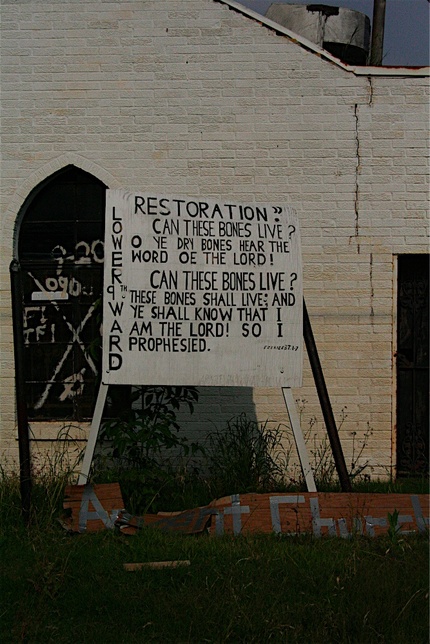
The feeling I get from Obama’s speech reminds me of the feeling I got when I was in the Lower Ninth Ward of New Orleans a couple weeks ago (as a visitor) and seeing a little church that had been damaged by the flood. Clearly, (even though the neighborhood had been destroyed) the congregation had worked to restore their church and their community and to prepare for the time they would at some point be allowed to go home. Inside this church (and beautifully lit by sunlight through a stained glass window) was a painting of Christ standing in a river (or possibly floodwater). You can read the sign at the church in the photo above.

Seeing the effort that had been made to restore this church (building and community) that was surrounded by the destruction left by Katrina – I found the message really inspiring in its power and hopefulness. There’s a lot of restoration that needs to be done in our country – of our ideals, and of our communities. I too hope Obama deepens and broadens his message.

It cannot do any harm.

The Future of Iraq

I have a feeling it will contain many moments like this:

Recently, Mr. Sadr has been taking a different tack. His supporters have met with Sunni Arab tribal leaders from Anbar Province who have been feuding with the insurgent group Al Qaeda in Mesopotamia. The meetings were billed as an effort to forge a nationalist movement to overcome sectarian tensions, and the message appeared calculated to appeal to war-weary Iraqis. Some political analysts saw it as an attempt to expand his political bloc, and his return may also be an effort to advance this agenda.

It’s their country. One day, they will have to fight for it by themselves.

Catholic Bobos

David Brooks tells the story of my own family:

On the one hand, modern Catholics have retained many of the traditional patterns of their ancestors — high marriage rates, high family stability rates, low divorce rates. Catholic investors save a lot and favor low-risk investment portfolios. On the other hand, they have also become more individualistic, more future-oriented and less bound by neighborhood and extended family. They are now much better educated than their parents or grandparents, and much better educated than their family histories would lead you to predict.

More or less successfully, the children of white, ethnic, blue-collar neighborhoods have managed to adapt the Catholic communal heritage to the dynamism of a global economy. If this country was entirely Catholic, we wouldn’t be having a big debate over stagnant wages and low social mobility. The problems would scarcely exist. Populists and various politicians can talk about the prosperity-destroying menace of immigration and foreign trade. But modern Catholics have created a hybrid culture that trumps it.

Theocons Vs Marriage

The unintended consequences of homophobia:

Conservative opposition to gay marriage is having unconservative effects, helping to push the boundaries of family law into new territory that challenges the primacy of marriage itself. By opposing gay marriage, conservatives are forcing gay families to seek refuge through untraditional means that could undermine marriage or destabilize family concepts in ways that gay marriage itself would not.

Art and Commerce

Today’s artists are down with capitalism. And why not? Money quote:

Most working artists split their time among the various sectors fairly evenly, according to a report from University of Minnesota. Roughly 39% spend most of their arts time in the commercial sector, and 42% engage in part-time commercial work. Only 19% of the artists surveyed did no commercial work at all.

"The so-called reclusive artist of fifty or sixty years ago, the Horowitzes who showed up, played their concert and then left, although extraordinary artists, are gone. The world has changed a great deal, especially in America," says Joseph W. Polisi, president of the Juilliard School.