The Story Of Stax

Aaron Gilbreath reviews Robert Gordon’s Respect Yourself: Stax Records and the Soul Explosion, which offers insights into a groundbreaking Memphis studio:

[The book’s] absorbing scenes show the way original music gets made. Here, it’s often accidentally: musicians goofing around in the studio, tinkering with riffs they’d written or combinations of notes they find themselves drawn to. In this quiet way, Respect Yourself portrays the enigmatic workings of creativity — and the role of common, unplanned events — as with the way the chorus to Sam and Dave’s breakout hit “Hold On, I’m Comin’” resulted when Dave was sitting on the toilet, and Isaac Hayes kept telling him to hurry up and get back downstairs to the studio. The way Otis Redding came to Stax’s attention while working as a chauffeur for a visiting guitarist, and kept asking people at the session to let him sing. And how Rufus Thomas casually recorded his big hit “Walking the Dog” during a quick studio visit on the fly between church and Sunday dinner. Gordon wisely contrasts Stax’s loose “organic” approach with Motown’s assembly line, automaker approach. As Isaac Hayes put it, “Stax was down-to-earth, raw, very honest music.”

Reviewing the book in December, Elsa Dixler highlighted (NYT) what made Stax stand out from other labels:

As early as 1962, some of the qualities that made Stax unusual were apparent. The most important was the absence of racism in a Memphis that was still completely segregated. “Being treated like an equal human being . . . was really a phenomenon,” Al Bell, who later became the executive vice president of Stax, recalled. “The spirit that came from Jim and his sister Estelle Axton allowed all of us, black and white, to . . . come into the doors of Stax, where you had freedom, you had harmony, you had people working together.” An obvious symbol of that harmony was Booker T. and the MG’s, consisting of two black musicians and two white. Gordon makes clear how extraordinary this atmosphere was by following the stories of the effort to unionize Memphis’s mistreated sanitation workers and of the white flight that followed the city’s slow compliance with Brown v. Board of Education.

The Failure Rate In France

Claire Lundberg explores the ups and downs of the country’s state-subsidized university system. Among the downs:

[A]t France’s open-enrollment public universities, the dropout and failure rate after the first year is close to 50 percent. The most competitive majors, such as law and medicine, cull their student lists with more brutal testing. Future French doctors must pass a government-regulated subject test after their first year of college—a test for which the initial failure rate is 90 percent. Many students take the entire year a second time, but even these redoublants have an 80 percent failure rate. (The French minister of education is trying to implement reforms that redirect the weakest students into other professions after their first semester.)

People who want to be doctors or lawyers often retake the first year several times, in hopes of passage—each time, costing the government more money.

The Ministry of Education would like to limit the number of times these tests can be taken. In a way, this makes sense—the government is paying to train the doctors, they want to make the decisions about who will and won’t progress in the profession. But of course, there are other skills that go into being a doctor besides the ability to pass a government exam. The French system works beautifully if you’re extremely focused from a very early age, work well under pressure, and are great at taking tests. It works less well if you’re not sure at age 16 exactly what you might want to do with your life, or if your family members and peers aren’t already familiar with the system.

The Mirage Of Food Deserts

Eliminating them has been one of Michelle Obama’s pet issues:

But access to healthy foods isn’t a solution to obesity:

Unfortunately, more fresh food closer to home likely does nothing for folks at the bottom of the socioeconomic ladder. Obesity levels don’t drop when low-income city neighborhoods have or get grocery stores. A 2011 study published in the Archives of Internal Medicine showed no connection between access to grocery stores and more healthful diets using 15 years’ worth of data from more than 5,000 people in five cities. One 2012 study showed that the local food environment did not influence the diet of middle-school children in California. Another 2012 study, published in Social Science and Medicine, used national data on store availability and a multiyear study of grade-schoolers to show no connection between food environment and diet. And this month, a study in Health Affairs examined one of the Philadelphia grocery stores that opened with help from the Fresh Food Financing Initiative. The authors found that the store had no significant impact on reducing obesity or increasing daily fruit and vegetable consumption in the four years since it opened.

Aaron Carroll flags a new study that shows similar results:

This will be disappointing news to people who have been fighting to eliminate food deserts. But it’s not all bad news. The study found that perceptions of accessibility to healthier food went up. And there were signs that those residents who did choose to shop in the supermarket might be making healthier choices. But there were too few of them to make a real difference.

Access may be necessary, but it’s not sufficient. Policies that are aimed at just eliminating food deserts may not work. More needs to be done.

Learning About Your Loved One’s Death On The News, Ctd

A reader can relate to Philip Seymour Hoffman’s family:

The shock of receiving such news through the media is a terrible experience. My father was killed over Lockerbie Scotland in 1988 in the Pan Am bombing. I had news radio on in the background and I heard that the plane had disappeared from air traffic control radar. Over the next three hours the airline knew nothing, and I sat with my mother, sisters and brother by the TV, trying to discover whether anyone could have survived such a crash and whether our father was still alive. It was two full days before the airline could confirm that he was, in fact, on the plane (we kept praying that he had missed it, even that he had had some accident on the way to the airport that kept him from communicating with us). But the fact that his death wasn’t confirmed didn’t keep the Philadelphia Inquirer from publishing our father’s picture on the front page as one of the victims. Mourning that starts in public never really goes away.

Another:

My uncle, after whom I am named, was killed when the destroyer USS Gwin was torpedoed in the Battle of Kolombangara. General MacArthur disclosed the loss of the ship in one of his “communiques”, before any of the families of the crewmen had been notified, and my grandfather suffered his first heart attack after he read about it in the newspaper. (He survived.)

Engineering Nostalgia

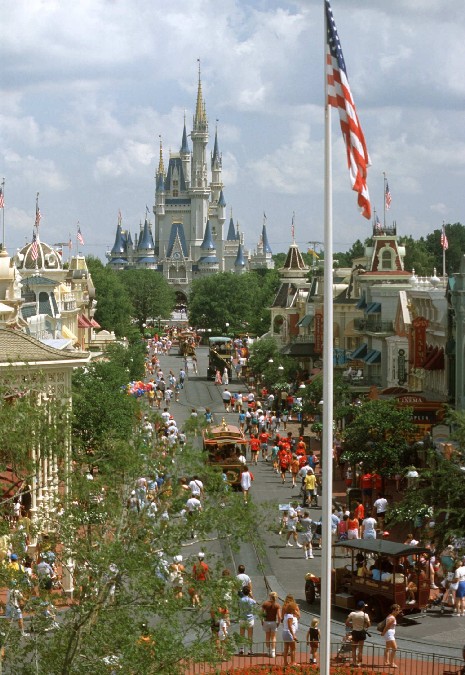
Linda Besner considers the appeal of Disneyland’s design:

In Charles Montgomery’s book Happy City: Transforming our Lives through Urban Design, Montgomery talks to John Hench, a former leader of Disney’s Imagineering dish_mainstreet team, who says, “There’s some nostalgia involved, of course, but nostalgia for what? There was never a main street like this one. But it reminds you of some things about yourself that you’ve forgotten about.” The idea is that architecture and urban design play a powerful role not only in how people use a public space but in how they feel, about themselves and about other people, while they’re there. Montgomery visits Disneyland with a neuroscientist who points out how the fudge-scented air and pedestrian-friendly boulevards make people more relaxed and outgoing. Nursing-home designers have taken a leaf from Disney’s book and replicated some of the architectural features of Main Street in elder care environments.

Disneyland is about evoking innocence, and embedded deep in our collective memory is the association between innocence and the long period of peace between the Napoleonic wars and World War I; a time when there had been just enough technological innovation to improve people’s lives (electricity, the telephone, better agricultural techniques) but not enough to cause mass destruction of people and the environment (machine guns, the car, industrial farming). The late Victorian era is close enough to make us feel comfortable but distant enough to make us feel safe from the anxieties of the modern world.

(Image of Main Street, USA at the Magic Kingdom, Walt Disney World Resort in Florida via Wikimedia Commons)

A Profile In Self-Preservation

Weigel pans Charlie Crist’s new book:

The conversions of Charlie Crist, from Republican to independent to Democrat, make up one of the least inspiring tales in modern politics. To take it seriously is to admit you’re the sort of person who takes Scientology stress tests and supplies credit card info to anyone who claims to need help from Nigeria. … This book exists because Crist remains fairly popular, and the Republican who replaced him, conservative hospital tycoon Rick Scott, does not. Democrats have celebrated Crist’s slow embrace of their party, grudgingly, even as Florida’s Democratic Sen. Bill Nelson leaves open the possibility that he’ll run if Crist screws up.

Chotiner’s review is similarly blunt:

“Together, I know we can achieve amazing things,” he writes in the last line. (No, really.) It would be easy to say that Crist is addicted to clichés and soundbites because he chooses to ruminate on votes all day. But that’s too cynical. All these many years and compromises later, Charlie Crist probably can’t think any other way.

The Signs Of Mental Illness

Screen shot 2014-02-05 at 5.15.53 PM

Photographer Lisa Lindvay captures her family coping with her mother’s mental illness:

Lindvay’s intimate photographs of her siblings and father in their home, as they come to terms with her mother’s mental illness, challenge our notion of domestic bliss. The house is a mess—overrun by soda bottles, pizza boxes, computer wires, and detritus lodged in the carpet—and each family member seems to be suspended in their own private world. …

The images are unsparing, but never unkind. The house itself feels neglected, but at the same time it is clearly a comfort to the family, a place where they can be both vulnerable and free. Though things are coming apart there, the home could very well be the structure that holds them together.

Jenna Garrett passes along more images from the series:

Though Lindvay’s mother is absent, the signs of her struggle are present in every frame, each image heavy with abandon and quiet exhaustion. Here we are privy to the deeply private tale of her father and sibling’s lives behind the closed and musty blinds, the grimy floors and junk food artifacts a constant reminder of what is broken and missing.

(Photo by Lisa Lindvay)

Moving At The Speed Of Life

How the pace of a city affects its residents:

Robert Levine and his colleagues have studied the speed of life in cities around the world and across the U.S. In a series of experiments they measured how fast solitary pedestrians in a downtown core covered a distance of 60 feet (being careful to exclude those who are obviously window shopping), timed how long it took to complete a simple commercial transaction, and recorded the accuracy of randomly selected clocks in the downtown business area. They found that places with a faster pace of life also had more robust economies (as measured by GDP per capita, average purchasing power, and average caloric intake), and that people in larger cities tended to move faster than those in less populated areas. They also found truth to the stereotype that people move slower in hotter places.

So as you might expect, fast-moving people are associated with fast-moving economies. But does that faster life translate into greater happiness? In faster places (specifically, economically developed areas of North America, Western Europe, and Asia), people were more likely to smoke, less likely to take the time to help strangers in need, and more likely to die from coronary heart disease. Yet Levine and his colleagues found that residents in faster places tended to report feeling somewhat happier with their lives than those who lived in slower places. A city’s pace of life was indeed “significantly related” to the physical, social, and psychological well-being of its inhabitants.

Filling In The Blanks On Bach

George Stauffer appreciates that John Eliot Gardiner’s recent book on the great composer has insights into his personal character:

Moving beyond the hagiographies of the past, he presents a fallible Bach, a musical genius who on the one hand is deeply committed to illuminating and expanding Luther’s teachings through his sacred vocal works (and therefore comes close to Spitta’s Fifth Evangelist), but on the other hand is a rebellious and resentful musician, harboring a lifelong grudge against authority—a personality disorder stemming from a youth spent among ruffians and abusive teachers. Hiding behind Bach, creator of the Matthew Passion and B-Minor Mass, Gardiner suggests, is Bach “the reformed teenage thug.” In the preface we read: “Emphatically, Bach the man was not a bore.” Neither is Gardiner.

(Video: Glenn Gould plays Bach’s Keyboard Concerto No.1 with Leonard Bernstein and the New York Philharmonic in 1960)

Tracing Jewish Surnames, Ctd

Dara Horn pours cold water on Bennett Muraskin’s theories about Jewish surnames:

[T]he immense attention paid to this article reveals the degree to which many American Jews are still fascinated to learn where they came from. Unfortunately, it also reveals how the members of a group so highly educated in other respects know so little about their own history that they will swallow any “fact” from the Jewish past that comes flitting across their screens. …

“Lieb means lion in Yiddish,” we are told. Actually, leyb means lion in Yiddish (with the vowel sound ey as in “hey”), while lib (the word that sounds like the German word lieb) is a verb form for “love”—as it is in German; this error requires an ignorance of two languages. We are told that Berliner means “husband of Berl,” despite the fact that Berl is a man’s name in Yiddish and Berliner is more recognizably derived from Berlin. We are told that Lieberman means “loverman”; it is actually a term of formal address, as in “dear sir.” We learn that Mendel is derived from Emanuel, when a rudimentary knowledge of Yiddish makes it clear that it is a diminutive of Menahem. There are more like this, but I needn’t bore you.