Ann Vs Mitt

Romney’s wife says she’s integral to his thoughts on policy:

"He listens to my advice probably more than anyone else’s. We never sort of go off on our own, either one of us, without feeling like we’re going together on whatever journey that we’re on."

Mitt says:

"her positions are not particularly relevant to my campaign."

They really do make Bill and Hillary look honest, don’t they?

Gore, Lincoln, and Reason

Gorescottgriesgetty

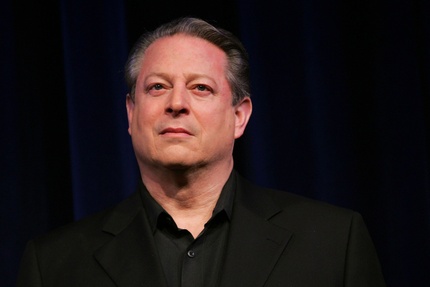
I have only read Time.com’s excerpt of Al Gore’s new book, "The Assault On Reason." But there was enough in it that echoes and resonates with my own political evolution on this blog over the past few years that I just ordered it from Amazon. In many ways, I think Gore’s career in public life has really taken off since he abandoned the electoral path in politics. He is a thinker and a loner – and the task of electoral politics, something I think he felt obliged to follow because of his father’s legacy, never truly suited him. Now, freed to participate in political life as an unelected crusader, he has found his role at last. I hope he doesn’t abandon it. He has done more to raise awareness of a critical issue – climate change – as a private citizen than he ever managed as vice-president. I can’t help but feel that the death of his father liberated him as well. He seems much happier because he has stopped trying to be someone he isn’t. On the plane ride back from L.A., I also found myself reading Adam Gopnik’s diverting essay on Lincoln in the new New Yorker. Am I the only one to see some resonances in their convictions? No, I’m not comparing Gore to Lincoln as statesmen. Please. But I do see their mutual understanding of the critical importance of reason in wartime to be a very important message for our time. Perhaps the most critical message we now need to hear. Check out the echoes between the two. Gore first:

For the first time in American history, the Executive Branch of our government has not only condoned but actively promoted the treatment of captives in wartime that clearly involves torture, thus overturning a prohibition established by General George Washington during the Revolutionary War.

It is too easy — and too partisan — to simply place the blame on the policies of President George W. Bush. We are all responsible for the decisions our country makes. We have a Congress. We have an independent judiciary. We have checks and balances. We are a nation of laws. We have free speech. We have a free press. Have they all failed us? Why has America’s public discourse become less focused and clear, less reasoned?

Faith in the power of reason — the belief that free citizens can govern themselves wisely and fairly by resorting to logical debate on the basis of the best evidence available, instead of raw power—remains the central premise of American democracy. This premise is now under assault.

Now read this passage from Adam Gopnik’s piece about Honest Abe:

Lincoln believed in legalism. One of his first public speeches, the Address Before the Young Men’s Lyceum, in Springfield in 1837, declared a radical insistence on "reason" to be the only acceptable form of public discourse; the cure for the prevalence and epidemic of violence in American life would be "hewn from the solid quarry of sober reason": "Passion has helped us, but can do so no more. It will in future be our enemy. Reason—cold, calculating, unimpassioned reason—must furnish all the materials for our future support and defence."

We must revive this vision – this quintessentially American vision. Before it is too late.

More Einstein

Green

"[A] person who is religiously enlightened appears to me to be one who has, to the best of his ability, liberated himself from the fetter of his selfish desires and is preoccupied with thoughts, feelings, and aspirations to which he clings because of their superpersonal value … The main source of the present-day conflicts between the spheres of religion and of science lies in the concept of a personal God … To be sure, the doctrine of a personal God interfering with natural events could never be refuted, in the real sense, by science, for this doctrine can always take refuge in those domains in which scientific knowledge has not yet been able to set foot … [But] a doctrine which is able to maintain itself not in clear light, but only in the dark, will of necessity lose its effect on mankind, with incalculable harm to human progress.

In their struggle for the ethical good, teachers of religion must have the stature to give up the doctrine of a personal God, that is, give up that source of fear and hope which in the past placed such vast power in the hands of priests. In their labors they will have to avail themselves of those forces which are capable of cultivating the Good, the True, and the Beautiful in humanity itself. This is, to be sure, a more difficult but incomparably more worthy task . . . . [I]t seems to me that science not only purifies the religious impulse of the dross of its anthropomorphism but also contributes to a religious spiritualization of our understanding of life. The further the spiritual evolution of mankind advances, the more certain it seems to me that the path to genuine religiosity does not lie through the fear of life, and the fear of death, and blind faith, but through striving after rational knowledge," – Excerpts from "Science and Religion," Ideas and Opinions (NY: Laurel, 1954), pp. 50-58.

Ryan Sager, Ron Paul And Anti-Semitism

I should begin by saying that I have great respect for Ryan Sager. He’s an energetic, careful, enterprising young reporter and I admire his work a lot. That’s why I was dismayed to read his off-the-cuff assertion that Ron Paul was anti-Semitic based on an old, probably ghost-written and pretty anodyne statement of disdain for the Israel lobby in Washington. Paul made the statement in the context of lambasting all such lobbies. And it’s perfectly consonant with his general isolationist views. Still, we all make quick judgments in online journalism and Ryan has made an honorable effort to review the issue and report some more. His latest piece exonerates Paul to my mind. And I might add I have and have always had no truck with anti-Semitism of any kind. Longtime readers know very well my admiration for the Jewish state and my revulsion at anti-Semitic smears. Here’s Ryan’s post. In the first paragraph, he writes:

Over at Reason’s Hit & Run blog, David Weigel got Ron Paul to comment on the quote I took note of a little while ago that "By far the most powerful lobby in Washington of the bad sort is the Israeli government." I said that I considered this statement anti-Semitic on its face; I still do.

But at the end of the piece, Ryan writes:

At the end of the day, do I still believe Ron Paul is "an anti-Semite" as I said in my initial post? I think that was an overly harsh assessment, and I apologize for it. Nonetheless, I have emailed his campaign spokesman to ask if he stands by the main quotation in question here: "By far the most powerful lobby in Washington of the bad sort is the Israeli government."

My own vote for such an honor, by the way, is the AARP. Of course, I can’t even stand the gay lobby, HRC. But I think it’s perfectly possible for a politician to believe it is the Israeli lobby for foreign policy reasons, without being anti-Semitic. No doubt some anti-Semites are among that camp. But it doesn’t follow that everyone in that camp is therefore automatically anti-Semitic.

A Scientist and the Economist

He’s not happy:

There are a number of reasons that this particular article irritated me. The tone was condescending – the Economist was lecturing at biologists. The article’s thesis is supported by nothing more than bald assertions. The article operates from the entirely unsubstantiated presumption that scientists in my discipline are routinely being dishonest. The article is also largely wrong.

Great magazine though.

The Base and the Bill

A reader writes:

It’s just my opinion and some or many probably wouldn’t admit it. But I think the unspoken about aspect of this thing is that many of us in the conservative, grass roots have at best, no trust in Bush’s competence at all and at worst, are hoping the I-bill goes down in flames specifically to deal Bush an embarrassing and ignominious defeat.

There’s a cumulative effect in action here. When you piss away your credibility on a variety of fronts over time (spending largess, no vetos, Harriet Miers, incompetence in Iraq, half-assed at best Soc Sec reform efforts, deep-sixing Tax Reform, etc.) over time, you get no benefit of the doubt whatsoever on something like this.

It’s certainly a signifigant element in my stance (not to mention of course, the nonsensical, labyrinthian, unenforceable aspects of the package itself).