Malkin Award Nominee

https://twitter.com/EWErickson/status/553593617856868353

Update from a reader:

Erickson’s recommendation is doubly offensive (and doubly dumb) considering that he’s actually repurposing a trope of old-timey anti-semitism. As Zaid Jilani points out here, using pork products to taunt those who don’t eat them has been a staple of Jew-baiting in Europe for centuries:

In the book Anti-Semitic Stereotypes: A Paradigm of Otherness in English Popular Culture, 1660-1830, the author notes that English schoolboys would taunt Jews with a chant, “Get a bit of pork/Stick it on a fork/And give it to a Jew boy, a Jew.” In German culture, there was a popular concept of the “Judensau,” depicting Jews suckling from a pig; the bigoted imagery was so common it was even placed on churches to keep Jews away. Pope Leo VII called Jews “pigs,” and during the Inquisition, the  Spanish Jews were actually called “marrano” referring to a one-year old pig.

I wonder if Erickson realizes just what tradition he’s drawing on here. I suspect not.

Who Won’t Republish Charlie‘s Cartoons? Ctd

Dan Savage takes aim at another cowardly outlet:

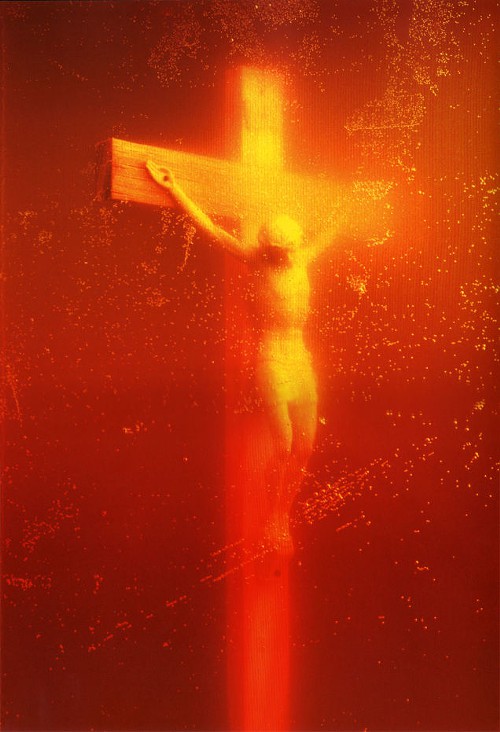
I was thinking about how afraid everyone is when I heard the Associated Press had yanked all images of Andres Serrano’s 1987 work Piss Christ from their website and archives. Before we knew how many people had died in the attack yesterday—before we learned that one of the victims (the one shown on the cover of the New York Times) was a Muslim cop—right-wing news outlets, bloggers, and Twitterers were condemning the AP’s supposed hypocrisy and anti-Christian bigotry. Slate:

The Associated Press is among the numerous news outlets that have been self-censoring images of the Charlie Hebdo cartoons that may have provoked 1420766951-pisschristasWednesday’s deadly Paris attack. In a statement, the news organization said that such censorship is standard policy: “None of the images distributed by AP showed cartoons of the Prophet Muhammad. It’s been our policy for years that we refrain from moving deliberately provocative images.” The conservative Washington Examiner publication then pointed out that the AP nonetheless continued to carry an image of Andres Serrano’s 1987 “Piss Christ” photograph—which is certainly provocative, having been the subject of massive controversy in the United States, and which was actually vandalized by Catholic protesters when it was on display in 2011 in, as it happens, France.

All images of Piss Christ have since been scrubbed from AP’s website—they’re all gone, including legitimately newsworthy photos of a vandalized Piss Christ. In an attempt to explain the memoryholing of Piss Christ, the AP says they’ve “revised and reviewed our policies since 1989.” The implication: Piss Christ should’ve been removed from the AP’s website years ago and its presence until yesterday afternoon was an oversight. (Perhaps the AP will send the Washington Examiner a thank-you note for bringing this matter to their attention.) The AP’s explanation is complete and total bullshit. They didn’t pull down those images of Piss Christ because they were “deliberately provocative.” The AP pulled them down because they’re afraid.

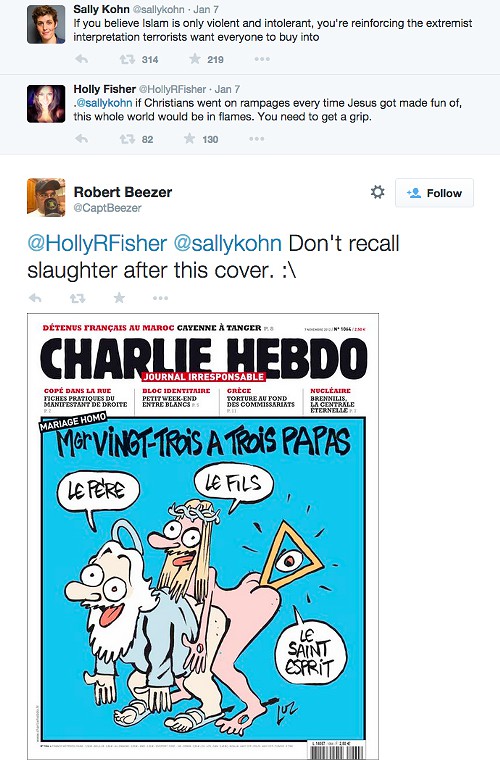
Here’s what the AP should’ve said to Christian conservatives screaming about Piss Christ and double standards: “Yeah, we blurred out those Charlie Hebdo cartoons because we’re afraid of them. We didn’t do the same to Piss Christ because we’re not afraid of you.” [That’s] something that Christians, conservative and otherwise, should be proud of. … Here are two (Holly and Robert) boasting yesterday:

1420763045-dontrecallcharlieimage

Christian conservatives want to have it both ways: They want credit for not reacting violently when their sacred symbols, holy texts, imaginary friends, etc. are mocked while also wanting the same deference—the same kid-glove, blurred-image treatment—that violent Muslim extremists have “won” for their sacred symbols, holy texts, imaginary friends, etc. But you can’t have it both ways. You can’t claim to be better than “they” are because you can take a joke while at the same time demanding that people stop joking about you. You can’t hold up their attempts to eradicate art (and artists) that offend them as proof that they’re hopelessly backwards while at the same time demanding the disappearance of art (and artists) that offend you.

Update from a reader:

I just read your item on the Washington Post censoring the Charlie Hedbo images as offensive. It is odd to me that they would strike them from the web, because they definitely printed the images in the print version of the paper. I wish I could show you an image, but I only know this because my husband noted it as he was throwing the dead tree version of the Post into our fireplace. Because it is cold. But here is an article on it (also still on the Post site): “Washington Post opinions section publishes controversial Charlie Hebdo cartoon“.

Ambinder’s take on the free speech question:

1. The attack ought to be connected to Islam, or religion, but not to Muslims. We cannot be afraid to criticize and even ridicule beliefs we find to be harmful and absurd. But neither is it humane nor in the interest of Europe, to indict the people who at worst have committed a thought crime and who at best can be persuaded to disregard that belief, just like practicing Christians and Jews (and even Bill Donohue, who doesn’t incite violence) have in the U.S.

2. Free speech has consequences. Saying it doesn’t is magical — it presupposes that there is some universal law which holds that good things will always happen when people are given license to speak their minds. Not always. But censoring political, symbolic, and religious speech, or trying not to offend anyone often have worse consequences. Censoring enfeebles our minds. Avoiding controversy removes the edge from humor. Protecting people from cartoons concedes sacred ground to much more harmful beliefs and practices.

Let the ink flow.

The Endgame In France

Early reports had suggested that all the hostages had escaped unscathed, which appears not to be the case.

More Hostages In France

And it appears that the situation in Dammartin-En-Goele may be intensifying:

Nico Hines explains the newest crisis in Paris, which conflicting reports indicate may have led to two more deaths:

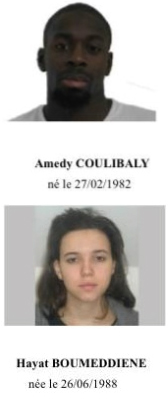
Twenty miles south [of where the Kouachi brothers have been cornered], in the east of the city, new-french-suspects-edit at least one gunman is believed to have taken six hostages at a Jewish store. Police suspect that the third gunman is the same man who shot and killed a policewoman on Thursday morning before escaping in a bullet-proof vest.

Parisian police have released a photograph of the suspect, Amedy Coulibaly, 32, who was a member of the same local terror network as the Kouachi brothers. They believe a 26-year-old woman was involved in the attack on the policewoman, it is not known if Hayat Boumeddiene is also helping her former partner stage the attack on the supermarket.

Hines also sums up the news, out last night, that the older Kouachi brother was possibly trained by the Yemeni branch of al Qaeda:

A senior U.S. intelligence official told The New York Times that Saïd Kouachi, the older brother, spent several months in Yemen in 2011, where he received small-arms and marksmanship training from al Qaeda in the Arabian Peninsula, one of the most feared al Qaeda affiliates.

Joshua Keating comments:

If AQAP was involved, even indirectly, in Wednesday’s attack, it would be the group’s biggest success outside the Middle East in quite a while. And coming at a time when international attention has shifted to al-Qaida’s hostile erstwhile allies ISIS—with that group’s leader, Abu Bakr al-Baghdadi,directly challenging Zawahiri’s leadership of the international jihadist movement—it’s a sign that al-Qaida is still far from contained.

You can watch a livestream of crisis coverage here:

Closing In On The Kouachis

https://twitter.com/nffc82/status/553476183124606977

Capitulation Of The Day

[Re-posted and updated from earlier today]

A reader spots an “interesting bit of irony”:

The Washington Post article that criticizes Donohue’s ridiculous comments about Charlie Hebdo and the idea that offensive speech ought to be censored contains this cowardly disclaimer:

Editor’s note: An earlier version of this article included images offensive to various religious groups that did not meet the Post’s standards, and should not have been published. They have been removed.

If any reader knows exactly what images they removed, let us know and we’ll post them here. Update:

I saw the WaPo story before the images were pulled down they were exclusively images aimed at insulting Catholics and Jews. I left a comment asking why they weren’t also running the images aimed at insulting Muslims – i.e., the images that were particularly newsworthy. Awhile later all of the images were taken down. Definitely not my intent in making the comment. I just thought it was hypocritical to run one set of cartoons and not the other.  Here are a couple of the images I remember seeing before they were pulled:

hebdo-covers

Another reader:

The CBC has also refused to air the cartoons. Here’s the internal memorandum courtesy web journalist Jesse Brown:

The Urgency Of Blasphemy

https://twitter.com/shashj/statuses/553202822662356992

In the wake of the terror attack on Charlie Hebdo, Douthat stands up for blasphemy:

[T]he kind of blasphemy that Charlie Hebdo engaged in had deadly consequences, as everyone knew it could … and that kind of blasphemy is precisely the kind that needs to be defended, because it’s the kind that clearly serves a free society’s greater good. If a large enough group of someones is willing to kill you for saying something, then it’s something that almost certainly needs to be said, because otherwise the violent have veto power over liberal civilization, and when that scenario obtains it isn’t really a liberal civilization any more.

Again, liberalism doesn’t depend on everyone offending everyone else all the time, and it’s okay to prefer a society where offense for its own sake is limited rather than pervasive. But when offenses are policed by murder, that’s when we need more of them, not less, because the murderers cannot be allowed for a single moment to think that their strategy can succeed.

Saletan refuses to pretend that the hyper-sensitivity to religious mockery that motivated this attack isn’t specific to Islam:

Islamic moderates who protest these caricatures are undercut by Islamic radicals. Charlie Hebdo insults all religions. Its current issue mockingly questions the existence of Jesus. But Christians haven’t responded with bullets.

Three years ago, after Charlie Hebdo’s office was bombed, its editorial director, Stéphane Charbonnier, pointed out that the magazine was “provocative on many subjects. It just so happens that every time we deal with radical Islam … we get indignant or violent reactions.”

Now Charbonnier is dead. The problem isn’t just the violence. It’s the celebration from other quarters of the Muslim world. On social media, there are comments celebrating Wednesday’s “blessed” attack and telling the killers, “You pleased our hearts.” There are congratulations to the terrorists for shouting “God is great” and striking “a paper known for its abuse of Islam.”

But Sarah Harvard stresses that Islamic doctrine doesn’t actually condone killing those who create offensive images of the prophet:

So what does Islam say about depictions that are not in a positive light? Islam’s most poignant instance of aniconism came when the Prophet Mohammed returned to the city of Mecca in 630 AD. After years fleeing from persecution, Mohammed and his followers had marched back to Mecca to rid idol worshiping from the holy city. According to the critically acclaimed book Muhammad: His Life Based on the Earliest Sources, upon entering the most sacred point in Islam’s most sacred mosque, Mohammed destroyed all the pagan idols and paintings that were sacrilegious to Islam. (He specifically guarded images of the Virgin Mary and Jesus.) Mohammed didn’t seek out the creators of the images or sentence those responsible for the idols and sacrilegious depictions to death.

Historically, Razib Khan argues, the Islamic radicals’ views of blasphemy are far closer to the norm than our modern, somewhat radical attitudes toward free speech in the US:

[T]he behavior of Islamic radicals is definitely not beyond comprehension. Rather, it is totally explicable, and in many societies and times would be entirely normal and healthy behavior. Attacking the religion of the folk is understood to be synonymous with attacking the folk. That is why Thomas Jefferson had to elucidate his views on religion in the first place, they did not come naturally to people in the 18th century. They had to be inculcated over generations. Even if Islamic radicals in the West prey upon the marginalized, they reflect ancient and primal methods of social outrage and sanction. What you see here is the reality of living in a multicultural world where there is no a harmony of values and norms, and free movement of individuals who don’t necessarily subscribe to the social viewpoints of the lands in which they settle.

To Michael Brendan Dougherty, the incident illustrates how modern secularism is not only a Western idea, but a Christian one:

We used to say of comedians, “He can make that joke because he’s Jewish.” In this respect, the Western world’s comfort with attacking Christianity is an inadvertent admission that Christianity is “our” religion. And so it elicits from us none of the respect, deference, or fear we give to strangers. Viewed this way, secularism looks less like universal principle than a moral and theological critique derived from Christian sources and pitched back at Christian authorities.

The great irony of Islam’s continued clashes with the Western way of life — whether its widespread riots over a YouTube video or the murderous actions of a crazed minority— is that it has revealed, to the surprise of everyone but Pope Emeritus Benedict, that modern secularism is a kind of epiphenomenon of Christendom.

Who Won’t Republish Charlie’s Cartoons?

Mark Steyn wishes the MSM would grow a pair:

http://youtu.be/WklsCGIfLdQ

Amen. Christopher Massie finds a clear divide between digital and legacy publications:

With few exceptions, it has been digital outlets like The Huffington Post, The Daily Beast, Business Insider, BuzzFeed, Vox, and Slate that have exercised their constitutional right by republishing the cartoons that are thought to be the basis for the attacks. In contrast, many “legacy” organizations, from CNN, to The Washington Post, to The New York Times, largely withheld the images.

A Dish reader also called out the CBC, as well as an egregious example from the WaPo. Massie talks to Daily Beast editor Noah Shachtman, who calls not publishing the images “giving in to the monsters that just massacred a bunch of people.” Massie is on the same page:

While editors are regularly forced to make difficult calls about publishing sensitive material, and while yesterday’s murders show that worries about angering jihadists are not without basis, in this case, the obvious news value of the cartoons ought to have outweighed any trepidation. The absence of a confirmed storyline as to whether a specific cartoon ignited the attack means that a wide array of context, including the images, is potentially relevant. Furthermore, if readers want to understand the tragic affront to free speech, there is no replacement for seeing the cartoons, in their unabashed irreverence.

Nous Sommes Charlie, But Do We Really Want To Be?

Yglesias, for one, is dismayed that yesterday’s attack made martyrs of cartoonists whose work he found distasteful in the extreme:

Viewed in a vacuum, the Charlie Hebdo cartoons (or the Danish ones that preceded it) are hardly worthy of a stirring defense. They offer few ideas of value, contribute little to any important debates, and the world would likely have been a better place had everyone just been more polite in the first place.

But in the context of a world where publishers of cartoons mocking Mohammed have been threatened, harassed, and even killed, things look different. Images that were once not much more than shock for its own sake now stand for something — for the legal right to blaspheme and to give offense. Unforgivable acts of slaughter imbue merely rude acts of publication with a glittering nobility.

One of Dreher’s readers makes a similar point:

I am a francophone European, and I sometimes read Charlie Hebdo. I am shocked by these murders and I hope the assassins will be caught and will pay dearly for their crimes. This being said, je ne “suis” pas Charlie et je ne l’ai jamais été: I am not Charlie and I never was.

I’ve always thought that Charlie’s brand of “humour” was despicable and part of the problem, not a solution. I’m not going to change my mind about this because of the murders. The people who died have become martyrs of the freedom of expression, but they were hardly the best defenders of the freedom of expression. First because the freedom to express your opinions does not imply that these opinions are correct – and Charlie was a far left, violently anti-religious rag. It is not because you are free to be vulgar, unfair and insulting that all these things are good. Moreover Charlie was not very good when the freedom of expression of its adversaries was at stake: look at the “Dieudonné” affair for instance.

Dieudonné M’bala M’bala is a controversial French comedian and political activist who’s been convicted many times of antisemitism. Diana Johnstone is on the same page as Dreher’s reader when it comes to Charlie Hebdo‘s spotty record on free speech:

In 2002, Philippe Val, who was editor in chief at the time, denounced Noam Chomsky for anti-Americanism and excessive criticism of Israel and of mainstream media.  In 2008, another of Charlie Hebdo’s famous cartoonists, Siné, wrote a short note citing a news item that President Sarkozy’s son Jean was going to convert to Judaism to marry the heiress of a prosperous appliance chain. Siné added the comment, “He’ll go far, this lad.” For that, Siné was fired by Philippe Val on grounds of “anti-Semitism”.  Siné promptly founded a rival paper which stole a number of Charlie Hebdo readers, revolted by CH’s double standards. In short, Charlie Hebdo was an extreme example of what is wrong with the “politically correct” line of the current French left.

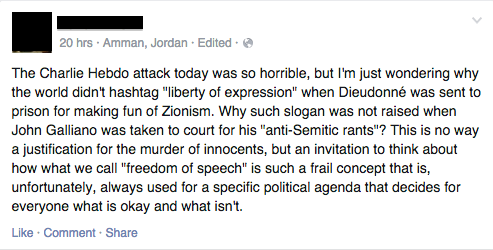
Indeed, many Muslims on social media are wondering why free speech seems a bit freer than usual when Islam is the target. One such Muslim is a Jordanian friend of Dish editor Jonah Shepp, who didn’t want to reveal her name:

Screen Shot 2015-01-08 at 12.19.55 PM

Meanwhile, responding to calls for other publications to reprint Charlie’s most controversial work in solidarity, Arthur Goldhammer cautions against sacralizing artists and journalists who saw profaning the sacred as their life’s work:

Reproducing the imagery created by the murdered artists tends to sacralize them as embodiments of some abstract ideal of free speech. But many of the publications that today honor the dead as martyrs would yesterday have rejected their work as tasteless and obscene, as indeed it often was. The whole point of Charlie’s satire was to be tasteless and obscene, to respect no proprieties, to make its point by being untameable and incorrigible and therefore unpublishable anywhere else. The speech it exemplified was not free to express itself anywhere but in its pages. Its spirit was insurrectionist and anti-idealist, and its creators would be dumbfounded to find themselves memorialized as exemplars of a freedom that they always insisted was perpetually in danger and in need of a defense that only offensiveness could provide.

Update from the in-tray:

Long-time reader (and francophone) here. I just saw you forward a tweet regarding Charlie download (1)Hebdo‘s alleged racism in its cartoon “Rassemblement bleu raciste” [Update: the Twitter user deleted that tweet, but the image in question is embedded to the right]. I am not 100% certain of the background behind that cartoon. Unfortunately, the Charlie Hebdo website isn’t showing much in the way of past content at this time. That said, a quick google search reveals that this caricature – albeit maladroit – might have been put forth as a criticism of the French extreme right’s racist references to Minister Taubira. I invite you to look at the following links – here and here – which give a bit more detail on the text that allegedly accompanied the caricature. I may be wrong here, but I’m pretty sure that caricature was not the whole story and is mischaracterizing Charlie Hebdo’s position.
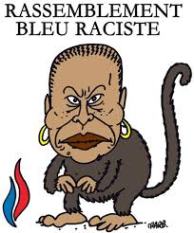
The first link is to a web forum and the second is to an article in French, so if any other readers, especially French-speaking ones, have something more conclusive, please let us know. Update from another:

As a French citizen, I was infuriated by your understanding of this drawing by Charlie Hebdo.  This drawing was made as a response to racism found in the French weekly newspaper Minute, which depicted Taubira as a monkey.  This shocking (and I concede awkward) drawing is meant to denounce the racists from Minute and the Front National, the nationalist extreme right party (their logo at the bottom left of the drawing).  The drawing is meant to exemplify how racist and shocking their words were.  I found that title/question insulting the memory of Charlie Hebdo.

Another adds further context:

Charlie Hebdo’s picture of Minister Taubira was indeed posted in the context when many Front national supporters and representatives made racist comments about Christiane Taubira, who supported legalizing gay marriage. They constantly compared her to a monkey and on some occasions taught their children to throw bananas at her.

The title is in fact a pun on the new name Marine Le Pen wanted to give to the Front national so as to nominally distance her own political agenda from her father’s (who was well known for his antisemitic and racist comments). She called her own movement « Rassemblement Bleu Marine » (this name itself included a pun since it means both a « Blue Navy Rally » and a « blue rally around Marine Le Pen » ). Charlie Hebdo just added a pun on her pun, replacing “Bleu Marine” with “Bleu raciste”. It was meant to show that the new Front national around Marine Le Pen was in fact just as racist as the former one and the caricature of Taubira as a monkey was meant to represent the so-called new Front National’s vision of a black female Minister of Justice.

Regarding “freedom of speech”, Dreher’s reader’s comments about a double standard are quite off the topic. From a legal point of view, in the US sense, freedom of speech is restricted in France. The cases that reader mentions does show an obvious double standard when it comes to antisemitism on the one hand and islamophobia on the other, but rather the fact that there is room for prosecution in France if you make public comments that suggest that you support racial inequality or that you deny the existence of events such as the Holocaust. There is no room for prosecution for any kind of religious blasphemy. Charlie Hebdo fought against the idea that anything was too sacred not to be ridiculed or laughed about. Such was their idea of freedom. They were irreverent by principle, but never racist nor in any way comparable to ideologues such as Dieudonné.

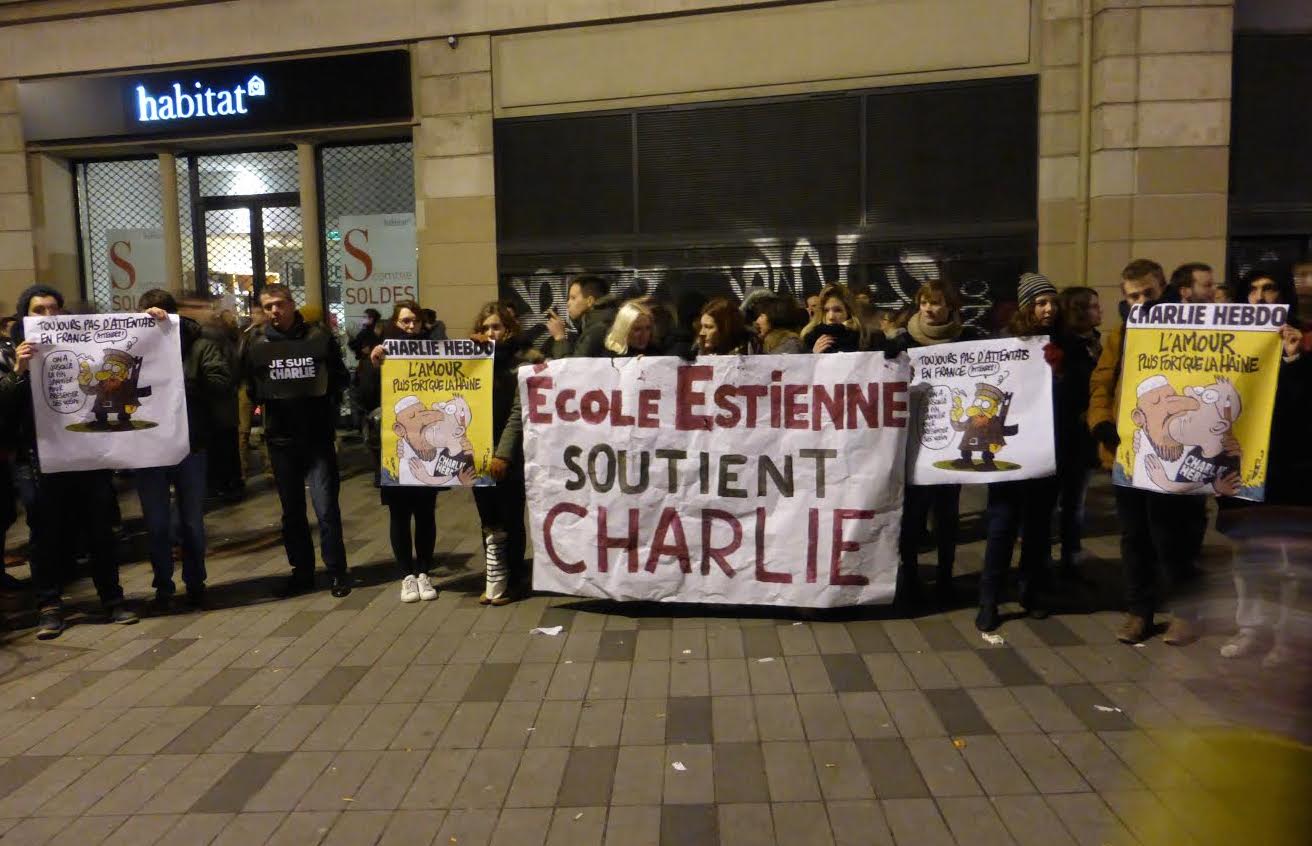
In any case, thank you for your coverage of the Charlie Hebdo attack and for pointing out the MSM’s lack of courage in reproducing the caricatures. Below is a picture I took at yesterday’s march in Place de la République around 8pm:
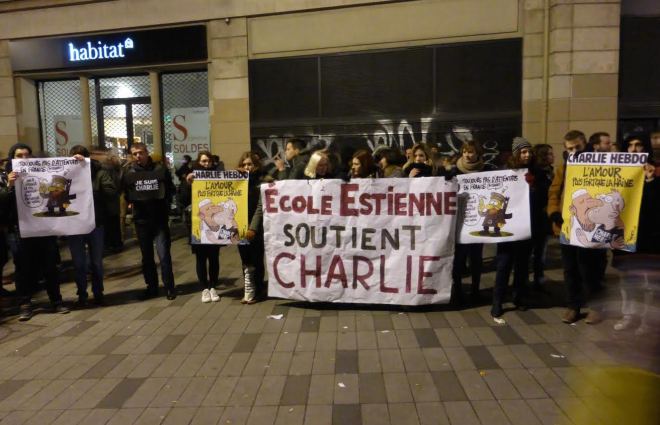
unnamed (28)

Kids, students, anonymous people are absolutely not afraid of showing these caricatures in public in France. It’s important that they are not and to some degree they are less than they ever were.
Did Terrorists Just Elect Le Pen?

James McAuley worries that the terrorist attack on Charlie Hebdo will empower France’s xenophobic far-right:

An additional dimension to this tragedy is that it plays directly into the hands of those public figures and politicians who would like to see France Screen Shot 2015-01-08 at 12.45.23 PMregress into an organic national community of blood ties, rather than of citizens. The Islamic extremists who executed the attack on Charlie Hebdo may have murdered journalists and artists, but surely their crime is also against other Muslims in France, who are now likely to be viewed as enemy aliens hostile to the essence of the Republic itself, regardless of their own beliefs. Michel Houellebecq, for instance, who often paints Muslims as a dangerous fifth column, might now perhaps be vindicated in the eyes of unreflective readers; and, in the words of one Lebanese blogger, today might very well be the day that Marine Le Pen became President of France. Le Pen, by the way, has compared the Muslim presence in France to the German occupation of the 1940s. After today, we can only hope that others will not start doing the same.

Le Pen was quick to express her own outrage, calling for France to bring back the death penalty and demagoguing against “Islamists who have declared war on France”. It’s a bit rich, given that Le Pen herself has been ridiculed in Charlie more than the Prophet Muhammad and once sued the magazine for its depiction of her (the cover on the right is one of its kinder representations of the far-right leader). And as Juan Cole astutely observed, inflaming anti-Muslim sentiment is a feature, not a bug, of Islamist terrorism. Kaj Leers reinforces that point today:

The danger now is that populists will hijack the debate and push the press into an anti-Islam frenzy. As this was being written, nationalist organizations and proponents of identity wars, such as supporters of the Pegida movement in Germany, were already using the Charlie Hebdo massacre as justification for their anti-Islam stance. This is precisely what religious fundamentalists seek:

to divide the world neatly into pro- and anti-Islam parts, leaving no distinction between mainstream Muslims and the fundamentalist fringe. In reality, no group has suffered more from violence by Islamist extremists over the past decades than Muslims themselves. At around the same time the hitmen exited Charlie Hebdo headquarters, where they killed 12 people, a bomb attack in Yemen killed 37 people and injured scores more. The last thing media should do now is give the terrorists the divided world they seek.

And it’s not just Le Pen; Bershidsky discovers that the attack is driving more Frenchmen into the arms of right-wing nationalist and anti-immigrant groups:

After the Paris attack, the number of people who “liked” the Facebook page of the German anti-immigrant group Pegida, which holds big and ever-growing weekly demonstrations in Dresden, moustachejumped by about 7,500 to 120,500. … After the killings, Marine Le Pen, leader of the French far-right Front National, made a politically correct speech condemning Islamic fundamentalism, but one of her top lieutenants, Wallerand de Saint-Just, explained in an interview before she spoke that the problem was Islam, which “has a tendency to create fanatics more than any other religion,” and the French nationality of the suspected terrorists, which makes it impossible to deport them.

Wednesday’s act of terrorism is clearly encouraging anti-Muslim, anti-immigrant forces. They also don “Je suis Charlie” buttons, even though Charlie Hebdo was a leftist publication that made fun of them more often than it went after Muhammad.

But Kevin Lees sounds a more hopeful note, stressing that France hasn’t been instantly engulfed in anti-Muslim hysteria:

Instead of instinctively falling into some cartoon mould of right-wing xenophobia, most of what we saw from Paris, from France and much of the rest of the world were precisely those things about which France should be proudest — the freedoms and rights that necessarily follow from the liberté, égalité and fraternité that have formed the heart of French public life since the 1789 revolution. Far from embracing knee-jerk anti-Muslim sentiment, the world watched as France, implausibly, united behind Hollande, who actually looked like a president for perhaps the first time since his election. They rallied in city after city, from Paris to Marseille and beyond, not to excoriate a religion or five million French Muslims, but to defend freedom of expression and speech. No one’s burning down banlieues tonight in France.

But there been at least three attacks on mosques throughout the country so far, so Lees may be speaking prematurely here. Aurelien Mondon pushes back on Le Pen’s “clash of civilizations” posturing:

Le Pen told us that we should not be in “denial” but should name things for what they are. It is time to talk about Islam openly, she suggested. This is, at best, out of touch with contemporary French fillettesociety. Currently, two of the best-sellers in France are filled with virulent anti-Islam rhetoric and countless vocal anti-Islam commentators are given air in the mainstream media on a daily basis. Islam is definitely not absent from the public debate.

What is absent from our mainstream media and politics is a careful analysis of what Islam is in France today. This would show once and for all that the Muslim “community” is not the monolith Le Pen would like us to believe. The terrorists who massacred 12 people on 7 January are apparently Muslim but so was the policeman who lost his life trying to stop them. Mustapha Ourrad, Charlie Hebdo’s copy-editor killed in the attack, was born in Algeria.

If yesterday’s events do catapult Le Pen into the presidency, Marian Tupy mulls over what that would mean:

While, as libertarians, we despise much of what Ms. Le Pen stands for, the two mainstream political parties in France, Mr. Sarkozy’s socialist center-right UPM and Mr. Hollande’s Socialist Party, have totally failed to address the legitimate concerns of the French citizens, chief among them the failure of multiculturalism and high unemployment. The country is ready to hand the reins of power to someone else.

Second, the euro will end its role as a global currency and remain a legal tender in something akin to Großdeutschland greater Germany, composed of Germany and her satellites, like the hapless Slovakia. … Third, on day two of a Le Pen presidency, border guards will return to the French frontiers. Of course, the end of the freedom of movement will be in full breach of all sorts of European treaties and conventions. (The British, by the way, would love to do the same, but cannot, because the British, being British, follow the rules. In contrast, the French, being French, will do what they have always done: follow their national interest.)