Papers, Please

After visiting McAllen, Texas, to participate in a vigil, Jose Antonio Vargas realized that, “for an undocumented immigrant like me, getting out of a border town in Texas—by plane or by land—won’t be easy. It might, in fact, be impossible”:

[S]ince outing myself in the New York Times Magazine in June 2011, and writing a cover story for TIME a year later, I’ve been the most privileged undocumented immigrant in the country. The visibility, frankly, has protected me. While hundreds of thousands of immigrants have been detained and deported in the past three years, I produced and directed a documentary film, “Documented,” which was shown in theaters and aired on CNN less than two weeks ago. I founded a media and culture campaign, Define American, to elevate how we talk about immigration and citizenship in a changing America. And I’ve been traveling non-stop for three years, visiting more than 40 states.

Of course, I can only travel within the United States and, for identification, when I fly I use a valid passport that was issued by my native country, the Philippines. But each flight is a gamble. My passport lacks a visa. If TSA agents discover this, they can contact CBP, which, in turn, can detain me. But so far, I haven’t had any problems, either because I look the way I do (“You’re not brown and you don’t look like a Jose Antonio Vargas,” an immigration advocate once told me), or talk the way I do—or because, as a security agent at John F. Kennedy International Airport who recognized me said without a hint of irony, “You seem so American.”

I might not be so lucky here in the valley. I am not sure if my passport will be enough to let me fly out of McAllen-Miller International Airport, and I am not sure if my visibility will continue to protect me—not here, not at the border.

And today, just as he predicted, Vargas was detained:

A TSA agent checked Vargas’ Philippines passport and compared it to his ticket, according to a video of the exchange as well as sources familiar with the exchange. Satisfied, the agent initialed the ticket and cleared Vargas for travel. At that point, a Border Patrol agent took the passport from the TSA.

“Do you have your visa?” he asked.

“No, there’s no visa,” Vargas replied.

The agent asked Vargas a few more questions, then placed him in handcuffs and escorted him to the McAllen Border Patrol station for further questioning, according to the source. The station is not a detention center.

Dara Lind explains why the Pulitzer Prize winning journalist won’t necessarily be deported:

The government has “prosecutorial discretion” to determine what to do with unauthorized immigrants. That means it can decide whether or not to put Vargas into deportation proceedings in immigration court. The Obama administration has said, repeatedly, that its focus is on deporting unauthorized immigrants who fit its administration “priorities”: convicted criminals, “recent border crossers,” and people who have been deported and returned to the US. 98 percent of all people deported last year fit into one of those priorities. Vargas doesn’t meet any of those criteria.

Charles Cooke is sympathetic to Vargas but thinks the authorities had no alternative:

[T]his is a horribly sticky situation. Without question – and through no initial fault of his own – Vargas has found himself in a veritable nightmare. As he tells the story, he was brought here at a young age and told that he had legitimate papers, only later to discover that those papers had been forged. From that point on, his options were severely limited.

Conservatives who ask, “but why didn’t he just apply for legal status?” are rather missing the point. Under current law, he is unable to do so without leaving the country in which he has built his life. (Or marrying a U.S. citizen.) Because he did not have a petition filed before 2001, he didn’t qualify for relief under Section 245(i); because he is too old, he doesn’t qualify for the deferred action policy that President Obama illegally put into place in 2012. He’s genuinely stuck. Moreover, there really is no “home” for him to “go” to. This is it. If I had my way, he would be among those to whom some form of amnesty was extended. Those who have known nothing else should not be sent abroad.

Still, this is really not the point. The law that I would like doesn’t yet exist. And, knowing this better than anyone, Vargas willingly placed himself in this position. What were those charged with enforcing the rules supposed to do, exactly? Slip him under the desk?

Update:

The South-Of-The-Border Crisis

In a must-read counterpoint to the media narrative that the Central American children pouring across our border are fleeing gang violence, Saul Elbein argues that the problems in Guatemala are far more extensive. He paints a picture of a failed state offering a veneer of legitimacy to a corrupt, feudal “deep state” that maintains itself through violence and exploitation:

The only model of power that exists in Guatemala is … terroristic, extra-legal, and dominated by violence. So is it any surprise that after the war, on the streetswhere people grasped for the scraps that weft, where children grew up with no chance at wealth and less at respectpirate organizations like the MS-13 grew? What we’re seeing in Guatemala is not quite, in other words, a crime wave. It’s simply the way things have been there for a long time, pushed to the next level. If you are a civilian there, beneath the labelssoldier; gangster; policeman; army; cartelis but one underlying reality: men with guns who do what they want and take what they want. Your options are to buy your own security and gunmen; to join a gang yourself; or to leave.

And so many leave.

Meanwhile, Central American migrants are now being barred from Mexican cargo trains:

On Thursday, a freight train derailed in southern Mexico. It wasn’t just any train, though:

 It was La Bestia—”the Beast”—the infamous train many Central American immigrants ride through Mexico on their way to the United States. When the Beast went off the tracks this week, some 1,300 people who’d been riding on top were stranded in Oaxaca. After years of turning a blind eye to what’s happening on La Bestia, the Mexican government claims it now will try to keep migrants off the trains. On Friday, Mexican Interior Secretary Miguel Ángel Osorio Chong said in a radio interview that the time had come to bring order to the rails. “We can’t keep letting them put their lives in danger,” he said. “It’s our responsibility once in our territory. The Beast is for cargo, not passengers.”

In light of the situation, Keating advocates a major rethink of how we respond to chaos in Latin America, not to mention our own role in creating it:

I don’t claim to have an immediate fix for Central America’s ills, but surely there are more creative strategies out there than pouring money into a failing drug war and then walling ourselves off from the victims. Latin American issues tend to get shortchanged in the U.S. foreign policy conversation relative to more remote regions. I suspect this is part of the reason why Central America’s instability is only garnering attention now that the consequences of it have quite literally arrived at our doorstep.

On a broader level, the crisis should be a reminder that the U.S. is not immune from events to its immediate south. We’re an American country—in the regional sense of that word—and it’s time to start thinking like it.

(Photo: Central American migrants boarding the “La Bestia” train. By Pedro Ultreras.)

On Immigration Reform: Republicans vs Republicans

Noah Rothman flags a survey by a Republican polling outfit that finds large majorities of Republican voters in key states in favor of immigration reform:

86 percent of self-described Republicans and 79 percent of independents in those 26 states said that the immigration system is in need of fixing. Moreover, 79 percent of Republican respondents said that it was “important” for Congress to act on immigration reform this year. … In worse news for opponents of immigration reform, voters do not believe that the argument that President Barack Obama would not enforce border security provisions in an immigration bill is a valid reason for opposing reform. 72 percent of all respondents said did not believe that concerns over enforcement of border security was a good reason for rejecting immigration reform, including a majority of Republicans and 69 percent of independents. The Harper survey found that nearly two-thirds of all voters and 54 percent of self-identified Republicans support a pathway to legal status for illegal immigrants.

And yet Republicans in government remain committed to stonewalling. Vinik takes them to task:

If Republicans object to [Obama’s request for $3.7 billion in emergency funds], what exactly do they propose instead? How should we move through the huge backload of cases? Where should we hold the unaccompanied minors in the meantime? And how should we pay to transport them to their home countries?

Reforming the 2008 law, as Republicans want, could help relieve pressure on the immigration system, but it could cause children who qualifyor who should qualifyfor asylum to be turned away. Even so, there are more than 50,000 unaccompanied minors in U.S. custody. Tweaking the law will not suddenly alleviate the problem.

But Tomasky knows exactly why they are doing this:

We’ve all seen this movie way too many times. I don’t know what the Republicans will end up doing here, but it will be dictated by the usual two factors. First, the outrage of the base. It’s cranking up already—oppose Obama here, or you will get a primary. That’s what drives nearly everything in the congressional GOP now. (By the way, what might Lindsey Graham be saying if his primary, rather than having turned out favorably for him already, were next week?) And my it’s heartening, isn’t it, to think that the House Republican caucus is going to follow the moral lead of the Texas delegation on this?

The second factor will be their internal polls. … If the polls now tell them very clearly that most voters—let’s refine that; most likely 2014 voters—are going to blame them for the irresolution of this problem, they’ll compromise. Otherwise, they will oppose. That’s the extent of it.

Previous Dish on the Republican response to the border crisis here and here.

The Misery For Child Migrants

Susan Terrio spent years interviewing children who had crossed into the US unaccompanied and were detained by US immigration. In a distillation of her research, she gives a sense of what life is like in the facilities:

Being locked up with no set endpoint creates feelings of helplessness among children who Familes and Children Held In U.S. Customs and Border Protection Processing Facilityare already suffering from trauma. Ernesto remembers his feelings of disorientation: “You don’t know what’s going to happen. I asked, ‘Why do they send me here?’ We were so afraid. Were they going to take us somewhere and kill us?’”

In 2012, the length of stay in [Office of Refugee Resettlement] facilities for unaccompanied children averaged 60 to 75 daysORR officials told me. And the longer the children stay, the more anxious they tend to feel and the more likely they are to act out. Some who qualify for protective status instead choose to self-deport in order to escape prolonged confinement. …

Based on site visits and 100 interviews with federal staff, I found that immigration custody is plagued by systemic problems. It takes an ad hoc approach that undermines consistency and fairness, lacks coordination in data collection, restricts information flows, enhances redundancy and concentrates power in the hands of senior government administrators whose decisions are difficult to review or appeal. Complaints about the abuse of children by facility staff have continued. Government officials have been slow to report abuse and have repeatedly failed to hold abusers accountable. More troubling is the lack of independent oversight to track the government’s compliance with its own detention standards—those who oversee operations are supervisors working for the ORR.

(Photo: A young boy bows his head in a holding cell where hundreds of mostly Central American immigrant children are being processed and held at the U.S. Customs and Border Protection Nogales Placement Center in Nogales, Arizona on June 18, 2014. Brownsville, Texas, and Nogales, have been central to processing the more than 47,000 unaccompanied children who have entered the country illegally since October 1. By Ross D. Franklin-Pool/Getty Images)

“Obama’s Katrina”

That ridiculous comparison, courtesy of Rick Perry, is the latest meme from the far right. The Texas governor on Wednesday insisted that Obama visit the border as a show of leadership, but the president declined, saying he wasn’t interested in photo-ops and didn’t need to be there in person to understand what was going on. But Charles Pierce urges Obama to go, calling his refusal “politically idiotic and morally obtuse”:

There is a massive and growing humanitarian crisis on our southern border. The president can’t be drinking a beer and shooting pool in Colorado, while laughing off the offer of a joint, while we’re rounding up unaccompanied refugee children and sticking them in Army camps. He wasn’t elected to be fundraiser-in-chief. He wasn’t elected even to be the leader of the Democratic party; that’s an honorific that comes with the day job. He was elected to lead the whole country, and it does the country no good to have him up there at a press conference, even telling the truth about the inexcusable dereliction of duty in the Congress and talking airily about how he wouldn’t participate in “theater.” That’s every bit as tone-deaf as anything his predecessor ever said on any subject.

Kilgore agrees:

I’m reminded of an anecdote about former Sen. Chuck Robb … encountering a constituent while campaigning in a grocery store who was beside herself with agony over some obnoxious decision by her local government.

Robb responded by saying something along the lines of: “Your problem, as I understand it, is not within the jurisdiction of the federal government. However, my staff can direct you to the proper authority should you wish.” Some wag contrasted this with how Bill Clinton would have handled it: by hugging her, crying with her, and generally making her feel noticed. Clinton wouldn’t have been able to do anything about the local zoning board or whoever it was, but the constituent would have felt immensely better—a feeling that could easily be projected via media coverage. Instead, Robb basically wrote her a memo.

On occasion just showing up in a messy situation is more important than having a solution or being “right.”

Aaron Blake adds that a firsthand look would probably be more instructive for the president than he thinks:

Obama seemed dismissive Wednesday night of the idea that being on the ground and seeing the situation firsthand would give him any additional insights. “Nothing has taken place down there that I’m not intimately aware of,” he said. But just hours earlier, Obama was talking up the importance of hearing directly from average people who were struggling. In fact, he visited Denver expressly to visit people who had written him letters — something he said in a speech Wednesday morning was as important to his job as his daily national security briefing. We at The Fix are very data-driven, and we prefer numbers to anecdotes. But we also recognize that being on the ground lends perspective that you can’t get through other means — no matter how good your staff or your information is. Obama might not think that visiting the border is a good use of his time, but it’s hard to see how it’s not without some informational value.

Noah Gordon, on the other hand, makes the case against dashing to the border:

A visit can be useful for boosting a region’s battered morale, for shaking hands and airing anodyne messages of support for victims. This is not one of those situations. Rebuilding homes, or supporting the troops, is universally popular, and it’s easy to strike a pose of resolve in the wake of a storm. How to adjust immigration policy is more divisive and complicated. Does Obama embrace the illegal migrants whom Speaker John Boehner wants to dispatch the National Guard to stop? Or stand in the doorway, hands on hips, reminding these children there’s likely no safe haven here? Does he hand out water bottles or Notices to Appear? …

Besides, this isn’t the aspect of immigration policy the administration wants to trumpet, but the part it wants to sweep under the rug. Obama’s balancing act now requires asking Congress for $3.7 billion to pay for the removal (and humane treatment) of some illegal immigrants while using executive action—over the head of a House speaker who is suing him for doing so—to make overall deportation policy more lenient. Obama’s decision not to visit the border is a gamble, but it may still be a smarter bet than making the trip.

And Waldman rolls his eyes, saying the border crisis is the “exact opposite” of Obama’s Katrina:

In that case, it was Bush’s failure of competence and his inability to go beyond photo ops that resulted in so much destruction. In this case, the president’s critics are actually demanding a photo op, while refusing to take any immediate practical steps to address the problem.

Update from a reader:

Another factor in the president’s refusal to do photo ops at the Texas border is that the people most interested in the photo would probably be Central Americans – either those whose children have fled, or those who may be thinking of heading north. And this kind of photo sends the wrong message – unless the president is actually pushing toddlers back into the Rio Grande in person.

Another:

If President Obama were to visit the border to witness the situation there firsthand, the very people criticizing him for not going would be the first to criticize him for being there in person and seeking to turn the migrants/refugees into Democrats. It doesn’t matter what Obama does; conservatives will find a way to demonize him in their loudest voices.

Cartel Coyotes

Caitlin Dickson connects the current border crisis to the Mexican drug cartels, who have taken over the business of smuggling migrants into the US:

Under the cartel-run migration model, migrants typically make arrangements to cross from their hometowns and are told to find their own way to a certain point where they will meet the coyote. The city of Altar, for example, about 112 miles from Nogales in the Mexican state of Sonora, is a popular launching point for border crossers, and as such, it has become a center of immigration commerce. Here, smugglers often tell migrants to wait for days before they cross, during which time they are nickel-and-dimed into buying stealth desert-crossing gear—camouflage backpacks, black water bottles, and carpet booties—from vendors who set up shop around town.

For those coming from Central America, just getting to a meeting place like Altar often means riding buses or atop freight trains from southern Mexico where they may be subjected to robbery, beatings, and getting thrown off the train by cartel lackeys. Those who make it will continue to encounter crippling fees at practically every leg of their journey to the border. Refusal or inability to pay may result in migrants being forced to carry backpacks filled with marijuana, getting kidnapped in order to extort money from their families, or being murdered on the spot.

The cartels are also partly responsible for the gang violence driving these children out of Central America in the first place. Ongoing Dish coverage of the migrant refugee crisis here.

This Is A Refugee Crisis, Ctd

Protests Continue in Murrieta Against Processing of Undocumented Immigrants

Yesterday, Obama requested $3.7 billion from Congress to address the border crisis. The bulk of the funds ($1.8 billion) will go to HHS to better care for the tens of thousands of unaccompanied Central American children who have arrived in recent months, and another $1.1 billion to Immigration and Customs Enforcment to detain, prosecute, and deport undocumented families. But the plan is already catching heat from both sides:

By sending the request to Congress, Republicans, who are outraged over Obama’s immigration policies, will now have an opportunity to express their fury in must-sign legislation, possibly attaching policy riders or demanding budget cuts elsewhere. “The Appropriations Committee and other Members, including the working group on the border crisis led by Rep. Kay Granger, will review the White House proposal,” Michael Steel, a spokesman for House Speaker John Boehner, said in a statement. “The Speaker still supports deploying the National Guard to provide humanitarian support in the affected areas—which this proposal does not address.” And liberals are organizing to block the White House efforts to rewrite laws to make the deportation of child migrants from Central America less cumbersome.

And so you see that the GOP is so consumed with scoring political points against the president that they are prepared to allow what they have spent so long denouncing as outrageous. We have long known this. The animating spirit of the GOP these days is revenge – not advancing conservative policy options, not addressing an immigration crisis they have been hyperventilating about for weeks and months: just finding an occasion to stick it to the imposter president. Allahpundit therefore theorizes about what nefarious scheme Obamnesty is really up to:

The Orwellian irony there is that amnesty fans are pounding the table about due process for minors caught entering the U.S. illegally when, in many cases, those same minors won’t end up availing themselves of the process that’s due. The point isn’t to make sure they get a hearing before being deported, it’s to create a pretext that allows them to remain in the U.S. for the time being so that they can quietly disappear into the population while supposedly waiting for their hearing.

“Due process” is, in other words, being used as a tool to abet the breakdown in process, facilitating illegal immigration. And the chief executive is happy to let that go on, at least for now. Instead of pursuing summary deportation, he’s going to ask Congress for $3.8 billion in extra resources, nearly double his initial amount, to “process” all the new cases. Even though, as we all understand, many of them will end up going unprocessed, by design.

But from the left, the criticism is that Obama is being too tough on the children, many of whom likely qualify as refugees. Josh Voorhees, for instance, argues against Obama’s theory that expediting deportations will deter more kids from making the trip across the border:

Obama says that if parents knew for certain that their children would be sent home almost as soon as they arrived on U.S. soil, then they’d decide against sending their kids trekking across the Mexican desert in the first place. The president is betting that these families are choosing to have the children come—for reasons ranging from better jobs to reuniting with family—and not because they believe they have no other choice. And that’s where the president’s wrong, according to the plan’s critics.

“These parents and kids say that they understand how horrible the trips will be—that they might be robbed of their money or sexually abused, that they’ll be hungry and might die,” says Karen Tumlin, the managing attorney at the National Immigration Law Center. “And even after these kids get apprehended, they say they’d do it all again because of the violence and conditions in their home countries.” She and her fellow advocates argue that a parent who’s willing to pay to send her child with a “coyote” to the United States has already decided that doing anything—no matter how great the risk or low the odds—is better than doing nothing.

And William Finnegan fears that this approach will end up overlooking legitimate asylum claims:

The most disturbing part of the Administration’s response to the crisis at the border has been a suggestion by the President that, in order to fast-track deportations of young people from Central America, he might seek changes to a 2008 law meant to protect the rights and the welfare of trafficked children. Yes, there are a great many children, and the political optics are terrible for Obama. And yes, many of the newly arrived children will probably end up being deported. But others may have a valid claim to asylum—they come, after all, from some of the most violent societies in the world. All of them have a right to counsel and to a fair hearing. It’s called due process.

In any case, Waldman reminds us that this problem is largely outside of American control:

The trouble we’re having now is really two problems coming together: an increase in the number of children from Central America making this journey, and a system that doesn’t have the resources to handle them once they get here. A number of conditions are combining to create the former: desperate poverty and violence in the three countries most of these kids are coming from (Guatemala, El Salvador, and Honduras), false rumors that children who come today will get to stay under the administration’s Deferred Action For Childhood Arrivals policy (which actually only applies to people who came to the US before June 2007), and the more accurate belief that if you make it to the US you might get to stay anyway, at least for a while until your deportation hearing. … [I]n the long run, the chief driver of undocumented immigration is out of our control. The reason we aren’t faced with hundreds of thousands of Canadians sneaking over our northern border is that life in Canada is quite pleasant. People come from the south because the difficult and dangerous prospect of making it to America and then trying to build a life once you get here seems less frightening than staying where they are. And there’s only so much we can do about that

Offering an alternative solution, the Bloomberg editors argue that “to stem the flow of migrants, the U.S. must establish — and help to pay for — deterrence programs in Central American nations”:

One pilot program in Guatemala, for example, gives children repatriated from the U.S. a safe place to stay and provides education and job training. Beefed-up services at U.S. embassies and consulates could also help. Senators Charles Schumer and John McCain, a Democrat and a Republican, have suggested requiring claims for refugee status to be made at U.S. embassies in Central America rather than on U.S. soil. The White House has called for only $300 million for international programs. (The 2008 law under which the administration is operating specifically called for programs to assist in reintegrating and resettling victims of trafficking.) The more children can find services and hope in their own countries, the fewer will be tempted to make the dangerous trek north.

(Photo: Miguel Hernandez (R), an immigrant rights activist, stands among anti-immigration activists outside of the U.S. Border Patrol Murrieta Station on July 7, 2014 in Murrieta, California. Immigration protesters have staged rallies in front of the station for about a week in response to a wave of undocumented immigrant children caught along the U.S.-Mexico border in Texas and transported to the Murrieta facility while awaiting deportation proceedings. By Sandy Huffaker/Getty Images)

This Is A Refugee Crisis, Ctd

Michelle Garcia turns to international law to argue that the Central American children pouring over the US-Mexico border deserve our protection:

report released in March by the United Nations High Commissioner for Refugees, which deserves wider mention in the press than it has received, found that of a representative sample of 404 Mexican and Central American child migrants interviewed, 58 percent “were forcibly displaced because they suffered or faced harms that indicated a potential or actual need for international protection.” 

In other words, an unspecified number of these children could be eligible for refugee status, meaning refusing the children could be a breach of U.N. Conventions.

Honduras regularly ranks as the “murder capitol of the world.” Violence in El Salvador has in recent years rivaled the levels of the civil war period. The link between violence and displacement was recently explored by Insight Crime, which noted that about 2 percent of the population of El Salvador and Mexico have been driven from their homes in recent years. In El Salvador, “Out of these approximately 130,000 individuals, nearly one-third felt compelled to leave their homes two or more times.”

Apart from the tough standards to qualify for refugee status, a 2008 law extends protections to children fleeing abuse. Between those rules and the refugee and amnesty guidelines, immigration lawyers believe up to 80 percent of the unaccompanied minors from Honduras, El Salvador, and Guatemala may be eligible for a Special Immigrant Juveniles visa, according to a Fox News Latino report.

Meanwhile, Marc Siegel worries that the children being detained at the border aren’t being screened rigorously enough for communicable disease, noting apparent cases of scabies, TB, measles and chicken pox:

A physician working to take care of any infected child must treat that child with compassion and appropriate medication. He or she should never provide substandard care or weigh in on the political issue of whether a child should be in this country or how he or she got here.

At the same time, immigrants in poor health or suffering from a communicable illness who enter this country illegally create public health risks. This is why we have such an extensive system for screening the health of legal immigrants in the first place before they are allowed in. It is not a political statement to say that the effectiveness of these screenings is being undermined if hundreds of thousands pass through our borders without them. Whatever the partisan arguments about how this crisis erupted, the most urgent question right now is how to prevent a public health crisis.

Previous Dish on the Central American refugees here, here, and here.

This Is A Refugee Crisis, Ctd

A reader testifies to the truth of that statement:

I am a leader in my Catholic parish’s decades-old sister parish relationship with a church in San Salvador. I have been visiting regularly since 2009. In these five years, the level of violence and insecurity has increased dramatically. Our parish supports their parish school and our families sponsor about 45 kids there. We measure this crisis in the impact on these kids, not on partisan hyperbole. Here are some of the concrete situations we’ve encountered:

• A teenager’s mom is killed in front of her, because the mom can’t pay extortion money to the gang. The teenager has dropped out of school because she needs to support the rest of her family.

• Half of the older boys in the program can no longer attend the weekend enrichment programs because they have to cross a newly shifting gang boundary due to a split in the local Calle 18 “chapter”. Before, they knew how to navigate between MS-13 and Calle 18. Now, who knows? They stay in their one-room shacks in sweltering heat as adolescence passes them by.

• Kids from Calle 18  are sent to a neighborhood  controlled by MS-13 on a mission to beat up someone (doesn’t matter who really). They choose a beloved social worker who is one of the few responsible father figures in the neighborhood.

• A young nun gives presentations on human trafficking and the reality of immigration. She tells adolescents that there is a really high risk of rape. They tell her, “I’ve already been raped by (my father; the police; the gangs). What do I have to lose?” She tells them about dying of thirst in the desert. They tell her about death in their neighborhood because of lack of clean water.

The boys and girls on the border are children fleeing for their lives. They are not economic migrants.

This Is A Refugee Crisis

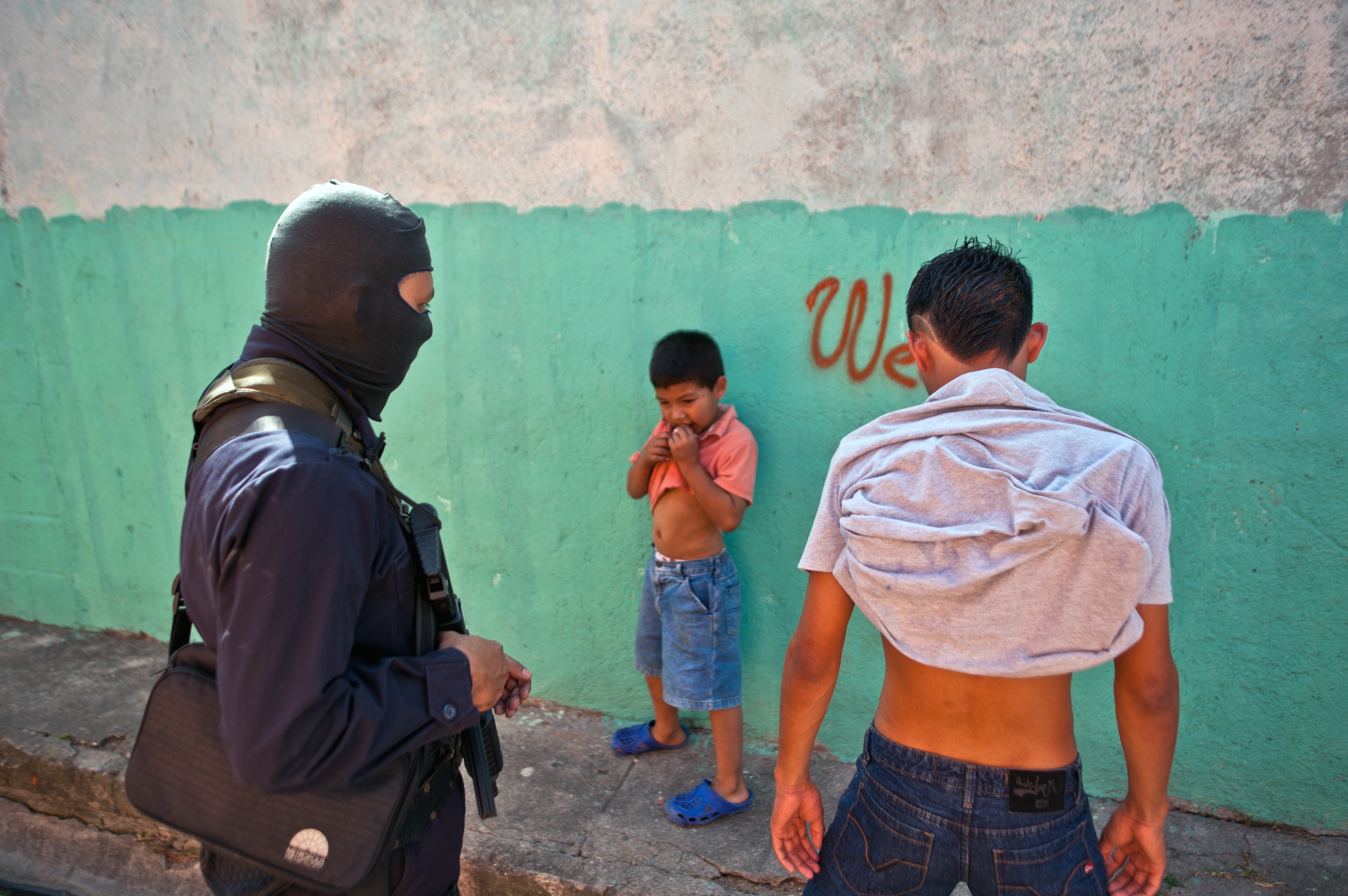
EL SALVADOR-POLICE-OPERATION

Amanda Taub illustrates how gang violence in Central America is driving thousands of unaccompanied children to seek refuge in the US:

Children are uniquely vulnerable to gang violence. The street gangs known as “maras” — M-18 and Mara Salvatrucha, or MS-13 — target kids for forced recruitment, usually in their early teenage years, but sometimes as young as kindergarten. They also forcibly recruit girls as “girlfriends,” a euphemistic term for a non-consensual relationship that involves rape by one or more gang members.

If children defy the gang’s authority by refusing its demands, the punishment is harsh: rape, kidnapping, and murder are common forms of retaliation.  Even attending school can be tremendously dangerous, because gangs often target schools as recruitment sites and children may have to pass through different gangs’ territories, or ride on gang-controlled buses, during their daily commutes.

Why now? The Economist‘s take:

El Salvador, Honduras and Guatemala have had shockingly high murder rates for years, however. The reason so many of them have decided to leave at once is a widespread rumour that Mr Obama’s administration has relaxed the barriers against children—and their mothers if the children are young enough—entering the United States.

A leaked border-agency memo based on interviews with 230 women and children apprehended in the Rio Grande Valley concluded that they had crossed the border mainly because they expected to be allowed to stay. Migrants talk of a “permiso” (permit) to stay in the United States, although this may be a misunderstanding of the American immigration procedure in which many children are put in the care of family members while waiting for deportation hearings. Some Hondurans conspiratorially say they think America is preparing for war; that’s why they are letting more youngsters in. Others blame Facebook: it is easy for relatives in the United States to show the trappings of prosperity.

Julianne Hing disputes the notion that Obama’s policies are to blame for the influx:

Republican lawmakers are having a field day casting Obama administration policy, namely DACA—a program initiated in 2012 which gave a narrow class of undocumented youth short-term work authorization and protection from deportation—as responsible for the sudden uptick of new migrants. In early June, Alabama Sen. Jeff Sessions even called Obama “personally responsible” for the influx, Think Progress reported. It’s become popular political fodder for politicians with midterm elections on the mind.

However, humanitarian groups like the United States Conference of Catholic Bishops and the Women’s Refugee Commission have noted the jump in unaccompanied minor border crossings since late 2011 (PDF), long before Obama announced DACA in June of 2012. What’s more, in interviews with hundreds of detained youth, multiple agencies and researchers have found that the vast majority have no idea about the existence of DACA, let alone the notion that they might take advantage of it for themselves.

Dara Lind accuses the administration of getting its response to the crisis backwards:

The Obama administration now believes that the government’s top priority should be swiftly returning a child to his or her home country if it’s not immediately clear that he or she deserves legal status here. That means the administration sees this as an immigration crisis — children coming to the United States because they can, for economic opportunity, family reunification, or to game the system. If that’s the case, a crackdown will deter families from sending their children, because the odds would no longer be in their favor.

It means they don’t see it as a refugee crisis — children will now be assumed not to be in danger unless they can prove otherwise. But if families are currently sending children because they’re genuinely convinced the children are in mortal danger, a crackdown won’t have as much of a deterrent effect.

(Photo: A policeman checks a man during the operation ‘safe house’ at the Maquilishuat neighborhood in San Salvador, El Salvador on January 15, 2014. Salvadorean police make ‘safe house’ operations to search for drugs and gang members in violent neighborhoods. By Jose Cabezas/AFP/Getty Images)