Obama Just Ruined Cuba! Ctd

by Will Wilkinson

Shep Smith seems to think so:

https://www.youtube.com/watch?v=s5xcmIRFPSs

Responding to that clip, Allahpundit finds that notion entirely fatuous:

This is exactly what it sounds like, a guy seemingly willing to trade away greater prosperity for Cubans if it means Americanizing the island in return for preserving the quaint, simple culture that decades of authoritarianism and economic retardation have produced. It’s basically the “noble savage” view of economics. What doth it profit a Cuban to gain a middle-American depot for cheap building materials if he lose his cheap-rum-making soul? Where are we going to go to watch people riding around in 60-year-old Studebakers now?

Ryan Kearney accuses those afraid of “spoiling” Cuba of fetishizing poverty:

When Americans daydream about visiting Cuba before it’s “spoiled,” they’re implying that the island today is some kind of paradise. I have been there. It is not a paradise.

The buildings in Havana are literally crumbling, many of them held upright by two-by-fours. Even the cleanest bathrooms are fetid, as if the country’s infrastructural bowels might collectively evacuate at any minute. And the streets are riddled with potholes, some large enough to swallow a Russian Lada. The country isn’t so much frozen in time as in a state of perpetual rot, which is exactly what the 1961 embargo was designed to do.

But the cars! Yes, let’s talk about those cars. Cubans don’t drive American antiques because they love American antiques as much as we do, but because they have no choice.

There is, however, a real argument to be made that opening up the Cuban economy could have negative consequences. As Neil Irwin elaborates, “one of the biggest risks might be moving too fast”:

That is a conclusion of some scholars who very much favor economic liberalization of Cuba — but want it done right. Gary Clyde Hufbauer and Barbara Kotschwar, scholars at the Peterson Institute for International Economics, published a book this spring looking at the hard task of reintegrating the two economies as Fidel and Raúl Castro fade from the political scene. Their conclusions suggest it would be foolhardy to imagine a rapid return to the days when American tourists frequented the Tropicana, and the Federal Reserve Bank of Atlanta had an office in Havana.

There is, they argue, a model for how not to make the transition, a prime example being Russia’s “shock therapy” approach to privatizing industries and introducing democratic government after the demise of the Soviet Union. … Cubans — and Americans wanting to do business there — will be better off if they instead emulate Vietnam and China, two countries that have migrated from Communism to a hybrid system that is nominally Communist but practices free-market capitalism to a large degree. That has allowed them to become more fully integrated into the global economy and helped millions of their citizens escape poverty over the last generation without bloodshed or revolution.

Likewise, Dougherty warns that embracing free markets – which Cuba hasn’t exactly signed on to anyway – won’t magically heal the damage done by half a century of communism:

Law and order can make markets appear. But it is civil society and a culture of social trust that make free markets tolerable. And it is precisely this social trust that communism so effectively destroys. “We pretend to work, and they pretend to pay us,” became a de facto motto for the late Soviet Union. Cuba, like East Germany or the Czech Republic, has a memory of a modern civil society before communism. Some even remember when it was a relatively wealthy nation. But the memory is an ever-more distant one. The news of normal diplomatic relations is to be welcomed, as is the end of a useless American policy. But Cuba’s restoration will require something that an army of policy experts cannot provide.

Clive Irving, meanwhile, focuses on the environmental drawbacks of opening up Cuba to more tourism:

[B]efore a new tide of tourists can flow from Miami to Havana, Cuba will need to build more runways. The two airports taking the most tourist traffic, Havana and Varadero, are already at near capacity in peak season with flights from Canada, Europe and Latin America. More runways, more hotels, more roads, more infrastructure? The island faces an environmental challenge of huge proportions. With more than 3,000 miles of coastline, Cuba is the Caribbean’s largest island and the most ecologically diverse. There are six UNESCO biosphere reserves and nine UNESCO World Heritage sites.

Although tough environmental controls were put in place in 2000, enforcement has been haphazard. Surging coastal development has destroyed natural protection—mangroves and wetlands, just at the time when Cuban scientists calculated that climate change would wreak havoc.

It’s also worth noting that the possible transformation of Cuba into an tourist mecca for Americans may not come about due to the baleful depredations of free-market capitalism, but might just as well come about through centralized state planning. Responding at length to Jeremy Scahill’s tweet that “I’m glad I got to visit several times before US tourists try to turn it into Cancun,” Josh Barro observes:

Cancun isn’t a symbol of free market capitalism, and American tourists didn’t make the place what it is today. An arm of the Mexican central bank did, in perhaps the largest and most successful example of central economic planning in North American history. Cuba should be so lucky as to have made its planned economy work as well as Cancun’s.

Barro’s account of the way Cancun got to be Cancun is fascinating, but it seems he missed Scahill’s gist.

This is point worth taking very seriously. Socialists have a terrible habit of romanticizing the Cuban dictatorship, and whitewashing its crimes. Still, as repressive totalitarian regimes go, the quality of life in Cuba is remarkably high.

According the United Nation’s Human Development Index – which takes into account a life-expectancy, education, and per-capita GDP – Cuba ranks 44th in the world, while Mexico ranks a 61st. 61st isn’t bad (there are 187 countries in the index), but 44th is pretty good! One might reasonably wonder about the credibility of Cuba’s national statistics, but if they’re in the neighborhood of the truth, this level of human development is a remarkable achievement for such a low-income country, a real outlier, and it would be a pity if opening up Cuba led to a reversal health and education. But I’m not too worried. I think I also agree with Scahill about this:

Neoliberal or not, opening up Cuba ought to make it a good deal wealthier. If the Cubans are able to use that extra money to shore up the policies and institutions that already work surprisingly well, then loss of a little undeveloped shoreline, and a little Cancunification, will be a small price to pay.
But How Will It Play In Miami?

by Dish Staff

Cuba Support

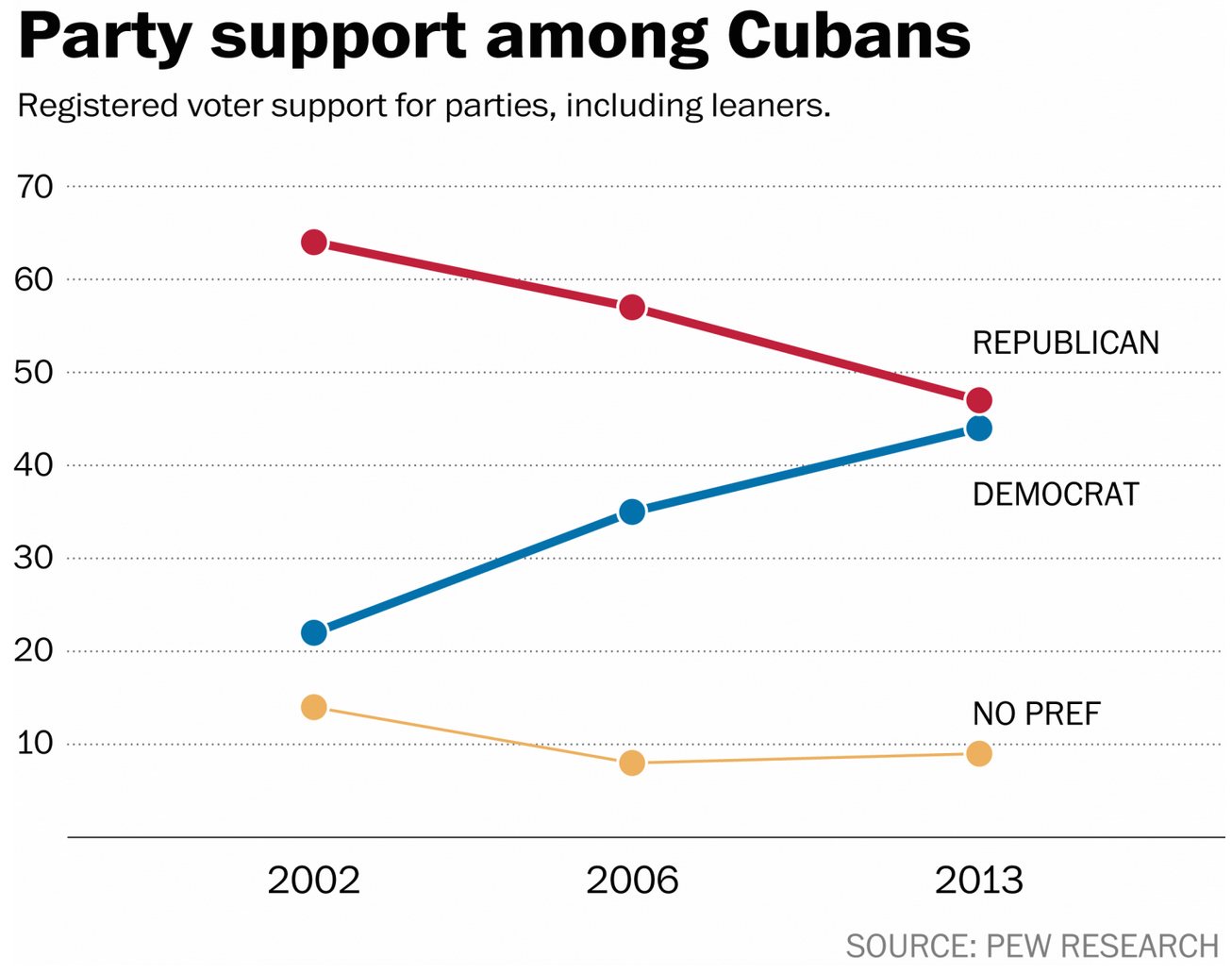
The supposedly implacable, politically powerful bloc of Cuban exile voters in southern Florida has long been one of the obstacles to a rapprochement with Cuba, but Annie Lowrey points out that this bloc isn’t as solidly Republican or pro-embargo as it used to be:

Is there a chance that President Obama’s policy might swing some Cuban-Americans back towards the Republican Party? Certainly, and we won’t know for sure until we get new polling data, likely in a number of weeks. But it is worth noting that those younger Cuban-Americans tend to be much more supportive of diplomatic normalization than their older counterparts. A recent Florida International University poll found that 90 percent of young Cuban-Americans in Miami-Dade County — 90 percent! — favor having diplomatic relations with Havana. A similar proportion support lifting the travel ban, and just more than 60 percent of young Cuban-Americans support ending the embargo.

Nate Cohn looks at some other evidence that Cuba just isn’t that much of a political flashpoint in Florida anymore:

It’s hard to know whether Mr. Obama’s decision will move the needle among Cuban-American voters. Polling data reflecting Mr. Obama’s decision, which will arrive in a few weeks, will tell us more. Nonetheless, the available polling data suggests that many Cuban-American voters are receptive to restoring diplomatic relations with Cuba, including 68 percent in an F.I.U.poll and 79 percent in an Atlantic Council poll (although the sample was extremely small).

Perhaps the more telling evidence, though, is that Mr. Obama managed to make substantial gains among Cuban-Americans even though he was open to revising Cuba policy. Mr. Crist also ran on a more open Cuba policy and won the Cuban-American vote in the exit polls last month. The fact that Mr. Crist’s advisers thought it strategic to emphasize the issue may be an indication of what their polling data showed. The uninspired Republican response in prior campaigns may be telling in its own right. Republicans didn’t exactly blanket the Miami media market with ads about Mr. Obama’s Cuba policy, which might also be an indication of how they think the issue plays.

Tell that to Marco Rubio, who could very well run for president wearing this issue on his sleeve. Russell Berman doubts such a strategy would get him very far, though:

Polls show more and more Americans support normalizing relations with Cuba, and the trend even extends to Rubio’s cohort of Cuban-Americans. Rubio dismissed talk of the 2016 race on Wednesday, “out of respect for the gravity of the issue,” he said. And he didn’t have much to say about the polling, either. “This is not a political thing,” he said. “I don’t care if polls say the 99 percent of the people support normalizing relations with Cuba.” It’s a principled stand, sure, but it probably won’t make his increasingly arduous journey to the White House any easier.

Larison shakes his head at Rubio’s insistence that opening diplomatic channels with Cuba is beyond the pale:

It’s important to repeat again and again that establishing normal diplomatic relations is the bare minimum of engagement with another country. The U.S. maintains normal relations with all kinds of governments, including some of the very worst in the world. That isn’t because we approve of everything they do, nor is it because we are doing them any favors by having normal relations, but because this is the kind of relationship all governments seek to have with each other except in times of crisis or war. There is no good reason for the U.S. and Cuba not to have normal relations today, and so we should have them. If the U.S. refused to have normal relations with every state because of its authoritarian character or the abuses it has committed, as Rubio claims to want, it would have to shut down its embassies in half the countries around the world.

(Chart from Philip Bump.)

Obama Scraps Our Failed Cuba Policy, Ctd

by Dish Staff

Readers react to the big news:

Normalization of relations is a great and long overdue policy.  I have a question about it that I haven’t seen addressed: will it create an opportunity to close Guantanamo?

Another:

Hopefully everyone’s noticed that the Republicans opposed to normalizing relations with Cuba:

A) Have no problem with us having diplomatic relations with China, another Communist country with an even worse human rights record.

B) Are currently defending the US’ own recent human rights abuses, i.e. torture.

We all know the real reason: political posturing.  Castro stripped Cuban aristocrats of their wealth.  They fled to Florida and have been propping up anti-Castro policy ever since.  There are no principles here.

Another asks:

Lost in all the coverage is the one issue I think is the most important – will this change the absurd “Wet-foot/Dry-foot policy?

After we normalize relations with Cuba, what happens to refugees who make it to U.S. shores? Or those who overstay their (presumably soon to be issued) visas? Will they be allowed to stay and fast-tracked to attaining resident status? Or will Cuban refugees be deported like Haitians, Mexicans and others who come here illegally? I’m not saying they should. But it’s wrong to treat economic refugees from Cuba who aren’t facing imprisonment as dissidents differently than those from other nations. Anyone have an answer to this?

Another outlines “the points to make”:

1) The 50-plus years of sanctions and embargoes were failing to drive the Castros and their ilk from power.  Diplomacy such as this – with an effort to defuse tensions to where the authoritarian regime will end political harassment – is due its chance to work.

2) The outrage against a friendly posture towards Cuba by the far right, and by the anti-Castro hardliners, are going to fall on deaf ears.  Polling has shown a sizable majority of Americans, sizable majority of CUBANS (especially younger generations distanced from the passions of the Cold War era) back an end to sanctions and normalizing relations.

3) Obama’s move is honestly a very small, very minor moment in our nation’s international efforts … except somehow this move is one of the cornerstones of Obama’s administration.  Because it is one of the moves his office has done to improve our nation’s international reputation that has been damaged by the heavy-handed neocon exploitations of the Bush/Cheney years.  This move is going to go over well with our Caribbean and Central/South American allies, for starters.  And it’s been a move we SHOULD HAVE done since the fall of the Soviet Union …

While Obama’s and the nation’s reputation remains stained by the failures to bring Cheney and his ilk to trial for their torture regime, he’s at least made good faith efforts in other areas – isolating Putin over his assault on Ukraine, getting Syria to clean out MWDs, treating with Iran as part of efforts to block ISIL and the Taliban, etc. – to show the United States takes its role as a superpower serious.  This move is part of that trend.

4) Obama shouldn’t have received that Nobel Peace Prize so early in his presidency; they should have waited until moves like this to demonstrate how he’s using diplomacy the best way possible: ending hostilities, improving relations with ally and foe alike, and

This isn’t over yet, obviously.  A lot has to get resolved over the issues of reparations (property ownership seized from the 1960s for example) and human rights (end to political arrests, open local elections).  But this is a huge step.  It breaks the stalemate of embargoes that weren’t working, and it forces the political ideologues to face new realities.

Meep-meep.

Another addresses Will’s post:

I’m one of the Twitterers who posted a comment about getting to Cuba before Starbucks (in an @reply to a friend). But my comment was not intended the way you suggest, and the way that a dozen other think pieces are also suggesting. I had not forgotten that Cuba was unbelievably poor, and that their mid-century architectural/technological condition was actually the sad result of arrested economic development. I have no interest in poverty tourism.

What I meant – and what I think most people meant – was that we hoped Cuba could grow fully into a nation with their own culture, as free from American normalization as possible. It would be a shame if American developers stormed in and turned the country into just another Floridianesque suburb. That seems all too possible.

Of course, if that kind of American assistance is what’s best for Cuba, then that’s fine. I want what’s best for them. But how do you say all this in a tweet. Really.

The backlash on these comments is exactly that Illiberal Left position that you’ve been writing about on the Dish, hacking away at harmless comments for not being explicitly clear that such and such person is not being maligned. It’s pouncing on people for personal gain and satisfaction.

I’m excited and hopeful for Cuba.

Obama Just Ruined Cuba!

by Will Wilkinson

Not really! Obama’s decision to normalize relations with Cuba (which does not yet include lifting the embargo) is a giant step toward fixing Cuba. Nevertheless, people are already worried that Cuba will no longer remain a zoo of human inmates dwelling in picturesque shabbiness – already complaining about the prospect of Cubans no longer trapped on a prison island, no longer oppressed by a totalitarian regime, and therefore free to buy a Big Mac. Seriously. This is a real thing on Twitter:

Look, I totally understand the sentiment. There is something singular and vivid about a vibrant, tropical ruin frozen in the 1950s. Cuba is a showcase of dilapidated anti-commercial mid-century nostalgia, and I too sort of wish I had gone to see it, just as I wouldn’t mind having seen Soviet Leningrad. Come to think of it, it would be pretty interesting to see the slave ships coming into harbor in prebellum Savannah. What a scene those auctions must have been! But the human part of me, the moral part, as opposed to the aesthetic and amorally curious tourist part, can only regret that slaving Savannah and communist Russia lasted as long as they did, and today I can be nothing but hopeful that something like freedom is finally coming to the Cubans. If it does, and I make it to Havana, and see a McDonald’s, I will walk into that McDonalds, buy a large Diet Coke, and pour a little on the ground in half-sincere mourning for the pretty, impoverished theme park of tyranny I never had the chance to see.

Faces Of The Day

by Dish Staff

Cuba Releases Alan Gross, Held In Prison For 5 Years

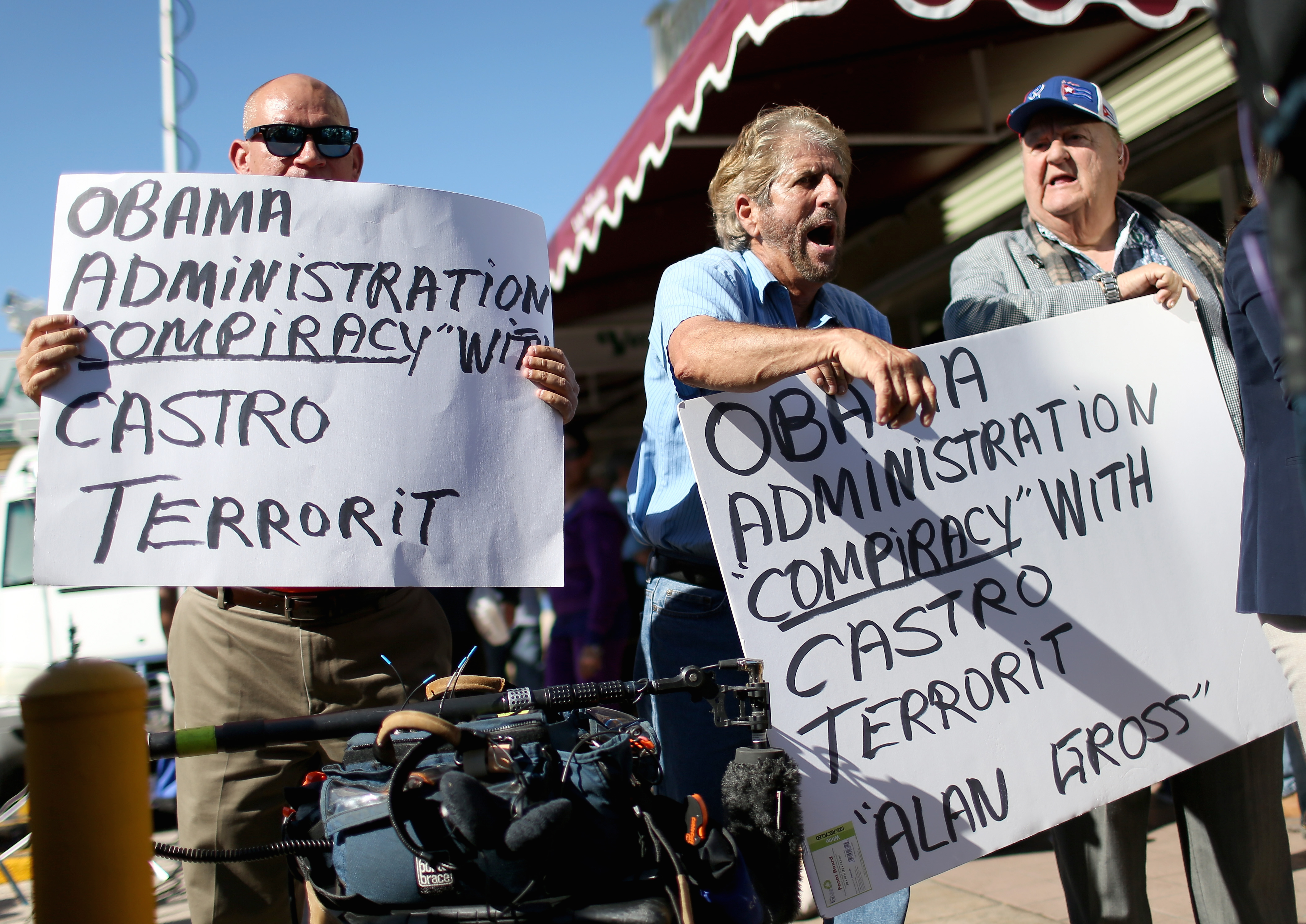
Osvaldo Hernadez, Miguel Saavedra and Carlos Munoz Fontanillehas (L-R) react to the news, outside the Little Havana restaurant Versailles in Miami, that Alan Gross was released from a Cuban prison on December 17, 2014. Gross, an American contractor, had spent five years in Cuban jail and reports indicate he is on his way back to the United States. By Joe Raedle/Getty Images.

Obama Scraps Our Failed Cuba Policy

by Dish Staff

https://twitter.com/jonfavs/status/545276674846519297

How the deal came together:

The initiative comes after more than a year of secret talks, with a major impetus provided by Pope Francis, who hosted the final discussions between Cuban and U.S. officials at the Vatican in the fall. U.S. President Barack Obama and Cuban President Raul Castro spoke on the telephone yesterday for the better part of an hour, going down the checklist of measures that had been agreed in secret talks over the course of more than a year.

The agreement includes a “decision to reopen embassies, closed since 1961, and a dramatic expansion of the kinds of licenses that will allow Americans to travel legally to Cuba”:

Even if “tourism” is still barred by law, it is difficult to imagine that anyone wanting to visit the island will not be able to find some category that allows that to happen.

More on the accepted reasons for travel here. And yes, you can bring back cigars. Massie approves of Obama’s actions:

This is not – repeat not – going soft on Cuba. It’s getting tough with Cuba.

The old approach has had half a century to work and yet, golly, the Castros are still there, still running their sunshine-soaked island gulag. By any reasonable measure the old approach has failed. Every sensible person knows this. Every reasonable person knows just about any alternative policy could hardly do worse. So why not try something different? If the embargo was going to topple the Castros’ nasty little regime it would have done so by now. Perhaps capitalism should be given a chance instead.

There are other benefits to this startling eruption of sanity. American relations with the rest of Latin America have long been complicated by the stupidity of its Cuban policy. A reset here allows – in theory at least – an improvement in this area too. It is hard to see how this opening can hurt the United States anywhere in the western hemisphere.

Rubio, of course, is pissed:

“The President’s decision to reward the Castro regime and begin the path toward the normalization of relations with Cuba is inexplicable,” said Rubio in a statement. “Cuba, like Syria, Iran, and Sudan, remains a state sponsor of terrorism…Appeasing the Castro brothers will only cause other tyrants from Caracas to Tehran to Pyongyang to see that they can take advantage of President Obama’s naiveté during his final two years in office. As a result, America will be less safe as a result of the President’s change in policy.”

Goldblog dismisses such criticisms:

Critics of Obama’s Cuba initiative have a point: There is no way to guarantee the success, in human-rights terms, of this dramatic new opening. But time has discredited the alternative vision. The seemingly never-ending embargo did nothing to bring about the conclusion of the seemingly never-ending rule of the Castro brothers. After 50 years of trying one thing, and seeing that thing fail, and fail again, it was about time that the United States try something else.

Yglesias adds that “US policy towards Cuba isn’t really about human rights”:

While the Cuban government has a genuinely awful human rights record, it’s hard to argue that that explains US policy towards Cuba. While Cuba is the only country in the Western Hemisphere rated “not free” by Freedom House, it’s hardly the only such country in the world. The United States conducts normal diplomatic relations with China and Vietnam, who run similarly repressive regimes. And the United States considers not-free states such as Saudi Arabia, Bahrain, and Jordan to be close allies worthy not only of normal diplomatic relations but deep military and security assistance.

Cuba policy, in other words, has been driven by Cold War strategy and domestic politics much more than by human rights. That’s why with the Cold War issues now obsolete and the domestic politics changing, US policy is set to change too — even without significant change in Cuba’s human rights situation.

Keating provides some more important context:

[W]hile we certainly can’t say that Cuba is on the path toward democracy, Raul Castro’s government has carried out some meaningful reforms, including loosening rules on travel and private property. Even the country’s best-known anti-Castro dissident, Yoani Sanchez, thinks the embargo is now counterproductive.

Larison’s take:

The administration deserves credit for trying to make such a significant change to Cuba policy. When relations are restored with Havana, it will be a genuinely praiseworthy achievement of Obama’s second term. Normalization with Cuba is broadly popular in the U.S. and has been becoming more so over the years, but there is a dedicated core of supporters of the status quo that will presumably put up strong resistance to these changes. Let’s hope that they’re unsuccessful in any attempt to delay or derail this rapprochement.

And Noah Feldman supports Obama fighting the Cuba Lobby:

The risk that Obama carries in taking on a concentrated lobby isn’t totally unfamiliar to him. After all, he tried to take on the NRA by pushing gun control after the Newtown shootings. When he lost, the political cost to him was much less than the cost of doing nothing. With regard to Israel, Obama has tread much more carefully, limiting himself to the unmistakable message that he thinks West Bank settlements are an obstacle to peace and that Benjamin Netanyahu is, too. Many pro-Israel lobbying groups detest him for it, but they haven’t yet had the occasion to go to war against him.

With the end of his presidency in view, Obama has to take risks if he wants to score some legacy points. His gamble on Cuba may not be fully realized. But the results will have implications for the structure of American interest group politics more broadly.

Earlier Dish on the deal here.

Ending The Embargo?

by Dish Staff

Cuba’s release of US citizen Alan Gross is being coupled with a thaw in US/Cuba relations. Both Obama and Cuban President Raúl Castro are set to make public statements today:

Gross’ “humanitarian” release by Cuba was accompanied by a separate spy swap, the [senior administration officials] said. Cuba also freed a U.S. intelligence source who has been jailed in Cuba for more than 20 years, although authorities did not identify that person for security reasons. The U.S. released three Cuban intelligence agents convicted of espionage in 2001.

President Obama is also set to announce a major loosening of travel and economic restrictions in what officials called the most sweeping change in U.S. policy toward Cuba since the 1961 embargo was imposed.

Amanda Taub runs through the basics of the US-Cuba deal. Juan Cristobal Nagel is live-blogging the news. Elliott Abrams prefers the status quo:

On human rights, liberty, individual freedom there have been no changes: Cuba remains a communist dictatorship run by the Castros.

The new Republican-led Congress has a job to do here: to ask whether the President simply forgot about the Cuban people’s rights in his urge to show he isn’t just a lame duck and can still do important things. To make sure that the United States isn’t giving this vile regime a lifeline just when the old age of the Castro brothers is bringing it closer and closer to an end. To limit the benefits to Castro unless and until there are human rights improvements in Cuba.

But Phillip Peters notes that the US political climate has been changing:

As recently as 2000, Cuban Americans broke three-to-one for Republicans in Presidential elections, but no more. In 2012, exit polls showed them splitting 50-50 between President Obama and Gov. Mitt Romney. Considering that the president had mildly liberalized Cuba policies in his first term and Governor Romney was calling for a return to President Bush’s hardline policies, this was a shocking result.

But it was not a fluke: it reflects changing policy preferences in a Cuban-American community increasingly populated by younger generations and more recent immigrants. A 2014 Florida International University (FIU) poll showed that for the first time since its surveys began in 1991, a majority of Cuban Americans, 52 percent, wants to end the embargo. (During the 1990s, five FIU polls showed average 85 percent support for the embargo.) Among those under age 30, 62 percent want to end the embargo and 88 percent want to re-establish full diplomatic relations with Havana.

Larison believes a shift is long overdue:

Normalizing relations with Cuba shouldn’t be seen as a “reward” for the regime. It is the removal of a barrier that has been senselessly maintained for more than five decades. If anyone is being punished by the embargo, it is the people in America and Cuba that would otherwise have productive commercial and cultural exchanges. The U.S. gains nothing by persisting in the embargo. On the contrary, it needlessly alienates Latin American governments and puts the U.S. in the absurd position of defending a Cold War relic. Normalization is twenty years overdue, and nothing will be gained by delaying it any longer.

David Graham notes Republican opposition to normalizing relations:

Republican Senator Marco Rubio of Florida, whose parents were born in Cuba and moved to the United States, has opposed looser travel restrictions. Senator Ted Cruz, another Republican whose father was born in Cuba, also opposes lifting the embargo.

Earlier this month, Jeb Bush, the Republican former Florida governor who on Tuesday announced that he’s “actively exploring” a presidential bid, said, “I would argue that, instead of lifting the embargo, we should consider strengthening it.” As proof that the embargo’s backers aren’t ready to surrender, the Miami Herald reported that “the crowd of donors, the backbone of Cuba’s exiled elite, applauded loudly” when Bush made that proposal. But their view looks more beleaguered than ever today.

And Morrissey wonders how this will play out politically:

This abrupt change will make Florida a very interesting place for Hillary Clinton in 2016. The Cuban exile community has been firm about playing tough against the Castros, but the younger generation may be moving away from that policy. We’ll see.