Egypt’s Gift To Erdogan

Claire Berlinski notices how the Egyptian coup has given Turkey’s prime minister another chance to steer the media away from protests in Istanbul, which have not subsided:

[T]he Gezi protests were so massive, and so widely publicized, even internationally, that none of us could figure out how he’d change the subject this time, even with the customary media lockdown. “Frankly,” I said to a friend, “the only way he could do it is by announcing that he’s always felt like a woman trapped in a man’s body and announcing that he’s scheduled himself for immediate gender reassignment surgery.”

I was wrong. God intervened. He handed Erdoğan a coup in Egypt, instead.

Now, to put this in context, the Turkish media barely noticed the coup in Mali, and I’d be astonished if more than 100 Turks were aware that in recent years there have also been coups in Honduras, Guinea-Bissau and Niger. But as of the Fourth of July, one would have thought, from reading the local press, that one was not in Turkey but in Egypt, which was more than passing strange. And while the world seems to believe the Egyptian coup was a “nightmare” for Erdoğan, putting an end to his ambitious foreign policy fantasies (and this is true), it it important to understand that it was simultaneously a dream come true, not only turning all foreign attention away from Turkey, but enabling him to turn all domestic attention away from Turkey, and lending credibility to his absurd claims that the Gezi Park protesters were in fact coup-plotters, despite extensive, serious research indicating that they were anything but.

Recent Dish on Turkey here, here and here.

Is Egypt Heading For A Civil War? Ctd

Michele Dunne isn’t ruling it out:

What could easily happen is a return to the sort of low-level insurgency and domestic terrorism that plagued Egypt during the 1980s and especially the 1990s. That period saw the 1981 assassination of President Anwar Sadat, a 1995 unsuccessful attempt on Mubarak’s life, a 1997 attack in which 58 tourists and four Egyptians were killed in Luxor, and many other incidents in which jihadi Islamists targeted Christians, liberals, foreigners, and government officials. Tens of thousands of Islamists were imprisoned, often for lengthy periods without charge. The Sinai will probably become much more dangerous than it already has, further setting back efforts to restart tourism and get the economy on track. Clashes between Islamist demonstrators and security forces are likely to continue, and those between armed Islamist and secular gangs might become common.

Will the post-Morsi violence become an actual civil war? Several more shoes would have to drop—a return to arms of the so-called repentant former jihadis, the drift toward extremism of more Brotherhood members, the formation of more and larger armed Islamist units in lightly governed areas of Egypt, such as Sinai and the Western Desert­—to bring about that unhappy prospect. But it can no longer be excluded altogether.

Earlier debate on the subject here.

Ask Michael Hanna Anything: Egypt’s Progress Since 2011

Yesterday we heard from Michael about the polarization in Egypt, as well as an explanation of the Morsi government’s terminal flaws. In this video, Hanna surveys how the country has changed since the fall of Mubarak, including the expanding political consciousness within Egyptian society:

Michael Wahid Hanna is a Senior Fellow at The Century Foundation, where he works on issues of international security, international law, and US foreign policy in the broader Middle East and South Asia. He appears regularly on NPR, BBC, and al-Jazeera. Additionally, his Twitter feed is a must-read for anyone interested in Egyptian politics. Our full coverage of the current events in Egypt is here. Our Ask Anything archive is here.

Ask Michael Hanna Anything: Morsi’s Failure To Govern

In our second video from Egypt expert, he explains how Morsi and the Muslim Brotherhood neglected to pursue reform and reconciliation following the 2011 revolution, and thus have only themselves to blame for their downfall:

https://vimeo.com/70048624

Earlier this week, Hanna further detailed these failures, including how Morsi screwed up his response to the June 30 protests:

An honorable exit for Morsy would have been a recognition of reality. A crippled executive with a tenuous grip on authority who could not govern effectively — even at the peak of his popularity — was no longer in a position to fulfill his role. A negotiated safe exit would have also preserved the Muslim Brotherhood’s political gains and ensured its participation in the design of the transitional stage and upcoming elections. Such an exit would have also reversed its disastrous decision to renege on previous pledges and contest the presidential election, thereby relieving the organization of the enormous strain of governing Egypt during this tumultuous period.

Such a decision would have required Morsy to undertake a thorough assessment of his errors and an objective appraisal of the country’s current dynamics. As difficult as such steps would have been, they were Egypt’s only way out. Instead, the country has chosen one poison over the other.

But in the end, no functional political order can emerge, let alone a democratic transition, without the free, fair, and full participation by the Muslim Brotherhood. With Morsy now incommunicado and presumably filled with rightful indignation at his fate, he can still help bring Egypt back from the brink. To do so, however, will require him to be a real leader and make a painful concession — placing his country’s future first.

Michael Wahid Hanna is a Senior Fellow at The Century Foundation, where he works on issues of international security, international law, and US foreign policy in the broader Middle East and South Asia. He appears regularly on NPR, BBC, and al-Jazeera. Additionally, his Twitter feed is a must-read for anyone interested in Egyptian politics. Our full coverage of the current events in Egypt is here. Our Ask Anything archive is here.

Will We Cut Egypt’s Aid? Ctd

Elliott Abrams supports suspending aid:

Some argue that a suspension of aid, which is clearly required by U.S. law when there is a coup, is foolish right now because we need to stay close to the Egyptian military. Others say the vast majority of Egyptians rose up to throw the Muslim Brotherhood out, so an aid suspension would insult and enrage them. Still others say there was not really a coup, because what the military did responded to the millions of Egyptians who went to the streets to eject President Morsi. …

Look back at all those things we want for Egypt, and the answer should be obvious: We will do our friends in Egypt no good by teaching the lesson that for us as for them law is meaningless. To use lexicographical stunts to say this was not really a coup, or to change the law because it seems inconvenient this week, would tell the Egyptians that our view and practice when it comes to law is the same as theirs: enforce the law when you like, ignore the law when you don’t. But this is precisely the wrong model to give Egypt; the converse is what we should be showing them as an ideal to which to aspire.

But the illegal occupation and settlement of the West Bank? Not a problem. I’m with George Washington: in favor cutting all military aid to both Israel and Egypt. From the other end of the political spectrum, Egyptian writer Nawal El Saadawi seconds the motion:

On July 5, I watched a group of American men on CNN threatening to cut off aid to the revolutionary Egyptian people. And I laughed out loud. I hope that they cut off this aid! Since the time of Anwar Sadat in the 1970s, this aid has destroyed our political and economic life. This aid helps the U.S. more than anyone else. This aid goes directly into the pockets of the ruling class and corrupts it. This aid has strengthened American-Israeli colonial rule in our lands. All that the Egyptian people have gained from this aid is more poverty and humiliation.

Brad Plumer considers what would happen if we cut off aid:

Probably not much at first. Military aid to Egypt for 2013 was already disbursed back in May, and there likely wouldn’t be another round of funding until next spring. But cutting off aid would certainly reshape the U.S.-Egypt relationship — and mark a big break from the past 65 years.

Back in 2012, Shana Marshall doubted that the US would cut aid to Egypt, partially because, although “domestic interest groups are rarely invoked in the debate over military aid to Egypt, the $1.3 billion in annual assistance represents a significant subsidy to U.S. weapons manufacturers.”

More Dish on the debate over Egypt’s aid here and here.

Ask Michael Hanna Anything: Is Egypt Heading For A Civil War?

In our first video from Michael, he offers his thoughts on the troubling rise of polarization in Egypt, and whether civil strife could follow:

Some see no civil war any time soon. Laura Dean:

First, the Egyptian army is powerful, and though it might provoke here or deliberately refuse to act there, it nevertheless would not allow a full-blown civil war. This would defeat the military’s central objective of cementing its own authority. And it is not clear that the Brotherhood would be willing to call on its supporters to take up arms or could marshall enough support to take on a force as powerful and apparently united as the Egyptian Army. Egypt is unlikely to become another Algeria, where the army removed the Islamists from power before they had been allowed to try their hand at governing, resulting in civil war. In this case, by contrast, the army has widespread support in part because many people think that the Brotherhood sealed its own fate through a year of bumbling and incompetent governance.

Furthermore, while there are clear efforts to marginalize the Brotherhood, the army and interim government have gone to great lengths to include and accommodate the Salafi Nour Party, indicating that there is still room for Islamists to participate in politics. The Nour Party may absorb former Brotherhood members and others who might otherwise defect from the political process entirely. Finally, Egypt already had an armed Islamist insurgency in the 1990s. And it didn’t work.

Nour Youssef looks at how Egyptians of various political stripes are responding to recent events:

The word polarization fails to describe what is happening now. Public opinion is more of an aggregation of wishes for the defeat, suffering and death of certain members of the public, who are no longer considered members altogether, by other members of the public, whom they no longer consider members of the public.

Case in point, the sentence “We need to cleanse Egypt of (insert group of people you disagree with)” is one I hear everywhere. The refusal to accept that the country will not run out of islamists or secularists for many years, if ever, and that neither party can be effectively shunned from society, is making conversations simply exhausting.

Michael Wahid Hanna is a Senior Fellow at The Century Foundation, where he works on issues of international security, international law, and U.S. foreign policy in the broader Middle East and South Asia. He has published widely on U.S. foreign policy in newspapers and journals, including articles in the New York Times, the Los Angeles Times, the Boston Globe,  Christian Science Monitor, the New Republic, and World Policy Journal, among other publications, and is a frequent contributor to Foreign Policy. He appears regularly on NPR, BBC, and al-Jazeera. His Twitter feed is also a must read for anyone interested in Egyptian politics. Our full coverage of the current events in Egypt is here. Our Ask Anything archive is here.

Egypt’s Insta-Democracy

Interim President Adly Mansour has announced that a new constitution will be drafted and voted on within the next five months and that parliamentary elections will follow soon thereafter. Nathan Brown thinks the declaration “will set off more political battles than it will resolve”:

Start with a constitutional declaration written in secret and dropped on a population that, still basking in post-revolutionary goodwill, is not reading the fine print. Then add a considerable measure of vagueness, an extremely rushed timetable, critical gaps and loopholes, and a promise that everyone gets a seat at a table but not much of a guarantee that anybody listens to what is said at that table: The generals are clearly calling the shots for the short term, but there’s just enough opacity, and a dose of influence for civilian officials and politicians, that it’s not clear where the real responsibility lies.

Reward those who cut deals with the military or security apparatus, but also allow those who missed out on cutting a deal to decry the very idea of such deals. Add in measures of repression, xenophobia, media restrictions and harassment, and the postponement of all reform questions. Use state media in a blatantly partisan way. And subject Egyptians to a rapid series of elections so that, as soon as they’re done with one round of balloting, they are called to vote on the next.

Allahpundit wonders if the Brotherhood will eventually play ball:

The timetable doesn’t give the Muslim Brotherhood and its political allies much time to choose whether to participate in electoral politics or sit out and hope that their absence will impact the validity of the results.  They should know, however, that this trick rarely works; usually the sitters end up isolated and delegitimized as everyone else moves on from the past.  If the military can keep a lid on further outbreaks of violence, the Muslim Brotherhood will have little choice but to participate — which means it will be in their interests to see violence flare up and derail the elections.  That’s why the issue of who started the shooting this time will be secondary to whether it starts up again, and who starts the violence in the future.

Meanwhile, Juan Cole unpacks the interim constitution:

The third paragraph says that the economic system is based on social justice and that no one shall be exempt from paying taxes (US corporations wouldn’t like that provision).

Para. 4 says that citizens are equal before the law and shall not be discriminated against on the grounds of gender (al-jins), origin, race (naw`), language, religion or doctrine. The 2012 constitution did not guarantee equality before the law for women.

Para. 5 says that the private lives of citizens are sacrosanct and protected by the law, and that correspondence, whether mail or electronic, and telephone conversations, and other means of communication, are all sacrosanct and their secrecy is guaranteed except by the issuance of a warrant by a judge, for a limited period of time and in accordance with the law. (This one is now in advance of the practice in the United States).

It also guarantees against arbitrary arrest (which is hypocritical since the military is rounding up Muslim Brothers not known to have committed a crime).

A Redder And Bluer World

Protesters In Texas Statehouse Block Texas Lawmakers From Passing Abortion Bill

We used to live on a planet defined by collectivism/communism and individualism/market capitalism. It was a crude way to describe the second half of the 20th Century, but it worked relatively well. Vast, stultified masses were toiling under the disproven theories of dead Victorians in Russia, China, and parts of South America; while the West either endured a kind of socialism (in Western Europe/India) or a more robust capitalism. We know how that struggle played out. What we didn’t know was what would replace it, when India, China and Russia – let alone South America – embraced, in varying degrees, the tangible success of the market in making people’s material lives more pleasant than at any point in post-hunter-gatherer human history.

But we know now. Market capitalism could not be restrained merely to the economic realm. It necessarily empowered individualist challenges to tradition and totalist faith – and, empowered also by the information technology revolution – these challenges could not be TURKEY-POLITICS-UNREST-DEMOgeographically contained any longer. And so in the increasingly fundamentalist Pakistan, one of the most popular Google search terms is “gay sex”. In Nigeria, 30 school children are burned alive for the crime of getting educated outside of religious rote indoctrination. In Tehran, ecstasy is easy to find, while in the Iranian hinterlands, young gay men are hanged in public. In Turkey, middle class secularists are in open revolt against creeping Islamization. In Israel, the once largely secular socialist country is becoming more and more dominated by religious fundamentalists who are now shaping its foreign policy in such a way as to provoke religious war rather than prevent it.
In Egypt, we have just witnessed a key precedent for civil war. The secular pragmatists and liberals – having lost to Islamists in the last election by a landslide – have engineered a counter-coup against the incompetence and fundamentalism of the Morsi government, which showed not the faintest clue of how to run a country. What is particularly striking to me is how each side now has a clearly different set of facts than the other. For the secularists, it is a given that the Muslim Brotherhood started the fracas that became yesterday’s massacre. For the Islamists, and anyone with open eyes, the overwhelming evidence is of a premeditated slaughter of unarmed citizens.

In America, violence, mercifully, is held at bay in these struggles, but the political system has effectively ground to a halt under their weight. Despite getting fewer votes than the Democrats for president, House and Senate, the Republicans are using their gerrymandered majority in the House to block even executive branch appointees from approval. They are determined to destroy universal healthcare. Rick Perry Leads "The Response" Prayer Rally In HoustonThey are launching a national campaign to shut down abortion clinics. They deny climate science. They voted against tax cuts – purely because a Democratic president proposed them.
There are relatively easy compromises to be had right now in a sane republic: short-term stimulus accompanied by long-term structural tax and entitlement reform; reform of universal healthcare to empower individuals rather than burden companies; pricing CO2 more aggressively to abate climate change; investing in infrastructure to help accelerate growth in the long run. There are good arguments to be had in all these areas – how best to tackle climate change? what share of the economy should the welfare state take as boomers age? – but the differences, compared with the crises facing many other countries, are relatively minor.

But the cultural gulf has rarely been as deep or as wide. My view on this is that our division is not really about politics or even ideology. Ideology is an often ill-fitting misnomer for something much more powerful – deep cultural alienation between the two parts of America. That alienation, in my view, is at its core the same alienation we are seeing in countries as diverse as Turkey and Egypt and Iran and Israel. It’s about the response to modernity – a choice between fear/rejection and relish/adoption. It’s between a red world and a blue world. Or rather an increasingly blue world in deadly conflict between an increasingly red one.

David Brooks reviewed Charles Taylor’s masterpiece, “The Secular Age”, today. Money quote:

Taylor’s investigation begins with this question: “Why was it virtually impossible not to believe in God in, say 1500, in our Western society, while in 2000 many of us find this not only easy but even inescapable?” That is, how did we move from the all encompassing sacred cosmos, to our current world in which faith is a choice, in which some people believe, others don’t and a lot are in the middle?

The real question, however, is how societies can retain their coherence and unity when they are caught between the reassuring certainties of fundamentalism and the exhilarating disorientation of modernity. The worldviews are from such different places – and are now penetrating cultures which, before the globalization of information, were able to keep them at bay. And so a mutilated woman in Saudi Arabia can see unfathomable sexual pornography with a click of a mouse. And young, hip Tehran youth look on in disbelief as the crudest forms of religious frenzy guide an economy toward the rocks. If you go from the central cities of these countries and venture further and further into the rural heartlands, you will find not only that the blue parts of these countries are getting bluer, but that, in response, many of the red parts are getting redder. Soon, both parties create a different set of facts, as well as beliefs, about their world. Until they are barely able to communicate with each other at all.

The places where these forces are not as strong are in Western Europe and China – where traditionalist religion has either died or was killed by decades of brutalizing communist atheism. But in those countries where fundamentalism has not lost its power, and where ISRAEL-RELIGION-JUDAISM-WOMENmodernity has not lost its seductive appeal, the conflict is deepening. I thought Barack Obama could somehow transcend this, and help move us forward. He has in many ways, but he is not engaging in an argument with his opponents, because in a religious and cultural war, arguments are just less potent than symbolism, resentment, identity and a divine claim to absolute truth. My fear is that these two forces are intensifying the strength of the other. Egyptians now have their own set of facts about yesterday’s massacre – but we in America have FNC and MSNBC. And the more the fundamentalist forces recoil from a multi-racial, multi-cultural, sexually free society, the more secularists are tempted to move from condescension to outright hostility. Before long, we have atheism in its most unadulterated form banishing people of faith from any role in public discourse – and vice-versa (think of climate denialism among those declaring God in control of the weather).

All of this is an epic struggle for meaning – and the possibility of meaning in any communal sense. That’s why it’s so intractable. That’s why it is tearing countries and cultures apart. That’s why reasoned debate, however vital, is so disarmed right now. Because pride, honor and identity are at stake. The ressentiment in the rural heartland is echoed by the bigotry of liberal, urban Americans when they discuss their fellow citizens in the redder, fundamentalist states.

I’m not sure there can be a political resolution to this in the short term. Obama was as good a try as any – and he has made under-EGYPT-POLITICS-UNRESTappreciated pragmatic progress in reforming America, shifting our foreign policy back toward sanity, saving us from a second Great Depression or the fate of much of Europe, and even winning universal healthcare. But there comes a point at which he simply hits a brick wall, just as the Islamists did in Egypt and the Green Movement did in Iran and the secularists have in Turkey and the liberal individualists in Tel Aviv against the settlers on the West Bank.
The only way through this impasse is through religious reform, in my view. This may take more than my lifetime. But proving the ineptness of theocracy, exposing the fallacies of the fundamentalist psyche, while treasuring varieties of religious experience that include within them a toleration of the conscience of others, is surely the only way forward. It will not be easy getting to a more purple world. But if it is not possible, then we face a century of warfare and social dysfunction. The unanswered question, to my mind, is whether this dynamic has so purged religious institutions of free thinkers and writers and theologians and saints that it has sealed its own – and everyone else’s – demise. As a Christian I refuse to believe that. But as a writer and observer of the world, it becomes harder each day.

(Photos in descending order: Reproductive rights advocates fill the Texas capitol celebrating the defeat of the controversial anti-abortion bill SB5, which was up for a vote on the last day of the legislative special session June 25, 2013 in Austin, Texas. By Erich Schlegel/Getty Images.

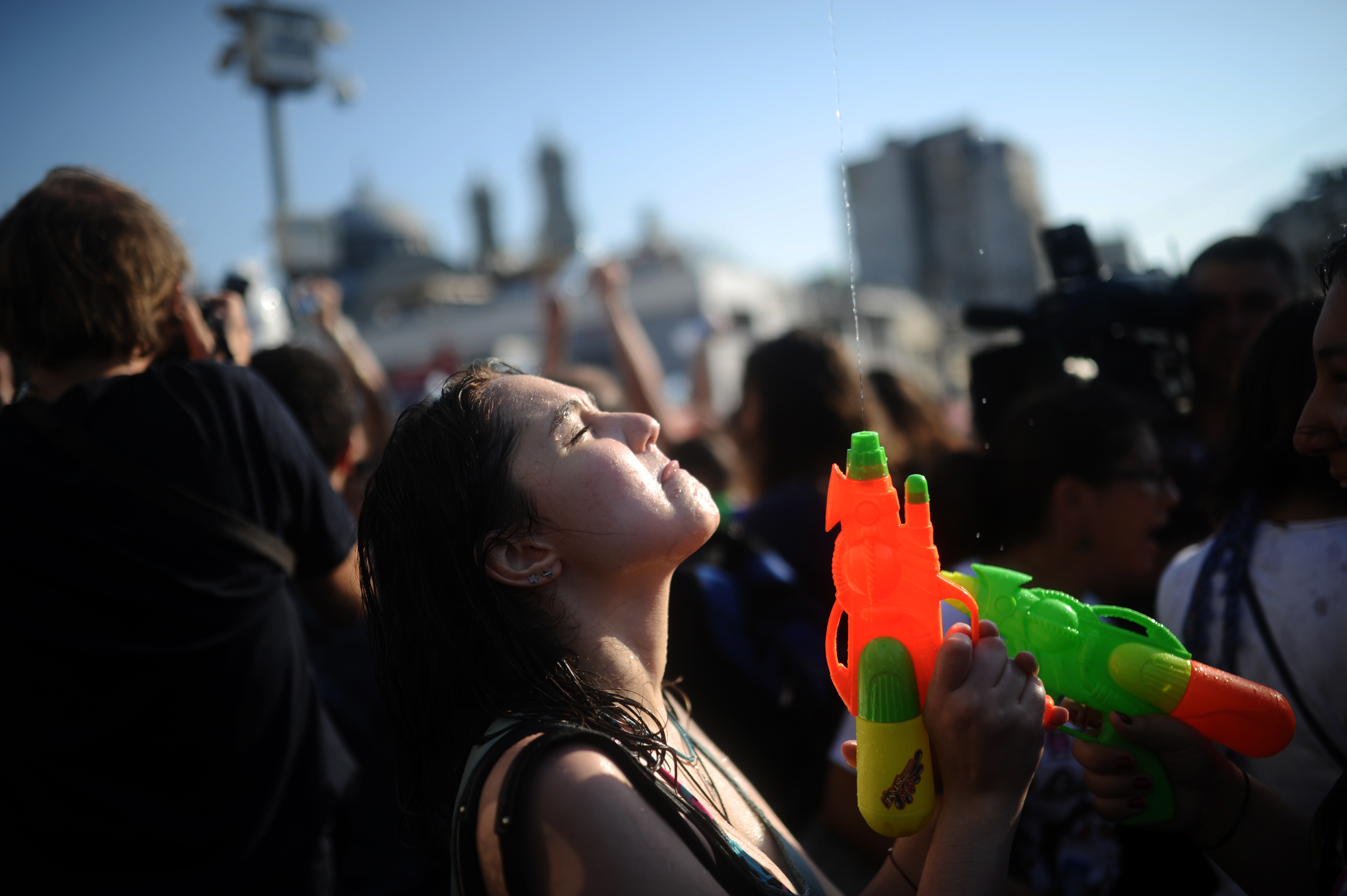
A woman protestor plays with a water gun on Taksim square on July 6, 2013 before clashes on Istiklal Avenue in Istanbul. Riot police fired tear gas and water cannon on July 6 to disperse some 3,000 demonstrators who tried to enter flashpoint protest spot Taksim Square in Istanbul. By Bulent Cilic/AFP/Getty Images.

Donna George of Houston, TX, stands and prays during the non-denominational prayer and fasting event, entitled ‘The Response’ at Reliant Stadium August 6, 2011 in Houston, Texas. Thousands attended the event organized by Gov. Rick Perry in order to pray for God to help save ‘a nation in crisis’ referring to America. By Brandon Thibodeaux/Getty Images.

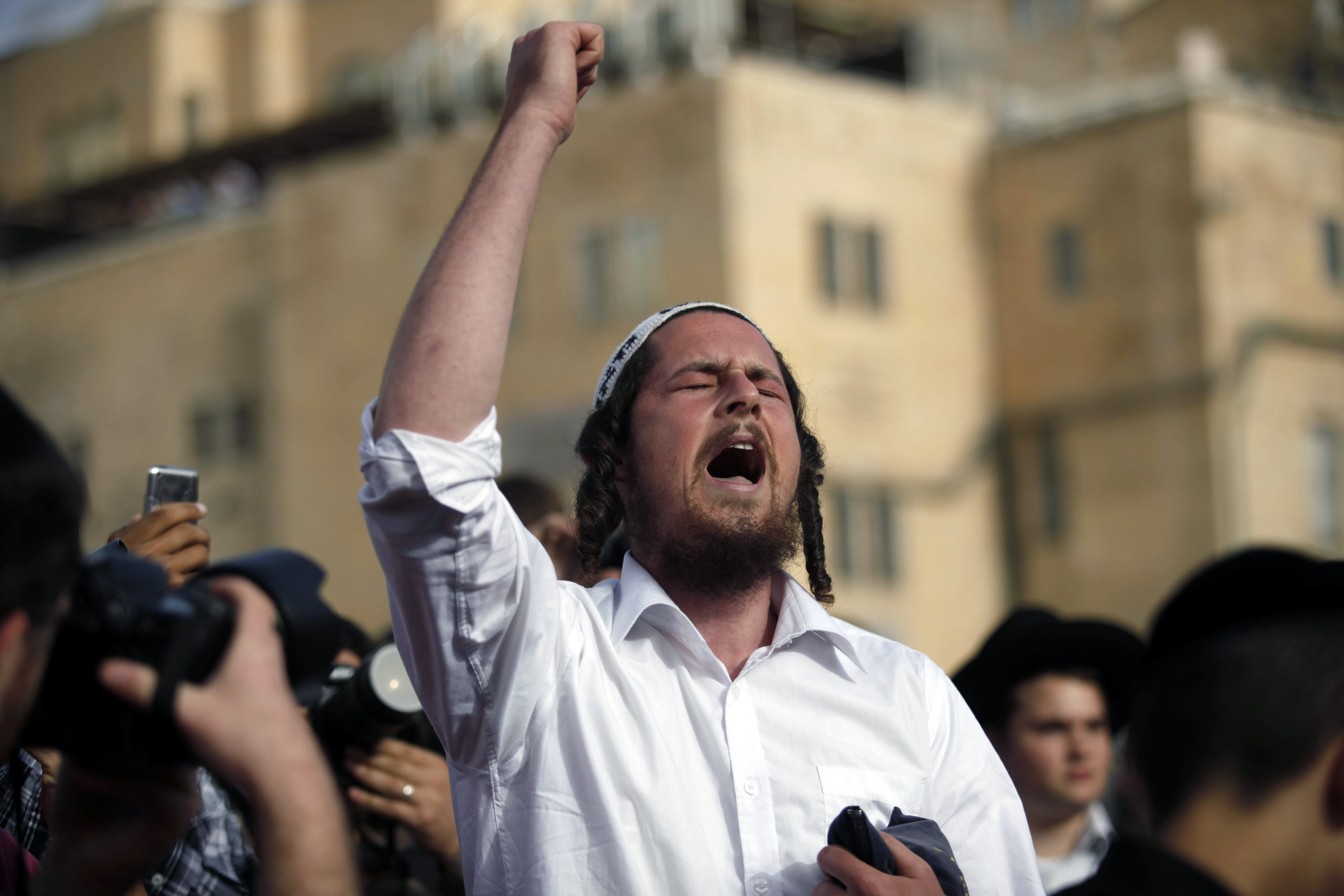
An Orthodox Jewish man chants slogans to protest against members of the liberal Jewish religious group Women of the Wall who pray with traditional Jewish prayer apparel for men on June 9, 2013 at the Western Wall in Jerusalem’s Old City marking the first day of the Jewish month of Tamuz. By Gali Tibbon/AFP/Getty Images.

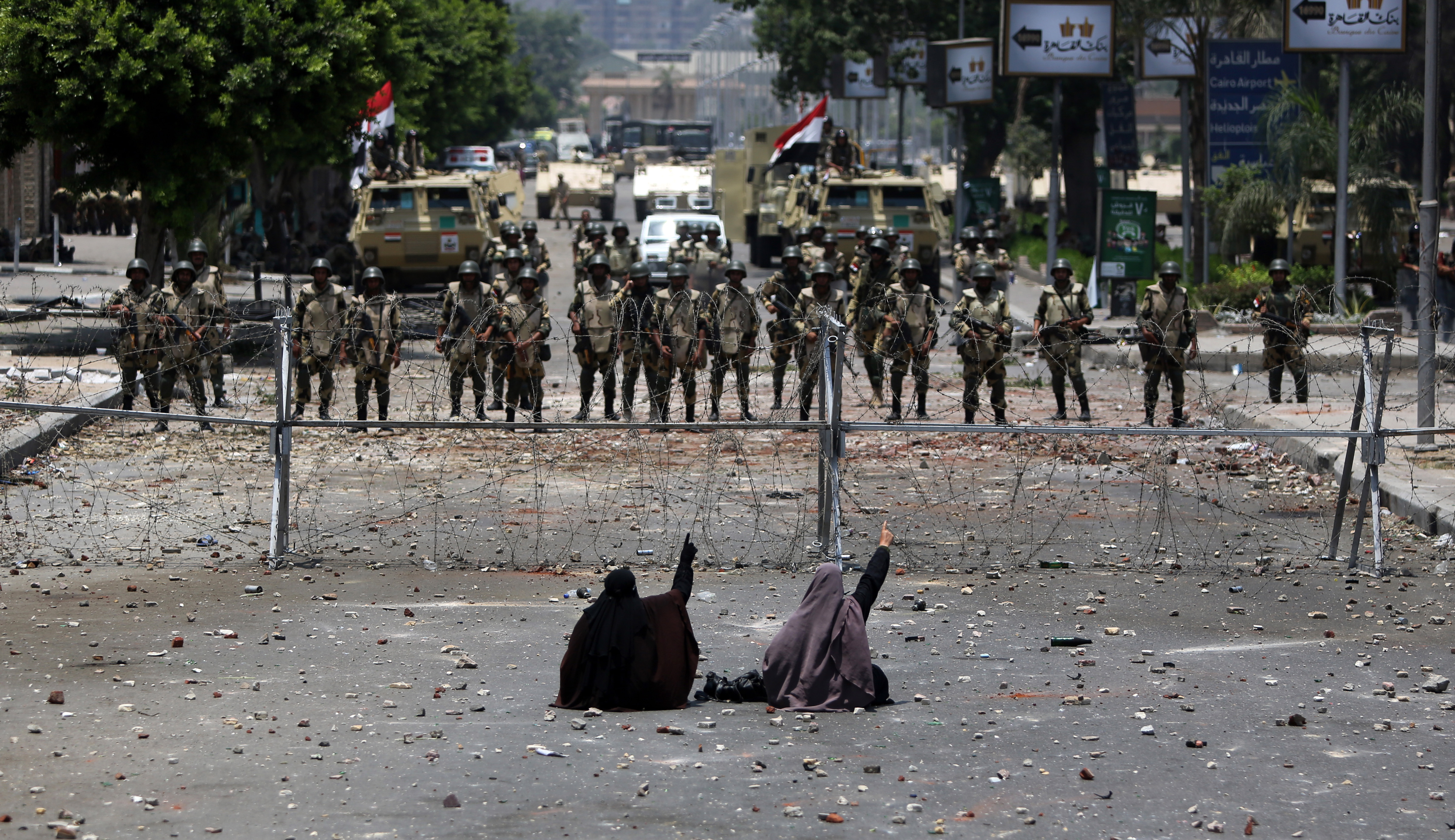
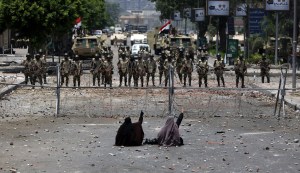
Egyptian supporters of deposed president Mohamed Morsi sit in front of barbed wire fencing that blocks the access to the headquarters of the Republican Guard in Cairo on July 8, 2013.  By Mahmud Hams/AFP/Getty Images.)

Will We Cut Egypt’s Aid? Ctd

Supporters Of Ousted President And Opponents Continue To Wage Street Battles

Larison shakes his head:

If the U.S. isn’t willing to suspend aid to a foreign military after it carries out what everyone can recognize as a coup against a properly elected government, it won’t be willing to suspend it later when the coup leaders fail to hold early elections or for any other reason. I think everyone debating this in the U.S. knows perfectly well that this is so. Perhaps it is time to acknowledge that all this talk of U.S. leverage is just a pretense that the U.S. has the ability to influence events in Egypt when it no longer does.

Goldblog makes the case for keeping that cash flowing:

In Pakistan, we saw what can happen when American military aid is cut off. After Pakistan went nuclear, the U.S. retaliated by punishing its army. Most notably, the U.S. stopped bringing members of the Pakistani officer corps to America for training. The result: a Pakistani officer corps that doesn’t know, or like, the U.S. And, of course, our boycott of Pakistan’s military didn’t actually end the country’s nuclear program. Cutting off the Egyptian military would only free it to behave more brutally toward its internal foes than it does now.

I’m with George Washington:

The nation which indulges towards another a habitual hatred or a habitual fondness is in some degree a slave. It is a slave to its animosity or to its affection, either of which is sufficient to lead it astray from its duty and its interest … The peace often, sometimes perhaps the liberty, of nations, has been the victim.

End aid to Egypt and Israel. The first doesn’t deserve it; the second doesn’t need it. And the long taxpayer-funded bribery to keep the two countries from conflict has inevitably led to what Washington warned so presciently against. Because of this “unbreakable” bond, we have supported violent dictators in Egypt and a brutal, grinding occupation in Palestine. And the Arab world blames us for both. They are not wrong.

Turning the US into a slave of the expansionist Jewish state and of the Egyptian military needs to end. It has hurt all three of its participants … and may even force the US into an insane attack on Iran’s nuclear program. This is a golden opportunity to cut our ties. We should take it – and would, if the Congress were not also a victim of this departure from America’s “duty and its interest”.

Recent Dish on the subject here.

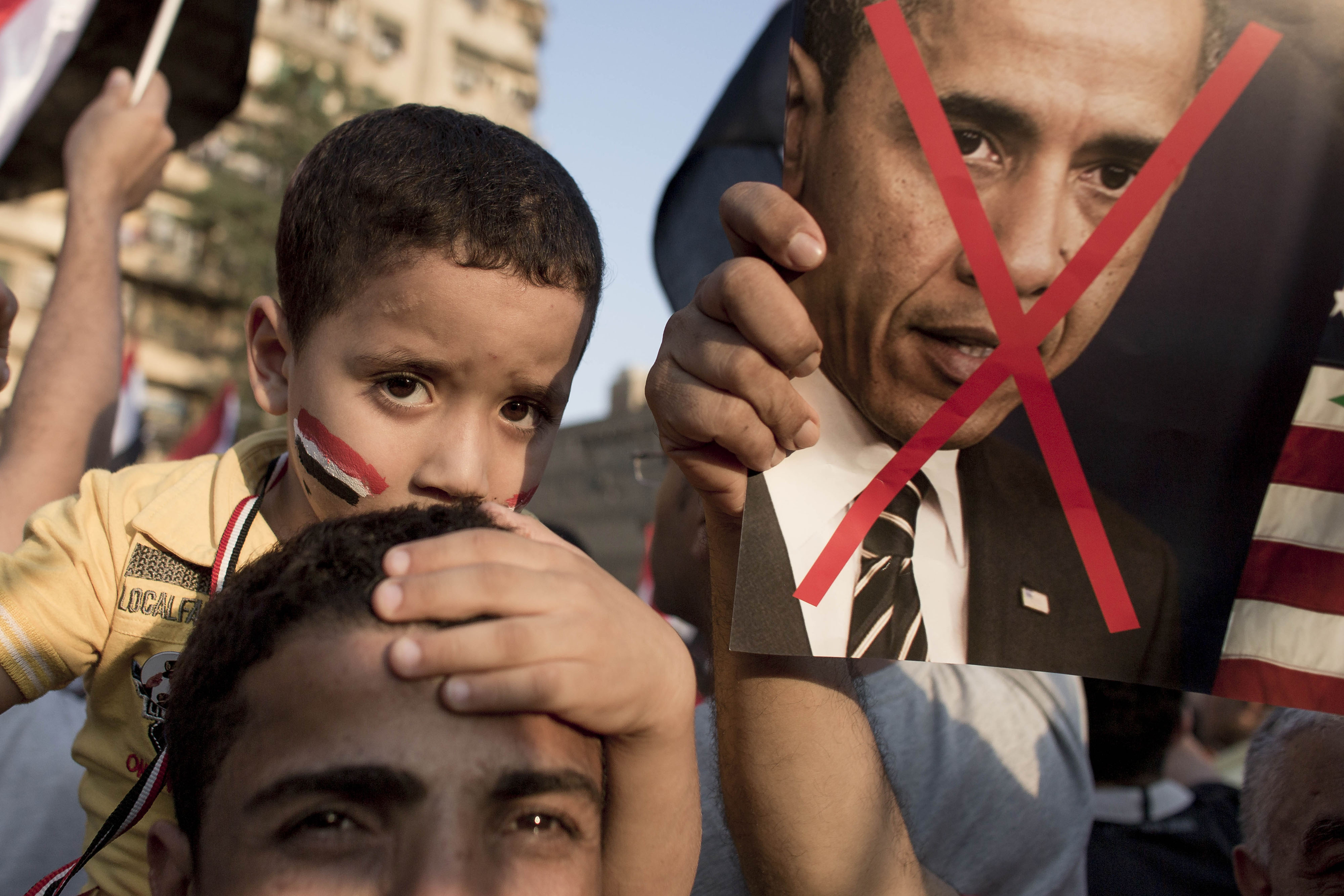
(Photo: A man displays a poster picturing the crossed face of U.S. President Barack Obama as tens of thousands of people attend a rally in Tahrir Square against ousted Egyptian President Mohamed Morsi on July 7, 2013 in Cairo, Egypt. By Carsten Koall/Getty.)