What’s The Endgame In Egypt?

Shadi Hamid is unsure:

I think there are two options. First is the Algeria or eradication scenario, in which the military and old-regime elements simply try to destroy the Muslim Brotherhood. That’s the repression option. Then you have the referendum option. I don’t know how you would do it, exactly. The military has dug in so deep to its position, and it’s already calling the Muslim Brotherhood terrorists, so I don’t know if this is realistic. But typically what you’d do is have some vote where both sides agree to abide by the will of the people.

At least in the near term, though, I think we could just be in a continuation of this low-level civil conflict, this war of attrition between the two sides. A stalemate with violence, if you will. The short-term outlook is very dark now.

Larison expects more violence:

It is likely that incidents such as these will keep happening, because the Brotherhood has a great deal to gain from continued clashes with the military. These will result in excesses and abuses that can be used to discredit the coup leaders in Egypt and internationally, and over time the coup government will lose the popular support that has been invoked so many times as its justification.

A War Of Words

As hostilities rise in Egypt, Marya Hannun sees a parallel fight playing out on Wikipedia:

“To describe the events which allowed Morsi’s rise to power as a ‘revolution’ but those which led to his downfall as a ‘coup’ is clearly biased and violates NPOV [neutral point of view],” one user writes. “A number of the comments by those defending the use of ‘coup’ in the title and trying to shut down discussion frankly strike me as Wiki-lawyering.”

Others have argued that it’s biased not to call the overthrow of Morsy a coup: The “military removing the president and installing a new one (even if not military), suspending the constitution and seizing control over various state apparatus, e.g. state TV fits the normal definition of a coup, particularly since there doesn’t seem to be anything in the constitution or other legal basis for these actions (to be clear I’m only referring to the legal aspect not the ethical or moral or whatever),” one Wikipedian points out. “It is called by the reliable media a coup d’état,deposing a president especially elected is a coup d’état ,and wikipedia only goes with neutral naming,” another notes. …

For what it’s worth, the debate isn’t limited to English-speaking Wikipedia users. The corresponding Arabic page on Egypt’s political upheaval is entitled, “The coup of July 3, 2013 in Egypt.” And the first heading under the corresponding discussion frantically reads, “Revolution or Coup?!”

Who Will Pay Egypt’s Bills?

Evelyn Gordon focuses on the country’s economic problems:

If you think last week’s revolution was primarily a revolt against the Muslim Brotherhood’s undemocratic behavior, then you’ll think the West’s main goal should be “supporting the Egyptian people in their aspirations to democracy and inclusive governance,” as EU foreign policy chief Catherine Ashton put it last week–for instance, by helping them draft a new and improved constitution. But if you realize that the revolution was primarily about economic distress, then you’ll understand the West’s main goals should be arranging short-term aid and pushing long-term economic reforms needed to stabilize the economy–because without economic improvement, even the best constitution won’t prevent another coup next year. Desperate people can’t afford to wait for the next election to bring about policy changes.

Drezner suspects that Egypt will have to ask the IMF for more money:

Please bear all of this in mind as you read about the alleged decline of U.S. influence in the region. There’s a difference between declining salience and declining influence. Because if I’m reading this correctly, Egypt will have no choice but to go back to the IMF — and the United States still has a wee bit of influence within that international organization.

Recent Dish on the subject here.

Everyone In Egypt Needs A Voice

Pro-Morsi Supporters Killed In Shooting Incident Outside Presidential Guard Barracks

Steve Negus wants Egypt to adopt a parliamentary system:

The new electoral law should increase incentives for compromise, for example, by increasing the power of parliament and of the prime minister over that of the president. Parliamentary systems are better for encouraging negotiation and limiting the ‘winner takes all’ mentality that is so risky in democratic transitions, and if political rules are being revisited, the parliamentary model is one that should seriously be considered. A blocked political order in which temporary winners exclude their opponents is one that the last two years have shown us the importance of avoiding.

Laura Dean hopes that the Muslim Brotherhood will be given a place at the table:

As we have seen time and again in this part of the world, it is impossible to stamp out ideas by censoring them. In so doing you only push them underground and legitimize their most radical elements. Even the Brotherhood spokesman, Wael el Karim, who is more diplomatic than most said, “Now we see the only path to power in Egypt is by force.” Only by bringing them into the political fold and treating them like the political losers that they are, rather than like criminals, which they are not, can that rift be healed and can they begin to develop into the mainstream political player, among many players, that they could be.

My fear is that the army just overplayed its hand – and made all this far more difficult. This video (featured in our Tweet reax earlier) is the most dispositive I’ve seen yet: a soldier just picking off civilians from a rooftop as if he is hunting for game. Then this:

Dish coverage of this possible turning point in Arab history here, tweet reax here, expert analysis here, and the Arab world’s response here. Stay tuned for updates.

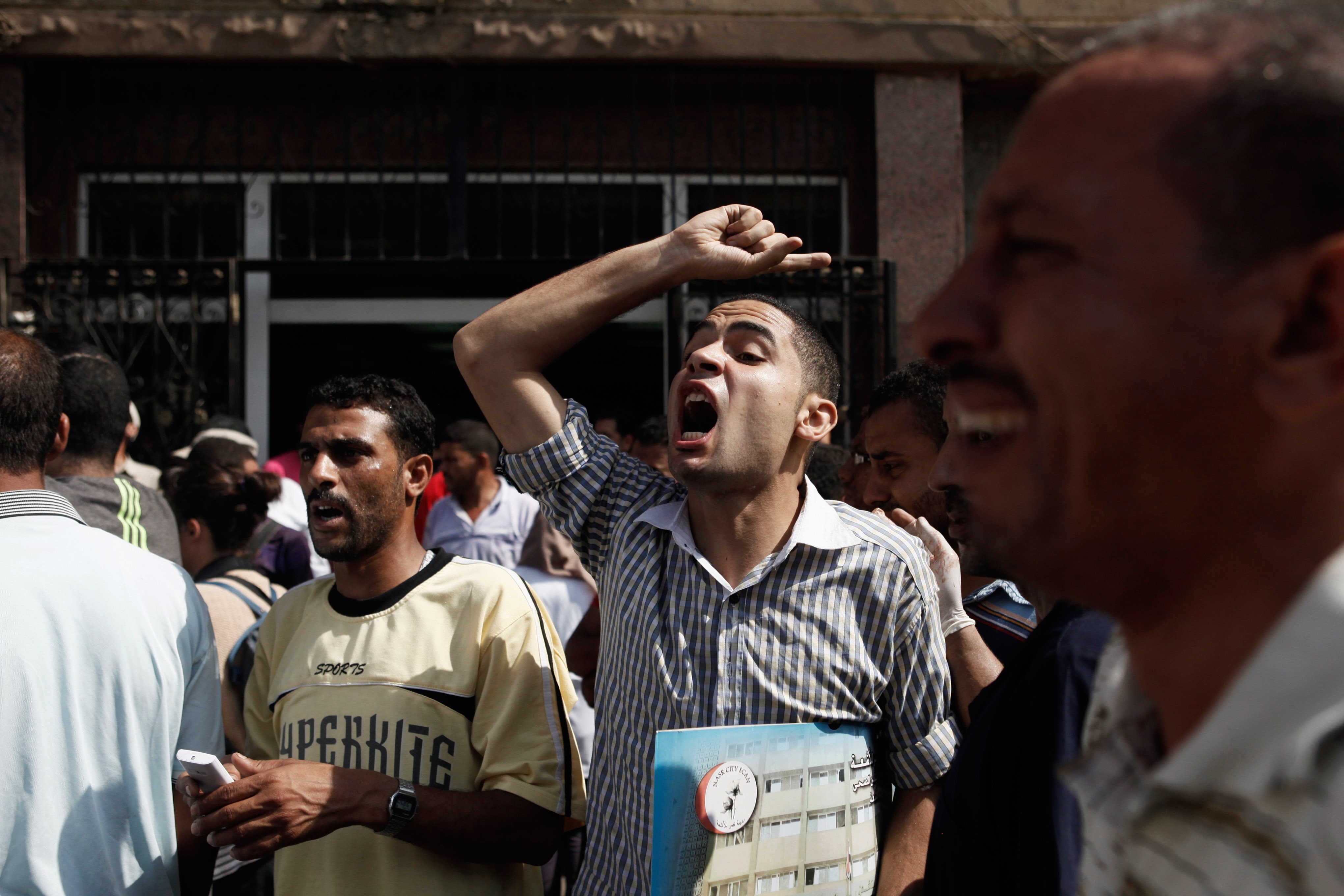
(Photo: A man reacts after seeing the body of a slain protester at the Liltaqmeen al-Sahy Hospital in Cairo’s Nasr City district, allegedly killed during a shooting at the site of a pro-Morsi sit-in in front of the headquarters of the Egyptian Republican Guard on July 8, 2013 in Cairo, Egypt. By Ed Giles/Getty.)
The Coup Watched ‘Round The Arab World, Ctd

Adam Shatz runs down how news of Morsi’s ousting is going down across the Middle East:

Qatar, which invested heavily in the Brothers, has lost a major ally. (The Saudis, who supported the more extreme Salafis against the Brothers, played their hand much better: the Salafis sided with the army and are likely to have a say in the transition.) Hamas, which reshuffled its regional alliances when its parent organisation came to power in Egypt, leaving its offices in Damascus for Doha, must be weighing its options. Bashar Assad is already gloating. Morsi was a passionate champion of the Syrian insurgency; only two weeks before his overthrow, he infuriated Assad (and, more fatefully, Egypt’s secular-minded generals) by appearing at a rally where one cleric after another called for jihad against the regime in Damascus. In an interview with the official Thawra newspaper, Assad said: ‘The summary of what is happening in Egypt is the fall of what is called political Islam.’ That autopsy might have come as news to his Islamist allies in Tehran and in Hizbullah, without whom he could not have defeated the rebels in Qusayr. Still, the Sunni trend in Islamism has suffered a serious blow in Cairo, and its effects are likely to be far-reaching.

Madawi Al-Rasheed zooms in on Saudi Arabia in particular, whose rulers always saw the Brotherhood as a rival brand of Islamism:

The failure of the Muslim Brotherhood to hold on to power for a year is now celebrated in the official Saudi press. So-called liberal journalists congratulate the Egyptian people on getting rid of the so-called religious dictatorship while forgetting their own plight under a regime that was equally if not more oppressive. In contrast, Saudi Islamists spread the rumor that Saudi Arabia, together with the United Arab Emirates, was behind Morsi’s fall. While there may be some truth to this, such rumors undermine the Egyptian crowds that assembled to press for his downfall. If the outcome so far pleases the Saudi regime, it should not obscure the fact that Egypt remains diverse, volatile and may not unquestionably succumb to the rule of Islamists or other governments eager to patronize them. The Egyptian crowds got rid of their Islamists and will not become clients of the Saudi regime. They have staged two revolutions so far and will continue to do so until they reach a post-revolutionary equilibrium in which all are politically represented.

William McCants gauges the Salafi reaction:

[N]o Salafi is likely more pleased with the turn of events in Egypt than Ayman al-Zawahiri, the leader of al Qaeda. For decades, Zawahiri has argued that the Muslim Brotherhood’s engagement in party politics does nothing more than strengthen the hands of its adversaries and ratify an un-Islamic system of rule. Since the beginning of the Arab Spring, he has continued to make his argument that the West and its local proxies will never allow an Islamist government to actually rule. He doubtless views the coup last week as a final vindication of his argument.

More Dish on the regional reaction Egypt’s coup here.

The Massacre In Cairo, Ctd

EGYPT-POLITICS-UNREST

Omar Ashour fears that the country is on the brink of civil war:

The shadow of Algeria in 1992 looms. There, the full-blown civil war did not start right after the coup in January, but in September 1992; nine months later. If al-Seesi and his junta behave like Khaled Nezzar in Algeria or Francisco Franco in Spain, we are likely to see an escalation in armed confrontations between the junta and the president’s loyalists. This can have disastrous regional and international consequences. Egypt’s population is three times that of Algeria in the 1990s and more than four times that of Syria. Unstable Libya and Sudan are on the borders and so is Palestinian Gaza and Israel. All sides in Egypt have their international and regional allies and patrons and they will be asking them for help.

Walter Russell Mead adds:

Few potential tourists and investors these days are picking up their newspapers and thinking that Egypt is looking like a safe destination once more. The uglier the military government looks, and the more blood it has on its hands, the harder it will be for Western governments to shovel billions more aid dollars into the Egyptian money pit.

The calendar is also bad; Ramadan has come. The mosques will be packed and emotions will be high. This is the time of year when religion looms largest in the life of the average Egyptian, and it is the time of year when the imams have their biggest audiences. From the Brotherhood’s point of view, the military could have done it no greater favor than creating 42 new martyrs at the start of the holiest month in the year.

And David Kenner notes that the “violence is already threatening to break apart the alliance between some political forces and the military”:

The Salafist Nour Party, which was already feuding with other opposition forces over the selection of the next prime minister, has withdrawn from any negotiations on government formation, while a spokesman said that “[i]t is as if the former regime is back fully fleshed.” Secular leader Mohamed ElBaradei, meanwhile, called for an independent investigation into the events.

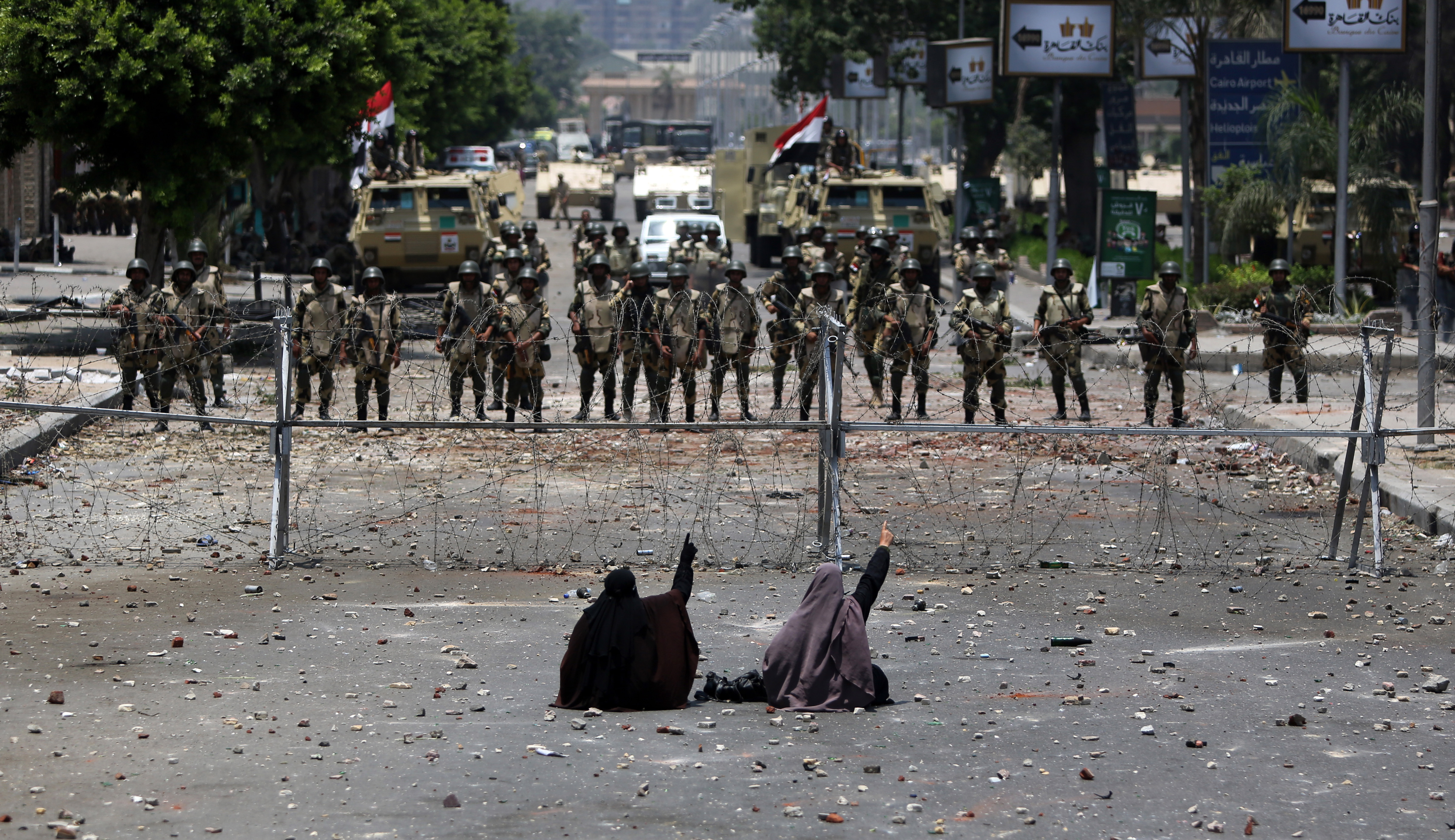
(Photo: Egyptian supporters of deposed president Mohamed Morsi sit in front of barbed wire fencing that blocks the access to the headquarters of the Republican Guard in Cairo on July 8, 2013. Forty-two loyalists of Egypt’s ousted president were killed while demonstrating against last week’s military coup, triggering an Islamist uprising call and dashing the army’s hopes for an interim civilian administration. By Mahmum Hams/AFP/Getty Images)

Massacre In Egypt: Tweet Reax

The Massacre In Cairo

Pro-Morsi Supporters Killed In Shooting Incident Outside Presidential Guard Barracks

The bottom line is that we still don’t quite know what happened. Did some Muslim Brotherhood members try to storm the Republican Guards HQ after dawn … or did the military open fire on praying protestors? A helpful summary from the Guardian:

The Egyptian military says gunmen from an “armed terrorist group” and linked to the Muslim Brotherhood – the Islamist organisation with which Morsi is affiliated – tried to storm the building shortly after dawn, firing live ammunition and throwing firebombs, killing one police officer. But the Muslim Brotherhood said troops opened fire at protesters, including women and children, none of whom had attacked the troops. The Guardian’s Patrick Kingsley spoke to a number of witnesses who gave differing accounts of what happened. Accounts from five of the wounded backed the Brotherhood’s version of events.

The NYT has this detail:

Bullet holes in cars, lampposts and corrugated metal barriers indicated that gunfire was coming from the top of a nearby building where the sandbag barriers around makeshift gun emplacements were visible. Bullet casings on the ground and collected by Islamist demonstrators bore the stamp of the Egyptian Army. But Egyptian state television showed film of a pro-Morsi protester firing what appeared to be a homemade handgun at advancing soldiers from behind a corner about 250 yards away. The footage was in daylight, hours after the initial attack began. A witness who lived nearby said he saw two men with similar weapons among the protesters.

The protesters, witnesses and video footage all appeared to portray the pro-Morsi demonstrators as attempting to fight back against the soldiers by throwing rocks.

It seems insane to me that, holding power and needing some Islamist support, the military would then engage in an unprovoked slaughter of protesting Morsi supporters at prayer. And yet the slaughter seems beyond anything we have yet seen since the start of this turbulence. I tend to agree with Juan Cole, until we get further evidence:

Both narratives are problematic. The army’s description of a “terrorist attack” sounds propagandistic. The Brotherhood account doesn’t indicate a motive for the army abruptly to launch an attack on peaceful demonstrators.

But this does, from the army spokesman:

The scene spiralled out of peacefulness at about 4am, he says. An armed group attacked the perimeters around the Republican Guard HQ, and the personnel responsible for securing the premises – from the army and police – were attacked by live ammunition, Ali says.

At the same time other groups started to climb up the buildings nearby and throw stones, molotov cocktails, bombs and heavy objects, Ali says, resulting in the death of one army officer and the injury of 42. Many of them are in a very critical condition, he says.

Stay tuned.

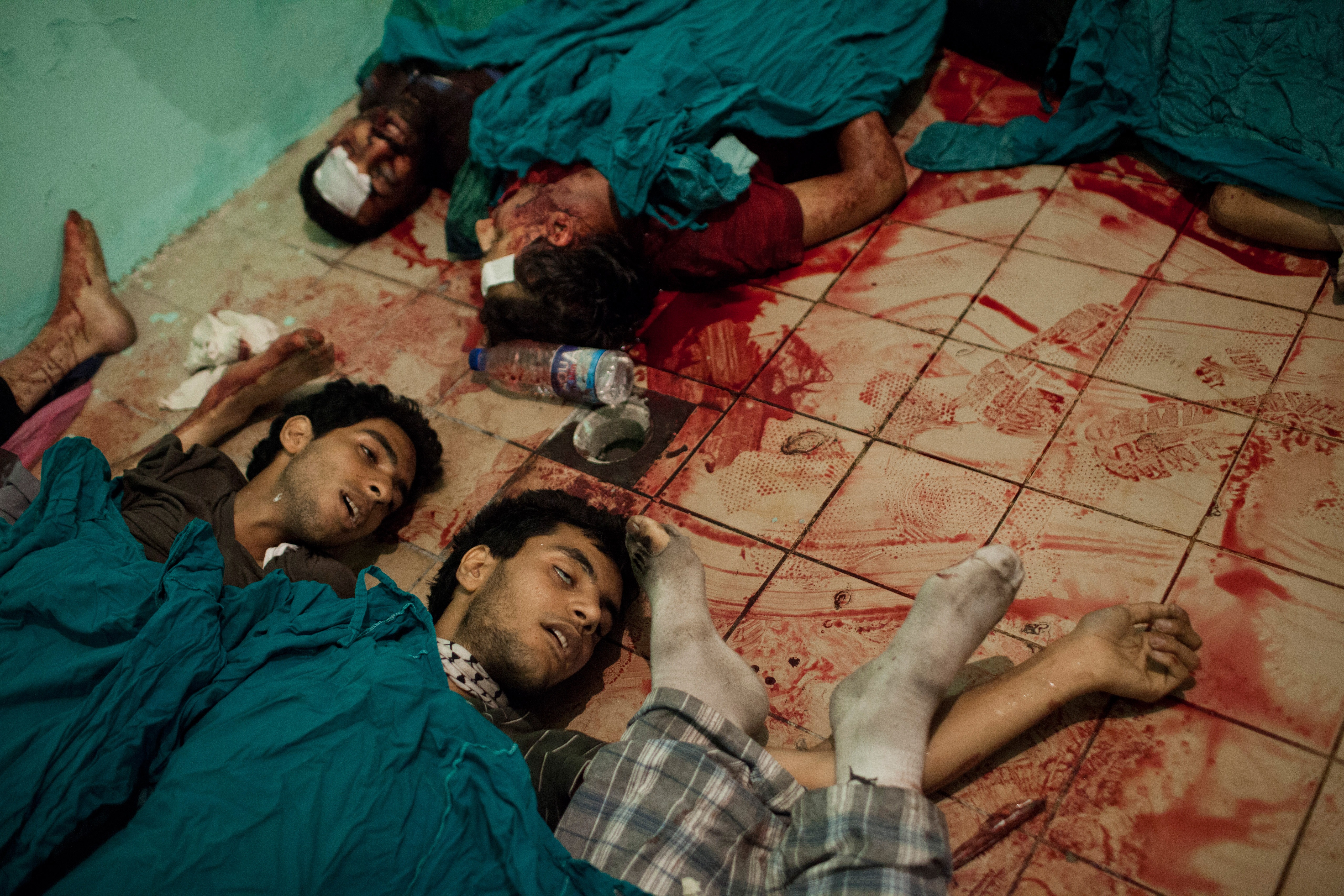
(Photo: The bodies of men lie on the floor of a morgue at the Liltaqmeen al-Sahy Hospital in Cairo’s Nasr City district, after allegedly being killed during a shooting at the site of a pro-Morsi sit-in in front of the headquarters of the Egyptian Republican Guard on July 8, 2013 in Cairo, Egypt. By Ed Giles/Getty.)
Egypt: Fact Of The Day

As the country now seems on the brink of full-scale civil war, this tiny nugget leapt out at me:

The recent 2008 Demographic Health Survey in Egypt (EDHS) reported that the FGM/C prevalence rate among women from ages 15-49 is 91.1 percent, but 74 percent among girls age 15-17.

Declining, perhaps, but still close to ubiquitous. Mark Steyn notes how Morsi’s wife conducted herself while “First Lady”:

President Morsi’s wife, Naglaa Ali Mahmoud, is his first cousin, and covered from head to toe. If you were a visiting foreign minister, you were instructed not to shake hands, or even look at her… Eschewing the title first lady, she preferred to be known as “first servant.”