The Coming Fight Over Egypt’s Constitution

Nathan Brown looks ahead:

Here’s the unspoken secret: the military, al-Azhar, and the Salafis got exactly what they wanted in the 2012 constitution. There are provisions on the military (no real civilian oversight), al-Azhar (a muscular supervisory role over Islamic legal issues), and the Islamic sharia that each of these actors want to protect. The Brotherhood had allowed these clauses in order to get necessary support for a constitution that other political forces had bitterly come to oppose.

So when it comes time to suggest constitutional amendments, today’s happy family of Morsi opponents may turn into a rather dysfunctional group. This is precisely where the 2011 revolution began to go off the rails, where kumbaya gave way to roller derby. It could happen again.

Making Room For The Muslim Brotherhood, Ctd

Daniel Levy insists that Egyptian democracy must include Islamism:

A democracy for everyone except Islamists will be handicapped and ultimately fail in a country like Egypt with a large community of religious believers and in which the Brotherhood is a popular and socially-embedded movement. President Morsi and large segments of the Brotherhood, after long periods of harsh persecution and after difficult internal debates, ultimately endorsed the democratic electoral process. That decision just had sand kicked in its face, and by the bucketful, undermining the movement’s more democratic wing and empowering its more radical wing.  Is this more naivety – is a democratic Islamist an oxymoron? Let’s not be determinist or allow Egyptian generals and secularists to create a self-fulfilling prophecy.

Larison adds:

[T]he coup isn’t likely to weaken political Islam in Egypt or elsewhere over the long term, but will push Islamists out of the political process and encourage fanaticism to flourish unchecked. The coup will give many Islamists in other countries a clear lesson that they may as well not participate in any political process.

Earlier Dish on this subject here.

Egypt Erupts

A roughly chronological review of the past three hours of bloodshed:

Fighting Assault With Social Media

https://twitter.com/basildabh/status/352567375259901952

Lydia Tomkiw spotlights Egypt’s sexual assaults:

[T]he nationwide protests that began on June 30 brought a new round of sexual assaults and mob attacks, with Human Rights Watch reporting on Wednesday that “mobs sexually assaulted and in some cases raped at least 91 women in Tahrir Square” over the last four days (journalists and foreigners have also been victims of the violence).

Since Egypt’s first wave of game-changing protests in 2011, several online tools have sprouted up to help document these kinds of cases and reduce their frequency. HRW, for instance, cites Operation Anti-Sexual Harassment (OpAntiSH), which confirmed 46 attacks in Cairo’s Tahrir Square on June 30, 17 on July 1, and 23 on July 2. The Twitter accounts @OpAntiSH and@TahrirBodyguard are organizing volunteers to protect women and intervene in instances of assault (according to HRW, OpAntiSH intervened in 31 such cases over the past week).

Meher Ahmad profiles Tahrir Bodyguard:

Tahrir Bodyguard attempts to patrol the crowds at Tahrir with groups of men and women wearing helmets and neon yellow vests. In an interview with Now This News, the group’s co-founder Maria Sanchez Munoz, said the team of 150-some volunteers intervene in sexual assaults without weapons, only with their bodies. The mob-mentality of the large crowds at Tahrir makes their task especially difficult, as they often become subject to harassment and violent attacks themselves.

With Abdullah As A Guide

Jeffrey Goldberg seeks advice on Egypt’s democratic transition by bragging of talking to a monarchical dictator, who appoints the members of the legislature and whose foul regime tortures at will. This is how Wiki describes human rights in Jordan:

According to a report by Amnesty International, intelligence agents in Jordan frequently use Jordan Celebrates 65th Anniversary of Independencetorture to extract confessions from terror suspects. Common tactics include, “beating, sleep deprivation, extended solitary confinement, and physical suspension.” Palestinians and suspected Islamists are treated especially harshly. Though Jordan has improved many procedures including a prison reform campaign in partnership with EU in this respect, agents at the General Intelligence Department remain largely immune to punishment.[28][29]

In May 2010, the UN Committee against Torture reiterated long-standing concerns at Jordan’s failure to investigate and prosecute allegations of torture, to provide adequate protection against torture, and to prosecute perpetrators in accordance with the seriousness of the crime. It noted the “numerous, consistent and credible allegations of a widespread and routine practice of torture and ill-treatment” including in General Intelligence Department (GID) and Criminal Investigations Department detention.[30] The government did not respond to the Committee’s recommendations.[8]

But they’re not Islamists, so that’s fine. You can even be chums with dictators and brag about it on Bloomberg news. If you somehow don’t see how Abdullah fits into Goldberg’s alleged support for Arab democracy, then you clearly know nothing about the region and should understand all its nuances better.

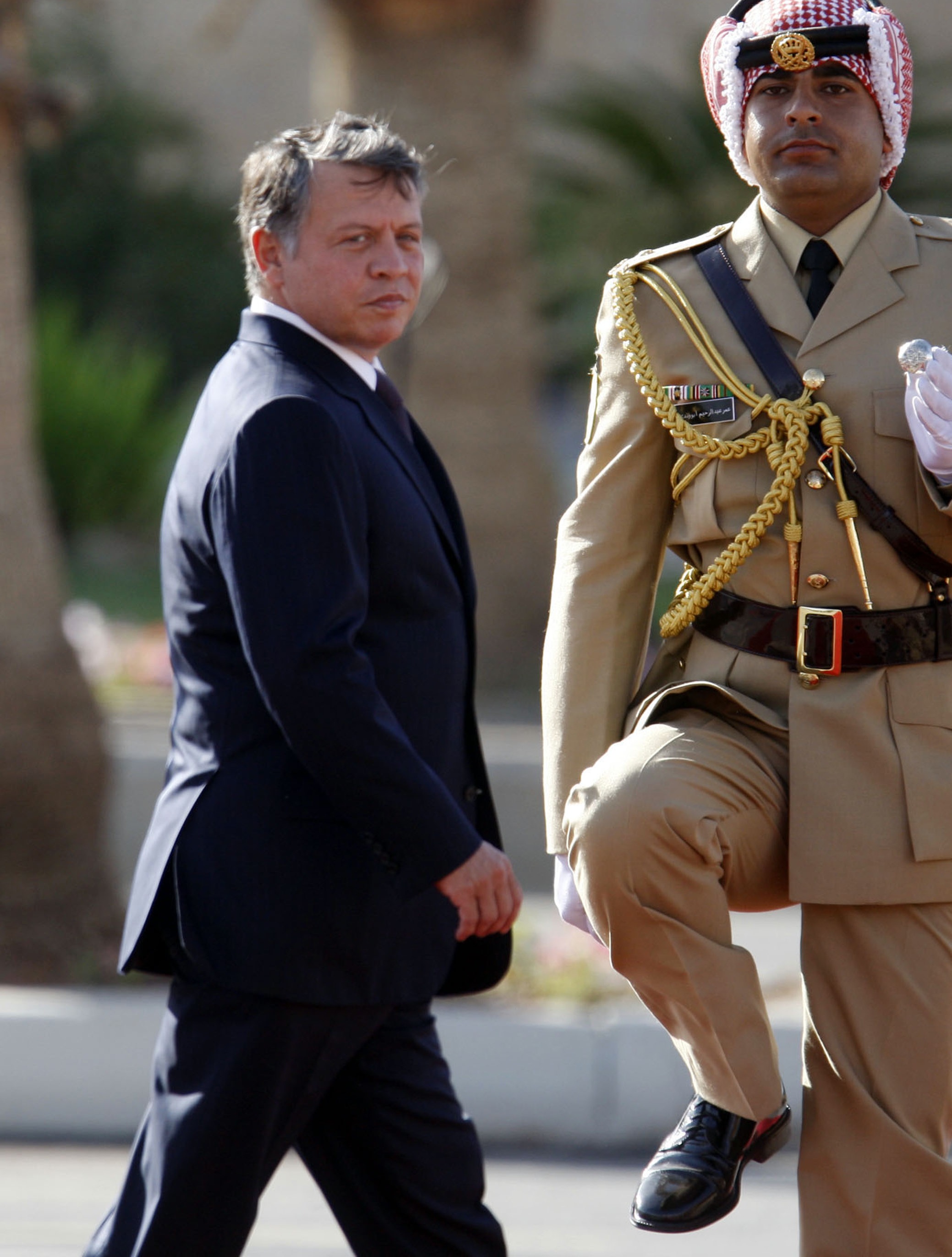
(Photo: King Abdullah II of Jordan arrives at an official celebration for the 65th anniversary of Independence, on May 25, 2011 in Amman, Jordan. The Hashemite Kingdom of Jordan gained independence from Britain on May 25, 1946. By Salah Malkawi/Getty Images)

Face Of The Day

Egypt Protsts Intensify As Army Deadline Approaches

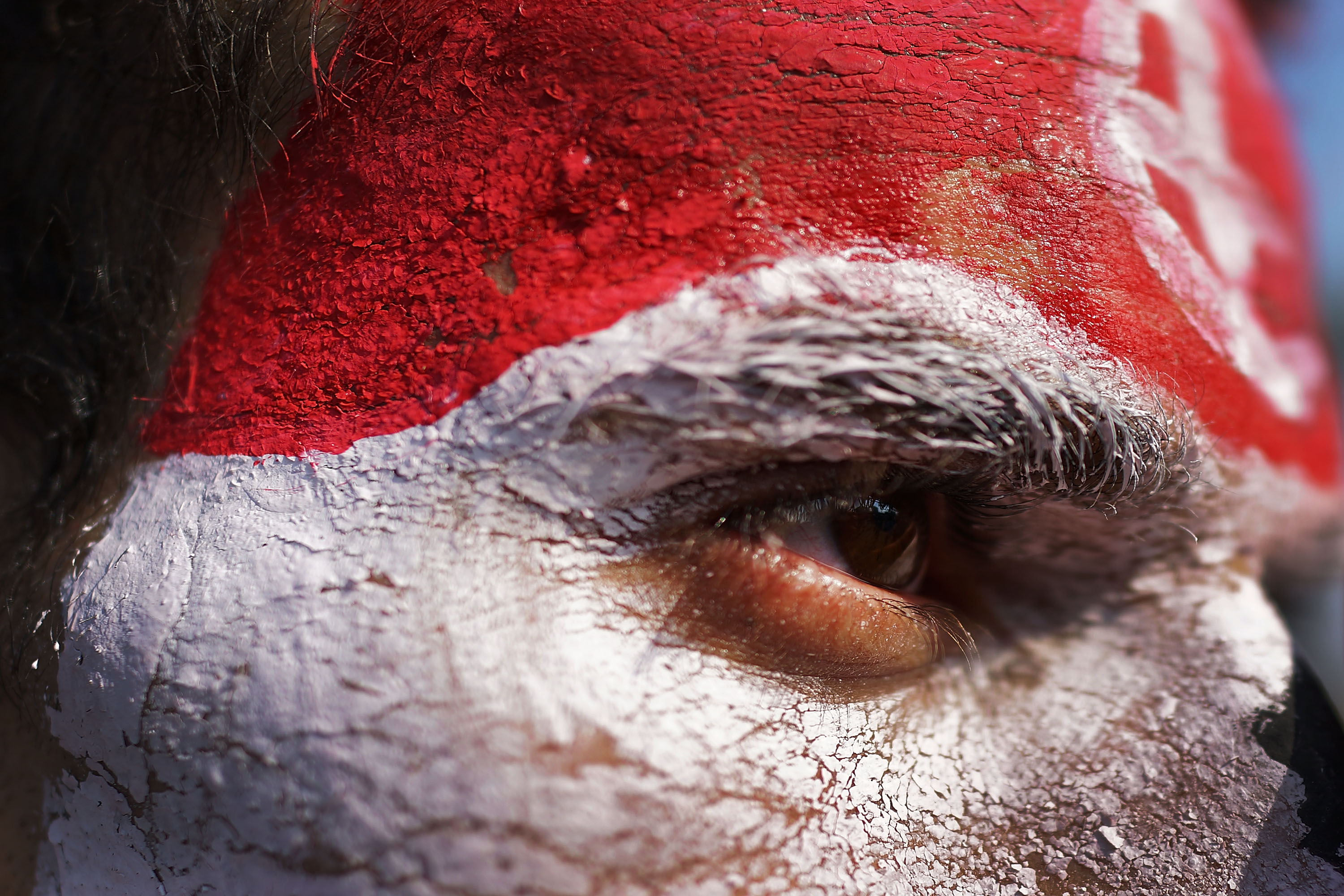
A man with his face painted the colors of the Egyptian flag looks out as thousands of Egyptian protesters celebrate in Tahrir Square as the deadline given by the military to Egyptian President Mohammed Morsi passes on July 3, 2013 in Cairo, Egypt. By Spencer Platt/Getty Images.

The Coup Watched ‘Round The Arab World

Egyptian President Morsi Ousted In Military Coup

Rania Abouzeid considers what the events in Egypt signal to other “Arab Spring” countries:

Egyptians aren’t the only ones watching. The rise of political Islamism during the so-called Arab Spring was in many ways a reaction to the repression of Islamists under the various secular regimes they helped topple in Tunisia, Libya, and Egypt. Their rise was like a recoil after the restrictions on their political participation were lifted. An equilibrium was bound to be reached at some point, although the fear was always that, once in power, Islamists might curtail the very freedoms that helped them get there—one vote, one time, so to speak. What is the message from the pro-democracy advocates in Tahrir Square? Was it that if the results at the ballot box don’t go your way, and your interests coincide with that of the military, it’s fine to depose Egypt’s first democratically elected leader? That even if Islamists play by democracy’s rules and win an election, they can be undemocratically removed?

Many Egyptians, it appears, would say yes.

I was struck by this quote from an Egyptian woman in the NYT today:

“Why is it just ballot boxes? Are ballot boxes the only forms of democratic expression when the rulers fail the people? Why did we have to bear his bad administration at a time when the country cannot cope with such failure?”

Channeling Jefferson?

What country can preserve its liberties if their rulers are not warned from time to time that their people preserve the spirit of resistance?

Like others, I remain conflicted about what just happened in Egypt – worried about the coup precedent, yet relieved by the ouster of someone incapable of uniting the country. But the faces on the streets, the unusually massive public demonstrations, and the dismal record of Morsi tip the balance, in the end, for me, for now. The integration of the Arab Muslim world into modernity will be messy, protracted and contain any number of twists and turns. Our role should be patience and distance, not micromanagement. This is their struggle before it is ours. And we have to let them lead us, not the other way round.

(Photo: An Egyptian woman celebrates in Tahrir Square, the day after former Egyptian President Mohammed Morsi, the country’s first democratically elected president, was ousted from power on July 4, 2013 in Cairo, Egypt. By Ed Giles/Getty Images.)
Egypt Didn’t Oust Islamism

Elizabeth Nugent believes that it “would be a mistake to read the mobilization against the president and in support of the military as simply anti-Islamist, as a political ideology”:

Egyptian citizens overwhelmingly support the mixing of religion and politics. They also just protested in historic numbers against an Islamist ruling party. The political questions facing the Egyptian electorate, then, appear to be what form of Islamism, which Islamists, which of the social, economic, and political laws included in sharia to implement, and how – and perhaps most importantly, how to balance all of this with a democratic system reflecting the will of the people (the data similarly reveal high levels of support for democracy among Egyptians).

In post-Mubarak Egypt, where the Brotherhood is no longer the only Islamist game in town, we do ourselves a disservice to think about Egyptian politics as a binary of pro- and anti-Islamist. There are currently a number of Islamist parties for Egyptian voters to consider, including but not limited to the Building and Development party, formed by the once violent Gama`a Islamiyya and which seeks to establish a democracy based on sharia law; the Flag party, founded earlier this year by popular cleric Sheikh Hazem Salah Abu Ismail; the Nour Party, a Salafi party that surprised by winning almost a third of contested seats in Egypt’s 2011 parliamentary elections; the Watan party, which split with Nour over disagreements over the level of political involvement from Salafi clerics. At the very least, Egyptian political currents might currently be divided between three strands: pro-Brotherhood Islamists, anti-Brotherhood Islamists, and secularists. Even better, we might start to think of Islamism as a spectrum – with more and less Islamist individuals and parties, conservative and liberal Islamists and parties – based on developing political ideologies and concrete political platforms.

Egypt’s New President

Ty McCormick introduces us to Adil Mansour, formerly the president of the Supreme Constitutional Court, who was sworn in today:

“He is not the president of Egypt in the same way that Morsy or Mubarak were presidents of Egypt,” Tarek Masoud, an associate professor of public policy at Harvard University’s John F. Kennedy School of Government, tells Foreign Policy. The best analogy, according to Masoud, is probably Sufi Abu Taleb, who served as acting head of state for eight days following the assassination of Anwar Sadat in 1981.

“The administration of the country is going to be in the hands of the military, but they had to put a constitutional face on it. [Mansour] is under no illusions about the extent of his power,” says Masoud.

Despite his subordinate position, however, Mansour will likely exercise considerable control over the drafting of a new election law, experts say. “His main job will be to get an electoral law done,” Michael Wahid Hanna, a fellow at the Century Foundation, tells FP. Over the past year, the Supreme Constitutional Court has twice invalidated electoral laws drafted by the Shura Council, Egypt’s upper house of parliament. The result, according to Hanna, has been a delay in holding parliamentary elections and a deepening of the political crisis in Egypt.

Making Room For The Muslim Brotherhood

Hussein Ibish warns that institutionalizing “the exclusion of the Muslim Brotherhood will be a catastrophe”:

The lessons from the Algerian experience must hang heavy in the air. The Brotherhood left no choice for the whole rest of society, united, to reject their governance. But, if they stay within the law and eschew major outpourings of violence, they should not be persecuted or prosecuted. If they turn to violence, as some of their rhetoric suggests they might, this will be a calamity. It will lead to civil war, at least of a kind. They will lose, but it will be a generalized catastrophe.

If, on the other hand, non-Islamist forces who have now seized power by popular acclimation seek to systematically exclude the Brothers even if they continue to try to play by the new rules, they will be courting disaster. They must allow the Brotherhood to run in upcoming elections, and hope that they will learn their lesson and behave in a more reasonable, normative and inclusive manner if elected. If not, they will be rejected again. Democracies, from the outset, have always had to incorporate and accommodate non-democratic and authoritarian-minded forces (which the Brotherhood most certainly is) in spite of their hostility to the pluralistic order in which they participate. It is one of the great hazards of a free, open and democratic system: to be true to itself, it must generously afford oppressive groups more liberty than such groups would allow anyone else.