Men (No Longer) At Work

by Dish Staff

Screen Shot 2014-12-16 at 5.33.21 PM

Binyamin Appelbaum looks into the causes of the decline in America’s male work force:

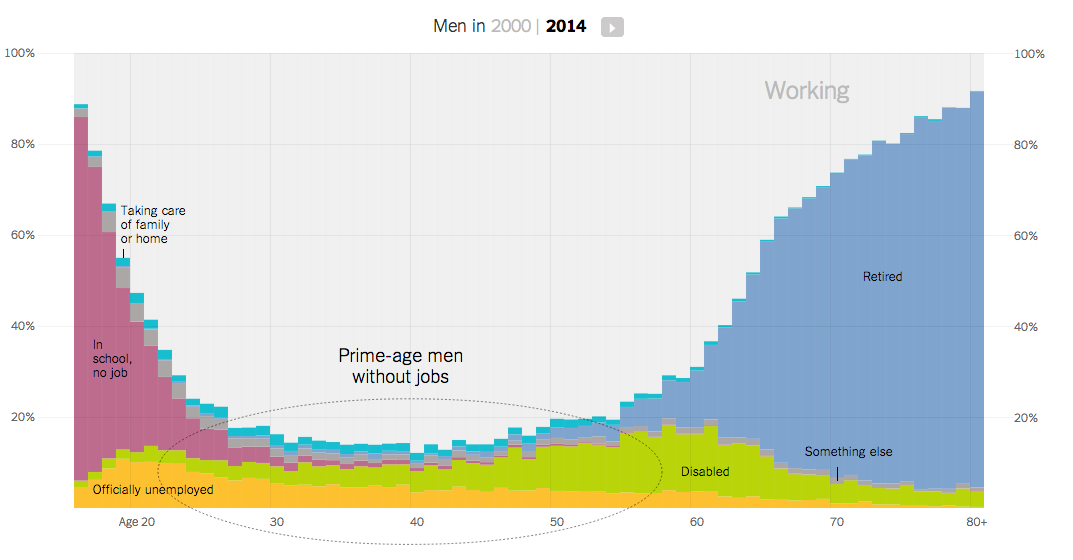
Working, in America, is in decline. The share of prime-age men — those 25 to 54 years old — who are not working has more than tripled since the late 1960s, to 16 percent. … Many men, in particular, have decided that low-wage work will not improve their lives, in part because deep changes in American society have made it easier for them to live without working. These changes include the availability of federal disability benefits; the decline of marriage, which means fewer men provide for children; and the rise of the Internet, which has reduced the isolation of unemployment. …

The resulting absence of millions of potential workers has serious consequences not just for the men and their families but for the nation as a whole. A smaller work force is likely to lead to a slower-growing economy, and will leave a smaller share of the population to cover the cost of government, even as a larger share seeks help. “They’re not working, because it’s not paying them enough to work,” said Alan B. Krueger, a leading labor economist and a professor at Princeton. “And that means the economy is going to be smaller than it otherwise would be.”

At the same time, Amanda Cox points out, many older men are postponing retirement:

The decline of traditional pension plans and rising education levels, which are associated with less physically demanding jobs, may both help explain why the elderly are working longer. The full retirement age for Social Security benefits also began gradually increasing in 2000.

Some countries have developed policies that encourage older people to leave the labor force, so they do not “crowd out” younger workers. But studies across countries and time suggest that crowding-out may not actually be a problem. Economies do not appear to have a fixed number of jobs. When more older people are working, they are earning money that they will then spend in ways that may create more jobs for young people, for example. Even if this is the case, though, the rise of elderly employment in recent years has not provided enough of a lift to put more young people back to work.

Derek Thompson suspects that more is at play here than employment, suggesting that the American male is having a full-on identity crisis:

Looking to the future, one aspect of the decline of work that might not receive enough attention is identity. If the future of work isn’t quite biased against men, it certainly seemed biased against the traditional idea of manliness. Construction and manufacturing, two male-dominated industries, are down 3 million jobs since 2008. Most of those jobs are dead, forever. Meanwhile, the only occupations expected to add more than 100,000 jobs in the next decade are personal care aides, home health aides, medical secretaries, and marketing specialists, all of which are currently majority female. …

The economy is not simply leaving men behind. It is leaving manliness behind. Machines are replacing the brawn that powered the 20th century economy, clearing way for work that requires a softer human touch.
The Disparities In Dining Out

by Dish Staff

Screen Shot 2014-08-29 at 1.42.10 PM

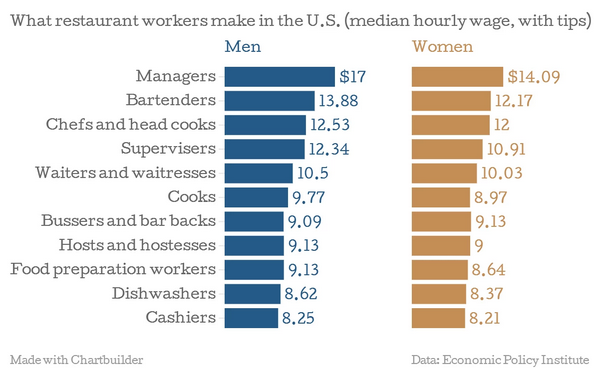
Roberto Ferdman flags a report that reveals gender wage gaps in the restaurant industry, even when tips are accounted for:

The median hourly wage paid to women is less than it is for men in all but one of the eleven jobs surveyed in a report by the Economic Policy Institute. In some cases, the gap is slight—for cashiers, dishwashers, food preparation workers, and hosts and hostesses, it’s a matter of cents. But in others, including supervisors and bartenders, the difference is well over a dollar. For managers, the highest earning occupation, the disparity was nearly three dollars per hour.

“This is what we identify as pay discrimination,” said Valerie Wilson, an economist at the Economic Policy Institute. “The work women are doing is being valued at less than the work men do in the same job.” Women, however, aren’t merely being paid less to do the same job—they’re being paid less and less compared to men as they move up in the ranks, too. Some of the highest earning occupations—managers, bartenders, and supervisors—are also the ones with the largest gender pay gap.

Drum adds his two cents:

There are other reasons besides gender for pay gaps, and the EPI report lists several of them. Whites make more than blacks. High school grads make more than dropouts. Older workers make more than younger ones. You’d need to control for all this and more to get a more accurate picture of the gender gap.

But in a way, that misses the point. There are lots of reasons for the gender gap in pay. Some is just plain discrimination. Some is because women take off more time to raise children. Some is because women are encouraged to take different kinds of jobs. But all of these are symptoms of the same thing. In a myriad of ways, women still don’t get a fair shake.

But that’s not to say that the business is especially kind to men, either. Tom Philpott pulls some other salient findings from the EPI report, which paints a grim portrait of restaurant workers overall:

Restaurant workers’ median wage stands at $10 per hour, tips included—and hasn’t budged, in inflation-adjusted terms, since 2000. For nonrestaurant US workers, the median hourly wage is $18. That means the median restaurant worker makes 44 percent less than other workers. Benefits are also rare—just 14.4 percent of restaurant workers have employer-sponsored health insurance and 8.4 percent have pensions, vs. 48.7 percent and 41.8 percent, respectively, for other workers. …

As a result, the people who prepare and serve you food are pretty likely to live in poverty. The overall poverty rate stands at 6.3 percent. For restaurant workers, the rate is 16.7 percent. For families, researchers often look at twice the poverty threshold as proxy for what it takes to make ends meet, EPI reports. More than 40 percent of restaurant workers live below twice the poverty line—that’s double the rate of nonrestaurant workers.

Let The Applicant Work For It

New research suggests that employers should give up trying to woo job interviewees:

[P]articipants asked to entice the applicant were poorer judges of character than those explicitly asked to evaluate them. A follow-up field study found similar effects in genuine interviews within two samples: applicants to an MBA program and teachers applying for school assignments. In both samples, interviewees rated as having high [Core Self Evaluation (CSE)] were more likely to go onto success – job offers for MBAs or “above and beyond” citizenship behaviours by the teachers – but only when the ratings came from interviewers who reported having a strong focus on evaluation. Those who reported giving more attention to selling the role produced CSE estimates that didn’t predict future success.

The authors note in their conclusion that “interviewers who focused only on evaluating applicants actually believed they were less able to select the best applicants than those who adopted a selling focus.” In fact the reverse was true, and the risk goes the other way: when we focus too much on soliciting applicants, we can miss the gorilla in the room: that they simply aren’t up to snuff.