Was There A Jewish Factor?

Josh doesn’t think so:

But a reader makes a distinction between this year’s primary and the several others in Cantor’s career:

Two factors in Cantor’s defeat that have not been played up as much as one would have thought … at least not yet:

1.  Cantor’s district was gerrymandered big time to make it a safe seat for him, under the assumption that Democrats would likely be gunning for him.  That left him with a much more rural, Christian district (that was even further to the right than he has been, as impossible as that sounds to anyone who is not a Tea Party disciple).  He got burned by his party’s effort, in a purple state, to make sure that suburban Richmond would remain a red congressional seat.  Poetic justice, if you ask me.

2.  Compounding that, Cantor is Jewish.  Anti-Semitism runs pretty deep in Christian conservative districts in the Commonwealth of Virginia.  Xenophobia’s cousin, if you will.

A NYT report lends a little weight to that theory:

David Wasserman, a House political analyst at the nonpartisan Cook Political Report, said another, more local factor has to be acknowledged: Mr. Cantor, who dreamed of becoming the first Jewish speaker of the House, was culturally out of step with a redrawn district that was more rural, more gun-oriented, and more conservative. “Part of this plays into his religion,” Mr. Wasserman said. “You can’t ignore the elephant in the room.”

Some more context on the Jewish angle:

It’s worth noting that Cantor was not merely the only Jewish Republican in the House caucus (one among 233 lawmakers), he was the highest ranking Jewish member of the US Congress in American history. Though there’s no shortage of support on Capitol Hill for Israel, especially among Republicans, Cantor … held a special role for Jewish conservatives in the United States. When Netanyahu visited the United States four years ago, he met privately with Cantor before an official visit with Hillary Clinton, then the US secretary of state at the time, and he told Netanyahu that House Republicans would act as a ‘check’ on the administration of US president Barack Obama.

Although there’s no love lost for Cantor among Jewish Democrats, who largely noted they wouldn’t be sorry to see his exit from Congress and from the House leadership, his loss is a blow to big-tent Republicans who desire as broad and diverse a leadership as possible.

My own feeling is that this is overly paranoid. We’ve seen absolutely no evidence of anti-Semitism in the Brat campaign’s rhetoric, the issue never hurt Cantor before, and there are countless other reasons to explain the loss.

Did Democrats Put Him Over The Top? Ctd

A reader updates us with some data:

Despite Dish-heads’ anecdotes, an analysis of voting patterns and vote totals by WaPo indicate that Democratic cross-over votes had little to do with Cantor’s loss:

Virginia’s lack of party registration makes it difficult to pin down whether Democrats crossed over in large numbers, but local level turnout provides some indirect clues on whether this phenomenon was widespread. On two counts, the data cast doubt on whether Democratic cross-over voting caused Cantor’s loss. …

Some Democrats surely selected a Republican ballot and voted for David Brat, but Cantor’s loss seems to be much more the result of weak support among Republican voters, some of whom showed up for a race they typically ignore to vote for the tea party conservative who was besieged with attack ads.

Cantor Couldn’t Buy His Reelection

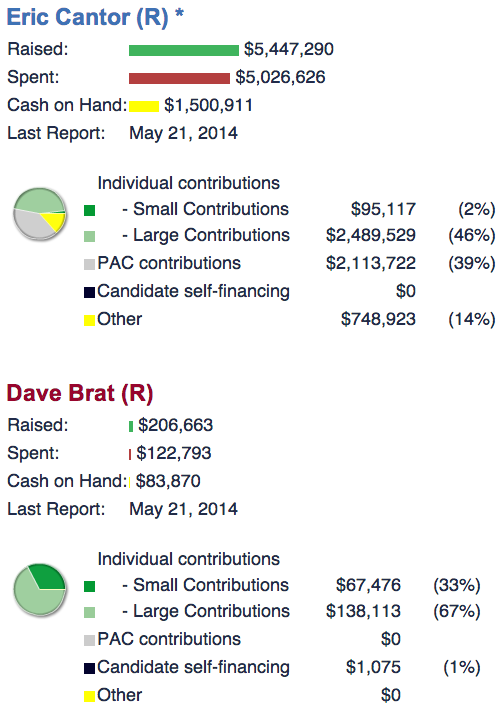
As we noted in our tweet reax, his fundraising advantage was massive:

Cantor Brat

Sean Sullivan marvels at the spending gap:

$4.9 million: Cantor spent about $4.9 million on operating expenditures this election cycle, according to campaign finance records. He still had more than $3.7 million on on hand late last month.

$123,000: Brat spent just under $123,000 on operating expenditures. So yeah, to say he was outspent doesn’t even begin to the tell the story.

Brett Logiurato is amazed Brat won despite being outspent “by more than 25-to-1”:

How big was the spending disparity between the two candidates? Cantor’s campaign spent more at steakhouses than his challenger, economics professor Dave Brat, spent on his entire campaign, a mind-blogging stat that was first noted by the New York Times.

It also helps explain why Cantor lost. The Rooted Cosmopolitan blogger, who has “managed two winning campaigns against incumbent Republican Congressmen in New England,” point outs that in “2013 Cantor spent roughly twice as much at Bobby Van’s [steakhouse] as he did on polling”:

[Cantor] spent about $400,000 airing television ads, but that’s probably less than he spent on airfare. He appears to have done no significant direct mail or digital advertising. There are few disbursements that look like field-related expenses. He paid for no opposition research. And his staff costs appear only marginally higher than they were in 2013, which suggests he never really ramped up for the election, but instead maintained his focus on traveling the country on behalf of other Republicans, and while on the road raising enough money to pay for his expenses (which include few nights in modest lodging but plenty of nights at some of the most expensive hotels in the country). …

Cantor spent money as if the only election that mattered was the House Republican Conference leadership votes. But in spending his time and money on that election, he made himself vulnerable to humiliation at home.

It’s reassuring that, much like Huckabee’s routing of Romney in the Iowa caucuses despite a 15-1 spending advantage, big money doesn’t always prevail. And such defeats take the edge off all the angst over Citizens United. In many cases, raising a ton of money can actually be a liability if it reinforces a reputation of cronyism. Update from a reader:

The huge spending disparity is misleading, since most of the money went to helping other Republicans. Sounds like he was beat because of his arrogance; Cantor believed all he had to do was run a few ads and show up.

Who Will Be The Next Majority Leader?

House To Vote On Payroll Tax Cut Extension

Costa reports on Cantor’s possible replacements:

House Majority Whip Kevin McCarthy (R-Calif.), an easygoing Californian and former recruiter of conservative candidates, is best positioned to take Cantor’s place, regardless of when he leaves. McCarthy has a deep well of support and a light managing style that has won favor with the conference’s younger and more independent members. He was a co-author of “A Pledge to America,” the GOP’s 2010 election manifesto and seen as an able communicator. But his at times rocky experience on the floor, where he has seen some major votes fail after being whipped and some conservatives unhappy with his tactics, has raised questions about his leadership.

One possible rival to McCarthy for majority leader is Rep. Jeb Hensarling (R-Tex.), the chairman of the Financial Services Committee, who is a favorite of tea party activists and known in the House for his clashes with Boehner, Cantor, and McCarthy.

Ron Elving eyes Paul Ryan:

[He] had been counted out, in part because he was thought unwilling to challenge Cantor. Now the field is wide open. And given his lack of interest in a presidential run in 2016, wouldn’t he rather be speaker than chairman of Ways and Means?

Josh Green expects “that the center of gravity in the House will shift further to the right”:

Cantor’s absence leaves a void that the right wing will push hard to fill. As a result, next year’s legislative agenda will look different and more conservative.

This in turn will affect the GOP presidential primary, because the candidates will have to take positions on whatever legislation the House is entertaining. Many commentators are already weighing in to predict that Cantor’s loss will spell doom for the GOP in 2016, and it may. But conservatives see it as a validation of their worldview and an opening to further assert their influence — which means there’s going to be an even bigger fight about that first.

Albert R. Hunt predicts “the remaining four months of this session will be dominated by internal jockeying for leadership posts among the majority House Republicans”:

Speaker John Boehner may escape without a challenger but there will be intense rivalry for the No. 2 and No. 3 House posts. The top contenders will be House Whip Kevin McCarthy of California, who would like Cantor’s job, and Texas Congressman Jeb Hensarling. Emboldened by the shocking Cantor upset, the Tea Party caucus almost certainly will demand one of the top three leadership posts for one of their own. The most likely standard bearers from this contingent might be Louisiana’s Steve Scalise or Georgia’s Tom Price.

Rick Klein is on the same page:

Boehner’s days as House Speaker were thought to be numbered even before this stunner. Cantor’s defeat ends the leadership career of the man who was most widely mentioned as his successor — a charter member of the GOP crop of “young guns” who had more credibility among conservatives than even Boehner himself. Any thought of the House Republican conference steering back toward a moderate direction in choosing a leader was zapped by Cantor’s primary defeat. In elevating new leaders, House Republicans seem certain to want to push further to the right now.

(Photo: U.S. House Majority Leader Rep. Eric Cantor (R-VA), House Majority Whip Rep. Kevin McCarthy (R-CA), a crouching House Republican Conference Chairman Rep. Jeb Hensarling (R-TX) and, on the far left, House Majority Chief Deputy Whip Rep. Peter Roskam (R-IL) talk prior to a media availability on Capitol Hill on December 20, 2011. By Alex Wong/Getty Images.)

The Cantor Shocker: Blog Reax

cantor

Tomasky’s jaw drops:

Cantor was not an enemy of the Tea Party. He was in fact the Tea Party’s guy in the leadership for much of the Barack Obama era. He carried the tea into the speaker’s office. And still he got creamed. Creamed! Has a party leader ever lost a primary like this? Stop and take this in. Like any political journalist, I’m a little bit of a historian of this sort of thing, although I readily admit my knowledge isn’t encyclopedic. But I sure can’t think of anything. Tom Foley, the Democratic House speaker in the early 1990s, lost reelection while he was speaker, but that was in the general, to a Republican, which is a whole different ballgame. And he was the first sitting speaker to lose an election since…get this…1862! But a primary? The No. 2 man in the House, losing a primary?

He declares that “immigration reform is D-E-A-D”:

There is no chance the House will touch it. That means it’s dead for this Congress, which means that next Congress, the Senate would have to take the lead in passing it again. (The Senate’s passage of the current bill expires when this Congress ends.) And the Senate isn’t going to touch it in the next Congress, even if the Democrats hold on to the majority. Those handful of Republicans who backed reform last year will be terrified to do so. And it’s difficult to say when immigration reform might have another shot. Maybe the first two years of President Clinton’s second term. Maybe.

Chait echoes Tomasky:

[T]he biggest issue by far was immigration reform. Cantor was no reformer, really. He rejected the bipartisan immigration reform deal that Marco Rubio and other Republicans had negotiated in the Senate. But he did hope to salvage some partial compromise, perhaps allowing some illegal immigrants who had been brought over the border as children, and thus could not be deemed personally guilty, to stay unmolested. Brat rejected even that. Any token of conciliation was too much. He still uses the old lingo, calling undocumented immigrants “illegals.” The immediate, and probably correct, reaction in Washington is that Cantor’s defeat wipes out whatever tiny shred of a hope that remained for immigration reform.

But Jay Newton Small finds that it’s not so clear-cut:

Some observers cautioned against drawing sweeping conclusions about immigration, and when the dust settles, it may prove that Cantor’s problem was less ideology and more a sense that he stood more for his own ambition than for any definable policies. He frequently reinvented himself with splashy policy speeches, and toured the country raising money and gathering chits for an eventual run for House Speaker.

“Was immigration an issue? Yes. Was it the deciding factor to the tune of 11%? Not no, hell no. It’s a fairy tale,” Virginia Democratic strategist Dave “Mudcat” Saunders said.

Ben Jacobs and Tim Mak also downplay the immigration angle, claiming Cantor beat himself:

One Virginia Republican familiar with the race suggested that Cantor’s loss was due to “a perfect storm” brought about by the fact that Cantor seemed to be schooled in “the George Armstrong Custer school of tactics as opposed to Sung Tzu school.” The Republican suggested that while immigration was a factor, the bigger issues were internal party politics. As opposed to other Virginia Republicans in Congress, Cantor didn’t show the most basic respect to Tea Partiers in his district. It wasn’t about Cantor’s votes but rather that he didn’t even show up to explain himself and get yelled at. If the Majority Leader, who was the only Jewish Republican on Capitol Hill, had paid more attention to the words of Woody Allen, who said “80 percent of life is showing up,” he would be in much better political shape.

Erickson’s view:

Cantor lost his race because he was running for Speaker of the House of Representatives while his constituents wanted a congressman. The tea party and conservatives capitalized on that with built up distrust over Cantor’s other promises and made a convincing case Cantor could not be trusted on immigration either. Cantor made it easy trying to be a congressman from Virginia and a worthy successor to the Speaker in K-Street’s eyes.

Ezra makes a bunch of smart points. Among them:

Of late, there’s been a lot of talk about “reform conservatism,” a gentler, more inclusive, more wonkish brand of conservatism. Cantor, a founding member of the “Young Guns,” was one of reform conservatism’s patron saints. His loss suggests reform conservatism doesn’t have much of a constituency, even among Republican primary voters. The Republican base, at least in Cantor’s district, isn’t in the mood for technocratic solutionism. It’s still angry, and it still believes that any accommodation is too much accommodation.

But Ramesh isn’t ready to believe anybody’s theories yet:

It is easy enough to attribute his defeat to the sentiment among conservatives that Cantor is not sufficiently hostile to an amnesty for illegal immigrants, and that the Republican establishment is too squishy: too willing to raise the debt ceiling, vote for bank bailouts, and so on. But then why did Senator Lindsey Graham, who vocally championed the immigration bill while Cantor distanced himself from it, win walking away in conservative South Carolina? Why did Senate Republican leader Mitch McConnell of Kentucky, who is just as much an establishment figure as Cantor, and more favorable to the immigration bill, thump his primary opponent a few weeks ago?

Cohn’s take:

There’s a certain poetic irony to Cantor, who exploited Tea Party frustrations in order to undermine Boehner, falling to a Tea Party challenger himself. And as my colleague Danny Vinik points out, this probably isn’t good news for the Republican Party’s political prospects in national elections, given how out of sync the Tea Party is with the rest of the country. But there’s a long way to go before 2016. In the interim, the country needs a government that can actually functionwhich means it needs an opposition party that can bring itself to compromise, at least once in a while. In the wake of Cantor’s loss, Republicans may be even less enthusiastic about that than they were before.

(Photo by Gage Skidmore)
The Cantor Shocker: Tweet Reax

https://twitter.com/jetpack/status/476543773452042240

https://twitter.com/jetpack/status/476532552245997569
https://twitter.com/jetpack/status/476542405098078208 https://twitter.com/jetpack/status/476529014446620672

Did Democrats Put Him Over The Top?

A reader writes:

I live in the 7th District in Virginia, and I am a Democrat who voted for David Brat in the open primary. There has been a whisper campaign going on among the Democrats in the district for the last few weeks and it resulted in many Democrats coming out to vote for Brat. We felt especially encouraged after the 7th District committee nominated Jack Trammell to be the Democratic candidate for the seat last Sunday. We now feel we at least have a fair chance at winning it. (By the way, Jack Trammell is a professor at the same small college as Brat, Randolph-Macon.)

Well, not quite the Democrats of Mickey’s dreams, I guess. Update from a reader:

Here’s a theory to support your reader who, though a Democrat, voted for Brat: in 2012, roughly 47,000 people voted in the 7th District Republican primary. This time, roughly 65,000.  Now let’s assume that of those 18,000 new voters, 16,000 were Democrats voting to axe Cantor, then rework the numbers if they hadn’t voted: Cantor would then have had around 29,000+ votes, and Brat would have had around 20,000+.  Which would have worked out to approximately 59% for Cantor, which is where he was at in 2012 and much closer to his internal polling showing him with a lead of 34% among likely REPUBLICAN voters.

I’m thinking time will show that Democrats in his district were fed up with him, and decided to do something about it.

A subsequent Dish update here throws cold water on the theory.

Dick Morris Award Nominee

This time, it goes to a pollster:

A poll conducted late last month for House Majority Leader Eric Cantor (R-Va.) shows him with a wide lead over challenger David Brat heading toward next Tuesday’s Republican primary election.

The poll, shared with Post Politics, shows Cantor with a 62 percent to 28 percent lead over Brat, an economics professor running to Cantor’s right. Eleven percent say they are undecided.

The internal survey of 400 likely Republican primary voters was conducted May 27 and 28 by John McLaughlin of McLaughlin & Associates. It carries a margin of error of +/-4.9 percentage points.

The Coulter-Kaus-Drudge-Ingraham Coup

Salon’s Jim Newell this morning noted the weird avalanche of headlines on the Drudge Report:

Screen Shot 2014-06-10 at 9.23.41 PM

And gave us a roll-call of the writers, bloggers, and talk radio hosts who helped gin up the insurrection:

There’s Drudge, of course. And Ann Coulter. And radio/TV personality Laura Ingraham, who recently suggested that the United States should have traded Eric Cantor to the Taliban for Bowe Bergdahl. And the writings and tweets of Mickey Kaus, now of the Daily Caller, have been indistinguishable from those of a Brat staffer in recent months.

Here’s Mickey’s latest post:

Bottom-Up Bipartisanship? Yesterday Dave Brat, the conservative economics professor who is challenging Majority Leader Eric Cantor in today’s primary, sent out what I assume will be his final pitch to voters …

Notes: 1) This is a pitch — against a “low wage agenda” and “crony corporate lobby” — that can appeal to Democrats as well as Republicans. Maybe partisanship will eventually be transcended, not at the top, with David Brooks, Gloria Borger and Jon Huntsman imposing a Beltway consensus they hammer out at an Atlantic panel, but at the bottom, where less sleek figures like Brat, Phyllis Schlafly and Jeff Sessions, can make common cause with Democratic workers who’ve gotten the short end of previous top-down triumphs such as global trade and Reagan’s 1986 amnesty, as well as of ineluctable technological trends like automation. 2) Perhaps not coincidentally, Democrats can vote in the Cantor vs. Brat primary. …

Backfill: See also this earlier Brat release, which expands the potentially bipartisan anti-corporate agenda to “other issues – like spending, debt and insider trading” …

That’s what Brat seems to represent, so far as I’ve been able to glean in the past hour or so. And here’s part of Mickey’s previous post, mocking Cantor for backing “amnesty” for immigrant “kids”:

Little did Cantor know that this exquisitely calibrated stand would prove to be about the most embarrassing position he could take — when the “kids,” often unaccompanied, started surging across the southern border, causing a humanitarian and policy crisis just as he was facing a challenge in Tuesday’s Virginia primary. Even the New York Times couldn’t help but notice that the young illegal migrants said they were motivated, not just by conditions back home in Central America, but also by the prospect that they’d qualify for Cantoresque amnesty. ”Central Americans, [said a Salvadoran immigration official] were left with the sense that the United States had ‘opened its doors’ to women and children.”

Check out how many of his posts for the past two months have been obsessively about the Cantor race.

He won big tonight. Almost as big as Brat.

Cantor Can’t No More

 
So after all the obits for the Tea Party, we get the stunning news that Eric Cantor has been ousted from his Congressional seat by an anti-amnesty professor, touted by Laura Ingraham. This appears to have been a factor:

In an interview just last Friday, Cantor suggested he could work with President Obama to allow a path to citizenship for some children of illegal immigrants already in the country. In the campaign’s final days, Brat criticized Cantor for siding with Obama on the contentious issue.

His district had also been extended recently to include some more conservative areas around suburban Richmond. But this race – which Cantor once won by 79 percent in a primary – wasn’t even close. 56 – 44 is pretty much a landslide.

Here’s a glimpse of Dave Brat, introducing himself at a fundraiser last February. This was his intro:

This is his core pitch:

It doesn’t get more Tea Party than that: debt and amnesty, with a real populist, anti-big-business message. Notice also the anger at the big banks, the loathing of Wall Street, the populist equation of the Republicans and the Democrats, and the appeal to average and middle income “little guys.” Cantor was portrayed as an “insider-trader.” And yet this appealing message from an appealing and effective figure didn’t get much support from national Tea Party groups, as Laura Ingraham is now venting on Fox.

Does this completely end the chance of immigration reform in this Congress? Surely it has. In the next Congress? I’m beginning to suspect so. Does it cement the rightward-still passion of the GOP base? Yep. Does it give it an appealing, populist, insurgent message of change? You bet it does.