I’ve made this point before, but a reader puts it more succinctly:
You should not be surprised by the reactions you report to the Russia-Georgia conflict. I still think a part of you believes (or hopes) that the many of the people you write about are conservatives in any recognizable sense of that hallowed word. But they are not what Burke or Santayana or Oakeshott would recognize as fellows. They are brute nationalists and defenders of their own power positions.
That position is augmented by a Manichean sense of the world that is underpinned by a crude and mistaken version of Christianity. What is truly sad is that so many highly educated people are willing to cast a veil over their naked aggression and self interest and call it a coherent philosophy. I know, from your writings, that you realize this; however, there seems to be a part of you that is still stunned by the last 10 years.
No shit, Sherlock. One of the good things about having a blog that has published almost daily for almost a decade is that one’s own evolution and zig-zags through a period of history are exposed to the glare of day. It isn’t pretty at times – especially when one is not fixed to a set ideology which allows you to plug the events of any given day into a pre-existing template. And especially when you’re as passionate as I can be on any given day after a strong cup of coffee.
And so my support for what looked like a reasonable, moderate, inclusive, tax-cutting, realist in 2000 became moot on 9/11. At first the decision to take out the Taliban and to squeeze Saddam to prevent WMDs getting to Jihadists seemed exactly right. Defending the West from theocratic mass murderers with terrifying technology was vital – as long as we understood we were defending the West’s core values: freedom of speech and religion, self-determination, secular government and human dignity (which would require an absolute prohibition on torture). Trusting the administration on WMDs, I supported a US-UN effort to force Saddam’s disarmament, and if that failed, was perfectly prepared to see the West go to war to forestall a threat and remove a dictator. The rest is archives. I’m still thrilled that the Taliban were knocked for six and that Saddam is deposed and dead. Thrilled beyond belief. But not beyond reason. And two lessons were learned, one of which bears directly on this Russia-Georgia conflict.
The first was that the Bush administration’s public stance and their actual one were different. The case for WMDs was much weaker than they let on in public, and at the very best was insufficient to base an invasion on. The claim that their goal was not revenge against a symbol of Arab contempt was belied by the lack of any preparation for a post-invasion phase, the allowance of chaos and mass looting in the wake of the invasion, the use of the war as a partisan bludgeon in domestic politics, and the institution of torture as the central weapon in the war. By the time of Abu Ghraib, the founding myths of the war had been brutally exposed, and many of us were reeling. These were not forgivable errors of the kind that happen in any war; they were evidence of bad faith in going to war, criminal negligence in conducting it, and betrayal of core values in conceiving of it. We saw with our own eyes the actual nature of the torture policy and the extent of the chaos. Since then, we’ve been trying to rescue the invasion, botched in practical terms and undermined in moral ones. Thanks to Iraqis’ own natural power-balancing, the stabilization of the country by mass ethnic cleansing, brutal over-reach by al Qaeda, miscalculations by the Sadrite opposition, and brilliant counter-insurgency tactics by Petraeus, we have somehow been able to craft an opening to extricate ourselves from there without too much damage going forward. That’s a huge achievement, and Petraeus deserves all the praise he has received. So do Gates and even Bush after 2006, even though so much had been squandered by then.
So we can leave, right? Now the other shoe drops. No, we don’t want to leave. If we can turn Iraq into a pliant, non-despotic state, we should be able to keep troops there indefinitely, and use Iraq as a critical base in the Middle East to control oil, allegedly protect Israel, and pressure Iran. We can add more troops to Afghanistan, turning that vast region into a zone for American and allied soldiers in another counter-insurgency operation in an ungovernable region. And now, we have a border dispute in the Caucasus, with Russia flexing its muscles against a young democracy with an impetuous leader, and, again, in the eyes of McCain and Bush and Lieberman, it requires even more American commitment. Put all these things together and you can see that, for some, the end of the Cold War was not a golden opportunity to set up an international security structure that helped channel and constrain the hyper-power in ways that advance our interests while avoiding classic counter-balancing from emerging powers.
The end of the Cold War was an opportunity to create a new one. For some, we now realize, the Cold War was not about democratic values versus totalitarianism, in the Kirkpatrick formulation. It was about American hegemony against any rival power, totalitarian or not, globally expansionist or not. The end of Communism was, for some, a problem. It removed a key rationale for military power. China was the first object of demonization, in the first months of the Bush administration; then – defensibly – Islamism; then Iran, Iraq and NoKo; now, Russia. Islamism may well be seen as a rival to Communism in ideological terms, and worthy of a new Cold War of sorts. But we also learned fast enough that its asymmetrical dispersal across the world made traditional warfare, as in the Cold War, irrelevant, even counter-productive. But we still put a militarist template on it in Iraq and Afghanistan. And it remains an over-arching defense of more traditional hegemonic actions – largely centered on oil supplies – in the Middle East. You can absolutely understand and defend a military state-centered response to 9/11 at the time. But we have surely learned the limits of its potential – indeed the further damage it can do.
McCain is very, very comfortable in this situation. It speaks his language. A thoroughly twentieth-century figure, he lives and breathes war and conflict as a state of being. For him, it is always 1938 somewhere; America’s duty is to control, occupy or intervene wherever any rival seeks influence and any group does not share our alleged values. And so American power must be brought to bear in Georgia and Iraq and Iran and Burma and Darfur and Bosnia and anyplace else where American interests are threatened or democratic allies seek help. And for militarist American exceptionalists, this all makes sense. This is the higher purpose McCain lives for: the glory of liberation, the thrill of conquest, the adoration of the soldier, the defeat of evil.
But for conservatives whose goal is peace, not war; who are quite comfortable balancing global power with other great powers such as Russia, China, India and Europe rather than demanding an expanding American hegemony; who believe that defense means defense, not a proactive preference for war; who see war and control of other countries as something distasteful if it goes beyond pragmatic self-interest; those conservatives do not agree. For me, for example, the 1990s were a golden age. I missed none of the infirm glories of the end of Communism. It was fantastic not to have the West rallying to fight or living with existential threat or on the edge of ideological conflict. 9/11 indeed changed that – but the threat, we have discovered, is not something Cold War tactics can blunt. It does require police work, and strong alliances, and much better human intelligence, and better surveillance and smarter border control. Compared with these, the invasion of Iraq remains at best a wash in the terror war. We created terrorists that we subsequently had to fight, putting us in the awful position of recreating the dynamics of the war on drugs in the war in terror.
Where does thus leave us? If the reaction to the last week is any indicator, Americans are still viscerally committed to the kind of Cold War dynamics we once had a chance to leave behind. The Republican party especially thrives on such conflict, enabling it to dominate domestic politics with appeals to bravado and patriotism and empire. Meanwhile, America’s fiscal standing continues to slide down and down; its military consumes more and more resources; dependence on foreign oil does not prompt us to find alternative energy resources as an urgent national security matter, but to face off against Petro-powers, demonize oil companies, offer gas tax gimmicks, and occupy dysfunctional regions in far away countries because our addiction to a substance that is wrecking the planet is too great to resist.
This is the way great powers fall. And this election presents us with a very rare chance to move in a different and more rational direction. Turning this around will be a monumental task because so many forces now conspire to push this country further and further along on this declinist, neo-imperial path. But it can be done over a generation.
Or to put it more bluntly: yes, we can. And yes, we must.
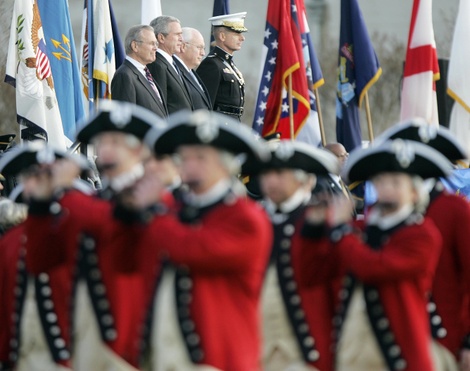
(Photo: Rome’s triumvirate, 2001 – 2006, by Tim Sloan/Getty.)


 The Dish