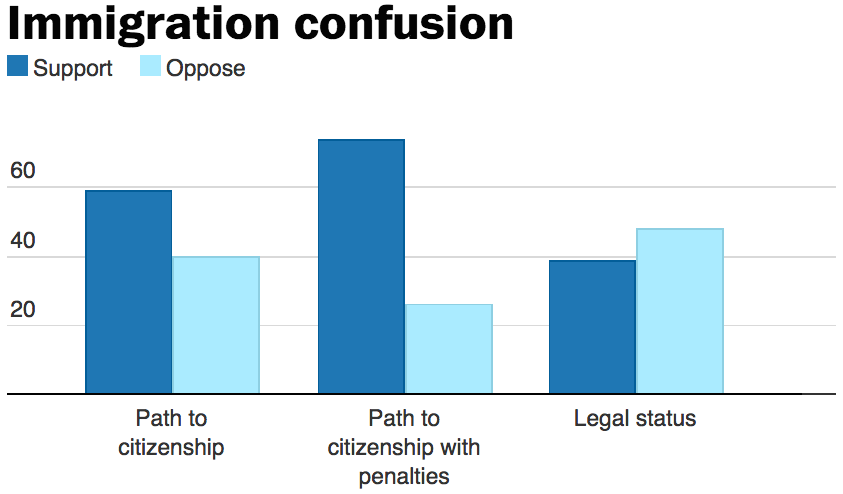
While polling has long shown a clear and strong majority of Americans support a path to citizenship, some recent polls have shown far less support for legal status. While the NBC/WSJ poll shows Americans oppose legal status 48-39, a Washington Post-ABC News poll in September showed Americans opposed legalization 50-46. Among registered voters, it was 53-43.
Why the support for citizenship but not legal status? Your guess is as good as ours. Maybe people don’t like the idea of two classes of Americans. Maybe they think of citizenship as something that is earned, and legal status as something that is bestowed without cost to the beneficiary.
Whatever the reason, it bears emphasizing that Obama’s announcement tonight has much more to do with legal status and nothing to do with citizenship.
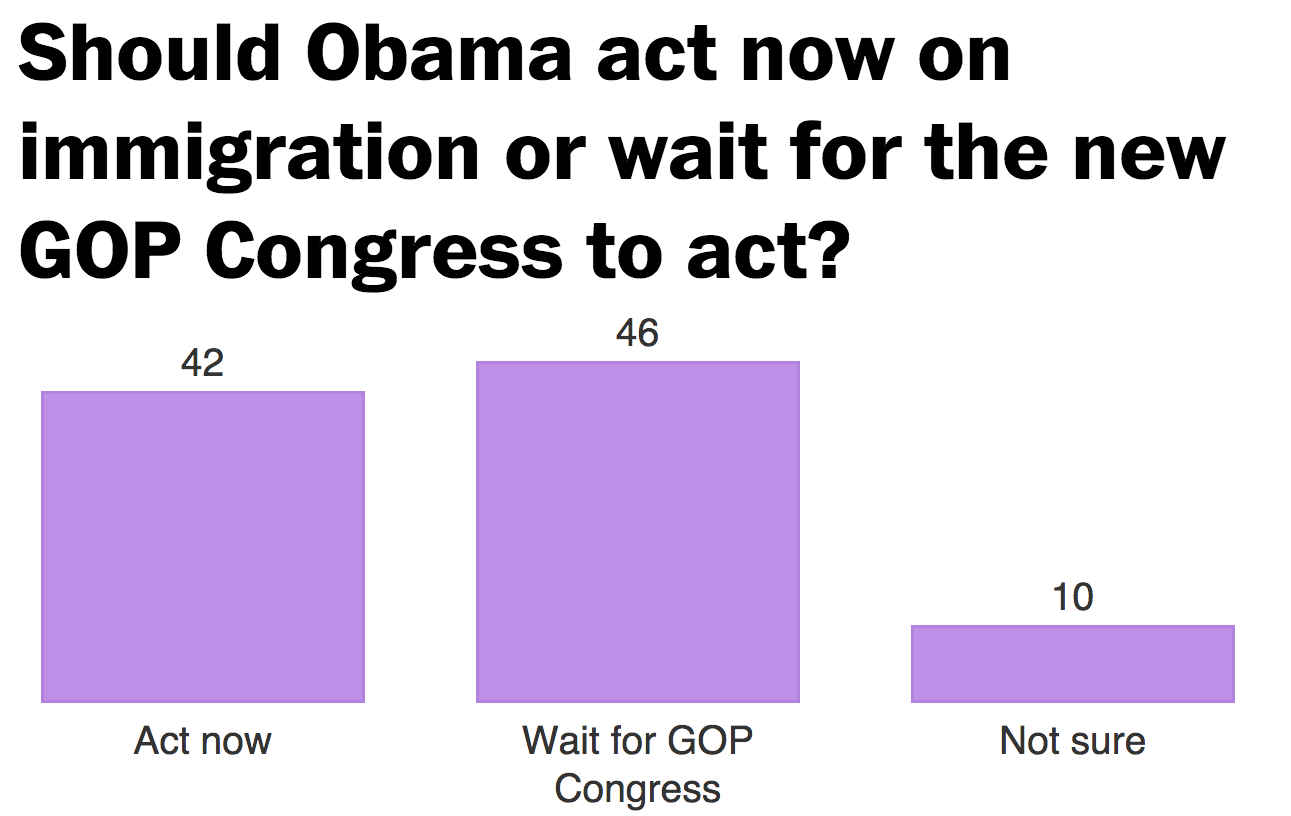
According to a USA Today poll,Democrats want action now; Republicans want him to wait; independents are split down the middle; and the overall result is slightly in favor of waiting, by 46-42 percent. In other words, pretty much what you’d expect. Politically, then, this probably holds little risk for Obama or the Democratic Party.
But Jonathan Cohn is unsure how the executive action will play out:
[A]s Greg Sargent notes, congressional action really isn’t an option right now. And the Obama Administration is likely to frame its action in ways that polls suggest the public likes—by emphasizing that people who go through the new programs will have to go through background checks and, afterwards, will have to start paying taxes. Will these arguments play well? Will the image of a president getting something done assuage those frustrated by Washington gridlock? Your guess is as good as mine—and I guess we’ll start to find out tonight.
Previous speculation about the popularity of Obama’s forthcoming executive order here.
Obama is scheduled to announce his executive action on immigration tonight at 8 pm ET. Like Mark Krikorian, Frum rejects the comparison of Obama’s amnesty to Reagan’s and George HW Bush’s:
Reagan and Bush acted in conjunction with Congress and in furtherance of a congressional purpose. In 1986, Congress passed a full-blown amnesty, the Simpson-Mazzoli Act, conferring residency rights on some 3 million people. Simpson-Mazzoli was sold as a “once and for all” solution to the illegal immigration problem: amnesty now, to be followed by strict enforcement in future. Precisely because of their ambition, the statute’s authors were confounded when their broad law generated some unanticipated hard cases. The hardest were those in which some members of a single family qualified for amnesty, while others did not. Nobody wanted to deport the still-illegal husband of a newly legalized wife. Reagan’s (relatively small) and Bush’s (rather larger) executive actions tidied up these anomalies. Although Simpson-Mazzoli itself had been controversial, neither of these follow-ups was.
Executive action by President Obama, however, would follow not an act of Congress but a prior executive action of his own: his suspension of enforcement against so-called Dreamers in June 2012. A new order would not further a congressional purpose. It is intended to overpower and overmaster a recalcitrant Congress.
What both Frum and Krikorian’s analyses fail to explain is how Obama’s planned action is not a faithful attempt at executing the law. You can’t argue that Obama’s “order would not further a congressional purpose” without explaining what Congress’s purposes are in passing immigration laws. This error isn’t unique to Frum or Krikorian: Conservatives often fail to use a legal framework in analyzing Obama’s action. … Bush and Reagan’s actions were legally acceptable for the same reason Obama’s would be: ensuring that our immigration policy is fair.
Obama, in contrast to Reagan and Bush 41, is not trying to implement a lawfully created amnesty. There has been no congressional amnesty. In fact, there has been no immigration action from Congress in the past few years except the post-9/11 REAL ID Act of 2005, which made it harder, not easier, for aliens to qualify for immigration relief. More than that, Congress declined to pass a legalization of the type Obama is issuing during both Obama’s term and in a hotly-contested bill during President Bush 43′s term.
Thus, Obama is clearly contravening both ordinary practice and the wishes of Congress—as expressed in statute—by declaring an amnesty himself. This is nothing like Reagan’s or Bush’s attempts to implement Congress’ amnesty.
Republican presidents can, and will again, avoid enforcing environmental regulations. If Republicans identified a serious legal basis for selectively enforcing the estate tax, they could go ahead and do it. It would infuriate liberals just as weak environmental enforcement infuriates liberals. And it would be incumbent on the norms police to show that the discretion that exists in immigration law also exists in tax law. But it wouldn’t add up to a new method of politics.
Carl Hampe points out that “Congress has significant powers as well in this situation”:
It could pass legislation terminating the grant of work authorization to this population. It could use its power of the purse to prevent the Department of Homeland Security from expending funds to give the beneficiary class employment authorization documents. Ultimately, only Congress can decide the permanent legal fate of undocumented immigrants receiving the temporary immigration benefits that Obama is considering now. This happened, for example, when President Jimmy Carter in 1980 blessed the legal entry of certain Cubans and Haitians who arrived during the Mariel Boatlift. But these individuals did not obtain the right to permanently stay in the country until Congress acted to recognize these rights for those in this group without disqualifying criminal records.
In short, the immigration debate is primarily a question of politics and policy, not law. The president must act within certain legal parameters, but he apparently will do so. Congress has many legal tools to respond to his actions.
I understand the president’s need to act on immigration; I hope he will issue his EO and delay its effective date until the end of January or mid-February, giving the House one last chance to do something on the issue. But put into context, including the history of the last six years, the renunciation of the comprehensive Senate bill by its chief sponsor, Marco Rubio, in the face of grassroots conservative opposition, and the history of actions by previous presidents, it is not nearly as explosive as the rhetoric or editorials would suggest. Will it be separated from other issues where there is an opportunity for constructive action, or will it be the excuse for another meltdown into gridlock in the 114th Congress? We will have an answer in the lame duck.
And Francis Wilkinson fears DC will only get more dysfunctional:
If Obama is not departing from norms in this case, he certainly looks to be pushing the line. With a functioning Congress, large changes to immigration would rightly be the legislature’s prerogative. Of course, we don’t have a functioning Congress, and we do have millions of people living in limbo. It’s not hard to understand why Obama is doing this, and perhaps party relations in Washington really can’t get much worse. But I think they will.
(Photo: A man walks next to the U.S. – Mexico border wall on November 19, 2014 in Calexico, California. By Sandy Huffaker/Getty Images)
Obama’s upcoming plan is being characterized, in advance, as relief for 5 million unauthorized immigrants. But based on the rumors about who’d be likely to be included in the plan, that’s not exactly accurate.
What it looks like is that, by the time Obama’s new plan goes into effect, 5 million unauthorized immigrants, in total, will be eligible to apply for protection from deportation. That includes immigrants who are already eligible for protection — even before any new plan is announced — because they qualify for the Deferred Action for Childhood Arrivals program, which the Obama administration introduced in 2012.
If the undocumented parents of American citizens are allowed to stay, Roberto Ferdman figures “we’re talking about an estimated 3.5 million immigrants who currently don’t have protection from deportation”:
There’s a separate possibility that the plan might also include relief for immigrants who arrived in the country as children and are still younger than 18 years old. Those, according to Pew, amount to another 650,000 people. If this group is also included in Obama’s executive action, that would bring the total number of people affected by his action up to 4.15 million.
But this massive number doesn’t account for the millions more indirectly affected by the reform: the families of those who would no longer be deported. Even the most conservative estimate—let’s say 2.8 million undocumented adults are paired up and each couple has one child—suggests that more than a million children will suddenly not have to worry anymore about whether their parents will be deported.
A reader provides “some perspective from a Midwestern family”:
Our college age son is expecting a baby and his 19-year-old girlfriend is undocumented. She has lived in the USA since she was four and is a high school graduate. She’s bright, mature, goal oriented, and resilient – but has had little opportunity to advance economically or attend post secondary school due both to her undocumented legal status and the fear that has prompted her parents to limit their overall assimilation. Being undocumented, neither she nor her parents have ever held jobs providing health insurance or had bank accounts. She’s grown up moving continually as her parents follow work.
Being undocumented, she can not obtain even unsubsidized health insurance through the ACA. Being undocumented she can not obtain a drivers license/state ID or credit. Should she live in our home state of Indiana, she is ineligible for any Medicaid coverage for prenatal or post natal medical care. In California, her home state, where my son now lives, MediCal provides basic prenatal care but only for 30 days at a time – so, our son takes a day off of work (unpaid) every month to escort her to a social service department so she is approved for the next 30 days of prenatal care. She is eligible for WIC but her family can not apply for food stamps.
Both my husband and I have always believed that we live in a big country with room for everyone, and morally we believe this teenager has the right to this nation’s opportunities just as our ancestors did – but it’s been an abstract position until now, and our position was never the norm in our Midwestern suburban community.
Now we’re terrified to think that this lovely girl could be deported pregnant with our son’s child, or that as a parent, she could be consigned to living on the scraps of a menial labor force. The issue is no longer abstract, as I’ve spent the last several weeks researching immigration law and the benefits of President Obama’s 2012 executive orders affecting Dreamers. We’re facilitating and paying for our son’s girlfriend’s DACA application (not an inexpensive or easily documented endeavor), and after the baby arrives, we will retain an immigration attorney to initiate the long and uncertain process for her to perhaps acquire ultimate residency.
My husband I have been slapped by the realization of what being undocumented means to our family. In the last few months, we’ve frequently wondered how many American babies will be born to mothers without access to reasonable prenatal care? How much will state Medicaid programs spend on NICU support for unnecessarily premature infants? How much will school systems spend for special education programs to support children born with preventable learning or developmental disabilities? How many Dreamers grow up in the U.S. without memory of their home countries but are denied access to state tuition at public universities, or just simply can’t be hired for jobs that provide a basically livable wage and dignified entry onto the labor force? How much of a contribution to social security and Medicare would an additional 10 million wage earners provide today? In 20 years as their often large families exponentially hit the payrolls?
I suspect that our family represents the precipice (at least in our corner of the cornfield) of what will eventually impact many Americans who are currently hostile to immigration reform. Because their kids, like our kids, are meeting, marrying, and socializing with a hugely diverse generation of peers. And when things hit home and people open whatever closet door they’ve forced others into, light seeps in.
Another reader:
I am a native-born American. Over the years as a pastor, I’ve worked with any number of immigrants from several different countries. Republican rhetoric is always about securing the border and what to do about the “illegals.” They seem not to realize the immigration system is SO MUCH MORE than border security and people in the US without permission. And our entire immigration system is badly broken. Refugees are immigrants. International students are immigrants. International business persons are immigrants. Foreign-born spouses of US citizens are immigrants. Foreign-born family members of US citizens are immigrants.
A member of my church is married to a French national. They were married in the US. He wants to represent his father’s business in the US. It will take two years and hundreds of dollars in fees for them to be considered for a visa for him. Her parents are working on it from this end and they are so frustrated.
As I understand it, a significant percentage of “illegals” are students and tourists who have overstayed their visa. Could we not establish a readable card issued upon arrival or at a consulate? Set up card readers in post offices, libraries, public buildings. Once a week you have to swipe your card. The reader reports your location to a regional or national monitoring center. It also tells you how many days you have left, or gives instructions about contacting INS/ICE. This is not difficult. But as long as immigration is a way to scare people and raise money for your campaign, we won’t have a solution.
My favorite immigration story is from a friend in Belgium. He met a man in Oregon over a social network website and they fell in love. My Belgian friend visited the US to see his love once a quarter and stayed for a month. On the third trip in a year, the immigration officer at the airport began to question him. It appeared to the officer that my friend was coming to conduct business on a tourist visa. My friend was concerned that if he revealed that it was a male-male relationship, he would not be allowed in. He tried two or three not-quite-false-but-not-full-disclosure explanations. They were not working. Finally he told the officer he had fallen in love with a man in Oregon. All these trips were to see him and make plans for him to move to Belgium where they could get married. He waited. The officer stamped his passport, handed it back, and said “Good luck to you both.”
They are now married and living in Brussels. My Belgian friend simply cannot move his business to the US, even if they wanted to. The immigration hurdles are simply too high.
Another lends his expert input:
I’m an immigration attorney. We’ve all been discussing much of what POTUS may do. Here are my two cents:
(1) Whatever Obama does, it will necessarily be very very limited. In essence, all he can do for the undocumented is formally state that he’ll defer acting to remove a certain class of such individuals. He is free to change his mind, or a future president is free to reverse that order. That’s not much in the way of legal protection, especially since to benefit from this decision, an undocumented immigrant must present themselves to the government. Imagine if the Mayor of New York said “for a period of two years, we’ll not prosecute anyone who engages in casual acts of prostitution, provided this person comes forward and registers with us.”
(2) If the GOP truly is outraged at Obama on the grounds that he is abusing his authority and should be enforcing the law much more, there is an “easy” fix. Just pass a bill which (a) details the enforcement they want and (b) appropriates the money for it. Then Obama has no more discretion. But I’m not holding my breath …
My complicated views on the matter here and here. Blogger input here.
What is so galling about the president’s pending circumvention of federal immigration law is that the White House hasn’t even attempted to justify it on grounds of necessity — no doubt because any effort to do so would be risible. The nation obviously faces no immigration emergency that could possibly justify the kind of extralegal action that Obama is contemplating. Cultivating a new constituency for the Democratic Party certainly doesn’t rise to that level, but neither does a big-hearted attempt to stop often cruel deportations of individuals and families residing in this country illegally.
Along the same lines, Douthat hits back at the argument that Obama’s actions don’t matter because they can be reversed by the next president:
As long as the United States elects its chief executives it will always be true that one president’s unilateral policy move can be theoretically reversed by the next one. But that reality doesn’t really tell us much of anything about whether a particular moves claims too much power for the executive branch itself.
Even in the fairly unlikely event that Chris Christie or Marco Rubio cancels an Obama amnesty, that is, the power itself will still have been claimed and exercised, the line rubbed out and crossed; the move will still exist as a precedent, a model, a case study in how a president can push the envelope when Congress doesn’t act as he deems fit.
Which is why it would have unreasonable to expect, say, liberal and libertarian critics of George W. Bush’s expansive claims of wartime authority to be mollified by being told: “Don’t worry, when you elect a president, you can run Guantanamo and the black sites and the N.S.A. the way you want, so stop complaining and just focus on the next election.” Those critics did focus on the next election, and in 2008 they won it, and put a liberal constitutional lawyer in the Oval Office in Bush’s stead. But in the end the Bush administration created precedents and facts on the ground that his notionally civil libertarian successor just accepted, and claimed powers that a liberal president has often (if oh-so-reluctantly) exploited to the hilt
Benjamin Wittes fails to see what laws Obama is breaking:
Republicans are tossing around all sorts of rhetoric about Obama’s decision to proceed unilaterally. John Boehner has floated the idea of litigating the matter. Some Republicans have described such an “amnesty” as a constitutional crisis. Some have even talked about impeachment. All of that assumes, of course, that the coming action is illegal, that the statute itself doesn’t give Obama authority to decide to stay his hand with respect to lots of deportations. Yet I have seen no news story or legal analysis that contains an actual argument to that effect. …
Obama himself has sown doubt about this own authority to effectuate this policy outcome without congressional involvement—stating in the past that he would love to do it, but did not think he had the legal authority. But at least as I read the relevant provisions of the Immigration and Naturalization Act, the statute actually gives him wide discretion to decline to deport non-criminal aliens who are legally deportable. Specifically, it contains no directive requiring the administration to pursue garden variety deportation cases. In fact, it has very little to say at all—except with respect to aliens who have committed crimes—about what happens if the President just doesn’t feel like deporting people. That silence seems to me to convey the authority not to act, both in the case of an individual whose circumstances authorities find compelling and also in the case of five million people whose circumstances authorities find compelling or whose status authorities choose for policy reasons to regularize.
I’ve been struggling with the issue of precedents for Obama’s proposed deferral of deportation initiative, so it behooves me to link to Mark Krikorian’s argument that the Reagan and Bush deferrals should not be counted as apposite. His first point is numerical:
Despite claims at the time that “as many as 1.5 million” illegal aliens might benefit from the policy, the actual number was much, much smaller. In 1990, Congress passed legislation granting green cards to “legalization dependents” — in effect codifying the executive action Bush had taken a just few months earlier. That (lawful) measure actually cast the net wider than Bush’s action, and yet only about 140,000 people took advantage of it — less than one-tenth the number advocates claim.
But could it be that the purported beneficiaries of the current deferral are also being over-estimated? What matters, surely, is how many children Reagan and Bush thought would be protected by their executive actions, if we are looking for a precise precedent of presidential intent. And the Reagan/Bush precedent did give the deferred the right to work. There’s also the argument that as a percentage of the total population of illegal immigrants, the numbers are not so dissimilar. In 1990, there were an estimated 3.5 million illegal immigrants in the US – so deferring deportation for 1.5 million meant deferring it for 43 percent of the relevant population. In 2014, there are 11.7 million illegal immigrants, of which up to 4 million would be affected by the proposed deferral. That’s 34 percent or 42 percent if you include the DREAMERs. Seems like a rough precedent to me.
Then Kirkorian argues that the Reagan/Bush precedent was a mere tidying up after the 1986 amnesty – and not a unilateral attempt to bypass the Congress:
It was a coda, a tying up of loose ends, for something that Congress had actually enacted, and thus arguably a legitimate part of executing the law — which is, after all, the function of the executive. Obama’s threatened move, on the other hand, is directly contrary to Congress’s decision not to pass an amnesty. In effect, Bush was saying “Congress has acted and I’m doing my best to implement its directives,” while Obama is saying “Congress has not done my bidding, so I’m going to implement my own directives.”
But a tidying up can mean many things. In this case, it meant giving a reprieve from deportation that the law did not itself contain. Yes, it was subsequently superseded by the 1990 law – but that indicates to me that it needed a law to make it more than an executive decision. And yet that executive action nonetheless went ahead.
It seems pretty clear to me that Obama may not be as out on a limb as some Republicans are claiming – but that he is pushing his luck in ways that, as I’ve argued before, are likely to hurt him and even the cause he seeks. He could make immigration a political liability for Democrats rather than for Republicans; or at the very least be credibly described as an initiator of partisan conflict, with unforeseen consequences. If I were advising POTUS, I’d urge that he use this threat as a way to negotiate an expeditious immigration reform bill. If that fails, by all means blame the Republicans. But it would be an act of great recklessness – both for his future and his legacy – to press ahead regardless.
Americans are split on whether Obama should take action:
The split is somewhat counterintuitive, since a strong majority of Americans approve of what is likely to be the key element of the executive action: effectively legalizing millions of immigrants who are here illegally. As Post pollsters Peyton M. Craighill and Scott Clement pointed out over the weekend, 57 percent of those who voted on Nov. 4 favored legalization for these people, while 39 percent wanted deportation, according to exit polls. And even that split was actually narrower than most polls have shown.
But in politics, the process matters too, and many of those who otherwise support legalization also appear opposed to or hesitant about doing so without the regular checks and balances of the legislative and executive branches.
Yglesias bets that the executive action will help Democrats:
Hill staffers who believe in the political power of immigration reform point out that one of the biggest substantive drawbacks of executive action — its very tenuousness — is a political asset. What discretionary authority giveth, discretionary authority may taketh away, after all. If a Republican wins the White House in 2016, there will be no checks and balances to stop him from ordering the deportation of millions of immigrants granted relief by Obama. This dramatically heightens the stakes, not just for the immigrants themselves (who of course won’t be eligible to vote) but for their friends, family, coworkers, and employers.
Of course the higher stakes also involve higher stakes of backlash. But from the viewpoint of the party that benefits from higher turnout, the risk-reward ratio looks good.
If there are 5 million people who are affected by this order, the number of people who either have family ties to these individuals or affective relationships with them is much larger. I don’t know if it’s 15 million or 20 million or 40 million. But it’s a lot more than 5 million people who will feel acutely the fate of these people hanging in the balance with the 2016 election. And advocates on both sides of the immigration divide, deporters and pro-immigrant activists will press the issue throughout the 2016 cycle. The 5 million affected can’t vote and won’t be able to for years. But many family members, friends, community members and employers can.
Jennifer Rubin, on the other hand, argues that “it is essential that every Democratic senator and congressman in the new Senate take a vote (be it on the merits or on cloture of a filibuster) on the issue of executive action”:
At some point, they will need to face the voters and explain why they abdicated their responsibility and power to the executive branch. Maybe this is why Sen. Claire McCaskill (D-Mo.) declared about executive action on immigration, “I am not crazy about it,” although she blamed the GOP-controlled House for not acting on the issue. For someone who understood the voters’ intentions well enough to vote against Sen. Harry Reid (D-Nev.) as the new minority leader, surely she could see that the voters dislike unilateral action as much as they dislike the Reid era in the Senate. In any case, make each Democrat vote.
The president’s plan would be costly. The vast majority of those who would gain residency rights under the president’s reported action will be poor. Their low incomes will qualify them for means-tested social programs just as soon as their paperwork is in order. This will not be a small-dollar item. Forty-one percent of the net growth in the Medicaid population between 2011 and 2013 was made up of immigrants and their children. Legalize millions more poor immigrants, and sooner or later, programs from Medicaid to Section 8 housing vouchers to food stamps will grow proportionately. It’s not widely appreciated how much past immigration choices contribute to present-day social spending. In 1979, people living in immigrant households were 28 percent more likely to be poor than the native-born. By 1997, persons in immigrant households were 82 percent more likely to be poor than the native-born. Wittingly or not, U.S. immigration policy has hugely multiplied the number of poor people living in the United States. The president’s plan will put millions of them on the path to qualifying for welfare benefits.
Meanwhile, Bouie dubs Obama’s executive order a defeat for Republicans:
Democrats weren’t going to relent on immigration. Latinos are an important part of the Democratic coalition and key to the party’s effort to change the partisan dynamic in states like North Carolina, Georgia, Texas, and Arizona. And while Latino disappointment wasn’t determinative in this year’s elections, it’s dangerous for Democrats to delay action through 2016, both on the merits—there’s no guarantee of immigration reform in 2017—and on the politics; absent action on immigration, Latinos might just sit out the presidential election, dealing a blow to Democrats in key states like Florida, Colorado, and Nevada. (To that point, it’s no surprise that lawmakers from the latter two have urged Obama to move with executive action on immigration.)
There’s no evidence that any president, up to and including Barack Obama earlier in his tenure, ever thought that it would be proper to grant legal status to several million illegal immigrants unilaterally.
I agree with him that Obama should press the GOP (yet again) to pass comprehensive immigration reform rather than issue a mass deferral of deportation. But we should also be able to agree on some facts. And that sentence misleads – just as Ross’ latest column misrepresents the truth. Obama is not able to grant legal status to millions by himself. At best, he can grant temporary legal status by deferring deportation. But such a status would expire with his presidency. As for no precedent, granting 5 million immigrants a deferral of deportation is more expansive than 1.5 million under Reagan and the first Bush. But again, if we’re talking about mass deferrals of deportation in the millions, there sure is a precedent. And it was set by that icon of conservatism, Ronald Reagan, in an era when large swathes of the right actually believed in open borders.
President Obama is expected to announce his executive action on immigration reform this week, promising a partisan bloodbath. Fox News is already talking about the i-word, of course:
Josh Voorhees revisits what exactly Obama’s action will probably be:
The most sweeping action the president will likely take is to extend DACA-like reprieves to particular groups of unauthorized immigrants, the largest of which will probably be parents of children who are U.S. citizens or permanent residents. Such a reprieve would temporarily protect them from the threat of deportation, but it wouldn’t remove that threat forever. Despite what conservatives are suggesting with their talk of “executive amnesty,” the president doesn’t have the unilateral power to make someone a U.S. citizen or permanent legal resident. …
There is one group for whom Obama’s actions could have a more lasting impact:
those unauthorized immigrants whose spouses are U.S. citizens or legal residents. Most people in that group are technically eligible to apply for a green card already, but only if they first leave the country and wait out what’s typically a lengthy separation from their family. Obama could offer what is known as “parole in place” to that group, allowing them to stay in the country legally while the green card process plays out. He did a similar thing last November for undocumented individuals with immediate family members serving in the U.S. military. Anyone who has a green card in hand before the president leaves office in early 2017 wouldn’t have to worry about losing it if the next president changes course.
Outlining why Obama is moving ahead with this controversial power play, Dara Lind attributes his eagerness to the “smashing success” of DACA:
DACA beneficiaries say they’re no longer afraid to excel in school or become leaders in their communities, because they’re no longer worried that getting noticed will lead to getting deported. Advocates see the success of the DACA program as evidence that the administration has the ability to remove the threat of deportation from larger numbers of people if it really wants to. That’s why they’ve continued to push for affirmative relief, rather than being willing to rely on administration promises about passive protection of immigrants.
Unless the rumors about what Obama’s about to do are wildly wrong, it looks like the advocates’ argument has been persuasive. The White House has been convinced that if it really wants to remove the fear of deportation from unauthorized immigrant residents, it’s going to need to let them apply for relief themselves.
Also, Scott Clement and Peyton Craighill observe, there’s some evidence that the public would support the action Obama plans to take, if not the means by which he’s taking it:
[D]espite Obama’s low approval ratings (especially on immigration) and Democrats’ “(butt-)whuppin‘” in the midterm elections, he has something on his side: Public support for allowing undocumented immigrants to stay in the country. The 2014 national exit poll found 57 percent of midterm voters say most illegal immigrants working in the United States should be offered a chance to apply for legal status. Just less than four in 10 support deportation instead. And majority support on this issue isn’t all that surprising given national polling in recent years.
But Ian Gordon points out one thing Obama’s action apparently won’t address:
Still, given this year’s border crisis, it’s notable that the president’s plan seems to make little to no mention of the folks who provoked it: the unaccompanied children and so-called “family units” (often mothers traveling with small kids) who came in huge numbers from Central America and claimed, in many cases, to be fleeing violence of some sort.
The administration has been particularly adamant about fast-tracking the deportation of those family unit apprehensions, whose numbers jumped from 14,855 in fiscal 2013 to 68,445 in fiscal 2014, a 361 percent increase. Meanwhile, ICE has renewed the controversial practice of family detention (a complaint has already been filed regarding sexual abuse in the new Karnes City, Texas, facility) and will soon open the largest immigration detention facility in the country, a 2,400-bed family center in Dilley, Texas—just as Obama starts rolling out what many immigration hardliners will no doubt attack as an unconstitutional amnesty.
Tomasky, brimming with righteous indignation, claims that the Senate immigration bill “could have passed the House of Representatives, and probably easily, at any time since the Senate passed it in June 2013”, if not for Boehner’s decision never to let it come to a vote:
It’s been 16 months, nearly 500 days, since the Senate passed the bill. The House could have passed it on any one of those days. But Boehner and the Republicans refused, completely out of cowardice and to spite Obama. Insanely irresponsible. And on top of that, Boehner told Obama in June that he was not going to allow a vote on it all year. In other words, the Speaker told the President (both of whom knew the bill had the votes) that he was not only going to refuse to have a vote, but that he was going to let the Senate bill die. And now, when Obama wants to try to do something about the issue that’s actually far, far more modest than the bill would have been, he’s the irresponsible one? It’s grounds for impeachment?
Still, Danny Vinik worries about the consequences if Obama and the Democrats take the low road to immigration reform:
The president’s supporters argue that it’s the Republicans who have violated democratic norms, by refusing to even allow a bipartisan immigration bill that passed in the Senate to come to a vote in the House. It’s also unlikely that a move on immigration would set a precedent for future Republican presidents to undermine laws that Democrats support. I haven’t been able to imagine a comparable scenario where a Republican would have considerable legal authority to make a unilateral policy change. Immigration is a unique issue.
Still, Democrats could also lose some of their ability to claim the moral high ground on such issues. And that could matter very soon, because some Republicans are so angry about a potential immigration order they are considering using a government funding bill to block it, possibly setting up another shutdown.
Brian Beutler contemplates the Republican response:
There are three tools Republicans can use to stop Obama, but toxic Republican politics preclude the only one—a pledge to vote on comprehensive reform—that would actually work. That leaves the spending and impeachment powers. If, like Boehner, Republican hardliners truly believe the president is preparing to violate his oath of office, and an appropriations fight won’t stop him, then suddenly Krauthammer’s option becomes the last arrow in their quiver.
It won’t succeed either. But Boehner knows that this is where many of his members’ minds are already starting to wander. It’s why he’s once again floating the possibility of suing Obama instead.
Rachel Roubein also previews the Republican response:
If Obama announces his executive order next Friday at noon, the House could stay in session for as long as needed rather than beginning the planned Thanksgiving recess. The chamber could pass a resolution rejecting the president’s actions. Then House Republicans would focus on appropriations.
The current funding bill is set to sunset Dec. 11, and lawmakers are jockeying over passing another short-term continuing resolution or a longer-term package. The House could attach a rider prohibiting enforcement of Obama’s order, or it could not provide money to departments that would respond to executive action.
Lastly, Francis Wilkinson wants to know just what Obama’s opponents propose as an alternative:
There are, after all, a finite number of answers to the question of what to do about millions of undocumented immigrants living in the U.S.:
1. You can offer them a path to legalization and/or citizenship.
2. You can deport them.
3. You can maintain the status quo, in which the undocumented remain in the U.S. without legal rights or recognition (and perhaps “self deport” in accord with the wishes of Mitt Romney). …
[Senator Jeff] Sessions, who along with Republican Senator Ted Cruz of Texas represents the hard end of anti-immigrant views in the Senate, shrinks from saying he supports deportation. He loudly condemns the status quo. And he’s virulently opposed to amnesty.
Readers know that my first instinct on hearing of president Obama’s decision to defer deportations for hundreds of thousands of illegal immigrants in the near future was to oppose it:
Instead of forcing the GOP to come up with a compromise bill – which if it can, great, and if it cannot, will split the GOP in two – he’d merely recast the debate around whether he is a “lawless dictator”, etc etc. rather than whether it is humane or rational to keep millions of people in illegal limbo indefinitely. It would strengthen those dead-ender factions in the House that are looking for an excuse to impeach. It would unify the GOP on an issue where it is, in fact, deeply divided. And it would not guarantee a real or durable solution to the clusterfuck.
Among the more impassioned advocates of this view is Ross Douthat, whose conservatism and reason I respect a great deal (so sue me). He concedes that deferring deportations is indeed part of a president’s legal prosecutorial discretion but believes the context makes the current proposal outrageous. Money quote:
The reality is there is no agreed-upon limit to the scope of prosecutorial discretion in immigration law because no president has attempted anything remotely like what Obama is contemplating. In past cases, presidents used the powers he’s invoking to grant work permits to modest, clearly defined populations facing some obvious impediment (war, persecution, natural disaster) to returning home. None of those moves even approached this plan’s scale, none attempted to transform a major public policy debate, and none were deployed as blackmail against a Congress unwilling to work the president’s will.
The trouble with this argument is that the very text to which Ross links argues against him. There were indeed previous instances in which vast numbers of illegal immigrants were granted deferred relief, pending legislative gridlock or delay, by presidential discretion:
As Congress was debating the Immigration Reform and Control Act (IRCA) of 1986, it weighed and opted not to provide a legalization pathway for the immediate relatives of aliens who met the requirements of IRCA unless they too met those requirements. As IRCA’s legalization programs were being implemented, the cases of unauthorized spouses and children who were not eligible to adjust with their family came to the fore. In 1987, Attorney General Edward Meese authorized the INS district directors to defer deportation proceedings where “compelling or humanitarian factors existed.” Legislation addressing this population was introduced throughout the 1980s, but not enacted. In 1990, INS Commissioner Gene McNary issued a new “Family Fairness” policy for family members of aliens legalized through IRCA, dropping the where “compelling or humanitarian factors existed” requirement. At the time, McNary stated that an estimated 1.5 million unauthorized aliens would benefit from the policy. The new policy also allowed the unauthorized spouses and children to apply for employment authorizations.
So both Reagan and the first Bush did exactly what Obama is proposing, as the AP has also reported, and their measures involved 1.5 million people. More to the point, the deferrals were for family members whose deportations would split parents from children. And that’s why Ross’s refusal even to address the humanitarian issue here is so disappointing. For someone who is often a stickler for Catholics in public life to follow their bishops’ lead, he is certainly treading on highly un-Catholic ground here in insisting that legal children separated from their illegal parents. The US Catholic Bishops regard this as an issue of “great moral urgency”:
As pastors, we witness each day the human consequences of a broken immigration system. Families are separated through deportation, migrant workers are exploited in the workplace, and migrants die in the desert … Immigration is a challenge that has confounded our nation for years, with little action from our federally elected officials. It is a matter of great moral urgency that cannot wait any longer for action.
As someone who has been through the immigration system – surviving the HIV immigration and travel ban for twenty years – I perhaps have a more personal understanding of this.
It is hard to describe the psychological agony of an immigration service having the power to tear your family apart, especially when it has been built in America for many years. These are human beings we are talking about – not abstractions in a partisan mudfight. They are mothers about to be separated from their children – and treated as inferior to them. They have no rights, even though they may have contributed a huge amount to the US economy, and have often displayed real tenacity in building strong and intimate families. They face real deadlines, and Obama, for a long time, has not stinted in deporting them under the law, as a (futile) way of building trust with the GOP.
It is also true that the House GOP does not seem to have any intention of moving on comprehensive immigration reform, preferring simply to build an even bigger fence on the Southern border, while the Senate has already passed a bipartisan comprehensive bill. Obama campaigned on this issue in 2008 and 2012. Majorities in the country favor a path to citizenship. Obama has said any action he takes would be superseded immediately by any new law. In a sane polity, Obama’s threat would lead to a commitment by the GOP to move a bill forward to address the core issues promptly. And I certainly favor that. Such prosecutorial discretion should never be considered as an alternative to legislation – just relief to individuals trapped in a limbo that would tear their families apart.
I still favor Obama’s deferral of his deferral in the interests of a more productive and constructive relationship with the GOP over the next two years. But that’s a prudential judgment of the politics of this. And it’s a close call. Far closer than Ross or the GOP would have anyone believe.
(Photo: US President Barack Obama pauses during a press conference in the East Room of the White House on November 5, 2014. By Brendan Smialowski/Getty Images.)


 The Dish