The Amnesty Plan Cometh

Yesterday, administration officials leaked that Obama still intends to go ahead with executive action on immigration, and may roll out his order as soon as next week:

One key piece of the order, officials said, will allow many parents of children who are American citizens or legal residents to obtain legal work documents and no longer worry about being discovered, separated from their families and sent away. That part of Mr. Obama’s plan alone could affect as many as 3.3 million people who have been living in the United States illegally for at least five years, according to an analysis by the Migration Policy Institute, an immigration research organization in Washington. But the White House is also considering a stricter policy that would limit the benefits to people who have lived in the country for at least 10 years, or about 2.5 million people.

All in all, the NYT reports, up to five million undocumented immigrants could be protected from deportation. Waldman sees the logic behind the plan:

What’s significant about that isn’t just that it covers millions of people, but where the focus is: keeping families together.

Obama could have gone farther and extended protection to people without children who had been here a certain length of time, but it’s no surprise that he would want to lead with changes to the immigration system that stand a strong chance of getting wide support among the public. Nobody likes to see families broken up, and if you’re looking for a sympathetic face of undocumented immigration, you can’t do much better than an American kid who is terrified that his parents will be deported.

Needless to say, Republicans are apoplectic. John Boehner is considering tacking immigration onto his proposed lawsuit against Obama, and yesterday’s revelation gave several of the GOP’s 2016 hopefuls the opportunity to slam the president on this issue once again:

Sen. Marco Rubio (R-Fla.) is calling the plan a “terrible idea,” warning it would badly damage any possibility of compromise on immigration legislation. “As someone who supports immigration reform, that wants to see us achieve something, I believe it will set us back. I believe it will make it harder for us to achieve the sorts of reforms our country needs,” Rubio told reporters on Thursday. “It will be deeply divisive. I’ve been saying that for months, and I’m glad others are beginning to say the same thing because it’s true. If he takes executive action, I believe it will make it harder, even impossible in the short term, to achieve what we’re trying to achieve in immigration reform.”

Mataconis believes “the President’s current position is politically unrealistic if the he really wants Congress to pass an immigration reform bill”:

Whether he likes it or not, the bill that passed the Senate is dead. It probably would not have passed the House in any case, but it most certainly would not pass during a lame duck session. More importantly, it would not pass the new Senate that will take office in January. Rather than setting up a confrontation based on a bill that will be dead once the current Congress ceases to exist, the answer will be to start over in a new Congress. Which means that the new bill will have to be something that can pass both the House and the new Senate.  That is a political reality that the President doesn’t seem to recognize.  Of course, that assumes that he is making this threat because he wants to see Congress act. I don’t think he does. I think that, like every other Democrat, he wants to keep the immigration unresolved so that his party can continue to exploit it to appeal to Latino voters.

Continetti suggests how Congressional Republicans should strike back:

Boehner and McConnell can announce a simple rule: No immigration reform if Obama commits such a brazen and unconstitutional act. No piecemeal bills. One bill: border security legislation authorizing the construction of an actual wall (call it infrastructure spending) and making E-Verify compulsory. Such measures do not preclude legalizing the population of illegal immigrants. They are prerequisites for it. They are not anti-immigrant. They are anti-illegal immigrant. They are not part of the corporate agenda of comprehensive reform, fast-track authority, and corporate tax cuts. They are part of a middle class agenda of family tax relief, sound money, and replacing Obamacare. Nor is that a weakness. It’s a strength.

Allahpundit has another idea:

Boehner and McConnell call a press conference flanked by Marco Rubio, Rand Paul, Ted Cruz, and Paul Ryan. If any Republican governors eyeing 2016 want to attend too, they’re invited — Christie, Walker, Jindal, Jeb Bush, whoever. At the presser, B&M make a short statement: The GOP intends to challenge Obama’s amnesty in court as an unconstitutional infringement on separation of powers. If, however, they lose that suit, they’ll encourage any Republican successor to O to use the amnesty precedent in other areas of policy, starting with tax reform. … The point, obviously, is that the practice of dubious executive power grabs at Congress’s expense can work for both parties. And will.

But Cillizza figures Obama is just past caring at this point:

No matter what congressional response McConnell and Boehner craft — and they are undoubtedly looking at their options right now — the most obvious and predictable outcome of Obama’s move on immigration is that any hope of bipartisanship on much of anything in the 114th Congress is probably now out of the question. Obama knows that.  And it would seem he doesn’t care. Or rather, he has made the calculation that the chances of genuine bipartisanship on virtually anything was so low in the first place that it didn’t make sense to not do what he believes is the right thing.

I urge the president to delay his executive order on immigration here.

And They Shall Beat Their Melting Pots Into Fenceposts

Concerned that the American “melting pot” isn’t living up to its promises, Reihan argues that curtailing the influx of low-skill immigrants would actually help existing communities assimilate:

If you believe Gregory Clark, an iconoclastic economist at UC–Davis, it might take even more than three generations for the descendants of less-skilled immigrants to reach an average level of social status. Legalizing large numbers of unauthorized immigrants will definitely help them attain that social status. Yet it won’t change the fact that even under the best circumstances, the wages commanded by people with less than a high school diploma tend to be very low, and the social connections they can draw upon are usually limited to other people facing similar challenges. Moreover, while the best evidence we have finds that less-skilled immigration doesn’t have a negative effect on the wages of less-skilled natives, it does have a substantial negative effect on the wages of less-skilled immigrants already living in the U.S. These are precisely the people who have the weakest social connections to other Americans, and who need all the help they can get to put down roots in this country.

Which brings me back to the melting pot. There is an alternative to allowing today’s less-skilled immigrants and their descendants to form the bedrock of an ever-expanding underclass. There is a way to help poor members of our foreign-born population form the social connections they will need to move from the margins of American society to the mainstream. What we need to do is limit the future influx of less-skilled immigrants.

Noah Smith begs to differ:

Would an immigration “pause” really increase the rate of assimilation? Actually, it depends on math. If the chance that someone assimilates is simply a fixed percentage chance (a Poisson process), then adding more immigrants will simply leave the rate of assimilation unchanged. If immigrants assimilate at slower rates when there are more of their co-ethnics around — the “ethnic replenishment” hypothesis — then adding more immigrants will indeed slow the melting pot, and may even increase the fraction of unassimilated people as time goes on. Or it could even be that a higher rate of immigration forces more people out of ethnic enclaves, by decreasing the opportunities available within those enclaves — in this case, more immigration would mean a faster rate of assimilation.

Tyler Cowen presents a related pro-immigration argument. He contends that “developed countries that can absorb new immigrants at a modest cost should have relatively bright futures”:

If you’re not convinced that a declining population is a problem, consider Japan. In terms of real gross domestic product per hour worked, Japan has continued to have good performance, but it has a fundamental problem: The working-age population has been declining since about 1997. And Japan’s overall population has been growing older, so with fewer workers supporting so many retirees, national savings will dwindle and resources will be diverted from urgent tasks like revitalizing companies and otherwise invigorating the economy. Japan has already gone from being a miracle exporter to a country that runs steady trade deficits. Perhaps there is simply no narrowly economic recipe to keep its economy growing; Edward Hugh made this argument in his recent ebook, “The A B E of Economics.”

Japan now has two main options: encouraging more childbearing and learning how to accept and absorb more immigrants. But it does not seem close to managing either task.

The Immigration Battle Begins

Yesterday, I urged the president to hold off on amnesty by executive order. In his first post-election press conference, John Boehner warned Obama against “playing with matches” and “poisoning the well” with the incoming Congress by pursuing unilateral action on immigration reform, stressing that there would no chance of reform legislation passing both Republican-majority houses if the president went ahead. Russell Berman gauges the seriousness of that threat:

It’s a lot of sound and fury, but it probably won’t change the mind of a president who has been waiting for House Republicans to act on immigration reform for nearly two years. Boehner can’t do any less on the issue than he’s already done, and few in Washington gave much chance to an overhaul passing under Republican rule in 2015 anyway. …

Perhaps a more legitimate worry for the president is that beyond killing the slim-to-none prospects for congressional action on immigration, he would extinguish the hopes for bipartisan cooperation with the new Republican Congress on other issues. Well, those are limited to begin with, and as McConnell made clear with his remarks on Wednesday, Republicans need to get legislation signed by the president to advance their political interests, not his.

I don’t buy this. Portraying the president as a lawless illegal-lover is also in their political interests. Waldman argues:

I’ll bet that John Boehner would like nothing better than to have Barack Obama issue some executive orders on immigration. Then he’d have an easy answer every time someone asked when he was going to allow a vote on a comprehensive immigration package. What can I do? Obama poisoned the well. It’s not my responsibility anymore.

Peter Weber wants Obama to call Boehner’s bluff:

Boehner and his fellow GOP leaders aren’t just threatening to withhold something they can’t deliver anyway — they are threatening to withhold something they still need. Latinos are angry that Obama threw them under the bus by not acting before the election, but they still gave Democrats 62 percent of their votes (in a terrible year for Democrats). As Obama told Boehner in their discussions, “There will never be another Republican president again if you don’t get a handle on immigration reform.”

Republicans, traditionally in favor of a robust executive branch, may be hoping that Obama falls into a trap, enacting unpopular immigration measures and bolstering their assertion that he’s an imperial president. Maybe the second part will stick, but voters are with Obama on this issue. Even among the Democrat-slaying electorate that showed up on Tuesday, 57 percent favored giving illegal immigrants a path toward legal status.

Randal O’Toole advises the GOP to give up this fight:

Considering that Latinos are one of the nation’s fastest-growing demographics, and that they regard a war on illegal immigration to be a war on their families, Republicans should reverse course. The economic truth is that immigrants have always added more to our economy than they take away, and by achieving the American dream for themselves, they create demand for more work for people who already live here.

Worries that immigrants will abuse our welfare system are just symptoms that the welfare system should be reformed, for if it gives immigrants bad incentives, it must also give American citizens bad incentives. Reversing course on immigration is not just the economically correct thing to do, it is also politically strategic because it will allow Republicans to regain the support of Latinos, many of whom hold conservative beliefs and should feel right at home in a Republican Party that doesn’t treat them as enemies of the state.

But Jonathan Tobin suspects the executive order will backfire, as I do:

[F]or the president to now defy both public opinion and the will of Congress by acting on his own will do more than embitter his Republican antagonists. Though it will mollify one part of his coalition, rather than putting the issue to bed this end run around the law will create even more anger in the political grass roots around the country that will ensure that this issue will still be red hot in 2016. As they should have learned this year, it takes more than an energized base of minorities to win elections. Amnesty for the current crop of illegals will bring us more border surges and more damage to the rule of law. Obama may be content with that being part of his legacy, but it will be his fellow Democrats who will still be stuck trying to explain a move that can’t be defended when they go back to the voters in the future.

Greg Sargent gears up for what he expects to be a long and nasty rumble:

If this reaches such incendiary levels, how far will GOP leaders feel compelled to go in fighting it? McConnell is already pledging that “there is no possibility of a government shutdown.” But if there is any area where conservatives will continue to demand maximum confrontation, you’d think it’s here. If so, they will demand a Total War posture against Obama’s efforts to defer the deportations of millions. Democrats should be ready for this. It could very well be a huge battle. And by the way, the politics of it won’t be easy. While majorities favor legislative legalization, it’s not clear how the public will react to executive action on immigration.  I would not be surprised if the broader public disapproves of it.

Me neither.

No, Mr President: Wait Some More On Immigration Reform

US-VOTE-MIDTERMS-OBAMA

On the whole, I found the president’s presser yesterday reassuring. First off, it upset Ron Fournier and the usual Washington establishment types, which is a good sign. Second, his very affect – calm, upbeat, confident – is classic Obama. Third, his basic stance of asking the GOP to put up or shut up now they have majorities in both Senate and House is exactly the right move. It forces some kind of constructive proposal out of them and puts the onus on them to say – at long last – what they might be for instead of whom they are against. Or, more likely, it reveals the emptiness of their opposition and lack of a constructive policy agenda.

But it seems to me that this effective strategy is immediately undermined by his continuing to threaten unilateral executive action on immigration. The threat makes sense as a way to bring the GOP to the table, but not if he fully intends to follow through before the end of the year regardless. Instead of forcing the GOP to come up with a compromise bill – which if it can, great, and if it cannot, will split the GOP in two – he’d merely recast the debate around whether he is a “lawless dictator”, etc etc. rather than whether it is humane or rational to keep millions of people in illegal limbo indefinitely. It would strengthen those dead-ender factions in the House that are looking for an excuse to impeach. It would unify the GOP on an issue where it is, in fact, deeply divided. And it would not guarantee a real or durable solution to the clusterfuck.

Yes, he’s out on a limb with his supporters on this – and they punished him for it with low turnout on Tuesday. But he punted before the election and he could punt again. And the truth is: no real progress on this can be made without legislation, and the looming demographic challenges for the GOP in 2016 without any action on the issue makes some movement on this a sane move in the next six months, especially from the point of view of the donor class and business lobby.

In other words, it makes much more sense to me for Obama to ask the GOP for a major legislative proposal before he takes any unilateral action. If they fail to do so – and it’s perfectly possible they do, given intense divisions within their ranks – then Obama’s executive action makes much more sense and can be defended much more easily, as a response to Congressional failure. But to pre-empt this with a divisive act that would polarize the country still further would make no long-term progress likely and put the blame for gridlock on his shoulders, rather than the GOP’s. And what good would that do?

What I’m saying is that he should precisely “wait” some more before acting on this. He’s waited long enough to make another six months’ delay, while he demands a bill to sign, a perfectly palatable option. If he accepts another bucketload of efforts to secure the border as part of the deal, his position remains more popular than the GOP’s with the center and the Latino population. And the real goal of all this is legislation that can guarantee citizenship, better immigration criteria and a secure border beyond any president’s executive orders or revised regulations. Unilateralism can make that less likely rather than more.

(Photo: US President Barack Obama pauses during a press conference in the East Room of the White House November 5, 2014 in Washington, DC. By Brendan Smialowski/AFP/Getty Images.)

Obama Promises To Act On Immigration

What he said at his press conference last night:

http://youtu.be/GnFlH5RJ52s

Zeke J Miller summarizes Obama’s remarks:

On immigration reform, Obama vowed to plow ahead with unilateral action. On minimum wage, he pledged to keep up the fight despite GOP opposition. Shaking up his White House staff? “Probably premature,” he said. He called, for the umpteenth time, for Congress to take up the banner of additional transportation infrastructure spending, which has fallen on deaf ears in each previous iteration.

Dickerson imagines how Obama taking executive action on immigration will play out:

If the president goes forward, he weakens House Speaker John Boehner and McConnell’s leverage with their members. House and Senate leaders are never going to get their members to agree to any future deals on immigration (or any other issues that require trusting the president) if he takes unilateral action on immigration. That’s because their voters are going to think individual Republicans are turncoats for working with a president who would act like that.

Maybe the president wants to exacerbate existing tensions within the GOP by playing hardball on the executive orders. But that’s a pretty aggressive bet. And since Republicans are most irritated by the president’s unilateralism, it’s safe to say that action in advance of legislation would swamp any more happy talk.

Jonathan Alter somehow still believes that the GOP and Obama can hammer out a deal on immigration:

Of course the odds against achieving anything more than bills on Ebola, ISIS, and maybe infrastructure are steep. Lots of Republicans feel they were sent to Washington to beat up on immigrants. That’s where old-fashioned backroom deal-making comes in. During the 1940s and 1950s, House Speaker Sam Rayburn hosted an informal gathering in a Capitol hideaway office that was dubbed “The Board of Education.” No panderers or demagogues allowed.  Many of the great bills of the post-war era emerged from those sessions.

David Corn isn’t counting on such bipartisanship:

The fundamental political dynamic of the Republican Party has not shifted; it’s advance has been fueled by its Obama-hating tea party wing. Joni Ernst of Iowa and Cory Gardner of Colorado will be two new GOP stars in the Senate, and they both hail from the far-right region of their party. Their model senator will likely be Ted Cruz of Texas, who on election night refused to endorse the newly reelected Mitch McConnell of Kentucky as Senate majority leader, signaling his intention to lead what might be called the Monkey Wrench Caucus. And in the House, the tea party club—which blocked House Speaker John Boehner’s deal-making with the White House and pushed for government shutdowns and a debt ceiling crisis—will likely have a few more members when the new Congress convenes in January. The lesson the House tea partiers will probably draw: Obstruction pays off, big-time.

Eleanor Clift highlights other parts of Obama’s presser:

Now that the Republicans are in charge, Obama said he’s looking for them to put forward a very specific governing agenda, so they can find areas of agreement. He singled out the rebuilding of the country’s infrastructure, an area where in the past Republicans and Democrats have found easy agreement. And he listed three specific items he wants from the lame-duck Congress: more resources for U.S. troops and the medical community to combat the spread of Ebola; a new authorization to use military force against ISIL; and a budget. Congress passed short term legislation in September to keep the government open. they’ve got five weeks to pass a budget, he said, adding that he hopes they will do it in a “bipartisan no drama” way. “We don’t want to inject any new uncertainty” into the economy, he said.

“Amnesty” In Jeopardy?

Even though Press Secretary Josh Earnest swears the plan is still on, Yglesias expects the GOP wave to scuttle Obama’s promise to take executive action on immigration reform by the end of the year:

To see why, just think about the speech that the president would have given had he announced this initiative back in June. He would have said that immigration reform was a pressing problem. He would have praised the Senate for passing a bipartisan reform bill with an overwhelming majority behind it. He would have noted that the House of Representatives had refused to bring any kind of immigration legislation to the floor. He would have argued that the public was behind him, and made the humanitarian case for action, and flagged the business community’s desire for reform. He would have bemoaned Republican obstructionism. And he would have plowed ahead with a controversial expansion of executive authority.

His argument, in other words, would have been that House Republicans were obstructing something the public, the business community, and even a bipartisan majority of the Senate wanted. But can you really cry obstruction right after losing an election? Republicans are now able to claim not just that Obama was stretching his authority in a novel way, but doing so specifically to overturn an adverse result in the midterms.

With nothing left to lose, though, Allahpundit fears he’ll go all-in:

Obama has nothing to fear from voters anymore. Even in a worst-case scenario, where he issues the order and there’s a public backlash, Hillary and the rest of the 2016 crop are free to condemn him for it. “I support the president’s noble goal of bringing the undocumented out of the shadows,” she’ll say, in perfect left-speak, “but we need to let the people’s representatives work this out in Congress.” That’s a win/win answer, pandering to the Latino voters she needs in 2016 while distancing herself from O for the benefit of independents. And of course, amnesty fans who are grateful to Obama will end up expressing it by voting for her, notwithstanding her (tepid, phony) opposition to it.

Meanwhile, issuing the order would have some nice political benefits for Obama. It’d be his way of showing his deeply demoralized base that he’s not giving up on progressivism entirely, even if he ends up making a deal or two with the evil GOP. And it’d be a clever way to throw the new Republican Congress off-balance, putting Boehner and McConnell in the agonizing position of deciding whether to pander to their base by fiercely opposing the order or to pander to Latinos they’re wooing for 2016 by going easy on Obama over it.

Obama had delayed his promised executive action out of fear of making even more trouble for Democrats in the midterms, but Esther Yu-Hsi Lee observes that the delay might actually have hurt some candidates:

Sen. Mark Udall (D-CO) vacated his Senate seat for Rep. Cory Gardner (R-CO) on Tuesday night, setting off speculation that low Latino turnout was the cause. Advocacy groups like Presente and the National Day Laborer Organizing Network (NDLON) have actively called on Latinos, who were a decisive force in the 2012 election, to resist voting for Democrats out of anger that the President hadn’t acted on promised action. Despite Udall’s loss, a Latino Decisions poll found that Latino voters in Colorado still strongly favored him over Gardner by a 71 percent to 23 percent margin. On the campaign trial, Democratic House members like Rep. Joe Garcia (D-FL) were confronted by Latino voters who demanded to know why the party — including Obama — had done nothing on immigration reform. Garcia lost his race on Tuesday to Republican challenger Carlos Curbelo.

Adrian Carrasquillo takes a closer look at Colorado, where new polling data “supports advocates’ contention that Udall’s defeat may have had something to do with immigration”:

According to a Latino Decisions election poll that connected with 400 Latino voters in Colorado in English and Spanish, on cell phones and on landlines, voters were not well-informed on the distinctions on immigration stances between the two candidates. A Colorado advocate with knowledge of the poll set to be released Wednesday said only 46% of Latino voters said they knew Udall’s stance on immigration and beliefs on Gardner’s stance were all over the place, with 21% saying he supported a path to citizenship, 38% saying he opposed “comprehensive immigration reform,” and 20% saying they didn’t know his stance.

And while Latino voters did turn out for Udall — in slightly higher aggregate numbers, according to early figures, than they voted four years ago — their share of the vote didn’t rise as fast as some expected. (Latinos make up more than 20% of the population of Colorado, according to federal figures.) So while Udall won 71% of the Latino vote, according to Latino Decisions, he fell short of Obama’s 87% showing in 2012 and Michael Bennet’s 81% in 2010, with the lack of clear distinctions on immigration as part of the reason why.

Drowned In Search Of Freedom

Screen_Shot_2014-04-30_at_2.28.04_PM

Barbie Latza Nadeau tells the ugly story of how as many as 500 Middle Eastern migrants seeking refuge in Europe were deliberately shipwrecked off the coast of Malta by their traffickers last week:

Unlike most of the traffickers who eventually either abandon the ships or meld in with the migrants, these traffickers had devised a bucket brigade plan to pass their human cargo between a series of increasingly smaller vessels mid-journey, always taking the bigger boats back for more refugees, according to survivors. … The only problem with the plan to pass the passengers was that eventually the migrants refused. According to two Palestinian survivors who spent a day and a half in the water before being rescued, the boat they had been on for just a day was met by yet another smaller vessel “for the umpteenth time” about 300 miles off the coast of Malta and the migrants, who were by then extremely tired, hungry and sea wary, were ordered to once again jump onto the smaller ship to continue the journey.

According to reports from refugee aid groups in Sicily who spoke to the survivors, when the migrants refused to transfer yet again, the trafficker from the mother ship allegedly hopped onto the waiting ship, which then rammed the vessel full of migrants until it sank. The smugglers then sped off, leaving as many as a hundred people floating in the water. Only a dozen survived, including two children who were saved when a merchant ship called the Pegasus spotted them floating in the sea. They said that the rest eventually sank beneath the surface—some after bobbing in the water clinging to debris for several hours.

Zooming out, Dara Lind explains how dangerous that voyage is:

Crossing the Mediterranean is much deadlier than crossing from Mexico into the US. The National Foundation for American Policy found that the deadliest year on record for the US/Mexico crossing was 2012, when 477 migrants were killed. That’s about 1 of every 1000 migrants apprehended crossing the border illegally. In 2011, which was the deadliest year for the Mediterranean crossing before this year, 1,500 migrants were killed: 1 in every 50 migrants who crossed. And the IOM’s initial estimates for this year indicate that 2014 will be twice as lethal as 2011: they estimate that 3000 migrants have been killed so far making the voyage.

(Map from Pew.)

Asylum Roulette

To qualify for asylum in the US, immigrants have to prove not only that they have a credible fear of persecution in their home countries but also that they belong to a particular social group and are being persecuted because they belong to that group. Not all victims of violence qualify. That burden of proof, as Emily Bazelon points out, leaves many asylum seekers in the lurch, including victims of domestic abuse and gang violence:

In 1996, the Board of Immigration Appeals, which functions as the country’s central immigration court (with review by the federal appeals courts) “broke new ground” on gender-related claims by “granting asylum to a Togolese woman who fled her country to escape female genital cutting,” as Blaine Bookey, a staff attorney for the Center for Gender and Refugee Studies, explains in this 2012 article. The idea was that the risk of cutting both depended on gender and was widespread in some African countries.

Domestic violence, however, didn’t easily get the same kind of recognition as a basis for persecution worthy of asylum. In 1999, the Board of Immigration Appeals rejected the asylum claim of Rody Alvarado Peña, a Guatemalan woman whose husband, she testified, treated her “as something that belonged to him and he could do anything he wanted.” Alvarado said she spent 10 years suffering frequent abuse, including the dislocation of her jawbone and a kick in the spine when she was pregnant. She was dragged by the hair, pistol-whipped, and raped. When she tried to run away, the Guatemalan police and the courts did not protect her. The BIA accepted that Alvarado had been abused but ruled that she was not part of a recognized social group—“Guatemalan women subjugated by their husbands” didn’t make the list—and that she had not shown she was abused because she was a Guatemalan woman living under male domination.

Is The Border Crisis Over?

Screen Shot 2014-09-09 at 2.21.53 PM

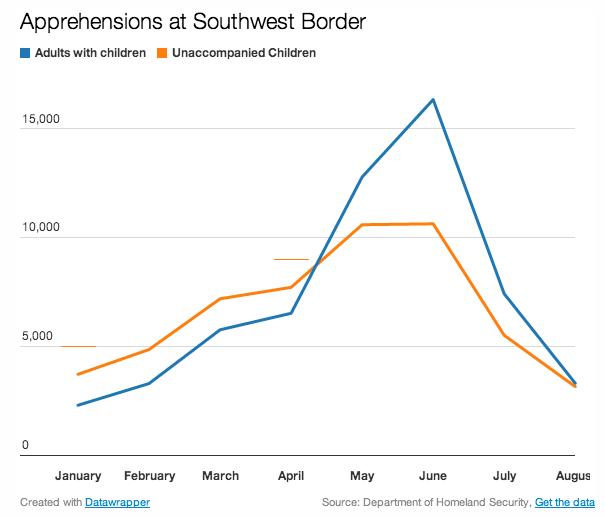
The influx of migrant children into the US has plunged in the past two months, “from more than 10,600 apprehended in June to just over 3,000 in August”:

One major culprit is the hot summer weather, which could discourage migrants from making the journey from Central America to the United States. But at the same time, the Obama administration has engaged in an aggressive public-relations offensive in Latin America to warn parents against sending their children here. And immigration courts nationwide have expedited processing cases of the migrants recently caught at the border, putting those hearings ahead of others in line. “The system is, by and large, working,” said Kevin Appleby, the director of migration policy for the U.S. Conference of Catholic Bishops. “If anything, they need to ensure that the children are receiving the appropriate due process and we’re not violating our own law or international law.”

But Danny Vinik isn’t celebrating:

The ultimate answer is that we just don’t know why so many unaccompanied minors came across the border this year or why it is falling now. One reason may be that the administration ran multiple ad campaigns to deter parents from sending their kids north, explaining that the journey is dangerous and the kids wouldn’t be allowed to stay. The Mexican government also stepped up enforcement on its side of the border. And the weather may be having an effect as well. It’s still tough to tell the exact reasons. Given that, it would be foolish to make sweeping policy changes, like House Republicans voted to do before the August recess.

That’s not to say this situation does not require action. The thousands of kids who came across the border still need housing and food. The immigration courts are still backlogged. This crisis isn’t over. But it’s a different one than policymakers originally imagined. It’s not about border security or stopping the flow of unaccompanied minors. It’s about fairly handling the ones who are already here. That’s a very different problem.

(Chart via Vinik)

The Immigration Can Gets Kicked Down The Road, Ctd

Heaping scorn on Obama for delaying action on immigration, Beutler fears that the decision will come back to bite the president and his party should Democrats lose the Senate:

Obama will have placed himself in an incredibly awkward position. He will still be bound by his modified pledge to announce deportation relief before the end of the year, but will have to act in the aftermath of an election Republicans just won opposing what they tendentiously describe as “executive amnesty.” They’ll rewrite the story of their victory around their position on deportation.

The delay might also motivate some Democrats to stay home in November, Suderman suggests:

The potential flip side … is the move could depress turnout amongst pro-immigration Democrats. And it’s clear that immigration activists are not happy. The administration says the move is still coming, but there’s skepticism that it could be put off permanently.

“All the progress we’ve made over two years was destroyed in six weeks,” ImmigrationWorks USA head Tamar Jacoby told The New York Times. “Given the string of broken promises from this president to the Latino community on immigration, there is a real question as to whether he will follow through,” America’s Voice director said to the paper. But the administration seems to have decided it’s worth the risk. Basically, the White House is betting that the GOP’s negative response to a pre-election announcement would be more significant than whatever effect this has on Democratic turnout.

Sargent, on the other hand, sees Democrats playing a long game:

Democrats have an interest in seeing this happen just before the GOP presidential primary, because it makes it more likely the GOP candidates will out-demagogue one another in calling for Obama’s protections from deportation for millions to be rolled back, pulling the GOP field to the right of Mitt Romney’s “self deportation” stance in 2012.

Byron York shakes his head at the way Obama has punted on this issue for years:

During the days when his power was at its peak, Obama pursued higher-priority issues even as he led immigration activists to believe they were up next. Which leads to the conclusion that perhaps immigration reform — the substance of it, not the politics — has never been all that important to the president. Now, there’s still something more important: protecting vulnerable Democrats from voter disapproval of unilateral presidential action on immigration. Obama says he will finally act, after the election, after voters can no longer hold him or his party accountable. But who knows? Maybe something more important will come up yet again.

Douthat holds out hope for a less imperial solution:

[T]here is another possibility, which is that Caesarism delayed will eventually become Caesarism eschewed altogether … or else that Obama will eventually do something unilaterally on immigration, but it will be much more modest (a down payment on reform, the White House can tell activists) than what’s been floated and promised these last few months. Maybe the politics will keep looking somewhat ugly, maybe Democrats up for election in purple states in 2016 will pressure Obama to keep punting — or maybe the president will actually heed some of the criticism of his plan and revert to a more modest conception of how presidential power should be exercised on this issue. I’m not such a cynic that I don’t believe the last scenario is impossible, and it’s a good reason for the White House’s critics to be pleased with this delay: Sure, it could be setting us up for an even balder power grab in four months, but where there’s procrastination there’s hope, and a journey away from executive overreach could begin with exactly this kind of step.