The Immigration Can Gets Kicked Down The Road

ICE Detains And Deports Undocumented Immigrants From Arizona

Obama is delaying his executive order on immigration deportations until after the elections. Jonathan Cohn spells out the political logic of the move:

Vulnerable Democrats seeking reelection let the White House know, publicly and privately, that they feared an executive order would deal serious, maybe fatal, blows to their candidacies: While the ensuing debate would energize immigration reform supporters, particularly Latinos, it would also energize the conservative base. Given the political geography of the 2014 midterm elections, in which control of the Senate will depend on the ability of Democrats to hold seats in red states like Arkansas and North Carolina, the political downside seemed bigger than the political upside.

But Ezra Klein has a hard time squaring this political calculation with the White House’s former rhetoric:

This is the problem with the White House’s decision — and, to some degree, the way they’ve managed this whole issue. If these deportations are a crisis that merits deeply controversial, extra-congressional action, then it’s hard to countenance a politically motivated delay. If they’re not such a crisis that immediate action is needed, then why go around Congress in the first place?

Cillizza sees signs of political malpractice:

[W]hat Obama and his senior aides failed to account for — or underestimated — was the blowback from within his own party to a major executive action by an unpopular president on an extremely hot-button issue.  (Worth nothing: Obama’s approval numbers eroded steadily over the summer and into the early fall; his political standing today is weaker than it was when he pledged action on June 30.)  The move, it became clear, would have been seen as bigger than just immigration as well; it would have been cast (and was already being cast) by Republican candidates and strategists as simply the latest example — Obamacare being the big one — of federal government overreach.

This disconnect between the long-term legacy building prized by Obama and the near-term political concerns of many within his party is not new but, quite clearly, became a major point of tension.

Beutler is puzzled:

The political reasoning sounds incredibly straightforward. Most of the Senate Democrats running in tightly contested elections represent conservative states with low immigrant populations and deep hostility to “amnesty.” So why introduce more uncertainty into those campaigns, and potentially ignite a fire under the GOP base, when you could just as easily wait six weeks?

But it also seems suspiciously simple to me. That’s in part because I don’t entirely understand how much cover you buy for vulnerable Democrats if you put off the official announcement, but tell the press that the dreaded amnesty is coming just a few weeks later.

PM Carpenter is befuddled by the White House “political operation’s second-term bumbling”:

Now, everybody is pissed off. Immigration activists are screaming “betrayal” and “broken promise;” a major labor union is “deeply disheartened”; the nation’s most influential Spanish-language news anchor has denounced the delay as “the triumph of partisan politics”; Republicans are gleefully outraged; and Democrats are stuck with defending an executive action that never was, but still will be–“I’m going to act because it’s the right thing for the country,” said the president [Sunday] on “Meet the Press”–thus it might as well have been.

Gabriel Arana takes the president to task:

Given how long immigrants have had to wait for any sort of relief from the fear of deportation, another few weeks may seem like no big deal — that is, of course, if you’re not one of the tens of thousands of people who’ll be kicked out of the country while the president waits out the midterms.

But for many immigrant-rights supporters, the delay shows the president doesn’t understand the moral crisis at the heart of the immigration debate, in which those looking to escape poverty get branded as parasites, their children as “anchor babies.” Our dysfunctional immigration system has created a powerless class of millions of people; without the ability to vote or to advocate on behalf of themselves in public, they have no choice but to wait for our politicians to take sympathy. Lawmakers all “play politics,” but extending the suffering of this vulnerable population because it might save you a few votes at the ballot box is yet another sign you don’t fully consider them Americans.

How Tomasky sees this playing out:

Despite whatever acidic rhetoric Latino leaders are dishing out toward Obama today, I would expect that will change this fall. He’ll announce his unilateral moves on immigration after the election. The Republicans will boil with rage. In all likelihood, they’ll move to impeach. So then we’ll have the spectacle of one party—the party that has blocked the passage of an immigration bill in the first place—seeking to throw a president of the other party out of office for trying to do something on immigration that he wouldn’t have had to do if the first party hadn’t spent two years refusing to pass a bill. It’s pretty clear which side of that fence the vast majority of Latinos are going to come down on.

(Photo: A Honduran immigration detainee, his feet shackled and shoes laceless as a security precaution, boards a deportation flight in Mesa, Arizona to San Pedro Sula, Honduras on February 28, 2013. By John Moore/Getty Images)

Are We Abetting Central American Gangs? Ctd

Tomasky thinks we need to take a hard look at our own role in Central America’s descent into violence:

So in the three crisis countries, or at least in two of them (Guatemala and El Salvador), there’s a pattern. U.S.-sponsored civil wars tore the country apart in the 1980s. What happened next? As Ryan Grim and Roque Planas put it in a terrific Huffington Post piece tracing this history in greater depth, “With wars come refugees.” Terrified citizens of these nations started running to the United States by the tens of thousands.

When they got here, there was nothing for them. Depending on how old they were, they or their kids formed gangs in Los Angeles and elsewhere in the 1990s. We responded to that by “getting tough” on crime, throwing thousands of them in jail. Then when they got out of jail, we deported them back. We escalated the drug war—we had some success in Colombia, which merely pushed much of the cocaine trade into Central America. The ex-gang members we deported created extremely violent societies, societies where 10-year-old kids are recruited into new gangs and threatened with death if they don’t join, and it’s from those societies that today’s children are fleeing.

But Robert Brenneman stresses that the situation there is not as hopeless in as the prevailing narrative would have you believe:

While it is true that many of the children who reach the US border have grown up in difficult and even dangerous situations and ought to be granted a hearing to determine whether or not they should be granted asylum, I have Central American friends (including some from Honduras) who might bristle at the suggestion that every child migrating northward is escaping life in hell itself. The idea that all Central American minors ought to be pronounced refugees upon arrival at the border rests on the mistaken assumption that these nations are hopelessly mired in violence and chaos, and it encourages the US government to throw in the towel with regard to advocating for economic and political improvements in the region.

True, a great deal of violence and hopelessness persists in the marginal urban neighborhoods of San Salvador and Tegucigalpa, but these communities did not evolve by accident. They are the result of years of under-investment in social priorities such as public education and public security compounded by the entrance in the late 1990s of a furious scramble among the cartels to establish and maintain drug movement and distribution networks across the isthmus in order to meet unflagging US demand. At the same time as we work to ensure that all migrant minors are treated humanely and with due process, we ought to use this moment to take a hard look at US foreign policy both past and present in order to build a robust aid package aimed at strengthening institutions and promoting more progressive tax policy so that these nations can promote human development, not just economic growth. It is time we take the long view with regard to our neighbors to the south.

Previous Dish on our role in the Central American crisis here and here.

Boehner’s Border Bill, Now With Cruz Control

Late Friday night, just before heading home for their August recess, House Republicans passed a bill to address the child migrant crisis. To do so they threw an abattoir of red meat to the right flank – pledging less than a fifth of the resources that Obama says he needs and simultaneously reinforcing deportation for the half a million DREAM Act kids. It won’t pass the Senate, of course, but it gives House Republicans a Potemkin vote they can cite when they face their Hannityed constituents this month. It’s hard to beat Weigel’s wit:

Just one year ago, Republicans were talking about passing their own version of the DREAM Act. Tonight, they put the party on record for the total cessation of Barack Obama’s quasi-DREAM Act. The arc of history is long, but it bends toward Steve King.

And a certain congresswoman from Minnesota, as Chait notes:

A party that began the Congressional term hoping to move left from Mitt Romney’s immigration stance has instead moved toward Michele Bachmann’s. (Bachmann — who, along with Steve King, helped draft the House bill — pronounces herself thrilled.) The party’s new dogma will potentially entangle its next nominee in an even less humane debate than the one that ensnared Romney. At the very least, it has put 216 House Republicans, many of whom will one day seek higher office, on record for a policy most Latino voters consider disqualifying. The aye votes include potential 2016 presidential candidate Paul Ryan, who is not likely to be greeted by friendly mariachi bands any time soon.

It is understandable that the party’s Congressional wing, based mostly in safe, deep-red districts, has failed to craft a national strategy for its 2016 candidate. But the House’s course of action has fallen well below “unhelpful” and instead verges on outright sabotage. How do they think this is going to work out for them?

Why the change of heart? A political system so gerrymandered and a country so demographically sorted no Republican need persuade a single Latino this fall in order to get re-elected. Nate Cohn elaborates:

Hispanic voters are all but absent from this year’s most competitive Senate battlegrounds. … Hispanic voters will have even less influence over the composition of the House, which is all but assured to remain in Republican hands. The clearest illustration of the extent to which the House G.O.P. is insulated from Hispanic voters is this: The party easily held the House in 2012, even though Republicans won only 30 percent of the Hispanic vote for Congress, and even though Hispanic turnout in that presidential year was higher than in a midterm election.

The reason is simple. In districts held by House Republicans, Hispanics represent only 6.7 percent of eligible voters. The Hispanic share of eligible voters is nearly as low in the House battlegrounds, 7.4 percent. Most of those Hispanic voters are only in a few districts; the G.O.P. could afford to lose them given their healthy edge in the House.

But Cillizza argues that their PR problem is bigger than that:

This is the latest in a string of incidents in which Republicans have been their own worst enemy — often because they simply can’t get out of their own way. Given their dismal approval ratings, the best way for Republicans to handle almost every issue — including this one — is to make as few waves as possible. Stay out of the news. Let President Obama do the heavy lifting on what the funding level ends up as. This issue is a no-win politically — people don’t like the idea of kids being shipped back to dangerous places but also don’t love people coming here illegally or spending billions of dollars that may or may not solve the problem.

And yet, Republicans found a way to make the story all about them in the dying days of this session of Congress. It’s remarkable — and not in a good way.

Cruz Missile Shoots Down Border Bill

The House’s modest emergency spending bill to address the child migrant crisis was scuttled yesterday after the GOP leadership failed to convince the Tea Party caucus to vote for it. I harrumphed about it last night. Cillizza breaks down how it happened, for anyone who can’t already guess:

The failure of the GOP leadership’s immigration solution fits a now-familiar pattern for congressional Republicans. Led by Boehner, the party’s top brass fight with President Obama on the parameters of a legislative solution to a problem in the country.  In hopes of answering the “do nothing” charges leveled at them by Democrats, those same GOP leaders put a proposal on the table that offers a handful of concessions but nowhere near the number the White House is demanding. The tea party faction in the House — led by Sen. Ted Cruz (yes, you read that right) — balks, demanding that the GOP make no concessions of any sort to the president. The party leaders whip support for the bill but, ultimately, find that 20 (or so) of their conference will not be for it under any circumstances. That means Boehner either has to a) pass legislation with Democratic votes or b) pull proposals off the House floor to avoid embarrassing losses.

The issues change — tax increases, immigration, the farm bill and so on and so forth — but the underlying reality remains the same: House Republicans simply cannot be led.

Chait, too, has seen this show before:

The House is a highly autocratic chamber that traditionally passes basically anything the leadership of its majority party wants to pass. The Tea Party has changed all that, by bringing to Washington a large enough bloc of Republicans who don’t want to vote for anything that they can bring down even bills that are far too conservative to be passed into law. That’s why House Republicans have had to pull bills to lift the debt ceilingextend tax cutsextend farm subsidies, and reopen the government. In Boehner’s House, failure is always an option.

This particular bill pitted the GOP’s desire to actually stop waves of illegal immigration children from streaming across the border — theoretically a point of bipartisan agreement — against their distrust of Obama in particular and legislation in general. Republicans dealt with the problem, as they often do, by crafting the most conservative possible bill — thus losing all Democratic support — yet still not often to win support from enough Republicans.

Vinik looks at the role Cruz played:

Since his election in 2012, Cruz has angered a number of his Senate colleagues. He was the architect of the “defund Obamacare” movement last year that ended in a politically toxic government shutdown and eventual Republican capitulation. In February, Cruz forced some of his Republican colleagues to take a politically-damaging vote to raise the debt ceiling. In all of these situations, Cruz has been focused on his own political future, staking out a position as far to the right as he can. He didn’t care that his antics damaged the party. They were good for Ted Cruzand that’s what mattered.

That’s what happened again on Thursday with the House GOP’s bill to address the border crisis. And it’s going to continue happening in the future, particularly on immigration-related issues where Cruz has always taken a hard line position.

Ben Jacobs remarks on what a blow this is to the party leadership:

The failure of the vote, which comes just before Congress’s August recess, means it is unlikely that any additional funds will be allocated to deal with the border crisis until September at the earliest—and also signals the official death of the Senate comprehensive immigration reform bill. It also marks yet another political defeat for Boehner and House leadership in what was the first test of new Majority Whip Steve Scalise, who recently took over the position when former Whip Kevin McCarthy ascended to Majority Leader. McCarthy replaced Eric Cantor, who stepped down after losing his primary last month to anti-immigration candidate Dave Brat.

Scalise, as whip, is responsible for party discipline and making sure that Boehner has an accurate sense of how many votes he has within the GOP caucus on a particular bill. This was the first controversial vote that the Louisiana conservative had to organize Republicans for in his new position, and it’s clear that he wasn’t able to rally as much support among GOP backbenchers as he initially thought.

After the bill failed, Boehner and his deputies suggested that the president take executive action on the crisis instead, which was pure political gold for Democrats, and pretty rich at that:

Democrats got plenty of yuks out of the House GOP’s response to the failure. In a joint statement, the party’s four House leaders attempts to move blame and the buck back over to Barack Obama. “There are numerous steps the president can and should be taking right now, without the need for congressional action,” they wrote, “to secure our borders and ensure these children are returned swiftly and safely to their countries.” Faiz Shakir, an adviser for Harry Reid, immediately tweeted the punchline: “The same people who are suing the president for taking exec action are calling on him to take exec action.” A little cute, maybe, but for the umpteenth time—the first day of a new leadership team!—the House GOP leadership has stepped on a rake.

Noah Rothman is disappointed for reasons of politics, not policy:

Lacking the authority to resolve the border crisis on their own, the House GOP sought an advantageous position for the summer in order to put the onus back on the president. That effort failed and, unless the House Republicans’ emergency scramble to craft and pass some border measure is fruitful, GOP members will spend the summer explaining to the press why they did nothing on a “crisis” but were perfectly united when it came to suing the president. And the average Democratic base voter will be that much more energized for it. …

This was an unforced error. One which serves to elevate the careers of a few while diminishing the party’s overall chances for success in November. The House Republicans may yet correct this mistake, and the damage might be mitigated if they do. But if they do not, this is going to be one long August recess.

But the Bloomberg View editors refocus on the fact that the child migrant crisis is, y’know, a crisis:

The protection of refugees — legitimate and otherwise — is both a moral crisis and a policy challenge. These children are a genuine strain on the immigration system, and adjudicating their cases will cost money. At the same time, many have fled violence and deserve a chance to make their case for asylum. Meanwhile, House leaders have delayed a planned recess, in the apparent hope that they can still achieve the goal of appearing to do something. When members return, Election Day will be that much closer. It’s not easy to imagine that this Congress could reach new lows. But it may.

Boehner’s Border Bill

The House has introduced a bill to deal with the migrant children crisis, offering far less money than the $3.7 billion Obama had requested and focusing mainly on tightening border controls:

The House bill attempts to relieve backlogged immigration courts by allowing those Central American children to be treated as if they were Mexicans, who are screened more quickly by the U.S. Customs and Border Patrol. House Minority Leader Nancy Pelosi and Senate Majority Leader Harry Reid oppose changing that provision, arguing it would grant the unaccompanied minors fewer legal protections and that there are other ways of speeding up immigration cases. The Obama Administration supports the policy change.

House Appropriations Chairman Hal Rogers broke down the House bill into three pots of funding: border control, temporary housing and foreign aid to Guatemala, Honduras, and El Salvador. The majority of the money, $405 million, is set aside to boost the Border Patrol and Immigration and Customs Enforcement. Another $197 million would be allocated for the Department of Health and Human Services, which is charged with taking care of the migrant children until their family members or guardians can be found while the minors’ immigration cases are handled. There’s also $22 million in funding to hire judges and speed up judicial proceedings, $35 million to send the National Guard to the border and $40 million to support uniting the families in the aforementioned Central American countries. The bill would cover the costs through the end of September.

But with anti-immigration hardliners like Ted Cruz and Jeff Sessions pushing for the bill to include language blocking deferred action for childhood arrivals (DACA), Sargent questions whether even this bill can pass the House:

GOP leaders are resisting the inclusion of such language. But it needs to be stated once again that Cruz, King, and Sessions are not outliers in this debate. Broadly speaking, their position on this crisis — and on immigration in general – is the GOP position writ large.

Republican leaders don’t want to include any measure against Deferred Action for Childhood Arrivals in the current border plan because the politics are terrible. That would entail responding to a crisis involving migrating minors not just by expediting deportations (which the current GOP bill would do), but also by calling for still more deportations from the interior. But the GOP leadership’s position is only that they don’t want any anti-DACA language in their current response to the crisis. The GOP position writ large is still that we should deport all the DREAMers, block Obama from any further executive action to ease deportations, and not act in any way to legalize the 11 million.

Cruz et al. aren’t the only ones trying to advance their agendas through the bill, though. Senate Democrats are looking to tack on the “Gang of Eight” comprehensive immigration reform package, though Boehner says “no way”. Allahpundit quips:

He can’t turn around in the middle of a border crisis, three months out from the midterms and with Dave Brat having nuked Eric Cantor on immigration, and agree to amnesty. Try him again next year, though!

Public opinion, meanwhile, may be breaking in favor of a generous response to the underage migrants. Emma Green flags a new poll that seems to suggest as much:

How does America see the children who arrive at its border? According to a new poll from the Public Religion Research Institute, the answer is “sympathetically.” The survey found that 69 percent of respondents thought these kids “should be treated as refugees and should be allowed to stay in the U.S. if authorities determine it is not safe for them to return to their home country,” and roughly the same percentage said the government should provide them with shelter and support. Only 27 percent said they “should be treated as illegal immigrants and should be deported back to their home countries.”

But the respondents were more ambivalent about immigrants in general. While 56 percent agreed that Central American families are trying to keep their kids safe in “very difficult circumstances,” another 38 percent said they are “taking advantage of American good will and really seeking a back door to immigrate to our country.” And 42 percent said that immigrants are a “burden on the country” because “they take our jobs housing and healthcare”—a seven-point increase compared to another poll that asked the same question in early July.

Borderline Politics On The Right, Ctd

immigration3

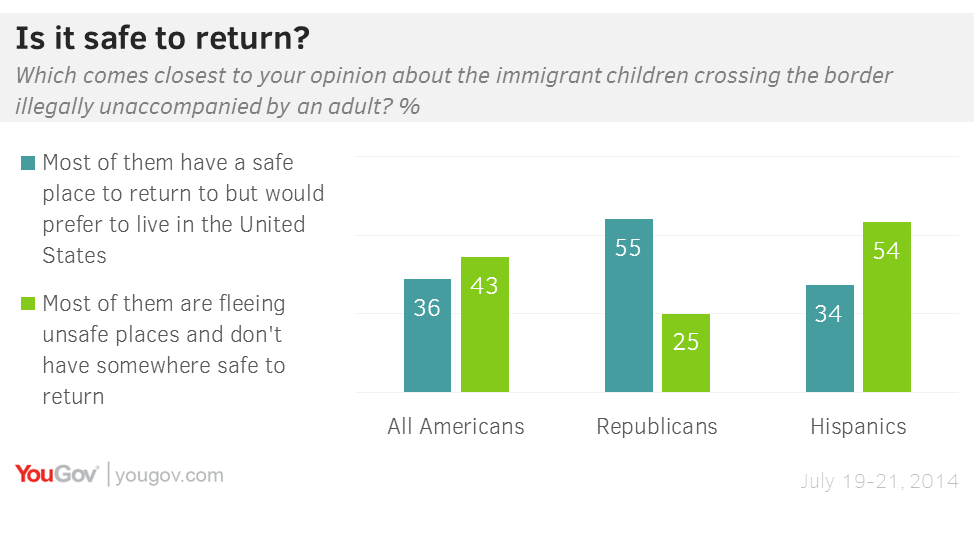
A new Economist/YouGov poll further illustrates the widening partisan gap on immigration and the isolation of Republicans in particular:

While most say they have at least some sympathy for the children, a majority of Republicans reports little or no sympathy. More than three in four Hispanics say they are sympathetic, and a majority of Hispanics report “a lot” of sympathy for the children. That reflects the large differences in these groups in how they judge the children and their motivations in coming to the United States. Overall the country is closely divided on whether the children now coming to the United States illegally are fleeing unsafe situations in their home country or have safe homes but would just rather live in the United States. Republicans see the children as coming from safe places; Hispanics, and a plurality of the public overall, do not.

This apparent nativist turn augurs poorly for the GOP, Molly Ball believes:

In the past, contrary to popular belief, support for immigration reform has seldom been toxic in Republican primaries. (A notable exception came four years ago in Georgia, when Nathan Deal ran to the right on immigration on the way to winning his gubernatorial primary and the governorship.) But the current crisis on the border has inflamed the perpetual hot-button issue, particularly among the vocal minority of the Republican base for whom the only acceptable “reform” is mass deportation. And candidates like [David] Perdue are exploiting the issue as a wedge.

That’s bad for immigration reform, which was already stalled largely because of House Republicans’ fear of just this sort of political backlash. And it’s probably bad for the long-term prospects of the Republican Party, whose elites are convinced its future national success rests on increasing its share of the Hispanic vote—a process they believe must start with passing immigration reform. Here’s a representative take from Tom Donohue, president of the (100 percent, openly pro-amnesty) Chamber of Commerce: “If the Republicans don’t do it, they shouldn’t bother to run a candidate in 2016,” he said in May.

But George Will wants to welcome the child migrants with open arms and make them into Americans:

I’d like to second the motion. If America cannot find a place for children fleeing terror and crime and violence, then America is no longer America. Hugh Hewitt, to his great credit, put forth a similar proposal earlier this month. Will and Hewitt may be on to something, Zach McDade explains, because children of immigrants now make up the majority of American children:

It’s a demographic fact that gets surprisingly little attentionthe fact that, if not for immigrants and their children, the U.S. child population would be shrinking. There are more than 17 million children with at least one immigrant parent in the U.S. They represent over a quarter of the 70 million people under 18 years old. Their proportion will grow over time, as the number of children born to non-immigrant parents declinesin both relative and absolute terms.

This matters, because today’s young people make up tomorrow’s productive workforce, generating economic activity and supporting retirees. We already face a declining young-to-old population ratio, putting huge strain on Social Security and other safety net programs. The children of immigrants will provide a crucial and growing buffer against this demographic shift.

Obama’s Border Crisis Plan

Late last week, Obama rolled out a proposal to start processing refugee status applications from young, would-be migrants in Honduras before they make the treacherous northbound journey (NYT). The pilot plan, which could be expanded to El Salvador and Guatemala, envisions receiving around 5,000 refugee applications and accepting 1,750 of them over the first two years, at a cost of $47 million. Alec MacGillis applauds:

There is no shortage of questions that immediately spring to mind. Doesn’t 5,000 applicants seem awfully low, given that since October 1 more than 16,500 minors have traveled to the U.S. border from Honduras alone? How would the U.S. personnel at the embassy in Tegucigalpa decide which young applicants were so threatened by gang violence that they qualified for the coveted status and entry to the U.S.? What would this new approach mean for the young Central Americans who already made the risky journey to the U.S. in recent months?

But the proposal comes with two clear benefits, one substantive and one political. First, it is a big step toward addressing the immediate humanitarian crisis: It will deter at least some young people from making the dangerous trip, thereby reducing demand for the migrant traffickers who are profiting off the children’s desperation. … Shifting the entry point for at least some of the young Central Americans to their countries of origin will hopefully redefine the problem as what it is: a challenge to our country’s laws and policies on asylum, which as now written do not directly address the plight of young people in gang-ravaged societies; and, more broadly, a reckoning with our responsibility to our southern neighbors.

But Roberto Ferdman outlines why the proposal won’t be enough on its own and could have unintended consequences:

The current proposal, which assumes that some 5,000 children will apply in Honduras, would cost nearly $50 million over the course of two years. And Guatemala and El Salvador might see a similar program implemented if the pilot is deemed successful. But less than 2,000 children would be selected from those that apply in Honduras. That’s a mere fraction of the more than 16,000 that have been apprehended at the U.S. border this year (and the thousands more that are likely still in transit).

There’s also the potential for confusion over the definition of the word refugee. The U.S. launched similar screening programs in Vietnam in the 1970s and in Haiti in the 1990s. But those were set up in the aftermath of a war and devastating hurricane, respectively. “There’s serious worry that if the proposal is enacted it will stretch the current meaning of the word refugee,” [Columbia University political scientist Carlos] Vargas-Ramos said.

Why Honduras, any way? Well, because it’s the worst off:

Honduras has the highest murder rate of any country in the world. According to the latest report from the U.N. Office of Drugs and Crime, the Central American nation saw 90.4 homicides per 100,000 people in 2012. The majority of the violence in Honduras is carried out by two main gangs, Mara Salvatrucha, or MS-13, and Barrio 18. Both were created in Los Angeles by Salvadoran immigrants, between 2001 and 2010. The U.S. deported more than 100,000 convicted members of both gangs back to Central America, where corrupt law enforcement and political instability—particularly in Honduras, which underwent a coup d’état in 2009—allowed them to spread out and take control of entire cities, kidnapping, torturing, and brutally murdering anyone standing in their way. San Pedro Sula, Honduras’s second largest city and a gang stronghold, is considered the most dangerous city in the world. According to the CIA World Factbook, Honduras had 17,000 refugees or people displaced within the country as a result of extortions, threats, or forced gang recruitment in 2013.

Jeremy Relph reports from the country’s Bajo Aguán region, where land disputes and government corruption are keeping the violence going:

These days Bajo Aguán is virtually off-limits to the country’s army and police. Campesinos have been the victims of private security and government forces, and the Honduran government has done little to halt it. The ruling right-wing National Party protects rich landowners. They’ve focused on maintaining security and addressing violence with force. The left paints the campesinos as victims and pacifists. At stake is fertile land, and massive profits.

Bajo Aguán is the rural center for palm oil production and land rights battles. Palm oil is in everything from Ben & Jerry’s ice cream to Johnson’s baby shampoo to Pringles. During the last decade, large energy companies like BP have begun heralding palm oil as the next green biofuel. Across Africa the spread of plantations has threatened chimpanzees with extinction. In Indonesia and Malaysia, the world’s leading producers, its extraction is linked to human rights abuse. Honduras is no different.

In an interview with Susan Glasser, Honduran president Juan Orlando Hernández articulates his understanding of how the American drug war has contributed to his country’s crisis and what the US should do differently:

We all share responsibility, from those who produce the drug to the transit countries, but also the country that uses the drugs. And the United States is the great consumer of the drugs. The advantage that you have here—if you can call it an advantage—is that the violence has been separated from the transit of drugs. That’s why for many officials and public servants the drug problem in the United States is one of public health. In Central America, the drug problem is life or death. That’s why it’s important that the United States assume its responsibility. … A Central America at peace, with less drug violence, and with opportunities, is a great investment for the United States. On the contrary, if they are only investing in border security and not in the source of the problem, in the genesis of the problem, then we will have more of the same.

No Country For Young Women

U.S. Agents Take Undocumented Immigrants Into Custody Near Tex-Mex Border

Among the many horrors that the Central American refugee children are fleeing, Mónica Ramírez and Anne Ream focus on the epidemic of sexual violence, which is often ignored, or even committed, by the police:

One key factor driving this crisis is the well-documented and widespread sexual and gender-related violence in Latin America. In a 2014 report conducted by the UN High Commissioner for Refugees, 70 percent of children interviewed cited domestic violence as well as violence at the hands of gangs, cartels, or “state actors” (such as police), as reasons for fleeing homes in Mexico and Central America. Sexual violence has become so widespread in Guatemala in recent years that in 2009 Doctors Without Borders launched its first Latin American mission dedicated to treating rape and abuse victims. And gender-based violence is now the second highest cause of death for women of reproductive age in Honduras. …

Anti-violence advocates on the ground say that two factors drive the high incidence of sexual and gender-related violence in the region: a lack of awareness about the nature of gender-based violence, which has historically been downplayed or normalized, and the absence of official efforts and channels that might encourage reporting of such crimes. The fact that law enforcement and judicial systems are most often dominated by men who are disinclined to pursue sexual violence or trafficking cases, and may in fact be implicated in such violence themselves, further exacerbates the crisis.

Previous Dish on the chaos in Central America here and the child migrant crisis here.

(Photo: An undocumented immigrant sits after being detained by U.S. Border Patrol agents some 60 miles north of the U.S. Mexico border on July 23, 2014 near Falfurrias, Texas. She said she was from Guatemala, one of a group of immigrants Customs and Border Protection agents caught moving north through dense brushland in Brooks County. By John Moore/Getty Images)

An Executive Solution To Immigration?

In the face of a hopelessly deadlocked Congress, Ronald Brownstein expects Obama to act alone on the border crisis and on immigration reform more broadly. His chosen course of action, Brownstein adds, could have major consequences for the Republicans:

The president can’t provide [illegal immigrants] citizenship without action by Congress. But using the same theory of “deferred action” that he employed in 2012 for children brought to the U.S. illegally by their parents, he could apply prosecutorial discretion to allow some groups of the undocumented (such as adults here illegally with children who are U.S. citizens) to obtain work permits and function openly. Though the administration is still debating the reach of Obama’s authority, some top immigration advocates hope he could legalize up to half of the undocumented population.

Such a move would infuriate Republicans, both because the border crisis has deepened their conviction that any move toward legalization inspires more illegal migration and because the president would be bypassing Congress. They would likely challenge an Obama order through both legislation and litigation. Every 2016 GOP presidential contender could feel compelled to promise to repeal the order. Those would be momentous choices for a party already struggling to attract Hispanics and Asian-Americans.

Francis Wilkinson agrees that executive action is the only way forward, even though it will infuriate conservatives:

If Obama defers deportation for a large number of undocumented immigrants, calls for his impeachment may expand beyond the back benches of Congress. But Obama has already deferred deportation for the young “Dreamers” who qualified for his 2012 Deferred Action for Childhood Arrivals. When House Speaker John Boehner outlined his proposed lawsuit against the president for allegedly exceeding his powers, Boehner, no doubt mindful of his party’s poor reputation among Hispanic and Asian voters, focused on Obama’s implementation of the health-care law and left DACA out of the complaint.

A broad amnesty would no doubt inspire legal actions and political recriminations. But Obama is already reviled by anti-immigration activists and Republicans, who will be no more willing to compromise tomorrow than today. Perhaps foolishly, Obama whetted the appetites of pro-immigration forces for bold executive action. Their energy and expectations are high. With Democrats on the cusp of solidifying Hispanic support, perhaps for a very long time, the prospect of alienating Hispanic voters through timidity or inaction may now be the more dangerous route.

Borderline Politics On The Left

Josh Kraushaar casts doubt on the notion that immigration reform is a winning issue for the Democrats:

The conventional wisdom has long held that immigration is the equivalent of Kryptonite for Republicans: If they don’t pass comprehensive reform, their party is writing its own extinction. Indeed, GOP officials have been publicly telegraphing their own vulnerabilities on the subject for years, highlighted by a 2013 RNC-commissioned report where immigration was the only policy area where the authors recommended the party moderate its positioning.

But what if that isn’t the case? A look at the current politics surrounding immigration suggest that Democrats are facing as much conflicting internal pressures from the current border crisis as Republicans face from their own base when it comes to “amnesty,” or legalizing illegal immigrants. President Obama is caught between his base, which has been pushing him to treat the migrants as refugees and settle them in the country, and the majority of voters, who believe that most should be returned to their home countries.

If the House Judiciary Committee’s numbers are correct, the base is winning that particular fight. Byron York relays the new figures, which show that “the ‘vast majority’ of unaccompanied minors seeking asylum are granted it before even appearing before a judge”:

“Information from U.S. Citizenship and Immigration Services (USCIS) that shows 65 percent of unaccompanied alien minors’ asylum applications have been immediately approved by asylum officers in Fiscal Year 2014,” says a Judiciary Committee statement. “And this is just the first bite of the apple. Many more cases can be approved later. Where an asylum officer does not approve the application, it is then referred to an immigration judge where the applicant can try again. If that fails, they can continue to appeal their case.”

The Judiciary Committee says asylum approval rates have “increased dramatically” under the Obama administration. Overall, according to the committee statement, “Approval rates by asylum officers have increased from 28 percent in 2007 to 46 percent in 2013 and approval rates by immigration judges in affirmative cases have increased from 51 percent in 2007 to 74 percent in 2013.” And that does not count appeals.

On the other hand, it’s not as though the GOP is offering any great alternatives. Alex Nowrasteh slams the Asylum Reform and Border Protection Act, introduced in the House last week, which would expedite deportation procedures for undocumented minors:

H.R. 5137 allows children apprehended at the border to be removed without any asylum screening to a “safe third party country” (i.e. Mexico) without an agreement from that country, as is required by current law. If H.R. 5137 becomes law, the U.S. government would immediately start dumping Honduran, El Salvadoran, and Guatemalan children into Mexico.

The crisis along the Southwest border has prompted many Americans to want all unlawful immigrants and children removed. But this bill goes far beyond that desire. H.R. 5137 would remove many foreigners who have legal rights under our current immigration laws. H.R. 5137 would be a disastrous blow to America’s asylum system and send numerous children with legitimate asylum claims back into danger.

Recent Dish on immigration politics and the border crisis here, here, and here. Read our complete coverage of the crisis here.