Are We Abetting Central American Gangs? Ctd

EL SALVADOR-GANGS-TRUCE

Alec MacGillis shines a light on US gun trafficking to Central America, making the argument that our loose gun regulations are contributing to these countries’ gang violence problem:

According to data collected by the ATF, nearly half of the guns seized from criminals in El Salvador and submitted for tracing in the ATF’s online system last year originated in the U.S., versus 38 and 24 percent in Honduras and Guatemala, respectively. Many of those guns were imported through legal channels, either to government or law enforcement agencies in the three countries or to firearms dealers there.

But a not-insignificant number of the U.S.-sourced gunsmore than 20 percent in both Guatemala and Honduraswere traced to retail sales in the U.S. That is, they were sold by U.S. gun dealers and then transported south, typically hidden in vehicles headed across Mexico, though sometimes also stowed in checked airline luggage, air cargo, or even boat shipments. (Similar ratios were found in traces the ATF conducted in 2009 of 6,000 seized guns stored in a Guatemalan military bunker40 percent of the guns came from the United States, and slightly less than half of those were found to have been legally imported, leaving hundreds that were apparently trafficked.)

“It is a problem,” says Jose Miguel Cruz, an expert in Central American gang violence at Florida International University. “The problem is we don’t have any idea how many [of the trafficked guns] there are. It’s a big, dark area.”

Cynthia Arnson, director of the Latin American Program at the Woodrow Wilson International Center for Scholars, tells Dylan Matthews that an effective US response to the crisis must address its root causes:

Of the $3.7 billion requested by the administration for dealing with the child migrant crisis, a very small percentage of it, about $295 million, goes to addressing root causes of the violence. I think that ever since the United States, starting with the end of the Bush administration, began to pay more attention to Central America as the drug violence was spilling over from Mexico to Central America, there’s been an overemphasis on security and controlling drug trafficking and also just not enough resources overall. …

There’s been a focus in the US and elsewhere in the region on capturing drug kingpins, but I think a lot of people who have looked at this, given the weakness of institutions, including police and law enforcement, including the judiciary, have said that a better approach is to try to reduce the violence connected with local illegal markets, and focus on providing citizen security to the general population. You can’t abandon the attempt to capture major traffickers, but you cannot do that without providing for safer communities and creating greater resilience at the individual and the community level.

Previous Dish on the violence in Central America and the US’s role in it here and here.

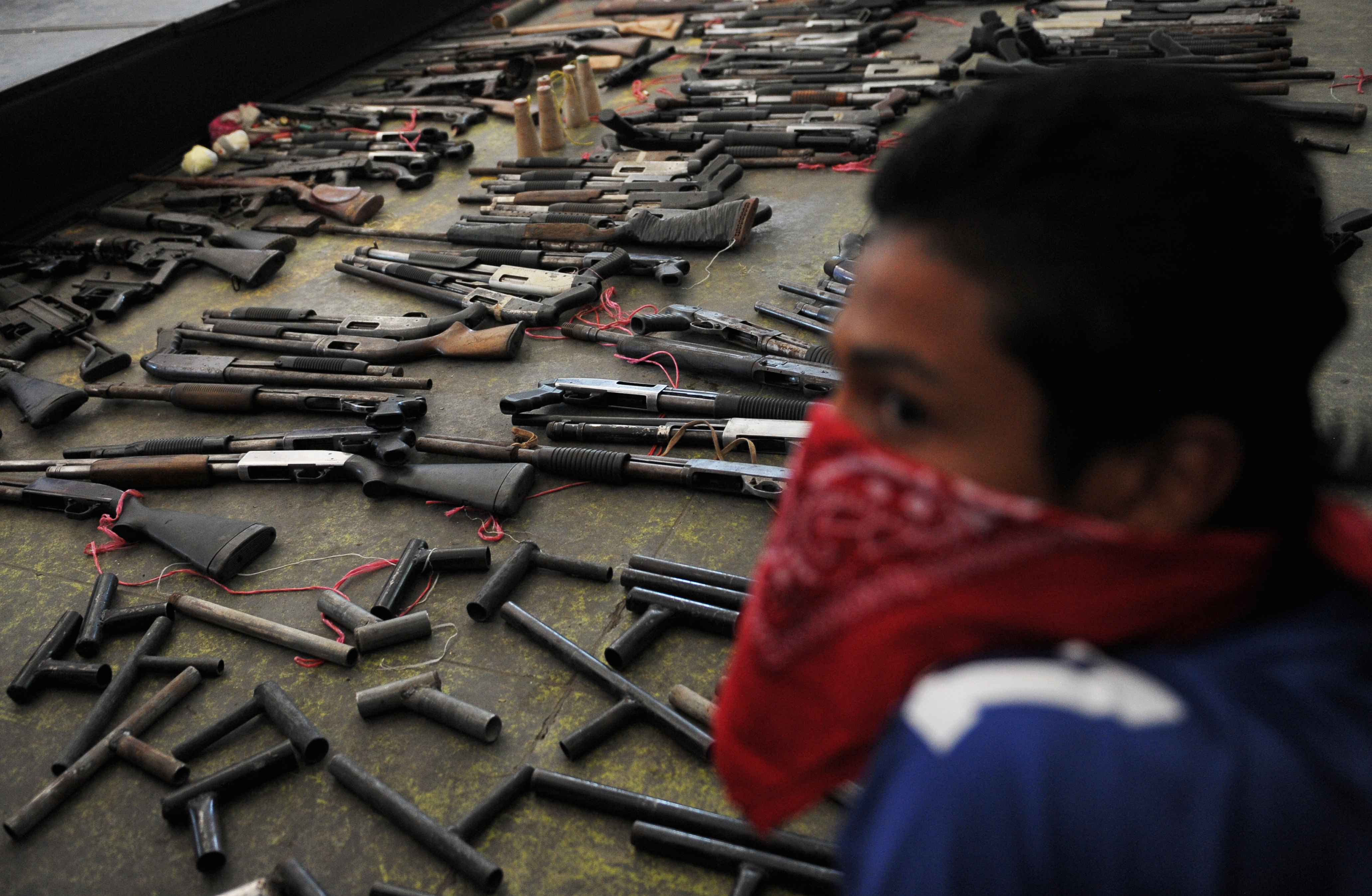
(Photo: A member of the “18 street” gang takes part in an event to hand in weapons in Apopa, 14 Km north of San Salvador, El Salvador on March 9, 2013. Gang leaders surrendered about 267 weapons as part of the truce process between gangs in El Salvador. By Jose Cabezas/AFP/Getty Images)
Migrant Children Get Their Day In Court

Screen_Shot_2014-07-16_at_4.32.56_PM

The going conspiracy theory on the right regarding the border crisis, trumpeted by Allahpundit last week, is that Democrats arguing for child migrant due process are secretly hoping that the kids skip out on their court dates and disappear into the general population. Dara Lind debunks that theory, pointing to new data that shows that most of the Central American refugee kids are appearing in immigration court as instructed:

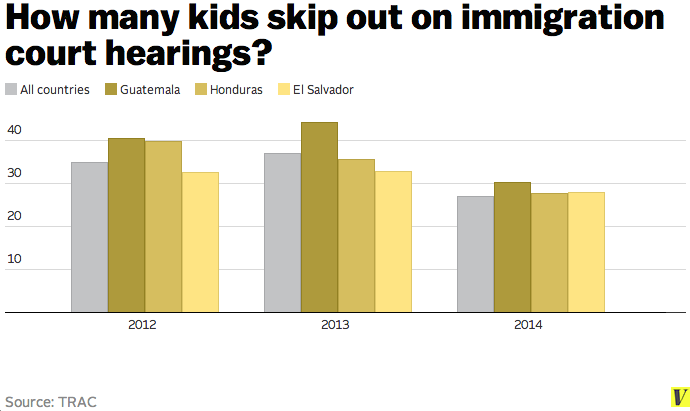
Previous data had shown that about 20 to 30 percent of children didn’t show up for their court hearings. The [Transactional Records Access Clearinghouse] data shows that that’s still holding true. Of all the kids with cases filed over the last decade whose cases have been closed, 31 percent were “in absentia.” That percentage is a little higher for cases filed over the last few years, possibly because there are more cases that are still pending from that time.

But the important question is: are Central American kids more likely to skip out on their immigration court hearings than other children? And the answer to that might be surprising.

This chart looks at children whose cases were filed in 2012, 2013, and 2014 — i.e. those who have arrived during the current surge — and whose cases have been completed as of June 30, 2014. (Many children whose cases have been filed since 2012 are still in the court process, so they theoretically have another chance to show up.) That means that it’s a good reflection of how many children who have come from Central America during the current surge end up skipping out on their hearings.

The data shows that Guatemalan children, at least, really do skip out on court hearings slightly more often than other children. But children from Honduras and particularly El Salvador are slightly more likely to show up for court hearings than children from other countries.

Borderline Politics On The Right

Contra Conn Carroll, Ross argues that Republicans in Congress need to do something about the border crisis:

It would be one thing if the G.O.P. genuinely didn’t think anything should be done about the current crisis: Then they could stand by their inaction on principle and blast the president for making extralegal moves. But the party’s official (and correct!) position is that we need more funding for immigration enforcement, both in the context of the current inflow and more generally, and that the Wilberforce Act’s guarantee of hearings should not be applied to most of today’s child migrants. Regardless of what the president does or doesn’t do, I just don’t see what Republicans lose from passing legislation that reflects both positions: If the president fails to execute it faithfully or if it ends up amended in some counterproductive way, they can attack the White House and the Democrats for that, without carrying the burden of looking like do-nothings who are weirdly demanded more of the kind of executive “creativity” they officially oppose.

But Ted Cruz is now pushing for any legislative response to the border crisis to include language ending the president’s Deferred Action for Childhood Arrivals program. Sargent comments on what this means for the prospects of Congressional action, as well as for the GOP’s public image:

Ted Cruz is essentially calling on Republicans to formalize in their legislative response to the crisis what is already their actual position on immigration in general. (House Republicans already voted in 2013 to end DACA.) And not only that, National Review reports that more and more conservatives are now giving voice to the Cruz stance, arguing that Republicans must not offer any legislative response to the crisis because Obama’s “amnesty” for the DREAMers proves he cannot be trusted to work with them even on the current border debacle.

In the short term, this Cruz gambit could make it tougher for John Boehner to get any border bill through the House, and increasingly reliant on Dems to do so. But beyond this, it’s a reminder that even if the crisis is very tough politics for Obama and Dems, it is also putting Republicans in a terrible position, dramatizing that they have only moved further to the right on immigration since their 2012 loss led to a big round of soul searching about how to broaden the party’s appeal beyond core constituencies.

Weigel theorizes as to why Cruz would throw such a bomb, knowing that a bill ending DACA has no real chance of passing Congress:

Well, Cruz believes in it, and as far as he’s concerned it focuses the blame for the current crisis on DACA. A worried House Republican aide (remember, lots of these people still sort of want the House to pass an immigration bill before the election) tells Joel Gerkhe that Cruz’s bill “could look like an overreach, particularly given how the mainstream media will distort it.” But Cruz has previously found that the media’s coverage of his effort bounces right off of Republican voters. He has been able to spin the 2013 Obamacare funding fight not as a tragic own goal on the GOP, but as the very reason Obamacare riled the 2014 electorate. It’ll be dead easy to tell Texas (and Iowa) crowds that he wanted to kill the border crisis at the root, but mushy Republicans failed to stand with him.

Allahpundit, in character, is disappointed that Cruz only wants to end DACA going forward, rather than repeal it entirely and re-outlaw the immigrants who have already benefited from the program. He sees that as a political choice, too:

If you already qualify for amnesty under DACA, you get to keep your amnesty. This is all about ending eligibility for future illegals, not taking it away from people who already have it. That makes sense in light of what I said above. Cruz wants to show that he’s tougher on illegal immigration than his GOP rivals but not so tough that he’s a punching bag for “YOU HATE CHILDREN!” attacks from the left. He’s willing to let children currently involved in the program keep their eligibility. Which makes this a miniature version of comprehensive immigration reform: So long as future waves of illegals are turned away, the ones who are already here enjoy legalization.

Previous Dish on the politics of the border crisis here and here.

How Americans See The Border Crisis

immigration2c

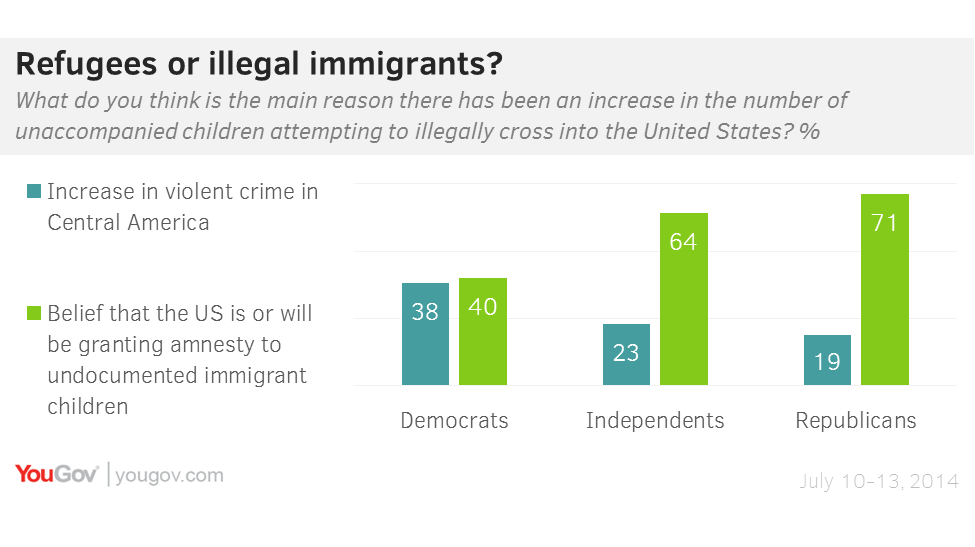
A new YouGov poll shows that more Americans attribute it to US immigration policy than to Central American gang violence:

The latest research from YouGov shows that most Americans (58%) think that the main reason behind the surge in child illegal immigration is a belief that the US is or soon will be granting amnesty to children. Only 27% think that the main cause is the increase in violent crime in Central America.

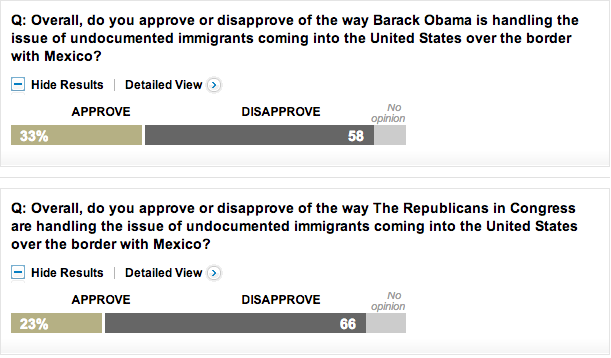
The same poll finds that 58 percent disapprove of the president’s handling of the situation and that 47 percent believe that deporting the migrant children as soon as possible should be a top priority. Dara Lind scrutinizes this last finding:

More than anything, the poll shows that Americans don’t agree on the right policy response because they don’t agree on the facts.

Americans are split on whether or not children would be safe in their home countries; 39 percent think they’re fleeing unsafe places, while 36 percent think they have somewhere safe to return. … It’s easy to look at this sort of confusion and take away the idea that Americans generally want tens of thousands of kids to be deported. The poll does show that’s true, to an extent. But that’s also because Americans are looking at the confusion in Washington and on the border and gravitating toward the option that seems most decisive — and in this case, that’s throwing more money at the border, and fast and furious deportations.

Are We Abetting Central American Gangs?

Taking a hard look at the refugee crisis, Frum blames it primarily on US immigration policy, which has unwittingly strengthened the gangs from which these children are fleeing. “If you want to migrate to the United States from Central America,” he writes, “you will probably have to seek the aid of a criminal gang. That fact implies a few follow-on facts”:

First, for all the talk of the “desperation” of migrants, those who travel here from Central America are not the poorest of the poor.

The poorest of the poor can’t afford it. Illegal migrants either have the funds to pay for the journey—or can at least receive credit against their expected future earnings. The traffickers don’t only move people. They also connect them to the illegal labor market in North America, and then act as debt collectors once the migrants have settled in their new homes. Salvadorans in the United States are less likely to be poor than other Hispanics are: illegal migration networks don’t have any use for people who can’t generate an income. On the other hand, Salvadorans are also less likely to own a home—their smugglers have first claim on their earnings.

Second, if these latest migrants gain residency rights in the United States, the gangs who brought them to the country will be enriched and strengthened. Gangs, like any business, ultimately depend on their customers. If too many people find that their $5,000 to $8,000 investments in border-crossing are not paying off, the illegal-migration business will dwindle. If, on the other hand, the gangs succeed in exploiting the opportunity Obama created, they’ll attract more business in the future.

Third, each wave of illegal settlement induces and produces the opportunities for the next. The unaccompanied minors smuggled into the United States this year all have relatives back home. If resettled in the United States, they’ll acquire the wherewithal to pay for the transit of those relatives. And, of course, many of these minors either currently belong to the gangs carrying out the smuggling or will soon be recruited by them. That’s another way to pay the cost of the trip.

Recent Dish on the sources of the crisis here and here.

Reform That’s Borderline Impossible

A new WaPo/ABC News poll dings both Obama and Republicans in Congress for their handling of the border crisis:

Screen Shot 2014-07-16 at 11.01.33 AM

The Republicans fare especially badly, but Noah Rothman attributes that to dissension in the ranks:

Republicans in Congress, who receive poor marks from nearly two-thirds of the public, can attribute some of that antipathy to their own voters. “Almost as many Republicans disapprove of their party’s handling of the issue as say they approve, with negative ratings rising to a majority among conservatives,” reads The Post’s write up of the poll. 48 percent approve of the GOP’s approach to the crisis while 45 percent disapprove. Only 22 percent of independents and 9 percent of Democrats approve of the GOP’s approach to the crisis.

The president, meanwhile, maintains the support of 57 percent of Democrats who approve of his approach to the border crisis. 12 percent of Republicans and 28 percent of independents agree. If the GOP maintained the intraparty unity that Obama benefits from, their numbers would look similar to the president’s.

The poll also asked respondents about the government’s $3.7 billion proposal to address the crisis. Sargent believes these results augur poorly for the plan’s fate in the House:

Crucially, only Republicans and conservatives oppose the plan. A majority of independents (51 percent) and moderates (58) support it, but only 35 percent of Republicans back it, versus 59 percent who are opposed, and only 36 percent of conservatives back it, versus 59 percent who are opposed. Among “conservative Republicans,” those numbers are a dismal 29-66.

This again raises the question: Can any plan to address the crisis pass the House? As I noted the other day, conservative groups such as Heritage Action are opposed, and may “score” the eventual vote on it, meaning more pressure on GOP lawmakers to vote No. Any funding plan first has to clear the Senate, which will be hard, but Democratic aides believe it will be doable. The House is another matter.

Drum agrees:

So Democrats are split and Republicans are opposed. This is not fertile ground for any kind of compromise. The only thing Obama has going for him is that what’s happening on the border really is a crisis, and at some point everyone might genuinely feel like they have to do something. But what? Even Obama’s fairly anodyne proposal has already drawn significant opposition from both sides, and any proposal that moves further to the left or the right will draw even more opposition. This could take a while unless, by some miracle, both parties decided they’re better off just getting this off the table before the midterm elections. But what are the odds of that?

“Public Health Nativism”

Anti-Immigration Activists Protest Arrival Of Unaccompanied Central American Children To Housing Facility

The largely unsubstantiated concern that the Central American migrant children are carrying infectious diseases is fast becoming a trope among Republican lawmakers. It was given an airing on the O’Reilly show last night. “The fact that this rumor is circulating at all,” Jesse Singal comments, “can still tell us some interesting things about the way human beings are wired to view outsiders”:

Erin Buckels, a researcher at the University of Manitoba who has studied this issue, explained in in an email that both her work and a great deal of prior research has “demonstrated a strong and automatic tendency to dehumanize outgroup members, even when we have no prior experience with those groups.” Notions of pollution and infection loom large here: We often “view outsiders with disgust — partly due to the risks of infectious disease that outsiders carried in our evolutionary past — and this causes a conservative shift in our thoughts and attitudes.” So unfamiliar people “are seen as closer to animals than humans, and therefore pose a danger to our bodies (and even our souls).”

This is basically a universal human impulse — every time you read a horrific story about a young couple being murdered for a relationship that stretches across sectarian or class or caste lines, that’s part of what’s going on. In certain contexts, people just can’t stand the notion of being “infected” by outsiders — and infection can mean anything from “them” crossing “our” border to members of an undesirable class having sexual relationships with “our” daughters — to the point where they will kill people to prevent that infection from occurring.

But Samuel Kleiner is blunter, calling the claim another example of America’s long, ugly tradition of “public health nativism”:

Doctors have debunked claims of diseased-ridden children: The migrants tend to be middle class with updated vaccines. By engaging in this right-wing fear-mongering, the aforementioned elected officialsand many othersare earning their ignominious place in a long, ugly history in American nativism that demonizes immigrants under the guise of public-health concerns.

With each wave of immigration, nativists have made public-health excuses for keeping out migrants. In the 1830s, cholera was described as an “Irish disease,” and in the late 1800s Tuberculosis was portrayed as a “Jewish disease.” In 1891, Congress banned any immigrant “suffering from a loathsome or dangerous contagious disease.” Even at Ellis Island, a site we celebrate as America’s front door for the “tired and weary,” medical inspections were a weapon aimed at immigrants who traveled on second and third class and were commonly used to quarantine and turn back unwanted immigrants.

And then as recently as 1993, the HIV ban was instigated to prevent gays and Haitians from entering the country. It took almost twenty years to repeal and replace it.

(Photo: An anti-immigration activist stands next to a Pinar County Sheriff’s deputy during a protest along Mt. Lemmon Road in Oracle, Arizona in anticipation of buses carrying illegal immigrants on July 15, 2014.  About 300 protesters lined the road waiting for a busload of illegal immigrants who are to be housed at a facility in Oracle. By Sandy Huffaker/Getty Images.)

Papers, Please

After visiting McAllen, Texas, to participate in a vigil, Jose Antonio Vargas realized that, “for an undocumented immigrant like me, getting out of a border town in Texas—by plane or by land—won’t be easy. It might, in fact, be impossible”:

[S]ince outing myself in the New York Times Magazine in June 2011, and writing a cover story for TIME a year later, I’ve been the most privileged undocumented immigrant in the country. The visibility, frankly, has protected me. While hundreds of thousands of immigrants have been detained and deported in the past three years, I produced and directed a documentary film, “Documented,” which was shown in theaters and aired on CNN less than two weeks ago. I founded a media and culture campaign, Define American, to elevate how we talk about immigration and citizenship in a changing America. And I’ve been traveling non-stop for three years, visiting more than 40 states.

Of course, I can only travel within the United States and, for identification, when I fly I use a valid passport that was issued by my native country, the Philippines. But each flight is a gamble. My passport lacks a visa. If TSA agents discover this, they can contact CBP, which, in turn, can detain me. But so far, I haven’t had any problems, either because I look the way I do (“You’re not brown and you don’t look like a Jose Antonio Vargas,” an immigration advocate once told me), or talk the way I do—or because, as a security agent at John F. Kennedy International Airport who recognized me said without a hint of irony, “You seem so American.”

I might not be so lucky here in the valley. I am not sure if my passport will be enough to let me fly out of McAllen-Miller International Airport, and I am not sure if my visibility will continue to protect me—not here, not at the border.

And today, just as he predicted, Vargas was detained:

A TSA agent checked Vargas’ Philippines passport and compared it to his ticket, according to a video of the exchange as well as sources familiar with the exchange. Satisfied, the agent initialed the ticket and cleared Vargas for travel. At that point, a Border Patrol agent took the passport from the TSA.

“Do you have your visa?” he asked.

“No, there’s no visa,” Vargas replied.

The agent asked Vargas a few more questions, then placed him in handcuffs and escorted him to the McAllen Border Patrol station for further questioning, according to the source. The station is not a detention center.

Dara Lind explains why the Pulitzer Prize winning journalist won’t necessarily be deported:

The government has “prosecutorial discretion” to determine what to do with unauthorized immigrants. That means it can decide whether or not to put Vargas into deportation proceedings in immigration court. The Obama administration has said, repeatedly, that its focus is on deporting unauthorized immigrants who fit its administration “priorities”: convicted criminals, “recent border crossers,” and people who have been deported and returned to the US. 98 percent of all people deported last year fit into one of those priorities. Vargas doesn’t meet any of those criteria.

Charles Cooke is sympathetic to Vargas but thinks the authorities had no alternative:

[T]his is a horribly sticky situation. Without question – and through no initial fault of his own – Vargas has found himself in a veritable nightmare. As he tells the story, he was brought here at a young age and told that he had legitimate papers, only later to discover that those papers had been forged. From that point on, his options were severely limited.

Conservatives who ask, “but why didn’t he just apply for legal status?” are rather missing the point. Under current law, he is unable to do so without leaving the country in which he has built his life. (Or marrying a U.S. citizen.) Because he did not have a petition filed before 2001, he didn’t qualify for relief under Section 245(i); because he is too old, he doesn’t qualify for the deferred action policy that President Obama illegally put into place in 2012. He’s genuinely stuck. Moreover, there really is no “home” for him to “go” to. This is it. If I had my way, he would be among those to whom some form of amnesty was extended. Those who have known nothing else should not be sent abroad.

Still, this is really not the point. The law that I would like doesn’t yet exist. And, knowing this better than anyone, Vargas willingly placed himself in this position. What were those charged with enforcing the rules supposed to do, exactly? Slip him under the desk?

Update:

The South-Of-The-Border Crisis

In a must-read counterpoint to the media narrative that the Central American children pouring across our border are fleeing gang violence, Saul Elbein argues that the problems in Guatemala are far more extensive. He paints a picture of a failed state offering a veneer of legitimacy to a corrupt, feudal “deep state” that maintains itself through violence and exploitation:

The only model of power that exists in Guatemala is … terroristic, extra-legal, and dominated by violence. So is it any surprise that after the war, on the streetswhere people grasped for the scraps that weft, where children grew up with no chance at wealth and less at respectpirate organizations like the MS-13 grew? What we’re seeing in Guatemala is not quite, in other words, a crime wave. It’s simply the way things have been there for a long time, pushed to the next level. If you are a civilian there, beneath the labelssoldier; gangster; policeman; army; cartelis but one underlying reality: men with guns who do what they want and take what they want. Your options are to buy your own security and gunmen; to join a gang yourself; or to leave.

And so many leave.

Meanwhile, Central American migrants are now being barred from Mexican cargo trains:

On Thursday, a freight train derailed in southern Mexico. It wasn’t just any train, though:

 It was La Bestia—”the Beast”—the infamous train many Central American immigrants ride through Mexico on their way to the United States. When the Beast went off the tracks this week, some 1,300 people who’d been riding on top were stranded in Oaxaca. After years of turning a blind eye to what’s happening on La Bestia, the Mexican government claims it now will try to keep migrants off the trains. On Friday, Mexican Interior Secretary Miguel Ángel Osorio Chong said in a radio interview that the time had come to bring order to the rails. “We can’t keep letting them put their lives in danger,” he said. “It’s our responsibility once in our territory. The Beast is for cargo, not passengers.”

In light of the situation, Keating advocates a major rethink of how we respond to chaos in Latin America, not to mention our own role in creating it:

I don’t claim to have an immediate fix for Central America’s ills, but surely there are more creative strategies out there than pouring money into a failing drug war and then walling ourselves off from the victims. Latin American issues tend to get shortchanged in the U.S. foreign policy conversation relative to more remote regions. I suspect this is part of the reason why Central America’s instability is only garnering attention now that the consequences of it have quite literally arrived at our doorstep.

On a broader level, the crisis should be a reminder that the U.S. is not immune from events to its immediate south. We’re an American country—in the regional sense of that word—and it’s time to start thinking like it.

(Photo: Central American migrants boarding the “La Bestia” train. By Pedro Ultreras.)

On Immigration Reform: Republicans vs Republicans

Noah Rothman flags a survey by a Republican polling outfit that finds large majorities of Republican voters in key states in favor of immigration reform:

86 percent of self-described Republicans and 79 percent of independents in those 26 states said that the immigration system is in need of fixing. Moreover, 79 percent of Republican respondents said that it was “important” for Congress to act on immigration reform this year. … In worse news for opponents of immigration reform, voters do not believe that the argument that President Barack Obama would not enforce border security provisions in an immigration bill is a valid reason for opposing reform. 72 percent of all respondents said did not believe that concerns over enforcement of border security was a good reason for rejecting immigration reform, including a majority of Republicans and 69 percent of independents. The Harper survey found that nearly two-thirds of all voters and 54 percent of self-identified Republicans support a pathway to legal status for illegal immigrants.

And yet Republicans in government remain committed to stonewalling. Vinik takes them to task:

If Republicans object to [Obama’s request for $3.7 billion in emergency funds], what exactly do they propose instead? How should we move through the huge backload of cases? Where should we hold the unaccompanied minors in the meantime? And how should we pay to transport them to their home countries?

Reforming the 2008 law, as Republicans want, could help relieve pressure on the immigration system, but it could cause children who qualifyor who should qualifyfor asylum to be turned away. Even so, there are more than 50,000 unaccompanied minors in U.S. custody. Tweaking the law will not suddenly alleviate the problem.

But Tomasky knows exactly why they are doing this:

We’ve all seen this movie way too many times. I don’t know what the Republicans will end up doing here, but it will be dictated by the usual two factors. First, the outrage of the base. It’s cranking up already—oppose Obama here, or you will get a primary. That’s what drives nearly everything in the congressional GOP now. (By the way, what might Lindsey Graham be saying if his primary, rather than having turned out favorably for him already, were next week?) And my it’s heartening, isn’t it, to think that the House Republican caucus is going to follow the moral lead of the Texas delegation on this?

The second factor will be their internal polls. … If the polls now tell them very clearly that most voters—let’s refine that; most likely 2014 voters—are going to blame them for the irresolution of this problem, they’ll compromise. Otherwise, they will oppose. That’s the extent of it.

Previous Dish on the Republican response to the border crisis here and here.