Rapprochement With Rouhani? Ctd

Fareed encourages the administration to engage with Iran:

Now of course this could all be camouflage and smoke screen. But there is another possibility. The international sanctions against Iran are hurting the country badly. Tehran’s support for Bashar Assad’s brutal regime in Syria is costing Iran money and arms every month and has tarnished its legitimacy at home. The Arab Spring, for all its problems, has put the spotlight on Iran’s Supreme Leader, who has been in power for 24 years. One of the chants heard in Tehran two years ago was “Mubarak, Ben Ali, now it’s time for Sayyid Ali [Khamenei].” In these circumstances, defusing some tensions, easing the sanctions and reviving the economy would be extremely useful to the regime in Tehran.

At the very least, the Obama Administration should come up with a reasonable offer that would signal to the Iranian people that if the regime is willing to credibly forswear nuclear weapons, ordinary Iranians will have a brighter future. But it is difficult to sound reasonable while you are beating the drums of war.

Relatedly, Fisher analyzes Rouhani’s interview with NBC (snippet above):

As Rouhani-skeptics often point out, the president is not the final authority in Iranian politics. Supreme Leader Ayatollah Ali Khamenei is ultimately in charge, especially on matters of national security and foreign policy. The best case for skepticism about Rouhani’s peace overtures is that he’s just freelancing and will inevitably be undercut by Khamenei. That’s still possible, but Rouhani told NBC News that Khamenei gave him full authority to cut a deal with the West over Iran’s nuclear program — the single biggest sticking point of any negotiations. If true, then for Khamenei to hand Rouhani that power would be a remarkably positive step just in itself, a sign of institutional weight shifting toward compromise and diplomacy. That Rouhani could actually see it through is even better.

The Best Of The Dish Today

Pet Shop Boys Perform In Beijing

First off, check out Colbert later tonight. It was a blast. And I’ll be on AC360 Later in an hour with Bill Kristol. Good times.

Today, we aired various indications that Rouhani is serious about opening a dialogue with the West. Today, in an interview with Ann Curry, he has gone even further. Money quote:

“In its nuclear program, this government enters with full power and has complete authority,” Rouhani told Ann Curry, NBC News national and international correspondent and anchor at large, in his first interview with a U.S. news outlet since his election. “The problem won’t be from our side,” he said at the presidential compound in Tehran. “We have sufficient political latitude to solve this problem.” Asked whether Iran would ever build a nuclear weapon, Rouhani noted that the country has repeatedly pledged that “under no circumstances would we seek any weapons of mass destruction, including nuclear weapons, nor will we ever.”

Syria was a dress rehearsal for the real deal: a normalization of relations with Iran in return for clear and open international inspections of all its suspect sites. That would transform the current global dynamic, and lead us away from the threat of war to the possibility of a real peace between then people of America and the largely pro-American people of Iran.

We covered the developments here and here, while airing a fascinating video about Iran’s Revolutionary Guards fighting for their God in Syria – while regarding all Arabs as sub-human.

We raised Mike Allen’s publication of a press release by Fox under his own byline; we noted how bro culture keeps evolving; and how blogging has made me a better writer. Plus: the moment the US almost nuked itself.

The most popular post of the day remained Meep Meep, Motherfuckers from Sunday night. Second was this super cool political ad.

See you in the morning.

(Photo: Neil Tennant  and Chris Lowe of Pet Shop Boys perform on the stage in concert at MasterCard Center on August 22, 2013 in Beijing, China. By ChinaFotoPress via Getty Images. I’ll be posting a review soon.)

Rapprochement With Rouhani? Ctd

Jasmin Ramsey reports on the good vibes stemming from letters exchanged between Obama and Rouhani recently:

That both leaders have publicly acknowledged such rare contact is an important development in and of itself, according to Robert E. Hunter, who served on the National Security Council staff throughout the Jimmy Carter administration. “This is an effort as much as anything to test the waters in domestic American politics regarding direct talks, regarding the possibility of seeing whether something more productive can be done than in the past. And except out of Israel, I haven’t seen a lot of powerful protest,” Hunter told IPS.

Suzanne Maloney remains cautious about engagement:

[T]he presumption that Rouhani will drive an easier bargain may be overly optimistic. The Europeans who sat across the table from him during his time as Iran’s nuclear negotiator remember him as a tough customer. And his recent track record underscores the difficulty of expecting too much from Rouhani on the nuclear issue. The only recent progress on this issue came in 2009, with a tentative agreement to export much of Iran’s enriched uranium in exchange for Western-supplied fuel rods for its medical research reactor.

Ironically, the primary Iranian proponent of this arrangement was Ahmadinejad, whereas Rouhani played a vocal role in scuttling the deal, which he described as “illegal,” a “mistake,” and a Western attempt to deprive Iran of its uranium stockpile. These criticisms helped persuade Khamenei to back away from an initial acceptance of the agreement, sending Iran further down a path of international isolation and pressure.

Hossein Mousavian adds:

There remains a possible dealbreaker. Obama’s understanding of how to approach Tehran can be encapsulated as follows: “My view is that if you have both a credible threat of force, combined with a rigorous diplomatic effort, that, in fact, you can strike a deal”. Although the use of force and bullying is part of US foreign policy, the grand civilisation and culture of Iran has made the Iranian nation attach great importance to respect and honour, resisting any form of coercion and humiliation.

I suspect Obama, compared with other presidents, is almost uniquely capable of doing just that. What the Iranians crave is respect and honor. We should have no illusions that Rouhani is some kind of Western liberal. We should have no illusions that he, rather than Khamenei, is calling the shots. But since the regime insists it doesn’t want and hasn’t built a nuclear weapon, and since the sanctions on the country have indeed been crippling (with inflation now accelerating fast), and since the regime still has only tenuous public support, largely outside the main urban centers, it makes sense for Rouhani to explore the chances of a deal that would end Iran’s diplomatic and economic isolation in return for adherence to non-proliferation, guaranteed by international inspectors.

That’s why, although I remain deeply skeptical of the Tehran regime, this seems to me to be well worth exploring, and for a second-term president to be prepared to risk a great deal for a legacy-making agreement.

Know hope.

Inside Iran’s War In Syria

Above is a fascinating video presumably filmed to be part of a documentary for Iran’s Revolutionary Guards or for the Iranian public. Mackey has run it down and it looks legit. If you are in any doubt that Iran is critical in supporting Assad’s disgusting dictatorship, just watch for a few minutes. What strikes me is the religious nature of their motivation. This is about Shia Islam fighting evil, i.e. Sunni Islam. We keep under-estimating the power of this long, bloody struggle between the two largest traditions in Islam – and therefore the resilience and fanaticism of the participants. Jeff Weintraub noticed this statement by the Iranian commander, which also hit home for me:

“The front we’re fighting at now is not a front where the Syrian army is at war with the people. [….] The current war in Syria is that of Islam versus the nonbelievers. Good versus evil. We are ‘good’ because Iran’s supreme leader is on our side. The front is supported by Hezbollah. The fighters are Iranian, Hezbollah, the Iraqi and Afghan mujahadeen and others. The opponents are Israel, Saudi Arabia, Turkey, Qatar, funded by the Emirates. Plus America, England, France and Europe.”

Notice that the West and Israel are now identified as Sunni-supporters, even though the US lost lives and trillions and soft and hard power delivering Iraq from the Sunnis to the Shi’a. You can never win with these fanatics. But more fascinatingly, as Jeff also spies, is an insight into the contempt the Shia feel for the Sunnis (which is reciprocated in spades). It’s at 4:19:

After much talk about how they treat their Syrian allies with respect, one Iranian says, while driving through a village:

“When we came, there was no human being. They deserted the village.”

To which another Iranian replies: “There are still no humans now, only Arabs.”

Complicated, isn’t it? And so nasty and ugly and unending. If we can find a way to keep our distance from this lose-lose region so much the better.

Can Obama Pull A Reagan On Iran? Ctd

M Hashem Pesaran believes failure is not an option for Rouhani’s diplomatic efforts:

If Iran and [the P5+1] do not take full advantage of the current opportunity, the consequences are likely to be even more serious than if the status quo had simply gone unchanged. While the general international reaction to Iran’s new chief executive has so IRAN-POLITICS-EXPERTS-ROWHANIfar been favourable, a lack of progress over the next few months could create new levels of frustration and desperation, bolstering the radicals on both sides in the sanctions/nuclear debacle and bringing us closer to military intervention with dire and unthinkable consequences. Israeli prime minister Benjamin Netanyahu is already spreading doubts about the utility of negotiating with Iran, arguing that Rouhani is a “wolf in sheep’s clothing”. …

The P5+1 countries need to offer a deal to help Rouhani’s administration domestically and strengthen its ability to deal with the radicals inside Iran. Squander the current opportunity, and they will weaken Rouhani’s administration to the extent that it could fail, paving the way for the ascension of extremists. It is now up to the moderates on both sides to deliver.

Amen. Previous coverage of possible US/Iran diplomacy here and here.

Chart Of The Day

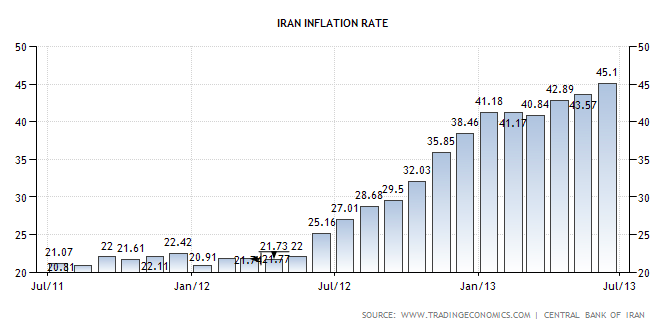
Perhaps one of the more salient factors behind Rouhani’s new outreach to the US on nuclear development:

Screen Shot 2013-09-17 at 12.21.10 PM

The sanctions have worked, the Iranian economy is in free-fall, and the regime desperately needs a better relationship with the world as a result. If the account in Der Speigel about plans for opening up Fordo for international inspection is correct, then this underlying economic crisis helps reveal that this new opening is not a function of generosity for Iran, but of dire necessity. What we have to do is be patient, listen carefully, and hope.

Can Obama Pull A Reagan On Iran? Ctd

Der Speigel reports that Rouhani is preparing to announce a plan to “decommission the Fordo enrichment plant and allow international inspectors to monitor the removal of the centrifuges”:

Rohani reportedly intends to announce the details of the offer, perhaps already during his speech before the United Nations IRAN-POLITICS-EXPERTS-ROWHANIGeneral Assembly at the end of the month. His foreign minister, Mohammad Javad Zarif, will meet Catherine Ashton, the European Union’s top diplomat, in New York next Sunday and give her a rough outline of the deal. If he were to make such wide-ranging concessions, President Rohani would initiate a negotiating process that could conceivably even lead to a resumption of bilateral diplomatic relations with Washington.

Other developments seem promising as well. On Monday, Iran’s new nuclear energy chief Ali Akbar Salehi reportedly told the UN’s International Atomic Energy Agency’s (IAEA) member states that the country was ready to “enhance and expand” cooperation. Additionally, US President Barack Obama revealed on Sunday in an interview with broadcaster ABC that he and Rohani had exchanged letters, though he did not discuss the content of their correspondence.

If verified, this offer strikes me as a huge gamble by Rouhani which demands a commensurate gamble from Obama. Following the Syria model, Obama has a golden opportunity to reach out to the moderate leadership in Tehran, which commands considerable support in the country, in order to propose international transparency for Iran’s nuclear program without regime change. Rouhani, in the mold of Gorbachev, is obviously signaling a willingness to talk.

Michael Axworthy offers an aerial view of the nuclear crisis, urging Obama to re-engage:

The nuclear weapon’s only purpose is deterrence – in this case as an instrument to bolster Iran’s hard-won independence and the survival of the Iranian regime. If there were no hostility, or if the level of hostility could be reduced and made safe, the threat and the need for deterrence would also be reduced. The fundamental problem is that hostility and the need to resolve it – easier said than done, of course.

But it is perhaps relatively easy, notwithstanding the history, the harshness of the rhetoric, the intransigence, the failures of understanding and imagination on both sides, and the vested interests some have on both sides in the continuation of the hostility. Relatively easy because this dispute lacks many of the features that make other longstanding international crises and problems intractable. The three states most deeply involved, Iran, the U.S. and Israel, share no mutual borders. There are no border disputes or territorial claims. There are no refugees demanding the right to return. There is no inter-communal violence. Within quite recent memory the peoples involved have been allies, and even today there is no deep-seated hatred between them – for the most part, indeed, rather the reverse.

The mutual animosity between Iran, Israel and the US is a tragedy. It’s a tragedy forged by history, by the machinations of the CIA, the evil of the Iranian theocracy, and the understandable paranoia of Israelis. But it can be undone. And it must be undone. If that means dealing with a regime, elements of which (the Revolutionary Guards et al) are anathema to us, so be it. There were plenty of factions in Gorbachev’s USSR that were hostile to us. But Reagan saw the bigger picture – and took the risk.

Your call, Mr president. But the stars may be aligning.

Can Obama Pull A Reagan On Iran?

IRAN-POLITICS-EXPERTS-ROWHANI

Last night, I wrote that “Syria is the proof of principle for an agreement with Iran”. But that the second phase of dealing with regimes harboring WMDs in the Middle East will require real courage and boldness from the president – Reagan at Reykyavik boldness. Beinart sees the same comparison:

Since Syria is caught in the middle of an American-Iranian (and to a lesser degree, American-Russian) cold war, it’s worth remembering what ended the last Cold War. In the 1980s, Mikhail Gorbachev decided that the Soviet Union could no longer afford to prop up unpopular regimes in Eastern Europe. But to cut Eastern Europe free, Gorbachev had to answer hard-liners who had long argued that the USSR needed a ring of clients to protect it against another attack from the West. That’s why Ronald Reagan’s willingness to embrace Gorbachev and negotiate far-reaching arms-control deals—despite bitter criticism from conservative politicians and pundits—proved so important. As Reagan himself argued, “I might have helped him see that the Soviet Union had less to fear from the West than he thought, and that the Soviet empire in Eastern Europe wasn’t needed for the security of the Soviet Union.” By helping show Gorbachev that he could safely release Eastern Europe, Reagan helped end the Cold War. And when the Cold war ended, so did civil wars across the globe because the U.S. and USSR no longer felt that their own security required arming one side.

Today, President Obama’s real strategic and moral imperative is not killing a few Syrian grunts to punish Assad for using chemical weapons. It is ending the Middle Eastern cold war that fuels Syria’s savage civil war, just as the global Cold war once fueled savage civil wars in Angola, El Salvador, and Vietnam. It’s possible that strengthening Syria’s rebels and sanctioning Iran could further that goal, just as Reagan’s military buildup showed Moscow the cost of its Cold War with the United States, but only if such efforts are coupled with a diplomatic push that offers Iran’s leaders a completely different relationship with the United States, one that offers them security and status absent a nuclear weapon and no longer requires them to cling to Bashar Assad. By striking Syria, Barack Obama is making that harder. By doing so in alliance with groups that oppose any thawing of the U.S.-Iranian cold war absent total Iranian capitulation, he’s making it harder still.

This will not be easy, as Suzanne Maloney explains, but the potential for win-win-win is there:

Rouhani was elected to rescue Iran from its ruinous spat with the United States over its nuclear ambitions. He and those around him are sophisticated enough to appreciate that this objective will be much further out of their reach if all parties get tied up in a U.S.-Syrian military engagement. It would be difficult, if not impossible, for Tehran to insulate its assets and personnel in Syria from any military strike against the regime, and it would be even more challenging for Iran’s president to restrain the hard-liners in Iran’s security establishment from responding with force. So it comes as no surprise that, in hopes of advancing his mandate to rehabilitate Iran’s place in the world, Iran’s pragmatic president has thus been trying to modulate Iran’s public posture on Syria.

Russia’s diplomatic option may temporarily salvage Tehran’s investments in Assad and Syria. And perhaps that would disappoint those hoping to use intervention in Syria to set Tehran back on its heels. Still, the presumption that only a robust show of U.S. force in Syria can dissuade Iran from weapons of mass destruction is false. Using diplomacy to defang Assad would boost Iran’s readiness to work with the international community on the nuclear question.

Mohammad Ayatollahi Tabaar’s piece on the rise of Iranian pragmatism is on the same page:

In a recent interview with Iran’s state-controlled TV, Rowhani said he has been in touch with leaders of several countries and his foreign minister has spoken with his counterparts from 35 states to prevent a war. He emphasized that Iran would support “any initiative” to avoid a strike against Syria and pointed out that Tehran in principle agrees with the proposal for international control of Assad’s chemical arsenal. Moving to the nuclear issue, he said Iran’s approach for a “win-win solution” will begin during his upcoming trip to New York, where he will meet with foreign ministers of some of the P5+1 countries. He added that if the other side is serious, the “nuclear question will be resolved in a not very long period of time.”

Both the United States and Islamic Republic view the situation in Syria as a means to signal to the other side. The Obama administration claims that its serious handling of Syria will send a message to Iran and its nuclear program. The Rowhani administration, on the other hand, intends to show its diplomatic handling of Syria will pave the way for a diplomatic solution of the nuclear issue.

And why cannot both be right? Larison looks at the situation from Iran’s perspective:

 Imagine for a moment that the U.S. were in Iran’s position: a much more powerful government hostile to ours had waged two wars of regime change on our borders, it defined its policy towards our country solely in terms of grossly exaggerated fears of the threat that we ostensibly posed to them, most of the surrounding region was filled with governments aligned against ours, and one of our only remaining allies on the planet was threatened with attack from that same government. Wouldn’t we see this government as deeply hostile to us, perceive it as a major threat to our security, and do what we could to discourage an attack on our country? In such an environment, hard-liners would usually benefit and prevail in internal policy debates. If Iranian hard-liners benefit from an attack on Syria, the effect will be the opposite of the one that many Syria hawks predict, and it will make it that much more difficult to reach an agreement on the nuclear issue.

Which is why a Russian-backed UN process is so preferable to the other options. And why this is but a preliminary to the real event.

(Photo: Iranian President Hassan Rowhani attends a session of the Assembly of Experts in Tehran on September 3, 2013. By Behrouz Mehri/AFP/Getty Images)

Meep Meep, Motherfuckers

obamasmug

“Had we rolled out something that was very smooth and disciplined and linear, they would have graded it well, even if it was a disastrous policy. We know that, because that’s exactly how they graded the Iraq war,” – president Obama.

Oh, snap!

It’s been awesome to watch today as all the jerking knees quieted a little and all the instant judgments of the past month ceded to a deeper acknowledgment (even among Republicans) of what had actually been substantively achieved: something that, if it pans out, might be truly called a breakthrough – not just in terms of Syria, but also in terms of a better international system, and in terms of Iran.

Obama has managed to insist on his red line on Syria’s chemical weapons, forcing the world to grapple with a new breach of international law, while also avoiding being dragged into Syria’s civil war. But he has also strengthened the impression that he will risk a great deal to stop the advance of WMDs (which presumably includes Iran’s nukes). After all, his announcement of an intent to strike Assad was a real risk to him and to the US. Now, there’s a chance that he can use that basic understanding of his Syria policy – and existing agreement on chemical weapons – to forge a potential grand bargain with Iran’s regime. If that is the eventual end-game, it would be historic.

To put it plainly: Syria is the proof of principle for an agreement with Iran. And an agreement with Iran – that keeps its nuclear program reliably civil and lifts sanctions – is the Holy Grail for this administration, and for American foreign policy in the 21st Century.

As for the role of Putin, I argued last week that it was the Russian leader who had blinked, the Russian leader who had agreed to enforce Washington’s policy, and that the best response was to welcome it with open arms. So it was another treat to hear the president say, in tones that are unmistakable:

“I welcome him being involved. I welcome him saying, ‘I will take responsibility for pushing my client, the Assad regime, to deal with these chemical weapons.’ ”

Meep meep.

(Photo: President Barack Obama in the Oval Office on September 13, 2013. By Dennis Brack-Pool/Getty Images.)