Is Iran Part Of The Solution In Syria?

IRAN-POLITICS-EXPERTS-ROWHANI

Jay Newton-Small floats the idea:

When I was there late last summer, it was clear that Iranians weren’t particularly happy with Tehran’s unwavering support of Syria. Most of the bazaari wanted to see the money flowing to Syria spent instead propping up Iran’s faltering currency and economy. Add to that Assad’s use of chemical weapons, which are much reviled in Iran, and Rouhani might find popular support to weaken, if not break ties with Assad. And Iran might just be the only country Assad would listen to if they asked him to step aside. It is in both Washington and Tehran’s interests to prevent a failed state in Syria, and to stop Sunni radical al Qaeda factions from taking over the country. Such cooperation has been done before: Iran was a key ally in the U.S. invasion of Afghanistan, an Iranian neighbor, and with the toppling of the Taliban.

Packer also raises the possibility of Iran and the US working together:

Some Iranians point to the Bonn Conference of 2001—where Iran and the U.S. coöperated in the formation of an Afghan government, after the fall of their mutual enemy, the Taliban—as a model for what might take place with Syria. The U.S. and Iran have a common interest: preventing Salafi extremists, affiliated with Al Qaeda, from gaining power in the region. If this appeared probable in Syria, Iran might be willing to drop its support for Assad in exchange for a face-saving transition, backed by Turkey, Jordan, and the Gulf states: a ceasefire, a peacekeeping force made up of Muslim troops from the region, protections for Alawites and other minorities, U.N.-sponsored elections, and exile in a comfortable dacha for the Assad family.

None of this is likely.

It would take imaginative diplomacy of the kind that the Administration has shown little taste for in the Middle East. Iran would have to be convinced that it can’t win but also that it needn’t lose, and this would not be possible without deeper American engagement.

Judis nevertheless hopes for a diplomatic solution:

In Ha’aretz, Zvi Bar’el reports that Iran and Russia are working on a compromise proposal that could forestall an American attack on Syria. It would consist of a transfer of power in Syria in stages that would culminate in an election in which Bashar al Assad would not run and the transfer of Syria’s chemical weapons arsenal to Russia or another country. … Who knows whether these proposals are genuine, but they could represent a constructive way out of the current morass.

And that, it appears, is what just happened. And this moment might offer Obama an opening with the new administration in Tehran – an opening we all desperately need to avoid another war in the region.

(Photo: Iranian President Hassan Rowhani attends a session of the Assembly of Experts in Tehran on September 3, 2013. Iran’s Assembly of Experts is a body that selects the supreme leader and supervises his activities. By Mehrouz Mehri/AFP/Getty Images.)
Iran’s Tweet Diplomacy

Iran expert Scott Lucas comments on the disparate messages coming from Rouhani’s advisers, namely the one who denied the legitimacy of the Rosh Hashanah tweet via the state-run Fars News Agency:

We believe this is pressure from Fars and the Revolutionary Guards to Rouhani’s team to back off from their moderate positions on Israel and especially Syria. … It’s a legitimate account and [Rouhani] has said that this is the only official account of the president on Twitter.

Fisher points out that the advisor did not “directly dispute the English-language account or say the tweets don’t represent Rouhani’s views”:

The non-denial denial is perhaps in response to the Western media attention to this tweet, but it raised more questions that it answered. Tehran-based reporter Amin Khorami, Al-Monitor’s Arash Karami and others say that the account is actually run by the media office of Rouhani’s presidential campaign team. The campaign has been over for a couple of months, so it raises the question of whether the people running the account continue tweeting in an official or unofficial capacity and whether or not they coordinate directly with Rouhani or his office. The prevailing speculation among Iran-watchers is that Rouhani may be keeping the account semi-official to inure him from criticism by internal hard-liners while allowing continued gestures of good faith toward the West. Although one Iran analyst suggested to me that Washington may be overstating the account’s significance in representing Rouhani’s views.

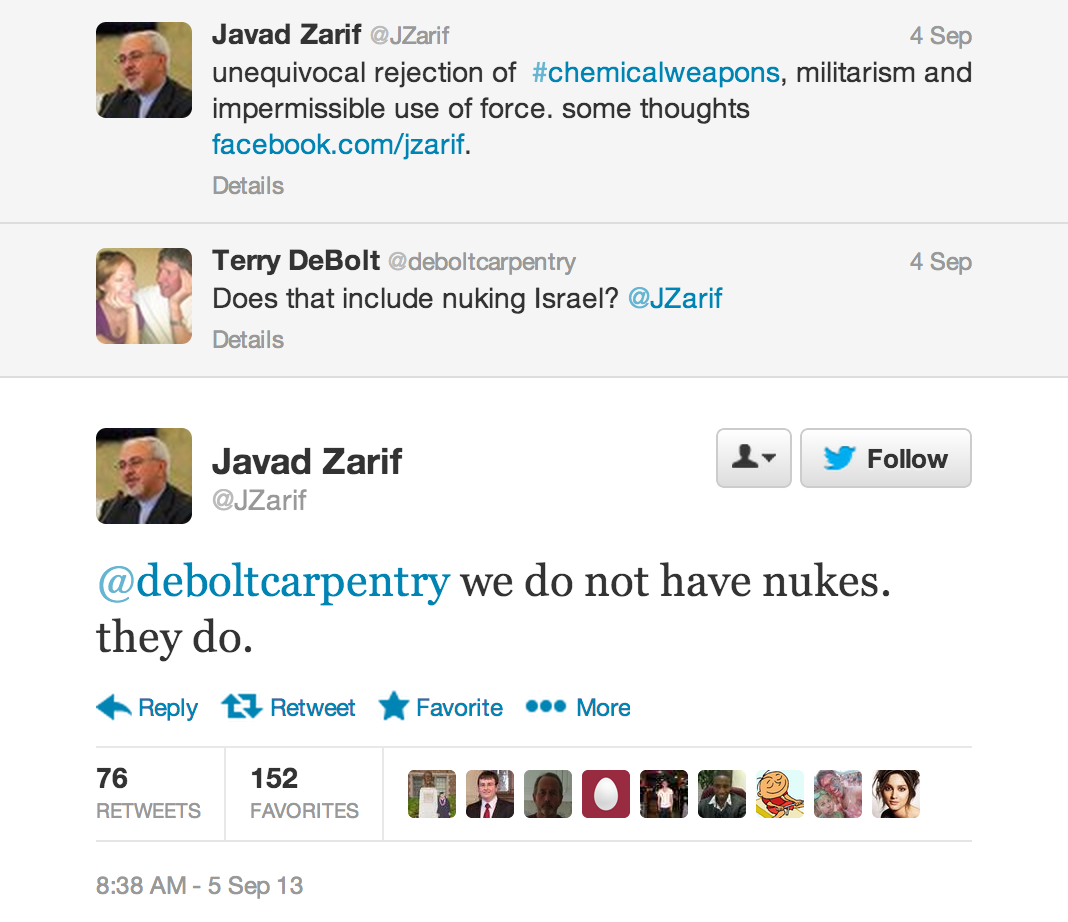
Meanwhile, the Iranian foreign minister continues to mix it up on his new Twitter account:

Screen Shot 2013-09-06 at 2.44.00 PM

AIPAC Wants This War, Ctd

Former Netanyahu aide Joel C. Rosenberg – surprise! – lambastes the president for dithering on intervention in Syria and thereby jeopardizing Israel’s war to remain the sole nuclear power in the Middle East:

If President Obama is so distrusted by the American people and her representatives in Congress that he cannot build solid support for limited military strikes against Syria’s chemical-weapons facilities, the Israelis are coming to the painful realization that there is no chance for the president to pull together support for preemptive military action against Iran’s nuclear facilities. Zero. Nada. Zilch. … That means one thing: The Israelis are on their own, and now they know it.

Enter AIPAC. Next week, that formidable group will storm the Hill for another war, even as Israelis themselves are content to allow the civil war to burn both sides in Syria out. It’s not in Israel’s interests that either Assad or the Jihadist rebels gain the upper hand. And yet they will happily ask the United States to risk its own potential enmeshment in a wider war – just to keep the conflict going. But AIPAC is fixated in forcing Obama to start yet another major war in the Middle East; and AIPAC never loses. They’ll threaten Democrats with de-funding and ostracism; they’ll win over Christianist Republicans with religious arguments about the need for Israel and America to stand together Muslim Jihadists. Goldblog takes things down a notch:

I believe it would be a mistake to assume that just because the president is hesitant on Syria he will be hesitant on Iran. Why? Because the president has defined Iran’s nuclear program as a core threat to U.S. national security. He has made it clear that only two challenges in the Middle East rise to the level of core American national interests: The mission to destroy al-Qaeda and the goal of stopping the Iranian nuclear program. He has stated repeatedly, over many years, that it is unacceptable for Iran to cross the nuclear threshold, and his administration has worked assiduously to sanction Iran in the most punishing of ways.

I hope Netanyahu listens to Jeffrey on this. And Rouhani does as well.

Can Iran Bring Syria To The Table?

Omid Memarian reports on the question:

“Iran can be helpful in resolving the Syrian crisis and bringing the civil war to an end,” Hooman Majd, an Iranian-American journalist and the author of Ayatollahs’ Democracy, told The Daily Beast in an email. “As long as the US goal is not regime change, almost as a precondition, I think the Iranians and the Russians probably see it in their interests to bring the civil war to an end, and help manage the transition to a representative government, as long as that government has no elements openly hostile to Iran, to Shias, or to Russia (such as Al-Qaeda affiliated or sympathetic groups).”

“Iran has shown a willingness, (particularly the new administration in Iran) to be involved in a diplomatic solution—it would make sense for the US to take Iran up on that,” Majd added.

But Karim Sadjadpour argues that “successful diplomatic engagement with Iran is hampered by the fact that outside powers — be it the U.S., Russia, or the Arab world — cannot offer Tehran assurances that a post-Assad government in Syria will remain friendly to Iranian interests”:

Ironically, the collapse of the Assad regime would produce a common interest for Washington and Tehran in making sure that radical Sunni Islamists, who hate Shiite Iran even more than America, do not rule Damascus. Until then, as long as Iran sees itself embroiled in a zero-sum game in Syria, a half-way meeting point, however desirable, will likely remain elusive.

Regardless, Juan Cole believes that American intervention will kill any chance of negotiations between the Syrian government and rebels:

By striking Syria, Obama has all but guaranteed that a negotiated solution becomes impossible for years to come. In the absence of serious negotiations, the civil war will continue and likely get worse. The US should give serious thought to what the likely actual (as opposed to ideal) reaction in Syria will be to the landing of a few cruise missiles. The anti-regime elements will celebrate, convinced that it will all be over quickly if the US gets involved. The last thing they will want will be to negotiate with the regime.

Tweet Of The Day

Update: The account appears to be fake:

Not only were the blessings not a diplomatic signal, they weren’t even really blessings from Rouhani himself, according to Iran’s official Fars News Agency. Mohammad Reza Sadeq, an adviser to Rouhani, said the Iranian president doesn’t even have a Twitter account (although he kept referring to it as “tweeter”), let alone that he was behind the eyebrow-raising tweet purportedly from the leader of a country that wishes for Israel’s destruction. “President Hassan Rouhani has no tweeter account,” Sadeq said.

But a very well-sourced Iranian reader we reached out to is discrediting the Fars News Agency report and says the tweet is legit. We will get to the bottom of the story and update as necessary. The latest: Javad Zarif, the Iranian foreign minister, apparently just opened a Twitter account yesterday and sent this out:

And he is already engaging in some fascinating exchanges, namely with Nancy Pelosi’s daughter:

Some credible confirmation of the foreign minister’s account:

Final update: Rouhani’s PR team has put out a press release confirming the original tweet. Translated money quote:

The Press Sec./Office of President Rouhani congratulates Jewish compatriots on the occasion of the new year

Where Iran Really Is Revolutionary

In an interview about the risks of human overpopulation, Alan Weisman, author of The World Without Us, argues that Iran, of all places, has developed “the most successful family-planning program in the history of the planet.” How they did it?

[T]he present ayatollah, Khamenei, issued a fatwa saying there was nothing in the Qur’an against having an operation if you felt that you had enough children that you could take care of. Everything from condoms through pills, injections, tubal ligations, vasectomies, IUDs—everything was free, and everything was available in the farthest reaches of the country.

I interviewed this wonderful woman, an OB/GYN who was part of this, right after the plan was implemented, ten years after the Iranian Revolution, in the late ’80s. She was going on horseback into these little villages to help perform vasectomies and tubal ligations. As the country grew more prosperous, her transportation changed to four-wheel-drive trucks and even helicopters. Everyone was guaranteed contraception if they wanted it.

The only thing that was obligatory in Iran was premarital counseling, which is actually a very nice idea. I recommend it to everybody who’s contemplating getting married. The Quakers do it in our country, and, for six months before a couple gets married, they attend classes. In Iran, you could go to a mosque, or you could just go to a health center. They would talk about things to get you prepared for getting married, including what it costs to have a child, to raise a child, to educate a child.

People got the message really well. They were told, “Have as many children as you want to have, as you think you can take care of.” Most Iranians continue to choose to have either one or two.

A few months ago, Narges Bajoghli reported that sanctions have made birth control harder to come by in the country:

For years, there has been a plethora of birth control pills and other contraceptives easily available and extremely affordable in Iran, a country that boosts one of the most successful family planning programs in the world. It is only in the aftermath of cumulative American-led sanctions against Iran’s banking and financial sectors that most of these options have disappeared from pharmacies. Up until two months ago, pharmacists told me, there were simply no foreign made birth control pills available at all. Many doctors are wary of prescribing the Iranian-made pills because sanctions have made access to the raw materials required to produce them nearly impossible, making many of these drugs unreliable.

The View From Tehran

Juan Cole points out the Islamic Republic is conflicted over its ally’s use of chemical weapons:

Although he later had to walk it back, former Iranian President Akbar Hashemi-Rafsanjani deplored the Syrian government’s use of gas against its own people, and Tehran-watchers are convinced that the Baath army’s action has provoked a heated debate within the closed Iranian elite. Current Iranian President Hasan Rouhani has condemned all chemical weapons use. Because Tehran backs the Syrian Baath government, it has publicly taken the same position as Russia, that the rebels gassed themselves. That allegation is not plausible, and it is clear that even some high ranking Iranian political figures have difficulty saying it with a straight face.

On the other hand, Scott Lucas notes that Iran’s Revolutionary Guards seem ready for vengeance should the US decide to strike:

While the Guards are careful not to say that they will respond with direct attacks against American interests — e.g. through troops in Syria, anti-aircraft support to the Assad regime, or blockage of the Straits of Horumz — its leaders are [signaling] that the Islamic Republic would respond via allied groups by carrying out unspecified attacks against American interests in the Middle East. Revolutionary Guards commander General Mohammad Ali Jafari threatened on Saturday: “The US imagination about limited military intervention in Syria is merely an illusion, as reactions will be coming from beyond Syria’s borders.” Jafari’s warning extended to any countries who joined Washington in the attacks, saying they would face “immediate crises in their national security”.

Alireza Nader examines the struggle between Rouhani and Iran’s hardliners:

Could Rowhani win them over, or even manage to outmaneuver the most recalcitrant Guards officers? This is a possibility considering Rowhani’s sharp political skills and the economic pressures faced by Tehran. But we shouldn’t underestimate the capability of U.S. military strikes against Syria to undermine nuclear negotiations, especially if they inflict significant damage on Assad. …

The key question is whether [the hardliners] will prevent [Rowhani] from adopting a softer line. Supreme Leader Ayatollah Ali Khamenei is a stalwart supporter of the Assad regime, which he views as the frontline of “resistance” against Israel and the United States. Khamenei, despite his supposed fatwa against nuclear weapons, is less likely to care about Assad’s chemical use. He appears to view Syria through a very cold and calculating lens; Tehran must support Assad, as the regional influence and even the existence of the Iranian regime would be in jeopardy without him. Khamenei may also fear a retreat from this steadfast position could endanger Iranian deterrence vis-à-vis the United States in the future. Today Damascus, tomorrow Tehran.

Sune Engel Rasmussen thinks Iran would be better off if it abandoned Assad:

Iran’s support for Assad [is] financially costly and strains an economy already suffering under sanctions, inflation, and widespread mismanagement. This is partly why Iran wouldn’t be able to afford a proportionate response to a U.S. attack on Syria. As Meir Javedanfar has argued, Iran wouldn’t want to risk the loss of hard-to-replace anti-aircraft systems and fighter aircrafts, or to expose its nuclear facilities to attacks from Israel. …

[T]here are plenty of reasons Iran might have already cut Assad loose, were it not for the fact that Syria is Iran’s most important regional ally. But that relationship is changing. The fall of Saddam Hussein has paved the way for much friendlier relations between Iran and Iraq and rendered Syria less vital for Iran than it used to be. So there is a good chance that Supreme Leader Ali Khamenei would be willing to “cut the head off the snake” in Damascus and keep the body. Assad is not as important for Tehran, as is ensuring that Syria’s power structure is friendly to Iran’s interests. Aware that a negotiated solution is the only way to achieve that, Iran has long called for political reforms in Syria.

Karl Vick adds that Iran could dramatically improve its image by working to end Assad’s use of chemical weapons: 

If, as a crucial ally of Assad, Tehran can help coax the Syrian dictator to amend his behavior — perhaps by a dramatic gesture such as surrendering its stockpiles of WMDs to a third party, like Russia — the implications would be immense. Not only would chemical and biological weapons exit the Syrian theater, where combatants include Islamist extremists, but the West would also have an encouraging answer to the question of whether the Iranians, represented by a newly elected leadership, can negotiate in good faith on the question of controlling weapons of mass destruction.

Will Iran Protect Its Ally?

by Patrick Appel

Eli Lake reports on Iran’s response to America attacking Syria:

Recent U.S. intelligence assessments are not entirely comforting, but one silver lining is that for now the government’s analysts do not expect Iran to attempt terrorist attacks outside the Middle East or Afghanistan in the event of limited U.S. air strikes on Syria, according to U.S. officials who spoke with The Daily Beast on the condition of anonymity. Although Iran as recently as 2011 plotted a terrorist attack in Washington, D.C., a statement Wednesday from the country’s supreme leader, Ayatollah Ali Khamenei, hinted that Iran would focus retaliation inside the Middle East.

Larison thinks bombing Syria will make war with Iran more likely:

A direct attack on Syria would make it virtually impossible for Rouhani to pursue a more conciliatory course, which in turn makes conflict with Iran more likely in the coming years. Iran might not respond militarily to an attack on its ally, but if hard-liners in Tehran are as blinkered as our own “credibility”-obsessed politicians they very well might feel that they have to respond or risk being perceived as weak. Whether Iran retaliates or not, Rouhani will be in no position to offer concessions, and Iran hawks here will use this to justify their own demands for even more sanctions and more aggressive measures against Iran’s nuclear program.

Karim Sadjadpour has a useful primer on Iran’s alliance with Syria. A section on Iran’s strategic interests:

Syria has been Tehran’s only consistent ally since the 1979 Islamic revolution. Whereas the rest of the Arab world supported, and in some cases bankrolled, Saddam Hussein during the Iran-Iraq war, Hafiz al-Assad’s Syria sided with Tehran. While Iranian and Syrian tactical interests have occasionally diverged during the last three decades, on macro-strategic issues the two regimes have more often worked in unison.

Beyond its political support, Syria is also critical to Iran in that it provides it a geographic thoroughfare to Lebanese Shi`a militia Hizb Allah, which is one of the crown jewels of the Iranian revolution. Both Syria and Hizb Allah are crucial elements of Iran’s resistance alliance, and much of Hizb Allah’s armaments are thought to emanate from Iran via the Damascus airport.

Iranian motivations in keeping the al-Assad regime in power are also driven by deep concerns about the composition of a post-Assad government. Given Syria’s overwhelming Sunni Arab demographic majority, Iran fears the prospect of Syria being rendered a Sunni sectarian regime aligned with Saudi Arabia or the United States and hostile to Shi`a Iran. While visiting Damascus in August 2012, former Iranian Supreme National Security Adviser Saeed Jalili stated that “Iran will absolutely not allow the axis of resistance, of which it considers Syria to be a main pillar, to be broken in any way.” In other words, if the ends are opposing the United States and Israel, almost any means are justified.

Rapprochement With Rouhani?

On Sunday, Hassan Rouhani was sworn in the new Iranian president. Abbas Milani thinks his proposed cabinet shows promise:

[I]n spite of dire warnings from websites close to Khamenei and the Revolutionary Guards (IRGC), Rouhani did include in his 18 cabinet nominees (who must be approved by Parliament) some key figures close to the reformists and to Rafsanjani. …

His nominee for foreign minister, Mohammad Javad Zarif, is easily his most important olive branch to the U.S. and the rest of the international community. The American-educated Zarif was the country’s one-time representative to the United Nations, and has extensive ties to American political and financial leaders. Zarif has a well-earned reputation as a consummate diplomat, and is firm in his belief that rapprochement with the U.S. and the West is a key to the regime’s long-term survival and interest. He is, like Rouhani, of the opinion that Iran should safeguard its legal rights under the Non-Proliferation Treaty—including the right of enrichment—but must do so while affording the international community the requisite guarantees that the country’s nuclear program will not be diverted to military use.

Ishan Tharoor also focuses on the potential foreign minister:

Zarif’s appointment won’t thaw relations between Washington and Tehran overnight. “People who are celebrating should be a little more cautious,” says Edward Luck, a former high-ranking U.N. official who is now dean of the Joan B. Kroc School of Peace Studies at the University of San Diego. “We’ll get a better face, better music, but the basic fundamentals of the relationship with the U.S. will be the last thing to change, not the first.”

As Foreign Minister, Zarif of course will have a global agenda, not just an American one, and will enter office at a delicate moment at home.

“He will have to be a little careful, he’ll have to look over his right flank,” says Luck. The Rouhani administration has to wade through an economic mess inherited from Ahmadinejad’s tenure and do damage control in the neighborhood. Relations with key regional players like Saudi Arabia are at the lowest of ebbs. “There’s also the situation with the Arab Spring, conflicts in Syria, tensions in Egypt. The U.S. is not the central part of the conversation,” says Trita Parsi, president of the National Iranian American Council, which seeks to build bridges between Washington and Tehran.

Ben Cohen isn’t convinced of any moderation:

Since his election, Rouhani has repeated the mantra that Iran’s nuclear program is entirely peaceful, declaring, “The nation will only be happy when we neutralize the plots of the U.S. We will protect the nuclear technology alongside any other technology.” Essentially, Rouhani wants us to believe that Iran’s nuclear program is benign simply because he says so. Yet he has given no indication that he will permit the IAEA to thoroughly inspect the nuclear facilities, nor has he even hinted whether Iran will reveal additional secret nuclear installations, such as the underground uranium enrichment plant at Fordow that was exposed by the U.S., British, and French intelligence agencies in 2009.

On the domestic front, Ahmad Alehossein suspects Rouhani faces serious obstacles:

[T]he new government may not even be able to pursue such moderate reforms for some very obvious reasons: (1) further economic liberalization in the context of the existing harsh economic sanctions, falling foreign investment, and international isolation is practically impossible unless Iran’s deep state radically changes its nuclear programme; (2) Iran’s economy is structured around a rentier capitalist system mostly dominated by the military and religious-financial institutions only responsible to the supreme leader. Therefore, further economic liberalization in this context means further monopolization (as has already been the case) which in turn strengthens the deep state; (3) Dealing with a double-digit unemployment, a relentlessly growing inflation rate, and a historically unprecedented inequality requires measures such as substantial investments in infrastructures and participatory planning which are in contradiction with the very basics of Rouhani’s economic doctrine.

Max Fisher watches Rouhani’s first press conference, featured in the above video:

The bad news: Wants the U.S. to make the first big move by lifting sanctions

The dilemma in any peace process is that, often, one side has to make the first concession. But in a conflict like this one, where both sides have felt previously burned by the other, that can be a major sticking point. So it’s unsurprising but not encouraging to see Rouhani set a pretty high bar for “first steps”: he said he wants the U.S. to demonstrate its good faith by raising sanctions. From Rouhani’s perspective, this makes sense because the U.S. can always turn sanctions back on, whereas any cuts that Rouhani makes to the nuclear program will be much tougher to reverse if the peace process falls though. Still, this seems unlikely to happen, in part because Obama is probably not going to want to take the enormous foreign policy and domestic political risk of lifting sanctions, given that he can’t guarantee that Rouhani will both want and be able to reciprocate.