Orgies In The Islamic Republic of Iran

In an excerpt from her book Plays Well In Groups: A Journey Through The World Of Group Sex, Katherine Frank spotlights anthropologist Pardis Mahdavi’s research into Iranian sex parties:

When talking about their weekend adventures, some of Mahdavi’s informants focused on the recreational aspect of the parties: “[There is] alcohol, there is sex, there is dancing, there is—it’s just fun! It’s what we do for fun!” Others viewed the parties as a representation of “all things Western,” a way of gaining status and claiming a cosmopolitan identity; some also expressed ideas about sex as freedom that harked back to ideas underlying the sexual revolution in the United States. Still others claimed parties offered escape and “eased the pain” of living in Iran. As one man said, “Sex is the main thing here; it’s our drug, it’s what makes our lives bearable, that’s what makes parties so necessary.” “If we don’t live like this, we cannot exist in the Islamic Republic,” a woman declared. “We hate our government, despise our families, and our husbands make us sick. If we don’t look fabulous, smile, laugh, and dance, well then we might as well just go and die.”

But the new sexual culture in Iran, Mahdavi believes, is not simply an embrace of Western consumerism and morality nor merely an escapist hedonism, a “last resort.” Urban young adults, the focus of Mahdavi’s inquiry, made up about two-thirds of Iran’s population; they were mobile, highly educated, underemployed, and dissatisfied with the political regime at the time. Some were directly involved in politics. Many used the Internet to make connections, blog about their frustrations, and peer into youth cultures elsewhere around the world. Willingly taking risks with their social and sexual behavior, as these Iranian young people were doing, was viewed as a step toward social and political reform—not just a means of escape and excitement. After all, the consequences of partying in Tehran were different from in Los Angeles, despite similarities in flashy dress, electronic music, and group sex.

Previous Dish on sex in the Islamic Republic herehere, here, and here.

Why Can’t Inspections Work In Iran?

A good question – answered thoroughly in a must-read here. Yes, they can. And in my view, Obama should do everything he can to reach a bilateral agreement with Rouhani to avoid another Middle East war.  If he can pull that off and get universal healthcare successfully installed, we’re talking Reagan. If Kerry manages some kind of Israel-Palestine deal in the next three years, we’re talking bigger than Reagan.

Remaking An Iranian Epic

Iranian graphic artist Hamid Rahmanian collaborated with Professor Ahmad Sadri on Shahnameh: The Epic of the Persian Kings, a revamping of a 1000-year-old national legend by Abolqasem Ferdowsi. In an interview, Rahmanian explains why he took on the project:

[W]e wanted to take it out of the hands of the scholars and introduce it to a larger, broader audience. There is an interest in mythology here in the West, particularly, in American. If you go to a bookstore, you can find books on every mythology on earth, but for some reason, Persian mythology seems inaccessible and not represented in the pantheon of world mythologies. Also, many younger Iranian Americans know about Shahnameh but few have read it. We thought this would be a great introduction the text for second generation Iranians who have grown up here in the US, a way to connect to their roots.

Rahmanian also discusses the artwork in the book:

In terms of the illustrations, I’ve taken from over 500 hundred years of the visual culture from Iran and its neighbors, The Ottoman Empire, Central Asia, and Mughal India who were influenced by Iranian painting from the late fourteenth to mid nineteenth centuries. I deconstructed hundreds of miniature paintings and lithographs then wove together thousands of these elements into new illustrations, much like a DJ samples different sounds to create new music. For those who are not familiar with Persian miniatures, it’s a great introduction to the art of that region. For those who know the­ work, it’s a totally new take on something familiar.

Sourena Parham emphasizes the cinematic qualities of the work: “The unique result is a fresh visual narration that makes the ancient text feel as if it is flows seamlessly, like a finely edited film.”

Iran Votes For Change: Tweet Reax

https://twitter.com/SaeedKD/status/345939930280775680

https://twitter.com/PoliticallyAff/status/345941018874617858

https://twitter.com/iShahrzad/status/345934533142671360

https://twitter.com/Omid_M/status/345940487913496577

https://twitter.com/Max_Fisher/status/345945322570252289

https://twitter.com/PoliticallyAff/status/345942146194493440

Iran Votes For Change: Blog Reax

IRAN-VOTE-ROWHANI-WIN

Among Juan Cole’s initial observations:

Those who believed that Khamenei would try to fix this election for Jalili as he is accused by the Green movement of doing four years ago were mistaken. Either the Leader feels that he has sufficient control of the country to risk a mildly reformist candidate like Hasan Rouhani winning, or the turmoil the country faced in 2009 chastened him and he decided to let the public blow off steam by giving him a president he isn’t entirely happy with.

Suzanne Maloney believes that Rouhani could improve relations with the West:

Today, despite the campaign antics, Rouhani is an ideal candidate to spearhead a new initiative to wrest Iran from its debilitating battle with the international community over the nuclear issue. His credentials for this assignment are clear: as a member of the religious class, he offers the prospect of clerical continuity; as a long-time consigliore of Khamenei, he harbors no intentions of pushing the constraints on the presidency; and as the author of Iran’s previous dabbling in nuclear concessions, he can be the fall guy, yet again, for a deal that the Leader wishes to disavow. Rouhani is tested and nothing if not pragmatic. Though his supporters have crashed the gates of theocratic restrictions on debate, Rouhani has remained mostly cautious in his own statements, his campaign embodying its slogan of prudence as well as hope.

Bob Dreyfuss is optimistic:

[A] former nuclear negotiator for Iran under President Khatami, and as President Rafsanjani’s top national security adviser before that, Rouhani will have a chance to “reset” relations with the United States. Just as important, the emergence of Rouhani as president of Iran gives President Obama a tremendous opportunity to re-start talks with Iran on a new basis, and the fact that Iran’s next president won’t be named Ahmadinejad means that all of the efforts by hawks, neoconservatives and the Israel Lobby to demonize Ahmadinejad are now for naught.

Before the election, NIAC’s Trita Parsi predicted what a Rouhani win would mean:

First, it’s not just about Rouhani; it’s about the personnel that would follow him into government and populate key ministries and institutions and reconfigure the political makeup of the regime’s decision-making table. When Mahmoud Ahmadinejad came to power, within months he fired 80 of Iran’s most experienced ambassadors and foreign policy profiles. Many of these were Iran’s most pragmatic and competent foreign policy hands, often key players in Iran’s more conciliatory decisions, such as the collaboration with the United States in Afghanistan and the suspension of enrichment in 2004. They were replaced by inexperienced ideologues hired not for their capabilities but their loyalty to Mr. Ahmadinejad. A reversal of this trend can prove quite valuable.

Second, Mr. Rouhani and his entourage hold a different world view than those close to Mr. Ahmadinejad and the supreme leader. While still suspicious and distrustful of the West, and while still committed to Iran’s bottom line on the nuclear issue, the elite that associates with Mr. Rouhani does not see the world in Manichean black and white. The outside world may be seen as hostile, but common interests can still be found. Collaboration is still possible. Rather than emphasizing ideology and resistance, they pride themselves on being pragmatic and results-oriented (of course, within the context of the political spectrum of the Islamic republic).

Parsi believes both the West and Iran should now take this opportunity for a reset.

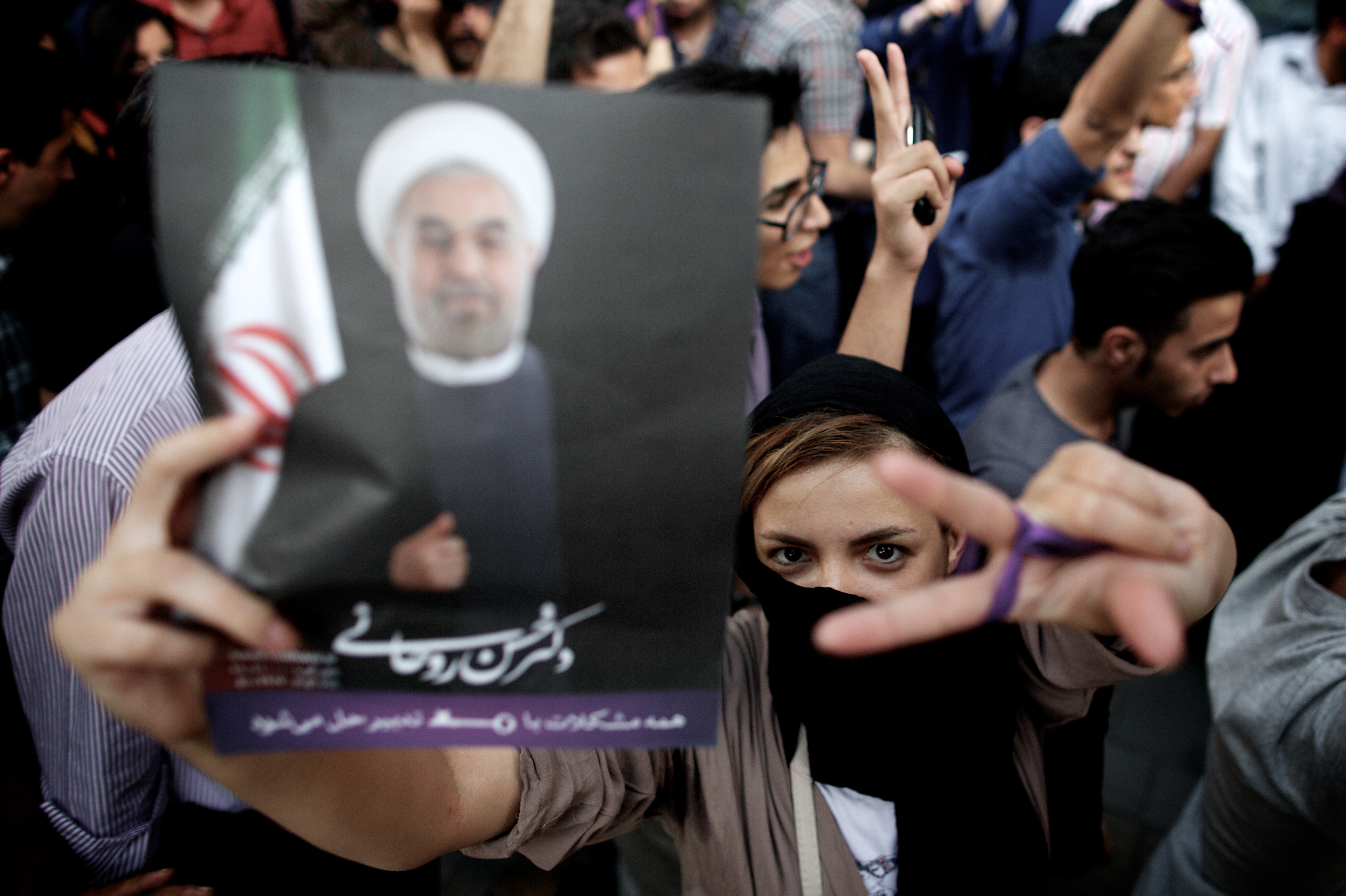
(Photo: An Iranian woman flashes the sign for victory as she holds a portrait of moderate presidential candidate Hassan Rowhani during celebrations for his victory in the Islamic Republic’s presidential elections in downtown Tehran on June 15, 2013. Iranian Interior Minister Mohammad Mostafa Najjar said Rowhani won outright with 18.6 million votes, or 50.68 percent. By Behrouz Mehri/AFP/Getty Images)

Iran’s Election Surprise?

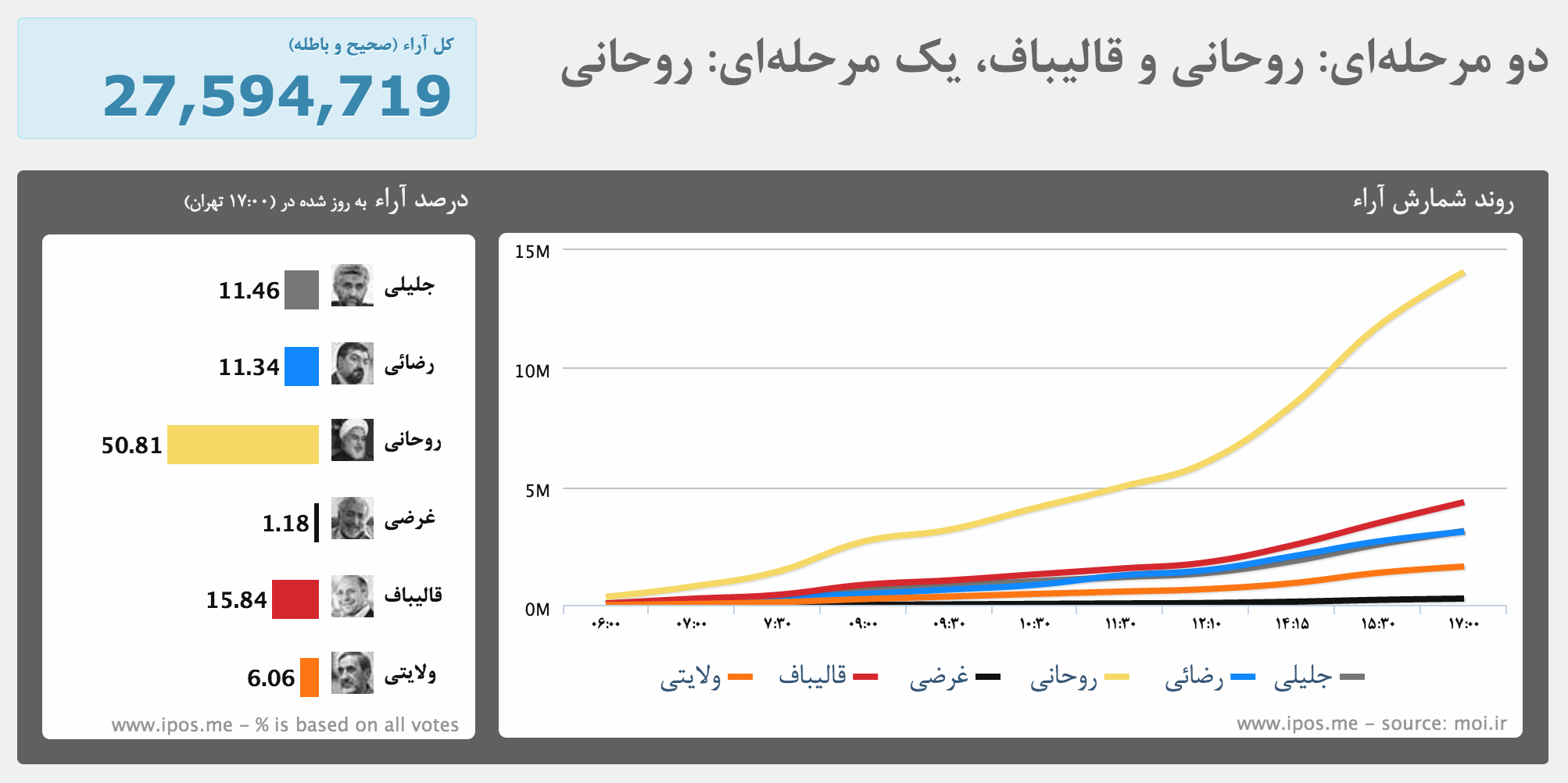
Here are the voting results as of 5 pm Tehran time, as tracked by Ipos.me:

ipos-iranelection-results

With the votes still be counted, reformist-backed candidate Hassan Rouhani is currently winning yesterday’s election in a landslide. We’ll have reax soon but in the meantime here’s a selection of tweets following the news as the results trickled out over the past 12+ hours:

https://twitter.com/thekarami/status/345670534509514752

https://twitter.com/SaeedKD/status/345711846042505217

https://twitter.com/Omid_M/status/345735721799278592

https://twitter.com/IranBlogger/status/345694591137230850

https://twitter.com/ianbremmer/status/346018038782521345

https://twitter.com/Najmeh_Tehran/status/345805085328158720

https://twitter.com/SaeedKD/status/345844909758099456

https://twitter.com/Najmeh_Tehran/status/345845437233762305

https://twitter.com/thekarami/status/345769771641475075

https://twitter.com/Najmeh_Tehran/status/345886784162500609

https://twitter.com/Omid_M/status/345882361784848384

https://twitter.com/thekarami/status/345882338527432705

https://twitter.com/shashj/status/345887742716157952

Iranian Election Update

https://twitter.com/thekarami/statuses/345613295564251136

Voting ended at 11 pm in Iran. Saeed Kamali Dehghan reports that a second round seems likely:

Election officials at Iran’s interior ministry were yet to announce final results but a high turnout after a last-minute excitement caused by the reformists’ endorsement of a moderate candidate boosted the chances of a second round next Friday. Hassan Rouhani, the moderate cleric backed by reformists and many opposition figures, and Tehran’s pragmatic mayor, Mohammad-Bagher Ghalibaf, looked likely to emerge on top, with the chief nuclear negotiator Saeed Jalili, thought to be the favourite candidate of the clerical establishment, falling behind.

He also points out:

In a strange paradox, the state is so keen during elections to showcase a country ostensibly united despite it differences that normal stringent rules do not apply. Thus a picture published by a conservative news agency showed a young woman with virtually no head-covering, her headscarf loosely tied at the back of her head. Iranian women voting abroad reported that they were able to vote without wearing the hijab despite normally strict rules imposed by embassies.

The BBC, meanwhile, complained that Iran had launched a new campaign of intimidation against staff working for its Persian service in London. Relatives of 15 journalists have been harassed, summoned for questioning and threatened.

Regardless of which candidate is ultimately declared the winner, Reza Aslan thinks we might end up missing Ahmadinejad and how extensively he took on Iran’s clerical establishment:

In his second term, Ahmadinejad steadily chipped away at the clergy’s religious, economic, and political control. First, he started questioning the mullahs’ self-proclaimed status as the arbiters of Islamic morality — and especially its obsession with proper Islamic dress. He condemned the actions of the country’s dreaded morality police, saying, “it is an insult to ask a man and woman walking on the street about their relation to each other.” Ahmadinejad’s media advisor, Ali Akbar Javanfekr, was even arrested for printing articles criticizing the law forcing women to wear veils.

The president then began repeatedly criticizing the clergy for their enormous wealth, which stood in stark contrast to most Iranians’ economic suffering under international sanctions. In a surprise move, Ahmadinejad curtailed the amount of money that the government pays to religious institutions, which have ballooned over the past three decades into a source of tremendous personal enrichment for many in the clerical elite.

Ahmadinejad also took a number of bold steps to wrest political power away from the mullahs. He ceased attending meetings of the Expediency Council, one of Iran’s many Orwellian committees whose purpose is to protect the political interests of the clergy. When Iran’s oil minister stepped down, Ahmadinejad took over the ministry himself until a permanent replacement could be found, establishing an extremely significant presidential precedent in the process. … But Ahmadinejad’s challenge to the clerical regime goes beyond any single skirmish with the supreme leader. Perhaps more important is his very public questioning of the foundation of the Islamic Republic’s political and religious authority. “Administering the country should not be left to the [supreme] leader, the religious scholars, and other [clerics],” the president said in 2011.

Aslan adds that “the one thing that the top contenders to replace [Ahmadinejad] have in common is their comical obeisance to the supreme leader”. Mackey and Enduring America are still live-blogging. Our earlier coverage from today is here.

Iranian Election Update

https://twitter.com/Najmeh_Tehran/status/345523444387049472

https://twitter.com/Omid_M/status/345507376297832448

https://twitter.com/GEsfandiari/status/345545597866082304

Karim Sadjadpour reads tea leaves:

Those who trust the integrity of the electoral process — an increasingly small group — foresee a run-off between Rowhani and Ghalibaf. Those who believe that Khamenei’s decision is paramount project Jalili as the obvious winner. And perhaps for the first time, Khamenei may see his interests in conflict with those of the Revolutionary Guards. If past is precedent, however, there’s one thing we do know: predicting anything about Iran’s opaque politics is a fool’s errand. And, having never progressed beyond college calculus I am no Nate Silverzadeh. But if there’s something that seems like a good bet, it’s that the Supreme Leader will remain supreme.

Shervin Malekzadeh offers an aerial view:

It is not lost on Rouhani’s supporters (nor on Rouhani himself) that some 34 years after the revolution and the consolidation of clerical authority in Iran, voters are turning to the sole cleric on the ballot for change. That Rouhani, a regime stalwart, the close companion of Khomeini, and the former head of Iran’s National Security Council today embodies the leading edge of reform speaks to the peculiarities of Iran’s democracy. The righteousness of the revolution is at stake, as it always is, during these elections. Iran seeks not only to stand against the United States, but to prove that its version of democracy, Islamic democracy, is the true version. Whether or not this impulse is sincere, the aspiration leaves the regime exposed to reinterpretations of what it means to be righteous, democratic, and Islamic. The creation of new narratives like Rouhani’s occurs because of pressure from the Iranian public. The hustle for votes means finding and accepting new ideas into the old folds of ideology. Outside of another revolution, which is unlikely to occur, this is a considerable accomplishment.

Live blogs covering today’s voting at the Guardian and Enduring America. Al Jazeera is polling the tweets. This week’s previous Dish on the election here and here.

Something Is Happening In Iran?

https://twitter.com/jetpack/status/345074584078405632

An Iranian reader writes in with an argument as to why the Green Movement should get out the vote tomorrow:

I’m trying to convince absolutely everyone I know to vote. I know there is a lot of discouragement and people think their vote won’t make any difference, but I think that’s the wrong mentality. First off, every one of the more than 20 million of us who voted for Mousavi in 2009 should be equally committed to voting again, as the reasons why we voted in 2009 remain just as important today: we don’t want our country in the hands of some clown who embarrasses us all, we still hate Khamenei, and we still want Iran to be free. We must think logically and keep trying in every way we can until we have finished what we started. The worst thing we can do is nothing.

Furthermore, if more than 20 million of us vote for a single candidate like [reformist Hassan] Rouhani, there is only one way the regime can win: to cheat ever bigger and dirtier than they did the last time. It’s unlikely that this is even possible as there isn’t as much solidarity in the regime as there was in 2009, nor are they as organized as they were then when the President was one of the candidates. Even Khamenei doesn’t seem like he has the energy or courage to pull off that big of a cheat. He says he’s not for any of the candidates; I think that means he’s afraid to say who he is for, in case they don’t end up winning.

Support may indeed be surging for Rowhani, who now has the backing of the reformists and centrists:

[Rouhani’s campaign] received a boost on Tuesday when Mohammad Reza Aref, Khatami’s senior vice-president, bowed out of the race. Later in the day Rouhani received explicit endorsements from both Khatami and Rafsanjani. Of the popular mood swing that followed, the Tehran journalist said, “I never saw this coming. Everyone was so without hope and talking about not ever voting again, and this morning things have changed 180 degrees. It’s like someone put something in the water last night and this morning people are just different.” According to another source in Tehran, “The atmosphere just completely changed after Khatami and Hashemi put their support behind Rouhani. People are really excited. Wherever Rouhani speaks there’s a frenzy. Today in Mashhad it was like four years ago with the appearance of Mousavi.” [a video of that rally is embedded above]

Looking at the rest of the field, it still seems as though Tehran mayor Mohammad Bagher Ghalibaf is attracting significant support.  Meanwhile, Thomas Erdbrink notes (NYT) a major difference between 2009 and now:

Wary of the raucous street demonstrations that erupted [four years ago], the government decreed that this year’s presidential campaign would consist of rallies in predetermined spaces and a series of tedious, four-hour debates that many Iranians dismissed as more like a pointless quiz show than a discussion of real issues. “Where are all the leaflets, the posters?” asked Roghaye Heydari, 55, who had come to the capital from her hometown, Dowlatabad, where most people see voting as a national duty. “Why are they not trying to create a proper atmosphere?”

Now, instead of election posters coloring the streets, plainclothes police officers hang around at major crossings, making sure there are no spontaneous gatherings. “I have never seen so much secret police in my life,” a shopper could be overheard telling her friend near the central Haft-e Tir Square on Saturday, nodding at groups of men wearing fashionable clothes that did not suit them.

Iranwire points out how important the rural vote may be:

Hossein, a photographer who travels frequently around the country for work, says that outside Tehran few know Rowhani well at all, and is skpetical of his chances. “[Ghalibaf] has the vote in towns and provincial cities, the villagers will vote for Jalili,” he says.

Voter participation in Iran’s provinces is likely to be high, given the presidential vote being held simultaneously with city council elections, which traditionally draw voters keen to influence local matters. Saeed, a civil servant who has just visited his hometown in northeastern Iran, says turnout will be high in the provinces for the city council vote. He himself says he doesn’t plan to vote. “They have already decided who will be the president,” he says. “I need to make sure we have a friendly mayor, though”. As for Rowhani, he does not have high expectations “Yes, the urban middle class might want him, but he does not have the majority of vote where people have the highest participation rate”.

Zooming out, don’t expect the same kind of foreign media access that we saw in 2009:

Reporters Without Borders, a Paris-based organisation, said on Wednesday that the Iranian authorities had not issued visas to the vast majority of foreign journalists who requested them. Iranian media were subject to “harassment, restrictions and censorship”. Journalists who have obtained visas have been prevented from moving freely in Tehran, banned from meetings of candidates supported by reformers and from contacting government opponents or the families of political prisoners, RWB added.

Yasmin Alem pushes back on the predictions of many observers that hardliner Saeed Jalili is the favorite to win:

[I]t may well be more that Jalili has been successful in portraying himself as the Supreme Leader’s ideal candidate, rather than Khamenei singling out Jalili. After all, Jalili has fashioned his campaign platform around Khamenei’s preferred topic of “resistance.” … [Also,] traditional and moderate conservatives actually dislike Jalili. Indeed, prominent members of parliament have been openly critical of Jalili, accusing him of inexperience and dogmatism.

She nonetheless cautions:

[D]espite the odds being against him, Jalili could still come out on top. He is unlikely to be able to muster enough votes in the first round, but he might be able to triumph in a run-off (especially if a little election “engineering” takes place). Frontrunner or not, a Jalili victory would have important implications for the course of politics in the Islamic Republic. By propping up Jalili, the Supreme Leader would inevitably alienate traditional conservatives and even some segments of the revolutionary guards who support Mohammed Baqer Qalibaf, leaving Khamenei even lonelier at the top. But Jalili winning would also signal that loyalty to the Supreme Leader would trump competence.

Finally, Saeed Kamali Dehghan reminds us that the anticipation of violence, as well as the spectre of of Neda Agha-Soltan, loom large over this week’s vote:

“These days, her image keeps coming back to my mind,” a Tehrani citizen said via online chat on Facebook. “Am I betraying her if I neda-agha-soltanvote? I don’t know, but many of my friends are saying we won’t achieve anything by simply boycotting the election.”

To vote or not to vote for Hassan Rouhani, the sole reformist-backed candidate standing in the race, is the dilemma shared by hundreds of thousands of people who lost faith in the fairness of Iranian polls. For families who lost loved ones in the aftermath of the 2009 election, the buildup to the vote is adding salt to the wounds. At least 100 protesters are believed to have been killed in the protests.
Is Iran Winning The Syrian Civil War?

Max Fisher worries that “it’s increasingly plausible that Iran will emerge as the big winner”:

How did it happen? The answer may be both simple and complex. For all the twists and turns in regional politics, sectarian divisions and even great-power politics, it might come down to something really simple: Iran just has a bigger stake in Syria than the U.S. does. …

A rebel-held Syria, whether those rebels were the Islamists favored by Saudi Arabia and Qatar or the moderates hoped for in Washington, would shut out Iran from its only major Arab ally and and make it much tougher for Iran to reach its proxies in Lebanon and the Palestinian territories. It would leave Iran less able to reach the outside world or to threaten Israel, which Tehran sees, rightly or wrongly, as an imminent threat to Iranian security that must be deterred.

Martin Longman questions the framing:

This makes it appear like we are openly aligned with the rebels, but that is not the case.

We are formally opposed to the continued rule of the Assad regime, and we are working with some rebel groups, but we are just as opposed to some of the rebels (probably the majority of them) as we are to the Iran-backed regime. As [Liz Sly’s WaPo article] notes, the war in Syria has morphed into a sectarian conflict that pits Sunnis against Shiities and Alawites. It is neither advisable nor possible for us to take the side of the Sunnis in a sectarian religious war. That would pit us not only against Iran, but against Iraq. Plus, it’s the wrong thing to do. …

It is a gigantic failure of analysis to look at Syria as a proxy war between Iran and the United States of America. We would like to diminish Iran’s power and influence, it’s true. But not at the expense of taking sides in a sectarian fight where the most effective fighters on our side are indistinguishable from al-Qaeda.