Iran’s Popularity Problem

Iran Popularity

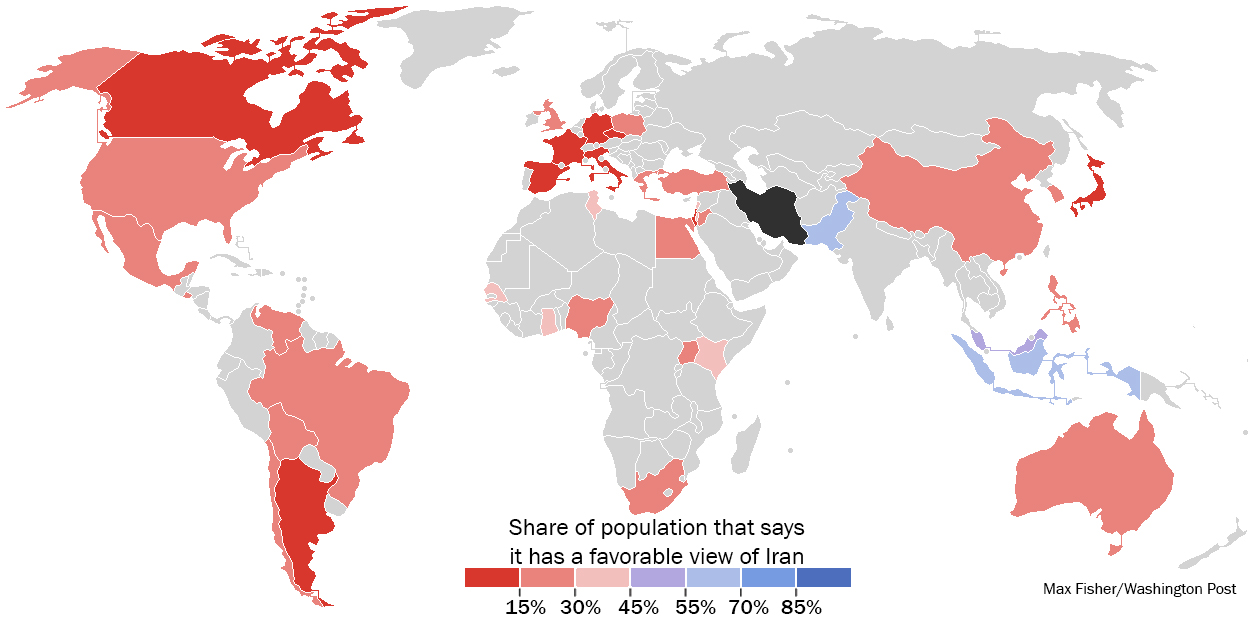
Max Fisher finds “bad news for Tehran” in the results of a recent Pew survey on views towards Iran:

Perhaps most consequential for Tehran are the negative views of Iran held in East Asia, particularly Japan and China, two crucial buyers of Iranian energy resources. While Asian economies have not joined the severe European and American sanctions against the Iranian energy industry and do not appear poised to do so soon, they do seem to be increasingly reluctant about importing from Iran.

Even the data from countries with a favorable view of Iran showed a troubling trend:

Pakistan, the one surveyed country where Iran is popular, appears to be slackening in its support for the fellow Islamic state and bastion of anti-Western resistance. The January Pew poll found that 79 percent of Pakistanis support Iran, but the new number is 69 percent. That’s still pretty high in both absolute and relative terms, but it’s hard to miss the significant quick drop in pro-Iranian attitude.

Iran Non-Election Update: The Final Week

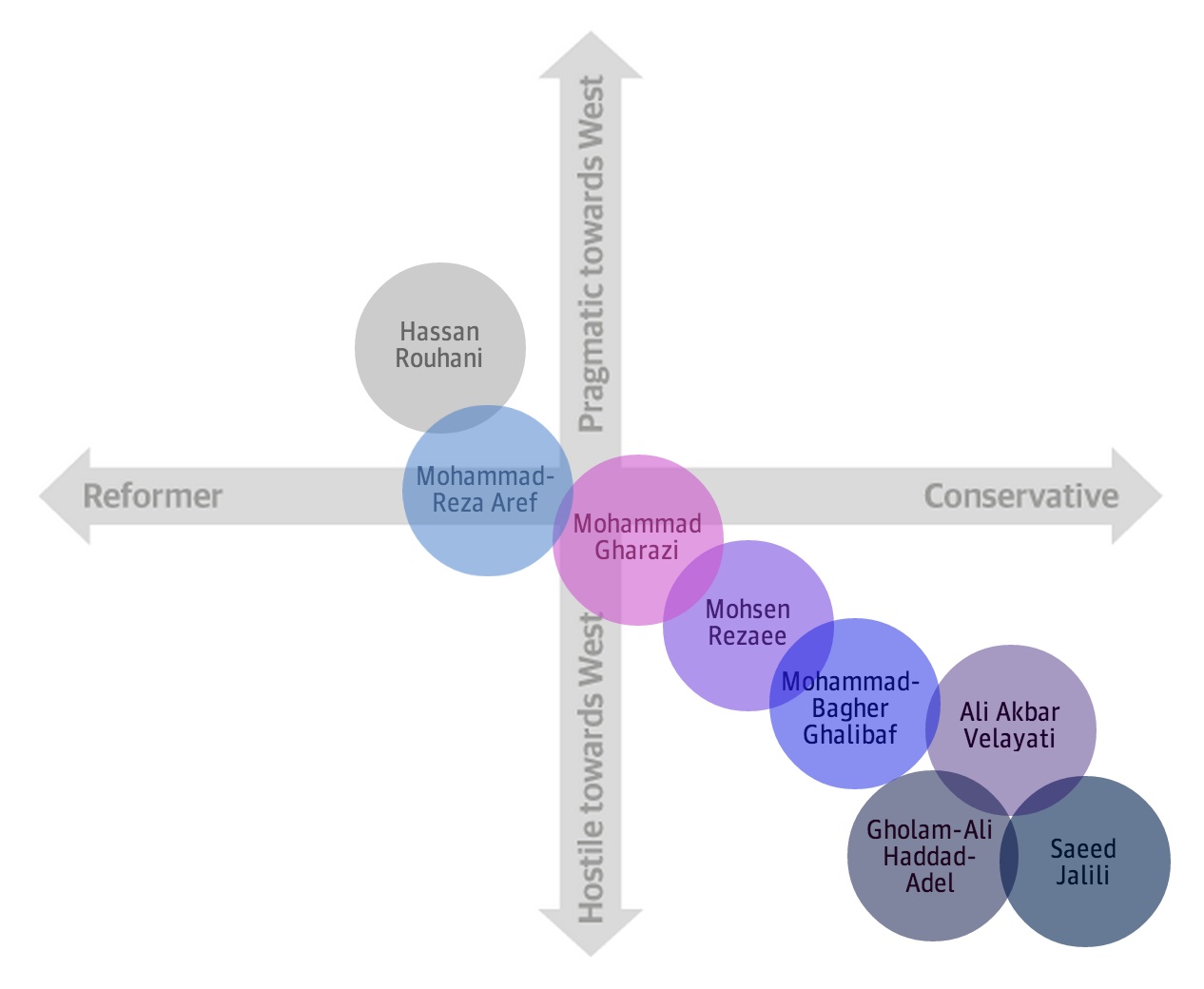
Guardian-IranPresCand-Chart

With Friday’s “selection” fast approaching, Barbara Slavin points out that, “if Iranian elections are supposed to follow a script, [some] of the actors seem to have forgotten their lines.” In particular she notes how much sanctions-related criticism has been directed at Saeed Jalili, the country’s top nuclear negotiator and the candidate widely considered to be Khamenei’s first choice for the presidency:

[During the third debate, former foreign minister Ali Akbar] Velayati and former nuclear negotiator Hassan Rowhani both implied that they would have done far better that had they been in charge [of the nuclear negotiations with the West]. Rowhani, who negotiated with the Europeans from 2003-2005 when he held Jalili’s post, has repeatedly noted that during his tenure, Iran continued to make progress on its nuclear program without being referred to the Security Council and hit with heavy sanctions.

The sanctions have seriously impacted the Iranian economy — the major topic of the presidential campaign. Thus, even if Khamenei had wished to prevent discussion of the nuclear question, he would have had a hard time succeeding.

Slavin believes that while both Rowhani and Velayati may realize they can’t win, they are nonetheless using the freedoms allowed them by their candidacies to criticize the regime. The reformist Rowhani, for instance, has suggested that Iran’s nuclear program should not be a higher priority than the country’s economy, and he has spoken out on other issues as well:

“We will open all the locks which have been fastened upon people’s lives during the past eight years,” Rowhani said during a speech on 1 June in the north Tehran neighbourhood of Jamaran. “You, dear students and hero youth, are the ones who have come to restore the national economy and improve the people’s living standards. We will bring back our country to the dignity of the past.”  … Tuesday night, in a 30-minute documentary more biography than manifesto, he verged on crossing Iran’s media “red lines” as he criticised the harassment of Iranian civilians by “plainclothes people” – a clear reference to the Basij militia – and the country’s “securitised atmosphere”. He also poured scorn on Ahmadinejad’s record, though that is by now a million miles from any red line. Elsewhere in the documentary, Rowhani, who is campaigning on the slogan Government of Proficiency and Hope, talked of “interaction with the world” and gender equality. “In my government, differences between women and men won’t be tolerated,” he said. …

[However, t]hough Rowhani may stimulate the reformists to back him and mobilise disenfranchised voters to the polling venues, he is no firebrand reformer. He has so far cleverly toed the line between appeasing the establishment by showing due deference to Khamenei and exhibiting his revolutionary and Islamic bona fides.

But that’s to be expected from most anyone trying to navigate the regime’s system. It also seems like Rowhani’s campaign may be working from Mousavi’s 2009 playbook:

Supporters entering [a Rowhani campaign rally on] June 8 were handed purple wrist ribbons, the color he’s using on campaign posters. The move may be inspired by Mir Hossein Mousavi’s 2009 campaign, which became so associated with the color green that the opposition born out of post-vote protests became known as the Green Movement. …

Most people at [Rowhani’s] rally were middle-class Iranians in their early 20s, and some also wore purple headscarves, headbands or T-shirts. A spillover crowd lined the street outside. Hundreds of policemen and dozens of police vans were stationed outside the stadium to prevent the possibility of spontaneous protests.

Indeed at a few rallies, Rowhani supporters broke into chants calling for the release of Mousavi and Karroubi, leading to some arrests as well as rumors, so far unfounded, that the Guardian Council would reevaluate and then bar Rowhani from the race. While most analysts believe Rowhani doesn’t have a chance, there are at least some signs that his rhetoric is resonating with voters:

News websites in the country run their own informal polls, and these have shown a strong lead for moderate reformer Hassan Rowhani after three rounds of televised presidential debates. With the conservative camp split among three candidates, [and 50.1% of the vote required for a definitive victory,] this could mean Mr. Rowhani forcing a run-off vote. Nonetheless, the widespread belief that the 2009 election was rigged has prompted caution among most Iranian observers about whether any of the anti-establishment candidates would be allowed to make it through to the run-off, let alone win.

The regime is worried about low turnout as well:

[Authorities] have taken the unprecedented step of scheduling local council elections for the same day, along with by-elections for the Assembly of Experts – a group of clerics that appoints the supreme leader. The authorities hope that combining the three elections will boost the vote, especially as official statistics show that turnout in local elections is often relatively high.

Meanwhile, Max Fisher scans a recent (US) poll conducted among voters in Iran which shows technocratic Tehran mayor Mohammad Ghalibaf in the lead instead:

The poll has 39 percent of decided voters saying they support Ghalibaf, a remarkable lead over all the other candidates. However, the poll also reports that 57 percent of voters are undecided, meaning that presently undecided voters could easily erase his lead. It’s plausible, though, that many of the undecided voters are disillusioned with Iranian politics – an increasingly common sentiment after the protests and crackdowns that followed the disputed 2009 election – and thus not likely to turn out on election day. … The polls look bad for Saeed Jalili, the country’s nuclear negotiator and a fervent nationalist who appears to be a favorite of Supreme Leader Ali Khamenei and the clerical establishment. He received 13.9 percent support from decided voters in the poll, placing him in a distant third.

Jason Rezaian profiles the supposed frontrunner:

Ghalibaf is viewed warily by some of Iran’s political conservatives and clerical rulers, who view him as being more focused on pragmatism than revolutionary ideals. But there are few signs that he would make bold diplomatic shifts or decisions about Iran’s nuclear program if elected. …

Ghalibaf is not just a wonk. With many years in law enforcement, he also has a history of doing what he deems necessary to maintain order, and critics say that has included the use of excessive violence in suppressing the biggest protests of the Islamic Republic’s 34-year history. In a recording that surfaced last month, Ghalibaf can be heard giving a speech to members of the Basij, a state-funded paramilitary group often enlisted to provide assistance to police in times of domestic tension or unrest. In it, Ghalibaf allegedly takes pride in his role in cracking down on protesters in Tehran in 1999 and 2003, and he acknowledges being a key player in the security forces’ violent crackdown against post-election protests in 2009.

Meanwhile, Gholam-Ali Haddad-Adel, a hard-liner candidate without much support, has now dropped out of the race.

(Image: Screenshot of the Guardian’s interactive guide to the Iranian presidential candidates.)
The Iranian Sexual Revolution

Afshin Shahi shines a light on how sex may be becoming “a form of passive resistance” in Iran:

Changing attitudes toward marriage and divorce have coincided with a dramatic shift in the way Iranians approach relationships and sex. According to one study cited by a high-ranking Ministry of Youth official in December 2008, a majority of male respondents admitted having had at least one relationship with someone of the opposite sex before marriage.

There are some clues as to what’s at play:

There are a number of potential explanations, including economic factors, urbanization, new communication tools, and the emergence of a highly educated female population — all of which are probably partly responsible for changing attitudes toward sex. At the same time, however, most of these factors are at play in other countries in the region that are not experiencing analogous transitions. (Indeed, a wave of social conservatism is sweeping much of the Middle East, while Iran moves in the opposite direction.) So what is different in Iran? Paradoxically, it is the puritanical state — rigid, out of touch, and dedicated to combating “vice” and promoting “virtue” — that seems to be powering Iran’s emergent liberal streak.

Iran Non-Election Update

IRAN-POLITICS-VOTE-ROWHANI

Abbas Milani zooms in on the aftermath of Rafsanjani’s disqualification:

On the one hand, sources representing the conservative ruling coalition deny that Rafsanjani’s fitness to serve as president has been rejected. “His fitness was simply not confirmed,” these sources claim. Other sources, like the daily Keyhan, the most reliable reflection of Khamenei’s views, have suggested that Rafsanjani in fact owes the Guardian Council a debt of gratitude. Reformists and opponents of the regime, Keyhan claims, were planning to use Rafsanjani against the regime, and the rejection of his candidacy saved him from this fate of becoming a puppet of the opposition, and of the U.S. and Israel. (By this logic, the man who is responsible for deciding what is “expedient” for the regime is somehow incapable of deciding what is expedient for himself.)

And lest there be any doubt about Khamenei’s real source of power, consider his first major appearance after the Guardian Council announced its list of approved candidates: He asked the Iranian people to vote for those who will stand up to the enemy, and said that those who were not allowed to run have nothing but themselves to blame—all while surrounded by [Revolutionary Guard (IRGC)] commanders and other military officials. A couple of days later, Iran’s police chief—another IRGC commander—announced that 300,000 policemen will be on hand on election day to forcefully abort any attempted demonstrations.

Milani sees the upcoming election as little but the regime’s continuing quest to consolidate power:

Unless there is a deus ex machina, Khamenei is unlikely to get the political “epic”—massive voter turnout—he repeatedly says the regime needs and wants. Instead, Iran is more likely to take yet another step toward becoming a Praetorian despotism dominated in every domain—politics, construction, oil, media, even soccer—by the IRGC.

Gareth Smyth goes over the campaign rhetoric thus far:

[N]either [the perceived frontrunner Saeed] Jalili nor any other candidate has so far offered much in the election other than banalities – despite Iran’s mounting problems, which now centre on the reduction of oil exports from 2.2m barrels a day to 1.1m in the past year due to tightening western sanctions. … In the face of 13% unemployment and 32% inflation, candidates have been slow to advance specific ideas for improving economic growth the IMF projects at -1.3% for 2013, or to explain how they might finance productive investment with lower oil sales cutting government revenue in the financial year ending in March from a budgeted $117bn (£77bn) to $77bn.

But a silver lining in this week’s news: the US relaxed the Iranian sanctions on laptops and mobile phones in an effort to help Iranians use technology to overcome the regime’s propaganda.

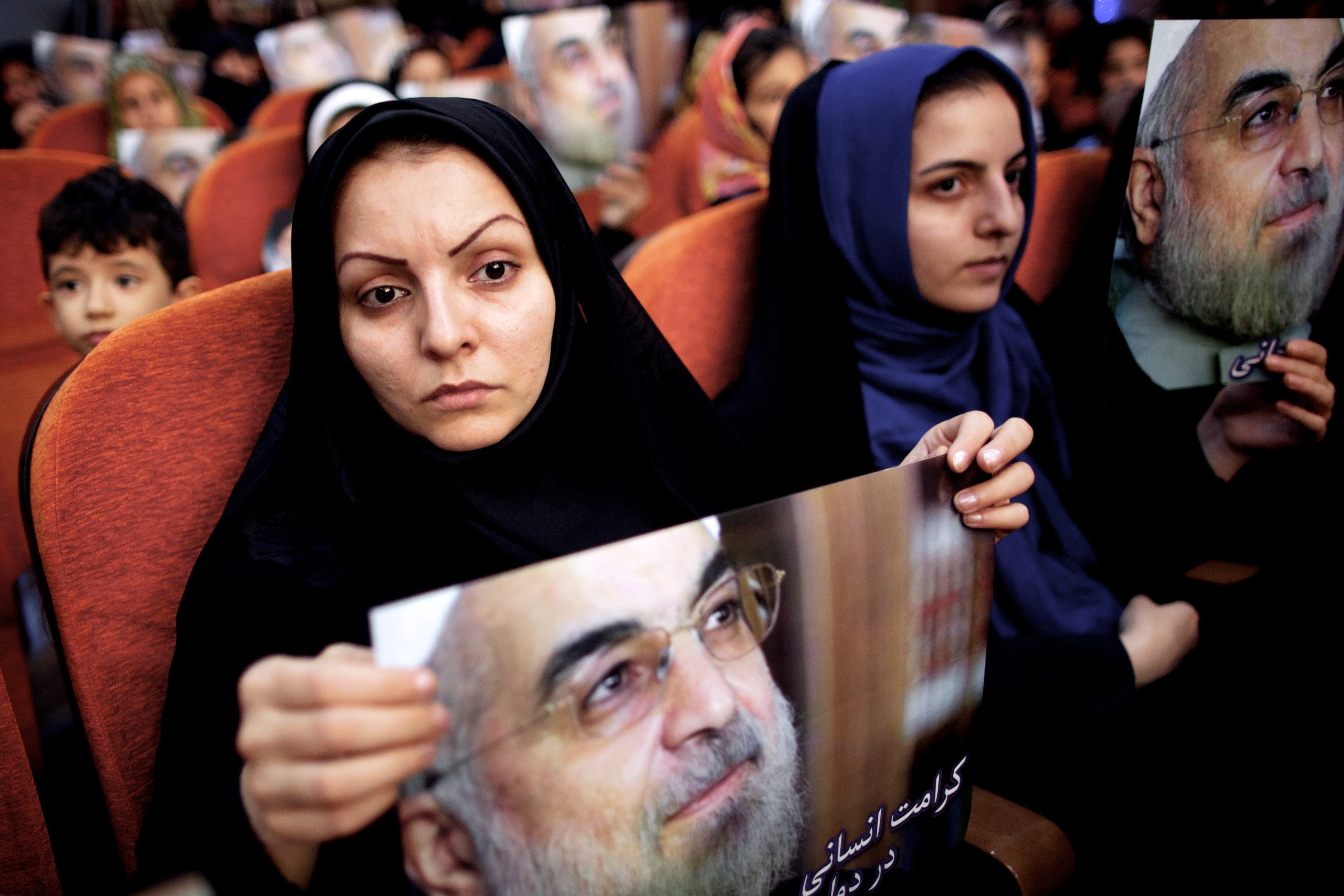
(Photo: Iranian supporters hold posters featuring Hassan Rowhani, moderate Iranian presidential candidate and former top nuclear negotiator, during one of his electoral campaign rallies in northern Tehran on May 30, 2013. Rowhani, the only cleric in the race, says his experience in leading talks with the so-called P5+1 group – the United States, Russia, China, France, Britain plus Germany – could help resolve the nuclear standoff. By Behrouz Mehri/AFP/Getty Images)

Iran’s Election Just Got Really Interesting

 
The Guardian Council has now barred the surprise candidacies of former president Rafsanjani and the Ahmadi-allied Mashaei. Rumors over the weekend said the rationale for disqualifying Rafsanjani would be his age (78), and security services had already been readying themselves for negative reaction to today’s announcement. Yesterday, Yasmin Alem noted the problems that Ayatollah Khamenei and his allies could face by shutting out Rafsanjani:

[Using his old age as] a pretext would expose the Guardian Council to potential ridicule, since its powerful secretary, Ayatollah Ahmad Janati, is eight years Rafsanjani’s senior. Another pretext could be to accuse the former president — as the minister of intelligence did a few days before his registration — of complacency in the 2009 revolt. But that would undermine the Supreme Leader’s own credibility since he reappointed Rafsanjani in 2012 as the chairman of the Expediency Council, a body that advises him directly.

Alem added that there may be consequences for ruling out Mashaei as well:

[There is] a risk that Ahmadinejad could go ballistic if his dauphin is barred from the race — a spectacle that would be problematic for at least two reasons. First, the president is technically in charge of conducting the election, meaning that the ruling clique’s hopes of an incident-free ballot could be dashed. Second, Ahmadinejad has threatened to blackmail regime insiders with a supposedly thick dossier of damning documents that implicate officials close to Khamenei in corruption scandals. But the Supreme Leader might well call Ahmadinejad’s bluff; experience has shown that the president typically caves when faced with Khamenei’s immense institutional power. Even if he doesn’t, Khamenei loyalists have laid the groundwork to soften the blow, announcing in advance that anyone who interferes with the electoral process or questions its results is doing the bidding of Iran’s enemies.

Both candidates can still appeal directly to Khamenei for inclusion in the race. Abbas Milani recently summarized why he thinks Rafsanjani would be trouble for the Supreme Leader:

In a sense, the Rafsanjani candidacy has put Khamenei and his IRGC allies in a lose-lose situation. If they allow him to run, they have, in effect, accepted defeat in their eight-year project of eliminating him and his moderate allies in favor of Ahmadinejad’s harebrained economic ideas and foreign policy adventurism. If they block his candidacy, though, they won’t have the “epic” election they so desperately need. With no economic rebound in sight, a controversial election will only worsen Iran’s politically explosive climate. Some IRGC commanders are warning of post-election riots not just in Tehran but around the country; they predict a “Russian style” riot that, according to IRGC’s political commissar, might be significantly worse and more widespread than the 2009 demonstrations, which were concentrated in Tehran. These anxieties indicate that a long hot summer is ahead in Iran.

Meanwhile, Saeed Kamali Dehghan reports that, with the election nearing, opposition activists are being increasingly targeted:

Iran has launched a public crackdown on dissent before next month’s presidential election, executing two men charged with espionage and waging war against God, arresting a group of activists and summoning campaigners for questioning. Political prisoners in some of the country’s most notorious jails have had their parole or visiting rights withdrawn and some transferred to solitary confinement.

Internet access in the country has been throttled, another sign that the regime is trying to stifle dissent. Previous Dish coverage of the election here and here.

Iran’s Election Just Got Interesting, Ctd

IRAN-VOTE-REGISTRATION-MASHAIE

First, former President Rafsanjani made a surprise entrance into the race. Now, the Guardian Council has delayed its announcement of the approved candidates for the election, which will give those candidates just over three weeks to campaign. David Patrikarakos notes how the regime is already attempting to discredit Rafsanjani:

Rafsanjani would have support from both conservatives and reformists, and, critically, he could win. So the question remains: will he pass the vetting process?

Ayatollah Ahmad Jannati heads the Guardian Council and is a close ally of Khamenei. He would probably like to reject Rafsanjani’s candidacy outright, but things are not that simple. … Rafsanjani is too powerful to be swatted aside like so many other candidates but, equally, the regime is determined to avoid a repeat of the popular unrest of 2009. … It is a sign of how isolated Iran’s ruling elite have become that Rafsanjani, a commercially minded pragmatist who never displayed any great love of reform beyond what was practically necessary, is now seen as a grave internal threat to the regime. Even were he elected there is no knowing how reformist he would be: his track record shouldn’t give any hope to the regime’s opponents, and how far he has changed remains to be seen.

Meanwhile, Laura Rozen takes a look at Saeed Jalili, the country’s top nuclear negotiator, who may emerge as the hardline establishment’s choice now that Rafsanjani is running:

Jalili, 47, a trusted Khamenei aide who has served since 2007 as the secretary of Iran’s Supreme National Security Council (SNSC) — the Iranian equivalent of National Security Advisor–has managed to largely bypass the bitter feuds that have polarized Iran’s ruling factions, analysts and associates observe. As a candidate who may be able to unite key conservative factions, a Jalili presidency potentially offers the prospect of a more consolidated Iranian leadership, which might be able to muster internal Iranian consensus if the Leader decides to make a deal, some analysts suggest. …

“I think he is the anointed one,” Suzanne Maloney, a former State Department Iran analyst at the Brookings Institution Saban Center, told Al-Monitor. The regime “may test run it, see how he [does], if anybody else appears to take off.” … Current and former Iranian associates describe Jalili as a pious and intelligent man, who has earned the trust of the Supreme Leader, but shown a disinclination to deeply engage with the modern world.

(Photo: Iranian President Mahmoud Ahmadinejad (R) and Esfandyar Rahim Mashaie (L) flash the sign of victory during their press conference after Mashaie registered his candidacy for the upcoming presidential election at the interior ministry in Tehran on May 11, 2013. Iran is expected to wrap up the five-day registration of candidates on May 13, leaving the fate of the hopefuls in the hands of the Guardians Council, an unelected body controlled by religious conservatives appointed by Khamenei. By Behrouz Mehri/AFP/Getty Images)

Iran’s Election Just Got Interesting

IRAN-VOTE-REGISTRATION-RAFSANJANI

The upcoming presidential election has already taken a dramatic turn, with both former president Rafsanjani and Ahmadinejad-ally Mashaei entering the race over the weekend. Next they will be vetted by the regime’s Guardian Council, along with hundreds of lesser-known candidates. Gary Sick attempts to unpack the political calculus, suspecting the news may indicate waning political influence from Ayatollah Khamenei:

I thought that the Supreme Leader had decided unequivocally that there was to be no repetition of 2009, i.e. no credible individuals challenging the existing system and no mobs in the street with grievances after the vote. He had even talked about eliminating the presidency entirely, in favor of a parliamentary system. … [Mashaei and Rafsanjani entering the race] implies that Khamenei was either unable or unwilling to exercise control of the process or that his objectives were quite different from what we had understood from his observable actions and words. At a minimum, these candidates were willing to put Khamenei in an embarrassing position by publicly ignoring his well-known preferences, apparently without concern for the consequences.

Of course, it is still possible that the Guardian Council will simply disqualify all but the “safe” candidates, despite the past history of leaders like Rafsanjani and their intimate association with both the Leader and the revolution. That would confirm the cynical interpretation of Iran’s leadership after 2009 — that it realized the revolution was dead and there was no need to pretend that it was about anything other than raw power.

Meanwhile, the top reformist candidates from 2009, Mousavi and Karroubi, are still under house arrest and probably won’t play a direct role in this election. What’s left of the reformist camp?

Iran’s reformists have been politically crippled since the disputed 2009 Presidential election, with leading members in prison or under threat of detention, parties banned, and communications disrupted. Curbed in Parliament for almost a decade, they were split over participation in the 2012 Parliamentary elections and won only a small fraction of the vote.

Despite much speculation, a campaign by former President Mohammad Khatami, in office from 1997 to 2005, has not emerged. Khatami’s latest statements ruled out his involvement in the election. In Khatami’s absence, the leading reformist hopeful is Mohammad-Reza Aref, former first vice president under Khatami. Aref said on April 5 that reformists had “boosted their relations” with the Supreme Leader. Mostafa Kavakebian, who presents himself as a leader of the faction in Parliament but who is disliked by many reformists for failing to support the challenge after the disputed 2009 Presidential election, has also declared his intention to stand.

In the current circumstances of regime pressure, neither candidate nor the reformist movement is likely to be of any significance in the race.

So all eyes are on Rafsanjani:

With a month to go before polling day there is plenty of scope for further drama. Observers say one crucial question is whether Ahmadinejad’s controversial former aide – Esfandiar Rahim-Mashaei, who is loathed by Khamenei and his supporters – will be allowed to run. If he is disqualified some believe that the outgoing president, who remains in office, will turn openly on Khamenei – perhaps by spilling the beans on what really happened in 2009 or by refusing to rig the results again. It is also tantalisingly unclear whether Rafsanjani will be a serious candidate or intends rather to play the role of kingmaker.

Farideh Fardi predicts that Rafsanjani’s entry will unleash “an intense battle over the direction of the country”:

Unlike 2005, when Rafsanjani was challenged by both conservatives and reformists, this time he will be coming in with solid support from the reformists.

It is true that the reformists are also a herd of cats, but few doubt [reformer and former president] Khatami’s ability to convince the herd to rally behind Rafsanjani. In fact, most reformist and centrist candidates have already said that they will withdraw if Rafsanjani runs. The exception may be former nuclear negotiator Hassan Rowhani, but, without support from Rafsanjani or Khatami, he will not be a significant candidate anyway. In effect, if Rafsanjani is qualified by the Guardian Council and if he chooses not to back off in favor of another candidate, the conservatives will be facing a centrist/reformist consensus candidate who may even peel away some of their own, particularly the ones in the commercial sector and many in the clerical community in Qom and elsewhere. …

Rafsanjani’s entry into the fray with solid support from Khatami and his followers will force the conservatives not only to scramble for a consensus candidate, but also search for one who is relatively popular or at least better known.

Rodger Shanahan is waiting to see who makes it out of the vetting process:

The fact that these candidates have registered in such dramatic fashion makes for increased interest in the race, but there is no guarantee they will appear on the final ballot. The Supreme Leader wields significant influence over the candidacies, and the the ability of these two men to survive the vetting of the Council of Guardians is anything but assured. Only ten out of 800 hopefuls survived the Council’s deliberations in 2001; in 2005 it was six out of more than 1000.

The economy is the highest priority for most Iranians, and the public’s belief as to whether any of the final candidates can offer some relief in this area will ultimately determine the turnout. The backroom manoeuvrings and positioning of putative candidates is likely to dominate the period until the confirmation of candidates and the three-week election campaign.

At the same time, the Guardian Council may charge Ahmadinejad for illegally endorsing his protegé and chief of staff, Mashaei. For more on the race, head over to Enduring America’s election guide.

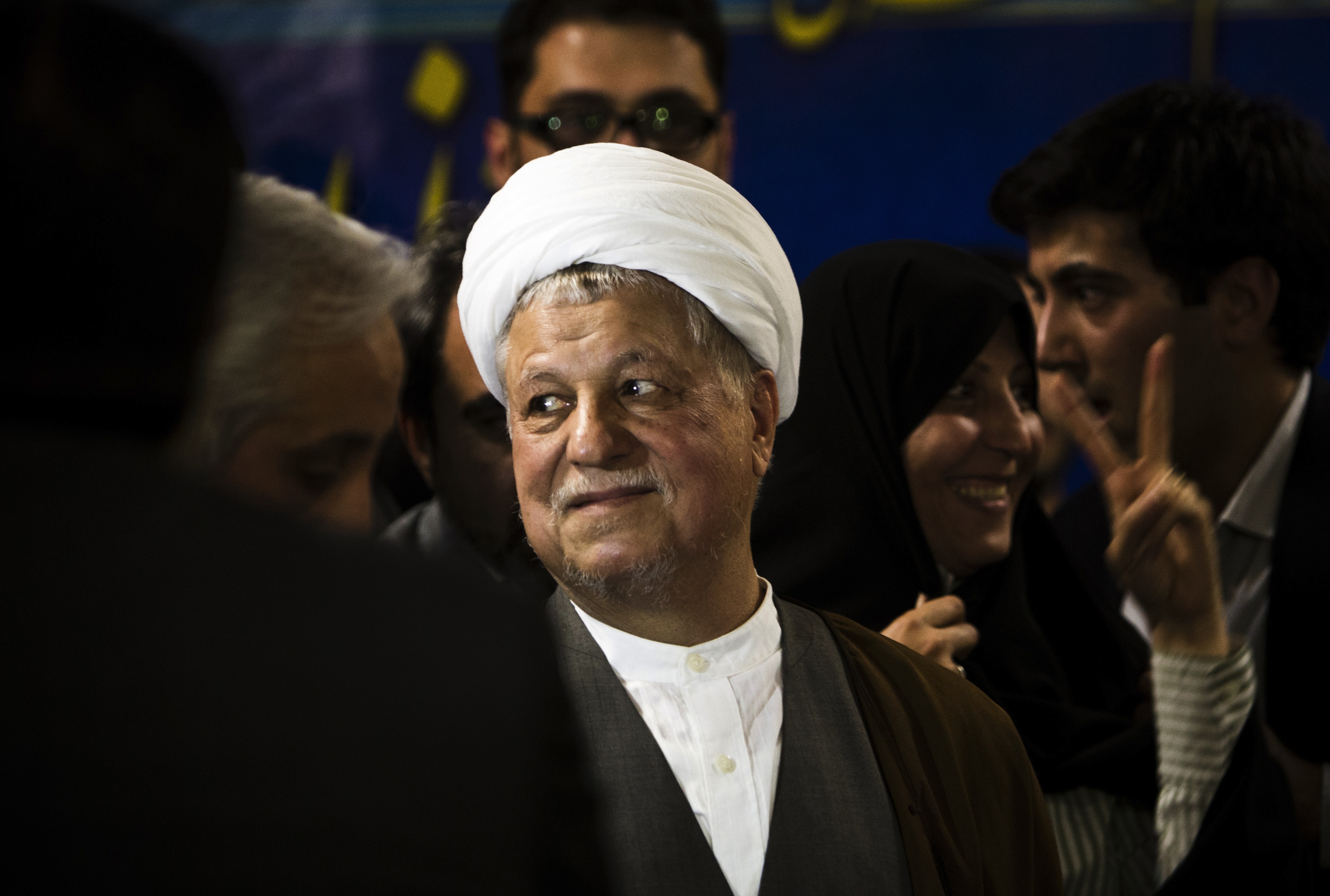
(Photo: Former Iranian president Akbar Hashemi Rafsanjani arrives to register his candidacy for the upcoming presidential election at the interior ministry in Tehran on May 11, 2013. By Behrouz Mehri/AFP/Getty Images)

Iran’s Suffocation Of The Press

Over the past few years, the theocracy has increasingly cracked down on journalists:

The pattern of rotating critical journalists in and out of prison has sown fear and self-censorship across the entire press corps, according to [Committee To Protect Journalists (CPJ)] research. At least 68 Iranian journalists fled into exile between 2007 and 2012 due to harassment and the threat of imprisonment, according to CPJ research. Only Somali journalists have gone into exile in higher numbers during that period.

(Hat tip: Max Fisher)

America, The Arab World, And Iran

Marc Lynch points out that only “two Arab countries now see Iran as a good model (Lebanon and Iraq), Iran is viewed unfavorably in 11 out of 17 Arab countries, and large majorities of Arab publics sided with the opposition Green Movement over the Iranian government and disapprove of Iran’s role in Syria, Iraq, and the Gulf”:

This should not be taken as a green light for military action against Tehran, though. While support for a military strike with international legitimacy has grown significantly since 2006 in the polling, there isn’t a majority in favor in any Arab country. A 34-point increase in support for a military strike among Jordanians or a 24-point increase among Egyptians is significant as a trend. But approval of military action doesn’t crack 40 percent in any surveyed country, which is hardly an overwhelming mandate. Indeed, an American or Israeli military strike is probably the only thing that could rescue Iran’s regional image at this point — particularly if the regime is able to emerge with a Hezbollah-like narrative of success through survival.

Lynch worries about the growing sectarianism evident in the polling:

In Saudi Arabia, 92 percent of Shia reported a favorable view of Iran compared with 0 percent of Sunnis; in Bahrain, 76 percent approved of Iran compared with 4 percent of Sunnis. The same phenomenon appeared in almost every country with a significant Shia population

He goes on to argue that capitalizing on “sectarian hatred might be useful for regimes seeking to browbeat Shia populations into sullen acceptance of their subordination, but virtually guarantees enduring popular discontent and recurrent uprisings.”