Ask The Leveretts Anything: Will Iran Stay A Theocracy?

brightcove.createExperiences();

During the Iranian uprising of 2009, the Dish continuously clashed with Flynt and Hillary Mann Leverett, the most well-known skeptics of the Green Movement. The husband and wife team continue to blog at Going to Tehran. Watch their previous videos hereherehere, here, here and here. In an excerpt from their new book, they touched on Western conceptions of the Islamic Republic:

In the more than thirty years since the Iranian Revolution, Western analysts have routinely depicted the Islamic Republic as an ideologically driven, illegitimate, and deeply unstable state.  From their perspective, Iran displayed its fanatical character early on, first in the hostage crisis of 1979-81, and shortly afterward with the deployment of teenage soldiers in ‘human wave’ attacks against Iraqi forces during the 1980s.  Supposedly the same Shi’a ‘cult of martyrdom’ and indifference of casualties persist in a deep attachment to suicide terrorism that would, if Iran acquired nuclear weapons, end in catastrophe.  Allegations of the Iranian government’s ‘irrationality’ are inevitably linked to assertions that it is out to export its revolution across the Middle East by force, is hell-bent on the destruction of Israel, and is too dependent for its domestic legitimacy on anti-Americanism to contemplate improving relations with the United States.

Update from an Iranian reader:

This is providing a platform for blatant lies, unbalanced by reality. I want you to talk to these guys with a straight face when they say that Iran is not a theocracy, or that women have great rights in Iran. My cousins are Bahaii’s and their kids are not allowed to go to school. They’re not allowed to have regular jobs. If this isn’t a theocracy then what is it? Some haven for women when they rape underage girls before they execute them! I’m really pissed at you guys right now. Shameful! Some idiots might watch these videos and believe it’s true.

Ask The Leveretts Anything: How Should Obama Deal With Iran?

brightcove.createExperiences();

During the Iranian uprising of 2009, the Dish continuously clashed with Flynt and Hillary Mann Leverett, the most well-known skeptics of the Green Movement. The husband and wife team continue to blog at Going to Tehran, in addition to Flynt’s role as Penn State Professor of International Affairs and Hillary’s role as Professorial Lecturer at American University and CEO of the political risk consultancy, Stratega. In 2011, they argued “there has been no Nixon to China moment under Obama.” Watch their previous videos hereherehere and here. A reader dissents to the series:

As a long-time follower of The Dish – it was instrumental to me as I was launching EA WorldView (then Enduring America) in 2008 and especially during the post-election crisis in Iran in 2009 – I have been unsettled by the platform you have given the Leveretts to push their book and their portrayal of life in Iran. While I fully agree that a well-rounded view of Iran and of US-Iran relations is essential to avoid military conflict and to find a way out of the punishing economic warfare, the Leveretts do not serve this purpose for me. Instead, they are pro-regime polemicists putting forth under-informed, rose-coloured caricatures of the leadership and the internal situation.

I would have responded directly on The Dish if it had a Disqus facility. I did try to respond on Going to Tehran, but the Leveretts have blocked any substantial questioning of their comments. For what it’s worth, this was my reaction:

A post reinforcing the hope that Going to Tehran will focus solely on the US approach to Iran and not venture any “analysis” on the Islamic Republic’s “internal dynamics” … .

A few questions to cut through the superficial reply and condescension about “how Americans been conditioned”:

1. While the introduction to how the system works in principle is useful, can the Leveretts explain – beyond an elegy of “populist” Ahmadinejad – how the current government established legitimacy in 2009? There’s nothing here in this answer.

2. If Ahmadinejad is the triumphant “populist”, with overwhelming public support, can the Leveretts explain the hostility of most elements of the regime – including, at times, the Supreme Leader’s office – towards him?

3. If the Ahmadinejad economic legacy is so successful, can the Leveretts explain why he was only able to pass one stage of his subsidy reforms, and then after great delay? Can they explain why the second stage has been blocked by Parliament and is unlikely to see the light of day?

4. Can the Leveretts explain a current inflation rate which, by official figures, is almost 30% and – according to some MPs and Iranian economists – between 40 and 60%? Can they explain the 40% drop in oil exports? The 70% drop in the value of the currency? The rise in unemployment, especially among those under 30?

I am even more distressed by the elegy given by the Leveretts in the second video. While recognising the advances of women in the Islamic Republic, any observer should also note the limitations on women’s rights – for example, the recent legislation further restricting women’s right to travel outside Iran and their “family rights” – and the detentions of women such as attorney Nasrine Sotoudeh and student activist Bahareh Hedayat, thrown in prison for daring to represent clients and for calling for political reform.

By the way, very best wishes on your Big Adventure with the new site – I am rooting for you.

Another also takes issue with the second video about women in Iran:

First off, all the educational programs put in place for women were put in place during the Shah. If the Mullahs had their way, women would not have be permitted to receive a higher education (as women even today are not allowed to major in certain fields that are deemed inappropriate for them). And watching and listening to the rant of the Leveretts, one would blindly think they were talking about a utopia in which the rights of women were equal and actually embraced. Oh yes, a regime in which women are worth ½ of men in court “embraces” women’s rights. A regime that has stoned women to death. A regime that has raped young girls before their executions so that they don’t “die as virgins” as “virgins go straight to heaven”. Such a “utopia” that women have had under the Islamic Republic.

It is a shame that such drivel is espoused by so-called “intellectuals”. A true travesty. The Leveretts are not only the greatest apologists for a tyrannical and oppressive regime, they consistently host Islamic Republic regime agents on their site such as Mohammad Mirandi. In addition, they travel to Iran on behalf of the regime. Not to mention that they have openly admitted members of the Basiji and Revolutionary Guards on their “blog”. Anyhow, I just wanted to voice my displeasure in hearing their rant on your page. We have freedom of speech and freedom of expression, but I found this to be uncharacteristic of you to give a voice to two people who bank on a totalitarian regime through sheer utter lies and Islamic Republic apologia.

Another:

I was born and raised in Iran. I’ve been watching the few videos you put up of these IRI sympathizers, and I’m trying to keep a level head, but it’s hard to watch. You can’t just put lopsided opinions up without balancing them. Iran also stones women to death. Although the majority of students in Iran are females (which started in the ’80s because a lot of young men were at war), their salaries, authority, and positions come nowhere near men’s. Women have no right to divorce. Women have very limited rights. Really, can you balance the gibberish? It’s hard to watch.

Ask The Leveretts Anything: Is Iran’s Enrichment Legitimate?

brightcove.createExperiences();

During the Iranian uprising of 2009, the Dish continuously clashed with Flynt and Hillary Mann Leverett, the most well-known skeptics of the Green Movement. The husband and wife team continue to blog at Going to Tehran, in addition to Flynt’s role as Penn State Professor of International Affairs and Hillary’s role as Professorial Lecturer at American University and CEO of the political risk consultancy, Stratega. In the fall of 2011, the Leveretts addressed how an IAEA report was “treated in some quarters as an effective casus belli”:

Even if every single point in the IAEA’s report were absolutely, 100 percent true, it would mean that Iran is working systematically to master the skills it would need to fabricate nuclear weapons at some hypothetical point down the road, should it ever decide to do so.  This is how we ourselves have long interpreted the strategic purposes of the Islamic Republic’s nuclear program—to create perceptions on the part of potential adversaries that Tehran is capable of building nuclear weapons in a finite period of time, without actually building them.  As [Mohamed ElBaradei, former head of the International Atomic Energy Agency] himself has pointed out, see here, having a “nuclear weapons capability” is not the same as having nuclear weapons.    

Iranian efforts to develop a “nuclear weapons capability”, as described by Baradei, may make American and Israeli elites uncomfortable.  But it is not a violation of the NPT or any other legal obligation that the Islamic Republic has undertaken.  While the NPT prohibits non-nuclear-weapon states from building atomic bombs, developing a nuclear weapons capability is, in Baradei’s words, “kosher” under the NPT, see here.  It is certainly not a justification—strategically, legally, or morally—for armed aggression against Iran.     

In the end, the United States and its allies have a choice to make.  They can continue down a path that will ultimately prompt them to launch yet another illegal and ill-considered war for hegemonic domination in the Middle East. … Alternatively, the United States and its allies can accept the Islamic Republic as an enduring political order with legitimate interests and sovereign rights, and come to terms with it—much as the United States came to terms with the People’s Republic of China in the  1970s.  In the nuclear arena, specifically, this means accepting, in principle and in reality, the continued development of Iran’s capacity to enrich uranium, while working with Tehran to put in place multilateral arrangements to ensure that the proliferation risks associated with uranium enrichment in Iran (as in any other country) are controlled. 

A round-up of favorable reviews of their new book is here. Watch their previous videos herehere and here. Read more in their new book, Going to Tehran: Why the United States Must Come to Terms with the Islamic Republic of Iran

Ask The Leveretts Anything: Are Israeli Fears Of A Nuclear Iran Overblown?

brightcove.createExperiences(); During the Iranian uprising of 2009, the Dish continuously clashed with Flynt and Hillary Mann Leverett, the most well-known skeptics of the Green Movement. The husband and wife team continue to blog at Going to Tehran, in addition to Flynt’s role as Penn State Professor of International Affairs and Hillary’s role as Professorial Lecturer at American University and CEO of the political risk consultancy, Stratega. Last fall, the Leveretts addressed Israel’s fears of a nuclear Iran:

Strategically, as we’ve argued before, see here, there is no way that a mythical nuclear-armed Iran, much less an Iran enriching uranium at well below weapons grade, poses an “existential threat” to Israel.  In New York, Netanyahu made much of the Islamic Republic’s alleged irrationality, even citing Bernard Lewis that “for the Ayatollahs of Iran, mutually assured destruction is not a deterrent, it’s an inducement.”  But countless senior Israeli officials—including the commander of the Israel Defense Forces, including Defense Minister Ehud Barak, including even Netanyahu himself, see here and here—have acknowledged, on the record, that it is highly unlikely that Iranian leaders would use nuclear weapons.  (For the record, Iranian leaders have said repeatedly over many years that they don’t want nuclear weapons and, in the assessment of both U.S. and Israeli intelligence services, they have not taken a decision to produce them.  In fact, we believe that the Supreme Leader, Ayatollah Seyed Ali Khamenei, has taken a clear decision not to do so.) 

The real existential threat to Israel comes from what Israelis see going on around them right now, and which Ahmadinejad so aptly pointed out—the mobilization of Arab and other Muslim populations to demand more participatory political orders. 

For as Ahmadinejad, Supreme Leader Ayatollah Seyed Ali Khamenei, and other Iranian leaders understand very well, the governments that grow out of this demand will not succumb to American pressure cum blandishments to “make peace” with Israel, even as it continues to occupy Arab land, suppress Arab populations, and flout international law in its grossly disproportionate applications of military force around the region.  Such governments will insist, before they can accept Israel, that it must change its policies in fundamental ways—ways so fundamental that most Israeli elites would see it as an abandonment of the Zionist project.  And over time—perhaps measured in decades rather the merely years—that will persuade most of the rest of the world to demand basic changes in Israel, too.

A round-up of favorable reviews of their new book is here. Watch their previous videos here and here and read more in their new book, Going to Tehran: Why the United States Must Come to Terms with the Islamic Republic of Iran

Ask The Leveretts Anything: The Treatment Of Women In Iran

brightcove.createExperiences();

During the Iranian uprising of 2009, the Dish continuously clashed with Flynt and Hillary Mann Leverett, the most well-known skeptics of the Green Movement. The husband and wife team continue to blog at The Race for Iran, in addition to Flynt’s role as Penn State Professor of International Affairs and Hillary’s role as Professorial Lecturer at American University and CEO of the political risk consultancy, Stratega. In a 2010 post, the Leveretts addressed the status of women in Iran:

The political views of Iranian women seem to cut across the Islamic Republic’s political spectrum. Certainly that was our impression of the political views of the educated, professionally-oriented young women we met at the University of Tehran. In this regard, Western polling data suggest that President Mahmoud Ahmadinejad carried the women’s vote in the June 12, 2009 presidential election. While Western media exhibited a strong proclivity for posting pictures of Green Movement rallies in which women were prominently featured, a review of any reasonable sample of photos of “pro-government” demonstrations would suggest that at least as high a percentage of women were involved in those gatherings. (Perhaps the women captured in photos of pro-government rallies are somewhat more conservatively dressed than those in the Green Movement gatherings, but they were present in large numbers.)

A reader pushes back on yesterday’s video:

In watching the Leveretts account of Ahmadinejad’s Iran, I learned a great deal about the Islamic Republic’s fiscal policy and constitutional arrangements but, hoping to find at least one mention of the mass immiseration constantly forced on its citizenry, I was out of luck. Iran is a country where torture is commonplace to the point of banality, where dissidents are routinely imprisoned, where protesters are shot and beaten, where the Internet is heavily monitored, where corruption runs rampant, and where the regime espouses the kind of antisemitic rhetoric we normally associate with the 15th century.

Despite what the Leveretts may think, Iran is also developing a nuclear bomb. You wouldn’t learn any of those things from the their answer to the question of “what is your view of the Ahmadinejad regime”. Somehow, the only think the Leveretts thought of Ahmadinejad was “economic reformer”. They’re masquerading as maverick truth-tellers but, in reality, they’re just playing the role of knee-jerk contrarians . There’s nothing novel about it. They’re not the first American intellectuals to sell apologia as insight and they won’t be the last. You want to push back against the simplistic garbage peddled by some news media, fine. But I’d rather they fought agitprop with truth rather than more agitprop.

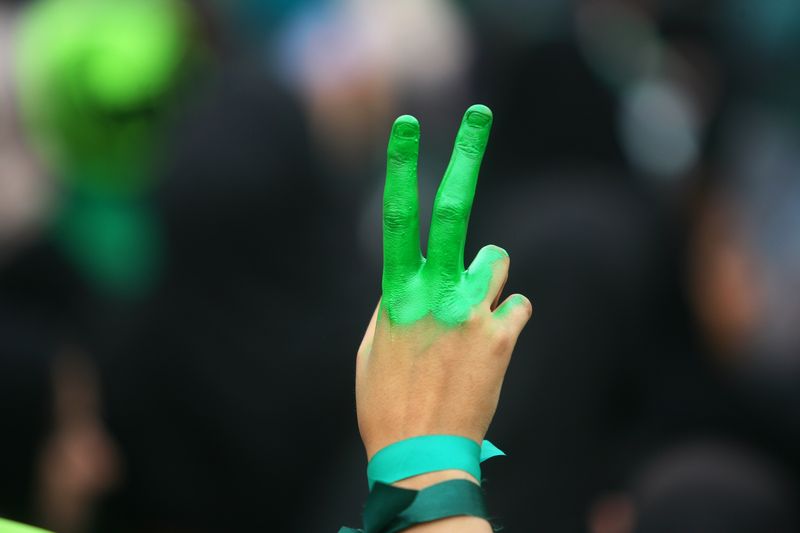
Will Iran Turn Green In 2013?

Iran_Fingers_GT

At Tehran Bureau, Alireza Nader writes that that 2013 Iranian election "may be more tightly scripted than any earlier presidential race to prevent serious debates or competition." Mark Katz agrees:

If indeed the only candidates allowed to run for president are just those few approved by the regime, the Iranian public may come to regard the entire presidential election process as illegitimate. With the downfall of long-ruling leaders in Tunisia, Egypt, Libya, and Yemen (and possibly Syria by mid-2013) providing role models for what popular uprisings can accomplish, the Iranian public may launch a more concerted effort in response to what it regards as an illegitimate presidential election outcome in 2013 than it did in 2009.

Here's hoping – as long as we don't push the opposition into the regime's hands by a new war.

(Photo by Majid/Getty Images)

Let Iran Get The Bomb

Stephen Walt claims that Iran going nuclear won’t change much:

[B]oth theory and history teach us that getting a nuclear weapon has less impact on a country’s power and influence than many believe, and the slow spread of nuclear weapons has only modest effects on global and regional politics. Nuclear weapons are good for deterring direct attacks on one’s homeland, and they induce greater caution in the minds of national leaders of all kinds. What they don’t do is turn weak states into great powers, they are useless as tools of blackmail, and they cost a lot of money. They also lead other states to worry more about one’s intentions and to band together for self-protection. For these reasons, most potential nuclear states have concluded that getting the bomb isn’t worth it.

But a few states-and usually those who are worried about being attacked-decide to go ahead. The good news is that when they do, it has remarkably little impact on world affairs.

Including Mao’s China – even in its most insane, totalitarian period. Containment of Iran is as possible for us now as containment of the USSR was for decades. It’s staggering to me that this position – once mainstream – is now unrepresented in both major political parties.

Will Iran Give Up Or Double-Down?

Christopher de Bellaigue argues that the sanctions against Iran, like those before them against Iraq, aren't working:

[T]he U.S. is at pains to show that the Islamic Republic will gain a life-saving reprieve if it falls in with U.N. resolutions calling on it to stop enriching uranium. If that happens, Hillary Clinton said in October, sanctions might be "remedied in short order." But Iran’s supreme leader dismissed her words as a "lie." Khamenei and those around him believe that sanctions policy is part of a bigger American project of Iraq-style regime change.

There is some logic to this; recent western tactics against Iran include sabotage, assassination and diplomatic isolation—hardly indicative of a desire for detente. The most recent round of nuclear negotiations foundered, in part, on Iran’s growing conviction that the U.S. will make no significant concession on sanctions unless Iran drastically scales down its program of uranium enrichment. That seems unlikely to happen–not simply for reasons of image and prestige, but because, as American hostility sharpens, Iran may judge its nuclear program to be the best defense it has against the fate that befell Saddam.

There has to be a way to give the regime some face-saving if it retreats. Or the logic of war could drag us all along with it – a war we do not need and cannot afford.

Iran Blinks?

From Al-Arabya:

Iran has suspended 20-percent uranium enrichment in order to have Western-imposed sanctions lifted, a parliament member told Al Arabiya on Saturday.  Earlier, Foreign Policy and National Security Commission of Parliament Mohammad Hossein Asfari told ISNA news agency that Tehran’s move was a “good will” gesture, hoping that Western countries will lift their sanctions on Tehran.

I’d apply maximal skepticism toward this announcement, which has not been confirmed elsewhere – and has now been changed by the news agency to report that the parliament member had said that Iran was “willing to” suspend enrichment if sanctions were lifted. A trial balloon? If so, a hopeful one.

War With Iran Just Got More Likely

David Remnick is alarmed by the alliance between Netanyahu and Foreign Minister Avigdor Lieberman, which was announced last Thursday:

Political insiders in Israel know that Netanyahu and Lieberman distrust each other, but their newfound alliance makes it almost impossible for a center-left bloc to win in January. Their leaders are, to the last, extremely weak. One of those centrist leaders, Tzipi Livni, told the Jerusalem Post that if Lieberman were to get a post like Defense Minister in a new government, disaster was inevitable. “We are talking about an existential threat to the State of Israel,” Livni said. “Netanyahu is losing his senses and is gambling with Israel's security out of political and survivalist considerations.” She continued, “Lieberman was the one who threatened to bomb the Aswan dam. Is this the Defense Minister that Israel needs right now?” 

Karl Vick reports on the significance of the coalition:

Even if Likud and [Lieberman's] Israel Beiteinu gather fewer total votes as a single list than they might have separately, the amount will surely be more than the Likud would have gained alone, and hence all but assures Netanyahu will emerge from the election atop the faction with the largest number of seats in the Knesset, likely assuring he will return as prime minister. 

What’s far from clear, however, is whether what’s good for Bibi is all that great for either party. In embracing Lieberman, Netanyahu has hitched his fortunes to starkly polarizing figure, an admirer of Vladimir Putin whose previous campaigns were striking for racist appeals targeting Israel’s own Palestinians, who account for 20% of the population. “There’s no question that in the old days the founders of the Likud would never have gone anywhere near someone like Lieberman,” Bradley Burston, an editor at the liberal daily Haaretz, tells TIME. “They would’ve seen him as someone that could infect the party with all kinds of anti-democratic elements that they were determined to, at least, formally disavow.

Adam Chandler weighs in:

[T]his is massively significant because there has not been a party so dominant in Israeli politics in decades. It would also force the hand of factions on the center and left to form a super-party of their own to survive compete. This means trotting out all the failed challengers, old corpses, and aspirants of the left and center and getting them to agree to work together without their egos interfering.

He adds:

My first (not particularly earth-shattering) instinct is to say that this is not only about inoculating Netanyahu against a challenge from the center-left by someone like Ehud Olmert, but also ensuring that the issues like Iran and the economy get pushed in the next term. Oh, and I can’t imagine it means anything hopeful for the two-state solution.

Previous Dish coverage herehere and here.