Is Iran’s Economy Collapsing? Ctd

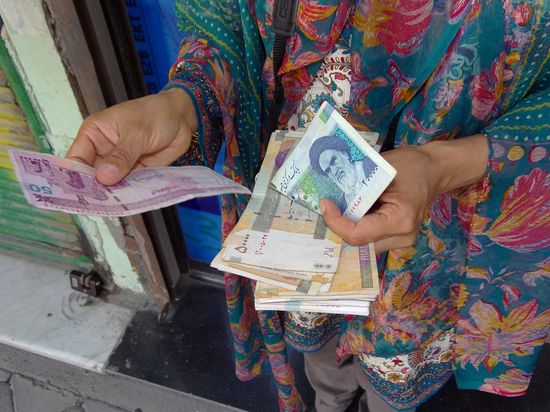
Omid Memarian passes along more details on Iran's currency problems:

So far, Iranians’ frustration over the plummeting exchange rate seems to be directed squarely at Ahmadinejad’s government. “If you listen carefully to the slogans people are chanting, they’re so far mostly economic in nature, not political, and their frustration is directed toward their own government, not the U.S. or international sanctions,” says Karim Sadjadpour, a senior associate and Iran analyst at the Carnegie Endowment. “Iranians are disunited about what kind of a political system they want, but they're united in wanting greater economic dignity.”

Juan Cole thinks Ahmadinejad may have been the specific target of this week's protests:

[T]he Iranian right and business classes have long loathed [Ahmadinejad] because of what they see as his populist and irresponsible mismanagement of the economy. (His subsidies for the working classes and the poor, and easy money policies grated on them). Ahmadinejad has been in bad odor with conservatives since his tiff last spring with the Supreme Leader over key government appointments, including in intelligence. The Supreme Leader won, as might be suggested by his title, and Ahmadinejad is a lame duck.

Although Ahmadinejad is hated in the West, Wikileaks revealed that he has often been the official most inclined to compromise with and negotiate with the West, being blocked by the Revolutionary Guards Corps and other hard liners to his right. For the Iranian far right to unseat Ahmadinejad is anything but a victory for the West.

He also warns that sanctions will likely not have their intended effect. And if a failure of sanctions leads to a military strike, former Secretary of Defense Robert Gates had some sobering comments about that option this week, as Bill Sizemore reports:

Neither the United States nor Israel is capable of wiping out Iran's nuclear capability, he said, and "such an attack would make a nuclear-armed Iran inevitable. They would just bury the program deeper and make it more covert."

Iran could respond by disrupting world oil traffic and launching a wave of terrorism across the region, Gates said.

"The results of an American or Israeli military strike on Iran could, in my view, prove catastrophic, haunting us for generations in that part of the world."
Previous Dish here and here.

The Civilian Cost Of Bombing Iran

Golnaz Esfandiari goes over a new report that indicates there would be nothing surgical about the civilian death toll:

[The study estimated there could be] up-to-70,000 people who would be killed or injured after being exposed to toxic plumes released as the result of such strikes [on sites like Isfahan’s uranium-conversion facility]. [The plumes] would reach the city within an hour. Such a scenario would mean that the people of Isfahan could experience a catastrophe similar to the gas leak in Bhopal or the nuclear meltdown at Chornobyl, says Khosrow Semnani, the author of the report, which is titled, “The Ayatollah’s Nuclear Gamble.”

“People’s skin could be burnt [when coming in contact with the plumes], they could become blind, their lung could be destroyed, their kidneys could be damaged, and in the future they could face other health problems such as skin cancer and [other forms] of cancer,” Semnani says. The report analyzed the impact of preemptive conventional strikes on four key nuclear sites: Isfahan’s uranium conversion facility; Natanz’s fuel-enrichment plant; Arak’s heavy-water plant; and Bushehr’s nuclear power plant. Workers at those sites — who include scientists, workers, support staff, and soldiers — would be among the first victims of a bombing campaign. The report estimates that the casualty rate at the sites would be close to 100 percent.

Is Iran’s Economy Collapsing? Ctd


Drezner says the sanctions are working:

Hey, it turns out that the sanctions against Iran really are crippling — so much so that even Mahmoud Admadinejad is admitting it and Benjamin Netanyahu now has sanctions fever.  Based on my own sanctions model, I’d predict that the sanctions are now becoming so costly that Iran will in fact be willing to compromise on its nuclear program — but any concessions will seem tiny compared to how devastating the sanctions have been. 

Drum notes the lack of bombs:

Regardless of what you think about Iran’s nuclear program (and the sanctions regime itself), there’s a lesson here: foreign policy isn’t always — or even often — about who can bluster the hardest. Nor is it about “red lines” and toughness. It’s messy. No one just sails from success to success. But Obama has pursued a sensible and persistent course against Iran’s nuclear program: first getting the world on his side by demonstrating a genuine willingness to engage with Iran’s leaders; pushing relentlessly for sanctions when that didn’t work; declining to back down when Iran tried to split the coalition he’d built; consistently turning down policy options that might have turned Iran’s people against him; and keeping military threats visible but always in the background.

Michael Hirsh thinks Iran’s bad week demolishes one of Romney’s biggest talking points:

Romney sought to pile on [Obama’s supposed foreign policy missteps] with an op-ed in The Wall Street Journal on Monday in which he wrote that Obama lacked “resolve” and, as a result, “our country seems to be at the mercy of events rather than shaping them.” He is also expected to deliver what was billed as a major foreign-policy address making many of the same points.

Is Iran’s Economy Collapsing?

Protests erupted today in Tehran over the country’s currency free fall, a hopeful sign for the impact of Obama’s sanctions. Matthew O’Brien explains the currency crisis:

Iran’s currency has collapsed in two ways — gradually and then suddenly. Iran is very much in the sudden phase right now. It took 24,600 rials to buy one dollar on September 24. It took 39,000 rials to buy one dollar on October 2. That’s good for a 59 percent drop in just a week. This kind of currency cliff-diving is basically a bank run on the rial — a bank run U.S.-led sanctions set off.

Chart here. Dashiell Bennet takes a deeper look at the protests: 

On Tuesday, President Mahmoud Ahmadinejad responded to currency crisis by vowing to crack down on illegal money changing and speculators, further angering the rather sizable number of traders (legitimate and black market) who rely on the exchanges to do business. On Wednesday morning, about 100 traders and money lenders gathered in front of Iran’s central bank to demand greater action on the struggling economy, and many of the shopkeepers at one of Tehran’s largest bazaars closed their stores in solidarity. Riot police quickly dispersed the group, while other officers swarmed on a popular black market district, rounding up money changers in a series of “cat-and-mouse” chases. Protesters responded with larger marches and burning tires.

This is a regime on the edge. The only thing the hardliners can hope for at this point is an Israeli attack or a Romney victory and impending US war to rally the people behind them.

Ask Beinart Anything: Will Israel Bomb Iran Soon?

brightcove.createExperiences();

Peter Beinart is a long-time friend of the Dish and author of the critically needed book, The Crisis of Zionism. From one of my many defenses of the book against its knee-jerk critics:

The notion that Beinart ignores the standard and fair criticisms of past Palestinian leaders is simply wrong, as any reader will see. Yes, he presses the case that the Israelis and their American patrons have recently led the Jewish state into a dead end – but his book is an argument, not a history. He lacerates one side – persuasively, I might add – but doesn’t excuse the other. … The real shift in US policy toward Israel has been the embrace of the settlements by the Christianist base of the GOP over the last decade and their continuing power. The real development is the fusion of Jewish and Christian fundamentalism around the cause of Greater Israel. Which means to say that a democratic Israel is living on borrowed time. And Peter’s book will one day be seen as one lone protest, a marker that not everyone acquiesced in Israel’s degeneration, not everyone put blinders on. Just most.

Read his latest writing at Open Zion, where he last week dissected Netanyahu’s UN stunt (the above video was taped just prior to it):

In his argument for why the United States and other world powers should draw a “clear red line” specifying when Iran’s nuclear progress would trigger military action, Netanyahu approvingly cited NATO, whose charter “made clear that an attack on one member would be considered an attack on all.” According to Bibi, “NATO’s red line helped keep the peace in Europe for nearly half a century.”

Yes, but NATO established a red line against Soviet attack. If the USSR invaded West Berlin, to use the most often-discussed scenario, the United States would be obligated to come to West Germany’s defense. What NATO self-consciously did not do was draw a red line against a Soviet bomb. To the contrary, the Truman administration rejected calls for a preventative military strike aimed at stopping Moscow’s quest for atomic power. Then, during the Kennedy administration, the U.S. and its NATO allies rejected calls to establish a red line that would have prompted military action against communist China before it joined the nuclear club.

Netanyahu may believe that NATO’s policies of containment and deterrence won’t work against Tehran because its leaders—unlike Stalin and Mao—are bloodthirsty tyrants who sometimes speak in messianic, apocalyptic terms. But people whose historical memory extends beyond breakfast should remember that NATO’s “red line” was not the equivalent of preventative war; it was the alternative to preventative war.

How Iran Handles Its Currency Crisis

7421182372_3aa984f5a7_b

As noted earlier, the rial is continuing to lose its value under the weight of Western sanctions and is now trading at a record low against the dollar. The regime's response:

Mobile telephone text messages that included the word "dollar" in English or in Farsi were censored, with the message not being received, AFP noted. The Farsi word for "foreign money" was also blocked. But text messages containing the words "USD", "euro" or the $ symbol were all transmitted and received normally.

Such text blocks on the word "dollar" were implemented before in Iran, on January 10, when the rial also dived precipitously. The country's two main mobile phone service providers, MCI and Irancell, claimed at the time they were not filtering messages.

Several Iranian websites that usually give real-time foreign exchange rates had the dollar rate blanked out on Monday. One website, mesghal.ir, did give a dollar rate, but at 25,650 it was lower than that reported by money-changers.

Just like the chicken.

(Photo by Adam Jones)

What Bombing Iran Would Entail

Noah Shachtman summarizes the research (pdf) of Anthony Cordesman, "one of Washington’s best-connected defense analysts":

Should the U.S. actually take Benjamin Netanyahu’s advice and attack Iran, don’t expect a few sorties flown by a couple of fighter jocks. Setting back Iran’s nuclear efforts will need to be an all-out effort, with squadrons of bombers and fighter jets, teams of commandos, rings of interceptor missiles and whole Navy carrier strike groups — plus enough drones, surveillance gear, tanker aircraft and logistical support to make such a massive mission go. And all of it, at best, would buy the U.S. and Israel another decade of a nuke-free Iran.

Cordesman is skeptical that Israel could successfully attack by itself:

“Israel does not have the capability to carry out preventive strikes that could do more than delay Iran’s efforts for a year or two.” Despite the increasingly sharp rhetoric coming out of Jerusalem, the idea of Israel launching a unilateral attack is almost as bad as allowing Tehran to continue its nuclear work unchallenged.  It would invite wave after wave of Iranian counterattacks — by missile, terrorist, and a boat — jeopardizing countries throughout the region. It would wreak havoc with the world’s oil supply. And that’s if Israel even manages to pull the mission off — something Cordesman very much doubts.

The Quakes In Iran

GT_IRANEARTHQUAKEBAJEBAJ_20120813

by Chas Danner

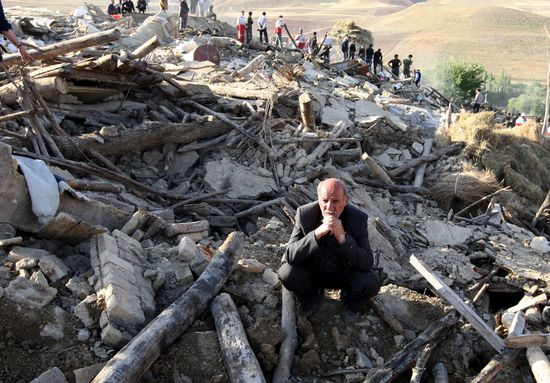
A pair of dangerously shallow earthquakes struck a rural and mountainous region of northwest Iran on Saturday, killing at least 300 and injuring thousands:

The majority of casualties were women and children whose houses had collapsed on them, reported Iranian media. The earthquake occurred at 5 p.m., when most women and children were preparing for the nightly Iftar dinner, which breaks the Muslim daytime fast during the current month of Ramadan.

The death toll is certain to rise. The Iranian authorities have been criticized over their response:

Although officials announced on Sunday, less than 24 hours after the disaster, that search and rescue operations had finished and all survivors had been freed from the rubble, some residents expressed disbelief that authorities could have reached some of the most remote villages so soon. "I know the area well. There are some regions where there are villages that you can't even reach by car," one doctor in the city of Tabriz told Reuters by telephone on Monday, declining to give his name because of the sensitivity of the issue. "It's not possible for them to have finished so soon."

There has also been widespread criticism of how the state media has handled the disaster. More images of the aftermath can be found at the Big Picture. Meanwhile, there is concern among Iranians living in countries like the US that they will not be able to offer assistance to those affected because of Western sanctions. Following the devastating 2003 earthquake in the Iranian city of Bam, the Bush administration did temporarily lift some sanctions to allow Americans to help, but it is as of yet unknown how or if the Obama administration will respond to such requests.

(Photo: An Iranian resident from the village of Baje-Baj, near the town of Varzaqan, stands on top of the rubble of his destroyed home on August 12, 2012, as rescue workers search for survivors, after twin earthquakes hit northwestern Iran on August 11. By Atta Kenare/AFP/Getty Images)