“Bombing Iran, Not Iran’s Bomb, Could Destroy Israel”

Eminent Holocaust historian Yehuda Bauer gets angry with Netanyahu's constant invocation of the genocide in justifying his Iran policy:

During the Nazi era, there was no consideration of the Jews as a genuine force. Today there is a consensus in the United States and Canada, as well as in Europe, that Israel's existence and security must be protected. True, this acknowledgment is not without its problems and may be incomplete, but 70 years ago it was completely absent. Could it happen again? Absolutely not, because Jews are no longer powerless…Today Jews have options, including military ones. The analogy is false, demagogic and infuriating, and it is more dangerous for us than it is for the Iranians.

The Psychology Of Attacking “Iran”

A recent study found that the more we see people as part of a coherent group, the more harshly we judge their actions. David Berreby applies the findings to the rhetorical build-up around Iran:

[I]t's not hard to see that we tend to see nations—especially far-off, unfamiliar nations—as unitary creatures, with feelings, thoughts and plans. It's embedded in our language about states, which unthinkingly uses phrases like "France wants to get out of Afghanistan" or "China fears dissent," assuming this is just a kind of metonymy (like saying "the White House reacted to the charges" to save time). This study suggests this mental habit isn't just a bit of poetic license, but rather a dangerous penchant of the mind.

So as the war drums beat around Iran, it might be worth trying to correct for your built-in bias to be harsh toward entities made of people. The next time someone explains why the West might need to attack, try substituting "Farhadi and his family" for "Iran" and see how that feels.

Or this 13-year-old Iranian singing Adele.

Obama’s Pyrrhic Victory On Iran

Rob Malley worries that Obama won the battle with Bibi, but lost the war:

For now at least, most commentators in the United States and in Israel have handed this round to Obama. He had two overriding objectives: to deflect Israeli pressure to conduct, or acquiesce in, a premature war; and to neutralize Republican criticism that he is too soft on Iran and too hard on Israel. On those fronts, one might say, mission accomplished. But victory came at a price … More clearly than previously, he recognized Israel's right to its own decisions; Netanyahu took the bait — or rather, grabbed it with enthusiasm, turning a banal acknowledgment of reality into an implicit license for Israel to unilaterally initiate action that will have broad and possibly dire consequences for all.

And Obama has all but committed himself to war – which means ground troops – if Iran does not change course. Previous thoughts along similar lines here.

Hurting Iran Doesn’t Automatically Help America

Larison warns against intervention in Syria:

Sectarian warfare in Syria could indeed hamstring Iran's ability to project power, but it isn't going to end Iran's patronage for Hezbollah. Iran's loss of Syria as an ally would be a significant setback, but it would likely also come at a great cost to the U.S. and friendly governments in the region. Stoking conflict in Syria would destabilize all of Syria's neighbors, three of which are U.S. allies or clients, potentially contributing to new sectarian conflicts in Iraq and Lebanon. It could also result in the establishment of a less predictable Syrian regime that is no less hostile to Western interests. It makes little sense to risk the stability and security of those states on the assumption that whatever is bad for Iran must be good for us. 

Would An Iran War Be Moral?

Robert Koons reviews just war theory: 

A formal declaration of the intent to wage war on the part of the Senate, along with a specific set of demands, must precede any U.S. military action. Iran must be given the opportunity to avoid war by ending its support of terroristic and other unjust aggression against Israel, and by recognizing Israel’s right to exist and right to a peaceful, negotiated settlement of the rights of Palestinians. If these conclusions are correct, then it would be wrong, not only for the United States to engage at this time in an attack on Iran, but also for it to participate substantially in an Israeli action (by knowingly providing the aid, arms, or technical support required, whether overtly or covertly). 

I'd also argue that pre-emptive war based on an enemy's alleged intentions, when it publicy declares the opposite, or based on inherent evil or insanity is counter to just war theory. Certainly the rhetoric of Santorum and Gingrich on this subject is a profound attack on Catholic just-war teaching. But don't expect the Bishops to make any fuss about that. War and torture seem trivial issues to them, compared with access to contraception or gay rights. R.R. Reno pushes back against Koons:

I think Koons misconceives the political importance of Congressional declaration of war with a moral importance. Our constitutional constraints on the declaration of war are legal mechanisms designed to ensure accountability and prevent our President from conducting private wars that do not serve the national interest. Formal declaration of war brings our foreign policy above board. Yes, that would clarify things for the Iranians, but as I observed we can make things clear in other ways.

The real importance is domestic. Citizens need to know when our leaders have committed military force, because at the end of the day it’s our blood and treasure that’s on the line. That’s not to say that a preemptive strike against Iran would satisfy other just war criteria, but it does suggest that Koons reasoning is a bit too legalistic and not altogether convincing.
Iran Is Not The Only Threat

137786478

Michael Crowley questions the GOP's heavy emphasis on Iran to the "near-exclusion of the many other nuclear threats America faces." He warns against being "fooled into thinking that Iran is the only, or even the likeliest, source of a possible nuclear bomb that might be used against America or Israel":

President Obama has devoted serious attention to the complex problem of loose nuclear material, and has tried to start a global conversation about nuclear disarmament. His administration keeps a close watch on Pakistan’s nukes (though with frustrating limits) and has reportedly developed plans for military action should the country’s nuclear arsenal come under imminent threat. But Republicans just haven’t seemed very interested in these dangers.

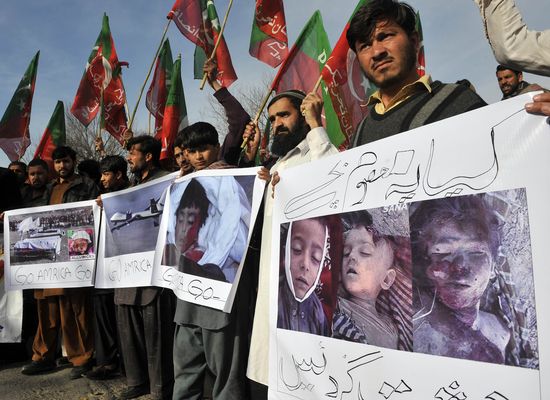
(Photo: Supporters of Pakistani cricketer turned politician Imran Khan of Pakistan Tehreek-i-Insaaf (PTI – Movement for Justice) hold placards during a protest in Islamabad on January 27, 2012, against US drone attacks in the Pakistani tribal region. A US drone on January 23 fired missiles into a vehicle, killing four militants in Pakistan's Taliban and Al-Qaeda hub of North Waziristan that hugs the Afghan border, security officials said. It was only the third such US attack reported in the nuclear-armed state so far this year, following a moratorium after US firepower inadvertently killed 24 Pakistani soldiers in November, plunging relations to an all-time low. By Aamir Qureshi/AFP/Getty Images)

Obama On Iran: “This Is Not A Game”

Chait cheers the president's Iran comments today:

His news conference offered the most crystallized version of what is likely to be his foreign-policy argument through the election. Obama repeatedly dismissed Republican attacks as bellicose political rhetoric. He argued that the demands he do more to stop Iran from obtaining a nuclear weapon generally dissolve, upon inspection, into endorsements of policies he is implementing, like sanctions and using the threat of an attack as leverage.

Can Diplomacy Prevent An Iran War?

Suzanne Maloney thinks it's the best bet:

Negotiations in the absence of mutual trust present a difficult dilemma but not a hopeless one. The depth of the estrangement that exists today between Washington and Tehran is hardly less fierce than it was during the hostage crisis, yet ultimately a mechanism for dialogue and a resolution to the standoff was found largely because both sides could ascertain no better alternative to achieve their interests. Even then, it took repeated forays and failures in diplomatic outreach by both sides, the persistent efforts of a well-situated objective intermediary, and a considerable investment in staff work to ensure preparation, mediation, and implementation of the complex financial, legal, security, and other dimensions of a bargain.

 Paul Pillar factors in the effect of sanctions:

Western negotiators need to persuade the Iranians that concessions on their part will lead to the lifting of sanctions. This may be hard to do, partly because the legislation that imposes U.S. sanctions on Iran mentions human rights and other issues besides the nuclear program, and partly because many U.S. hawks openly regard sanctions only as a tool to promote regime change or as a necessary step toward being able to say that “diplomacy and sanctions have failed,” and thus launching a war is the only option left. The challenge for the Obama administration is to persuade Tehran that this attitude does not reflect official policy.

The Big Lies Of Mitt Romney I: “No Military Options On The Table With Iran”

It's probably time to start the series. Here's what Romney said yesterday:

"This is a president who has failed …  to communicate that military options are on the table and in fact in our hand. And that it’s unacceptable to America for Iran to have a nuclear weapon."

These are two bald-faced lies. Here is what Obama said just last week to Goldblog:

In the conversations I've had over the course of three years, and over the course of the last three months and three weeks, what I've emphasized is that preventing Iran from getting a nuclear weapon isn't just in the interest of Israel, it is profoundly in the security interests of the United States, and that when I say we're not taking any option off the table, we mean it …  I think that the Israeli government recognizes that, as president of the United States, I don't bluff. I also don't, as a matter of sound policy, go around advertising exactly what our intentions are. But I think both the Iranian and the Israeli governments recognize that when the United States says it is unacceptable for Iran to have a nuclear weapon, we mean what we say.

Nothing the president said to Jeffrey he has not said before. But he was more explicit than ever. That Romney simply invents positions that Obama has not held and does not hold is nothing new. He lies.