But he might try to box Obama in to do it for him. In fact, it looks as if he has. Daniel Levy looks at the internal politics in Israel to read the tea leaves.
Tag: Iran
Does The Israeli Public Want To Strike Iran?
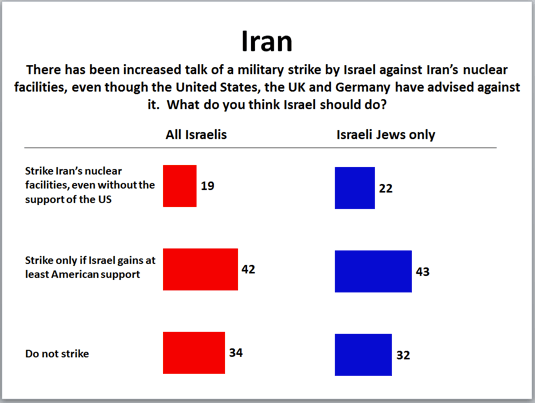
As I noted last night, it all depends whether America is willing to help, but support for unilateral action is very weak. All in all, 76 percent of Israelis don't want a strike at all or without America's overt backing. So, yes, the neoconservative war-mongers in DC, once again, are more pro-war than actual Israelis:
The poll also asked Israelis whom they prefer as the next US president. Shibley Telhami has details:
Overall, Obama led Santorum 33 percent to 18 percent; former House Speaker Newt Gingrich 32 percent to 25 percent; Ron Paul 32 percent to 21 percent; and tied Romney at 29 percent. It is noteworthy, that Paul performed slightly better — but within the margin of error — than Santorum, despite his strong opposition to a U.S. role in a military strike against Iran.
What does all this add up to? Contrary to the current discourse in our presidential elections, the Israeli public is neither enthusiastic about the prospect of war with Iran nor swayed by the seeming embrace of Israel by our GOP presidential candidates.
(Chart from here via Think Progress)
The Iranian People’s Oscar
In the above video, starting at the 2:00 mark, Iranian filmmaker Asghar Farhadi accepts the Academy Award for Best Foreign Language Film for A Separation. Alyssa Rosenberg calls it "by far the classiest, most meaningful speech of the evening":
One of the best things art can do is expose who we are, in all our beauty and ugliness, and remind us of what we’re capable of being. And in this case, it was also a brave act. Farhadi’s been wearing a necktie most of this awards season in a subtle rebuke to the Iranian regime’s suggestion that it’s a decadent Western accessory, and tonight, some commentators suggest that his speech could prevent him from returning to Iran or make life uncomfortable for him when he got back there. That’s a real risk for an award that carries less benefit than a Best Actor or Best Director statuette. Farhadi should be an example to politically engaged artists—and to politicians—everywhere.
Recent reviews of A Separation here. The Oscar was a first for an Iranian film:
Farhadi told the Monitor in an interview last month that A Separation, while not overtly political, is an allegory about the responsibility that comes with freedom. "There are those who simply want to live their lives, and feel they cannot live the way they want to in Iran," Farhadi told the Monitor. "Others are ideologically motivated: They will stay not matter what and try to change things." He added: "In a sense, human agency has decreased. The characters are inherently good, but their environment pushes them to fight with one another."
That is why acclaim for A Separation abroad has been a mixed blessing for Tehran's conservative leadership, who since the 1979 Islamic Revolution have railed against the cultural influence of the West, from Barbie dolls to video games.
Iranian state TV is somehow spinning the victory as a defeat over Israel. If only the people of Iran had a government even minimally equal to their own vivacity and brilliance.
Could Iran Bomb The US?
Nope:
It’s true that Tehran has a robust missile program. Its stockpiles of Shahab-3 ballistic missiles, which top out at 800 miles, strike fear into the hearts of Arab Gulf states. Israel has real reason to fear the development of its Sejjil medium-range ballistic missile, a more sophisticated weapon, that could maybe reach Israel in a few years. And unlike rogue-state missile flameouts like North Korea, Iran is able to launch satellites into space, which is a key ICBM step (since any intercontinental missile is going to have to fly through space in order to attack a foe so far away).
But none of that adds up to Iran getting a missile that can travel the 6,000 miles necessary for striking America any time soon.
Santorum’s Iran Obsession, Ctd
The former senator is now warning of an Iranian attack in North Dakota:
"Folks, you’ve got energy here. They’re going to bother you. They’ll bother you, because you are a very key and strategic resource for this country," the Republican presidential candidate said. "No one is safe. No one is safe from asymmetric threats of terrorism.”
Andrew Kaczynski has more on Santorum's long-held fixation:
When campaigning for re-election in 2006, Santorum attempted to make Iran an issue. "The principal leader of this Islamic fascist movement is Iran," he said in a speech to the Pennsylvania Press Club while campaigning."I believe this is the greatest enemy we will ever face. This is the enemy of our generation. It is the challenge of our time. And yet, we tend to play politics with it here in America — sadly." … In a recently removed 2010 video on the Vimeo channel of ExpressRiders.org, Santorum pitched potential investors on a full-length feature film on the Iranian nuclear threat. "I'm getting into the movie business," Santorum said, "this is a movie that needs to be made."
Is The GOP Willing To Pay For War With Iran?
Steve Clemons is asking:
It is ridiculous to think that a strike by Israel against Iran, that would in real terms tie the U.S. to the conflict, would not be staggeringly expensive and consequential. So, it would be interesting to hear from those who want to reside in the White House — and even the Obama administration which has some 'kinetic action' advocates on the inside — on what a more sensible financial management strategy for these proliferating conflicts, including an Iran war, would be. … Wars cost lots and lots of money — and if a substantial chunk of the GOP crowd wants these wars and feels that it is in our national interest to have them, then by all means they should start lining up some of the wealthiest in the country who are helping to agitate for these conflicts to pay more in taxes for them.
Along the same lines, Friedersdorf revisits Woodrow Wilson's blunt rhetoric about the extraordinary costs of war leading up to US involvement in World War I.
The Conservatism Of Doubt On Iran
Francis J. Gavin and James B. Steinberg want cocksure pundits to remember how little they know about the consequences of bombing Iran:
[T]he "right" answer, but the one you will never read on blogs or hear on any cable news network, is that we simply cannot know ahead of time, with any degree of certainty, what the optimal policy will turn out to be. Why? Even if forecasters could provide probabilities about the likelihood of a narrow, specific event, it is simply beyond the capacity of human foresight to make confident predictions about the short- and long-term global consequences of a military strike against Iran.
This is what I called the "conservatism of doubt." But the neoconservatives are not conservatives. They are radicals whose motto, as embraced by Bill Kristol, is always "Toujours l'audace!" The quote is usually associated with Georges Danton, one of the most radical and murderous of the leaders of the French Revolution, and King Frederick of Prussia, a man dedicated to the use of military violence.
How Kristol passes himself off as a conservative in any meaningful sense is preposterous. But he's been pulling this scam for years and the hacks in Washington don't know enough history or political philosophy or actual conservatism to challenge him.
Santorum’s Iran Obsession
Uri Friedman examines the former senator's putative expertise:
In a November radio ad, for example, the Republican presidential contender asserted that he was the only GOP candidate discussing the Iranian threat. "Even Newt Gingrich said 'no one has done more than Santorum to alert America to the dangers posed by Iran,'" the narrator crowed. Santorum's campaign website boasts that he "has recognized the looming threat of Iran's nuclear ambitions for nearly a decade — standing tall against both Republicans and Democrats who have discounted and dismissed the reality that this radical theocracy is intent on destroying Israel and Western civilization." Forget "nearly a decade" — in Iowa, he told voters, "I spent ten years focused like a laser beam when I was in the Senate on the country of Iran."… Santorum has adopted even more of a doomsday approach on the campaign trail, telling voters in Florida, Missouri, and South Carolina that they would not be safe in their states if Iran obtained a nuclear weapon.
He is to Iran what Cheney was to Iraq. Except it's funny, innit? Have they ever ever ever mentioned Cheney in a single debate or ad this season? Or is the comparison too obvious? And the global consequences even more catastrophic?
The Best Film Of 2011 Is Iranian
According to David Thomson:
The ways in which the characters in A Separation struggle for truth and honor, while yielding sometimes to compromise and falsehood, is not foreign to us. Few other films made last year give such a striking sense of, "Look—isn’t this life? Isn’t this our life, too?" In a complete world of film-going, we should no longer tolerate the label "foreign film," especially since it seems likely that a film from France in which the French language remains tactfully silent is going to stroll away with Best Picture. The Artist is a pleasant soufflé, over which older Academy voters can wax nostalgic. But A Separation is what the cinema was invented for.
Roger Ebert posed a related philosophical question to the film's director, Asghar Farhadi:
There's an ancient ethical question, I mentioned to Farhadi in an online conversation. "Your wife and your mother are both drowning — which would you rescue?" Is there a correct answer to this question?
"I would want to save both of them or die trying," he said. "I know that's a cop-out, but the pain that comes along with choice is a result of real liberty, and the pain of choice is the result of being free to choose. Determinism and Authority exist side by side in this ancient example. In the film I essentially try to ask this very question. Do we choose Termeh, the adolescent girl with a long future in front of her, or do we choose the old man with a past that is already behind? Do we sacrifice the future for the past? Having them both is the obvious ideal, but it is impossible here. This is the crossroads, and the choice is the important thing."
The film was originally well-received by Iranian officials, but they changed their tune following its success in the West. Anthony Kaufman thinks he knows why:
At a time when relations between Iran and the West couldn't be more contentious, you'd think a good work of art could help break down some walls between them. But no government–not in the U.S. either, I should add–likes to let someone else come along and make bridges without their approval. It takes away their power. And I think that's one of the reasons why the film isn't being universally accepted at home. Success spoils the government's ability to censor and control.
Is Our Iran Strategy Working?
Steve Coll analyzes recent actions:
The United States and the European Union are ratcheting up economic sanctions in the hope that they will push Iran’s President, Mahmoud Ahmadinejad, to re-start serious nuclear negotiations after a year’s hiatus. The E.U.’s twenty-seven member countries, which buy about a fifth of Iran’s oil exports, agreed last week to forgo all Iranian crude by July. Ahmadinejad said soon afterward that he would indeed be willing to talk again. The strategy, led by Obama, appears to be achieving its aim of raising the pressure on the ayatollahs to an unprecedented level. The value of Iran’s currency has fallen sharply. The diplomatic campaign would be stronger if it contained a definite plan to assuage Iran’s fears that the West and Israel ultimately seek regime change in Tehran—fears that presumably inform Iran’s search for a nuclear deterrent.
Joshua Pollack outlines what successful diplomacy would look like.
 The Dish