Would A Nuclear Iran Start More Wars?

Military_Nukes

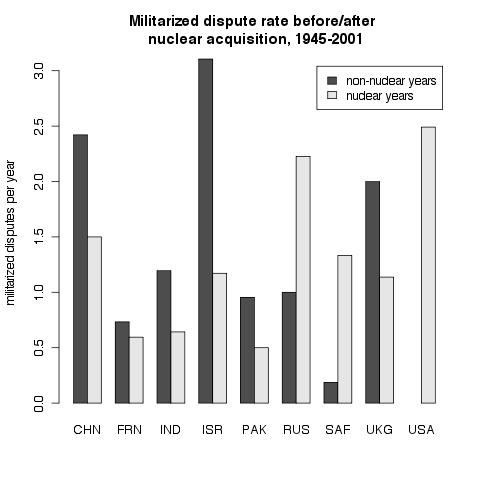
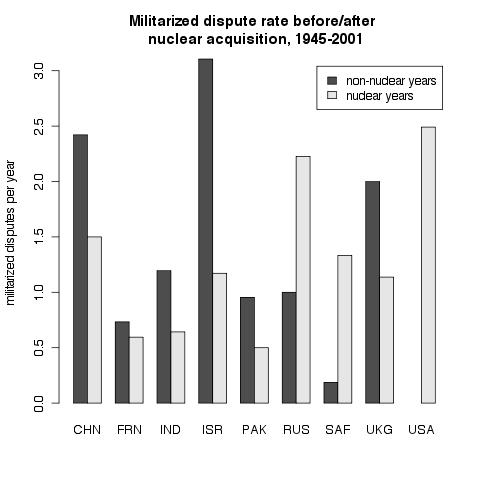
Not if history is any guide. James Fearon finds that nations typically get less aggressive after obtaining nuclear arms:

Obviously the fact that the other members of the nuclear club generally didn’t get much more aggressive in their foreign policy behavior after they tested doesn’t mean that Iran won’t.  But I think it’s astonishing how weak a case for this we are hearing from the preventive war advocates like Kroenig, or politicians contemplating it like Ehud Barak as reported in the Times article.  … We’ve heard these same concerns before, regarding Stalin’s USSR, Mao’s China, Kim Jong-il’s North Korea, and about the mortal mutual enemies of India and Pakistan.  All these cases have been very scary, and it’s understandable that the prospect of a nuclear Iran is incredibly scary for Israelis.  But so far, in none of these prior cases do the more extreme fears look historically justified.

The Deepening Iran War Madness

Now there are prominent neocon calls to not only attack Iran, but bomb it into regime change. Ackerman tears his hair out:

The funny-but-actually-horrible thing here is how reminiscent Fly and Schmitt’s argument is of, say, fall 2002. You’ve seen this play run before. A few reasonable people start thinking aloud, well, OK, maybe Iraq’s WMD is threatening enough to consider war. (Yo, Matthew Kroenig, how does it feel to be Kenneth Pollack?) Seizing an opening, the hawks come to jimmy the Overton Window even further: “If the United States seriously considers military action, it would be better to plan an operation that not only strikes the nuclear program but aims to destabilize the regime, potentially resolving the Iranian nuclear crisis once and for all.” It’s like they took a 2002 op-ed agitating for the Iraq invasion and did a find-and-replace.

I mean, seriously. This is actually a line in the op-ed: “More troubling are, in the words of former Secretary of Defense Donald Rumsfeld, the ‘known unknowns.’”

And in the classic case of Washington failing upwards, the chief neocon theorist who was deeply involved in backing the Iraq War fiasco, Robert Kagan, is back on the front cover of The New Republic. Lecturing us about America's role in the world. These people are shameless.

Iran Can’t Destroy America

Mark Helprin claims that Iran is a "mortal threat" to America. Greg Scoblete counters:

The United States is orders of magnitude more powerful than Iran, has conventional and nuclear military forces that could destroy Iran several hundred times over, devotes more money to its defense every year than the entire GDP of Iran and yet in the up-is-down world of some defense analysts, we are the ones in "mortal danger."

Tom Ricks bets that Obama isn't foolish enough to go to war:

I just can't see Obama getting us involved in another Middle Eastern war. The American people certainly have no appetite for it. I think he almost certainly would lose re-election if a war broke out, because his base would fall apart and the left would go into opposition.

Iran’s Trump Card

Is, of course, its oil:

Iran's production capacity represents about 5% of the world total. Mr Hamilton notes that supply disruptions of that magnitude in the past were associated with oil price increases of between 25% and 70%—and with American recessions. … So one interesting thing to note is that Iran could potentially send America into recession all by itself, simply by halting its oil production for a few months. That wouldn't be good for the Iranian economy, of course, but perhaps that's a small price to pay for the smiting of one's enemies, and so forth. America couldn't easily respond with force as it would in response to, say, a nuclear attack. Closing the Strait of Hormuz would be a different geopolitical animal but would, if successful, bring the global economy to its knees.

Iran Doesn’t Know How To Negotiate?

Joe Klein posits that the "Iranians have begun to 'negotiate' the North Korean way, through silly threats": 

These "signals" represent a complete misreading of what it takes to begin a negotiation with the Obama Administration. There’s a reason for that: the Iranians–not just the regime, but even the reform movement–have been isolated from the rest of the world for too long. They have no idea how to play the hand they’ve been dealt because they don’t know very much about the other players at the table.

Who Killed The Iranian Scientists?

Contra Frum, Eli Lake reports that Israel is the most likely suspect:

Patrick Clawson, the director of research at the Washington Institute for Near Policy, said the signs point to Israel. "This sophisticated technique is uncharacteristic of the Iranian armed opposition and the Iranian government, it is characteristic of the Mossad," he said.

"I am unaware of episodes when Americans and Europeans have done this kind of assassination. Of course, the Americans are involved in assassinations using predators, but not this kind of operation with agents on the ground, the natural suspect is the Mossad."

A former Mossad officer now living in Canada who goes by the pseudonym Michael Ross said the attacks bore the hallmarks of an Israeli operation. "This tactic is not a new one for the Mossad, and worked very effectively against Egypt’s rocket program in the 1960s. During that period, the scientists involved in that project were assassinated and the program suffered immensely."

Why Do Iranians Want A Nuke?

Hooman Majd relays public opinion from the country:

Few in Iran believe that the nuclear program is a quest for a Shia bomb to obliterate Israel once and for all. No, the Iranian people, from my greengrocer to college students who resent their government, still consider the nuclear question in generally nationalistic terms. The particular regime in power is of passing relevance. So sanctioning Iran’s central bank and embargoing Iranian oil, tactics the White House may be using as a way to avoid having to make a decision for war, will neither change minds in Tehran nor do much of anything besides bring more pain to ordinary Iranians. And making life difficult for them has not, so far, resulted in their rising up to overthrow the autocratic regime, as some might have hoped in Washington or London.

Larison adds his thoughts. 

The Fatal Flaw In The Case For Bombing Iran

Austin Long and Elbridge Colby pinpoint strike supporters' inability to define an endgame:

The basic question is: How do attack advocates propose to stop the Iranian nuclear program if Tehran refuses to roll over after one round of attacks? There are two logical responses to this question. One is regime change, presumably through invasion. But there are significant downsides to invasion, not least that such a war would likely prove protracted and costly. Attack advocates such as Kroenig effectively concede that the American people are unlikely to support this course.

The other is that the United States should be prepared to conduct repeated strikes over a long period of time to ensure the Iranian nuclear program is kept down. Unsurprisingly, Kroenig and others shy away from this answer, as it is a recipe for perpetual war.

The cost in lives, resources and America’s international reputation would be formidable, especially if done without diplomatic cover and international support that probably wouldn’t be forthcoming. Yet, even under the most favorable conditions in which Iranian retaliation stayed limited and international support was forthcoming, a long-term, limited-strike campaign might not work at a level of effort and damage in line with U.S. aims.

Goldblog is on the same page (follow-up here). Anne-Marie Slaughter proposes an international diplomatic initiative to prevent the US and Iran from driving each other over a cliff. My view is that containment and MAD is the only practical endgame, until the regime collapses. As, just like the Soviet Union, it will. 

Why Iran’s Hormuz Gambit May Backfire

Ackerman explains:

[I]n a sense, [US Admiral Jonathan Greenert] should hope Iran tries to close the Strait of Hormuz. There are few mistakes Iran could make that would be worse for it in the long run. Why? Because Iran would suddenly be responsible for sending world energy prices skyrocketing — perhaps to $200 a barrel — after a disruption of Gulf oil shipping. Washington usually has a hard sell when convincing other countries that Iran’s regional bellicosity and lack of transparency on its nuclear program merits a tough response. But when Iran hits the entire world in the wallet, the argument gets substantially easier.

Afshon Ostovar also thinks military escalation would be bad for Iran:

Iran's ability to keep the strait closed or constricted would likely be short lived. Because of the military operations that would be involved, and the damage it would do to the economies of the region, closing the strait would likely be considered an act of war against the United States and its Gulf allies. U.S. retaliation against Iran would thus be a near certainty, putting at risk much of Iran's maritime and littoral military assets. The United States could end up destroying much of Iran's navy, air force, and land based artillery just to clear the way for re-opening the strait. The United States might also take the opportunity to target Iran's nuclear sites, if not move to topple the Iranian regime altogether. Regional opinion (especially that of the United States' Arab allies) will most likely support military operations in such a context, and the international community will be hard-pressed not to support military action against an Iran that is willing to jeopardize world petroleum and gas markets for its own political purposes.

Remember Obama's supreme skill? Getting his enemies to self-destruct.

Might Iran Sanctions Succeed?

Hossein Askari is pessimistic:

The nuclear issue is a popular policy. What the United States should say is we are going to impose sanctions until you hold free elections, respect human rights. … This would have much force within Iran and with a change in regime, then the nuclear issue could be better resolved. The issue the US has picked (the nuclear issue) will not rally the people against the regime. Sanctions are aimed at hurting the government and forcing the regime to change its policies, or squeezing the average citizen to turn against the regime. It hurts the average person. This is sad, but inevitable, fallout of sanctions that cannot be helped.

Dan Drezner counters:

[The US wants] the sanctions to be so crippling that Khamenei's ultimate authority comes under challenge, to the point where factional divisions open up space for a substantive change in the regime.  This might work, but I'd put the odds of this happening at less than 1 in 3.  Still, this is the thing about instances in which economic sanctions are deployed.  Even if their prospects don't look great, they're usually employed because the other options have even worse odds. 

For the next, say, six months, pursuing this course of action makes sense. It weakens Iran at a key moment in the Middle East, and it might lead to some positive developments down the road.  That said, even if the sanctions work in crippling Iran's economy, they likely won't work at altering Iran's objectionable nuclewar policies — the expectations of future conflict are too great.  At that point, the United States is going to need to consider whether its prepared to pursue a longer-term containment strategy or alter course. 

Benjamin Friedman thinks the sanctions, together with other factors, have turned Iran into a containable paper tiger. Meir Javedanfar worries that economic pressure might cause Tehran to attack Israel.