What’s Iran Thinking?

Caitlin Talmadge analyzes the Strait of Hormuz standoff:

[N]aval confrontation in the Gulf would benefit no one. It would be bad for everyone, but worst for Iran, whose naval assets are scarce and not easily replaced—a lesson Iran learned the hard way in its last major naval confrontation with the United States, in 1988. With any luck, leaders in Tehran remember these realities. Certainly, their recent behavior suggests a desire to extract leverage by publicly making a threat rather than by stealthily following through on it.

Why Ron Paul Is Right And Barack Obama Is Wrong About Iran

One of the key things that Ron Paul has contributed to our discourse is the notion that we should try and look at conflict from the point of view of our foe. You'd think this would be obvious if we are attempting to influence, say, Iran's behavior, to understand their fears, their baseline interests and their ideology. So far, all we hear about is their ideology. But let's broaden our moral imagination in ways not allowed in the Washington Post.

Imagine that three scientists working on the US nuclear arsenal were assassinated in the streets of Chicago or Washington or Los Angeles by agents of Iran. Now imagine that an explosion took place at one of our nuclear facilities – also engineered by Iran. Also imagine that Iran was capable of blockading US ports to cripple the US economy. Imagine the dollar collapsing because of this and a new depression initiated. What do you think Mitt Romney would be saying? I suspect he would be saying that Iran has already declared war on the US.

But all these things have happened in Iran, probably by the hands of Israeli intelligence, perhaps by the US, or some combo of the two. Is it surprising that the Iranians are throwing rhetoric around, even if much of it is empty? Of course not. Vali Nasr argues that Iran is already on a war-footing because of this:

Iran has interpreted sanctions that hurt its oil exports, which account for about half of government revenue, as acts of war.

Who alone among the presidential candidates gets this? Only Ron Paul. Bob Wright has a must-read on the potential president's lonely sanity on this question. Jon Rauch also notes that the debate we're having about Iran is very very similar to the debate we once had about China's nuclear capacity:

Fifty years ago, [China] was the Iran of its day, a rising regional power that was radical, ideological, boldly antagonistic. It fought the U.S. in Korea, attacked India and Taiwan, supported violent insurgencies and more. Its leader, Mao Zedong, mused that killing half of mankind might be a price worth paying to make the world socialist. Understandably alarmed, some of President Eisenhower’s advisers urged a pre-emptive nuclear attack. (Ike wisely forbore.) President Kennedy said a nuclear China would dominate Southeast Asia and "so upset the world political scene" as to be "intolerable."

Notice the classic Kennedy recklessness in foreign policy (he was George W Bush avant la lettre), and the characteristic Eisenhower sanity. Now look at the history. Since China's adoption of nuclear status, it has actually behaved more responsibly abroad, not less. Jon makes a very persuasive case that nuclear weapons really don't give countries much of an edge, and, if anything, tend to calm them down, especially if they are in a region where they have foes who do have such weapons.

The Obama administration has foolishly decreed that it will never allow a nuclear-armed Iran. It's foolish because at some point, Iran will get one, and the US will therefore have to go to war either to stop it or to punish Iran for it. The obvious option – containment – is foregone.

Obama also argues that he opposes Iran's nukes because of proliferation in the region. At which point one must loudly cough "Ahem." Only one country in the region has illegally, in defiance of internatinal law and the NPT and US policy, has nuclear weapons and it's Israel, not any Arab state. More absurdly, the US government has a formal policy of never acknowledging this fact. At one point in the not-so-distant past, the US government was committed to the view that Iraq had nukes but Israel didn't.

When will the US evolve a sane policy in the Middle East? One that advances our interests, avoids a catastrophic global religious war, and bases it judgment on history and statecraft rather than religion and a US-Israel alliance that, since the end of the Cold War, has become increasingly unhealthy to both parties? Less Kennedy, more Eisenhower, please.
Iran: “The Sarah Palin Of Nations”

That's Karim Sadjapour's assessment, as a consequence of Iranian "simultaneously [having] delusions of grandeur and profound insecurity." His view of the prospects for negotiation:

What the Obama administration is trying to do is to subject the Iranian regime to enough pressure to bring it back to the table and get it to make meaningful compromises on the nuclear part. And there has been tremendous pressure in terms of the Central Bank sanctions, now the currency crisis.

There's external pressures as well. Their chief ally, the Syrian regime, is on the verge of collapse. The question is whether Iran's supreme leader, Ayatollah Khamenei, will calculate that — whether he will seek deliverance in a nuclear compromise in order to bring about some relief to himself, or whether he will seek deliverance with a nuclear weapon itself, thinking that that will bring him a shield from outside pressure. I think recent history doesn't bode very well

Gary Sick worries about the unintended consequences of our pressure policy. Michael Elleman runs down the evidence that Iran is looking for a nuclear missile. Dalia Dassa Kaye, Alireza Nader, and Parisa Roshan track [pdf] the history of Israeli-Iranian relations and the potential for a crisis if Iran nuclearizes.

Obama’s Iran Strategy: Working Out?

GT_IRANNAVY_120103

Walter Russell Mead answers in the affirmative:

[Iran's behavior] looks like the defiance of a cornered animal rather than the insolence of a rising power.  Iran’s chief regional ally, Syria, continues to disintegrate. Hamas, the radical Palestinian group whose previous links with Iran gave the unpopular Shiite Persians greater standing in the mostly Sunni Arab world, is shifting from a Syria-Iran alliance toward one with Turkey and possibly Egypt.  The rial continues to fall as sanctions hit the weak economy.  The recent decision to stop fuel subsidies will make the government less popular at a time of great stress. As protests sweep Russia, Putin seems to be shifting toward a more cautious foreign policy, one that offers little comfort to Iran. China, too, is unlikely to offer anything more than a bit of political cover at the UN.

Even uberneocon Max Boot doesn't see any Iranian military threat to the Strait of Hormuz:

The Iranians must realize that the balance of forces does not lie in their favor. By initiating hostilities they risk American retaliation against their most prized assets—their covert nuclear-weapons program. The odds are good, then, that the Iranians will not follow through on their saber-rattling threats. But this heated rhetoric does suggest how worried the Iranians are about the potential impact of fresh sanctions on their oil industry. All the more reason for the Europeans to proceed with those sanctions.

Juan Cole couldn't disagree more:

[E]ven Congress’s more severe sanctions and targeting of Iran’s Central Bank are likely to be ultimately ineffective in changing Iranian policy or undermining the regime. The international community will find work-arounds and close US allies like South Korea, facing major economic consequences, will lobby hard for exemptions. Obama, who was forced into this law and had opposed it, has every reason to grant the exemptions. In other instances, the NDAA will cause American will to be tested. It will take a lot of impudence to attempt to impose sanctions on Chinese banks for dealing with Iran, when Chinese finance is so important to propping up the US economy.

Daniel Serwer has mixed feelings.

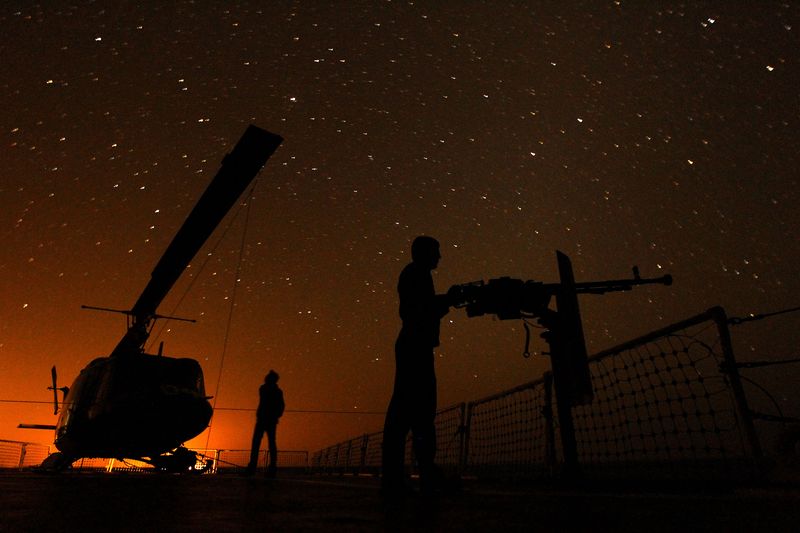
(Photo: Iranian navy conducts the 'Velayat-90' naval wargames in the Strait of Hormuz in southern Iran on January 1, 2012. Iran defiantly announced that it had tested a new missile and made an advance in its nuclear programme after the United States unleashed extra sanctions that sent its currency to a record low. By Ebrahim Noroozi/AFP/Getty Images.)

Iran’s “Photo-Shopped” Existential Threat

The regime that allegedly threatens the survival of America has now backed down from threats to close the Straits of Hormuz as its economy reels from sanctions and the threat of more. Their boasts about their rocket ranges are also, well, a little thin:

The Qhader missile, introduced in September, has a range of just 124 miles. The U.S. Navy's fifth fleet in Bahrain is 150 miles from Iran. Israel is four times farther. "We've seen that they've photoshopped, for example, photographs of missile tests before to make it look more impressive than it actually is, so I would take all this with a grain of salt. I think this is mainly posturing. It's gamesmanship. And it's again meant to send a message that the Iranians aren't simply going to sit back while their oil is sanctioned," said Michael Singh, Washington Institute for Near East Policy.

Iran's entire GDP is less than Norway's. Without oil, it's a basket-case. The idea that it can threaten the survival of the US, as Gingrich claims, is loopy. But in the current GOP race, Ron Paul is paranoid, not Newt.

Iran’s Oil Gambit, Ctd

A reader writes:

The reality is that Iran doesn't need to actually stop the flow of oil through the Straits of Hormuz in any significant way for the threat to be effective.  The mere threat itself has already pushed up the cost of oil a bit, so imagine what happens if Iran managed to sink a single tanker in the Straits.  While it might only be one tanker of oil eliminated from global supply, the markets would freak out.  The panic would drive up the price of oil, increase Iran's profits, and likely lead to a global recession.

Another writes:

I ran offshore oil field supply boats in the Persian Gulf for a couple of years a long time ago. It is inconceivable that Iran would be able to close the Strait of Hormuz. Three potential ways to do it have been discussed:

– attacking ships with planes, boats, or artillery as they pass through the strait. They've tried this before and failed. The US Navy would destroy any planes, boats, or artillery that tried it. The Iranians might slow it down for a day or two.

– placing mines in the shipping lanes. We are pretty good at sweeping mines. I watched US navy helicopters sweep the Gulf of Suez after Kaddhafi dumped a bunch there in the early 1980s. One boat was damaged out of (we think) several hundred mines dropped.

– sinking ships in the middle. The shipping lanes are 6 miles wide, plus a safety buffer, and about 300 feet deep. You'd have to sink a lot of ships to pile them up that high and that wide.

Iran’s Oil Gambit

GT_IRANNAVY_111228

Iran has threatened to cut off the Strait of Hormuz – through which 1/3 of the global sea trade in oil travels – if the US enacts new sanctions on the regime. Dan Murphy scoffs:

During the so-called Tanker War between the Iranians and Iraqis during the 1980s, shipping in the Strait was severely threatened by both sides. Both countries sought to deprive the other of oil revenue, and attacked the boats of neutral parties as well as their direct enemies. All of that drove up the price of oil and shipping insurance, but didn't ever close the Strait of Hormuz. Eventually, the US Navy began escorting ships through the Strait, concerned about the global price of oil.

None of this is to say that all the war talk on both sides isn't frightening, or a reason for concern. And it's not to say that Iran couldn't do substantial damage to tanker traffic through the Strait if it comes to war. But the Islamic Republic simply does not have its hands on the spigot for 40 percent of the world's tanker oil, no matter how much it wishes that it did.

Tim Lister is not as dismissive:

Any attempt to interfere with shipping would be a double-edged sword for Tehran. Iran also relies on the Strait to export its crude and other products, and has to import most of its refined gasoline for lack of refining capacity. The U.S. State Department says there is "an element of bluster" in the Iranian threats.

Even so, analysts worry that the deterioration in U.S.-Iranian relations could magnify the consequences of a collision or provocation in the Gulf. Shortly before retiring as Chairman of the U.S. Joint Chiefs of Staff, Admiral Mike Mullen said: "If something happens, it's virtually assured that we won't get it right, that there will be miscalculations which would be extremely dangerous in that part of the world."

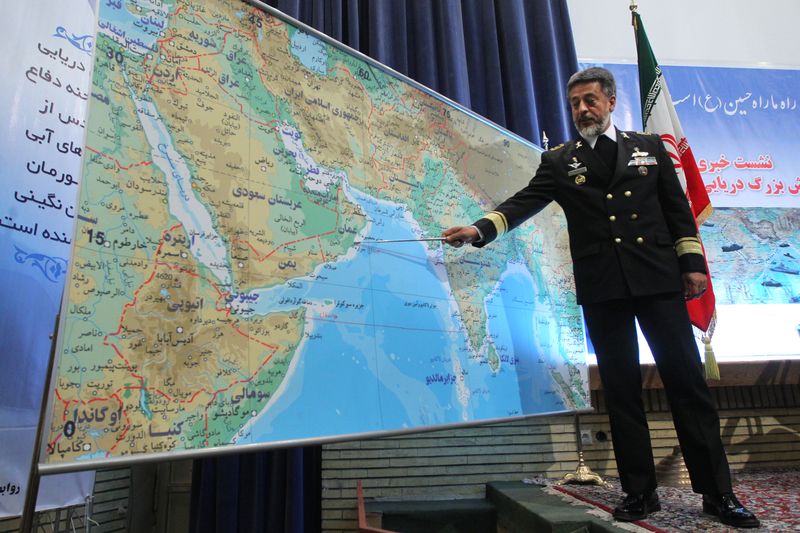
(Photo: Iran's Navy Commander Admiral Habibollah Sayari points at a map during a press conference in Tehran on December 22, 2011, saying that Iran will launch 10 days of naval drills from December 24, covering east of Strait of Hormuz and the Gulf of Oman to the Gulf of Aden. By Hamed Jafarnejad/AFP/Getty Images.)

Is Paul’s Position On Iran Popular? Ctd

Scott Clement digs into the numbers:

Paul’s preference for diplomacy is … shared with many Republicans. More than six in 10 picked “economic and diplomatic efforts” as the best Iran policy right now, according to a November CNN/ORC survey; fewer than one in four chose military action. Paul’s call for eschewing sanctions in favor of free trade agreements, however, stands in stark contrast to his fellow partisans who see Iran as a genuine threat and an enemy. More than nine in 10 Republicans in a 2010 Pew Research Center poll approved of increasing sanctions in an effort to keep Iran from developing a nuclear weapon.

Earlier commentary on the subject here.

Is Paul’s Position On Iran Popular?

Larison believes so:

The conventional wisdom is that Paul hurt himself politically by resisting the clamor for war against Iran, but I’m not so sure. Alone among the candidates on stage last night, Paul made the case for restraint and deterrence, and there is a much larger constituency for this inside the GOP than there once was. Huntsman might have benefited himself by presenting a more qualified position akin to the one Haass outlines in his essay on “Restoration Doctrine,” but he threw away any chance he had to sound reasonable on Iran long ago. That leaves Paul as the only one talking sense on avoiding another unnecessary war. Besides, his position on Iran isn’t as unpopular among Republicans as hawkish pundits would have you believe.

Last month, Rasmussen asked if the U.S. should take military action to prevent Iran from developing nuclear weapons “if diplomatic efforts failed,” and just 51% of Republicans said yes. 22% said no, and 27% were unsure. Paul has a chance to reach at least part of that 27%, and it is far from obvious that Paul alienated them last night.