Would Huntsman Invade Iran?

Possibly:

Eli Clifton tracks Huntsman’s increasingly hawkish rhetoric on Iran. Larison sighs:

Can we stop pretending that Huntsman is one of the reasonable ones now?

And note that Gingrich now appears to favor an actual land invasion of Iran:

He painted a chain of events in which an Israeli prime minister asked an American president for help with a conventional military invasion of Iran so that Israel would not have to use its nuclear arsenal to defend itself. Mr. Gingrich implied that he would go along. “What I won’t do is allow Israel to be threatened with another Holocaust,” he said. “This is a not-very-far-down-the-road decision.”

Bombing Iranian nuclear sites, as some suggest, is “a fantasy,” he said, because many are underground. Instead, the United States must seek “regime change” in Tehran. He suggested “serious economic steps, serious political and psychological and diplomatic steps,” including an embargo on imported gasoline.

None of this will likely stop Iran’s ability to advance its development of a nuclear capacity. And so the vision that Gingrich offers is a choice: either a nuclear Israeli attack on Iran or a US land invasion of Iran at Israel’s behest. And yes, this decision, like most decisions about Middle East policy under Gingrich or Romney would be governed ultimately by Bibi Netanyahu, backed by the Christianist right. Romney has even explicitly said that decisions in the US-Israel relationship would be governed by Israel’s prime minister, not the US president:

“I don’t seek to take actions independent of what our allies think is best, and if Israel’s leaders thought that a move of that nature would be helpful to their efforts, then that’s something I’ll be inclined to do. … I don’t think America should play the role of the leader of the peace process. Instead, we should stand by our ally.”

Can you imagine any political leader in this country ever saying “I don’t seek to take actions independent of what our allies think is best”? If a Democrat said that about Britain or Germany, he or she would be pilloried for abandoning American sovereignty. But Israel? It passes by without comment.

A vote for Gingrich or Romney is a vote for either a nuclear attack by Israel or another Iraq war in Iran. It would be Bush-Cheney on steroids – but this time, explicitly about directing US foreign policy around the interests of another country. And notice Gingrich’s warning:

“This is a not-very-far-down-the-road decision.”

As one war ends, another beckons. Without permanent warfare, the GOP feels lost.

Why Sabotage Iran? Ctd

Steve Walt disagrees with my reluctant endorsement of our "secret" campaign:

[W]aging a covert, low-level war is not without risks, including the risk of undesirable escalation. No matter how carefully we try to control the level of force, there's always the danger that matters spiral out of control. Iran can't do much to us militarily, but it can cause trouble in limited ways and it could certainly take steps that would jack up oil prices and possibly derail the fragile global economic recovery. Moreover, if some U.S. operation misfired and a couple of hundred Iranians died, wouldn't the revolutionary government feel compelled to respond?

If U.S. or Israeli operatives are captured on Iranian soil, will pressure mount on us to do more? (Just imagine what all the GOP candidates would start saying!) Such developments may not be likely, of course, but it would be foolhardy to ignore such possibilities entirely. Nor should we ignore the possibility that others will learn from this sort of "unconventional" campaign and one day use similar tactics against U.S. allies or the United States itself. 

Ali Ahmadi Motlagh thinks we should look at Saudi Arabia to see if escalation is on the horizon.

Why Sabotage Iran?

Larison asks why I'm ok with sabotaging Iran's nuclear program but not with assassinating Iran's nuclear scientists:

If the U.S. reserves the right to sabotage another state’s nuclear program because of an irrational fear of it, it is hard to see why it would distinguish between destroying facilities and equipment and killing personnel. If Andrew believes sabotage is the “best way forward,” that will include targeting the people involved in advancing the program with their knowledge and expertise. Since that part of it seems like dangerous overreaching to him, doesn’t that imply the same thing for the entire effort to sabotage Iran’s nuclear program?

Well, I have this bizare concern with human life as somehow more valuable than technology. But I take Daniel's point. I worry that the precedents we are setting in sabotaging Iran's nuclear program will come back to haunt us. I don't want sudden assassinations of America's nuclear scientists, or mysterious explosions at military research facilities. I also worry that it could lead to a spiral of confrontation which could spark conflict. But given the alternative – a full-scale Israeli war with Iran – I can live with it.

Has The Iran War Already Begun?

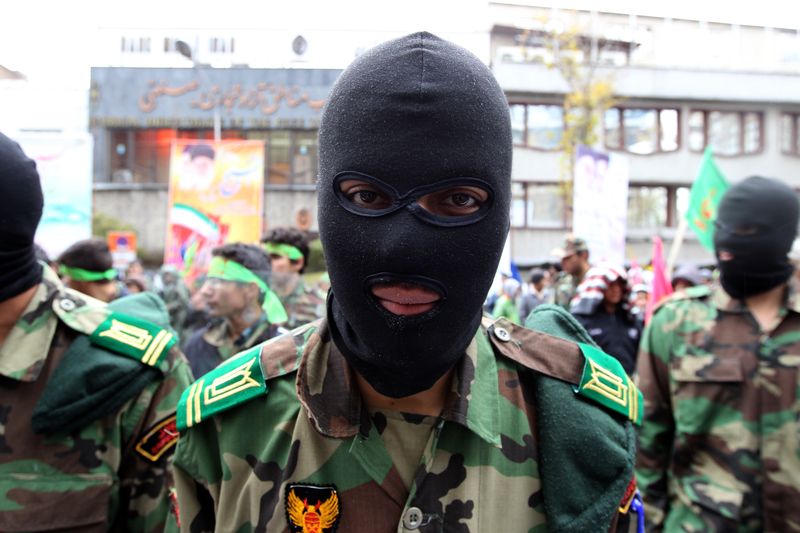
GT_BASIJ_111201

Goldblog, reacting to several mysterious explosions at Iranian nuclear sites, puts his thinking cap on:

I'm not entirely convinced, but it's not unreasonable to group these recent explosions with the Stuxnet virus of last summer that haywired an uranium enrichment facility in Natanz; last October's explosion at a Shahab missile factory; the killing of three Iranian nuclear scientists in the past two years, last November's attempted assassination of Fereydoun Abbasi-Davan–a senior official in the nuclear program — and rumblings of a second supervirus deployed this month as proof that the West's war on Iran's nuclear program is getting less covert by the minute.

Michael Totten feels somewhat similarly. There are also signs that the electronic war against the nuke program has been more successful than we previously believed. But nobody told Max Boot:

Western policymakers have implicitly made the same assumption today that their predecessors made in the 1930s, 1940s and 1990s: that an immediate war, even one fought on favorable terms, is to be feared more than a looming cataclysm that is likely to occur at some indefinite point in the not-too-distant future. That was the right decision to make with Stalin's Russia; it was tragically wrongheaded with Hitler's Germany and the Taliban/Al Qaeda.

Matt Fay and Michael Cohen are decidedly unimpressed with Boot's argument. I'd simply point out something that seems beyond most commentators. The US was rightly outraged by Iran's plot to kill the Saudi ambassador in Washington; but what about the targeted assassinations of Iranian nuclear scientists? If Iran started assassinating American scientists, would we not make a stink? Don't get me wrong: sabotage of Iran's nuclear program is easily the best way forward, along with sanctions. But killing individuals seems to me an over-reach we could come to regret.

(Photo: Members of Iran's paramilitary Basij militia parade in front of the former US embassy in Tehran on November 25, 2011 to mark the national Basij week. Iran has dismissed a US news report implicating it in a chemical weapons cache uncovered in Libya, saying it was a champion in fighting to eradicate such arms. By Atta Kenare/AFP/Getty Images.)

Iran’s New Embassy Crisis

GT_FLAG_111129

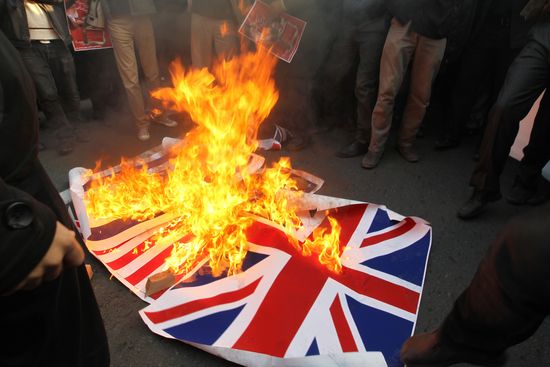
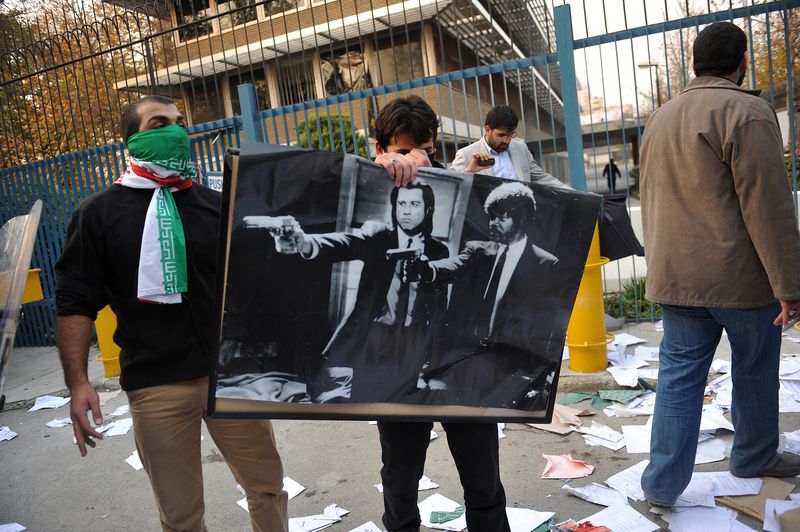
A group of Iranian "students" have ransacked the British embassy in Tehran. Julian Borger situates the attack in context of nuclear tensions:

[T]his is very much part of the Iranian push back against the diplomatic and economic pressure on Tehran following this month's International Atomic Energy Agency (IAEA) report on the Iranian nuclear programme, reporting that there was 'credible' evidence that Iran had experimented with a nuclear warhead design and might still be. In the wake of the report, the UK was the first to take punitive action, cutting off dealings with Iran's central bank. Hence, the call from the Iranian parliament, the Majlis, last week to downgrade diplomatic relations with London.

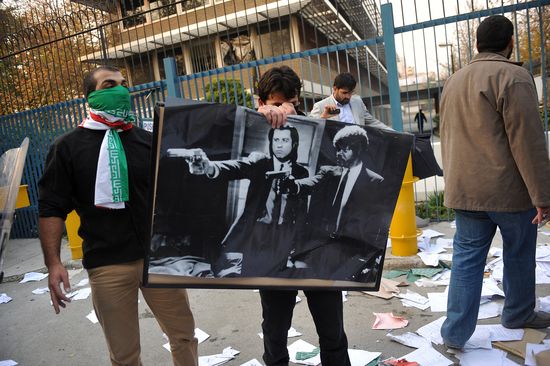
The Guardian liveblog is keeping close tabs on developments. In a photo that's fast becoming iconic, one protestor made off with a Pulp Fiction poster:

GT_PULPFICTION_1111129

(Photos: Iranian protesters burn the British flag outside the embassy in Tehran on November 29, 2011 and a man holds a poster featuring American actors John Travolta and Samuel L. Jackson in a scene from the film 'Pulp Fiction' following a break in at the British Embassy during an anti-British demonstration in the Iranian capital on November 29, 2011 in Tehran, Iran. By, respectively, Atta Kenare/AFP/Getty Images and FarsNews/Getty Images.)

Did Anyone Read The IAEA Report On Iran’s Nukes?

Here's an interesting argument that, despite the headlines, the new report does not actually refute the reassuring claims in the 2007 NIE finding. Money quote:

The NIE left open the possibility that Iran could continue its weapons-relevant activities. With four years of additional perspective, the latest IAEA report gives greater detail on the weapons work that Iran did prior to 2003, then updates the available information on what lesser work occurred after 2003. The new activities included:

– Engaging in experimental research, after 2003, on hemispherical initiation of high explosives.

– Further validation, after 2006, of a neutron initiator design.

– Conducting modeling studies, in 2008 and 2009, that could determine the yield of a nuclear explosion.

Carrying on scattered research activities does not amount to a full-fledged restart of an integrated weapons program. That type of activity still appears to have halted in 2003. The activities since seem more like Iran is refining its previous understanding of nuclear weapons design — not breaking for a bomb.

Iran Isn’t Building A Bomb?

Seymour Hersh has doubts about the existence of Iran’s nuclear program:

A nuanced assessment of the I.A.E.A. report was published by the Arms Control Association (A.C.A.), a nonprofit whose mission is to encourage public support for effective arms control. The A.C.A. noted that the I.A.E.A. did “reinforce what the nonproliferation community has recognized for some times: that Iran engaged in various nuclear weapons development activities until 2003, then stopped many of them, but continued others.” (The American intelligence community reached the same conclusion in a still classified 2007 estimate.) The I.A.E.A.’s report “suggests,” the A.C.A. paper said, that Iran “is working to shorten the timeframe to build the bomb once and if it makes that decision. But it remains apparent that a nuclear-armed Iran is still not imminent nor is it inevitable.” Greg Thielmann, a former State Department and Senate Intelligence Committee analyst who was one of the authors of the A.C.A. assessment, told me, “There is troubling evidence suggesting that studies are still going on, but there is nothing that indicates that Iran is really building a bomb.” He added, “Those who want to drum up support for a bombing attack on Iran sort of aggressively misrepresented the report.” 

Why not the Japan option … of having the technology to quickly make a nuke but not actually taking that step? It always seemed to me the obvious best choice for the Iranian regime. My own view is that we should assume that at some point in the future, Iran will have a de facto nuclear bomb capacity, even if they are smart enough to pull a Japan. The task is then an obvious one, not the radical and recently disastrous policy of pre-emptive war, but that classic and successful American policy: containment. From my paywalled column yesterday:

It seems to me inevitable that at some point, a country as advanced as Iran that wants to get a nuclear capacity will get one. That capacity, to borrow George Kennan’s words, will not be “charmed or talked out of existence”. It is not a matter of if but when. And history suggests it would not be catastrophic. In fact, a region with two nuclear powers facing off against each other is more stable than one country with a monopoly of nuclear force. The only time a nuclear bomb has ever been used was when only one country had it. The task, therefore, should not be the truly dangerous bid to prevent a nuclear weapon from ever being developed by Iran, but a containment strategy to prevent its ever being used. 

Reuel Marc Gerecht and Mark Dubowitz see a new way to enforce more damaging sanctions without harming ourselves or the Iranian people:

Effective energy sanctions don’t have to raise oil prices; they can actually do the opposite. Washington just has to learn how to leverage greed.

We should bar from operating in the United States any European and most Asian energy companies that deal in Iranian oil and work with the Iranian central bank, Revolutionary Guards or National Oil Company. At the same time, however, we should allow companies from countries that have little interest in Iran’s nuclear program, or its pro-democracy Green Movement, and that are willing to risk their access to American markets — mainly Chinese companies — to continue buying Iranian crude in whatever quantity they desire. This would reduce the number of buyers of Iranian petroleum, without reducing the quantity of oil on the market. With fewer buyers to compete with, the Chinese companies would have significant negotiating leverage with which to extract discounts from Tehran. The government could lose out on tens of billions of dollars in oil revenue, loosening its hold on power.

But where I differ from Gerecht, Dubowitz and Obama is the intolerability of an Iranian nuclear weapon. It’s a horrible option, but not a doomsday scenario. If Israel were to initiate such a pre-emptive global war, I think its long-term survival would be highly unlikely.

Why Do Israel And America Fixate On A Nuclear Iran?

Matt Steinglass's guess:

It seems to me that the American and Israeli obsession with Iran's nuclear weapons programme proceeds from a misguided messianic-apocalyptic streak in both countries' political cultures. There's a temptation to imagine the world of foreign policy as a broad extension of a Robert Ludlum novel: a desperate time-constrained race to stop evil madmen from committing atrocities. This vision is morally clarifying and inspiring. But it has little to do with reality, and it distracts the public from the actual challenges of foreign policy, which are usually messy and often involve actual sacrifices in order to achieve publicly valuable goals. 

Larison proposes an alternative theory.

What Happens If Iran Gets The Bomb?

The International Atomic Energy Agency's confirmation (pdf) of what we already knew – Iran is moving towards getting nukes – has poured a gallon of gasoline on the raging pro-Iran war fire. N-Pod, and other usual suspects have all come out guns a-blazing, while Romney makes his standard "Obama is the problem" non-argument. The most serious scenario for war:

[T]he Obama administration should not discount the possibility of an Israeli-Iranian nuclear conflict. From the very start, the nuclear balance between these two antagonists would be unstable. Because of the significant disparity in the sizes of their respective arsenals (Iran would have a handful of warheads compared to Israel's estimated 100-200), both sides would have huge incentives to strike first in the event of a crisis. Israel would likely believe that it had only a short period during which it could launch a nuclear attack that would wipe out most, if not all, of Iran's weapons and much of its nuclear infrastructure without Tehran being able to retaliate. For its part, Iran might decide to use its arsenal before Israel could destroy it with a preemptive attack. The absence of early warning systems on both sides and the extremely short flight time for ballistic missiles heading from one country to the other would only heighten the danger. Decision-makers would be under tremendous pressure to act quickly.

Fallows isn't convinced that a strike would succeed in preventing nuclearization. Paul Pillar hears echoes of Iraq in the coverage of the report. Yaakov Katz thinks the IAEA move will actually make war less likely:

The report also means that for the time being, an Israeli military strike will likely move to the back burner, and Jerusalem will focus instead on getting the world to impose crippling sanctions on Iran, not crippled sanctions like those that have already been passed.

Benjamin Weinthal explains what sorts of new sanctions might succeed in preventing an Iranian bomb. Marc Tracy imagines how China could be brought on board. And Ackerman develops a contingency containment strategy that might strengthen the American hand in the Middle East. For my part, I cannot see how we can prevent Iran from getting a nuclear bomb, and I cannot see how we can prevent the current insane Israeli government from launching a war on Amalek, if Netanyahu and Barak are as deranged as Dagan and others fear they are. And if they do strike first, the impact on the West – a wave of Jihadism, a masssive attempt to unleash weapons of mass destruction on the West as revenge – would be cataclysmic. Not just in terms of human casualties but in terms of pushing what's left of the world into the worst depression of all time. If Israel believes this will help Israel, they truly need to be saved from themselves.

Containment is the only policy that makes sense; and it is a policy Israel refuses to tolerate and which the US has recklessly disavowed. Which means that it's likely that the country that could indirectly launch a third world war against the West could be Israel. You think Obama could stop them? And since the Israeli government has a lock on the US Congress, and a fervent following in the opposition fundamentalist party here, we'd all be directly implicated in an attack, even if we are never told in advance.

It's staggering that a world power would make its very survival contingent on one extremist government in another distant country. And there are times when I think we are sleepwalking into the worst conflagration since the Second World War.