Israel’s Threat; Iran’s Danger

Don't you get the feeling that, as we obsess about Herman Cain's sexual harassment and Justin Bieber's paternity test, the world could be headed soon for a new depression, as Europe implodes, and world war, as the Israel-Iran conflict explodes? Shmuel Rosner thinks two factors will influence Israel's decision to attack: the perceived risk of a nuclear Iran and the feasibility of a strike. Walter Russell Mead sees a change in Israeli attitudes on the latter front. Paul Mutter examines the impact of a "super Stuxnet" on Israeli thinking. Marc Tracy does a cost-benefit analysis:

The negative consequences of an Israeli attack—massive war with Hamas and Hezbollah, maybe rockets from Iran itself, God knows what worse forms of retaliation—are essentially known and all but guaranteed. By contrast, the negative consequences of not launching a strike range vastly and unknowably, and if they go all the way up to Armageddon in the Middle East, they also go all the way down to Iran’s never making weapons. I know this is scary, but it’s the way life is lived: you can believe that the worst-case scenario for not striking Iran is worse than the worst-case scenario for striking Iran, and, because of the odds and the contingencies, still oppose striking Iran.

Judah Grunstein is skeptical about both this calculus and the arguments in favor of a strike. Robert Farley sees the idea of war with Iran as flat-out insane. The real question is: for whom? Insanity is relative.

For Israel, you can see how Netanyahu, born and bred into profound but often justifiable paranoia, sees himself as Churchill. You can see how the Jewish people live perpetually in fear of Amalek. But Churchill confronted an enemy equal in military force, greater in industrial strength, and explicitly territorially expansionary. Netanyahu faces an enemy with no record of territorial aggression (unlike Israel), a faltering economy, a divided leadership, massive domestic opposition, and a much inferior military operation. Israel itself is deeply divided over whether risking global war to defeat this country's acquisition of a handful of nuclear weapons (while Israel has well over a hundred), makes sense. I can see why some Israelis and Jews do not consider this literally insane. I cannot see how a rational American can come to the same conclusion.

But for the US, it seems pretty obvious to me that an Israel-prompted regional war in the Middle East would be a disaster, wiping out many of the gains Obama has made in taming and targeting Islamist terror, devastating the Middle East, unleashing terror attacks across the globe, probably pushing Pakistan into open hostility, and pushing an already fragile global economy into the Second Great Depression.

This must be at the center of our foreign policy debate. Are we the instruments of Israel's understandable, if misguided, foreign policy or the masters of our own? Are we governed by our reason or others' panic?
Iran’s Real Rival: Turkey

125699583

Mohammad Ayatollahi Tabaar explains how the Turkey's regional rise is torpedoing Iranian influence:

The Iranian government is aware of the ideological affinity between Iran's reformist opposition and the AKP [Turkey's ruling party]. Although they were born in diametrically opposed political systems, both strive to strike a balance between Islam and democracy. Iranian leaders fear that the AKP may inflict a similar damage to their legitimacy as the Iranian reform movement has. They acknowledge that the reformists, although defeated for now, managed to crack the heart of the establishment and bring many die-hard supporters of the regime to their side or neutralize them. Now, the AKP could create a similar legitimacy crisis for the Islamic government on a regional level, weakening Iran's soft power and undermining its popularity in the Muslim world.

Thomas P.M. Barnett notes another Turkish advantage over Iran: relative economic strength. Walter Russell Mead thinks the main beneficiary of the struggle between the two regional powers is the United States:

The US seeks a balance of power in the Middle East; that means its diplomacy can be flexible and work with any number of countries with varying political goals.  Turkey is not challenging Iran to help the US, but the consequences of Turkey’s increased activism (widely seen as proof of US decline in the Middle East) are actually shoring up the foundations of US geopolitical interests in this critical part of the world.  Indeed, the emergence of a healthy pluralism in the region, with a strong Egypt, Saudi Arabia, Iran, Turkey and others would tend on balance to make key US goals more achievable rather than less.

Agreed, which is why the neocon hostility to Turkey is so baffling (unless you assume that it's really about Israel's interests rather than the US's).

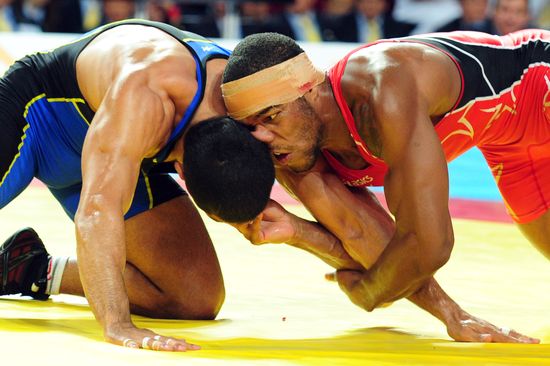
(Photo: Jordan Burroughs of USA (R) wrestles with Iran's Sadegh Saeed Goudarzi (L) during their Free Style 74 kg gold medal match at the Senior Wrestling World Championship in Istanbul, Turkey on September 17, 2011. By Mustafa Ozer/AFP/Getty Images)

Reading The Iran War Tea Leaves

The Guardian reported yesterday that the British are preparing for an attack on Iran. Ron Kampeas flags some conflicting analysis on the likelihood of a strike from different sources. Tarek Osman warns that events of recent months might enable a strike:

[I]f Israel or the United States (or both) were to decide to attack Iran – through air-strikes rather than a ground invasion – they will seek to ensure three preconditions in the region: that Arab resistance to any such attack will be limited; that it would not be perceived as an attack on “Islam”; and that Iran’s regional satellites (Hizbollah and Hamas) are given strong disincentives to engage in the struggle. All this will be difficult, but much of it is not impossible. Saudi Arabia and most other Gulf monarchies want to see Iran’s powers curtailed; Egypt will for the next few months at least be consumed by its internal travails; Syria’s regime is entangled in a domestic war for survival, and even Hizbollah’s solidarity with Iran in an armed confrontation with Israel would have its limits.

Unless there is evidence of an imminent threat to Britain or the US, I cannot think of a crazier strategy. As outlined above, it may well be seen as the West's entrance into the Sunni-Shi'a struggle in the region, providing plenty of ammunition for any Shiite Jihadist, let alone a Quds operative, to strike back, and force a ratcheting up of the police and security state at home even further. Bruce Riedel analyzes what Iran could do in response:

Iran’s capability to retaliate for an Israeli strike against the U.S. is enormous.  It could encourage its Shia allies in Iraq to attack American forces, as they seek to withdraw from the country before the end of the year, or the American diplomats who will stay behind. It could encourage the Afghan Taliban, with which it has developed a closer relationship in the last couple of years, to step up its attacks on NATO forces in Afghanistan. The Italian forces in Afghanistan are particularly vulnerable, since they are deployed near the Iranian border around Herat, but American bases across the country would be even more at risk than they are today. U.S. bases in the Gulf states, including Kuwait, Bahrain, Qatar, the United Arab Emirates, and Oman, would be in range of Iranian missiles and terrorists. Hizbullah and Iran have contingency plans for attacks on American diplomatic and other targets across Europe, Africa, Asia, and here at home. They don’t need to rely on Mexican drug cartels to hit inside America.

“Iran’s Victory In Iraq” Ctd

Meghan L. O'Sullivan gives a relatively level-headed critique of the withdrawal:

Washington also leaves behind less than optimal prospects for a robust U.S.-Iraqi partnership. Five or ten years from now, the relationship will be more anemic, in part because groups opposed to American influence have now gained an upper hand and are likely to be strengthened in the interim. Note the recent statement from the Iranian-allied Iraqi lawmaker Muqtada al-Sadr.

Apparently dissatisfied with the imminent departure of U.S. military personnel, Sadr declared all U.S. Embassy employees "occupiers" who should be "resisted." In addition, the nonmilitary bilateral relationship will be difficult to build without any forces on the ground. Last Friday's announcement complicated ambitions to expand the civilian footprint in Iraq — the U.S. State Department is putting plans to build consulates on hold due to security and cost concerns. 

“Iran’s Victory In Iraq” Ctd

R.K. Ramazani adds value:

Iran’s build up of influence is limited … for two major reasons. First, Iraqi nationalist sentiments place serious limits on the exercise of Iranian power. Even the pro-Iranian political factions are quite sensitive about foreign impingement on Iraqi sovereignty. The fellow Shia Iraqi forces, contrary to Iranian expectations, did not rise up against Saddam Hussein in the Iran-Iraq war; they fought against Iran. The other reason pertains to numerous disputes between the two countries. Many of these have been inherited from the Iraq-Iran war. They range from war reparations to border problems and continental shelf delineation in the Persian Gulf. For example, in 2009 Iranian forces penetrated Iraqi territory, as they had in 1982, and occupied the disputed Fakka oilfield for a few days. A more serious dispute between the two countries concerns Iranian border crossing. Iran repeatedly pursues an Iranian Kurdish separatist group into Iraqi territory.

Fred and Kim Kagan shrilly declare Iranian victory after the withdrawal. Matt Duss is as exasperated as Ted Galen Carpenter:

As for the idea that the U.S. withdrawal will "unquestionably benefit Iran," newsflash: The Iraq war unquestionably benefited Iran. As an Iraqi friend put it to me at a conference in 2008, “America has baked Iraq like a cake, and given it to Iran to eat.” As the New York Times reported earlier this month, Iran’s influence in Iraq — which was always primarily political, not military — has actually declined over the past two years (as with Al Qaeda in Iraq, the U.S. has benefited from our adversaries’ ability to alienate their own allies), but it’s worth noting that Iran’s influence was at its height when there were over 100,000 U.S. troops in Iraq. Does anyone seriously imagine that a few thousand extra U.S. troops would make the difference here? 

“Iran’s Victory In Iraq”

Ted Galen Carpenter is gobsmacked by neocon chutzpah over Iran’s influence in Iraq:

For neoconservatives to argue that the withdrawal of the few thousand remaining U.S. troops from Iraq significantly worsens that aspect is either obtuse or disingenuous. If they didn’t want Iran to gain significant influence in the region, they should have thought of that danger in 2002 and early 2003, instead of lobbying feverishly for U.S. military intervention against Iraq.

The United States has paid a terrible cost—some $850 billion and more than 4,400 dead American soldiers—to make Iran the most influential power in Iraq. And the pro-war camp cannot even claim a consolation prize—the emergence of a truly democratic Iraqi government. Evidence mounts that that the Maliki regime is becoming ever more authoritarian and corrupt. Such abuses as jailing (and even torturing) critics, harassing independent news media outlets and trying to bar Sunni political opponents from running for office have become increasingly common features in the “new Iraq.” And corruption has reached epidemic proportions. In essence, it appears that the United States, at great cost in both treasure and blood, has managed to replace a staunchly anti-Iranian Sunni dictator with a pro-Iranian Shiite quasi-dictator. 

But they cannot grapple with this, because it would mean abandoning their ideology and partisanship, hence the absurd attempt to fix the blame for the worst foreign policy decision since Vietnam on the president who opposed it in the first place and is ending it – on his predecessor’s schedule – today. What we have learned is that the project was inherently flawed – for reasons conservatives of all people should readily understand. Related coverage here and here

What Was “Iran” Thinking Ctd

Afshon Ostovar explains the history and standard operating procedure of the Quds Force, the branch of the Revolutionary Guards allegedly responsible for the plot:

The Quds Force has relied on its strong relationships with allied proxy groups and trusted militant networks. Its success in these operations has depended on not only the reliability of its partners, but also to a large extent on overlapping political and ideological interests. It is not a coincidence that the Quds Force works almost exclusively with individuals and organizations that have had long-standing ties with Iran's senior leadership and Revolutionary Guards commanders. Given the Quds Force's modus operandi, it is odd that its commanders would entrust an unprecedentedly brazen attack against a foreign diplomat on U.S. soil to a former used-car salesman and Mexican drug-cartel hit men. 

Odd it is. Yet Obama seemed adamant about it today. Ackerman parses an argument from Michael Singh. This was a helpful nugget:

One needs to take into account an important change that the IRGC made in its military command-and-control structure in 2005.

According to these changes (authored by the IRGC's then-chief strategist, Gen. Mohammad Jafari, who is now the organization's commander), individual IRGC commands were given greater freedom to act without seeking authorization. This change in doctrine was reinforced in practice. For example, the IRGC naval commander who took 15 British sailors hostage in 2007, apparently on his own initiative, was not punished by the regime but rather awarded a medal. This emphasis on distributed command, combined with the IRGC's reliance on asymmetric warfare in the face of America's vastly superior military power, makes seemingly odd terrorist plots such as the one recently revealed far more plausible.

Don’t Freak Out About Iran

Pdfnews.asp

Madison Schramm warns against an overreaction to the Iranian plot:

Iran has almost hit the nuclear capable mark, at which point it would possess the technical expertise and materials to move quickly to create a weapon. But if Iran manages to cross that threshold, it will be in the company of the estimated 40 states already in the nuclear capable club. Were the Iranians to gain capability and then to arm, Washington would need to prepare for some muscle flexing – not Armageddon.

If the government's accusations hold up, Ackerman thinks the Iranians have been exposed as bumbling fools. Shikha Dalmia concurs.

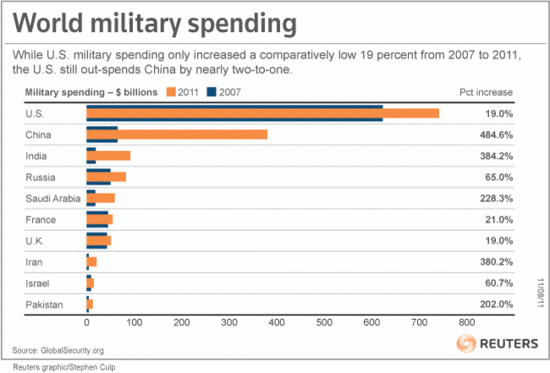
(Chart via Ben Adler)

What Was “Iran” Thinking?

Meir Javedanfar speculates about the potential actors and motivations behind the plot:

It could mean that Iranian Supreme Leader Ayatollah Ali Khamenei, the ultimate authority for permitting attacks of this nature, is willing to go further than simply hurting US and Saudi interests through proxies in Iraq and Lebanon. This would set a new precedent, as Iran previously shied from launching operations against US and Saudi interests on their own soil. Yet there’s another, somewhat intriguing possibility. Could elements within the Iranian government or security establishment have planned this attack, without Khamenei's knowledge in order to hurt him and his regime? On the surface, at least, this seems unlikely. However, details of the US claims certainly suggest that the idea isn’t completely without merit.

Doug Mataconis collects and assesses some other options.

Iranian Terrorists On US Soil – For Real? Ctd

Joe Klein sees the alleged Iranian plot as part of a bigger conflict:

The attempt to kill Adel al-Jubeir may have been a one-off by a rogue element of the Al-Quds Force, but it is also a clear sign of escalating tensions between Sunnis and Shi’ites in the region. Those tensions will only increase now. A Saudi response is not improbable. A collapse of the Assad government in Syria could precipitate a regional sectarian conflict between Sunnis and Shi’ites, which could become chaotic very quickly–involving Lebanon, Israel, Iraq, Jordan, to say nothing of the destruction of the Iranian and Saudi oil fields.