by Chris Bodenner
To quote a famous blogger, know hope:
by Chris Bodenner
To quote a famous blogger, know hope:
by Patrick Appel
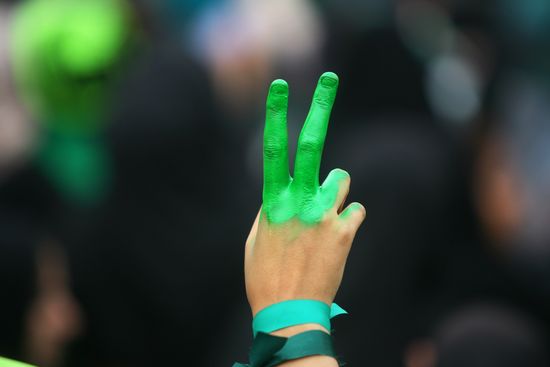
Reza Aslan wonders whether events in Egypt will reignite Iran's reform movement:
Iran is facing many of the same economic woes that plunged Tunisia, Algeria, and Egypt into revolt. As outlined by the Asia Times, Iran's rate of economic growth is close to zero, compared to three percent for Tunisia and 4.6 percent in Egypt. The official unemployment rate in Iran is reported at about 15 percent of the working-age population, and while that is roughly similar to the unemployment figures in Tunisia, most independent estimates place Iran's unemployed at closer to 30 percent. While Egypt's rate of inflation stands at an astonishing 12 percent, that is approximately half of Iran's inflation rate, which economists estimate to be close to 24 percent. According to the United Nations, some 20 to 30 percent of Egypt's population lives below the poverty line (the number in Tunisia is about eight percent). Compare that to the approximately 25 percent in Iran.
(Photo: By Majid/Getty Images)
by Patrick Appel
Thoreau's view of Egypt's democracy movement:
Like many Serious People, Richard Cohen is convinced that the Egyptian protests will lead to the rise of an illiberal regime that doesn’t respect minority rights. Now, yes, I am aware of what happened in Iran in 1979, and I am aware that Egypt has a history of illiberal regimes (e.g. the one that Serious People have supported for decades). However, just a few weeks ago Egyptian Muslims were in the streets protesting against violent fundamentalists and acting as human shields around Christian churches. So if I absolutely had to wager money on the outcome of these protests, I’d wager that the Muslims who acted as human shields for Christian churches are not about to turn around and put in place a radical theocracy. I’d be less than shocked if they elected something a bit more conservative than Turkey’s Justice and Development Party, but would that really be so bad?
by Patrick Appel
The men ultimately delivered me to a government building on the Nile, where a man in a police uniform spoke English and confirmed that I was either a native English speaker with an accent appropriate to his nationality, or an Iranian with an unusually effective ESL teacher. He guessed the former and let me go, but not before telling me by way of apology that there are "foreign people in the crowds who want to create danger and kill Egyptians." He said roadblocks and crowds along the corniche were advised to hunt down "Iranians, Hizbullah, Qataris, Hamas, and" — because why not? — "Israelis."
I suppose this list of suspects has some logic to it. Iran hates Egypt enough to have named a main Tehran thoroughfare after Khaled El Islambouli, the Egyptian artillery officer who gunned down Mubarak's predecessor Anwar Sadat (and injured Mubarak in the process). Qatar's Al Jazeera is indeed pro-demonstration. And Egypt is no friend of Hamas.
In any case, the net is wide, and purposefully so. Foreigners are under attack, not just journalists. A stroll down the corniche has never been so frightening.

by Patrick Appel
Matt Steinglass compares America's relationship with Egypt to its relationship with Iran:
Our position today is in some ways less like our position during the Green Revolution in Iran than it is like Mikhail Gorbachev's position during the Velvet Revolution in Czechoslovakia, or perhaps like John F. Kennedy's position in South Vietnam in 1963, when a signal that America would be receptive to a change of leadership quickly led to the coup that ousted Ngo Dinh Diem.
That's not to say that Mr Obama should openly demand that Mr Mubarak step down.
That coup in South Vietnam didn't work out so well, and from the perspective of most Russians today, Mr Gorbachev's actions in Eastern Europe in 1989 were disastrous for Russian interests. Mohammed ElBaradei may proclaim that a post-Mubarak Egypt will be democratic and secular, but Mohammed ElBaradei is a retired United Nations official; there is no organised movement pledging fealty to him. He looks very much like a Kerensky figure, the sort of well-known educated liberal internationalist who appears initially popular at the beginning of a revolution and is appealing to foreigners, but who is soon swept aside once the battle for power descends to the streets.
(Photo: Egyptian demonstrators gather at dusk in Tahrir Square in Cairo on January 31, 2011, on the seventh day of protests against long term President Hosni Mubarak. By Mohammed Abed/AFP/Getty Images)
by Patrick Appel
Tehran Bureau reports:
Reza, a professor of philosophy, told Tehran Bureau, "Mubarak is repeating the Shah's mistakes." The Iranian state media apparatus encourages this analogy, or any other that draws parallels between the Shah and Mubarak. The logic is simple. "If Mubarak is the Shah, then Egyptians' revolution can be portrayed as Iran's Islamic Revolution," explains Reza.
But that's not the only narrative:
"Like us, Egyptians are voicing their anger at a regime they consider corrupt and illegitimately in power," says Maryam, 27, from central Tehran. She does not remember the nights of 32 years ago. Her memory is filled with images from summer 2009. The fact that international observers regard the most recent election in Egypt as rigged only adds to her sympathy for ordinary Egyptians. "They are demanding democracy, which we wanted and want." The way she looks at the events, Mubarak is another "dictator, unpopular and unelected. It is Egyptians' right to get rid of him." In this analogy, the present Iranian opposition has much in common with the people of Egypt and the Iranian government is assigned a role similar to that of Mubarak's regime.
by Chris Bodenner
Ali Vaez compares and contrasts the two uprisings:
[T]he Tunisian "Jasmine Revolution" and the Iranian "Green Movement" shared striking similarities. In both countries, people from all strata of society partook in the protests, with youth and women at the forefront of the demonstrations. The tragic death of young students, like Neda Agha-Soltan in Iran and Mohammed Bouazizi in Tunisia, fueled the fervor against the oppressive governments. The mobile phones of citizen-journalists, not the professional cameras of Western correspondents, broadcasted the dramatic images of both rebellions. YouTube videos, Facebook pictures and Twitter slogans captured the imagination of millions around the world and served as testaments to the brutality of political orders bereft of mercy. During both movements, approximately 70 people reportedly lost their lives and many more were gravely injured.
The Iranian and Tunisian movements, however, are distinct in three ways. First, the rulers of Iran, comprised of former-revolutionaries who came to power by ousting the Western-backed Pahlavi monarchy, knew well that compromise under pressure only invites more pressure. The Supreme Leader did not show any sign of ceding control and ordered his massive suppression apparatus to nip the Green Movement in the bud.
Abbas Milani recounts the resilient cultural history of Iran:
More than once in Iran’s history, after the country was vanquished by outsiders—from Arabs to Mongols—the culture of the conquered survived and eventually molded the customs of the victors to its own pattern. It is hard to imagine that the 1979 revolution will be an exception to this enduring reality. …
In Tehran alone, 3 million people marched in remarkable discipline to demand their democratic rights. Their slogan pithily captured in a mere four words the hundred-year-old dream of modernity and democracy in Iran. Using thugs and guns, prison and torture, the ayatollah has so far succeeded in intimidating the people back into their homes. But a critical look at the past shows the bleak future of Khamenei and other champions of despotism. Violence can only delay but not destroy the rights of man in a nation that has embraced the cultural ethos of modernity. The hushed, brutalized quiet of today is at best a prelude to the liberating storms of tomorrow.
Goldblog takes a moment to recognize the achievement:
[Obama] did the difficult work of pulling together serious multilateral sanctions against Iran; he has convinced the Israelis — at least he has partially convinced some Israelis — that he has placed the prestige of his presidency behind this effort, and that he sincerely and deeply understand why it is in no one's interest to see Iran with a bomb, and he has supported, in ways that I only know the most general way, some very hard-edged counterproliferation programs, programs whose existence proves, among other things, that he is capable of real and decisive toughness.
What all this means is that the West — in combination with Iran's own incompetence — has created a bit of breathing space for itself.
Karim Sadjadpour's warning:
According to best estimates [a military strike] could delay Iran’s nuclear progress by 2-3 years, but it would likely entrench Tehran’s most radical elements for years, if not decades, to come. I think Iran’s hardliners—including Khamenei—would welcome a military strike; they would use it as a pretext to crush dissent and repair the country’s internal political divisions.
As one Iranian democracy activist once told me, there should be "less focus on the gun, and more focus on the bandit trying to obtain the gun." Bombing Iran will strengthen the bandit and only increase his desire to get the gun.
 The Dish