“Iran is winning and Israel is losing”

Juan Cole mounts the evidence:

From 2005 through 2006, Iran appeared to be on the retreat in the eastern Mediterranean. Pro-Western Sunnis and Christians took over in Beirut. Syria was expelled from Lebanon and there was talk of detaching it from Iran. The powerful generals of Turkey, a NATO member and ally of Israel, were reliably anti-Iranian. Now, Hariri is a supplicant in Tehran, Syria is again influential in Beirut, and a Turkey newly comfortable with Islam has emerged as a regional power and a force for economic and diplomatic integration of Iran and Syria into the Middle East. Iran’s political breakthroughs in the region have dealt a perhaps irreparable blow to the hopes of the United States and Israel for a new anti-Iranian axis in the region that would align Iran’s Arab and other neighbors with Tel Aviv.

Iran’s Weak Grip On Iraqi Politics

Iraq_Maliki_Getty

Joel Wing reads Wikileaks diplomatic cables from former US Ambassador to Iraq Christopher Hill:

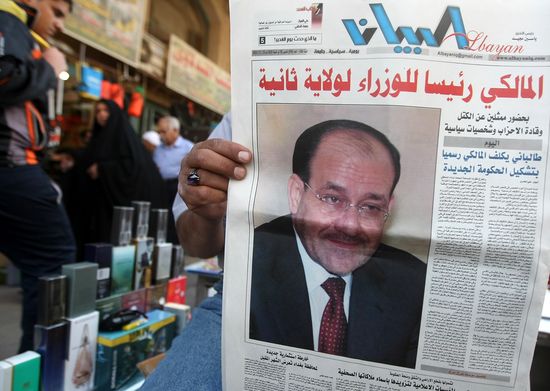
Conventional wisdom in the West is increasingly pointing to Iran as the biggest winner not only of the recent election, but post-war Iraq overall. As Ambassador Hill pointed out, Tehran is undoubtedly a major player in Iraqi politics. That being said, they do not give orders and the Iraqis comply. Iran’s main goal is being able to shape events in Iraq to their liking, not having direct control. Increasingly Iran is having problems at doing that as Iraqi nationalism has re-emerged and average citizens are becoming weary of their neighbor interfering in their affairs. That’s something that Ambassador Hill also mentioned in a later cable. The actions of the Iraqi parties point to the limits of Iran’s power. The Shiites did not unite before the vote, and it took them months to agree upon Maliki afterward, and some still refuse to do so. The Iraqi parties were caught up in their own power struggles and rivalries, and that ultimately played a larger role in their decisions than Iranian pressure. 

(Photo: An Iraqi man holds a newspaper featuring a front-page story on Nuri al-Maliki's second term as prime minister in Baghdad on November 25, 2010. By Ahmad al-Rubaye/AFP/Getty Images)

The Arabs vs Iran? Please. Ctd

Peter Beinart turns the debate on its head:

[F]or all their crowing about the fact that various Gulf princes want war with Iran, American conservatives seem not to have noticed that the most democratic Muslim countries in the region—Turkey, Iraq and Lebanon—want the softest line on Tehran. 

The bald reality is this: The vast majority of people in the Middle East loathe our military presence in the region and our largely uncritical support for Israel. The more devoted to those policies conservatives are, the more at odds with Middle Eastern democracy they’ll be. 

The Arabs vs Iran? Please. Ctd

John Limbert explains the ancient grudges between Iran and its neighboring nations:

Mutual ignorance compounds the hostility [between Iranians and Arabs]. Despite centuries of interaction and contact, neither side knows much about the other. What do Arabs and Iranians know of each other's art, literature, history, politics, and traditions? Very little. Perhaps a close parallel is the relations between Mexicans and Americans. As Americans we appreciate Mexican food (or a variety of it) and Mexican music. But what do most of us know of Mexico's culture and history? Very little indeed. So in this mutual ignorance it is easier to dismiss the others as "liars," "snakes," and "heretics" than make the effort required for understanding.

His bottom line on the prospect of a new regional war, as urged by the neocons:

Do the Arabs really want a war with Iran? Probably not, given the potentially disastrous economic and political consequences of such a conflict. But with all their pent-up grievances, both ancient and recent, they are not above sharing frustration, particularly with those American visitors who might — for very different reasons — share their feelings of hostility.

The Arabs vs Iran? Please. Ctd

Daniel Larison flags a cable:

Commercial ties between Dubai and Iran are significant (Dubai is Iran’s largest non-oil trading partner), and as a result the UAEG walks a fine line between maintaining and encouraging this trade and working to prevent suspected Iranian proliferation activities. Although the UAEG is worried about Iran’s nuclear ambitions, its short-term policy decisions regarding Iran center on not provoking its neighbor. 

Larison adds:

It still seems true that advocates of attacking Iran have been exaggerating the extent of support for this among our Gulf state allies. The leaked cables confirm that they are not simply making this up out of thin air, which is something of an achievement given the lousy track record of some hawks when it comes to making claims about foreign affairs. None of this changes the reality that “pro-Israel” hawks and the Israeli government remain the dominant forces pushing a confrontational U.S. policy towards Iran. The report that some Arab governments agree with this reckless, disastrous course of action isn’t really news, and it doesn’t make military action against Iran any less harmful to the entire region.

What is odd is the new concern for the fears and concerns of Arab governments from people who have spent the better part of the last decade deliberately ignoring or in some cases actively opposing the interests of those governments.


The Arabs vs Iran? Please. Ctd

Marc Lynch adds some light:

"The Saudis always want to fight Iranians to the last American" and it is "time for them to get in the game," Secretary of Defense Robert Gates tells the French foreign minister in a newly released cable from February 2010. This captures perfectly the point I made yesterday about how to read the reporting in these cables about the private hawkishness of Arab leaders. The question of Arabs and Iran was never an information problem — it's an analysis problem. The antipathy which many of these leaders feel for Iran has long been well known. But so has their reluctance to do anything about it. And so have the internal divisions within Arab governments and Gulf ruling families, and their deep fears of either Iranian retaliation or popular upheaval, and their bottomless hunger for U.S. weapons systems, and their hopes that the U.S. would magically solve their problems for them, and the disconnect between the palaces and the public.

In yet another post, Goldblog refuses to take the anti-Semite card off the table in this debate, where we share the same goals – the neutering of the Revolutionary Guards and the securing of a two-state solution in Israel/Palestine. This saddens and bores me. Let me just put this as plainly as I can: if Goldblog's readers think I am anti-Semitic, that's their problem, not mine. They need to get over their paranoia in an America where their sense of victimhood is a cheap form of maudling solipsism. There is real and disgusting anti-Semitism in the world, but it isn't based in Adams Morgan.

Meanwhile, how can we tighten pressure in Iran, encourage the Greens and force the Israelis out of their smug suicidal tendencies?

The Arabs vs Iran? Please.

08_arab_opinion_poll_telhami_page_graph2

Much hooey has been made about the Wikileaks documentation of various Arab autocrats wanting the US and/or Israel to "cut off the head of the snake" in Iran. In fact, my colleague Jeffrey Goldberg has even gone so far as to call this confluence of the interests of the Israeli right and the Arab dictators a "pan-Semitic" lobby – that both allegedly destroys the notion of a pro-Israel lobby being the main driver for war against Iran and the fiction of its apparent power. Apparently, a lobby for a foreign government is useless if it cannot instantly get the US to launch World War III to maintain said foreign government's regional nuclear monopoly for a few more years.

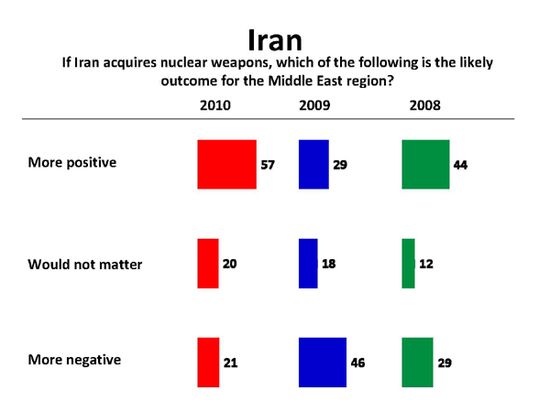
But a little reality check. Here is the latest poll of what the people of various Arab countries, Egypt, Saudi Arabia, Morocco, Jordan, Lebanon, and the United Arab Emirates, actually say they think about an Iranian nuclear weapon:

While the results vary from country to country, the weighted average across the six countries is telling:  in 2009, only 29% of those polled said that Iran's acquisition of nuclear weapons would be "positive" for the Middle East; in 2010, 57% of those polled indicate that such an outcome would be "positive" for the Middle East.

So, in fact, the Arab population, unlike their corrupt, gutless, torturing autocrats, is increasingly in favor of a nuclearized Iran. 77 percent of those surveyed said that Iran had a right to its nuclear program, even though close to 57 percent (a three-year high) viewed it as a military program designed for nuclear bombs (only 39 percent believed that three years ago).

When the Arab public was asked which foreign country was the biggest threat to them, a full 88 percent said Israel, 77 percent said the US and … drum-roll, Jeffrey … 10 percent said Iran.

The spectacle we are now watching is neocons hailing the Arab dictators they once claimed to abhor, while profoundly misleading Americans about the disastrous and catastrophic effect a US or Israeli war on Iran would have.
The Promise Of A Democratic Iran

Karim Sadjadpour made an important point in yesterday's FT:

The WikiLeaks revelations make clear that Arab officials believe Iran to be inherently dishonest and dangerous. The feeling is probably mutual. But they hide perhaps a more interesting issue, namely what type of Iranian government would actually best serve Gulf Arab interests.

President Mahmoud Ahmadi-Nejad and the Islamic Republic may be loathed, but equally the advent of a more progressive, democratic Iran would enable Tehran to emerge from its largely self-inflicted isolation and begin to realise its enormous potential. In the zero-sum game of Middle Eastern politics, a democratic Iran would pose huge challenges to Persian Gulf sheikhdoms.

(Hat tip: Norm)

Will Israel Attack Iran By Christmas?

To me, the most revealing parts of the Wikileaks diplo-docu-dump are about the Middle East. We already knew that the Sunni Arab autocrats cannot bear the thought of a Shiite nuclear bomb and are almost as worried as the Israelis. But now the evidentiary proof brings it home:

The Saudi king was recorded as having “frequently exhorted the US to attack Iran to put an end to its nuclear weapons programme”, one cable stated. “He told you NETANYAHUJimHollander:AFP:Getty [Americans] to cut off the head of the snake,” the Saudi ambassador to Washington, Adel al-Jubeir said, according to a report on Abdullah’s meeting with the US general David Petraeus in April 2008.

The cables also highlight Israel’s anxiety to preserve its regional nuclear monopoly, its readiness to go it alone against Iran – and its unstinting attempts to influence American policy. The defence minister, Ehud Barak, estimated in June 2009 that there was a window of “between six and 18 months from now in which stopping Iran from acquiring nuclear weapons might still be viable”. After that, Barak said, “any military solution would result in unacceptable collateral damage.”

Officials in Jordan and Bahrain have openly called for Iran’s nuclear programme to be stopped by any means, including military. Leaders in Saudi Arabia, the United Arab Emirates and Egypt referred to Iran as “evil”, an “existential threat” and a power that “is going to take us to war”.

If we take Barak’s word for it, the Israelis could launch World War III within a month. And would carry much of the Sunni Arab autocrats with it. One notes that Saudi foreign diplomats and functionaries are more wary about war with Iran than the royals. But there seems little discussion about the momentous consequences of a third war launched by the West against a Muslim country in less than a decade.

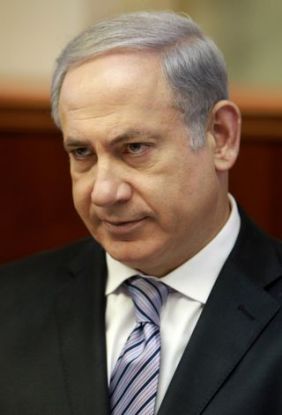
(Photo: Jim Hollander/Getty.)

Nukes, India, and Iran

Larison reacts to news that Obama endorsed India's bid to get a permanent seat on the UN Security Council:

Washington isn’t likely to abandon its fixation on Iran’s nuclear program, but it should give the administration some pause that it has just publicly endorsed permanent Security Council status for what is, in fact, one of the chief “rogue” nuclear states in the world. This is not a criticism of the administration’s engagement of India. On the contrary, the administration’s correct dealing with India stands as a rebuke to the administration’s Iran policy. Further, the favorable treatment shown to nuclear-armed India confirms that states that never join and flatly ignore the requirements of the NPT and go on to build and test nuclear weapons are not censured or isolated in the least. Instead, they are rewarded with good relations and high status. More to the point, if the administration had what it wanted and India were on the Security Council as a permanent member with veto powers, how much weaker would U.N. sanctions against Iran have had to be to satisfy India?