The Republican Wave And The War Drum-Beat Against Iran

Lynch is worried:

Dan Drezner's going to bed early tonight because he doesn't think the outcome of Congressional elections matters much for foreign policy.  … I'm gritting my teeth in anticipation of the next Congress becoming a platform for Iran war hawks, hyping the issue even further in anticipation of the 2012 elections…. look for another round of sanctions and some kind of Iranian Liberation Act on the horizon, regardless of how things are actually going for American diplomatic efforts.

Me too.

What Bombing Iran Would Actually Mean

Stratfor’s George Friedman is a realist on what it would really mean:

Destroying Iran’s nuclear capability does not involve a one-day raid, nor is Iran without the ability to retaliate. Its nuclear facilities are in a number of places and Iran has had years to harden those facilities. Destroying the facilities might take an extended air campaign and might even require the use of special operations units to verify battle damage and complete the mission. In addition, military action against Iran’s naval forces would be needed to protect the oil routes through the Persian Gulf from small boat swarms and mines, anti-ship missile launchers would have to be attacked and Iranian air force and air defenses taken out.

This would not solve the problem of the rest of Iran’s conventional forces, which would represent a threat to the region, so these forces would have to be attacked and reduced as well. An attack on Iran would not be an invasion, nor would it be a short war. Like Yugoslavia in 1999, it would be an extended air war lasting an unknown number of months.

There would be American POWs from aircraft that were shot down or suffered mechanical failure over Iranian territory.

There would be many civilian casualties, which the international media would focus on. It would not be an antiseptic campaign, but it would likely (though it is important to reiterate not certainly) destroy Iran’s nuclear capability and profoundly weaken its conventional forces. It would be a war based on American strengths in aerial warfare and technology, not on American weaknesses in counterinsurgency. It would strengthen the Iranian regime (as aerial bombing usually does) by rallying the Iranian public to its side against the aggression. If the campaign were successful, the Iranian regime would be stronger politically, at least for a while, but eviscerated militarily.

This doesn’t even account for the impact of another Western attack on a Muslim nation and what that would do for Jihadist recruitment or wider terrorism. For all the differences between Shia and Sunni, and the very complicated shadings of Islamist and Jihadist coalitions and factions, a US attack would surely serve to unite and corral the enemy at home and abroad.

Friedman posits nonetheless that a successful campaign could help Obama politically. I don’t believe the president is that cynical or that reckless. To entertain what would amount to a second term Bay of Pigs combined with a Cuban Missile Crisis is not exactly good political judgment. As in the economy, Obama may well be remembered for what he managed to prevent rather than what he accomplished. But prudent restraint and structural change are often much deeper achievements than, say, the reckless, deeply damaging agenda of the Bush-Cheney years.

It’s the difference between morally responsible statesmanship and reckless, fear-driven politicking.

Iran: Sui Generis or Soviet Republic?

Karim Sadjadpour sees an apt parallel between Soviet Russia and Iran today, drawing on George F. Kennan's 1947 essay, "The Sources of Soviet Conduct:"

[L]ike the Soviet Union, the Islamic Republic is a corrupt, inefficient, authoritarian regime whose bankrupt ideology resonates far more abroad than it does at home. Also like the men who once ruled Moscow, Iran's current leaders have a victimization complex and, as they themselves admit, derive their internal legitimacy from thumbing their noses at Uncle Sam.

And yet we fear them so.

“Armageddon” Will Happen If We Don’t Attack Iran

But no harm will come from attacking a third Muslim country in a decade. Sarah Palin really is the Christianist wing of AIPAC. But we knew that already. She is also to the right of Avigdor Lieberman when it comes to settlements on the West Bank. But we knew that already too.

Bombing Iran

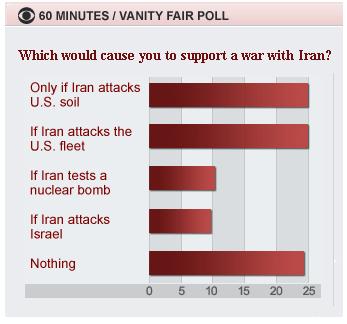
VF_Iran_poll

Most Americans are against the idea. Matt Duss draws a parallel:

As Ali Gharib astutely observed the other day, talk of “air strikes” are for Iran what “cakewalk” was for Iraq — the false idea that, through large-scale preventive military action, the U.S. can accomplish its goals with a minimum of fuss. It was a fantasy then, and it’s a fantasy now.

Greg Scoblete nods.

Iran And 2012

by Patrick Appel

I'd like to join Fallows and disassociate myself from Elliott Abrams claim that Obama may eventually bomb Iran in order to win reelection. Boiling down questions of this magnitude to crass political calculation is no way to have a debate. But since Abrams raised the point, over on the Israel-Iran debate page Karim Sadjadpour rebuts Abrams, writing that any honest analysis from the White House "would conclude that a military attack on Iran, and the myriad long-term repercussions of such an attack (which I will address later), could well sabotage Obama's chance at re-election." Greg Scoblete finds another weak link in Abrams's argument

Wars have frequently been waged for balance-of-power concerns, but in this case [if Iran acquired a nuclear bomb], how significant would the balance of power shift out of America's favor? Pakistan has nuclear weapons and is not the top country on the subcontinent – it can barely curtail its own home grown insurgency and it was threatened/cajoled by the U.S. to allow us to bomb portions of the country almost at will. North Korea has nuclear weapons and you'd be laughed out of a room if you suggested they had anything resembling "hegemony" in Asia.

Iran with a crude nuclear weapon would still be poor, weak and surrounded by unfriendly states.

Iran, Nuclear Ambitions, and Uncertainty

by Conor Friedersdorf

I'm looking forward to reading Jeffrey Goldberg's piece elsewhere at The Atlantic on Iran, its pursuit of nuclear technology, Israel's likely response, and America's options. In general I find his long form reportage an invaluable source of information and analysis, and I very much dissent from the uncharitable assessments of his past work offered by some of his critics. Indeed I am confident that if they read more of his work they'd change their assessment.

I do think it's fair to say that in important respects the Iraq War turned out differently than Mr. Goldberg anticipated. In this he is hardly alone. And although this point occurred to me in his defense, I think it's also an insight that should inform the current debate about Iran: there is always a substantial disconnect between what even our most informed analysts think is going to happen in a geopolitical conflict, and what actually happens if that very conflict actually occurs.

What I'd like to inject into the national debate is a reminder of how imperfect our knowledge can be. I wonder if Daily Dish readers can help. I'm hoping to gather a bunch of examples of analysis made prior to the Iraq War that proved incorrect in hindsight. Unlike most efforts of this kind, I'm not looking for gotcha moments with which to taunt other writers, especially since often as not I was every bit as wrong as they were (and lucky enough to have been covering other subjects). My purpose is to highlight passages that underscore how vast a gulf can separate what even informed observers think is going to happen, and the unexpected, unintended consequences of military action. Examples can be sent to conor.friedersdorf@gmail.com with the word "Iraq" in the subject line. The more diverse sources, the better.

On That Iran Policy Briefing

Joe Klein got the same memo days ago:

The powerful bazaari community has been shocked not just by the universal support for the sanctions, but also by their comprehensive nature. Iranian ships are sitting at their docks because they international community is refusing to insure them. Banks that have done business with Iran in the past are refusing to do so now because the UN sanctions–that's right, those "weak" UN sanctions–target them as well. The Iranian economy, a stagflation fiasco before the sanctions, is cracking.

As a result, the Administration has been receiving all sorts of feelers–public and, for the first time, private–from the Iranians about resuming the negotiations on the nuclear program.

Iran: Are Sanctions Working?

The president thinks so:

The sanctions were designed to exploit Iran's over-reliance on its paramilitary force, the IRGC, for ways to evade the sanctions, and to prevent its oil industry from obtaining the foreign investment necessary for development. A U.S. official said that Iran was recently forced to abandon an effort to develop an oil field because the IRGC didn't have the expertise and the country could find no subcontractors who were willing to risk the penalties imposed by the sanctions.

"By continuing to expose their evasions and deceptions, we create the dynamic of a private sector reticence to do business with them," another official said, as well as disquiet within Iran's business community and its middle class. 

The fact that Russia and China are on board and the Europeans have beefed up their sanctions must also weigh on the coup government's calculus. And there are signs of small progress in Iran. Ignatius notes:

Officials said these signs include the strike last month by Tehran bazaar merchants who are unhappy about the battered economy, as well as recent signals through various channels that the Iranians want to come back to negotiations… What came through in Obama's upbeat presentation was the administration's view that for all Tehran's bombast, the United States and its allies have the upper hand.

One reason for this confidence is that Iran appears to be having serious technical problems with its enrichment process — due to bad design, bad luck or deliberate sabotage. A senior official said that only 3,800 centrifuges were now operating at Natanz, at only about 60 percent of their design capacity, with another 4,000 in reserve to cope with breakdowns.

And so Obama, again, is offering an open hand to the coup regime to open its nuclear sites for effective and genuine international inspection, and to move toward shared anti-Taliban goals in Afghanistan. This may come to naught, but it turns the tables on Ahmadi on the international stage. And in the end, this matters. By tightening sanctions while keeping an open hand, Obama avoids the appearance of America being the bully, and prevents cooptation of national pride by the regime. The alternative – a military strike by Israel or the US – would unite Iran's opposition and regime, unleash a global religious war, intensify Shiite-Sunni polarization, kill countless civilians in the West, put US troops in an untenable position in Iraq and Afghanistan, and add turbo-charged gasoline to the Islamist brush-fire. 

None of the current policy is emotionally satisfying or risk-free. But the real alternative is so much worse we should hang in, and hope. That's called pragmatic, realist government. And it's a relief to see it at work again in America's corridors of power.