Iran – A Year Later

Weepiran

One way to see if an argument is worth its muster is to ask whether it addresses the core points of the best rebuttal. Reuel Marc Gerecht's op-ed completely fails this test today. The obvious reason that president Obama decided to keep his support for the Green Movement in Iran muted was … to help the Green Movement in Iran. His view – shared in large part by Mousavi and Karroubi – was that too strong a US public stand would backfire. It would allow the mullahs to play the Great Satan card more effectively, and marginalize the message of the Greens. Now, it's possible to disagree with that and see Iran as more like the old Soviet Union than a Muslim society with deep – and thoroughly understandable – suspicions about US meddling. But if so, you should make that case. Frankly, I remain unpersuaded that we should treat Iran like Czechoslovakia. I have learned something from this past decade which is that history and culture matter, that rhetorical grandstanding is no substitute for diplomacy and strategy, and that neoconservative projections about the Middle East have been proven spectacularly misguided, ill-informed and counter-productive.

Let's put it this way: Gerecht's op-ed this morning does nothing to change my mind.
Iran, A Year Later, Ctd

Juan Cole believes that the Green Movement still has life left in it. Karim Sadjadpour does a Q & A:

Two things happened after the elections that impacted Tehran’s foreign policy. First, any lingering moderates or pragmatists were essentially purged from the decision-making structure, leaving Ayatollah Khamenei surrounded by a group of likeminded hardliners with two overarching political instincts: mistrust and defiance. Second, the ongoing internal power struggles made it even more difficult than usual for the regime to make decisions. 

If We Bomb Iran

Bill Kristol and Jamie Fly

If the Iranian regime is so concerned about their survival that they won't hit the U.S. after a military strike against their country, than they obviously aren't going to be using their nuclear weapons against anyone lest they invite a far more devastating attack. The same argument, in other words, that leads Kristol and Fly to conclude we can safely attack Iran can be flipped around to conclude that we can live with and contain a nuclear-armed Iran.

Iran, A Year Later

Joe Klein checks in on the country and our policy towards it:

Iran is more like a baby Soviet Union. A regional power, with ties  to a dangerous terrorist network–Hizballah–but one that will respond to international diplomatic pressure. It is also a real country, with real assets, and unlikely to take actions that will result in a devastating attack by the U.S. or Israel. It is not Al Qaeda. If it continues to be recalcitrant–and there is no reason to believe it won't–the strategic answer is containment, just as we contained the Russians. This would involve a regional defensive alliance against Iran–an informal one, perhaps–involving Iraq, the Gulf States and the Sunni powers (plus Israel), a project that David Petraeus has been quietly pursuing as head of Centcom.

It would include the provision of anti-missile capabilities and the guarantee of American support if Iran moves on any of these nations. It also assumes that Iran will develop a nuclear weapon, which–as things stand–seems a probability. Most experts believe that Iran's aims here are defensive, as Hashemi Rafsanjani–the only Iranian leader ever to publicly mention the possibility of  a bomb–said in 2001: as a deterrent to Israel's nuclear arsenal. Any nuclear proliferation is potentially destabilizing–although it is also potentially stabilizing, preventing adversaries from going to total war, as war the case in the Cold War and now seems to be holding firm (in a nervous-making way) between India and Pakistan.

Watching America From Iran

Greg observes:

If I were an Iranian protester observing American political discourse since the Green movement began, what would I notice? During the last 12 months, the voices who claimed they want to see democracy take root in Iran were vastly more concerned with the foreign policy of a free Turkey than an unfree Saudi Arabia. I would notice that the voluminous output of anti-Semitism in Saudi Arabia was ignored, while the demagoguery of Turkey's leaders was treated as evidence of a nascent Islamist rogue state and regional competitor.

I would conclude that the same voices professing solidarity with my cause are less concerned with political freedom than with geopolitical orientation.

New Videos Surface From Iran

Accessnow.org has obtained a trove of exclusive footage of last year's post-election violence. Co-founder Brett Solomon emails:

These rarely seen videos are part of a collection of 6000 videos that were taken out of Iran on a hard drive, that are now added to 8000 videos that we securely store in our citizen media database, and are being released to commemorate the one year anniversary of the Iranian election. They witness the brutality of the regime and the bravery of the Green movement and serve as a warning signal for what must not be repeated in 2010.

Newsweek has a gallery of selected clips. A particularly gruesome one after the jump:

Meanwhile, Iranians are still shouting from the rooftops at night.

The Internet And Politics In America And Iran

Irantwitter

Dish eminence jeune Patrick Appel points out that internet users skew white, rich, educated, and young. Age is the greatest divide:

The young are more libertarian, pro-marijuana, and less religious than the American population generally. Millennials (pdf) are gay-friendly, racially tolerant, technologically savvy, welcoming of immigrants, open to government intervention, less hawkish, more accepting of non-traditional families, less inclined to marry early, and more optimistic about the state of the state of the nation. Thus, the consensus view among American Internet users may differ substantially from the result at the ballot box. This incongruity is amplified because senior citizens, the demographic least likely to have a robust online presence, has an outsized electoral footprint. 72 percent of American 65-to-74-year-olds voted in the 2008 election while only 48.5 percent of 18-to-24-year-olds exercised that right. We are in an era when the young have the most control over the dominant cultural medium while the old have the greatest say politically.

He also looks at the Iranian digital divide:

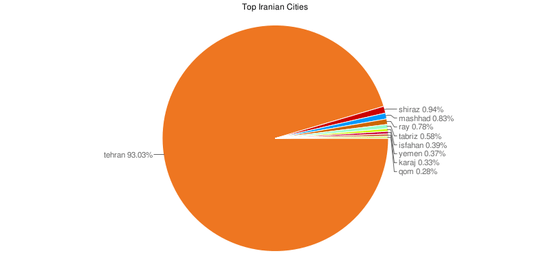
During last year's protests in Iran, Twitter was a primary means of receiving news from inside Iran. But how representative of the Iranian population were those tweeters? A few weeks after the protests broke out Sysomos found that 93 percent of Twitter users were located in Tehran, the center of the protests and one of Iranian opposition leader Mir-Hossein Mousavi's strongest bases of support.

The Executions In Iran, Ctd

The Leveretts go after Nazila Fathi, for her NYT article on five recent executions in Iran. From their follow up:

[O]ne of our criticisms is that Ms. Fathi did not inform her readers that the organization to which three or four of the executed prisoners (depending on which Western media reports one reads) are alleged to have belonged, PJAK, was designated as a terrorist organization not only by the Islamic Republic but even by the Obama Administration.  On this issue, Mr. Lucas now writes, “Point taken…yes, Fathi could have mentioned that PJAK is proscribed as “terrorist” by the US Government.”

…In the end, we do not know whether the five executed prisoners were wrongfully convicted—and, as we noted in our initial critique of Ms. Fathi’s article, we are personally opposed to the death penalty.  But we do know that Ms. Fathi’s reporting on this case was professionally irresponsible.  It is Ms. Fathi’s prerogative to report on human rights cases in Iran.  But when she, or any other journalist, does so in a professionally irresponsible way in order to advance a particular political agenda, we will call them on it.

Lucas's rebuttal:

The authors of Race for Iran have posted an attempted rebuttal of this column. As it is largely a misrepresentation of my analysis and a continuing assault on Nazila Fathi, I will not post a detailed response. There is no value in continued conversation with or even recognition of those who are void of information and deaf on ethics and morality.

I will note, however, how the authors met this challenge that I set on Wednesday: “1. Make their own critique of the material surrounding this case of the 5 executed Iranians and present that critique; 2. Alternatively, acknowledge that they have no concern with human rights, justice, and fairness within the Iranian system; 3. If they do so, disclaim any ability to assess the legitimacy of the Iranian Government since they are not concerned with issues — human rights, justice, fairness — which may affect the legitimacy of that Government in the eyes of the Iranian people.”

The authors make no attempt to meet the first test, but they do tacitly accwept the second and third challenges: “[Race for Iran] is not focused on human rights; it is focused on Iran and its geopolitics.”

The Executions In Iran

Tom Ricks:

Roxana Saberi, the journalist jailed for 100 days last year by the government of Iran, calls on people to continue to pay attention to people executed by Iran for political activities: "If the international community fails to condemn such atrocities, Iran's regime will continue to trample on the basic rights of individuals, many of whom have been detained simply for peacefully standing up for universal human rights."

Getting Tense In Iran

Yesterday, in response to the execution of five political prisoners over the weekend, protests broke out at Shahid Beheshti University against an appearance by Ahmadi:

[T]he Iranian government executed five Kurdish Iranians timed to intimidate and frighten people away from anticipated anti-government rallies on the anniversary of the disputed June 12, 2009 presidential election that gave Mahmoud Ahmadinejad another term in office. The political situation in Iran–while on the surface appearing to be relatively stable after a year of instability, political intrigue, anti-government protests, and brutal crackdowns–is building tension.

Mousavi condemned the executions. Meanwhile the Leveretts continue to throw cold water on the Green Movement.