A Deal With Iran: Tweet Reax

Obama’s Iran-Contra Moment

Listening closely to the president’s noontime presser, I couldn’t help but be reminded of Ronald Reagan’s famous address to the nation in March 1987. Reagan had been caught in a lie – his declaration that he had never traded arms for hostages in his attempt to reach out to Iran (yes, neocons – he was trying to reach out to Iran!). For months, he languished as investigations revealed that he had indeed done such a thing, and his credibility – long his strong point – was at stake. Here’s the address:

The most famous line – addressing his clear statement to the American people that he “did not trade arms for hostages” – was the following:

My heart and my best intentions still tell me that’s true. But the facts and the evidence tell me it is not.

Today, Obama said something very similar about his statement that “if you like your plan, you can keep it, period.” I love the guy, as I loved Reagan, even though I have not exactly held back when I thought he was screwing things up. And the yawning discrepancy between that unequivocal statement and the “facts and the evidence” of the cancellation of individual market insurance policies these past few weeks was startling, to say the least. Had I misjudged the man? Had he unequivocally peddled a focus-group line that he perfectly well knew was untrue, in order to overcome resistance to healthcare reform? Was he a bullshitter – or something worse, a liar?

As I heard him today, he explained it this way. He says he was focused on the large majority of Americans who get their insurance policies through their employer. And for them, the statement is true, even though, of course, insurance policies are fluid and subject to change. What he ignored was the 5 percent of people in the individual market, whose plans did not meet the standards of the ACA. He said he believed that the grandfather clause would help the majority of those people and that those whose policies could be canceled would see, once the website was up and running, that they now had access to better plans at a similar cost. He also says he believed that the constant churn in the individual market – which cancels or changes policies dramatically and unpredictably all the time – would make cancellations due to the ACA seem like business as usual. He now says he realizes his statement was wrong and irresponsible but that he didn’t fully grasp that at the time, as focused as he was on the 95 percent, and as he believed the grandfather clause would help the rest.

So the key question remains: Is this plausible?

I can’t answer that for you. But it was to me, just as it was plausible to me that Reagan basically did not absorb the full consequences of what he was doing in the Iran-Contra affair, and so lied without really meaning to lie. I think that’s what Obama is trying to say as well: he lied without really meaning to lie. In both cases, the two presidents had to come clean at some point in a very messy situation. Many dismissed the Reagan line as hooey, and a further deception. I didn’t and still don’t. But the important fact is that both Reagan and Obama took ultimate responsibility for the de facto deception. “It’s on me,” the president said today. Reagan, of course, couldn’t do much to redress it, except cooperate in investigations. Obama has offered a temporary administrative fix for a year to retroactively make his promise valid, while retaining the core of the ACA.

The other difference? Reagan had a better grasp of theater. His speech was intimate, direct, and his confession not mediated by a journalist or a press conference. Obama – under acute pressure from the Congress – had to act quickly. But in my view, his mea culpa would have been better served by exactly the kind of personal televised address that Reagan made. Americans are ready to forgive presidents who cop to their mistakes. To break through the chatter, Obama should, in my view, have used the Reagan approach – and still can, of course.

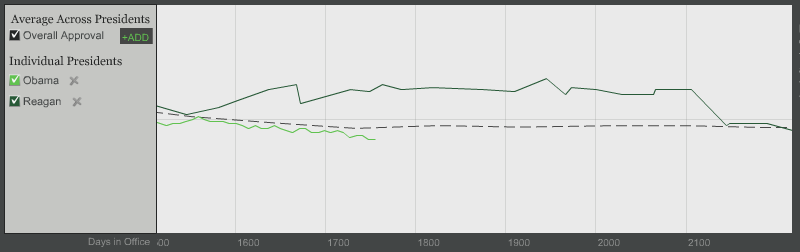
But some other context. Obama’s approval ratings have tumbled because of this credibility gap. They have declined, in Gallup’s measurement, from 45 percent approval to 41 percent in a few weeks. What people forget is that Reagan’s slide was much more dramatic. His approval rating collapsed from 63 percent to 47 percent in one month. That’s the biggest collapse in approval for any president since Gallup began polling. And after that, Reagan came back to the historical average approval rating for all presidents, which is where Obama now is as well. That dotted line is the average for all presidents:

Screen Shot 2013-11-14 at 1.28.13 PM

Obama now is where Reagan was – but sooner in his second term. But Obama, unlike Reagan, can still do something tangible to improve his position: he can make the ACA work and he should soon begin to make a much more aggressive, positive case for the reform. He has an administrative task right now. But he must soon also engage in a critical political task: to get off the defensive and onto the offensive; to make the case for the good things the ACA can do, and is doing; to remind people of the radical uncertainty of the past, and to demand that the Republicans offer more than just cynical, partisan spitballs to address the unfair, unjust and grotesquely inefficient mess that the ACA was designed to reform. That was the gist of his presser today. It needs to become a stump-speech. He needs to get out of his White House administrative mode as soon as he gets a grip on the reform, and launch a campaign mode against a return to the wild west of the past in healthcare and to expose the Republicans as cynical, opportunist critics who refuse to offer any alternative and any constructive reform.

But soon he needs to channel the core argument of this presser into a face-to-face talk with Americans. He needs to be as crisp and candid as Reagan was:

“I screwed up. I’m sorry. I didn’t think it was a lie, but it was. And I’ve changed the law to address the false promise. Now let’s make this reform work.”

Yes, he can.

A Word On Israel And Iran

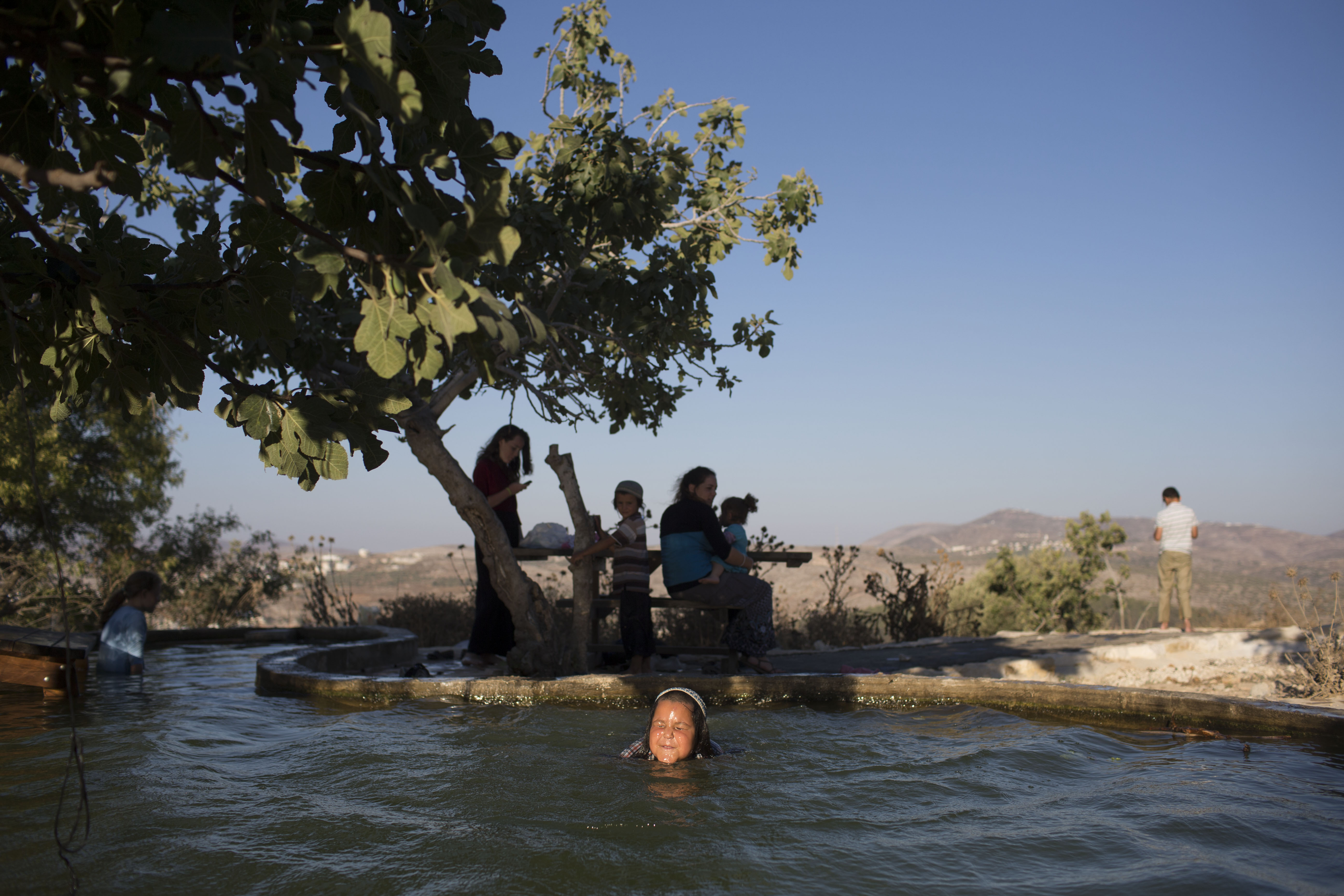
Life Continues In The Havat Gilad, West Bank Outpost

On the very sensitive issue of Israel, there is often little middle ground that isn’t swamped by angry rhetoric on either side of the debate. So, as the critical talks with Iran proceed, I want to clarify a couple of things.

My dismay at Israel’s rightward lurch, its refusal to freeze settlement construction on the West Bank and East Jerusalem, and its apocalyptic fear-mongering about Iran does not and should not mean that I couldn’t care less about the Jewish state. I can understand how, in the rough and tumble of daily blogging, many reflexive – and some thoughtful – supporters of Israel might infer that I harbor some disdain for the Zionist project, or indifference to the dangers Israel confronts on a daily basis. I don’t. For an Irish-Catholic Englishman, I have long been passionate about Israel’s security and success. It was one of the first foreign countries I ever visited, and for many years (shaped, of course, by my time at The New Republic), I completely sympathized with successive Israeli governments’ frustration at the lack of a decent negotiating partner and the continued, foul incitement to anti-Semitism of much of Palestinian culture.

Things changed for me during my unsentimental education about the world-as-it-is during the Iraq War catastrophe. That war was the defining event for me and my own political understanding of the 21st Century world. For others, it was an error or a failing, but their broader worldview remained intact. Mine didn’t. It didn’t make me an isolationist, but it sure radically tempered my belief in the ability of American power to remake the world in our own image – however well-meant that remaking may have been. It became clear to me that a global conflict between fundamentalist Islam and fundamentalist Judaism and fundamentalist Christianity could become apocalyptic, especially in the Middle East. What was urgently required was a move to pragmatism, toward defusing the most polarizing rhetoric, toward healing the wounds of Iraq, and a calmer, if clear-eyed, engagement with Muslim humankind.

I noticed during this period that, post-Arafat, the Palestinians were no longer an unreliable partner in negotiations. Abbas and Fayyad were ahmadinejadbehrouzmehriafpgetty.jpgabout as good as we were ever going to get, and the Obama presidency was the perfect reagent for a compromise that would defuse some of fundamentalism’s power and return us to the art of the possible. The way in which Israel’s leadership responded – contemptuously – signaled that we were dealing within a very different Israeli government than, say, Rabin’s. Their Gaza war, their hyperbolic rhetoric on Iran, their continued settlement of the West Bank, their constant apartment-grabs in East Jerusalem, and the increasingly extremist tone of Israeli political culture: all this made me see them as the current arrogant problem, and not the Palestinians. The way Netanyahu intervened in American domestic politics to undermine the president also appalled me.

Obviously I am not alone. Someone far more knowledgeable about the country whose views I had long shared – Peter Beinart – also shifted. Many others have among American Jews of the younger generations. And the motive for the shift is not to demonize Israel, but to assert America’s national interest first and foremost, and secondly to save Israel from becoming a pariah state that was hellbent on becoming a permanent occupying power, with all the moral corrosion that occupation implies. It is tempting to say that the moment for a two-state solution is past. But I want to resist that temptation – because without a two-state solution, Greater Israel is not a country the West can support with such largesse indefinitely. And I want to support an Israel that lives up to the best aspirations of its founders.

My support for an agreement with Iran that grants it the right to enrich uranium at low levels and subject to routine, tough inspection regimens is also a function of dealing with the world as-it-is and not as I would like it to be.

The fact is that Iran is a great country with deserved pride, but it’s been run into the ground by fundamentalist fanatics, fascistic in their extreme factions, who spout foul rhetoric and conduct themselves in ways that warrant profound suspicion. The crippling sanctions regime was a proper response to that. But when the Iranian response to years of sanctions is the emergence of a pragmatic faction given legitimacy by support in Iran’s highly constrained elections, and when that faction sends signals it is desperate to end sanctions and eager to rejoin the international community, we have an opportunity, as with Abbas and Fayyad, to defuse the tension.

For me, the emotions of June 2009 affect this too. The Green movement proved that Iran’s younger generation is on the side of freedom, not theocracy. And yet that movement, like the regime, also insists that the country has a right to enrich uranium. On this, all of Iran is united. It is not just foolish but impossible to somehow end that fact by making the end of uranium enrichment our non-negotiable stance. It guarantees failure.

Nor can we erase the fact that Iran has developed the capacity to enrich uranium, even under the most brutal of sanctions, and it is seen as a matter of national pride to retain that capacity. As Roger Cohen notes:

Although Western intelligence agencies believe the Islamic Republic has not taken the decision to make a bomb, Iran’s nuclear program has advanced far enough for the country to have the relevant knowledge. Destroying this know-how is near impossible. Iran knows how to produce weapons-grade fissile material; it may not yet be able to make a deliverable weapon. So, as Stephen Heintz, the president of the Rockefeller Brothers Fund, put it to me, “The key for the international community is to put all that capability in a box where it is verifiable, contained and controlled. That is what the deal is about.”

Indeed it is. Given its past behavior, the regime has to meet more exacting standards for a deal than might otherwise be the case. But without a deal, Iran will increase its nuclear activity, Israel will be tempted to pre-empt it, an arms race with the Saudis might follow, and the cycle of green-peacefundamentalist violence would be ratcheted up a notch. It’s the kind of cycle that can lead to catastrophe. Avoiding this – creating a space for hardheaded relations with Iran and a deep commitment to Israel’s security – seems to me easily the most practical move in the global war on fundamentalist terror by defusing it with pragmatism. Winning that war will make Israel more secure, enhance American policy options in the Middle East, bring down the price of oil, and give Iran’s silent pro-Western majority an opportunity to change the country from within.

That’s what I want to see. I know it’s tough, given the history of the Tehran regime. I know that hope is no longer as powerful an emotion as it was five years ago. But I see this moment of opportunity as similar to the one we faced in the late 1980s with the emergence of glasnost and perestroika in the Soviet Union, and for the same reasons of economic desperation, and pent-up popular frustration. Russia too is a great nation whose fundamentalist atheists had also driven into the ground. We found a way to rescue the country from its regime, by engagement after a ramping up of opposition. I hope Obama and Rouhani can become the Reagan and Gorbachev of this moment. Because the alternative is war at some point – sooner or later – and a tragedy for the Iranian people and for Israel’s core security.

Who really wants that? I mean: really? And what other options do we actually have, apart from the last resort of war – which the American people would not, in my view, support? We are in about the sweetest spot history will hand to us. If we squander this opportunity, the world will darken measurably.

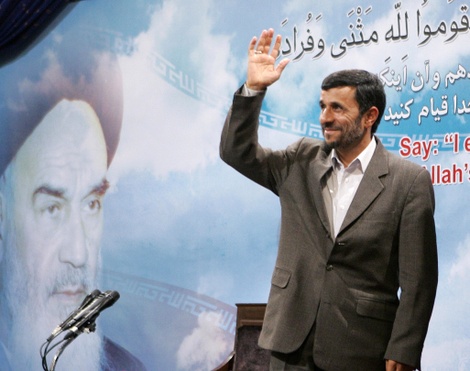
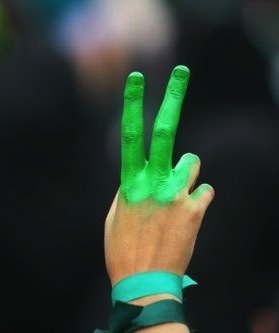
(Photos: A Jewish settler boy swims in a pool near the Jewish outpost Settlement of Har Bracha, West Bank on July 22, 2013. By Uriel Sinai/Getty Images. Mahmoud Ahmadinejad and the Green victory sign by Getty Images.)

The Iranian Rubik’s Cube, Ctd

Hooman Majd made important points about the US-Iranian negotiations while they were still ongoing:

Iran and the United States hadn’t talked for five hours in the past thirty-four years. We’ll have to wait to find out whether this is a historic moment, or merely another lost opportunity. But it seems improbable that the Americans and Iranians would make such a production of these talks without some real confidence that signing on the dotted line is within reach. Iran’s Supreme Leader, Ali Khamenei, took to Twitter to emphasize his support for the negotiations and his negotiators, whom he called “children of the #Revolution”—suggesting that hardliners in Tehran would have a difficult time sabotaging an agreement. …

As of Saturday night, it looked like it would take at least one more round of talks to reach a breakthrough. Members of the Iranian delegation indicated that the objections to signing a draft agreement came from the other side, but suggested that the remaining gaps looked too great to overcome in the few hours remaining. Zarif repeated what he had said before these discussions began—that it “wouldn’t be a disaster” if a deal was not signed this weekend.

Reza Marashi makes similar arguments:

One did not have to be in Geneva to see the obvious: more progress was made over the past three days than in the past three decades combined.

The importance of this breakthrough must be contextualized: Compare negotiations under Iran’s former chief nuclear negotiation Saeed Jalili to Foreign Minister Zarif’s current stewardship. It’s night and day, and the metric of success is now clear. The bedrock of these negotiations rests upon a simple but vital premise: It is in the interest of both sides to develop a peaceful solution to the U.S.-Iran conflict, and diplomacy is the only viable pathway that bridges status-quo mistrust to future cooperation.

To that end, both sides acknowledge — and are working to contain — the very real presence of spoilers who seek to maintain or exacerbate a negative trajectory in relations. “We’re not in the business of doing favors,” a Western diplomat told me, smiling. “We’re in the business of pursuing our interests.”However, no less important have been the forces for moderation that do not believe Washington and Tehran need one another as an enemy. As talks concluded, Foreign Minister Zarif and Secretary both emphasized their belief that progress was made and a deal can be reached.

Patrick Brennan’s assessment is much more pessimistic:

Kerry claims he was proud of the work that negotiators accomplished in Geneva this week, but it looks like the parties came to the table remarkably far apart, without any realistic framework for a deal. But the Security Council has passed multiple resolutions demanding that Iran halt its enrichment activities, while Iran’s players seem united in demanding that the deal include a provision explicitly recognizing the country’s right to do so. The International Atomic Energy Agency says there is now a “framework” for a deal with Iran that negotiators will try to iron out over the next three months, but this isn’t what the Obama administration was hoping for — they wanted an agreement on a six-month freeze in enrichment activities, which would then provide time to agree on a broader deal. Now, instead, Iran’s activities will continue unmolested, even if the IAEA’s framework proves useful over the coming months.

Kenneth Pollack notes that any deal will require sidelining Iran’s hard-liners:

We’ve never seen Khamenei actually overrule the hard-liners on an issue of this kind of importance. We’ve seen [previous supreme leader Ruhollah] Khomeini do it, famously, at the end of the Iran-Iraq War. The hard-liners wanted to keep fighting, and [later-president Hashemi] Rafsanjani and the pragmatists wanted to end it. In the end, although he said it was more bitter to him than “drinking poison,” Khomeini agreed to overrule the hard-liners. We haven’t seen that with Khamenei.

Larison argues that France, which derailed the negotiations according to some reports, has made a major mistake:

Iran hawks in the U.S. are predictably pleased with French interference, but no one else should be fooled into thinking that France has done itself or other Western countries any favors. It can’t be emphasized enough that Western actions that block an agreement with Iran on the nuclear issue benefits no one except Iran hawks and Iranian hard-liners, since it makes it more difficult to resolve the issue through diplomacy, and that in turn makes both armed conflict and a nuclear-armed Iran more likely. Perversely, France has given Iran an opening to agree to fewer concessions than it otherwise would have, and by demanding so much in the first stage France has made it less likely that Iran will agree to anything.

Juan Cole echoes:

France can’t possibly want no agreement (unlike Israel), and presumably there must be a way to satisfy Hollande in a confidence-building initial proposal. It may also be that Paris will feel so much heat from everyone else in Europe that they will moderate their hard line.

One thing France must keep in mind is that hawks in Washington actively want a war with Iran, and that if there is no agreement now, that war will be on the front burner if a Republican comes to power in 2017. Since the French opposed the Iraq War and have been traumatized by their participation in Afghanistan, presumably they don’t want to give the American Right such a luscious opportunity, which won’t in the end benefit French interests in the Middle East.

And Scott McConnell leafs through the history books:

France’s relations with Israel have been at least slightly chilly since de Gaulle denounced what he (correctly) perceived as Israel’s desire to hold onto the territory it captured in the 1967 war.  Before that, however, France was Israel’s largest arms supplier and helped get Israel’s clandestine nuclear weapons program off the ground in the 1950s. With Israel and Great Britain, France invaded Egypt in the 1956 Suez Canal crisis, hoping to topple Nasser and cut off aid to the Algerian rebels. The Clash of Civilizations—the fear-inspiring “Islamofascism” narrative—did not originate with Sam Huntington, or American or Israeli neoconservatives, but with French intellectuals trying to bolster international support for their colonial war in Algeria. So it would not surprise me if French strategists imagined a kind of Paris-Tel Aviv-Riyadh triple alliance, unlikely as it sounds, but not much more unlikely than the alliance of Republican France and Tsarist Russia which set the table for World War I.

My thoughts on the Geneva fallout here.

The Iranian Rubik’s Cube

Nuclear Talks in Geneva

So we have two somewhat conflicting narratives coming out of Geneva. The first we aired last night, via Laura Rozen and Marcy Wheeler. There was a general consensus that the French were the ones who derailed the imminent short-term agreement. Their motives? Cozying up to the pissed-off Saudis and also the usual Gaullist need to throw around what’s left of France’s weight. Hollande is set to visit Israel next month as well, inserting France into the occasional glimpses of daylight between the American and Israeli positions on Iran. Christopher Dickey has a must-read on the hardline faction still ensconced in the Quai D’Orsey. Money quote:

Under Sarkozy and his longtime Foreign Minister Bernard Kouchner, the Quai’s policies came to be increasingly dominated by the French version of American neo-cons, many of them former leftists who preached the spread of democracy and dreamed of remaking the Middle East, if necessary, through war.

Sarkozy liked to say if he’d been president in 2003 he’d have backed the American-led invasion of Iraq; Kouchner let it be known he thought an armed confrontation with Iran was more or less inevitable. The key player at the Quai is Jacques Audibert, the director general of political and security affairs, who has pushed a very hard line, insisting that the ideal goal of sanctions and the pressure on Tehran must be the de facto elimination of its nuclear program.

The other must-read is another masterful column from Roger Cohen. On France, he has a more nuanced take:

Its position reflects strong views on nonproliferation, its defense agreement with the United Arab Emirates, and a mistrust of the Islamic Republic that runs deep. There are good reasons for this mistrust. Laurent Fabius, now the foreign minister, was prime minister in the mid-1980s during a wave of Paris bombings that were linked to pro-Palestinian groups but are also believed by French authorities to have had Iranian backing in several instances. Fabius is not about to forget this or cut Rouhani any slack. This is not a bad thing. A deal has to be watertight in blocking Iran’s path to nuclear weapons while acknowledging its right to nuclear energy.

Yesterday, Kerry insisted that the failure of the short-term deal was not a function of French intransigence but of the Iranians being unable to sign off on some of the demands of the P5+1 group, without more consultation at home. In fact, most of the reports coming out today reflect that new consensus. The FT’s take is here. Money quote from Fabius:

“We [France] are not closed . . . we want a deal for regional and international security … France is neither isolated nor a country that follows the herd. It is independent and works for peace.”

Dickey notes:

France insisted that operations of a nuclear reactor at Arak—which is not online yet—be halted, and that current stockpiles of enriched uranium be reduced.These were the sorts of measures that the other negotiators expected to ensue at future stages of the normalization process. The urgent need right now is to stop the enrichment program that exists — freeze it and inspect it — since if it continues Iran soon will be only months, if not weeks, from procuring sufficient material for a bomb. As a result of the French posturing, that enrichment probably will continue, at least for the moment.

So it may be a subtle difference between the ambition of the temporary freeze and the ambition of the later, bigger negotiation. That can still be worked out, it seems to me, because it’s a small nuance. It’s also why this stalling tactic is arguably unlikely to end the process. Because, far from arresting Iran’s nuclear development for six months, it allows it to continue (which no one in the West wants). But you can see how the P5+1 regarded their own unity as more important than an immediate deal and sent the French-fortified proposal to be taken back to Khamenei. The French can say they tried to stop it, and yet not stop it, bolstering their alliance with the Saudis and Israelis while allowing the process to move forward. Win-win. So this became a slightly more aggressive stance designed to test Tehran and vent some of the nervousness about any deal. It could be, in other words, just a bump in the road – and perhaps a somewhat contrived one.

But I should add a caveat here. The crux of these negotiations is unknowable to those outside them. That’s how diplomacy works. We will find out the full story some day, and until then, these parsings of events and statements on an hourly basis need to be seen as entirely provisional.  But as a case study in Great Power diplomacy, it’s crack for poli sci graduates like yours truly.

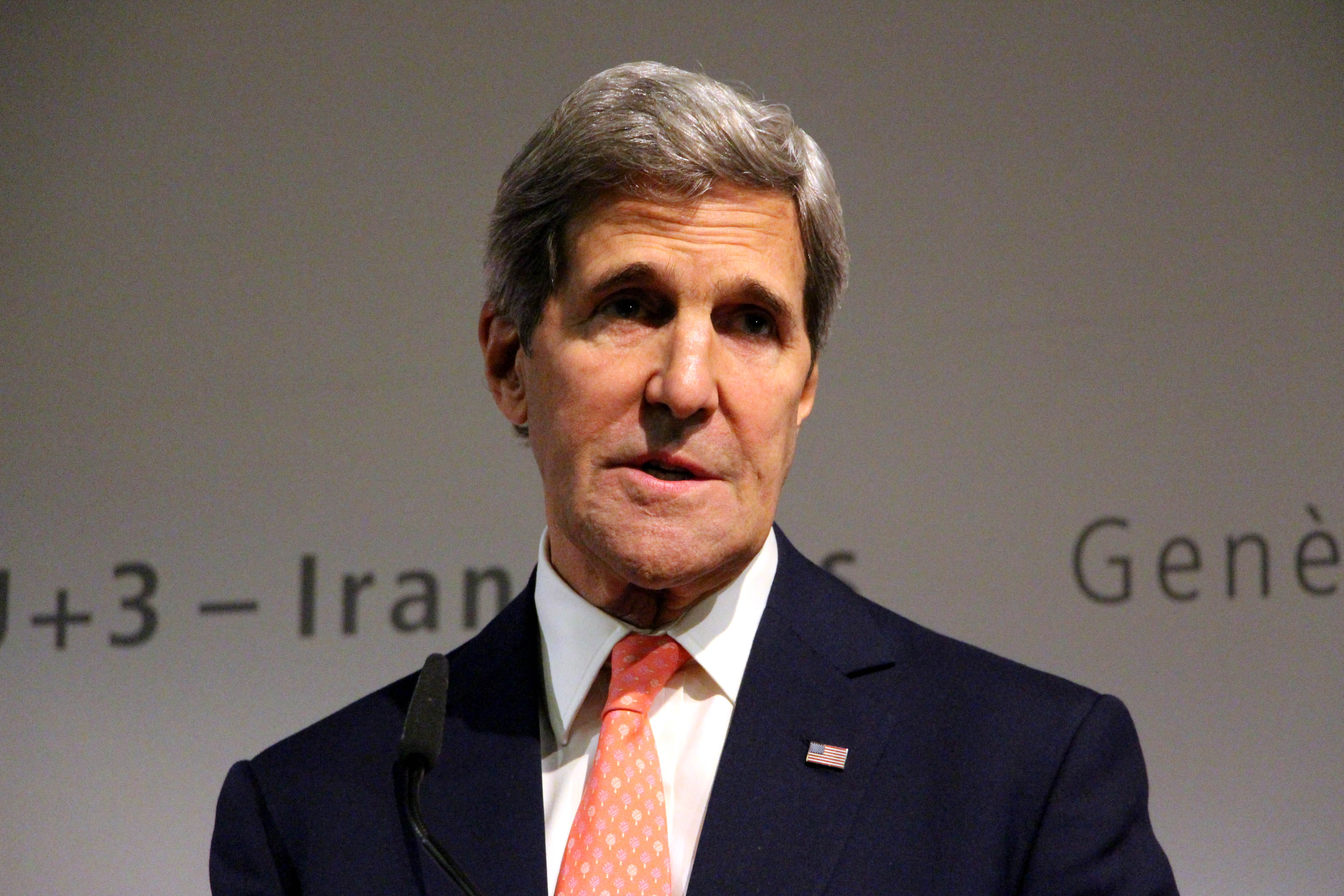
(Photo: US Secretary of State John Kerry speaks at a press conference after the third day of closed-door nuclear talks at the International Conference Center in Geneva (CICG) on November 10, 2013 in Geneva, Switzerland. By Murat Unlu/Anadolu Agency/Getty Images.)

What Happened In The Iran Talks?

We’ll be deciphering this in greater detail tomorrow, but the invaluable Laura Rozen’s account is well worth a read. All was going well, it seems, until the French made a sudden turn:

“In fact, the French are the big upset in the way of an agreement,” the senior diplomat said, on condition his name or nationality not be named. He said there is a joint P5+1 draft text of a framework agreement the parties have been working on. Good progress was being made, including in the five hour trilateral meeting between Kerry, Zarif and Ashton Friday. But the French say it is not our text, the diplomat said, a point which Fabius himself subsequently confirmed.

What was the objection?

France’s concerns were reported to center on wanting Iran to halt work on the Arak heavy water facility during the negotiations, as well as on Iran’s stockpile of 20% uranium. Another P5+1 diplomat told Al-Monitor Saturday that no one is telling the diplomats here what is going on, describing the situation as ‘outrageous.’

That’s a strong word, even though the public face is one of continued negotiations. No one said this would be easy. But few foresaw that the division would not be between the P5 and Iran but between the P5 and France. Marcy Wheeler thinks she may have the reason for the French volte-face:

Several weeks after this WSJ article describing a staged Bandar bin Sultan tantrum about US actions, it was revealed the “Western diplomat” involved was a representative of France:

“Diplomats here said Prince Bandar, who is leading the kingdom’s efforts to fund, train and arm rebels fighting Syrian President Bashar al-Assad, invited a Western diplomat to the Saudi Red Sea city of Jeddah over the weekend to voice Riyadh’s frustration with the Obama administration and its regional policies, including the decision not to bomb Syria in response to its alleged use of chemical weapons in August … Disappointed, the Saudis told the U.S. that they were open to alternatives to their long-standing defense partnership, emphasizing that they would look for good weapons at good prices, whatever the source, the official said.

Ah, yes, an arms deal for the French from the Saudis. That would explain a lot. So in the new Great Power game in the Middle East, Saudi Arabia and Israel are aligning with France. This could be a bump in the road or an attempt to derail the detente entirely. The Brits remain optimistic:

The British foreign secretary, William Hague, asserted that Western representatives were united in the last hours of the meeting over the proposals left for Iran to consider during the break. Mr. Hague told the BBC that “narrow gaps” remained with Iran but that much had gone right in Geneva. “On the question of will it happen in the next few weeks, there is a good chance of that,” he added. “A deal is on the table, and it can be done. But it is a formidably difficult negotiation. I can’t say exactly when it will conclude.”

Let’s hope they can thread the needle. Can someone else bribe the French? They’re clearly open for business.

The Iranian Nuclear Deal: Reax

Jonathan Tobin is predictably skeptical of the likely deal being forged in Geneva:

After more than a decade of diplomatic deception, the Iranians finally have what they wanted: an American president and secretary of state ready to recognize their “right” to enrich uranium and to hold on to to their nuclear fuel stockpile and to loosen sanctions in exchange for easily evaded promises. The next stop is not, as the administration may hope, a deal in six months to end the nuclear threat, but an Iran that knows that the sanctions have already begun to unravel emboldened to dig in its heels even further.

Justin Logan chides such hawks for making the perfect the enemy of the good:

[The deal is] not a complete, irreversible end of the problem posed by Iran’s nuclear program. What hawkish observers fail to understand is that there is no such solution, through diplomacy, military strikes, or otherwise. Thus the question was never whether this deal could provide Netanyahu’s desiderata: the shipping out of all enriched uranium, the destruction of Fordow and Arak, and an end to Iran’s pursuit of enrichment altogether. Nobody, perhaps even including Netanyahu thought that was possible. Given his various public statements, Netanyahu seemed to think any deal was a bad deal. So yes, it’s not time to pop champagne corks and forget the world, nor time to throw a tantrum. A prospective interim deal would be a small, but very important, step in the right direction. Given the disaster that would be a war in Iran, we should take this small step and see if it can be built on.

Larison wonders if Netanyahu will harm Israel’s international standing by rejecting the deal:

As Robert Farley and I discussed yesterday, there are three reasons why Israeli officials would publicly attack negotiations with Iran. The first is that they assume that any deal will be unacceptable to them, and are therefore writing off the negotiating process ahead of time. The second is that they want to keep public pressure on to make the deal as tolerable as possible, and the third is that they don’t need to take a risk in endorsing a deal no matter what it involves.

Some combination of the first and third reasons probably explains what Netanyahu thinks he’s doing, but he and his government may be underestimating the danger of isolating Israel on the one issue where Israel enjoys some broader international sympathy. Rejecting the deal out of hand before it has even been finalized gives the U.S. and European governments little reason to listen to Israeli complaints, since the latter are not going to be realistically satisfied, and that will make them much less sympathetic to any Israeli reaction to the deal.

Drum insists the Israeli PM has a credibility issue:

Netanyahu has made it clear that he’s just flatly opposed to any plausible bargain at all. His idea of a deal is that Iran first destroys its entire nuclear infrastructure and then—maybe—sanctions should be eased or lifted. This is pretty plainly not a deal that any national leader in his right mind would ever accept, and Netanyahu knows it. So he’s essentially saying that no deal should ever be made with Iran. Given an attitude like that, who’s going to take him seriously? Nobody. Add to that an unending string of personal affronts against President Obama, and it’s a credit to Obama’s self-control that he’s still willing to talk to Netanyahu at all.

But Max Fisher warns observers not to underestimate Bibi’s power, arguing that he “might be able to exert real leverage over the Iranian talks at perhaps their most vulnerable point: the U.S. Congress”:

Many lawmakers, particularly but not exclusively Republicans, are beginning to rally around the idea that any sanctions relief would be dangerous and requires their opposition. It doesn’t hurt that appearing tough on Iran is a politically popular position that poses few risks for lawmakers and substantial benefit. Keep in mind that according to public opinion polls, Americans hold highly negative views of Iran. In addition, lawmakers have been denouncing the Obama administration over Middle East policy for years. …

This is where Netanyahu could play a major role, and potentially scuttle any nuclear deal with Iran, should one emerge from Geneva. Sanctions relief will be controversial in Congress, and Republican lawmakers will try to draw as much attention to the issue as possible so as to rally public opposition. What they lack is a public face to put on their campaign. Netanyahu can provide that: He is popular in the United States and has demonstrated a flair for rallying Congress. He’s also not particularly shy about criticizing the diplomatic outreaches with Tehran. If Netanyahu continues arguing against an Iranian deal, and particularly if he does so in a way that’s crafted to resonate in any domestic American debate, he could make the Obama administration’s task in Congress much harder.

Meanwhile, Ian Black considers the view from Iran:

In the Islamic Republic, the key to momentum will be sufficiently tangible economic improvements to build up the popular support Rouhani needs to bolster his position vis-a-vis diehard conservatives and the Revolutionary Guards, imbued with decades of suspicion towards the US, the West and their Arab allies. The continuing confrontation over the war in Syria, where Tehran and Lebanon’s Hezbollah back Bashar al-Assad to the hilt while the Saudis support the Sunni rebels, has been a vivid reminder of Iran’s regional reach and influence. For the moment though, Rouhani appears to enjoy the backing of Iran’s supreme leader, Ayatollah Ali Khamenei, who has urged critics “not to consider our negotiators as compromisers.”

Hardliners there have been quiet, but not silent:

As US Secretary of State John Kerry and other foreign ministers of the five permanent members of the United Nations Security Council plus Germany (P5+1) arrive in Geneva in what is being viewed as positive developments in the nuclear negotiations with Iran, most Iranian media have given the latest developments straightforward coverage. Even the most hard-line outlets have not shown a strong reaction to what appears to be the beginning steps of an initial interim deal between Iran and the P5+1.

However, Fars News and Raja News both ran an article by [hardline Iranian analyst Mehdi] Mohammadi titled “Warning about repeating the Reformist experience in the new round of negotiations.” Under Reformist president Mohammad Khatami in 2003, Iran agreed to suspend much of its nuclear activity in an agreement with the EU-3 (Germany, France and Britain). Those negotiations were led by Hassan Rouhani, who was the secretary of the Supreme National Security Council at the time. Iran’s top negotiator today, Foreign Minister Mohammad Javad Zarif, was also part of the 2003 negotiation team. After failing to reach a more permanent arrangement, Iran resumed its nuclear activity in 2005, just before President Mahmoud Ahmadinejad took office. Mohammadi wrote, “The biggest threat in the Geneva negotiations is that we repeat the history of the 2003 to 2005 negotiations.”

Stephen Walt looks ahead:

Which side will win? I don’t know, but I do think this is a winnable fight for Obama if he tries. If the negotiators in Geneva can reach an agreement that 1) avoids war, 2) reduces Iran’s incentive for a bomb, 3) moves them further from the nuclear threshold, and 4) strengthens the already-tough inspections regime, and presents it to the American people as a done deal, I think the public will support it strongly. …

The rest of the P5+1 will be ecstatic (except maybe Russia and China, because they benefit from the United States and Iran being at odds), and they will be making supportive noises as well. Hardline opponents won’t be able to attack the deal without engaging in transparently obvious special pleading, partly on behalf of a country that already has nuclear weapons and hasn’t been all that cooperative lately. Under these circumstances, some of those diehard opponents in Congress might think twice about killing the deal, because their fingerprints would be all over the murder weapon. Indeed, that may be why they are now proposing new sanctions: better to kill the diplomatic process before it produces results than to try to discredit a reasonable deal later on.

A Breakthrough With Iran?

This week’s talks in Geneva have been unusually productive:

In a rare joint statement, the nations called the discussions “substantive and forward-looking” and formalized the next round of negotiations in Geneva on November 7 and 8. The United States and the European Union depicted the talks as “substantive,”“very important,” and “positive.” One senior Obama administration official beamed with excitement. “I’ve been doing this now for about two years, and I have never had such intense, detailed, straightforward, candid conversations with the Iranian delegation before,” said the official. “I would say we really are beginning that type of negotiation where one could imagine that you could possible have an agreement.”

Kaplan is similarly hopeful:

First, the chances for a truly historic breakthrough are pretty good – which, at this stage in talks of such magnitude, is astonishing. Second, the Iranians’ main demands—at least what we know of them – are pretty reasonable. … Not only that, but after the first day of meetings, the U.S. and Iranian delegations broke away for an hourlong bilateral session, which American officials described as “useful” in clearing up ambiguities.

After the second day, another meeting was set for November 7 – 8. Some said it would be at the “ministerial” level, which, if true, would mean Secretary of State John Kerry would head the American delegation. A U.S. secretary of state doesn’t usually become so visibly involved until much closer to the end of a negotiation, suggesting that maybe we’re closer to the end than anyone could have imagined.

This is remarkably fast work for any set of nations negotiating any issue—much less for nations that haven’t had diplomatic relations in 34 years, and on an issue that ranks among the globe’s most perilous and contentious.

Cole is cautiously optimistic:

Can a breakthrough be had? I believe so. The sticking points will be the extremists on both sides. In Iran, the Revolutionary Guards and Leader Ali Khamenei think the negotiations are another imperialist US trick, and getting them to sign on the dotted line of an agreement won’t be easy. On the US side, the Israel lobbies and Israel itself will accept nothing less than the mothballing of the whole Iranian enrichment program, which is highly unlikely to happen. A settlement would therefore have to be one that could be accomplished by Presidents Rouhani and Obama despite the carping of the right wings of their countries.

Colin H. Kahl and Alireza Nader wants the US to be realistic:

Instead of pushing for an impossible goal, the United States and other world powers should push for a possible one: an agreement that caps Iranian enrichment at the 5 percent level (sufficient for civilian power plants but far away from bomb-grade) under stringent conditions designed to preclude Tehran’s ability to rapidly produce nuclear weapons, including restrictions on Iran’s stockpile of low enriched uranium, limitations on centrifuges, intrusive inspections, and halting the construction of a plutonium reactor that could open an alternative pathway to nuclear weapons. Such an accord would allow Khamenei and Rouhani to claim Iran’s “rights” had been respected, giving them a face-saving way out of the current nuclear crisis. Even this might be difficult for the Iranian regime to stomach. But if paired with meaningful sanctions relief, it has a much better chance of success than insisting on the complete dismantling of Iran’s program.

Walt agrees:

Iran had zero centrifuges in operation in 2000 and only a handful in 2005, the last time the Iranians offered to freeze their program. The United States rejected all these previous offers, and now Iran has some 19,000 centrifuges, a plutonium program, and a larger stockpile of uranium that could in theory be enriched to make a bomb if Iran ever decides it wants one. In short, the hard-line position of issuing threats, imposing sanctions, and insisting that Iran give in to all our demands has backfired and put us in a worse position today.

Which is why I support engagement of exactly the kind we’re now doing and believe it is the sanest way to achieve peace and stability in the Middle East – and, ultimately, democracy for the people of Iran. Getting Iran more fully into the international economy, rewarding the reformists, increasing bilateral contact and communication all reinforce each other. We have a chance for a virtuous cycle rather than a vicious one. As Reagan ended the first cold war by engaging moderates, so Obama can end the Iranian version by rewarding Rouhani. Because, like Gorbachev, he’s the best hope we’ve got now that sanctions have almost achieved their goal.

The Benefits Of Quiet Diplomacy

SWITZERLAND-IRAN-NUCLEAR-POLITICS-DIPLOMACY

Joshua Keating is, like me, grateful the shutdown has been drowning out coverage of our negotiations with Iran:

Thanks to the government shutdown and the looming default, the news cycle this week has skewed heavily domestic, and understandably so. Somewhat lost in all this has been what is actually a pretty big foreign-policy story, the restarted Iran nuclear talks in Geneva. It’s still early to say, but while nobody’s been paying attention, the talks have been going surprisingly well. Those two things may be connected.

[Neither lifting sanctions or allowing some uranium enrichment on Iranian soil is] popular on Capitol Hill. And as Yochi Dreazen and John Hudson of Foreign Policy report, some members of Congress – some Democrats, in particular – are already signaling opposition to a deal involving lifting sanctions. But Congress has also had its attention elsewhere this week. As Rep. David Price told FP, “We’re in such a weird situation on the Hill with the shutdown and all the oxygen is pretty much going to that fight.”

It’s easy to imagine an alternative-universe scenario in which the government is not shut down, the Iran talks are front-page news, and this is a major focus of attention from Capitol Hill. It still may be tough to the White House to sell Congress on lifting sanctions, but it has to have helped lead negotiator Wendy Sherman that Congress hasn’t been setting the terms of this debate before she even sat down with the Iranians.

And as I noted last night, the talks have been remarkably cordial so far. A distracted Congress and relative quiet about the Israel-Palestine peace process is also helpful, as the invaluable Roger Cohen notes today:

For almost three months now Israelis and Palestinians have been negotiating peace in U.S.-brokered talks. They have been doing so in such quiet that the previous sentence may seem startling. Nobody is leaking. Because expectations are low, spoilers are quiescent. There is a feeling nobody opposed to a resolution need lift a finger because the talks will fail all on their own. This is good. Absent discretion, diplomacy dies.

I think we’re going to get a deal that precludes a war against Iran and begins a period of constructive engagement and detente with the theocracy in Tehran. There’s still a lot to get nailed down and verified, and there are powerful forces in both countries determined to prevent a deal (the Revolutionary Guards, AIPAC and religious fanatics in Iran’s and America’s reddest states among them) but both recently elected governments in Washington and Tehran have a huge amount riding on success.

Avoiding another war in the Middle East – and the wave of murderous Jihadism and polarization that would provoke – is, to my mind, the most important foreign policy goal of the next three years. The second most important? A two-state solution in Israel/Palestine. Domestic drama – and a new constellation of forces in the Middle East, as Cohen explains – may help Obama secure both.

Am I delusional? Maybe. But the coalition of countries behind the negotiations with Iran, combined with the unexpectedly successful chemical weapons suppression and destruction in Syria, has isolated Netanyahu even more acutely in the world, as his political position at home remains tenuous.

You know who he reminds me of – threatening to upend global peace and break the US-Israel alliance by a unilateral attack? Ted Cruz.

(Photo: US Under Secretary for Political Affairs Wendy Sherman (right) smiles at the start of two days of closed-door nuclear talks in Geneva October 15. By Fabrice Coffrini/AFP/Getty Images)

The Best Of The Dish Today

wile-e-coyote

We were, of course, consumed by the politics at the edge of the fiscal and economic precipice. My attempt at a zoom-out on the broader cultural and social forces behind this impasse – The Tea Party As A Religion – is here. A former friend of Ted Cruz told us of his past character and actions. I noted the consequences of epistemic closure on the far right, which is now basically synonymous with the right. The anti-incumbent mood reached historic highs, as Brit Hume rationalized the irrational and Ann Coulter betrayed a gob-smacking lack of self-awareness.

Meanwhile, talks with Iran got off to a positive start:

“I have been doing this now for two years and I have never had such intense, detailed, straight-forward, candid conversations with the Iran delegation before,” the American official said. “The discussions took place in English…the pace of discussions was much better. It creates the ability to have a back and forth.”

“There are [still] serious differences.” the U.S. official said, adding if there weren’t, “it would have been resolved” long ago. We “got more today than we have ever gotten before, but there’s still a whole lot more we have to get.”

The news on Obamacare, alas, remained unforgivably grim. The faith Americans have in their own government must be hitting all-time lows. Certainly the rest of the world sees us as a banana republic. And they’re thisclose to being right.

The most popular post of the day was The Tea Party As A Religion. The runner-up? What Moderate Republicans?, Ctd.

Sorry for being late with this post tonight. We had a Dish meeting that took three hours. And it’s been a marathon day of blogging. If you’ve appreciated it, and want to support the nine of us putting this out every day, please [tinypass_offer text=”subscribe”]. It takes two minutes and costs as little as $2 a month. And you are the only source of income we have.

See you in the morning. And, er, meep meep.