Mission-Creeping Toward Syria

by Dish Staff

Obama has authorized surveillance flights over Syria, in what looks like a first step toward some kind of military engagement there:

On Monday evening defense officials said the reconnaissance flights had already started, and told the New York Times that they include both manned and unmanned aircraft. President Obama has yet to approve any military action in Syria, but White House officials said he wouldn’t notify Syrian President Bashar al-Assad if he was — though the country’s foreign minister warned that “any strike which is not coordinated with the government will be considered as aggression.” …

There’s no way that destroying the terrorist group won’t benefit Assad’s forces (and humanity in general), but the U.S. is trying to find a strategy that aids the moderate Syrian rebels more. The Pentagon is said to be working on options that would target ISIS near the Iraqi border, rather than deeper in Syria. The U.S. is also considering increasing its support for the moderate rebels. Rear Admiral John Kirby, the Pentagon press secretary, said Defense Secretary Chuck Hagel is “looking at a train-and-equip program for the Free Syrian Army.”

Aaron David Miller believes the Syria air campaign is coming, and lists a number of reasons why it’s a bad idea. For one thing, he says airstrikes simply won’t do what we want them to do:

To have a chance of hitting the right targets with any consistency, those 500-pound American bombs require local allies on the ground to provide forward spotters and good intelligence. Airstrikes, as we saw in the open desert of Libya during the 2011 intervention, are better suited against militaries concentrating and moving in open areas than against local militias that have taken root. Take [for] instance Raqaa, the headquarters of the Islamic State’s caliphate. There’s no way an air assault in that urbanized and populated environment would work.

The idea that a bombing campaign alone — even if it’s devastating and sustained — will seriously check, let alone defeat, IS in Syria is a flat-out illusion. And I say this knowing all of the Islamic State’s many weaknesses: a governing ideology that alienates; weak or nonexistent opponents; and the absence of deep roots and legitimacy in Syria.

Adam Taylor examines our options for local partners if we rule out an alliance with the Syrian regime:

Right now … its not clear exactly how plausible U.S. strikes against Islamic State within Syria would be without some kind of approval, tacit or otherwise, from Assad. The Syrian government has warned that unilateral strikes against Islamic State on Syrian soil would be seen as an act of “aggression,” though it has indicated it is open to some kind of cooperation. Assad’s regime has anti-aircraft capabilities and an air force which could be used to hinder any U.S. intelligence gathering or strikes in Syria. Another factor is Russia, a prominent supporter of the Assad regime, which has also voiced criticism.

Joshua Landis, director of Center for Middle East Studies at the University of Oklahoma, argues that a key problem is that the more secular rebel groups don’t have the support they would need to actually control Syria. … Ultimately, Landis argues that the only way for the U.S. to truly destroy the Islamic State and the sectarian extremism it espouses would be to offer some kind of two-state solution for Syria, or get involved in extensive (and extremely expensive) state building exercise. There’s little political support in the U.S. for either. Instead, Landis suspects the U.S. will likely end up “mowing the lawn” with the Islamic State – a reference to the Israeli policy for keeping Hamas weak with periodic and limited strikes. It’s a policy that may be far more acceptable than working with Assad and more practical than a wider intervention, but it won’t necessarily be any more successful.

On the other hand, Pat Buchanan thinks we should go all-in on an alliance of convenience with Assad, which he argues would negate the need for ground troops:

We need no boots on the ground in Syria, for it is the presence of “Crusaders” on Islamic soil that is the principal recruiting tool of the jihadists. What we need is diplomacy beyond the simple-minded, “Either you are with us or you are with the terrorists!” a diplomacy that invites old enemies into a coalition for a cause on which we all agree. If Assad is willing to go in for the kill on ISIS, let us work out a truce and amnesty for the Free Syrian Army and call off that part of the rebellion, so Assad’s army can focus on killing ISIS. George H.W. Bush made an ally of Hafez al-Assad in Desert Storm. Why not make an ally of his son against ISIS?

We should next tell the Saudis, Qataris, and Kuwaitis that any more aid to ISIS and they are on their own. We should inform the Turks that their continued membership in NATO is contingent upon sealing their border to ISIS volunteers and their assistance in eradicating the terrorist organization. We should convey to Iran that an end to our cold war is possible if all attacks on the West stop and we work together to exterminate the Islamic State. Why would they not take the deal? As for Abu Bakr al-Baghdadi, the self-proclaimed successor to Muhammad, my bet is that he closes out his brief career as caliph at an unscheduled meeting with Seal Team 6.

But Peter Beinart thinks such an alliance would be politically disastrous:

[G]iven that President Obama called on Assad to leave power three years ago and last year almost bombed him for using chemical weapons, even a tacit alliance with the Syrian dictator would make Obama’s past flip-flops look trivial. In Washington, the outcry would be massive, especially because of Syria’s close ties to Iran. Regionally, it might be worse. If relations between Washington and long-standing Sunni allies like Saudi Arabia are frayed now—in part because the U.S. hasn’t intervened against Assad strongly enough—it’s hard to imagine the impact on those relationships were the U.S. and Assad to actually join forces.

From Somalia to Kosovo to Libya, the problem with America’s humanitarian interventions has never been ascertaining the nastiness of the people we’re fighting against. It’s been ascertaining the efficacy and decency of the people we’re fighting for. That’s a particular challenge in the case of ISIS in Syria. I’d love to believe our government is wise enough to surmount that challenge. I’d love to, but I don’t.

In any case, John Cassidy stresses that the US “can’t bomb its way to victory over the jihadists”:

The real keys to success lie in mobilizing the Kurdish and Iraqi forces to repel the jihadist fighters, engineering some sort of resolution to the disastrous Syrian civil war, and closing down ISIS’s international support network. That means keeping up the pressure on Iraqi politicians to form a more representative national government, trying to resurrect the Syrian peace talks, and, perhaps, sending more U.S. military trainers into Iraq. It also means exerting some real pressure on U.S. allies in the region that have been enabling and financing the jihadists inside Syria: Qatar, Saudi Arabia, and Turkey come to mind. Without the support, or the tacit encouragement, of any sovereign state, ISIS would be a much weaker force.
Will The ISIS War Come To A Vote?

by Dish Staff

If Obama wants to secure the public’s backing for the fight against ISIS, Jack Goldsmith recommends that he bring it to Congress for a vote:

The President must eventually educate the nation about why the United States is going to be deploying significant treasure and possibly some blood in Iraq and probably Syria to defeat IS.  As noted above, the case in theory is not hard to make.  But a mere speech from the Oval Office will not do the trick if the President wants the nation to understand the stakes and risks, and wants to get the American People truly behind the effort.  Only an extended and informed and serious national debate can do that, and such a debate can only occur if the President asks for Congress’s support.

Will Inboden also believes it’s time for a new, ISIS-specific Congressional authorization for the use of force:

Even before the Islamic State’s resurgence, some national security legal scholars were arguing that the Obama administration ‘s campaign against al Qaeda and its proliferating franchises was skating on increasingly thin legal ice. … Substantively, a new AUMF, especially focused on IS and its affiliates, could take into account the evolution and adaptation of militant jihadist groups in the 13 years since the Sept. 11 attacks, as well as the shifts and drawdowns of American ground force deployments in Afghanistan and Iraq. The Islamic State’s nihilistic wickedness may be generating the headlines now, but over time even more danger may be posed by its magnetism towards other al Qaeda franchises and its potential leadership of militant jihadist groups spanning the broader Middle East and points beyond in Africa and South Asia.

Ashley Deeks, meanwhile, explores the various ways in which the administration might kosherize an intervention in Syria under international law:

A UN Security Council Resolution would provide the clearest basis for action. This option was a dead letter back in July 2012, when Russia and China refused even to approve economic sanctions against Assad, let alone the use of military force. One question would be whether the politics on this have changed: there might be some reason to think that Assad is coming under pressure from his own supporters to take on ISIS. It seems unlikely that Assad would affirmatively embrace a UNSCR authorizing a coalition of the willing to target ISIS in Syria, but if Russia senses that Assad might tolerate such action, the Security Council dynamics could change. Then again, the U.S.-Russia relationship is so toxic right now that this option seems remote. …

Second, Assad could secretly give consent to foreign governments (including the United States) to use force against ISIS in Syria. This, too, seems improbable, given the longstanding animosities between Assad and various Western governments. But having one government give secret and reluctant consent to another to conduct strikes in its territory is not without precedent.

Foley’s Impossible Ransom, Ctd

by Dish Staff

Bucking the pundit consensus, Leonid Bershidsky argues that the US should not dismiss out of hand the option of paying terrorist groups ransoms for civilian captives like James Foley and Steven Sotloff:

Not leaving the ransom option open fits the logic of war. Either the U.S. Marines will drop out of the sky and destroy the hostage takers — in the case of photojournalist James Foley that didn’t work out — or the terrorists will kill their infidel victim and distribute the fortifying video to their supporters. Yet this approach may not be smart for detective work. Keeping the ransom option open may create opportunities to track down kidnappers and free hostages — and a growing number of successful hostage liberations would be as powerful a deterrent to terrorists as declarations that no money will be paid out. So a policy of refusing to pay isn’t so obviously superior, after all. One thing is for sure, though: More deaths like Foley’s will just raise the savages’ morale.

Michael J. Totten wonders if there isn’t a middle way:

Washington can’t pay ransoms, but it could and probably should offer a large cash reward for intelligence that leads to a successful rescue. Kidnappers might try to collect the reward money themselves, which would make it a ransom by other means, but there’s an easy way around that—kill all the kidnappers. Do not arrest them and send them to Guantanamo. Kill them.

I have no doubt Washington is looking for Sotloff and the others right now. They’ll send men if they think they know where he is. They’ve already tried at least once. We can only hope they’ll succeed before it’s too late. In the meantime, to all of my colleagues: for God’s sake, stay the hell out of Syria.

And Sandy Levinson brings up the uncomfortable truth that a human life isn’t really as “priceless” as we like to think it is:

We know, when we decide to build skyscrapers or major bridges, etc., that people are going to die.  Ditto, incidentally, with regard to raising speed limits on automobiles or continuing to allow the sale of alcohol in bars, etc., etc.  To be sure, we don’t know exactly who is going to die, and that makes all the difference, just as Barack Obama doesn’t know exactly whom he is sentencing to death when deploying troops or allowing the use of drones that will generate “collateral damage.”  For many, that non-specificity makes all the difference. … There is absolutely no excuse for what was done to Mr. Foley, but perhaps we have to treat war journalilsts the way we treat soldiers:  i.e., they voluntarily enlisted in a very dangerous occupation, for a mixture of reasons, including patriotism and devotion to the public weal, but part of the deal is that their lives will be on the line, to be protected only at “acceptable” cost.

Even if it is true that most of us consider our own lives “priceless,” no society has ever operated on that basis, and none ever will.

Unmasking “Jihadi John”

by Jonah Shepp

The UK intelligence agencies claim to have identified the ISIS militant who murdered American journalist James Foley in a video released last week:

According to The Times of London and other sources, “John” is believed to be Abdel-Majed Abdel Bary, a 23-year-old man from London, who went to Syria to join Islamist forces last year. His father, Adel Abdel Bary, is an Egyptian-born man who is accused of taking part in the 1998 U.S. embassy bombings in Tanzania and Kenya. He was extradited from the U.K. to the U.S. in 2012 and is currently awaiting trial. Bary was an aspiring hip-hop artist who performed under the name L Jinny when he still lived in London. His music has even been played on BBC Radio and there are several YouTube videos of his performances online. It’s believed those videos could have been used to match Bary’s voice to the voice of the man in the video of Foley’s beheading.

As Gary Sick put it in an interview the Dish referred to on Friday, “eventually … justice does catch up with these guys”. If Abdel Bary is indeed the man behind the mask, we hope this is the first step toward bringing him to justice.

Now seems like a good time for this small programming note: The Dish has tried to avoid referring to Foley’s murder as an “execution” or to his killer as an “executioner”, because these terms confer some degree of legitimacy on the act. An execution, properly understood, means the killing of an individual by a state within the confines of its laws. This killing clearly violated Iraqi, American, Islamic, and international law, to say nothing of human decency, and construing it as an execution gives the thugs who carried it out too much credit. As for its perpetrator, he is no dispenser of justice, but rather a depraved criminal who killed a man and made a snuff film.

Let’s never lose sight of the fact that these scumbags are criminals, not warriors. And justice can’t catch up with them soon enough.

It’s 2003 Again

by Jonah Shepp

What else can one possibly take away from this Noah Rothman exegesis of Peggy Noonan’s and Charles Krauthammer’s cases for expanding the new Iraq war to Syria? Here’s the crux of the argument:

The mission Krauthammer describes does not appear to require a significant American ground force, though it would be one which would only be effective in Iraq. The Islamic State’s stronghold in Syria will require an entirely different strategy, one far more robust and which may require putting American service personnel in harm’s way. But rolling back the Islamic State in Iraq is an acceptable short-term goal, and the American people should be informed that this is the mission in which their military is presently engaged. Those opposed to going to war to rid the world of ISIS worry that achieving that objective will require more commitment than most are willing to admit. And it is possible that the American national interests at stake in this region, while appreciable, are not threatened to the degree that would merit a return of tens of thousands of American troops to Iraq. At least, not yet.

These are worthwhile debates to have, and Americans need to have an honest discussion about this threat. It is a discussion that must be led by their president. It seems, however, that some conservatives are beginning to observe that those who object to a military solution to the Islamic State threat rest their argument on the claim that it heralds a new occupation of Iraq. This is a straw man argument. The vast majority of Americans of every political stripe do not want to reoccupy that country, and this is not on the table. Destroying ISIS, however, is.

Right, because we all remember what happened the last time right-wing hawks sold the American public on a war that they alleged would have no long-term consequences. After the past decade, I suppose I shouldn’t be all that surprised that the cheerleaders for this new war are demanding that their opponents make a probative case against intervention, while the neo-neocons’ contention that a light-touch war with no “significant” ground force is presented as obviously true. (By the by, how many soldiers constitute “significant”? 1,000? 10,000? 100,000? No one wants to say…) For more of the same, see Elliott Abrams here. Brian Fishman wishes advocates of an all-out, two-front war on ISIS would stop bullshitting the public already about what that would entail:

No one has offered a plausible strategy to defeat ISIL that does not include a major U.S. commitment on the ground and the renewal of functional governance on both sides of the Iraqi-Syrian border. And no one will, because none exists.

But that has not prevented a slew of hacks and wonks from suggesting grandiose policy goals without paying serious attention to the costs of implementation and the fragility of the U.S. political consensus for achieving those goals. Although ISIL has some characteristics of a state now, it still has the resilience of an ideologically motivated terrorist organization that will survive and perhaps even thrive in the face of setbacks. We must never again make the mistake that we made in 2008, which was to assume that we have destroyed a jihadist organization because we have pushed it out of former safe-havens and inhibited its ability to hold territory. Bombing ISIL will not destroy it. Giving the Kurds sniper rifles or artillery will not destroy it. A new prime minister in Iraq will not destroy it.

Please do not step in here with the fly-paper argument: that the conflict will attract the world’s would-be jihadis to one geographic area where we can target them all and thereby solve the problem. Notice that no authorities on jihadism ever make this argument. That is because they understand that war makes the jihadist movement stronger, even in the face of major tactical and operational defeats.

There is a case to be made for this war. It is not the case that its backers are making. They still seem to inhabit the same alternate universe as Donald Rumsfeld, in which the only limit to what American power can accomplish is the imagination of the Commander-in-Chief. I may not support all of Obama’s foreign policy choices, but I find it reassuring that he is nowhere near as prone as his predecessor was to flights of imperial fancy. As Fishman rightly points out, one cannot make the argument that the withdrawal of US forces from Iraq precipitated the current crisis without also acknowledging that the 2003 invasion set the ball rolling. The honest case for more intervention now, it seems to me, is that Bush’s Iraq adventure obligated the US to accept responsibility for maintaining the new Iraqi order we created and protecting the people of the Middle East from the jihadist menace our war unleashed.

But the usual suspects can’t make that argument, because to do so, they’d have to admit that they were wrong in the first place.

Should ISIS Be Censored? Ctd

by Dish Staff

https://twitter.com/dickc/statuses/502005459067625473

Glenn Greenwald is upset at Twitter for censoring the video of James Foley’s beheading:

Given the savagery of the Foley video, it’s easy in isolation to cheer for its banning on Twitter. But that’s always how censorship functions: it invariably starts with the suppression of viewpoints which are so widely hated that the emotional response they produce drowns out any consideration of the principle being endorsed. It’s tempting to support criminalization of, say, racist views as long as one focuses on one’s contempt for those views and ignores the serious dangers of vesting the state with the general power to create lists of prohibited ideas. That’s why free speech defenders such as the ACLU so often represent and defend racists and others with heinous views in free speech cases: because that’s where free speech erosions become legitimized in the first instance when endorsed or acquiesced to.

The question posed by Twitter’s announcement is not whether you think it’s a good idea for people to see the Foley video. Instead, the relevant question is whether you want Twitter, Facebook and Google executives exercising vast power over what can be seen and read.

Jay Caspian Kang joins the debate, coming down on the same side as Greenwald:

Twitter is not an editorial outfit; it’s odd to think that a company that allows thousands of other gruesome videos, including other ISIS beheadings, would suddenly step in. Twitter, for example, allows creepshot accounts, in which men secretly take photos of women in public. (The sharing of creepshot photos has been banned on Reddit because it tended to target underage girls.) Where, exactly, is the enforcement line? …

Facebook, Twitter, and YouTube have taken an outsize share of the information market, mostly by acting as facilitators. As presently constructed, the policies at each company about what do in these extraordinary situations are still in flux and under-formed. Having families fill out a form on a Web site about a beheading and chalking up the removal of the video to ill-defined company policy does not accurately reflect the power of the image, nor the power of social media. If Facebook, Twitter, and YouTube want to imagine their networks as something of a public square that can, at times, inspire revolutionary movements, they should come up with a more transparent and thoughtful way to deal with the extraordinary footage that is sure to come through their servers.

On the other hand, Emerson Brooking notes, ISIS’s social media propaganda ops are a key element of its war effort:

Social media has proven a powerful tool in the Islamic State’s military offensives. When IS advanced on Mosul beginning June 10, the Iraqi army collapsed immediately. An estimated 60,000 officers and soldiers fled in the first day of fighting. As IS has pushed both south and eastward, threatening to both encircle Baghdad and crush the semiautonomous Kurds, the rout has accelerated. More than 200,000 Iraqi minorities escaped ahead of IS’ early August offensive, abandoning their towns en masse. In total, some 500,000 civilians are thought to have sought refuge in Kurdish-controlled lands. While it is doubtful that more than a fraction of Iraq’s fleeing soldiers and civilians have seen the Islamic State’s postings, it only takes a small handful for the rumors to take hold.

Either way, though, Ben Makuch stresses how futile it is to try and banish ISIS from social media entirely:

I reached out to a Canadian fighter by the nom de guerre Abu Turaab al-Kanadi (“the Canadian”) on Monday, to see what the reaction was among online IS fighters. He’d been booted from Twitter, which I asked him about on Kik messenger. He was very blunt as to what solicited the hand of Twitter officials. “Probably the severed heads,” al-Kanadi said, adding that he was not offered any warning emails or an explanation from Twitter as to why his account was suspended. But al-Kanadi didn’t seem bothered: “It’s whatever. I made a new one.”  … Banning Jihadists from Twitter already seems like an impossible feat, especially when at any moment there’s nothing stopping a banned fighter simply from recreating an account outside the auspices of Twitter officials. Unless you could somehow impose an internet black out on targeted regions of Iraq—even then, the Iraqi government did that with mixed results—it’s a near impossible task.

Is ISIS A Threat To Us?

by Dish Staff

Chuck Hagel thinks so:

The group “is as sophisticated and well-funded as any group that we have seen. They’re beyond just a terrorist group,” Hagel said in response to a question about whether the Islamic State posed a similar threat to the United States as al Qaeda did before Sept. 11, 2001. “They marry ideology, a sophistication of strategic and tactical military prowess. They’re tremendously well-funded. This is beyond anything that we’ve seen,” Hagel said, adding that “the sophistication of terrorism and ideology married with resources now poses a whole new dynamic and a new paradigm of threats to this country.”

Hagel’s comments added to the mismatch between the Obama administration’s increasingly aggressive rhetoric and its current game plan for how to take on the group in Iraq and Syria, which so far involves limited airstrikes and some military assistance to the Kurdish and Iraqi forces fighting the militants. It has also requested from Congress $500 million to arm moderate rebel factions in Syria. But for now, the United States is not interested in an Iraqi offer to let U.S. fighter jets operate out of Iraqi air bases.

Retired Gen. John Allen seconds Hagel’s assessment, arguing that the US has the means to destroy ISIS and a moral and security-based obligation to do so:

IS must be destroyed and we must move quickly to pressure its entire “nervous system,” break it up, and destroy its pieces. As I said, the president was absolutely right to strike IS, to send advisors to Iraq, to arm the Kurds, to relieve the suffering of the poor benighted people of the region, to seek to rebuild functional and non-sectarian Iraqi Security Forces and to call for profound change in the political equation and relationships in Baghdad.

The whole questionable debate on American war weariness aside, the U.S. military is not war weary and is fully capable of attacking and reducing IS throughout the depth of its holdings, and we should do it now, but supported substantially by our traditional allies and partners, especially by those in the region who have the most to give – and the most to lose – if the Islamic State’s march continues. It’s their fight as much as ours, for the effects of IS terror will certainly spread in the region with IS seeking soft spots for exploitation.

Observing how the official rhetoric on ISIS has escalated, Eli Lake picks up on a choice of phrasing by Obama that he interprets as revealing:

In the aftermath of the 2012 attack on the U.S. diplomatic compound in Benghazi, Obama vowed to bring the attackers to justice. This week Obama struck a different tone, saying: “When people harm Americans, anywhere, we do what’s necessary to see that justice is done.” The difference between bringing suspects to justice and seeing that justice is done is roughly the same as the difference between treating terrorism as a crime and as an act of war.

Even though special operations teams were dispatched to Libya after Benghazi to target the jihadists suspected of carrying it out, Obama chose to treat the attack, which cost the lives of four Americans, as a crime. It took until June of this year for the FBI in conjunction with U.S. special operations teams to capture one of the ringleaders of the attack and bring him to the United States to face trial. A different fate likely awaits the leaders of ISIS.

Larison is steaming, of course:

The good news so far is that the administration doesn’t appear to be taking its own rhetoric all that seriously, but the obvious danger is that it will trap itself into taking far more aggressive measures by grossly exaggerating the nature of the threat from ISIS in this way. The truth is that ISIS doesn’t pose an imminent threat to the U.S. and its allies, unless one empties the word imminent of all meaning. Hagel made the preposterous statement today that the group poses an “imminent threat to every interest we have.” That is simply a lie, and a remarkably stupid one at that, and it is the worst kind of fear-mongering. Administration officials are engaged in the most blatant threat inflation with these recent remarks, which is all the more strange since they claim not to favor the aggressive kind of policy that their irresponsible rhetoric supports.

If the group can be contained, as Gen. Dempsey states, then it can be contained indefinitely. If that is the case, then the threat that it poses is a much more manageable one than the other ridiculous claims from administration officials would suggest.

Allahpundit figures it’s only a matter of time before ISIS attempts an attack on American soil:

ISIS has every incentive to do it, too. Nothing would lift their prestige in the jihadiverse more than an attack on American soil. They have nothing to lose at this point by holding off either; quite rightly, we’re going to bomb them whether they do it or not. They have the motive and they most certainly have the means, flush with cash to pay traffickers handsomely for smuggling them across and well supplied with men who can melt into the U.S. population more easily than the average ISIS neckbeard. If you want to knock Perry for something, knock him for understating the threat: Why would ISIS send a jihadi to cross the border, where he might be caught, when they could put one with a British passport on a plane and have him waltz into the United States instead?

By engaging the jihadists in battle, Keating points out, the US creates that incentive:

ISIS and its predecessor organization, al-Qaida in Iraq, have long held hostile views toward the United States and its presence in the Middle East. It has issued threats against the U.S. before, including a promise to “raise the flag of Allah in the White House.” U.S. and European governments have also warned for some time that the large numbers of international fighters who have traveled to Syria to fight with ISIS could return with the means and know-how to carry out attacks in their home countries. So far there hasn’t been much evidence of this actually taking place. … This has arguably been to ISIS’s strategic benefit. It’s hard to believe the U.S. would have taken quite this long to send in the drones had there been evidence that ISIS was actively plotting attacks against the U.S. homeland or even U.S. facilities in the Middle East. Now, that’s obviously changed. With the U.S. bombing its forces in Iraq, there’s no benefit for ISIS in refraining from attacks against Americans.

Foley’s Impossible Ransom

by Dish Staff

Before deciding to murder captive American journalist James Foley, ISIS had attempted to extort an enormous ransom from the US government in exchange for his release:

Long before the dark bluster behind ISIL’s rationale for killing an American civilian, there had reportedly been a call for a ransom. Philip Balboni, Foley’s boss at GlobalPost, told The Wall Street Journal that the captors demanded 100 million euros in exchange for Foley’s release. The New York Times reported the figure as $100 million USD, and says the captors also added other demands, including an exchange of prisoners being held by the United States. … Balboni also told WCVB, that the family received an email last week — after the U.S. began its bombing campaign against ISIL — indicating that they were going to kill Foley. That email made no demands and was “full of rage,” making no suggestion that he could be spared with a payment.

This revelation has left some people wondering why the administration was willing to trade with the Taliban for Army Sgt. Bowe Bergdahl, but not with ISIS for Foley. Joshua Keating makes the case for why those were the right calls:

As counterterrorism scholar Peter Neumann argued in a 2007 Foreign Affairs article, governments must at times negotiate and even grant concessions to groups it considers to be terrorists. The decision about whether to do so should be made less on the basis of the group’s relative odiousness than on whether such a deal could help stop violence. …

As I argued after the Bergdahl swap, the deal should be seen less in terms of what the U.S. was willing to give up for one soldier than as the Obama administration settling unfinished business before it pulls troops out of Afghanistan and gets out of the business of fighting the Taliban entirely. But a truce, or even a de-escalation of hostility, between the U.S. government and ISIS or any of its former affiliates in al-Qaida is hard to imagine. While the payment of a ransom could secure the release of a prisoner, it can do little beyond that except provide the group with much-needed funding. It would also encourage more kidnappings, both by ISIS and other groups that would be inspired by its example.

Will Saletan agrees that we were right to reject the ransom demand for Foley:

If you pay the ransom, you’re not just fueling the kidnap market. As Slate’s Josh Keating notes, you’re also funding ISIS’s war and its atrocities against civilians. Callimachi found that al-Qaida and its affiliates reaped a minimum of $125 million in ransoms in the last five years, and $66 million just last year. It’s now al-Qaida’s main revenue stream. And the demands won’t end with money. In addition to Sotloff, ISIS reportedly has at least three more American hostages it’s threatening to kill. It also has some Brits. The New York Times says ISIS “has sent a laundry list of demands for the release of the foreigners, starting with money but also prisoner swaps.” Altogether, according to the Committee to Protect Journalists, ISIS and other extremists in Syria have about 20 foreign journalists. I fear for those reporters. I’m horrified by Foley’s death, and I know Sotloff is probably next. But we have to think about the next 20 hostages, and the 20 after that. Every time we ransom a reporter, we put a price tag on the next one.

Adam Taylor explores the practices of European countries that do pay ransoms for civilian hostages, and why those decisions are controversial:

In countries that may pay ransoms, there appear to be mixed feelings about the practice: Last year French President François Hollande told families of hostages being held in Africa’s Sahel region that no more ransoms would be paid, though a few months later there were reports in French media of more money paid out. Germany also has questioned its own payments to terrorists. “We need to ask ourselves whether or not we can live with the fact that the money we are paying in ransom for hostages,” a German government security expert said in a 2007 newspaper interview“could be used to buy weapons that could kill our soldiers in Afghanistan.” Countries where hostages are taken have sometimes complained about ransoms, too. “Yemen constantly rejects handling the release of kidnapped hostages through the payment of ransoms to kidnappers,” Yemen’s foreign minister, Abu Bakr al-Qirbi, said in an interview with Saudi Arabia’s Asharq al-Aswat newspaper last year. “We do not want this conduct to expose many foreigners in Yemen to abduction as other kidnappers would seek to receive a ransom,” Qirbi explained.

Gary Sick offers his take in an interview with the Wire:

[A] live hostage is actually worth something. A dead hostage is really not worth anything. If they kill the second hostage, which they have suggested that’s what they’re going to do, they just lost the last of their bargaining effort. They have to ask themselves what they’re going to do. … I would say, in a cold-blooded way, that the second hostage’s value has gone up in their eyes unless they think something really significant could come from it. If they kill him and the bombing goes on, they’ve lost it.

Although this is all done with great bravado, I remember my good friend Danny Pearl, he was at the Wall Street Journal and al-Qaeda beheaded and killed him. One man was already hung for that. Another has admitted he carried out the beheading. If he ever comes to trial, he will be sentenced to death. Eventually, and it might be surprising, justice does catch up with these guys, and it is clearly a war crime. Killing an innocent civilian you are holding as a hostage is a war crime, period. If they ever get captured, they will be interrogated and they’re likely to be hanged for it. Now, in battle, they don’t think on it.

Fighting The Islamic State In Iraq And Syria?

by Dish Staff

SYRIA-CONFLICT

The border between Iraq and Syria is meaningless to ISIS, and may soon become meaningless to the US as well, with administration officials dropping hints right and left that the air campaign against the “caliphate” might eventually cross it. The hints began with deputy national security advisor Ben Rhodes on NPR early yesterday morning:

“We don’t rule anything out when it comes to the protection of Americans and the disruption of terrorist plotting against the United States. So we would not restrict ourselves by geographic boundaries when it comes to the core mission of U.S. foreign policy, which is the protection of our people.” … When Kelly McEvers floated an idea put forth by Ryan Crocker, former American ambassador to both Afghanistan and Iraq, that the U.S. work with Syrian dictator Bashar Assad against ISIL, Rhodes dismissed the idea out of hand. Citing a “vacuum” caused by Assad’s policies and “barbarism against his people,” Rhodes explained that ISIL was able to grow because of Assad, not in spite of him.

Joint Chiefs of Staff Chairman Gen. Martin Dempsey rounded out the suggestion in a press conference:

So far the airstrikes against ISIS have been successful, but the New York Times notes that the military’s current strategy is to contain the group, not destroy it. ISIS has been building up its base in Syria for more than a year, and General Dempsey said the threat would eventually have to be “addressed on both sides of what is essentially at this point a nonexistent border.”

That isn’t necessarily happening anytime soon. “That will come when we have a coalition in the region that takes on the task of defeating ISIS over time,” Dempsey said. “ISIS will only truly be defeated when it’s rejected by the 20 million disenfranchised Sunni that happen to reside between Damascus and Baghdad.” When pressed on whether the U.S. is considering conducting airstrikes in Syria, Defense Secretary Chuck Hagel would only say “we’re looking at all options.”

Allahpundit wonders exactly what options they’re looking at:

A year ago at this time, Obama was getting ready to bomb Syria to weaken Assad; a year later, here’s his deputy National Security Advisor refusing to rule out bombing Syria to weaken Assad’s chief opposition. Droning jihadis in places we don’t have boots on the ground is SOP for Obama, though. How big this news is depends on what sort of air assets Rhodes imagines us using in Syria and what sort of ISIS targets Obama’s willing to engage. If all he means is droning jihadi terror camps, that’s no great shakes. Why would we hold off on doing that in Syria when we don’t hold off in Pakistan and Yemen, two nominal allies of the United States? If he means using more muscular — and manned — aircraft, though, and if he’s imagining bombing ISIS’s front lines, that’s more significant. (It would also kinda sorta make us Assad’s air force, wouldn’t it?)

The Economist suggests that an air campaign over Syria would be an easier sell if regional leaders were on board with it:

Assad has previously tended to leave IS alone, happy to let it hurt the more moderate rebels. But recently his air force has struck the group’s base in Raqqa. The Americans have so far decided that they cannot do likewise, deeming that they must not be seen to operate on the same side as the man whose overthrow they have repeatedly demanded.

But they may be persuaded to change their mind if the most influential governments in the region, including Saudi Arabia, Egypt, Turkey and even Iran, were able in joint or parallel statements to endorse the bombing of IS in Syria—or at least to abstain from opposing it. So far the West has lacked a policy that spans national borders. Yet [Atlantic Council analyst Fred] Hof points out that “IS is a problem that transcends national boundaries and has to be approached as a problem that transcends nationalist boundaries.”

Rosie Gray takes up the question of whether striking ISIS in Syria would entail an alliance with Bashar al-Assad:

“What if, due to a deal [Assad] stopped slaughtering his own people?” former CIA analyst Nada Bakos said on Twitter on Wednesday night. Journalist Michael Weiss had asked, “To those advocating a deal with Assad to defeat ISIS, explain how this is any less barbarous” with a link to an article about new evidence of regime atrocities. Bakos said in an email to BuzzFeed that the goal should be to stabilize the situation in Syria, giving actors in the region a better chance at vanquishing ISIS.

“I don’t believe Assad’s forces can achieve that single-handedly and we aren’t about to partner with him, nor should we,” Bakos said. “However, arming the rebels at this point just means a longer, protracted war that is already full of proxies. It would be almost endless. If we can identify why we are taking action, we can then decide on our best course of action (which is likely still pretty awful). Our goal should be to stop the chaos, but sometimes all we can do from the outside is just help contain it.”

But at least for the moment, the administration is vociferously denying that such an alliance is in the offing:

“The Obama administration can’t partner with Assad overtly at this time, but the logic and trajectory of White House policy in Syria leads in that direction,” Tony Badran, a research fellow specializing in Syria and Hezbollah at the Foundation for Defense of Democracies, told Fox News. “White House policy in Syria is predicated on preserving so-called regime institutions.”

In public, the administration is not changing its position on Assad. And State Department spokeswoman Marie Harf disputed that the U.S. and Syrian governments share a common goal in defeating ISIS. “I would strongly disagree with the notion that we are on the same page here,” Harf said on Monday, while later admitting to Fox News, “We may be looking at some of the same targets.”

Keating’s perspective:

Even if the U.S. doesn’t coordinate with Assad’s government—the White House position as expressed by Deputy National Security Adviser Ben Rhodes is still that he’s “part of the problem”—the shift in priority to ISIS does make it more likely that the American government is going to accept Assad remaining in power. Or at least it makes it less likely that the U.S. will take any major steps to remove him.

Assad played the long game with a pretty weak hand and now appears to bewinning. Meanwhile, the death toll in his country just passed 191,000.

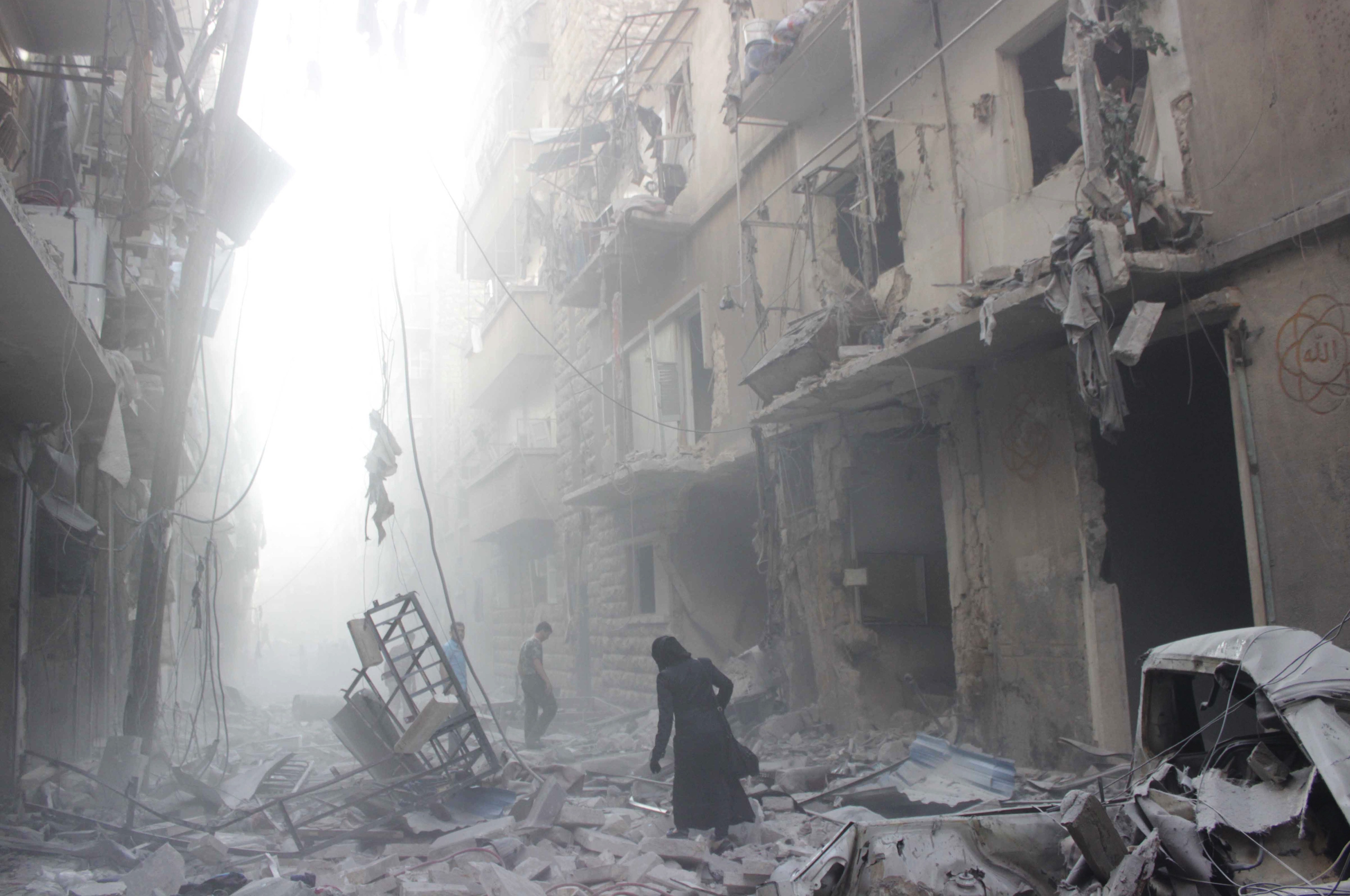
(Photo: A Syrian woman makes her way through debris following a air strike by government forces in the northern city of Aleppo on July 15, 2014. By Karam Al-Masri/AFP/Getty Images)

Why ISIS Brought Back Beheadings

by Dish Staff

Videos of masked militants beheading captive Westerners were a common feature of jihadist propaganda in the early years of the last decade, but such videos had scarcely been seen in a decade when the video of James Foley’s murder came to light this week. Katie Zavadski explains why:

According to University of Massachusetts, Lowell, professor Mia Bloom, the videos faded because they were frowned upon by higher-ups in organizations like Al Qaeda. Although Abu Musab al-Zarqawi, a high-ranking Al Qaeda in Iraq operative, was said to have personally executed Americans Nicholas Berg and Eugene Armstrong, Bloom says superiors, including Osama bin Laden and Ayman al-Zawahiri, looked down on the practice. “AQI got into a lot of trouble for those public beheadings,” she says, because they did more to alienate potential supporters than to recruit them.

“What’s interesting is that you saw a drop-off of these videos because they provoked somewhat of a backlash,” agrees SUNY Albany professor Victor Asal. While everyone knew these groups were doing horrible things, including beheadings, there was something particularly distasteful about videotaping their executions. By returning to these videos, ISIS is saying, “We will do what we want, how we want,” Asal says. “Be very, very scared of us.”

Adam Taylor explores ISIS’s macabre devotion to this particularly bloody method of murder:

The Islamic State may justify its beheadings with theology and history, but the use of the tactic is probably driven by more immediate factors. “I don’t think there’s anything inherently Islamist to these beheadings,” Max Abrahms, a Northeastern professor who studies jihadist groups, told The Post. “It’s important to recognize where Islamic State is coming from historically, in order to understand why it is beheading people — and why it’s using social media to broadcast it.”

In particular, Abrahms argues, the Islamic State may be seeking to differentiate itself from al-Qaeda in Iraq, a group he notes was “widely seen, even among jihadists, as a failure.” With high-profile beheadings, the Islamic State could be attempting to link itself to Khalid Sheik Mohammed, a Guantanamo Bay detainee and alleged Sept. 11 mastermind who is now thought to have killed Pearl.