A Sudden Crisis

by Dish Staff

Screen Shot 2014-08-21 at 10.47.17 AM

As the UN refugee agency launches its largest aid effort in more than a decade to help the hundreds of thousands of displaced people in northern Iraq, Swati Sharma remarks on how rapidly the humanitarian disaster has unfolded:

The rate at which the situation in Iraq has deteriorated is the largest reason why it is being called one of the worst humanitarian disasters in recent years. Let’s compare it with Syria.

While the climate there is extremely volatile, it has been deteriorating for more than three years. In comparison, conflicts in Iraq mostly started this year, and the worst of it commenced in June, when the Islamic State (then ISIS) took Mosul. Today, the number of displaced Iraqis is at 1.5 million — small in comparison to Syria’s 6.5 million — but almost 600,000 of them fled their homes in the past two months. Still, many were able to find homes and shelters in communities around northern Iraq.

In early August, Islamic State moved farther north. When the militant group took the northern region in and around the town of Sinjar, where many Yazidis live, more than 200,000 had to flee. Many were stranded on Mount Sinjar with dwindling resources, causing the Obama administration to launch airstrikes against the Islamic State.

Should ISIS Be Censored?

by Dish Staff

E.W. argues against Twitter and YouTube’s decisions to scrub the video of James Foley’s murder:

Censorship proponents are of the mind that the ISIS video constitutes propaganda and that its dissemination furthers ISIS’s aims. It is true that extremist groups have been known to use social media as a means to circumvent the checks media organisations employ to stop the spread of propaganda. But the video isn’t only propaganda. And since when has that label been sufficient grounds for censorship anyway?  The amount of online content that could be wiped from social media if this reasoning was applied uniformly would be staggering. …

Twitter is not television. No one is being forced to view the footage. Evening news shows can decline to show the video because not all their viewers might be comfortable seeing it. But people have to be able to access it on their own if they wish. It’s completely understandable that family members don’t want footage of a loved one’s death to spread, but it’s not clear that that’s their decision to make.

Earlier this week, J.M. Berger noted that support for ISIS on Twitter had been falling since the revelation that the group had massacred some 700 people in the Syrian province of Deir Ezzor:

Negative hashtag references to the Islamic State, using the derogatory Arabic acronym Daash, soared from Aug. 8 to Aug. 18, increasing by 44 percent. When hashtags referring to Daash along with a reference to the massacre specifically were included in the count, the total soared by 85 percent. The surge in negative sentiment toward IS took place concurrently with airstrikes on the self-proclaimed caliphate by both the United States and the Assad regime and during the period during which Iraqi Prime Minister Nouri al-Maliki stepped down, which IS has claimed as a victory. In other words, IS not only managed to completely erase all the goodwill it might have accrued from battling jihadists’ hated enemies, but it added considerable negatives on top of that.

Meanwhile, Keating takes a closer look at ISIS’s video capabilities:

The availability of laptops, editing software, and HD cameras has made it much easier to produce sophisticated-looking videos. The Internet has also made it simple for terror groups to promote them. But as Berger notes, these propaganda videos aren’t new. Rather, they’re part of a tradition of jihadi filmmaking dating back at least to Afghanistan in the 1980s and Bosnia in the 1990s. “Typically productions that jihadi organizations would put out would be, if not quite cutting edge, pretty close to the standards of the day with professional cameras and professional editing. Jihadi media has progressed at the same speed as the rest of the media,” he says. (This has been true of their print efforts as well.) …

But Jarret Brachman, who consults on international terrorism for the U.S. government and is author of the book Global Jihadism: Theory and Practice, says the content of ISIS’s videos is less important than its ability to promote them. “What I think really matters is the informal use of social media—Instagram, Twitter, and Ask.fm being chief among them—not only by IS’ formal media outlets but by this global following of informal advocates, surrogates, and cheerleaders,” he told me via e-mail.

Update from a reader:

As someone who knew Jim in grad school, I say yes, the video—a snuff film—should be censored. I am devastated. I cannot unsee stills of his final moments. Him on his knees in orange, his masked executioner in black, against a barren landscape. It was impossible to be online Tuesday without seeing those images. I recognized Jim instantly, before the media had confirmed that it was him. It’s one thing to see a person, any person, in this situation and think, Oh my god, that’s so horrible. It’s another thing to know that person and really feel the horror.

Why Intervene In Iraq And Not Syria? Ctd

by Jonah Shepp

SYRIA-CONFLICT

Lionel Beehner quibbles with Marc Lynch’s assessment that if the US had given arms to the Syrian rebels early on in the civil war, it would not have shortened the conflict or prevented the collapse of the state and the rise of ISIS. After highlighting some political science research to show that the question of whether outside interventions can help end civil wars is not settled, he throws this bomb:

Perhaps, then, the question we should be asking is not whether third-party interventions are, on average, helpful or harmful to civil war termination. The answer invariably is: Well, it depends. Rather, we should be asking: Is the world back in a 19th century multipolar paradigm, whereby civil wars were primarily fought between pro-democracy versus conservative/monarchist forces, and the latter typically won because their interventions were more robust and one-sided? …

In the current context, the anti-democratic axis as it were – that is, the Russia’s and Iran’s of this world – appear more willing to go “all in” to support their “proxies” than their pro-democracy counterparts in the West. That means we may be getting into bidding wars not that we can’t win – we have the bank and arms to outspend and out-supply just about anyone – but which we lack the will to win, whether due to flagging public support, setting too high a bar of excellence for our rebel or regime proxies (or fear of Mujahidin-like blowback), or – and this is where the 19th century comparison may be apt – because the stakes for us are perceived to be lower than they are for the Putins of this world.

Beehner can’t seriously believe that civil wars today are “primarily fought between pro-democracy versus conservative/monarchist forces”. On what side of this Manichaean divide would he place the Ukrainian separatists? Is the Muslim Brotherhood “pro-democracy” or “conservative”? What about Hamas? Which side is “pro-democracy” in Libya? Or Afghanistan? Or Sudan, or the Central African Republic, or Mali, or DR Congo? And for that matter, are all opponents of the Syrian regime “pro-democracy”? We know the answer to that one. Beehner’s broad characterization of contemporary civil wars seems breathtakingly reductive to me. Responding to it, Daniel Larison rightly warns against “projecting Westerners’ preferences onto anti-regime Syrians”:

It is a mistake to think of contemporary civil wars in terms of some sort of international contest between democracy and authoritarianism, not least because it creates the false impression that the U.S. and its democratic allies have something at stake in these conflicts when we don’t. There are illiberal authoritarians aplenty on both sides in Syria, but there are hardly any democrats of any kind to be found, and that wouldn’t have been changed by a larger commitment of U.S. resources at any point. The ability to provide arms and funding to anti-regime forces has never been in doubt, but skeptics have been absolutely right to doubt the wisdom and desirability providing this aid.

Look, I’d love to live in a world where every conflict has a “democratic” side. I’ll admit that when the Syrian civil war began as a series of largely peaceful demonstrations in early 2011, I had high hopes for change (and I think Larison may be overstating the absence of democratic elements in the Syrian opposition, at least looking back at that time). Such was the zeitgeist in the Arab world at the moment, when the fall of Ben Ali and Mubarak made anything seem possible, and I was as caught up in it as anyone else. When Bashar al-Assad made clear that demands for reform would be met with deadly force and the protest movement transformed into an armed uprising, I thought some kind of American intervention on the FSA’s behalf was a pretty reasonable proposition (though reading Lynch on the subject gave me pause).

But there was more going on in Syria than met the eye: the civil war turned out to be more of a messy sectarian power struggle than a battle between democracy and totalitarianism, and as it has dragged on over the past three years, the moral calculus has only become cloudier. The main target of my anger for how things turned out remains Assad himself, who could have prevented all of this death and destruction had he been willing to engage with the protesters of 2011 rather than gun them down. Instead he chose to run with the narrative that Islamist terrorists were out to bring down his regime and proceeded to torture and murder his opponents by the tens of thousands, radicalizing the rebels and leading to… well, have you read the news lately?

But in a state where no such thing as civil society has ever really existed, where democrats and Muslim Brothers alike have been tortured and massacred, and where Assad’s Alawite coreligionists believed (and still do) that they would be held collectively responsible for the regime’s misdeeds in the event that Assad ever went away, I highly doubt there was a way for the US to intervene on behalf of “freedom” and “democracy”, rather than merely empower some other faction. Regional leadership, such as the Arab League has continually failed to demonstrate, might have been able to pull it off, but as we ought to have learned from Iraq, there are very hard limits to what American guns can accomplish in service of the causes of liberty and peace.

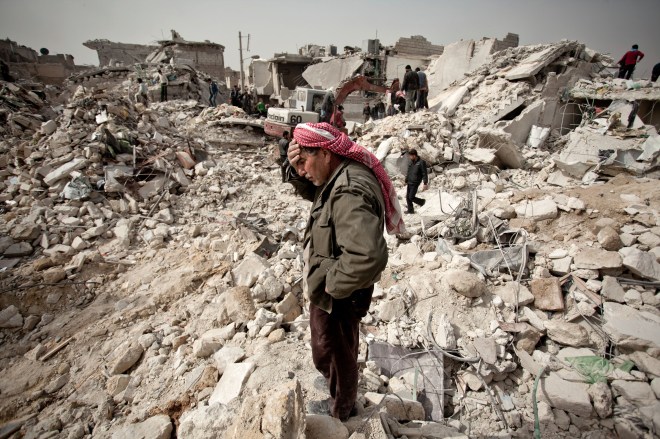
(Photo: A Syrian man reacts while standing on the rubble of his house while others look for survivors and bodies in the Tariq al-Bab district of the northern city of Aleppo on February 23, 2013. By Pablo Tosco/AFP/Getty Images)

Will Foley’s Murder Change Obama’s Iraq Plans?

by Dish Staff

In the wake of James Foley’s murder, Fred Kaplan urges Obama to start building a regional coalition to defeat ISIS:

If the jihadists of ISIS are as dangerous as Obama says they are (and the evidence suggests they are), then it’s time to plow through diplomatic niceties and pursue the common interests of nations with which we otherwise might not get along. Yes, it’s politically awkward, to say the least, for Obama to make common cause, even on this one issue, with Assad (a monster whom he once said “must go”) and the mullahs of Tehran (most of whom regard America as the “great Satan”). But in World War II, Roosevelt and Churchill joined with Stalin to defeat Hitler—and, if they hadn’t, Hitler would have won.

The net against ISIS should be widened further. A good model here is the 1990–91 Gulf War, in which Presidents George H.W. Bush and Secretary of State James Baker assembled a vast coalition to push Saddam Hussein’s army out of Kuwait. Nearly every Arab country in the region—Saudi Arabia, Jordan, Egypt, even Syria—sent whole armored divisions or air wings. Many of them didn’t do much in the war, but the important point was that they were there. Their presence demonstrated that this wasn’t a war of Western imperialists against Muslim Iraq; it was a multinational war against aggression.

Jacob Siegel expects the US intervention in Iraq to escalate, but points out that merely holding the recent gains against ISIS will require a sustained involvement anyway:

Defeating ISIS in an open confrontation has not been part of any proposed plan, but weakening the group and pushing back its advances could go from the de facto U.S. approach to the official strategy if the air campaign expands. The most visible result of the air campaign is the retaking of the Mosul Dam, a key piece of infrastructure that ISIS captured from Kurdish forces in early August. After a sustained bombing campaign with more than half the total U.S. airstrikes so far, 51 out 84 targeting ISIS positions around the dam, it was retaken Tuesday by Kurdish Peshmerga and Iraqi special forces.

The dam is no longer in ISIS’s hands, but keeping it that way may require keeping American airpower on call for the foreseeable future.

Spencer Ackerman scopes out what sort of escalation might be in the works:

One option under consideration, not directly related to the Foley killing, is a request for hundreds of more US marines to deploy to Baghdad to bolster security at the US embassy and related installations. The request, made by the State Department recently, is said not to be a response to an new anticipated push by Isis into Baghdad, which it has stopped short of attempting to seize. An official who was not cleared to speak to the press characterized it as coming out of an abundance of caution. …

The US Central Command continued on Wednesday to send fighter jets and armed drones to harass Isis near the Mosul Dam, a critical piece of infrastructure that the US considers to no longer be under Isis control. The warplanes launched 14 strikes against Isis vehicles and weaponry, tacitly a rejection of Isis’ demand with the Foley killing that the US relent in its newest air campaign in Iraq.

Ramping up the air campaign may soon become easier, as Baghdad appears willing to let US bombers take off from Iraqi bases:

The back-channel discussions over the bases, which have not previously been reported, highlight the White House’s uncertainty about escalating its low-level air war against the Islamic State. President Barack Obama proudly pulled all U.S. troops out of Iraq in late 2011. He has repeatedly stressed that the military campaign there that began Aug. 8 will be limited in both scope and duration. With broad swaths of Syria and Iraq under Islamic State control, key U.S. allies are pressing the administration to step up the fight. Taking off from Iraqi bases would make it much easier to do so because it would put the American aircraft closer to their targets.

“Everything is harder when you’re doing it from the outside,” a senior military official said. At issue is a little-noticed aspect of this air campaign: None of the strikes against Islamic State targets inside Iraq have been carried out by U.S. aircraft based inside Iraq.

Morrissey flags a new poll showing that 54 percent of the American public supports airstrikes against ISIS:

Obama deserves credit for taking action, if belatedly and perhaps not as robustly as some would like. So far, though, Americans aren’t inclined to think that his policies in Iraq have improved. His approval rating in June on the question was 42/52, and today it’s 42/51. In fact, slightly more strongly disapprove now (36%, from 34%) and slightly fewer strongly approve (16% from 17%) than in June, although all of those moves are within the margin of error. Interestingly, the American public likes the air strikes, but not arming the Kurds, which seems like more of a slam-dunk.

Foley’s British Executioner, Ctd

by Dish Staff

The ISIS jihadist who beheaded American journalist James Foley in a video released by the group on Tuesday has been identified:

As an international manhunt got under way on Wednesday, the English-speaking militant was identified to the Guardian by one of his former hostages as the ringleader of three British jihadists thought to be the main guards of foreign nationals in Raqqa, a stronghold of Islamic State (Isis) rebels. The militant who appeared on the Foley video, who called himself John and is believed to be from London, was said to be the main rebel negotiator during talks earlier this year to release 11 Islamic State hostages – who were eventually handed to Turkish officials after ransom demands were met.

The FBI, MI5 and Scotland Yard’s counter-terrorism command were all on Wednesday night racing to identify the militant who fronted the propaganda video that showed the brutal murder of Foley, the journalist who had been missing in Syria since 2012. Sources in Syria recognised the man as a point-man for hostage negotiations in Raqqa, where he is said to have held discussions with several families of jailed foreign nationals over the internet.

Josh Rogin and Eli Lake link Foley’s abduction and murder to a ring of foreign-born jihadists suspected in the kidnapping of other journalists in Syria. Several members of that ring were arrested and charged with false imprisonment shortly before Foley was kidnapped in November 2012:

The case fell apart because the two Western journalists who had been abducted in Syria in July 2012 and could identify the suspects did not appear to testify at the trial. One of them had testified against Shajul Islam at pretrial proceedings and said Islam was part of a cell of foreign-born extremists in Syria that included 10 to 15 U.K. citizens. Islam, through his lawyer, denied being involved in the abductions at the time.

One U.S. intelligence official told The Daily Beast that both U.S. and British counter-terrorism agencies have taken a keen interest in the suspected militants. “There is no official product on this yet for the intelligence community,” this official said. “But people who are out there and collecting on this believe the [Foley] abduction and the [Islam] trial are connected.”

The US had apparently tried to rescue Foley last month:

Details on the nature of the unsuccessful operation remained sparse late Wednesday. When American forces landed in eastern Syria — most likely in Raqqa province, where Foley is thought to have been held and killed — they came under heavy fire. The elite troops killed a number of militants, and one of the pilots involved in the operation sustained a minor injury when his aircraft came under fire, a senior administration official told Foreign Policy.

According to a defense official with knowledge of the situation, the operation occurred in early July. The same official added that the operation was based mostly on human intelligence — as opposed to satellite photographs and intercepted communications — and the military now believes the hostages had been moved from that location just days before the raid took place.

Obama denounced the killing in a press conference yesterday afternoon, calling ISIS a “cancer” but not committing to a particular course of action in response. After weighing the pros and cons of a retaliatory effort, Zack Beauchamp sees the president in a bind:

Obama’s Wednesday statement was two things: an emotional tribute to James Foley’s life, and a furious condemnation of ISIS and its goals. “Jim Foley’s life stands in stark contrast to his killers,” the president said. “[ISIS] has no ideology of any value to human beings. their ideology is bankrupt.”

What the presser wasn’t, however, was a policy address. Saying “the United States will continue to do what we must do to protect our people,” as Obama did, doesn’t say much about the choice between “hit them harder” and “don’t take the bait,” or any other clear US action or lack thereof. The American policy response is still just unclear. Regardless of what the US ends up doing, it should be clear that this isn’t an easy call for Obama. Sadly, it’s much harder to destroy ISIS than it is to condemn the atrocities they commit.

The Guardian weighs in on what Foley’s murder means in terms of the Anglo-American role in the fight against ISIS:

Bluntly put: if we target them, they will target us. The foreign secretary, Philip Hammond, was right to say on Wednesday that we – Americans and British in particular – have always been in their sights as one of the “far enemies” they reckon with. But fighter bombers over the Mosul dam, arms for the Kurds and help for the Baghdad government bring us more into the “near enemy” category, and that has consequences. Consequences in the region and, potentially, consequences at home in the United States and Europe.

We should not be alone in a contest with Isis. Regional powers should take on a greater role, perhaps even military, but certainly a more coherent diplomatic role. There should be a suspension of the rivalries which helped create the opportunity Isis seized.


How Far Will Obama’s Iraq War Expand? Ctd

by Dish Staff

Refugees Fleeing ISIS Offensive Pour Into Kurdistan

Saletan chronicles how the limited intervention in Iraq has already outgrown its original parameters:

In his weekly address on Aug. 9, Obama added a third mission to the military agenda: “We will protect our citizens. We will work with the international community to address this humanitarian crisis. We’ll help prevent these terrorists from having a permanent safe haven from which to attack America.” He repeated that point in a press conference: “We will continue to provide military assistance and advice to the Iraqi government and Kurdish forces as they battle these terrorists, so that the terrorists cannot establish a permanent safe haven.” That’s a huge undertaking. Any land controlled by ISIS can be construed as a safe haven. Does Obama plan to drive ISIS out of places such as Fallujah, which it held for months while the United States looked on? Does he plan to push ISIS all the way back to Syria?

Obama hasn’t forgotten all the principles that limited his commitment. He continues to insist that the solution to Iraq’s crisis is political, that Iraqis must achieve that solution themselves, and that putting U.S. troops on the ground creates a dangerous rationale for additional deployments to protect them. But 12 days into the military campaign, he’s showing signs of slippage. He’d better watch himself.

Larison stresses that mission creep is the rule, not the exception, when it comes to such interventions:

Once a president has committed to using force in a foreign conflict, all of the effective political pressure is on the side of escalation.

Having conceded that the U.S. should be involved militarily in a conflict, the president is bombarded with demands for deeper involvement in order to pursue the illusion of victory. If he doesn’t agree to these demands, he will be steadily pilloried in the media until he does, and any adverse development in the affected country will usually be attributed to insufficient American involvement. Since the initial decision to intervene was driven in part by the same sort of pressure, it is more than likely that the president will keep yielding to calls to “do more.”

Keating wonders what “mission accomplished” will mean in Iraq this time around:

The cynical answer is that the goal seems to be for Iraq to become just stable enough that we can go back to not paying attention to it. And I suspect that in the end, that may have more to do with how long the U.S. media continues to treat Iraq as a major story than with what’s actually happening there.

And Benjamin Friedman argues that “Americans, the president included, need to admit being out of Iraq potentially means letting it burn”:

The collapse of the fiction that U.S. forces stabilized Iraq before exiting forces us to confront the unpleasant contradictions in U.S. goals there. We want to avoid the tragic costs of U.S. forces trying to suppress Iraq’s violence. We want a stable Iraqi federal government and we want Iraqis to live peacefully. Each of those goals conflicts with the others. Even if the new Prime Minister is amenable to Sunni demands, U.S. bombing is unlikely to allow Iraqis to destroy ISIL and its allies. Large-scale violence will likely continue. Suppressing insurgency will likely require resumption of U.S. ground operations. And even that, we know, may not help much.

(Photo: Spencer Platt/Getty Images)

The Adaptable ISIS

by Dish Staff

While US airstrikes and advances by Kurdish forces have begun to reverse the gains ISIS has made in recent weeks, Joshua Keating doubts the group will be easily defeated:

Over the past few months, the group has shown remarkable flexibility in both its tactics and its targets, one of its key advantages over the national governments trying to stamp it out. If its progress against Baghdad stalls, it can turn against Erbil. If it suffers a setback in Iraq, it can simply focus its efforts on Syria (or Lebanon), where the dynamics of the ground as well as the international alliances work completely differently. If U.S. airstrikes turn the tide against it on the battlefield, it can turn back to urban warfare or suicide bombings.

In other words, a group like ISIS is perfectly positioned to exploit the hazy national boundaries, sectarian divisions, and mistrust among governments in the region where it operates. Given that those factors don’t seem to be going away anytime soon, my guess is that the Islamic State will find a way to regroup. British Prime Minister David Cameron is probably right to be warning the public of a long fight to come.

Yochi Dreazen warns that ISIS is also getting better at governing the territory it controls:

U.S. intelligence officials say the leaders of the Islamic State are adopting methods first pioneered by Hezbollah, the Lebanon-based Shiite militia, and are devoting considerable human and financial resources toward keeping essential services like electricity, water, and sewage functioning in their territory. In some areas, they even operate post offices. …

Taken together, the moves highlight the fact that the Islamic State, already the best-armed and best-funded terror group in the world, is quickly adapting to the challenges of ruling and governing. That, in turn, dramatically reduces the chances that the extremists will face homegrown opposition in what amounts to the world’s newest territory.

Accordingly, Faysal Itani argues that the key to defeating ISIS is to treat it like the state it claims to be:

Above all, ISIS wants to control territory and borders. Otherwise it is just one militia among many others in Syria and Iraq. This requires fighting on multiple fronts against multiple enemies, within both Syria and Iraq. That means openly moving fighters, arms and equipment across vast desert areas. Therefore, like any conventional army, ISIS is prone to overstretch. These increasingly lengthy lines of communication are prime targets for ground and air attacks that would destroy ISIS’ territorial integrity and fighting capability. …

But ISIS is adaptive, creative and ambitious. By contrast, the international community’s response has been rigid, predictable and unimaginative. If it continues to see and treat ISIS as simply a terrorist group, the international community will forever be playing defense, which ISIS can happily live with, until it no longer has to and can go on the offensive abroad. Unless its rivals understand and treat ISIS as a state, and exploit the vulnerabilities statehood presents, ISIS will continue to outclass them in ambition and sophistication, and it will have its state.

Foley’s British Executioner

by Dish Staff

The unidentified jihadist who murdered James Foley in the video released yesterday spoke fluent English with a London accent, likely placing him among the hundreds of UK citizens who have traveled to Syria or Iraq to join up with ISIS. That revelation could motivate the UK to step up its involvement in the fight against the Islamic State:

“We’ve been saying for a very long time that there are significant numbers of British nationals in Syria, increasingly in Iraq, and one of the reasons why what is going on in Syria and Iraq is a direct threat to our own national security is the presence of significant numbers of our nationals who may at some stage seek to come back to the UK with the skills, the tradecraft that they’ve learned working with these terrorist organisations, potentially posing a threat to our domestic security here in the UK,” [Foreign Secretary Philip] Hammond said.

Hammond said Britain was committed to helping the Iraqi government fight Isis and that, although the Iraqi government “has made it clear that it does not need and actually wouldn’t welcome western boots on the ground”, it did want help with surveillance and technological equipment. Asked if Britain would send soldiers to Iraq to train Iraqi forces, Hammond said this was “certainly something that we would consider”.

Josh Halliday rounds up some expert analysis of why the killer’s nationality is significant:

Prof Peter Neumann, director of the International Centre for the Study of Radicalisation at King’s College London, said the militant was chosen to front the video to cause maximum impact in the west.

“This is significant because it signifies a turn towards threatening the west. They are saying we’re going to come after you if you bomb us,” he said. Neumann said British fighters had been carrying out “horrific acts” like beheadings, torture and executions for a year and a half, but this appeared to be the first with a western victim. …

Dr Erin Saltman, a senior researcher at Quilliam Foundation, said the footage was geared towards disaffected Islamist extremists in the west who would be able to empathise with the British-accented militant. “The video is quite a shock mainly because the two characters are an American and a Briton. That’s done very deliberately,” she said. “As soon as you have a fighter with a Middle East accent it becomes very easy to disassociate with that and say they’re brutal, they’re barbaric. But when you have a British citizen, raised in the UK, this is somebody we can empathise with.”

Jihadism expert Shiraz Maher calls British jihadists “amongst some of the most vicious and vociferous fighters who are out there”:

Maher warned that the self-proclaimed caliphate was likely to carry out more atrocities because of western efforts to help people in the region. “Unfortunately, the way the Foley video is framed, it makes it very clear now that IS (Isis) will react against any western involvement or intervention into the conflicts either in Syria or Iraq and that, of course, given that we are now helping minorities in Iraq – the Yazidis, the Kurds, for example – they regard that not just as an assault on them but they regard that ultimately as a declaration of war against Islam itself.

“And therefore, that is the sort of narrative we have, of course, heard from al-Qaida in the past. That will license them to attack targets and individuals and western interests as they see fit.” Maher said British and other Sunni Muslims initially went to Syria because of an “existential threat” to their faith from Shia Muslims, and their presence has since swelled Isis ranks and allowed it to increase its territory and influence.

Ed Morrissey responds to the possibility that the executioner or his compatriots may be former Guantánamo Bay detainees:

The orange jumpsuits are obviously referencing Guantanamo Bay, but the British seem concerned that there’s more than just symbolism now in play with ISIS. The US began releasing British subjects from Gitmo during the Bush administration under international pressure to shut down the facility, as well as releasing other detainees to their home countries, all of whom pledged to ensure that they would not return to the fight. We’ve seen plenty of recidivism since then, and all to this same end — to rejoin the jihad against the West and the nations in this region, and to recruit others to do the same.

It won’t be a surprise if the jihadist turns out to be a former Gitmo detainee, but it is a bit of a surprise that the UK doesn’t keep a close enough watch on those former detainees to account for their whereabouts immediately. After all, they have already been identified as threats, picked up in the battle zones far from home, which is how they ended up in Gitmo in the first place.

ISIS Murders James Foley

by Dish Staff

ISIS released a video yesterday purporting to show the beheading of American journalist James Foley and threatening to do the same to his colleague Steven Sotloff if the US does not immediately cease its air campaign against the militant group:

A propaganda video circulated on Tuesday showed a masked Isis fighter beheading a kneeling man dressed in an orange jumpsuit who is purported to be James Wright Foley, a photojournalist who went missing in Syria in 2012. The masked executioner spoke in English, with what sounded like a British accent, and said the slaying came in response to the air strikes ordered by President Barack Obama against Isis 12 days ago.

Isis, whose chief spokesman came under US state department sanctions on Monday, warned of further revenge – including on another man purported to be a captured US journalist, Steven Sotloff – and in the video the victim was made to read a statement blaming the US for his own murder. Foley has been missing in Syria since November 2012, where he went to report on the bloody struggle to overthrow dictator Bashar al-Assad. He was initially thought to have been captured by forces loyal to the Assad regime.

So how did he end up in the hands of ISIS? Christopher Dickey wonders:

In Syria, he was picked up by gunmen from what the Federal Bureau of Investigation called an “organized gang” shortly after he left an Internet café on November 22, 2012. In May 2013, GlobalPost President Philip Balboni said that “with a very high degree of confidence, we now believe that Jim was most likely abducted by a pro-regime militia group”—that is, one loyal to President Bashar Assad—and that he was being held near Damascus by the Syrian Air Force intelligence service. “Based on what we have learned,” said Balboni, “it is likely Jim is being held with one or more Western journalists, including most likely at least one other American.”

Several groups fighting against Assad have claimed that there is—or was—a tacit collaboration, at least, between his intelligence services and ISIS, since it served the savage Assad regime well to claim it was fighting a terrorist enemy even more brutal than its own forces.

Uri Friedman remarks that Foley, before his capture, was part of a dwindling cohort of journalists reporting directly from Syria:

“We have never been prouder of our son Jim,” Foley’s mother posted on Facebook on Tuesday evening. “He gave his life trying to expose the world to the suffering of the Syrian people.”

That exposure is growing fainter by the day. Foley appears to have died while working in what is now the most dangerous place in the world to be a reporter—a country where dozens of journalists have been killed and kidnapped in recent years. As the Syrian conflict has grown more indiscriminately violent; as the Syrian government has targeted journalists, censored local news coverage, and barred foreign journalists from the country; as ever-stronger extremist groups have started seizing members of the press (and not even bothering to make demands for their release), news outlets around the world have pulled their staff from the country. Many Syrian journalists and citizen-journalists have been silenced.

Max Fisher knew him:

There will be many efforts in the coming days to derive meaning from Jim’s death. Some will say ISIS had him killed to punish the US for its recent air strikes against them in Iraq, some will say it was to egg the Americans on, and others will attribute it to simple madness. I would rather derive meaning from Jim’s life. As a journalist, I want to celebrate his dedication to truth and understanding. But that would sell him short. It is clear even just by secondhand accounts from the family that would do anything to help him, even when he insisted on returning to a war zone, and from the friends who were so enriched by knowing him, that Jim’s value was so much more.

Owen Jones is struck by the effectiveness of ISIS’s propaganda:

Everything about the video of Foley’s alleged murder was intended to chill. It is unlikely that Islamic State (Isis) selected an executor with a strong London accent for no reason. It was the Iraq war that first popularised the execution video but hearing the blood-curdling threats and dogma of Isis recited in tones that are all too familiar is itself a message.

Terrorism by definition aims to spread terror to achieve its political ends. One of the reasons Isis has outmanoeuvred its rivals is because it has embraced social media so effectively. By publicising its atrocities online, it tells would-be opponents what will happen if it is resisted, and this partly explains why so many have fled rather than confront Isis forces. The ruthless use of social media has proved instrumental in the toppling of entire cities. This operation is being gladly assisted by those in the west who portray Isis as a unique, undiluted evil that needs to be bombed out of existence, granting the militant group the mystique it clearly craves and relies on.

Shane Harris looks at how social media companies have tried to scrub references to the video:

Less than an hour after the video was first posted to YouTube, the company removed it. But the same video was soon posted by a different YouTube user, and it remained accessible for at least another half an hour. The company eventually removed the video from the user’s account, but it didn’t suspend the account itself, and within minutes, the user had posted it again. Twitter suspended the user’s account after he included a link to the video in his feed. …

But the social media companies are fighting a losing battle. They depend on users to flag offensive content or material that violates their terms of service — videos of murder undoubtedly do — but they don’t proactively police the photos, videos, and messages posted to their sites. The companies also have to determine whether posting violent rhetoric or messages constitutes promoting terrorists’ messages or is an act of free speech, and the distinction is not always clear.

How Far Will Obama’s Iraq War Expand?

by Dish Staff

Zack Beauchamp makes much of the recent escalation of American involvement in the Iraq conflict, embodied in Obama’s Sunday authorization of airstrikes to support the Kurds in recapturing the Mosul Dam from ISIS:

By explicitly authorizing airstrikes supporting Iraqi government forces, and not just the Kurdish peshmerga, Obama crossed an informal line he had previously held: don’t help the Iraqi government until there’s major political reform in Baghdad. That standard, it seems, no longer holds. This is a point Obama has been clear on since June. He’d authorized strikes only in defense of Kurdish territory in northeastern Iraq and to save the members of the Yazidi minority trapped on a mountain by ISIS forces. “The US is not simply going to involve itself in a military action in the absence of a political plan by the Iraqis,” Obama said in a June 13 address. He was more blunt in an August 8th statement, saying “the nature of this problem is not one our military can solve.”

Michael Crowley smells mission creep:

The worry is that Obama’s rationale of “protecting Americans in Iraq” can be stretched to justify almost any kind of military action — especially now that he has more than doubled the U.S. presence in Iraq to nearly 2000 personnel since June. (A key stage of mission creep in Vietnam involved sending troops to protect U.S. air bases in that country.) But Obama has given himself even broader license than that. When he announced the dispatch of 300 military advisors to Iraq back on June 19, Obama wrote himself something like a blank check.

“[W]e will be prepared to take targeted and precise military action,” Obama said, “if and when we determine that the situation on the ground requires it.” That language covers even more action that Obama’s protect-Americans vow. ISIS is little too close to Baghdad? Boom. Intel about suicide bombers eyeing Erbil? Boom. Imminent slaughter somewhere? Boom, boom, boom.

And Benjamin Friedman sees that “creep” accelerating into a sprint:

Only the speed of this slide down a slippery slope is surprising. As I recently noted, the humanitarian case for protecting the Yazidi easily becomes a case for continual bombing of ISIL and resumed counterinsurgency war in Iraq. Their danger to civilians was never limited to Sinjar. And as in Syria, the major humanitarian threat in Iraq is civil war.Americans, the president included, need to admit being out of Iraq potentially means letting it burn. The collapse of the fiction that U.S. forces stabilized Iraq before exiting forces us to confront the unpleasant contradictions in U.S. goals there. We want to avoid the tragic costs of U.S. forces trying to suppress Iraq’s violence. We want a stable Iraqi federal government and we want Iraqis to live peacefully. Each of those goals conflicts with the others.

Even if the new Prime Minister is amenable to Sunni demands, U.S. bombing is unlikely to allow Iraqis to destroy ISIL and its allies. Large-scale violence will likely continue. Suppressing insurgency will likely require resumption of U.S. ground operations. And even that, we know, may not help much.

The American public appears to support the air campaign, with a new poll putting that support at 54 percent, but the poll also reveals some anxiety about getting bogged down in Iraq again:

Thirty-one percent said they disapproved of the strikes, while 15 percent of the 1,000 randomly selected respondents who took part in the survey, which was carried out between Thursday and Sunday, declined to give an opinion. The poll found major partisan differences, with self-described Republicans markedly more hawkish than Democrats or independents, although a majority of Democratic respondents said they also supported the airstrikes.

However, a majority (57 percent) of Republicans said they were concerned that Obama was not prepared to go “far enough to stop” the Islamic State, while majorities of Democrats (62 percent) and independents (56 percent) said they worried that he may go too far in re-inserting the military into Iraq three years after the last US combat troops were withdrawn. Overall, 51 percent of respondents expressed the latter fear.