ISIS vs The Obama Doctrine

by Dish Staff

In Peter Feaver’s view, Obama’s intervention in Iraq disproves what had been a main feature of his foreign policy doctrine: the value of leading from behind. “In authorizing new combat action in Iraq when he did,” he argues, “Obama conceded that his approach of doing less as a way to make others do more was not working — at least not with respect to Iraq”:

President Obama rightly recognized that there was no long-term solution in Iraq until the Iraqi polity picked a less sectarian successor to Maliki. More controversially, Obama rejected multiple appeals for help from the Iraqis (and from our Kurdish partners) earlier in the crisis in the hopes that withholding aid would drive the Iraqis to dump Maliki in a desperate effort to secure American assistance. … Finally, when Obama was staring at a potential catastrophe in Erbil in the Kurdish region that might eclipse the disaster in Benghazi, he decided he could wait no longer and ordered U.S. forces into combat — despite the failure of Iraqis to meet the hitherto stated conditions for U.S. assistance.

Shortly after Obama acted, the Iraqis finally acted themselves, nominating a (hopefully more inclusive) replacement to Maliki. In other words, the Iraqis themselves may have been waiting to see if they could trust Obama’s offers of help. Perhaps it was Obama’s initiative that catalyzed the Iraqi’s action, rather than vice-versa, as Obama had intended. That, at least, is how the Bush administration would have interpreted the strategic dynamic.

James Jeffrey worries that Obama’s aversion to direct military action makes him reluctant to use one of his most potent tools:

Given Obama’s ambivalent views on the efficacy of military force, and America’s tortured history in Iraq, he downplays his strategy’s second element: direct U.S. military actions. Despite the president’s oft-stated belief that there is never any military solution to, well, almost anything, IS’s advances into Kurdish and Shiite Arab areas of Iraq are not a political or social phenomenon but a military achievement. And one cannot confront a classic military strategy with diplomatic niceties. …

Do military actions of this sort open the door to a “slippery slope” that could lead to new Iraqs and Vietnams? In theory, yes. But Barack Obama is the least likely president to make a mistake of this sort. Moreover, the reality doesn’t equal the fear: Over scores of deployments and combat operations since 1945, the United States has rarely headed down the slippery slope. And let’s be clear: The Iraq adventure under President George W. Bush was not a slippery slope but an intentional regime-change strategy gone wrong. What the president thus must do is to convince first himself and then the American people that our key interests — oil supply, protecting the homeland and allies from terrorism — are at stake so long as the Islamic State is rampant. Americans need to understand that if the United States does not stop them, no one will.

And Nabeel Khoury believes that we have no choice but to take the lead in defeating ISIS or concede hegemony in the Arab heartland to Iran:

There are no good options for the U.S. administration at this point, only bad and worse ones. Any counter-offensive to dislodge ISIS would have to include large forces on the ground, something the president has ruled out. This leaves two options for Washington: Take a deep breath, hunker down, and focus on a long term project to arm and train Kurdish forces, hopefully in collaboration with what’s left of the Iraqi army. The long delayed adoption of the FSA would be a natural part of this strategy. Washington’s failure to lead in these efforts will leave only one other option, which is to step aside and let Iran and Hezbollah take the responsibility for ousting ISIS, and therefore take credit and full control of Iraq after the fight is done.
Don’t Call Him Our Boy In Baghdad

by Dish Staff

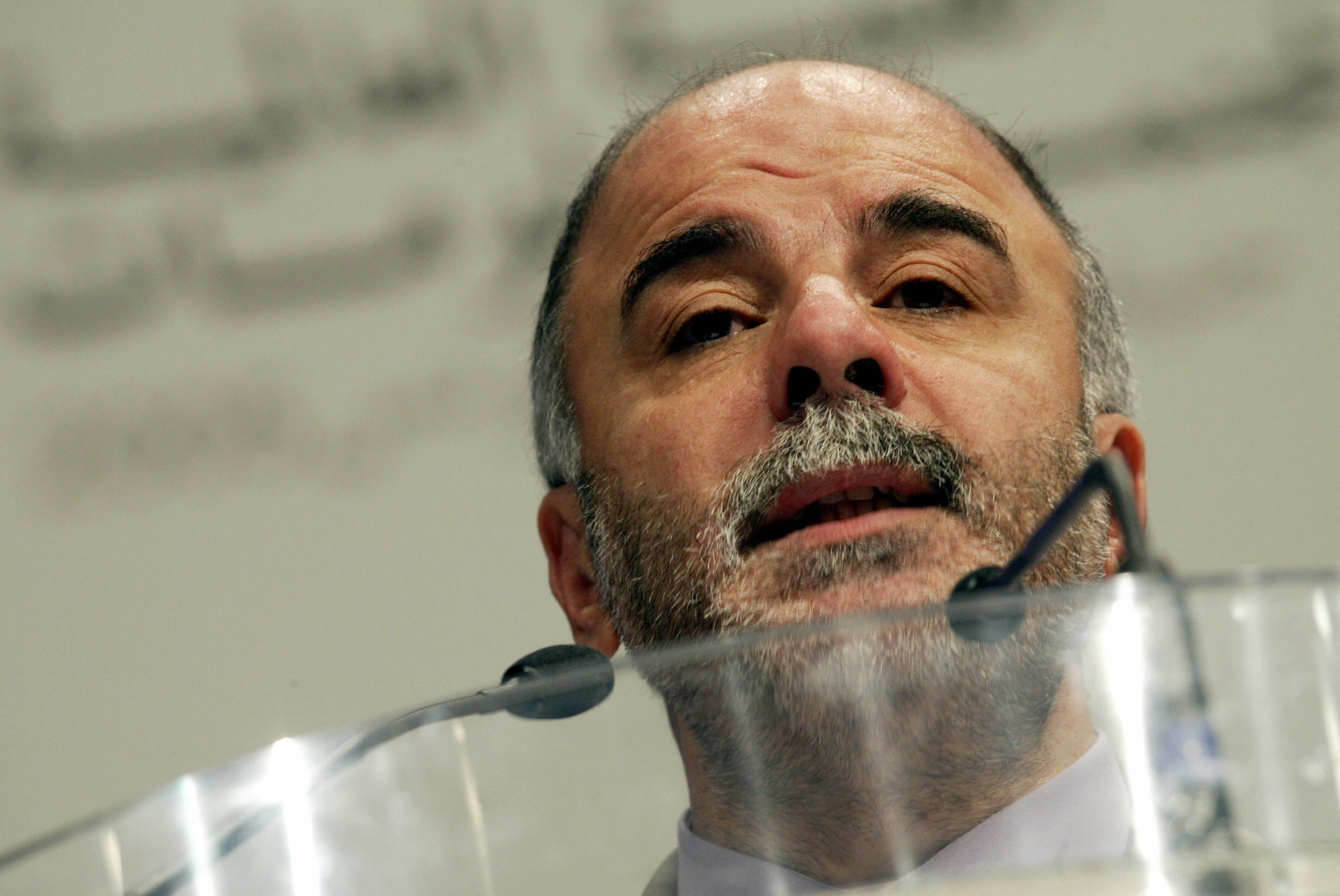
Iraqi Minister of Communication Haider a

David F. Schmitz hopes the US government has finally learned a thing or two from its experience at trying and failing to manage clients like Nouri al-Maliki and won’t make the same mistakes with his successor, Haider al-Abadi. There’s a broader lesson to be learned here, he argues, about the limits of our superpowers as a superpower:

Now that Iraq has a new leader who is said to be an amiable technocrat without Maliki’s overriding partisan agenda, can the United States escape its past as a poor puppeteer? Can Washington find a way to help Abadi rather than hinder him, empowering his government to take on the Islamic State without seeming to dictate its choices ? The Obama administration says it supports Abadi because it wants to see the democratic process upheld, and there is nothing wrong with this position. There’s no reason to think the Obama administration, no matter how many hundreds of advisers it sends or airstrikes it launches, will have any more success than the Bush administration did in stabilizing Iraq, because the underlying problem remains: It’s almost possible to get a foreign leader to do what is best for you, rather than what he believes is best for him, no matter how much money you throw his way or how hard you twist his arm.

The United States can still play a positive role, but instead of the business of building puppets, we should be more in the business of cultivation—helping good leaders to grow. Success in Iraq or Afghanistan can only come if an indigenous force and leader emerges with local support, and then only if the United States doesn’t demand that they reflect the will of Washington and the goals of the United States in all of their actions and policies.

Christopher Preble is on the same page. Abadi’s problems are many and daunting, he writes, but making them our problems won’t help solve them:

Abadi will need to find a way to form an inclusive coalition government, one that protects the rights of Sunnis and appeases the Kurds’ desire for autonomy, while maintaining support from Iraqi Shiites. This is a tall order. … Americans should wish Iraq’s new leader well, but policymakers should resist the urge to try to micromanage political events in Iraq. Even the appearance of U.S. influence over Abadi will undermine his legitimacy and thus could be counterproductive. Besides, it isn’t obvious that U.S. action—and only U.S. action—is essential to turning things around in Iraq.

Taking a closer look at those problems, Martin Chulov argues that bridging Iraq’s sectarian divide will be Abadi’s most daunting challenge:

Abadi has told followers his first job as prime minister will be to convince those Sunnis who have endorsed Isis in its attempt to establish a caliphate across Syria and Iraq that an Iraqi nation within its current borders remains a better option. Regional and Iraqi officials have encouraged Abadi to start by revitalising the demoralised national military and overhauling state institutions that have been co-opted by warlords and political blocs over the past decade. Many barely function. Abadi also aims to revive relations with Sunni Arab neighbours, including Saudi Arabia and the Gulf States, which boycotted Maliki’s government for close to seven years. Maliki, in turn, had accused Riyadh of bankrolling extremism in Iraq.

“He was such a divisive, polarising figure,” said one senior Saudi official of the ousted leader. “A new start was essential to even beginning to sort out this mess.”

But Ghaith Abdul Ahad resists the temptation to blame Maliki, and only Maliki, for running Iraq into the ground. At least to some extent, the problem is structural:

Maliki was not alone in his corruption, nepotism and oppression. In Iraq’s national unity government, ministries run by Maliki’s opponents are as corrupt as ministries run by his allies. Yes, he dominated the army, but every other party and sect had its own share of positions that were sold to the highest bidder. Detainees were freed by bribing officials who belonged to different parties. Ministers who publicly opposed Maliki never left his government because it generated so much wealth and power. Iraq’s division into fiefdoms, where each party greedily consumed its spoils, has created a country in which an oligarchy of a few thousand ministers, government officials, generals, militia commanders and all those people blessed with much-sought-after green zone badges – Sunnis, Shias and Kurds – have a monopoly on resources, leaving the rest of the nation with nothing much but the blame game.

Meanwhile, Ali Hashem spotlights Iran’s role in Abadi’s designation as prime minister, which suggests the level of interest with which Tehran is engaging the Iraq crisis:

During the weeks of talks, Iran’s secretary of national security, Adm. Ali Shamkhani, led the Iranian efforts on the ground. He visited Iraq on July 18 and met main leaders in Baghdad, Najaf and Erbil. Shamkhani was given a green light from Khamenei to try to end the crisis at any price. He was aware that the situation isn’t the same as before: Iran is no longer defending its regional security borders, but rather its direct borders; the Islamic State (IS) is now in Diyala, which borders Iran; and the last city that fell under IS control is Jalawla, less than 40 kilometers (25 miles) from the Iranian border.

In Tehran, the murmurs that Shamkhani will oversee the Iraq file have gotten louder. This is an indication that Iran is about to adopt a new policy, given Shamkhani’s historic relations with the Gulf countries and Iraq, his wide experience in dealing politically with regional conflicts and his closeness to Khamenei, all without ignoring the fact that he’s an Iranian of Arab origins.

(Photo: Haider al-Abadi by Jean-Philippe Kziazek/AFP/Getty Images)

ISIS Driven Out Of Mosul Dam

by Dish Staff

US airstrikes have helped Kurdish forces recapture the Mosul Dam area from ISIS militants:

“Mosul Dam was liberated completely,” Ali Awni, an official from Iraq’s main Kurdish party, told AFP, a statement confirmed by two other Kurdish sources. Early in the day US aircraft, for the first time including land-based bombers, carried out 14 strikes. Later, US Central Command confirmed further strikes had been carried out by “fighter and attack aircraft”.

In a letter to Congress, outlining the rationale and justification for the strikes, Obama said the integrity of the dam was crucial to the security of the US embassy in Baghdad. The US has consistently cited the security of US personnel in Baghdad as cover for its military operation to support the Kurds. Sunday’s first strikes were the first time that bombers as well as fighter jets and drones had been involved in the current air campaign, which began on 8 August alongside drops of humanitarian aid to Yazidi refugees marooned on Mount Sinjar.

If these reports are accurate, they come as a huge relief, considering the mass destruction the jihadists could cause by blowing the dam up. But Azam Ahmed adds (NYT) that ISIS’s mines are still barring access to the dam itself:

 A commander for the Kurdish pesh merga forces in the area, Gen. Omer Ibrahim, said that ISIS fighters had abandoned the dam complex and retreated to a nearby front. But the complex itself was heavily mined, meaning the pesh merga could not fully enter it and prolonging the push to fully occupy the dam. … Although a series of American airstrikes on ISIS positions near the dam had allowed Kurdish forces to reclaim nearby villages and to approach the area, Kurdish officers said the militants had slowed the progress of the military forces by planting roadside bombs.

This CENTCOM statement also appears to imply that the battle is still ongoing:

Bobby Chesney comments on the legal justification the administration is giving for our involvement:

Both humanitarian and force-protection themes appear in today’s Mosul Dam notification, of course, but the context for each is different. The dam is far from Erbil, and its fate poses no direct threat to US personnel there; the force-protection argument instead is linked to US personnel downstream in Baghdad. That’s not wholly unreasonable; my limited understanding is that a failure of the dam would cause significant problems in Baghdad. …

Perhaps more significantly, isn’t all of this argumentation pretty distant from the much more obvious motivation for this operation–i.e., that possession of the Dam was simply intolerable insofar as it substantially bolstered the ability of ISIS to control territory while also serving as a threat that could be held over Iraqi/Kurdish forces should they succeed (when the attempt inevitably comes) in ousting ISIS from Mosul? As the situation continues to unfold, I predict we will see situations in which US air support will be needed and will be provided, but that will be even more remote from the force-protection and humanitarian arguments that currently have been placed front-and-center; there have been many hints, after all, that a more robust US role may be in the offing once al-Maliki is gone.

Don’t Forget About Sistani

by Dish Staff

Adam Taylor remarks on the role the preeminent Shiite cleric played in turning the tables against Maliki, leading to his resignation yesterday:

The Post’s Loveday Morris reports that a message from Grand Ayatollah Ali Sistani was key in convincing Iraq’s political elite that embattled Prime Minister Nouri al-Maliki needed to go. The letter from Sistani, sent to leaders of Maliki’s Dawa party July 9, spoke of the “need to speed up the selection of a new prime minister who has wide national acceptance.” Not long after the letter was received, Haider al-Abadi, a deputy speaker for Iraq’s parliament and also a member of Dawa, was called upon to lead the country. On Thursday, Malliki finally admitted defeat.

It’s a bold move. While few people had doubts about Sistani’s theological power, he has rarely acted so directly to influence politics.

The 84-year-old Islamic cleric, infrequently seen in public and generally circumspect when making announcements, is a member of the “quietest” Shiite tradition that is suspicious of religion and politics mixing. However, Iraq’s crisis may now be so bad that Sistani is taking action – and we may just be seeing the start of it.

In a penetrating essay on Shiite Islam’s role in Iraqi politics, Mohamad Bazzi places Sistani in the context of a broader political-theological struggle within the faith:

Since the U.S. invasion in 2003, Sistani has competed with more radical clerics for leadership over the Shiite community in Iraq. This struggle reflects a parallel battle between Iranian and Iraqi clerics for dominance over the larger Shiite realm: … For Iran, the struggle over Iraq is not just a political or strategic one. It is also a theological battle over control of the Shiite narrative. At its heart, the argument is over competing visions of Shiism’s essence. Should the faith be defined by a diverse group of scholars living at seminaries and engaging in esoteric theological debates, while staying out of the political fray? Or should it follow the tradition of absolute political and religious leadership advocated by the leader of Iran’s Islamic Revolution, the late Ayatollah Ruhollah Khomeini?

Sistani represents the dominant theological school in Najaf, which rejects the Iranian model of rule by clergy. The Najafi clerics believe their role is to be spiritual leaders and not to participate directly in politics. Since the U.S. invasion, Sistani seized a more direct political role on several occasions, especially in 2004 when he lobbied for early elections and a constitutional referendum. But he never stepped into the political fray as forcefully as he has over the past two months, with his call to arms against ISIS and his leading role in Maliki’s ouster. Sistani’s actions could shift the historic debate regarding the position of clerics.

Maliki Bows Out

by Dish Staff

The Iraqi prime minister stepped down from his post yesterday, defusing a political crisis that just days ago looked like it would end in a coup:

On Thursday, the embattled Iraqi leader relinquished power and dropped the legal challenge to his successor, Haider al-Abadi, a member of his own Shiite Islamist Dawa Party. Abadi now has 30 days to form a new cabinet, and he will be under intense pressure from both Washington and Tehran — Iraq’s biggest patrons — to give powerful positions to members of the country’s embattled Sunni minority. The ministries of defense and the interior, which oversee Iraq’s security forces, have long been sought by Sunni leaders. Appearing on state television alongside his rival, Maliki pledged to support “brother” Abadi, citing the need for national unity.

Maliki’s change of heart came after his former backers in Washington and Tehran withdrew their support and urged him to step aside. He has also lost the support of much of his party and the Iraqi political class write large. Marc Ambinder observes that the US got what it wanted (and worked for):

Behind the scenes, the administration worked with Maliki’s party, the Iraqi National Group, offering assurances that the U.S. would stand fully behind its chosen candidate, so long as it wasn’t Maliki. The West encouraged Iraqi President Fouad Massoum to call for new elections within 30 days.

When people say that only a political solution will help Iraq, they mean two things. One: a strong leader who can unite the country without alienating a majority of a strong minority. Two: a political system that works, even minimally, and isn’t seen as unfair. Finding a strong charismatic leader is probably impossible, because Iraq has not lived peacefully without the strong arm of a dictator. It is a state that was drawn, not a state that drew itself. But the second is actually possible: Iraqis of all persuasions and demographic demarcations (Christians, Sunnis, Shiias, moderates, conservatives, agnostics, Baathists, and Kurds) need to have some confidence that they can participate in politics. Participating in politics creates a political culture, and a political culture forms bonds among even the most hated of rivals.

Juan Cole lists ten ways Maliki doomed himself. This was a big one:

In winter-spring 2013 when Arab Spring-type demonstrations were mounted by the Sunnis in places like Falluja and Hawija in the Sunni Arab west and north, al-Maliki declared them terrorists and sent in military troops and helicopter gunships to brutally suppress the protests. Sunni Arabs, having been informed that they would be a perpetual defeated minority in parliament were now given the idea that even peaceable assembly would be denied to them as a political tactic. Al-Maliki’s policies gave them no incentive to remain within the system. In the end they allied with the al-Qaeda offshoot, the so-called “Islamic State.” Al-Maliki didn’t so much lose the Sunni Arabs as drive them into the arms of IS with systematic policies of marginalization.

Al-Maliki’s successor needs to make the al-Da’wa Party a party of pan-Islam and try to attract Sunnis into it (this happened in the 1960s)– or better yet needs to found a Labor Party that could unite Iraqis across ethnicity and sect. This Shiite rule business can’t hope to put Iraq back together.

And Yochi Dreazen looks ahead to the challenges Abadi will face in forming a cabinet and uniting the country:

The Obama administration, which hailed Maliki’s decision to step down, has promised to increase its financial and military assistance to Iraq if Abadi’s new government has less of a sectarian bent than Maliki’s hard-line Shiite-dominated one.

Colin Kahl, who formerly served as the Pentagon’s top Mideast policy official, said Abadi will take office with widespread goodwill within the Sunni and Kurdish communities simply because he is not Maliki, who was reviled for instituting policies that discriminated against both groups. But Kahl said Sunni and Kurdish leaders will be looking to Abadi to quickly make substantive moves that show he is genuinely willing to share power. A key early test: whether Abadi puts Sunnis in control of the powerful ministries of defense and interior, which control the country’s military and police forces. Sunnis have wanted those posts for years to ensure that Iraqi security forces aren’t used against them the way they were under Maliki.

Is Kurdistan All It’s Cracked Up To Be?

by Dish Staff

Kurdistan’s image in the West as a stable, successful, democratic proto-state is not entirely in line with reality, Jenna Krajeski remarks:

Kurdistan is booming on the promise of oil wealth, and their securitymaintained by the peshmergahas enticed investors to the region. But progress has come alongside reports of rampant corruption, a widening gap between the rich and poor, and increasingly authoritarian tendencies in a government still dominated by family names. Disenfranchised Kurds find little hope of influencing the authorities or benefiting from the oil wealth. Perhaps nothing in Kurdistan illustrates its internal fissures more than the peshmerga themselves. …

And while crisis has unified the peshmerga who may be divided along party lines, not every Kurd is willing to take up arms to defend Kurdistan. A generation of Kurds living for over a decade in relative stability, many benefiting from the increasing wealth and education opportunities, have little interest in becoming soldiers. “Like other youth around the world, the Kurdish youth want to go to school, enjoy life, and travel abroad,” Natali said. “[They want to] take advantage of the opportunities of living a normal life, which means not going to the mountains to fight.” If the Kurdish and American governments hope that Kurdish nationalism will provide an endless flow of fighters for the peshmerga, they may be disappointed. The Kurdistan that President Barzani so desperately wants to usher into independence is one where people want to live more than they want to fight.

Kurdish leaders are also not blind to the need to manage their image and cultivate relationships in Western capitals. Kate Brannen looks into the KRG’s K-Street operation:

To spread their message in Washington, Kurdish leaders have long maintained relationships with members of the media, the think tank and academic communities, politicians on Capitol Hill, and officials in and out of government. For the last several years, the Kurds have also retained a slew of lobbying firms, including Patton Boggs, to work on their behalf. The Kurdish Regional Government, which runs the Kurds’ proto-state in northern Iraq, spends at least $1 million a year on these efforts, according to documents filed with the Justice Department.

The lobby’s influence appeared to have paid off when the White House announced it would conduct airstrikes over Kurdish territory. The U.S. government has also begun fulfilling the Kurds’ long sought-after goal of direct U.S. military support, including the provision of much-needed weapons and ammunition. France also announced Wednesday that it, too, will begin providing arms to the Kurdish forces. But some experts warn not to misread the situation. Kurdistan’s roster of high-powered lobbyists and high-profile public advocates has helped it gain American weaponry, but the influence campaign has yet to accomplish the Kurds’ primary goal: winning U.S. support for the creation of an independent Kurdish state. For the moment, that remains a bridge too far for the Obama administration, just as it did for the Bush administration before it.

A reader, meanwhile, chimes in on Kurdistan’s oil, writing that “a lot of executives and security experts in companies that have taken exploration license from the KRG are reassessing their emergency and security plans right now”:

ExxonMobil blocks in KRG 30-11-2011If you look at the map you will see that the status of Erbil might not be what raises the most concern. The most prolific assets in Kurdistan are traversing the Green Line, and in particular to the north-west of Kirkuk. As you will see from the attached map, the two primary Exxon assets are Al Qush and Bashiqa, both of which are in the Christian areas that ISIL ran through and where the Peshmerga retreated from. This also applies to Hunt oil’s primary asset and to the very prolific Shaikan bloc.This means that for the oil interests, the big question now is: can the KRG provide the security they promised? Can they put people on the ground for the foreseeable future and not risk seeing them on a YouTube channel from some Jihadi group? Can the KRG protect their assets in the disputed areas if relations with Baghdad should come to a confrontation sometime in the future? So far companies have bought into the KRGs assurances, but the ISIL progress will have dented that belief significantly.

The Plight Of The Yazidis Isn’t Over

by Dish Staff

While the Yazidis who fled their hometown of Sinjar and sought refuge in the mountains to the north are apparently no longer under siege by ISIS and hopefully will be able to escape to safety soon, Kimberly Dozier points to the others, for whom no rescue is forthcoming:

ISIS has taken hundreds, if not thousands, of Yezidis prisoner, and threatened them with slavery and rape. But a few of the prisoners have smuggled in cellphones and are reaching out—pleading for help. In desperate phone calls to relatives in Iraq and in the U.S., they’re begging for rescue from the prisons, schools or mosques across northern Iraq, where they are being held by ISIS militants.

They all tell a similar tale of horror:

families fleeing on foot caught by militants in trucks and cars. The men are then dragged away at gunpoint from their wives and children, never to be seen again. The younger unmarried women are being told they will be forcibly married to ISIS fighters. Some are taken away and raped and a few have even been sold at Mosul’s main market. The married women aren’t sure what will happen to them and their children—they fear they will be sold into slavery.

Matt Cetti-Roberts spoke to some Yazidis who managed to escape when ISIS overran Sinjar but whose families were not so fortunate. Resaleh Shirgany recounts:

I left my mother. I had never met her before because my parents were divorced, and four other family. [Crying.] They were living in the the Al Jazeera [housing] complex in the northwest of Sinjar. It was the third day after da’ash arrived. They discovered where they were living and my mother was one of five families that were raped. First they raped the women in front of the men, they then killed the husbands while the wives watched and then they killed the women. It was a massacre there. [Crying.] …

The same day when we ran away [from the mountain], my two female cousins who were behind us in a car as we left were captured by da’ash. One of them was pregnant and with her husband and her brother-in-law. They were stopped in the middle of the street. They raped them in front of the people that were with them and I could see it from the back window of the car. Suddenly everyone was gone. They took them away.

Previous Dish on the plight of the Yazidis here.

Is Khamenei Done With The Nuclear Talks?

by Dish Staff

The Supreme Leader has always been pessimistic about the negotiations between Tehran and Washington, but in a statement yesterday, he called them “useless”:

Speaking to Foreign Ministry officials, Ayatollah Ali Khamenei praised Iranian negotiators who have conducted the talks with the United States and five other world powers, and he did not call for abandoning them. But he appeared to give succor to Iranian hard-liners who are adamantly opposed to discussions that could lead to a scaling back of Iran’s nuclear program, which they insist is intended for peaceful purposes only. The remarks came two days after President Hassan Rouhani stirred controversy in Iran by calling opponents of the talks “cowards” and telling them to go to hell. Rouhani, considered a moderate, has been pushing for an agreement that would end the crippling economic sanctions against Iran. Khamenei has consistently been far more skeptical about the talks.

Reza Haghighatnejad highlights the apparent split between Khamenei and Rouhani:

In sharp contrast with Khamenei’s address earlier today, Rouhani has talked about the impact of eased sanctions, the practicalities of working with the U.S. to combat Islamic State insurgents in Iraq, the greater opportunities to tackle world issues.  It’s not only the nuclear program that the world needs to talk about, Rouhani’s camp suggests, and last year’s historic phone call between Rouhani and U.S. president Barack Obama was a symbol Western media–and Rouhani—gladly embraced. Rouhani has even sought out public opinion within Iran, commissioning a poll earlier this year to identify just what the ordinary Iranian public thought about increased contact with the West.

At the same time, the administration has been keen to show itself as tough, practical and resolute: Javad Zarif has said one of the most important outcomes of talks has been an American shift: U.S. officials now have a clearer understanding of what they can expect from Iran. According to Zarif, he and chief negotiator Abbas Araghchi have ensured that no new sanctions have been imposed over the last year—a view dismissed today by Khamenei in front of the world’s most influential diplomats. “They say these sanctions aren’t new, but actually they are,” Khamenei said, which proved that talks over sanctions have led to nothing.

Walter Russell Mead suspects that a “grand bargain” with Iran is a dangerous fantasy, regardless of our apparently aligned interests in Iraq:

[T]he perception that a breakthrough with Iran is just around the corner will encourage the President to slight or sacrifice the interests of traditional U.S. allies in the region. It will strengthen the hand of those in the Administration who tell the President that he should stay the course in the Middle East, pursuing a ‘grand bargain’ with Iran, and supporting ‘moderate Islamists’ and pro-Muslim Brotherhood governments in places like Qatar and Turkey, even if that alienates Saudi Arabia, Israel and Egypt.

If America takes this course, expect regional tensions to rise, rather than relax, even if things calm down in Baghdad. It’s not clear that the President’s goal of a grand bargain with Iran is within reach, or that it will deliver the kind of stability he hopes for. For one thing, it’s possible that the Iranians are less interested in reaching a pragmatic and mutually beneficial relationship with Washington than in using Obama’s hunger for a transformative and redeeming diplomatic success to lure him onto a risky and ultimately disastrous course.

Is The Siege On Mount Sinjar Broken?

by Dish Staff

A planned operation to rescue the thousands of Yazidis still camped out on Mount Sinjar in northwestern Iraq has been called off for the moment, with the Pentagon saying that the refugees were fewer in number and in better condition than initially believed:

After a small complement of special forces and US aid workers landed on Mount Sinjar to assess the situation of the Iraqi Yazidis – who for days have received air drops of food, water and medicine – the Pentagon said things were not as bad as initially feared. “An evacuation mission is far less likely,” said Rear Admiral John Kirby, the Pentagon press secretary, late on Wednesday. US humanitarian aid drops would continue, Kirby said, but for now US planes or troops would not come to rescue the remaining Yazidis from the mountaintop terrain that has provided a harsh refuge. …

“There are far fewer Yazidis on Mount Sinjar than previously feared,” Kirby said, crediting “the success of the humanitarian air drops, air strikes on [Isis] targets, the efforts of the Peshmerga [Kurdish guerillas] and the ability of thousands of Yazidis to evacuate from the mountain each night over the last several days”.

An evacuation has not, however, been permanently ruled out. Josh Voorhees weighs how it would play out politically:

The Defense Department’s current airstrike and aid-drop efforts have mainly been received positively from both parties in Congress. A rescue operation, however targeted, might change that, especially if it included a direct confrontation with ISIS fighters.

It could also be particularly difficult to sell given the lengths the White House has gone to to rule one out. “American combat troops will not be returning to fight in Iraq,” President Obama said this past weekend, “because there’s no American military solution to the larger crisis there.” It’s that last clause that the White House will no doubt point to if they do launch a short-term rescue effort.

Gordon Lubold wonders whether Obama will be able to stick to his “no ground troops” pledge:

The Pentagon confirmed late Wednesday that about 20 U.S. special operations forces had been sent to the mountain to assess the needs of the thousands of Iraqi civilians stranded there. They are part of a group of 130 troops Obama authorized Tuesday to go into Iraq to conduct an assessment of the humanitarian crisis. Those U.S. troops, in turn, join an additional 800 service members the Pentagon has deployed to Iraq since June, bringing the total number of troops the Pentagon has announced publicly up to nearly 1,000. The special operations forces returned to their base without incident, but their short time on the mountain could be the beginning of a new, dangerous chapter in Obama’s reluctant use of the military in Iraq. …

But it’s the airstrike campaign that could force the United States to expose more American forces to combat. Central Command has announced a number of airstrikes since the bombing campaign to protect Iraqi civilians, guard American personnel, and weaken IS began last Friday. Typically, such airstrikes would require personnel on the ground to “call in” those attacks. That would require U.S. personnel to operate in areas close to those controlled by the militants.

While a rescue mission is not the same thing as re-invading Iraq, Zack Beauchamp dismisses the administration’s claim that it wouldn’t count as “combat”:

[Deputy National Security Advisor Ben] Rhodes, according to the Times, differentiates between “the use of American forces to help a humanitarian mission and the use of troops in the battle against militants from the Islamic State.” In one sense, this is classic Obama squirrelly language. The administration got around legal limits on the 2011 Libya war by calling it a “kinetic military operation” rather than a “war.” Here, they’re calling what’s clearly a combat mission a “humanitarian” operation. Regardless of what they call it, US troops would almost certainly exchange gunfire with ISIS forces. Sorry, Ben — that’s combat.

But for people worried about mission creep, which is a reasonable thing to worry about, the distinction does matter. Rhodes’ point is that the US still hasn’t changed its decision that US ground troops should not be trying to roll back ISIS. He doesn’t even seem to be open to the idea of US troops, in addition to the ongoing US airstrikes, directly supporting the Kurdish peshmerga trying to drive ISIS out of Kurdistan.

ISIS And The Islamist Menace

by Dish Staff

Alex Massie contends that ISIS’s peculiarly evil worldview puts us at odds whether or not we choose to be:

Make no mistake, we may not consider ourselves at war with ISIS but they most assuredly reckon themselves at war with us. And with anyone else who does not share their murderous corruption of Islam. The world has rarely been short on horror but there is something especially horrifying about ISIS. If heads on pikes won’t convince you, what would be enough to persuade you this is an evil that must be confronted? And if not confronted today it will have to be confronted eventually. Because these are not people and this is not a worldview that will be content to carve out territory and then, once it has established its base, live quietly and peacefully ever after.

In the end, all the wrangling about cause and effect and who started what and who is to blame this or that becomes a form of dissembling dithering. In the end we are responsible. Not so much on account of the unforeseen consequences of past blunders but because we – the United States and its NATO allies – have the power, the equipment and the opportunity to do something about it.

David Rothkopf identifies the threat of radical Islam as “the principal source of threat to our interests, the stability of the region, and to our allies.” He argues that the US’s Middle East policy should address this threat holistically, rather than on a case-by-case basis:

While the conditions and specific upheavals in each state in the Middle East are, as noted earlier, different, it is this battle that is responsible for the greatest amount of today’s unrest and violence. Whether it is Ansar al-Sharia in Libya or the Muslim Brotherhood in Egypt, Hamas in Gaza or al-Nusrah Front in Syria, al Qaeda in the Arabian Peninsula, or the Islamic State struggling to establish its caliphate, it is clear today that extremist Islam is emerging as a threat so broad that it must be seen in its totality to be contended with.

Further, the ties of these groups to others operating in the periphery of this region — from the Taliban to the Haqqani network, from Boko Haram to Uighur or Chechen separatists — both underscore the global scope of the problem and the potential for significant alliances to help combat it.

Certainly, our traditional allies in the Middle East have come to see the problem as one. Consider the degree to which Israel and Egypt have cooperated to deal with Hamas. Consider that unifying animus toward the Muslim Brotherhood that has linked together not only those two former warring states but also Jordan, Saudi Arabia, Bahrain, Kuwait, and the United Arab Emirates.

Adam Taylor observes that ISIS’s extremist brand is catching on:

What’s really worrying is that despite all the confusion over its name, the Islamic State “brand” actually seems pretty solid — and worryingly global. It’s distinctive black-and-white flag was flown in London last week, and leaflets supporting it were handed out in the city’s Oxford Street on Tuesday. An American was arrested at a New York City airport this month after authorities were tipped off by his pro-Islamic State Twitter rants. The group has began publishing videos in Hindi, Urdu and Tamil in a bid to reach Indian Muslims. There are credible reports that the group is hoping to target Asian countries — and Indonesia is so worried that it banned all support for the Islamic State. The list goes on and on. Whatever you call it — the Islamic State, ISIS, ISIL, or something else — its brand is potent.

Indeed, even China is starting to worry:

China has been fighting a low-level separatist insurgency of its own in Xinjiang for decades and worries that foreign Islamic groups are infiltrating the region, emboldening the simmering independence movement. Uighur exile groups say China’s government overstates its terrorism problem and falsely paints protests that turn into riots as premeditated terror attacks. In any case, Beijing is likely alarmed by IS’s criticism of its treatment of the Muslim Uighurs and the group’s alleged plan to seize Xinjiang, no matter how far-fetched the idea might be. But just how actively authorities will deal with any IS threat remains to be seen.

Furthermore, Andrew Tabler cites “analysts and European and American officials” as saying that “hundreds, if not thousands, of ISIL and Al Qaeda operatives in Syria and the Islamic State are likely planning attacks either back home or elsewhere”:

These include Muhsin al-Fadhili, former head of Al Qaeda’s Iranian facilitation network; Sanafi al-Nasr, head of Al Qaeda’s Syria “Victory Committee”; Wafa al-Saudi, Al Qaeda’s former head of security for counter intelligence; as well as Al Qaeda founding member Firas al-Suri. Members of Al Qaeda Arabian Peninsula (AQAP) are also reportedly in Syria, indicating a growing opportunity for connectivity, coordination, planning, and synchronization with Jebhat al-Nusra and other jihadists. Taken together with national-based Jihadist units from China, the Caucasus, Libya, Egypt, Sweden, and beyond, the “Islamic State” is already the next Afghanistan or Pakistan’s Federally Administered Tribal Areas in terms of a durable safe haven and training ground for global Islamic terrorism.

William Inboden believes the threatened Yazidi genocide opened Obama’s eyes to the scope of ISIS’s fanatical ambitions and is changing the president’s beliefs about terrorism, the Middle East, and American power:

I have written before about the close connections between religious persecution and national security threats. The vicious Islamic State campaign to exterminate Yazidis and Christians further reinforces this point. The Islamic State’s targeting of religious minorities is not merely a side effect of its territorial advances; it is central to the group’s identity and purpose. The worldview of the militant jihadist holds religious pluralism and religious freedom to be anathema, and the Islamic State perversely considers its own measures of success to include eliminating religious minorities. Just as the Islamic State’s persecution of Christians and Yazidis should have been an early indicator of the larger security threat it poses, the longer-term American response to the Islamic State will need to go beyond airstrikes to include a renewed diplomatic commitment to protecting and promoting religious freedom.