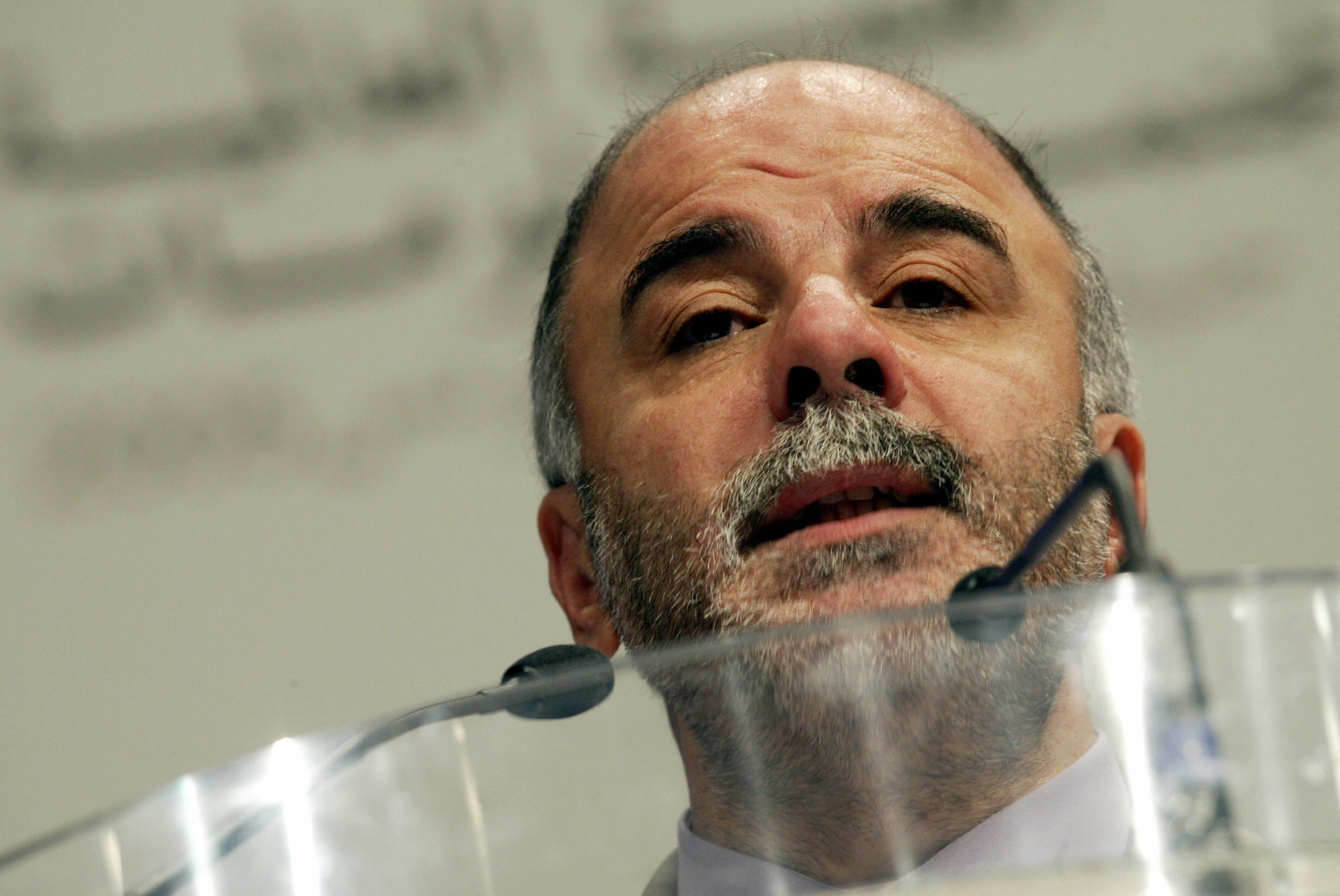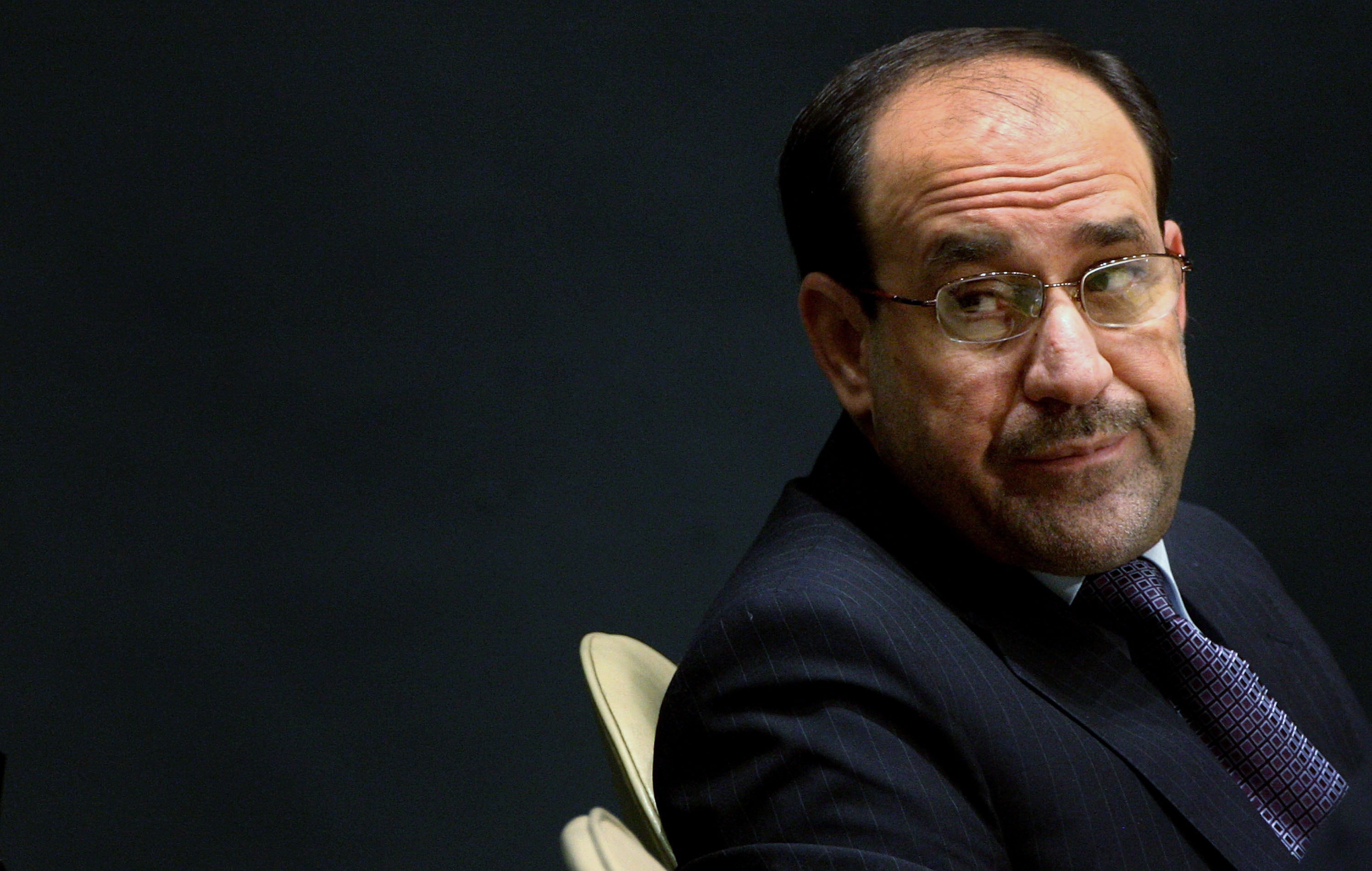
Maliki’s Last Stand

by Dish Staff

World Leaders Converge At 62nd U.N. General Assembly

Despite – or more likely, because of – the emerging consensus that it’s time for new leadership, the embattled Iraqi prime minister insists that he will remain in his post until a court orders him to vacate it:

“Holding on (to the premiership) is an ethical and patriotic duty to defend the rights of voters,” he said in his weekly televised address to the nation. “The insistence on this until the end is to protect the state.” Al-Maliki on Monday vowed legal action against President Fouad Massoum for carrying out “a coup” against the constitution. “Why do we insist that this government continue and stay as is until a decision by the federal court is issued?” he asked, answering: “It is a constitutional violation — a conspiracy planned from the inside or from out.”

Iraqi troops imposed heightened security in Baghdad Wednesday as international support mounted for a political transition. Tanks and Humvees were positioned on Baghdad bridges and at major intersections on Wednesday, with security personnel more visible than usual. About 100 pro-Maliki demonstrators took to Firdous Square in the capital, pledging their allegiance to him.

Josh Voorhees outlines the supposed constitutional basis for Maliki’s claim:

The issue of who’s in the right is a complicated one, all the more so given the Iraqi constitution’s often vague and muddled wording.

The letter of the law calls for the president to nominate a prime minister from “the largest Council of Representatives bloc.” In this case, that would be the State of Law coalition, which both Maliki and Abadi belong to. According to Reidar Visser, a historian and expert on Iraqi politics, there may once have been a case that Maliki deserved the chance to form a government. But such an argument quickly fell apart over the past 48 hours as the State of Law coalition split its support between the current prime minister and the man nominated to replace him. “Maliki’s promise to bring the case before the Iraqi federal supreme court will [now] be of academic interest only,”Visser has concluded.

Having lost the support of both Washington and Tehran, Maliki’s fate looks sealed, but he could still cause trouble:

“Ultimately, Maliki certainly cannot survive as ruler of Iraq without Iranian and U.S. support,” said Faysal Itani, a resident fellow at the Atlantic Council. “The question of his premiership is not very relevant now; he’s no longer prime minister of Iraq, whatever he says.” Michael Eisenstadt, of the Washington Institute for Near East Policy, said Maliki had lost support inside and outside Iraq, with 38 of the 96 lawmakers in his State of Law bloc backing Abadi just as Washington and Tehran effectively told him to throw in the towel. “In practical terms, Maliki’s fate as a legitimate politician is sealed,” Eisenstadt said. …

Even if he steps down, Itani cautioned that Maliki could make life difficult for Iraq’s next rulers. Maliki, Itani said, has spent years appointing loyalists to key positions throughout Iraq’s government and security organizations. He could emerge as a “pretty powerful de facto militia leader, capable of causing all sorts of headaches for the U.S., Iran, and his Shiite rivals,” Itani said. Eisenstadt, meanwhile, said Maliki could decide that violence is the answer.

And Maliki’s past misdeeds, Juan Cole adds, might make things difficult for his intended successor, Haider al-Abadi:

Unfortunately, in order to resolve the current crisis in Iraq, al-Abadi needs internal allies more than external lip support. He needs more than pro forma support from the Kurds in confronting IS in Diyala, Salahuddin and Ninawa provinces. And, he needs to detach some of the Sunni tribal leaders from the IS. The last time the Sunni rural notables allied with Baghdad against al-Qaeda, they were treated shoddily. Al-Maliki declined to continue their stipends or give very many of them government jobs. Since they had fought terrorists, they were often targeted for reprisals by the terrorists. And, al-Maliki even prosecuted some who had fought Baghdad before changing their minds and joining “Awakening Councils.” The difficulty is that when al-Abadi goes to the tribal chiefs, he may not get much of a hearing. He is after all from al-Maliki’s party.

(Photo: Spencer Platt/Getty Images)

Arming The Kurds, Ctd

by Dish Staff

The EU could not agree yesterday on whether to arm Kurdish fighters in Iraq, but gave member states permission to do so on their own. This morning, France announced that it would send an immediate shipment of weapons:

The sudden announcement that arms would begin to flow within hours underlined France’s alarm at the urgency of the situation in Iraq, where the Islamic State fighters are threatening the autonomous Kurdish region in northern Iraq. … French authorities have pushed other European Union members to do more to aid Christians and other minorities being targeted by the Islamic State group extremists. E.U. foreign ministers will hold an emergency meeting Friday to coordinate their approach to the crisis and to endorse the European arms shipments already announced, according to an E.U. diplomat speaking on condition of anonymity pending the official announcement later Wednesday.

Rick Noack notes that Germany is also considering sending weapons to Iraq, which might also entail arming the peshmerga directly. That would mark a major change in policy for the world’s third largest arms exporter:

“If Germany decides to arm the Kurds, this would be a watershed moment. Germany has so far refrained from delivering such aid to militants,” said journalist Thomas Wiegold, a leading authority on Germany’s defense industry.

In the past, Germany had always refused to deliver arms to rebel groups such as those fighting in Libya or Syria, although it did earlier approve the delivery of arms to Iraq. Iraqi Kurdistan, however, is a semi-autonomous region within Iraq, which makes it difficult for foreign governments to directly negotiate arms deliveries. Direct support would also contradict E.U. guidelines that rule out deliveries to warring parties that belong neither to the European Union nor NATO.

Meanwhile, the Kurds have sent the Pentagon their wish list of advanced weaponry, which, according to Eli Lake, includes armored personnel carriers, night vision equipment, and surveillance drones:

The Pentagon has yet to respond to the Kurdish request. But the list is an indication of the rapid expansion of the multi-pronged American campaign in Iraq. On Tuesday, the U.S. military announced it would be sending 130 more U.S. military advisers to northern Iraq, bringing the total number of troops to over a thousand in country. American boots on the ground will only be a small piece of the larger effort against ISIS, however.

The U.S. is scheduling up to 100 attack, surveillance, and humanitarian airdrop missions a day over Iraq.  Those flights are being carried out by drones and manned fighters, U.S. Navy and Air Force aircraft alike. But American forces are not the ones calling in those strikes, as has become commonplace in warzones throughout the world. Instead, Kurdish fighters are identifying targets for the American bombing runs, breaking with years of U.S. military practice meant to ensure that the right targets are hit—and civilians are not.

The No-Drama Doctrine

by Dish Staff

Cameron Hudson finds the Obama Doctrine of genocide prevention sensible, if not particularly satisfying to those who would have liked a more robust American response to the crisis in Syria:

In an interview Friday with Tom Friedman of The New York Times, Obama remarked, “When you have a unique circumstance in which genocide is threatened, and a country is willing to have us in there, you have a strong international consensus that these people need to be protected and we have a capacity to do so, then we have an obligation to do so.” Some would argue that this explanation walks back from the high-minded justification for the forceful response to the potential massacre in Benghazi, Libya, in late 2011 when Obama asserted that a failure to act “would have stained the conscience of the world.” More importantly, it sets a new and seemingly higher bar for taking action to prevent genocideone that is unlikely to be replicated very often.

If that’s the intent, it is not necessarily a bad thing.

Genocide prevention, as a community of practice, is in need of bookending. In a world full of nailsor potential nailsthe U.S. military is the literal hammer. Absent a clear understanding of the circumstances when force could be used to save lives, advocates and communities at risk hold out false hope that the cavalry is coming, when it so rarely is. Understanding when a military response is on the table and when it is not will focus our attention on the cheaper, more politically palatable non-military options that should always constitute the heart of genocide prevention.

Aaron David Miller argues that despite the decision to strike ISIS, Obama remains as risk-averse as ever:

The Friedman interview revealed another important reason why Obama’s risk aversion is likely to endure. The president raised the issue about the lack of follow-up to help Libya after Qaddafi’s overthrow. “Then it’s the day after Qaddafi is gone, when everybody is feeling good and everybody is holding up posters saying, ‘Thank you, America.’ At that moment, there has to be a much more aggressive effort to rebuild societies that didn’t have any civic traditions…. So that’s a lesson that I now apply every time I ask the question, ‘Should we intervene, militarily? Do we have an answer [for] the day after?'”

Even though he doesn’t come out and say it, you get the sense that if there was a chance to do it over again he’d be much more engaged. But there’s another way to read the president’s comment, too. And that’s this: Military action is only one step in a complex process that requires a huge investment to create a relatively stable and functional transition from authoritarian to democratic rule. And Obama understands that hitting the Islamic State (IS), as necessary as it may be, is hardly a panacea for rebuilding the new Iraq. More to the point, that’s not America’s job. And Obama isn’t going to correct his Libya mistake by getting bogged down in nation-building in Iraq.

But Micah Zenko expects the mission in Iraq to expand beyond Obama’s stated limits, because they all do:

The expansion of humanitarian interventions — beyond what presidents initially claim will be the intended scope and time of military and diplomatic missions — is completely normal. What is remarkable is how congressional members, media commentators, and citizens are newly surprised each time that this happens. In the near term, humanitarian interventions often save more lives than they cost: The University of Pittsburgh’s Taylor Seybolt’s 2008 review of 17 U.S.-led interventions found that nine had succeeded in saving lives. But they also potentially contain tremendous downsides — as recent history demonstrates.

On April 7, 1991, the United States began airdropping food, water, and blankets on the largest refugee camps along the Turkish-Iraqi border that were sheltering Kurds displaced by Iraqi Republican Guard divisions brutally putting down an uprising in northern Iraq. That same day, when asked how long the U.S. military would play a role within Iraq, President George H.W. Bush declared, “We’re talking about days, not weeks or months.” In support of the humanitarian mission in northern Iraq, the United States concurrently began enforcing a no-fly zone above that country’s 36th parallel. In August 1992, a U.S.-led no-fly zone south of the 32nd parallel of Iraq was formed by unilateral declaration to compel Saddam Hussein’s cooperation with U.N. weapons inspectors and to protect the Shiite population caught in a counterinsurgency campaign in the southern marshlands. Bush was right about the U.S. military involvement not being weeks or months: The northern and southern no-fly zones lasted another 10 and a half years.

Why Intervene In Iraq And Not Syria? Ctd

by Dish Staff

Frederic Hof slams Obama for not arming the Syrian rebels back in 2012:

No doubt the president is sensitive to the charge that his rejection of the 2012 recommendation by his national security team to arm and equip nationalist Syrian rebels robustly has contributed significantly, if inadvertently, to ISIL’s growth in both Syria and Iraq. His comments to Friedman implicitly dismiss the 2012 recommendation itself as a fantasy, but as Secretary Clinton’s Syria adviser I was a member of the administration at that time. The recommendation, in one form or another, was offered not only by Clinton, but by Secretary of Defense Leon Panetta, CIA Director David Petraeus and Chairman of the Joint Chiefs Gen. Martin Dempsey. Yet the president, ignoring decades of universal conscription and mandatory military service in Syria, persists in characterizing the Assad regime’s armed opponents as a hopeless collection of former butchers, bakers and candlestick makers.

What is truly curious, however, is the request to Congress for $500 million to finance what the president deems a fantasy. Indeed, if press reports are true that the United States is already involved in some low-level arming, equipping and training of Syrian rebels, one wonders how many taxpayer dollars have already been spent on something the commander-in-chief deems illusory.

In a post we noted earlier, Marc Lynch explains why arming was a dodgy idea, and remains so today. Larison piles on, starting with a reminder that the exact same outcome that anti-interventionists feared in Syria (jihadists taking control of American weapons intended for “moderate” allies) has come to pass in Iraq. And another thing:

It should also be obvious that groups such as ISIS benefit from collapsing state authority, so it is not clear why an even more activist Syria policy aimed at collapsing the Syrian government would have been bad for that group or one like it.

The bigger problem with the hawkish revisionism on this question points to the inherent absurdity of what they were demanding from the U.S. (and what the administration has more recently agreed to do). Syria hawks wanted the U.S. to arm anti-regime forces for the purpose of overthrowing the government, but they emphasized their desire to arm only the “right” kind of insurgents to distract from the small problem that their overall goal of regime change would inevitably empower jihadist groups. Syria hawks wanted to arm the opposition in the hopes that it would start a process that would bring the Syrian government down, and if that had happened that would have created an even worse chaotic landscape in which jihadist groups would have thrived even more than they already do. Instead of jihadists controlling just part of Syria, it is entirely possible that even more of Syria would have ended up under their control had the administration done exactly what Syria hawks wanted and if things had worked according to plan.

Max Fisher and Amanda Taub list some other reasons why Obama’s choice not to intervene in Syria doesn’t contradict his choice to intervene (reluctantly) in Iraq. Among these reasons is that there’s a difference between intervening to preserve the status quo and intervening to change it:

Obama ordered air strikes against ISIS in Iraq focused on the narrow goal of defending Iraq’s semi-autonomous Kurdish region. Kurdistan had been mostly secure until ISIS began pushing into the territory about a week ago; it’s got a stable, pro-American, oil-producing government. Obama’s strikes are meant to help Kurdistan defend itself, and to preserve the status quo of a secure Kurdistan. The strikes are very clearly not about trying to change the larger ISIS war in Iraq, or to help Iraq retake the vast ISIS-held swathes of territory. In Syria, there is no “good” status quo to defend. Any strikes against ISIS there would be about pushing the group back from Syrian territory it already controls, so that more moderate Syrian rebels could seize it. In other words, the air strikes would be about changing the facts on the ground in Syria, rather than preserving them.

Obama seems willing to use force when he can protect something good — a stable, secure Iraqi Kurdistan — but not to try to fix something bad. He doesn’t want to “own” the outcome, get dragged into a potentially long engagement that could easily escalate, or risk sending the conflict spinning in an unpredictable new direction. So the US approach to Syria and Iraq is consistent in this respect.

Even Allahpundit sees how these criticisms of Obama’s reticence to intervene ignore reality:

It’s easy to say in hindsight “we should have hit ISIS harder before they had time to establish themselves”; in reality, had Obama made that case at the time, he would have been scoffed at by war-weary lefties and righties. And with good reason: There’s simply never been compelling evidence, the way there is with an America-friendly battle-tested force like the peshmerga in Kurdistan, that an FSA armed by Uncle Sam would have been equal to the task of stopping the jihadis, let alone Assad.

Previous Dish on intervention in Iraq vs. Syria here and here.

Kurdistan’s Sticky Situation

by Jonah Shepp

iraq_oil_map

Oil may not be the be-all, end-all of the Iraq conflict, but it does play its part. Brad Plumer examines the oil politics of Iraqi Kurdistan and what’s at stake in the fight against ISIS:

By June of this year, Iraqi Kurdistan was producing 360,000 barrels per day — about 10 percent of Iraq’s production (and about 0.5 percent of the world’s supply). And much more was expected. In a 2009 State Department cable leaked by Wikileaks, one foreign firm said Kurdistan “has the potential to be a world-class hydrocarbon region.” Yet ISIS posed a (partial) threat to that boom when they showed up on the outskirts of Erbil, a city of 1.5 million that is hosting many of the oil and gas firms in the Kurdish region. On August 8, Reuters reported that some 5,000 barrels per day had gone offline in Kurdistan as a result of the fighting. Various oil firms, including Chevron, said they would withdraw some non-essential personnel from the region.

So far, the disruptions have been relatively minor, particularly since the US has launched airstrikes against ISIS that allowed the Kurdish military to retake a number of towns. The Kurdish regional government now insists that “oil production in the region remains unaffected.” ISIS, for its part, clearly has an interest in seizing oil fields. The group reportedly controls seven oil fields and two refineries in northern Iraq, as well as a portion of a pipeline running from Kirkuk to the port city of Ceyhan in Turkey. Reports have suggested that ISIS is now selling some 10,000 barrels of oil per day to fund its activities.

So it would make sense that, in an effort to help the Kurds defend themselves, the US might have some concern for an industry that serves as a major driver of development in Kurdistan. But Steve LeVine pushes back against those who believe the American intervention is primarily about protecting that industry. He sees two problems with their argument:

The first is that the Obama administration has steadfastly discouraged ExxonMobil, Chevron and the other companies from working in Kurdistan.

Until recently, it sought to sabotage the region’s efforts to export its oil. The White House’s rationale has been that, to the degree Kurdistan gains de facto financial independence from Baghdad, the less likely that Iraq will hold together as a country. On Twitter, Middle East energy expert Robin Mills has been among those pushing against the it’s-about-oil theory. A second problem is Obama himself—he is fixated on renewable energy and opposed to oil. When he has embraced oil, such as shale, Obama has done so reluctantly and often in order to placate the fossil fuels industry and its advocates. There may be rational speculation surrounding the role of oil in former George W. Bush’s original assault on Iraq, but there is little likelihood that it featured on Obama’s list of reasons to bomb ISIL.

Yishai Schwartz agrees that the all-about-oil argument, though “seductive”, is also reductive:

It seems likely that the decades of U.S. involvement and the vast web of American relationships in the regionboth of which have a great deal to do with oilplay a role in making Americans more viscerally concerned with the region and its people. In that sense, our humanitarian impulse in this conflict is quite likely connected to oil, albeit in a distant and complex way. But that is a long chain and a nuanced argument, to which the “Obama is worried about the world’s oil supply” thesis bears very little resemblance. So where does this conviction come from? Perhaps it’s cynicism borne of past experience: Oil has played a major role in Western interventions in the Middle East, often with disastrous results. But we shouldn’t assume that every statesman is Henry Kissinger or every action is a new Suez operation. The colonialist paradigm is a useful lens for historians, but when it becomes an ideological commitment for the political commenter, it’s simply another set of blinders.

Schwartz gets it exactly right here. Nobody doubts that petroleum, its ubiquity in the modern economy, and our dependence on it factor heavily into American foreign policy; it is, after all, the only reason we’ve been allied for 70 years with the Saudis, a regime whose values, interests, and activities contradict our own at every turn. It’s right and necessary to acknowledge how damaging petro-politics can be and to worry about our government being beholden to the whims of despotic rentier states. I’m not a huge Thomas Friedman fan, but he’s right to harp on this point as he has done periodically for years.

But the presence of oil interests in Iraq does not ipso facto preclude the possibility that American policy there might also be guided by something else. I used to buy into the theory that the 2003 Iraq invasion was about oil, and as LeVine mentions, it was likely part of the equation, but then so were the domestic politics of the War on Terror and a settling of scores between the Bush family and Saddam Hussein. A conspiracy-minded focus on any of these drivers obscures the key fact that the war was driven by an ideology – the neoconservative theory that democracy can be exported by force – that is dangerous in and of itself and whose promulgators have yet to exit the public sphere despite having been pretty conclusively proven wrong. So by all means, let’s talk about the oil, but let’s not mislead ourselves that it’s all about oil.

Water, on the other hand, might really be what it’s all about:

Mosul is not the only dam for which IS has fought. After taking large parts of Iraq in a campaign that started in Mosul, the country’s second largest city, in June, on August 1st IS battled to take control of Haditha dam on the Euphrates in the eastern province of al-Anbar. The fighters were repelled by Iraqi troops and Sunni tribes, but reports suggest the offensive continues.

IS may want to control these resources in order to bolster its claim to run a state. But it may have additional motives. Baghdad and southern Iraq rely on water being released from these dams. So IS could cut off the water, limiting flows to Baghdad and the south or, conversely, release large amounts that could cause floods (although this would also flood areas controlled by IS, including Mosul city, south of the dam). Any change in water flows would also affect the availability of food, because Iraq is heavily dependent on irrigation to grow wheat, barley, rice, corn and fruit and vegetables.

I’m at a loss for why people aren’t freaking out about this a whole lot more.

Arming The Kurds, Ctd

by Dish Staff

Spencer Ackerman examines the logic behind the Obama administration’s decision to arm Iraq’s Kurds:

The idea of arming the Kurds has been the subject of weeks of internal deliberation and official silence by president Barack Obama’s foreign policy advisers. It is a fateful step in Iraq’s current crisis, one that risks facilitating the long-term disintegration of Iraq. Several administrations over decades have refrained from arming the peshmerga due to concerns about reprisals from Saddam Hussein and his successors. US officials have demurred for days when asked about the deliberations. It provides an opportunity for Obama to use a proxy for confronting Isis on the ground – a step Obama has said he is unwilling to take with US forces – which defense analysts consider the only way to dislodge Isis from territory in north and central Iraq the group has seized since June. …

The danger is that arming the peshmerga will facilitate a permanent fragmentation of Iraq, something the Kurds consider a national aspiration.

Several disputed and multi-ethnic cities in northern Iraq complicate any peaceful cleavage, as do major oil holdings in both Kurdish and contested territory. The Peshmerga used the June disintegration of Iraqi army forces running from Isis as an opportunity to seize disputed areas like oil-rich Kirkuk.

While ISIS’s offensive across northern Iraq has shattered the conventional wisdom of the peshmerga as an unbeatable fighting force, the Kurdish fighters’ recent losses are not quite their fault, either:

Michael Knights, the Lafer fellow at the Washington Institute for Near East Policy and an expert on the military and security affairs of Iraq, dismissed the new conventional wisdom that the Peshmerga have caved. “I wouldn’t put it that way,” he said. “The premise is slightly off. It’s a very easy sell to report it that way. Nothing really crumbled quickly. There’s been nonstop fighting … for a number of weeks. They have been in combat with [the Islamic State] for two to three weeks. This has been a breakpoint.” For instance, from Aug. 1 to 3, the Islamic State launched an offensive in Iraq’s western Nineveh province that forced the Peshmerga to retreat. At the same time, the Peshmerga was fighting the militants for the cities of Jalula and Saadiya in Diyala province — areas that are “very difficult to defend,” according to Knights, stretching forces thin.

In fact, Mohammed Salih suggests, the Kurds are itching to make a comeback with American help:

Abdullah and other Kurdish commanders say that despite recent defeats, they can stop the Islamic State. The successful campaign to take back Makhmour and Gwer may signal that Kurds are able to push the militants back. The Peshmerga are especially counting on U.S. assistance these days. Their morale got a boost after U.S. F/A-18 aircraft bombed Islamic State positions on Friday, Aug. 8. Repeated U.S. airstrikes since have targeted Islamic State positions and convoys around Erbil and in western Nineveh. In parallel, Kurds have been strengthening their positions, and Kurdish reinforcements are coming in from across the region to help.

Peshmerga commanders say they have been outgunned in recent weeks. The Peshmerga have not been in a true battle since helping fight Saddam Hussein’s army during the U.S. invasion in 2003. Even then, most of the fight was carried out from the air by U.S. warplanes and missiles. The Islamic State’s crack fighting force, on the other hand, has been honing its skills over the past two years in Syria and Iraq. Around 150 Peshmerga troops have been killed and 500 others wounded in the latest fighting, according to Kurdish government statistics.

A bit awkward for the US, though, is that some of those “reinforcements … from across the region” are from Turkey’s outlawed PKK:

This initiative doesn’t just involve the pesh merga affiliated with the government of Iraqi Kurdistan, but a whole constellation of Kurdish units drawn from Turkey, Syria, Iraq and Iran. One of the main organizations in the counteroffensive against the Islamic State is the Turkish-based Kurdistan Workers’ Party, known by its acronym, PKK. Because of its history of militancy and violence in Turkey, it is still recognized by the U.S. State Department as a terrorist organization.

That reality echoes awkwardly with the present. Last week, as my colleague Loveday Morris reported, the PKK called for collaboration between an alphabet soup of oft-fractious Kurdish factions. One of the main outfits safeguarding Yazidi escape routes into Syria and retrieving the refugees at the border is the YPG, the armed wing of the Syrian Kurdish PYD party, which is itself an offshoot of the PKK. The YPG has fought both Islamist rebels in Syria, as well as the forces of embattled Syrian President Bashar al-Assad. Portraits of Abdullah Ocalan, the jailed founder of the PKK and a hero to many Kurdish nationalists, are ubiquitous in YPG camps, reports Al-Monitor.

The Man Who Would Not Be Maliki

by Dish Staff

Iraqi Minister of Communication Haider a

Adam Taylor provides some background on Iraqi prime minister-designate Haider al-Abadi:

Born in Baghdad in 1952, Abadi was educated at the University of Baghdad and later received a doctorate from the University of Manchester in Britain. He lived in Britain for many years after his family was targeted by Saddam Hussein’s Baathist regime. He was trained as an electrical engineer, but he entered politics after the U.S.-led invasion of Iraq in 2003. He became minister of communications in the Iraqi Governing Council in September 2003, then was a key adviser to Maliki in Iraq’s first post-invasion elected government. Just weeks ago, he was elected deputy speaker of parliament, and he has been considered a contender for prime minister after the past two elections.

The bigger question, however, is whether Abadi will be able to overcome the challenges confronting Iraq more successfully than Maliki. Like Maliki, he’s a Shiite Muslim and is a member of the ruling State of Law coalition. One of the chief criticisms of Maliki was that he entrenched Iraq’s sectarian politics, filling the government with Shiite politicians and limiting Sunni and Kurdish power.

Eli Lake claims that Abadi’s nomination was the result of an American push for “regime change”:

The American push—which has not been previously reported—wasn’t the only factor that led to al-Abadi’s rise. Iraq’s deterioration in recent months led some of Maliki’s Shi’ite backers to pull their support of him. Last month, Grand Ayatollah Ali Sistani, the most senior cleric of the Shi’ite sect, wrote a letter to Maliki asking him not to seek a third term as prime minister. But al-Abadi has been the United States’ preferred candidate since late June to replace Maliki, a man who Obama himself blamed over the weekend for creating the conditions for the current catastrophe that is engulfing Iraq. U.S. and Iraqi officials tell The Daily Beast that U.S. Ambassador to Iraq Robert Beecroft and Brett McGurk, the deputy assistant secretary of state for Iraq and Iran, have pushed Iraqi politicians behinds the scenes to consider al-Abadi as a new Iraqi head of state.

Of course, the administration rejects that account. But Iran might also have had a hand in Abadi’s ascent, Saeed Kamali Dehghan suggests:

Ali Shamkhani, the secretary of Iran‘s powerful Supreme National Security Council, was quoted by the official IRNA news agency congratulating the Iraqi people and their leaders for choosing Haider al-Abadi as their new prime minister. … Hossein Rassam, a London-based Iranian analyst, said Shamkhani’s statement reflect Tehran’s hand in al-Abadi’s appointment: “His appointment could not have materialised without Iran’s cooperation. This is the result of a series of negotiations and bargaining for the past number of days, it’s not something that has been decided overnight.”

According to Rassam, Iran’s top priority in Iraq has been to avoid a power vacuum in Baghdad and ensure the appointment of a prime minister sympathetic to Tehran. “With Abadi’s appointment, Iran has achieved both,” he said.

Suadad al-Salhy takes the temperature of Iraq’s political parties. While Abadi’s nomination has divided the Shiites in parliament, Sunni Arab politicians see him as a major improvement over Maliki:

Iraq’s Sunni blocs, who are strongly opposed to Maliki, expressed their satisfaction at Ibadi’s nomination. “We are backing this nomination. What happened today was a big change,” said Mohammed Iqbal, a senior Sunni lawmaker. “We are blessed to nominate Ibadi. He is well-educated, efficient and has good relations with everyone, and there is no negative points registered against him with regard to his political history,” Iqbal told Al Jazeera.

Kurdish leaders added, however, that Ibadi must fix persisting problems between the Kurdish region and the central government, particularly arrangements over oil and gas revenues and the annual budget. Meanwhile, Iraqi Kurds, who are fighting Islamic State group fighters who have advanced towards Erbil, capital of the Kurdish region, over the last two weeks, said that they were not opposed to Ibadi.

The threat of a coup by Maliki still hangs over the transition. Josh Voorhees outlines what a disaster that would be:

The situation is unfolding rather quickly, but as of right now it appears that Maliki may do whatever it takes to stay in power, and that could mean a coup. For starters, such a move could throw Iraq back into a bloody civil war at a time when the government is struggling mightily to push back the advances of ISIS in the north. There are a number of factions within the Iraqi military, and it remains to be seen how each would align itself in the event that Maliki does attempt to use the nation’s military to hold on to power. But it is clear that any soldier engaged on either side of such a standoff would be one that wouldn’t be fighting ISIS.

“Maliki’s coup is good news for the Kurds and Yazidis, though,” Allahpundit reckons:

Until now, the White House has clung to the idea that Iraq should remain unified and that all aid, especially military aid, should go through the central government in Baghdad. That’s one reason why the Kurds are undersupplied; Maliki’s going to siphon off whatever he gets from the U.S. for Shiite use. Now that he’s betrayed Iraqi democracy, though, the White House can cut him loose, refuse to recognize his legitimacy, and deal directly with the Kurds.That means arms (and maybe military advisors?), and that means a Kurdistan that’s secure from ISIS. If Maliki wants southern Iraq to be a Iranian protectorate there’s little we can do to stop him, but we can help build a counterweight in the north. Let’s get on with it.

But Douglas Ollivant doubts Maliki will go through with it in the end:

Ollivant, who formerly served as the top Iraq policy official on the National Security Council, said there was “very little” the United States could do to push Maliki out of power, but he said he didn’t think the Iraqi leader would resort to violence to stay in office. “I really think it’s all done but the shouting,” Ollivant said. “He’s going to talk tough and play out his last legal card, but he doesn’t want to be an international pariah. If we pull away, his only friends would be Iran and Syria, and even Maliki doesn’t want that.”

Maliki is losing the support of the Iranian-backed Shiite militias, and has apparently withdrawn his loyalist forces back inside the Green Zone, so a coup attempt is indeed looking less likely. Even so, Kirk Sowell warns of some major political challenges ahead:

More broadly, Sunni provinces will have to deal with the fact that Shiite Islamists have an outright majority in parliament, and the next government, whatever its precise contours, will reflect this. But Nineveh, the heart of the battleground with IS, will be especially difficult: It has been the scene of almost constant violent conflict since 2003, in part due to the fact that under Saddam Hussein’s Baathist regime, the Arab population was both a major recruitment source for the army and taught to view Kurds as an ethnic enemy. The Iraq Oil Report and others have reported that a number of local residents who aren’t Islamic militants are willing to work with IS for reasons of racial and sectarian enmity.

(Photo: Haider al-Abadi by Jean-Philippe Kziazek/AFP/Getty Images)

Why Intervene In Iraq And Not Syria? Ctd

by Jonah Shepp

Aki Peritz believes that ISIS poses a genuine terrorist threat to the US, and on that basis, suspects that Obama will eventually see fit to target the group in Syria as well as Iraq:

It is well and good that the president said he won’t “rule out anything,” but the reality is that multiple jihadist groups already have a permanent foothold in Syria. … Will ISIL, or another Syria-based jihadi group, try to strike American targets before Obama leaves office in January 2017? If past actions predict future behavior, then the answer is probably yes. Would the administration respond to a terror attack on America or Americans with airstrikes—or perhaps more—of its own? That too is likely in the cards, given that the United States just bombed Islamic State positions to help our Kurdish allies.

Hopefully, America’s airstrikes near Irbil will prove to be the high-water mark for ISIL’s ability to export its fanatical ideology. But the group has shown itself to be an adaptable, ruthless foe bent on destroying its enemies—including the United States. Since that’s the case, it’s only a matter of time before this White House decides that America must strike Syria as well.

And maybe it will, but the argument that it should fails on two levels. First, if ISIS wants to attack Americans, deploying more American soldiers in its areas of operation makes the targeting of Americans more likely, not less (and creates a justification for it, at least in the militants’ own view). And second, if ISIS wants to carry out an attack on US soil, it won’t do so with the soldiers and materiel in Syria that Peritz would have us bomb. Rather, that threat would likely take the form of a few fanatics with American or European passports, and I don’t see how airstrikes would address that, short of killing every single ISIS member and sympathizer in Syria and Iraq (and not only there – Peritz might want to start ginning up support for airstrikes on London and New Jersey as well).

No, this conflict is not ultimately about US homeland security; it remains, first and foremost, a regional power struggle. Certainly, some of the Syrian rebels would like us to get involved:

Moderate Syrian rebels argue that, in order to challenge ISIS in Iraq, it would be necessary to tackle them in Syria too. “To protect [the Iraqi city of] Irbil from ISIS, you need to hit ISIS hard in the Euphrates river valley in Syria,” said Oubai Shahbandar, spokesman for the opposition Syrian National Coalition. “Stopping ISIS expansion requires a ground game. U.S. needs to coordinate with the tribes and the Free Syrian Army that have been fighting ISIS since January.”

“Airstrikes won’t deny ISIS territorial gain,” Shahbandar said. “U.S. needs to support those forces like FSA and tribes in Syria already on the ground fighting ISIS.”

But others, Hassan Hassan reports, appear to have joined forces with the jihadists:

According to Samer al-Ani, an opposition media activist from Deir Ezzor, several fighting groups affiliated to the western-backed Military Council worked discreetly with Isis, even before the group’s latest offensive. Liwa al-Ansar and Liwa Jund al-Aziz, he said, pledged allegiance to Isis in secret, with reports that Isis is using them to put down a revolt by the Sha’itat tribe near the Iraqi border.

He warned that money being sent through members of the National Coalition to rebels in Deir Ezzor risks going to Isis. Another source from Deir Ezzor said that these groups pledged loyalty to Isis four months ago, so this was not forced as a result of Isis’s latest push, as happened elsewhere. Such collaboration was key to the takeover of Deir Ezzor in recent weeks, especially in areas where Isis could not defeat the local forces so easily.

This complication reveals how facile and ignorant the neo-neocon case for intervention in Syria is. Simply sussing out who our friends and enemies are within the fragmented rebel “coalition” has always been a much more daunting task than the hawks were willing to admit. We don’t have the intelligence to conduct such an intervention, well, intelligently, and there’s just no getting it now. Compare that to Iraq: it’s a mess, sure, but at least our friends (Kurds), enemies (ISIS), and liabilities (Baghdad) are much more clearly defined. That’s why Michael Totten finds the question in the headline of this post sort of boring:

The Kurds of Iraq are our best friends in the entire Muslim world. Not even an instinctive pacifist and non-interventionist like Barack Obama can stand aside and let them get slaughtered by lunatics so extreme than even Al Qaeda disowns them. There is no alternate universe where that’s going to happen. Iraqi Kurdistan is a friendly, civilized, high-functioning place. It’s the one part of Iraq that actually works and has a bright future ahead of it. Refusing to defend it would be like refusing to defend Poland, Taiwan, or Japan. We have no such obligation toward Syria.

That’s it. That’s the entire answer. Washington is following the first and oldest rule of foreign policy—reward your friends and punish your enemies.

In any case, ISIS’s positions in eastern Syria are already being bombed by the Assad regime, with much collateral damage:

Militants from the Al-Qaeda splinter group are fighting on a multitude of fronts in Syria’s complex civil war – against an array of rebel groups, regime forces, and the Kurdish YPG militia – while also being targeted by locals in the eastern province of Deir al-Zor. When ISIS entered Deir al-Zor last month, it seized a number of towns and villages along the Euphrates River, often by making agreements with locals. Since then, attacks have been staged against the jihadists, who have been accused of breaking their word and detaining residents of the area. Regime forces have only recently begun targeting ISIS positions in several provinces, while anti-regime activists say the strikes have led mainly to civilian casualties.

That’s another reason why, I suspect, Obama remains set against getting involved. A war of attrition between Assad and ISIS is very bad news for the Syrian people, but as soon as American bombs begin to fall, those civilian deaths accrue to us, and those terror attacks on Americans that Peritz fears start looking like a much more attractive option for ISIS and its allies.

Rescuing The Yazidis

by Jonah Shepp

More than half of the 40,000 Yazidis trapped on Mount Sinjar by ISIS militants have managed to escape through a safe passage opened by Iraqi and Syrian Kurdish militias, but many still remain in danger:

The refugees, all members of the Yazidi sect, began streaming back into Iraqi Kurdistan on Sunday after a perilous journey past Islamic State militants who had vowed to kill them and had surrounded their hideout on Mount Sinjar after storming the area. The day-long trek took them first over a mountain range into Syria, then through the Peshkhabour crossing three hours north-west of Irbil, where Kurdish officials were rushing to provide food and shelter.

Fleeing Yazidis said their escape had been aided by the YPG, a Syrian Kurdish rebel faction, and by US air strikes on Islamic State (Isis) positions which had forced the jihadists to withdraw for around six hours on Saturday. Their retreat gave a window for thousands of Yazidis, all desperately low on food and water, to begin streaming down the mile-high mountain and north across the Nineveh plains, which have been an ancient homeland of Iraqi minorities.

It’s important to remember that “rescuing” the Yazidis means, for now, sending them to save havens far from home. They are refugees, part of a massive wave of displacement, and will require consistent support while in exile and at some point (hopefully) in returning to their homes. I stress this because refugees have a tendency to get buried in our consciousness of protracted conflicts, especially in the Middle East. Esther Yu-Hsi Lee tallies the Iraqis displaced in the current conflict, who number over 1 million:

Just this week alone, the rapid advance of ISIL forces in several cities of Iraq has forced the internal displacement of about 195,000 refugees, including adherents of the religious Yazidi sect, Palestinians, and Turkmen living in Iraq — a move that has sent neighboring countries and international agencies scrambling to accommodate the refugee crisis within Iraq. …

Overall, nearly 200,000 internally displaced people have fled away from major cities, like Qaraqosh, the largest Christian city captured by ISIL this week, with the greatest concentration of people fleeing towards the northern provinces of Dahuk, Erbil, and Kirkuk, and Sulaymaniyah, near Turkey. Between January and July, there were at least 1.2 million displaced refugees within Iraq. And in June, the United Nations upgraded Iraq’s crisis to a level 3 humanitarian disaster — the most severe rating it has.

There’s really no overstating how catastrophic this situation is. Hundreds of thousands of refugees is one thing; hundreds of thousands more refugees, on top of multiple, unresolved refugee crises involving millions of people, is quite another. The sheer scale of the displacement is hard for us as Americans to comprehend, which makes it equally hard to appreciate the outsized role refugees have played in the history of the modern Middle East and the conflicts playing out there today. Some Arab communities, particularly the Palestinians, have suffered the trauma of being shuffled from one conflict zone to another over the course of three generations. That has to take a toll on one’s psychological wellbeing as well as one’s worldview: it’s really no shocker that people in such an intractable predicament are prone to radicalization and have a hard time building democratic states and civil societies.

Obama’s Iraq Strikes And Executive Power, Ctd

by Dish Staff

Republicans are making somewhat incoherent political hay out of Obama’s decision to carry out air strikes on ISIS targets in Iraq, arguing on the one hand that his objectives are too broad and on the other that they’re too narrow. But on the third hand – and you don’t read this very often on the Dish – Ted Cruz has a point here:

Cruz said he does not believe the 2002 Authorization for Use of Military Force in Iraq or the War Power Act provide Obama the authority to continue airstrikes against ISIS. “I believe initiating new military hostilities in a sustained basis in Iraq obligates the president to go back to Congress and to make the case and to seek congressional authorization,” Cruz said. “I hope that if he intends to continue this that he does that.”

As Yishai Schwartz points out, however, the administration doesn’t think it has authority to re-intervene in Iraq under the AUMF either. Instead, as Jack Goldsmith observed last week, they appear to be claiming a constitutional power to do so. In Schwartz’s view, this is extremely dangerous:

The problem, however, with relying on the Constitution alone is that this constitutional power is vague and open-ended. What exactly can’t the president order under his authority as commander-in-chief?

Especially after the Bush presidency’s extreme claims of executive war powers, Obama and many of his legal advisors are wary of relying on this vague and unrestricted constitutional power. If anything, they would like to see it clearly limited and defined. So the administration is caught in a dilemma: as Islamists butcher minorities in Iraq, it sees a moral and humanitarian imperative to act. But without specific congressional permission, a purely humanitarian intervention would set a virtually open-ended precedent for an American president to act militarily anytime, anywhere.

Furthermore, Ilya Somin doesn’t buy the argument that the need for immediate action hindered Obama from seeking Congressional approval for the intervention:

[T]his case – like the 2011 Libya intervention – is not a situation where a crisis developed so quickly that the president had no time to seek congressional authorization for the use of force. ISIS has been gaining ground against Iraqi government and Kurdish forces for many weeks, and its murderous and genocidal intentions have also been clear for a long time. President Obama had plenty of time to seek congressional authorization during that period. To be sure, some specific aspects of the tactical situation have only emerged recently, such as ISIS’ siege of thousands of Yazidi civilians on a mountaintop. But the possibility that ISIS would threaten large numbers of civilians in a position where local forces could not save them was readily foreseeable long before then.

He’s also deeply skeptical of the notion that air strikes don’t count as “war”:

To be sure, Obama also assures us that he will not deploy US ground forces against ISIS. During the 2011 Libya conflict, the administration argued that an intervention limited to air strikes alone does not require congressional authorization under the War Powers Act of 1973 if it does not “involve sustained fighting or active exchanges of fire with hostile forces.” Similar reasoning can be used to claim that such air strikes do not qualify as a “war” that requires congressional authorization under Article I of the Constitution. But such strained arguments did not pass the laugh test in 2011, and have not improved with age since then. The use of airpower in a “long-term campaign” clearly qualifies as warfare under any reasonable definition of the term.

P.M. Carpenter, on the other hand, wonders whether Obama promised a long-term campaign at all:

Perhaps my reception of Obama’s words was wildly imperfect, but what I heard in “we’re [not] going to solve this problem in weeks; this is going to be a long-term project” was this: untangling the political mess created by Maliki and his sectarian brutes is likely to span months. Not our military involvement, but rather the mess itself is the “long-term project.”  A months-long U.S. air campaign increases almost exponentially the odds of a downed, captive pilot, and I can’t see President Obama taking that risk.