Why Intervene In Iraq And Not Syria?

Rodger Shanahan distinguishes between the two situations:

There will of course be accusations that Obama is a hypocrite for intervening in Iraq but not Syria. That argument is simplistic and wrong. If the US is obliged to intervene militarily everywhere there is a humanitarian need, it would never stop intervening. Obama said as much in his speech. He is one of the few US leaders to understand the limits of American power.  Moreover, the situation in Syria is far more complex. To have assisted one side would have meant breaching a nation’s sovereignty (no big deal) and potentially assisting the very Islamist forces that pose a security threat to the region and the West (a very big deal). The intervention in Iraq requires Obama to do neither of those things, so the calculus is completely different.

Ryu Spaeth elaborates:

As Obama made clear, this authorization of force has modest goals: 1) to protect U.S. personnel in the Kurdish city of Erbil and 2) to facilitate a humanitarian mission for 40,000 Yazidi Iraqis who are trapped without food or water and face imminent slaughter at the hands of the Islamic State in Iraq and Syria. There is no equivalent situation in Syria with such clear, executable goals.

Furthermore, the Iraqi government is a U.S. ally, as is the regional government in Kurdistan, where the latest action is happening. The U.S. has an interest in bolstering the regime and keeping it together; that is not the case in Syria. While Obama said he would prefer the Iraqi government to take the lead in this endeavor, the U.S.’s hand was forced after ISIS took advantage of gridlock in Baghdad to sow chaos in Kurdistan, which had once been an oasis of stability in Iraq.

Finally, the U.S. is partly to blame for the situation in Iraq. This is what happens when you recklessly invade other countries.

Also, Congress isn’t stopping Obama this time:

Last year, the Syrian government launched a chemical weapons attack that killed thousands of Syrians, crossing a red-line that Obama had previously laid down. In response, the Obama administration began laying out the case for launching airstrikes against positions in Syria, arguing that international norms and the word of the U.S. needed to be upheld. Congress, however, was quick to slam the brakes on that effort, arguing that their authorization was necessary before any new U.S. force could commence. The vote count soon slid heavily against Obama, with only the deal between the U.S. and Russia to remove Assad’s weaponssalvaging the situation. In contrast, Congress has yet to protest the actions, with Speaker of the House John Boehner (R-OH) saying that Obama’s proceeding with airstrikes “is appropriate.”

Obama’s Iraq War Begins

For those just tuning in, the US Navy launched our first airstrike on ISIS early this morning:

U.S. officials tell NBC News that two US Navy FA-18′s dropped two five-hundred pound bombs on ISIS enemy forces outside Erbil this morning. No word on casualties. The two fighter jets flew off the USS George HW Bush aircraft carrier in the Persian Gulf. The Statement by Pentagon Press Secretary Rear Admiral John Kirby: At approximately 6:45 a.m. ET, the U.S. military conducted a targeted airstrike against Islamic State of Iraq and the Levant (ISIL) terrorists. Two F/A-18 aircraft dropped 500-pound laser-guided bombs on a mobile artillery piece near Erbil. ISIL was using this artillery to shell Kurdish forces defending Erbil where U.S. personnel are located. The decision to strike was made by the U.S. Central Command commander under authorization granted him by the commander in chief.”

So who was behind last night’s airstrikes?

The most probable answer is Iraqi Su-25s, manned by Russian or Iranians — or maybe Iraqis.  “The Iraqi government was just as quick to take credit for the strikes as other governments were to deny their involvement and so, combined with the fact that the IAF can launch such operations, it actually looks like they managed to do it on their own,” Khoury told BI. In any case, Iraq’s skies are crowded.

A former high ranking CIA official in Baghdad told Jeff Stein of Newsweek that Turkish jets carried out the airstrikes. “There’s no question about it,” he said, adding that “certainly we are giving them targeting data.”  Stein notes that Turkish F-16s were reportedly patrolling the skies over the area near Sinjar in northern Iraq, where about 50,000 Yezidis are starving after fleeing ISIS militants.

The Pentagon claims to have many options for how it might carry this mission forward:

“We’re talking a very, very permissive operating environment, at least in the air,” said Mark Gunzinger, a former DoD official and now an analyst with the Center for Strategic and Budgetary Assessments in Washington. “We have to be concerned about low-altitude MANPADs, but it’s pretty permissive, so that does open up how they might posture forces in an actual concept of operations.” … It is entirely possible that a sustained campaign would be launched from outside Iraq, relying on long-distance capabilities, Gunzinger noted.

“Since we don’t have a large footprint in country and we don’t have a lot of combat aircraft in country I think anything more than small strikes and raids, if it’s a more concerted effort, will rely heavily on longer-range capabilities,” he said. “This could be a very different kind of an air campaign than we’ve done in the past, depending on the size and duration.”

But Steven Bucci doubts airstrikes will accomplish much on their own:

This is not an adequate policy.  It is a knee jerk reaction that is too little, too late. Using air power alone to “plink” at individual vehicles and pieces of equipment did not work in Kosovo for Bill Clinton, and will not work here.  The policy of “do as little as humanly possible” just so you can get credit is now coming home to roost. This requires a much larger regional response.  ISIS is a regional threat, and it will take cooperation from numerous sources to deal with it.

And Noah Rothman suggests that the odds of further escalation are high:

Regardless of the assurances the president has made to a war-weary public, a report in CBS This Morning on Friday indicates that American military officials are aware of just how comprehensive a military campaign aimed at neutralizing this fundamentalist threat will have to be. “Senior officials describe ISIL forces as swift, effective, and capable of carrying out military mission with quote ‘tremendous military proficiency,’” CBS news reporter Major Garrett reported. “The Iraqi army and Kurdish fighters have been no match for them. Now, from the air, the U.S. will join the fight. Top advisers predict a long, very long military campaign.”

CBS reporter David Martin noted that the humanitarian airlift operation “could foreshadow a much larger military campaign.” He noted that at least 150 American military advisors and an “unknown number of diplomats” remain in Erbil, a city under siege by Islamic State forces.

The Road To Baghdad Is Paved With Good Intentions

Beinart recognizes the limits of American power to fix the Middle East but insists that our moral obligation to prevent a genocide in Iraq trumps all:

As I have learned myself very painfully, there is an enormous amount the United States cannot do. It cannot solve Iraq’s political problems. It may not even be able to hold Iraq together. It cannot solve the horror in Syria. It cannot defeat the Taliban. It cannot stop Libya from descending into anarchy. But it can save the people in the Sinjar Mountains, both by dropping supplies to keep them alive, and by bombing ISIS so Kurdish forces can retake the areas nearby. And in so doing, it can stop genocide. Thankfully, Obama is doing just that.

Is there a risk that the U.S. will find itself sucked back into a costly and futile effort to impose our will on Iraq? Perhaps, but everything we know about Barack Obama suggests he will resist that fiercely. And so will most Americans. It’s a risk worth taking, in part because in Iraq today, as in Southeast Asia four decades ago, we are culpable. Were it not for our war, and the anarchy it has bred, the Yazidis would likely not be facing imminent death. The reasons Americans want to turn away from Iraq are precisely the reasons we should not.

Greenwald, on the other hand, is pissed off that we’re intervening, stressing that “humanitarian airstrikes” are always and everywhere a contradiction in terms:

For those who ask “what should be done?,” has the hideous aftermath of the NATO intervention in Libya – hailed as a grand success for “humanitarian interventions” – not taught the crucial lessons that (a) bombing for ostensibly “humanitarian” ends virtually never fulfills the claimed goals but rather almost always makes the situation worse; (b) the U.S. military is not designed, and is not deployed, for “humanitarian” purposes?; and (c) the U.S. military is not always capable of “doing something” positive about every humanitarian crisis even if that were really the goal of U.S. officials?

The suffering in Iraq is real, as is the brutality of ISIS, and the desire to fix it is understandable. There may be some ideal world in which a superpower is both able and eager to bomb for humanitarian purposes. But that is not this world. Just note how completely the welfare of Libya was ignored by most intervention advocates the minute the fun, glorious exciting part – “We came, we saw, he died,” chuckled Hillary Clinton – was over.

Along the same lines, Walt argues that it’s time for us to get the hell out of the Middle East for good:

Some will argue that we have a moral responsibility to try to end the obvious suffering in different places, and a strategic imperative to eradicate terrorists and prevent the spread of WMD. These are laudable goals, but if the history of the past twenty years teaches us anything, it is that forceful American interference of this sort just makes these problems worse. The Islamic State wouldn’t exist if the neocons hadn’t led us blindly into Iraq, and Iran would have less reason to contemplate getting nuclear weapons if it hadn’t watched the United States throw its weight around in the region and threaten it directly with regime change.

So instead of acting like a hyperactive juggler dashing between a dozen spinning plates, maybe the best course is to step back even more than we have already. No, I don’t mean isolationism: What I mean is taking seriously the idea of strategic disengagement and putting the whole region further down on America’s list of foreign policy priorities.

But US interests are also at play here. Rather than genocide, Fisher observes that Obama’s real “red line” for ISIS appears to have been its incursion into Kurdistan:

Invading Iraq’s Kurdish region, it turned out, was Obama’s red line for ISIS. There are a few reasons why. The Kurdish region is far stabler, politically, than the rest of Iraq. (Kurds are ethnically distinct from the rest of Iraq, which is largely ethnic Arab; most Kurds are Sunni Muslims.) The Kurdish region, which has been semi-autonomous since the United States invaded in 2003 and has grown more autonomous from Baghdad ever since, also happens to be a much more reliable US ally than is the central Iraqi government. It has a reasonably competent government and military, unlike the central Iraqi government, which is volatile, unstable, deeply corrupt, and increasingly authoritarian.

It’s not hard to see how a cost-benefit calculation might lead the Obama administration to choose defending just Iraqi Kurdistan over defending all of Iraq from ISIS: the Kurdish region is smaller, it already has a competent military on the ground, it is reliably pro-US, and it can probably be protected at much lower risk to the US. With the rest of Iraq in chaos, the Kurdish region is also America’s last reliable base in the country, so if Erbil falls to ISIS then the US could effectively be out altogether.

And Kenneth Pollack doesn’t buy the arguments against humanitarian intervention:

At least according to the accounts we have received so far, the humanitarian need seems clear and pressing. The United States has the lift capacity to air drop humanitarian supplies and the military capacity to provide at least some degree of air support to the refugees against attack by ISIS fighters. That said, without a corresponding ground force, air power alone may not be enough to prevent a determined assault by ISIS. That is not an argument in favor of deploying ground troops, but neither should it be an argument against employing air power alone. Just because we are not certain to save them does not mean we should not try at all.

Any humanitarian intervention always begs the question, why intervene to help this group and not some other? There are vast numbers of people suffering in the world, so this is always going to be a question that some will ask. My response is that there are some situations where the suffering is acute, danger is imminent, and where there is something that the U.S. can do about it. Those are the cases where they U.S. should unquestionably act, and those criteria greatly diminish the number of eligible cases. I think the immediate situation of the Yazidi and other northern Iraqi minorities are clearly part of that set of cases. Moreover, I think it absurd to allow ourselves to be paralyzed by academic debates over which groups are most deserving of American assistance when there is a clear and pressing humanitarian need that we could be addressing.

Still, it’s not clear that Obama has a strategic plan here:

Retired Gen. Barry McCaffrey told MSNBC’s Chuck Todd he is “dismayed” by President Obama’s strategy in Iraq, and that it demonstrates “muddled thinking.”

“If you’re going to protect refugees, 50,000 people without water and food, you don’t do two F/A-18 strikes on an artillery unit somewhere in the vicinity,” McCaffrey insisted, criticizing Obama’s decision to authorize “pinprick strikes” against ISIL in the Sinjar Mountains, where tens of thousands of Yazidis are trapped as they flee from ISIL terrorists. “It looks to me as if a lot of this is internal U.S. politics to show we’re doing something,” McCaffrey said.

Who Are The Yazidis?

Raya Jalabi profiles the ancient faith community whose ongoing persecution at the hands of ISIS was a major factor driving Obama’s decision to authorize air strikes in Iraq:

The ancient religion is rumoured to have been founded by an 11th century Ummayyad sheikh, and is derived from Zoroastrianism (an ancient Persian faith founded by a philosopher), Christianity and Islam. The religion has taken elements from each, ranging from baptism (Christianity) to circumcision (Islam) to reverence of fire as a manifestation from God (derived from Zoroastrianism) and yet remains distinctly non-Abrahamic. This derivative quality has often led the Yazidis to be referred to as a sect.

At the core of the Yazidis’ marginalization is their worship of a fallen angel, Melek Tawwus, or Peacock Angel, one of the seven angels that take primacy in their beliefs.

Unlike the fall from grace of Satan, in the Judeo-Christian tradition, Melek Tawwus was forgiven and returned to heaven by God. The importance of Melek Tawwus to the Yazidis has given them an undeserved reputation for being devil-worshippers – a notoriety that, in the climate of extremism gripping Iraq, has turned life-threatening.

Under Ottoman rule in the 18th and 19th centuries alone, the Yazidis were subject to 72 genocidal massacres. More recently in 2007, hundreds of Yazidis were killed as a spate of car bombs ripped through their stronghold in northern Iraq. With numbers of dead as close to 800, according to the Iraqi Red Crescent, this was one of the single deadliest events to take place during the American-led invasion. The Yazidis had been denounced as infidels by Al-Qaida in Iraq, a predecessor of Isis, which sanctioned their indiscriminate killing.

A BBC feature explores the Yazidis’ beliefs and customs further:

Their own name for themselves is Daasin (plural Dawaaseen), which is taken from the name of an old Nestorian – the Ancient Church of the East – diocese, for many of their beliefs are derived from Christianity. They revere both the Bible and the Koran, but much of their own tradition is oral. Due in part to its secrecy, there have been misunderstandings that the complex Yazidi faith is linked to Zoroastrianism with a light/dark duality and even sun worship. Recent scholarship, however, has shown that although their shrines are often decorated with the sun and that graves point east towards the sunrise, they share many elements with Christianity and Islam.

Children are baptised with consecrated water by a pir (priest). At weddings he breaks bread and gives one half to the bride and the other to the groom. The bride, dressed in red, visits Christian churches. In December, Yazidis fast for three days, before drinking wine with the pir. On 15-20 September there is an annual pilgrimage to the tomb of Sheikh Adi at Lalesh north of Mosul, where they carry out ritual ablutions in the river. They also practise sacrifice of animals and circumcision.

Listening To The President

Amid the impending flurry of opinions, ideas, regrets, conclusions and arguments that you will greet today, it’s well worth eight minutes of our time simply to listen to what president Obama said last night about the US intervention in Kurdistan yesterday. Here’s what he obviously wants in descending order of importance: security for US personnel in Erbil; no genocide of the Yazidis; and a functional, multi-sectarian coalition government in Baghdad. The first two are achievable in the short term; the last is subject to the profound vicissitudes of the broken state of “Iraq”. Which is to say: we can see no long term clearly right now.

Like most decisions that come down to the president alone, this is a very, very tough one. The reasons to resist being pulled back into any conflict in Iraq are too obvious and manifold to state. But let me note one massive irony: one reason why ISIS appears to have made so much progress is because they are armed with American military equipment, abandoned by the Iraqi army. And the only reason ISIS exists at all in Iraq – and al Qaeda before them – is that the United States so thoroughly broke that country from 2003 on. So the proximate reasons for this American intervention are the unintended consequences of previous American interventions. You can see how global hegemony eventually provides endless reasons for its own perpetuation – and why some of us want to restrain and temper its ambitions.

Another obvious conclusion: the speech last night was very similar to the reasoning behind the ill-fated rescue of Misrata in the Libyan uprising. Again: an allegedly imminent slaughter of civilians. Again: the need to act expeditiously because of fast-moving events on the ground. And we saw how that intervention ended  – in chaos and disorder that has only enabled more slaughter and unrest. If we thought Libya had persuaded Obama that he should not act when he can to save thousands of innocent civilians threatened by murderous religious fanatics, then we misjudged his moral core.

Do I reject that moral core? Of course not. I would not want even the toughest realist in the White House to be unmoved by a possibly imminent mass execution of civilians. And this is not merely a possible mass execution. It’s attempted genocide. That distinction matters to me, and should matter to America. ISIS has now slaughtered countless innocents, as has the government of Assad in Syria. But the possible genocidal attempt to wipe out the entire, ancient Yazidi population makes this more than yet another grotesque incident in someone else’s civil war. Non-interventionism meets its toughest test when it comes to atrocities like these.

Then there is the issue of the Kurds, a feisty, stateless people whose sanity stands in stark contrast to some of their neighbors. They too have endured genocidal attacks in the past  – from Saddam Hussein. They have been staunch American allies for decades and critical to what’s left of any decent future in that part of the world. They are not active participants in the Sunni-Shiite Arab Iraq-Syria civil war. They have played a largely defensive game, with some opportunistic land grabs, while developing their own region in a manner Baghdad seems incapable of more broadly. If Erbil were to fall for lack of ammunition in the short term – because they are being targeted by US-made military equipment – then equalizing that imbalance in the short term seems to the least we can do.

Nonetheless, I remain troubled by this – as I think the president is as well.

The danger of getting sucked into the Iraqi vortex is great. What if air-strikes are not enough? What if ISIS manages to invade Kurdistan – or does unspeakable damage to the dam now under its control? We are talking about a Jihadist force born of a fanatical fusion of a depraved version of Islam with brutality and violence of unlimited scope. What we are now signaling, in other words, is that there are limits to what the United States will tolerate with respect to ISIS’ dominance and power projection. That means we could find ourselves forced to intervene again and again on these lines and for these reasons. Only the president’s fortitude and restraint – or willingness to retreat from the goals he has just set out – can save us. At that point, if the immediate need to save the Yazidis and Kurdistan is behind us, it is absolutely imperative that any further military action be authorized by the Congress. An expeditious act of executive authority is one thing. Another risk of war is something else entirely. And such a decision should not be a president’s anyway. It should be a decision by the American people, through their elected representatives.

My main fear of the intervention is that it might convey to Iraq’s terrible leadership that the US once again will do their hard work for them – and thereby relieve them of the task of constructing a new government, capable of rallying Sunnis, Shiites and Kurds to restrain ISIS. Perhaps the danger is now so great the dysfunction in Baghdad could break – and with indirect American support, a new and more widely legitimate Iraqi government can begin to roll back or at least cauterize the Jihadist onslaught. That’s the optimistic scenario.

But when has an optimistic scenario ever been borne out in Iraq? That is the question. As Barry Ritholtz put it today:

Each time I think I have finally put George W. Bush’s misadventures out of my mind, something comes about to remind us how utterly bereft of reason or intelligence the decision to invade Iraq was. It is likely to haunt the U.S. even longer than the disastrous Vietnam War.

Obama’s Iraq Strikes And Executive Power

Thousands flee Iraq's Mosul

Ed Krayewski’s not so sure Obama’s decision to re-intervene in Iraq is a good idea, but he’s positive that intervening without Congress’s formal sanction is a bad idea:

As a murderous regime intent on dragging the Middle East back into the Dark Ages makes advances in the region, it’s worth remembering how governments there have encouraged virulent strains of extremist Islam as a way to maintain their own power. If the U.S. were to intervene to defeat ISIL, it would almost certainly cause more harm than good. Yet with ISIL hunting down minorities in Iraq and the Iraqi government powerless to do anything to stop them, the question of whether the U.S. ought to intervene to protect those civilians from ISIL and a situation U.S. policy helped create is a harder one to answer. President Obama’s decision to order limited air strikes in this situation may not be the wrong call. But, given the last half century of U.S. war policy, he will certainly bypass Congress despite claiming to “consult” it. Making the decision unilaterally, outside the constitutional framework, will be the wrong call.

Ilya Somin cautions Obama against escalating unilaterally:

It is possible that the military action envisioned will indeed be so small-scale that no congressional authorization is required. But what if it turns out that very limited strikes and stepped-up assistance for Kurdish and Iraqi government forces are not enough to impede ISIS’ advance? In that event, any significant increase in US military involvement would require congressional authorization.

In addition to meeting constitutional requirements, congressional support could also give military intervention valuable political legitimacy and staying power. If the president goes in on his own, political support could evaporate quickly if anything goes wrong. Since he alone would bear the blame, congressional leaders – especially those from the opposition Republicans – would have every reason to hang him out to dry. For that reason, among others, it is generally better to enter a war only if there is a broad political consensus in favor of doing so, including both the president and Congress.

But Jack Goldsmith expects that Obama’s views on his constitutional prerogatives to fight Islamist terrorism are becoming more expansive, by dint of necessity:

Wanting to declare the statutory war against Islamist terrorists over, the administration has long maintained that the residual use of Article II in this context will be exceptional and limited.  Given the large and growing nature of the Islamist threat, not just in Syria and Iraq, but elsewhere, I do not see how the President can protect U.S. national security interests with exceptional and limited uses of force under Article II.  Put more simply, the threat is not limited, and neither can (or will) be our response.  The current crisis in Iraq might be a test of this view, and of whether the Congress and the nation are comfortable with a President using force in its name under the broad, unilaterally determined parameters of self-defense, or whether it wants more formal and defined input and guidance and limitations from the legislature.

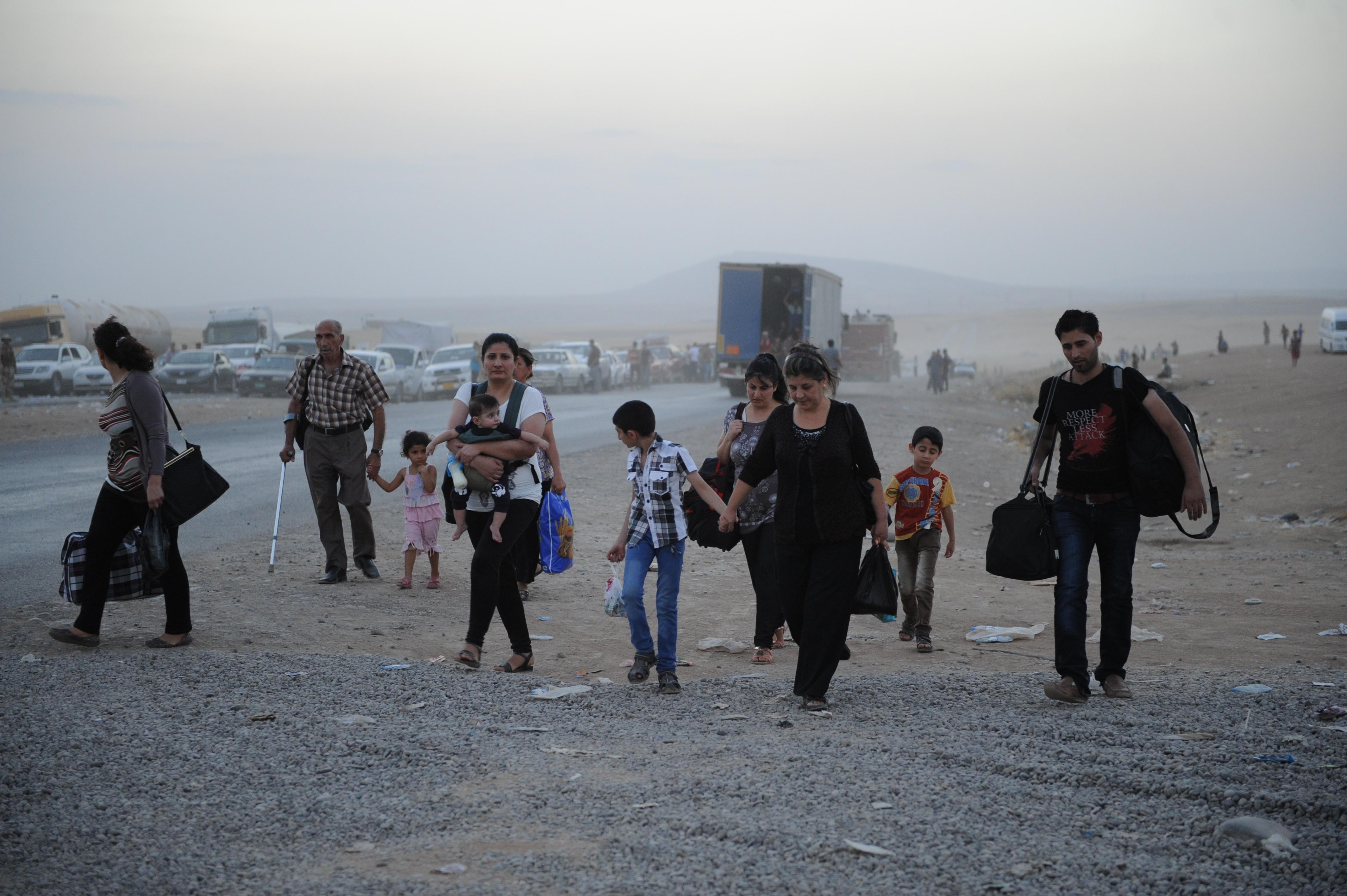
(Photo: Thousands of Yazidi and Christian people flee Hamdaniyah town of Mosul to Erbil after the latest wave of ISIL advances that began on Sunday has seen a number of towns near Iraq’s second largest city Mosul fall to the militants on August 6, 2014. By Mustafa Kerim/Anadolu Agency/Getty Images.)

Back To Iraq: Blog Reax

https://twitter.com/marieharf/status/497729146358099968

https://twitter.com/PentagonPresSec/status/497725099970031616

For Lawrence Kaplan, Obama’s decision to authorize airstrikes on ISIS targets in Iraq was a no-brainer:

The Yazidi, a tiny sect probably as old as the biblical province its members call home, have nearly been wiped out on dozens of occasions, by dozens of persecutors, and yet they survive. During the Iraq War, they turned to the Americans for protection, and the Americans turned to them for all manner of support. (The Yazidi supplied a disproportionate number of interpreters to the U.S. Army.) For this, the insurgents slaughtered the Yazidi, killing 500 on a single day in 2007. Whenever I would visit their ancestral home in the town of Sinjar, they would plead for stepped-up assistance from Washington.

The Yazidi need that assistance, and they need it today. For an administration that famously prefers to achieve its desired results abroad through suasion rather than brute force, this presents a conundrum. It should not.

Christine Allison argues that protecting Iraq’s religious minorities is a moral obligation:

If, through our own inactivity, we allow the Yazidis and Christians to suffer so much that they leave the country, what are we doing to Iraq, the cradle of civilisations? What about the smaller minorities, Shabaks and Mandaeans, who have found stability and shelter in the Kurdish region? Do we sit back and watch an extinction event in northern Iraq? As we commemorate the centenary of the first world war, we have only to look over Iraq’s border to see Turkey’s struggle to come to terms with its past in those years. Inaction in Iraq now will produce the same result: an ethnically “cleansed” landscape, a haunted population.

So now, in addition to our humanitarian efforts, we must turn to the Kurds, who, with their referendum on independence are apt to be perceived as causing “the break-up of Iraq”. But paradoxically, with their forces on the ground, they are the best protectors of northern Iraq’s diverse population. Air strikes and humanitarian drops are a beginning. But in the medium and longer term, London and Washington must find a way to maintain the balance of power between Baghdad and Kurdistan and still work closely with Kurdistan’s fighting forces to assure security.

Dreher also throws his full support behind the intervention:

It is my devout hope that the US kills as many ISIS berserkers as we possible can. I saw today video of a Christian child who had been decapitated by these monsters, and heads of Christians on pikes. There was news today that they were slaughtering Yazidi men and taking their wives as plunder. They are worse than Waffen SS. I’m pretty strongly noninterventionist, but that is not an absolute position, especially not when we can fairly be blamed for setting off this crisis. As they say in Texas, some people just need killin’.

Morrissey calls Obama’s announcement “the right and … only possible steps”, though he doubts airstrikes alone will do the job:

The Kurds have spent the last 23 years living in peace and freedom, relying on the US to protect their interests while being caught between the Turks, Iranians, and Iraqis. Walking away from the Kurds after their long support of our efforts to stabilize Iraq even at the expense of their own dreams of independence would be a betrayal that would send shock waves around the world to other groups working with the US — especially in Afghanistan. The Kurds will be the canary in the coal mine of American credibility for decades to come.

In the meantime, it will take more than a couple of airstrikes to stop the genocides of ISIS to come. The so-called Islamic State and its leadership is perhaps the most explicitly bloodthirsty regime to arise in generations or perhaps centuries, and nothing short of utter defeat will stop them from continuing to annihilate all those who do not bow down to them. The US and the West will have come to grips with this reality sooner or later, and in terms of lives lost and the effort necessary to stop ISIS, sooner would be much more preferable.

To Dan Hogdes, the events in Iraq prove that the US has to be the world’s policeman:

When people say “We don’t want America to be the world’s policeman,” I don’t think most of them actually mean it. What they really mean is “We don’t want America to be the world’s policeman, and the world’s prosecutor, judge and jury as well.”

And that’s a fair argument. But at the moment, with the implosion of the authority of the UN, there is no effective prosecutor, judge or jury. Earlier this week the UN patted itself on the back for the successful conviction of Khmer Rouge leaders Nuon Chea and Khieu Samphan. They are 88 and 83 respectively. Their victims – an estimated two million of them – died 40 years before. Pol Pot himself never faced justice. If we want a world based on laws then someone ultimately has to enforce them. And there is only one state on the planet with the means and inclination to do so. That state is the United States.

But the limits of the mission are very much in doubt. Ryan Goodman questions them:

[I]s this mission really just to protect US personnel or also to aid the Kurds? The New York Times reported that “aides said [the President’s] hand was not forced until ISIS won a series of swift and stunning victories last weekend and Wednesday night against the Kurds in the north, who have been a loyal and reliable American ally.” Similarly, Rep. Adam Smith, the ranking Democrat on the House Armed Services Committee, said “he supported intervening on behalf of the Kurds, as opposed to the unpopular Baghdad government. ‘The Kurds are worth helping and defending.’”

On the second mission (protecting religious minorities on Mount Sinjar), the President outlined three criteria for such humanitarian actions: “[1] innocent people facing the prospect of violence on a horrific scale, [2] when we have a mandate to help — in this case, a request from the Iraqi government — and [3] when we have the unique capabilities to help avert a massacre.” It is unclear, in my mind, why those three criteria won’t also apply to ISIS’s genocidal efforts elsewhere in the country, and the US ability “to help avert” those massacres.

Zack Beauchamp believes that the “key cause of all of this is ISIS’ somewhat surprising advance into territory held by Iraq’s Kurds”:

“This is a big deal,” Phillip Smyth, a researcher at the University of Maryland who follows this situation closely, said. “First, they push the Christians out of Mosul [Iraq’s second-largest city], and now they’re doing that.”

Smyth sees at least two basic motivations for the ISIS advance. One is simple opportunism: not every Kurdish unit is equally strong, and ISIS will take any territory it thinks it can, given the chance. The second is more strategy: they likely want to cut off Iraq’s Kurds from Kurdish communities in Syria, where ISIS is fighting a second front against the Syrian government. “They’re trying to cut off geographic links between those two territories,” he said.

John Cassidy asks, “Once the U.S. bombing starts, when will it stop?”:

That is one of the many tough questions that Obama and his colleagues will have to answer. Are the sole goals of the mission to help out the Yazidis and prevent Erbil from falling? Or is this the beginning of a U.S.-led effort not merely to halt the advance of ISIS on its eastern front, in the Kurdish region, but to roll it back everywhere in the country? On these questions, Obama was studiously ambiguous. … Already, though, one Rubicon has been crossed. A President who came into office on a promise to pull the United States out of Iraq, and who followed through on his pledge, has just ordered more combat operations in, or over, Iraq.

Josh Marshall wants to know what changed on the ground to tip Obama towards intervention, and why our understanding of ISIS’s and the peshmerga’s capabilities has been so wrong:

[W]hat’s happened to ISIS, which was supposed to be a fairly small, rag tag force, highly spirited perhaps but not a force capable of making gains against a disciplined regular army? Quite a bit of American weaponry did fall into ISIS hands when the Iraqi Army fled. But advanced weaponry usually requires significant training to use effectively or at all and additional time to integrate its use into a fighting force. It seems highly questionable that all that weaponry could have transformed ISIS’s capabilities so quickly.

And if ISIS hasn’t changed, is it possible that the Peshmerga were never really the vaunted force they were made out to be? That’s the question asked by this editorial in a Saudi paper. Whether it’s one of these misapprehensions or the other or both, either would seriously change the situation in Iraq from what we’d been led to believe as recently as a few days ago.

Indeed, if the Kurds can’t finish ISIS on the ground, even with American air support, what happens then? That’s where Jacob Siegel spots a major flaw in Obama’s plan:

The consensus among ex-CIA analysts, former military officers, and Iraq veterans who spoke with The Daily Beast is that the Peshmerga’s abilities were overrated. No one questions the Kurds’ willingness to fight, but their military prowess appears to have degraded in the years since the U.S. military stopped training them and withdrew from Iraq. … Air strikes against ISIS targets can weaken the group, buy time, and prevent it from massing on Kurdish forces, but according to military and CIA veterans, air power alone will not be decisive.

“The advisors need to be pushed out, if they haven’t been already,” said Nada Bakos, a CIA veteran who led the team analyzing the terrorist network that was ISIS’s predecessor in Iraq. The advisors she referred to are the special operations troops who have so far stayed away from the battlefield, offering intelligence and advice from headquarters in areas remote from the fighting.

Juan Cole is having flashbacks to 1991:

The Neocons who wanted to go to war against Iraq in the early zeroes always said that one reason a war would be good was that the US was spending a lot of money on the no-fly zone over Kurdistan– as if a whole war wouldn’t be much more expensive (it was, by about $1 trillion). Apparently not only has the Iraqi federal army almost completely collapsed, finding itself unable to take back Tikrit, but now the so-called Islamic State was making a move on Iraqi Kurdistan’s capital of Irbil. Obama’s hope that the so-called “Islamic State” can be stopped by US air power is likely forlorn. The IS is a guerrilla force, not a conventional army. But one thing is certain. A US-policed no fly zone or no go zone over Iraqi Kurdistan is a commitment that cannot easily be withdrawn and could last decades, embroiling the US in further conflict.

Lastly, Michael Crowley remarks on Obama’s evolution when it comes to genocide and US intervention:

In his 2007 comments about genocide, Obama at least seemed to imply that, because the U.S. can’t prevent slaughter everywhere, it shouldn’t take humanitarian action anywhere. But as President he has adopted a different point, first in Libya and now in Iraq: Just because we intervene in some places doesn’t mean we have to intervene everywhere. That doesn’t make for a very tidy doctrine. Nor will it console the miserable people of Syria. But it will bring jubilation to the terrified thousands on Mount Sinjar, for whom salvation is now coming.
Back To Iraq? Tweet Reax

https://twitter.com/Max_Fisher/status/497557187045359616

https://twitter.com/EvanMcSan/status/497556546000130048


https://twitter.com/BrettLoGiurato/status/497575078406520832

https://twitter.com/BrettLoGiurato/status/497565983482335232

https://twitter.com/nickrobinsearly/status/497561187656429569

https://twitter.com/joshgreenman/status/497557726105698305

https://twitter.com/Max_Fisher/status/497580465696423936

https://twitter.com/JeffreyGoldberg/status/497574852799496193

https://twitter.com/CrowleyTIME/status/497564436325216256


Did We Just Bomb Iraq?

https://twitter.com/PentagonPresSec/statuses/497488631599464448

Kurdish and Iraqi officials are attributing airstrikes on ISIS targets in northern Iraq to the US, but the Pentagon is denying everything:

The New York Times, citing Kurdish officials, reported that U.S. forces bombed at least two targets in northern Iraq. The McClatchy news agency also reported aerial bombings outside the town of Kalak in the Kurdish region of northern Iraq, stating that Kurdish media had described jets as American bombers. But the Pentagon press secretary, Rear Adm. John Kirby, said on Twitter that the press reports were “completely false.” The Pentagon also denied a report, by ABC News, that the U.S. had begun humanitarian air drops to people in need in northern Iraq.

Earlier on Thursday, a defense official told TIME that the Iraqi government had begun airdrops in northern Iraq and that it was considering providing “direct assistance wherever possible.” Multiple news outlets, including CBS News and the New York Times, reported Thursday that airdrops or airstrikes were among the options under consideration.

But even if they haven’t gone ahead with them yet, the Obama administration is definitely thinking about both as the situation rapidly deteriorates:

For months, hundreds of US military advisers sent to Iraq have compiled assessments of Iraqi military strength against Isis, a process that the Obama administration has portrayed as a prerequisite for any airstrikes. But with no offensive action taken, the Pentagon has faced criticism for dragging its feet on a deepening crisis.

Now Kurdish peshmerga irregulars have fallen back to positions closer to the regional capitol of the autonomous region, Irbil, following days of Isis gains in nearby towns in and near Iraqi Kurdistan. Tens of thousands of civilians are said to be crossing into Kurdistan for shelter. As much as the dire persecution of Iraqi religious minorities has prompted Obama administration discussions of food, water and medicinal air drops, the threat to the pro-US Kurds has contributed to the reengaged debate over air strikes.

Robert Farley explains why flying aid to the Yazidi refugees is easier said than done:

Unless the drops are very careful, militants might end up with the food and water. That’s not such a disaster, except that groups searching for aid packages can come into contact with armed militants searching for the same thing. The Pentagon has worked hard over the past decade to develop a system that allows precision delivery of large amounts of material, but the system remains geared toward getting supplies to experienced soldiers, not to groups of untrained civilians.

Moreover, airdrops of food, and especially water, are time- and resource-intensive. One off-the-cuff analysis suggested that 24 C-130 transport aircraft flying round trips every day would be necessary to keep the Yazidi supplied with water. Iraqi capacity is limited by the lack of available aircraft and by the need to devote resources to areas in direct combat. Iraq has a handful of C-130s, and a handful of smaller Antonov An-32s, but these aren’t nearly enough to meet the needs of such a large population, even under the best of circumstances. Thus, any operation would require the deployment of American, Turkish, or NATO transport aircraft to the area.

Gordon Lubold sums up the desperation in Iraq right now:

The situation has quickly grown dire. Humanitarian groups said earlier this week that as many as 40,000 civilians, many of whom are Yazidi, were trapped as vaunted Kurdish peshmerga forces defending the area lost ground to the Islamic State. Although the United States has supported Iraqi forces, including providing hundreds of Hellfire missiles, the peshmerga say they are poorly equipped to counter the Islamic State, previously known as ISIS. [White House spokesman Josh] Earnest on Thursday called the situation a humanitarian catastrophe. He also said the administration is deeply concerned about reports that several hundred girls had been abducted from the area.

Compounding the deteriorating situation is the Islamic State’s capture of Iraq’s largest dam, the Mosul. What that spells for civilians if, say, the militants blow it up, sending a 65-foot wall of water downriver, has been a concern since the Islamic State began its offensive across northern Iraq in the spring.

So Allahpundit figures if there’s a time to act, it’s the present:

The Yazidis starving on Mount Sinjar is bad, ISIS seizing the Mosul Dam is worse, and ISIS overrunning the one solid ally America has in the region is probably worst of all. Maybe the threat to Irbil finally convinced Obama to act. I’m honestly shocked that the jihadis could have the peshmerga so far back on their heels that the capital of Kurdistan could be under threat, but maybe that’s my own ignorance showing. If the Kurds aren’t going to push ISIS back, though, who is? Turkey? The Saudis?

A Genocide Is Being Committed In The Middle East

Some 40,000 Iraqi Yazidis, whose hometown of Sinjar was overwhelmed by ISIS militants on Saturday, are stranded on a mountain with little food or water after fleeing the city and being trapped there by the jihadists below, who consider them heretics:

UN groups say at least 40,000 members of the Yazidi sect, many of them women and children, have taken refuge in nine locations on Mount Sinjar, a craggy, mile-high ridge identified in local legend as the final resting place of Noah’s ark. At least 130,000 more people, many from the Yazidi stronghold of Sinjar, have fled to Dohuk, in the Kurdish north, or to Irbil, where regional authorities have been struggling since June to deal with one of the biggest and most rapid refugee movements in decades.

Sinjar itself has been all but emptied of its 300,000 residents since jihadists stormed the city late on Saturday, but an estimated 25,000 people remain. “We are being told to convert or to lose our heads,” said Khuldoon Atyas, who has stayed behind to guard his family’s crops. “There is no one coming to help.”

The Yazidis, Bobby Ghosh explains, are one of several Iraqi minority groups in danger of persecution and genocide by the murderous “caliphate”:

Many Shi’ites can flee—some already have—southward, and find refuge among family and those of their own sect; many of my Shi’ite friends in Baghdad are currently sheltering northerners sent to them by religious organizations. Kurds, likewise, have been streaming into the Kurdish-dominated areas to the north and west of ISIL-controlled territory. Yet another minority, the Assyrians, most whom are Christians, have also fled south, and now await succor from the West, especially from groups of well-established Iraqi Christians in the US, who themselves fled previous spasms of persecution. But other minorities, just as vulnerable to the wrath of ISIL, have neither international support nor nearby refuge. And ISIL seems to have identified them for special persecution.

ISIS has also captured the largest Christian town in Iraq. Razib Khan argues that these minorities’ days are numbered. To him, “the rise of the Islamic State, and the past 10 years of chaos and violence, suggest that this is the end of the persistence of ethno-religious sects such as the Yezidi across most of the Fertile Crescent”:

The Jacobites Christians, Assyrians, and Yezidi, lack powerful patrons and protectors. Though most Sunni and Shia would not countenance genocide, they are focused more on the exigencies of their own internecine conflicts. Many minorities already have large Diaspora populations Europe. Tens of thousands of Yezidi live in Germany, and tens of thousands of Assyrians live in Sweden. The most practical short term solution would be extend refugee status selectively to ethno-religious minorities to prevent them from being eliminated by genocide. …

Of course a final irony is that the migration of the ancient Middle Eastern minorities to the West will likely result in their diminishing over the generations. The corporatist straight-jacket of the Middle Eastern milieu was constricting, but it allowed for a communal identity to maintain itself. In the individualist West these small communities are unlikely to be able to self segregate in large enough ghettos where their cultural norms are dominant. This means that identity will become a choice, and over time intermarriage will likely result in a decrease in numbers. Though the Yezidi are rightly objects of sympathy, their cultural norms are quite retrograde in many ways. These folkways were adaptive in the circumstances of Kurdistan, a persecuted minority which had to maintain a high level of group cohesion. But in the West they are often impediments to full flourishing, and produce inter-generational conflicts.

Jacob Seigel notes that “Kurdish forces from Syria and Turkey have crossed the border, forming a rare alliance with the Peshmerga inside Iraq that has already begun clashing with ISIS to recapture the ground lost over the weekend”:

Tens of thousands of Iraqis now stranded in the mountains are awaiting the outcome of those battles. As for the United States, it is “working urgently and directly with officials in Baghdad and Erbil to coordinate Iraqi airdrops to people in need,” the Defense Department said. On Wednesday, it was 106 degrees in Mosul. There may be 25,000 children trapped in the mountains, according to the United Nations’ children’s relief agency. Forty of them have died already.

George Packer discusses what we might do to help the Yazidis:

Yesterday, a senior U.S. official told me that the Obama Administration is contemplating an airlift, coördinated with the United Nations, of humanitarian supplies by C-130 transport planes to the Yazidis hiding in the Sinjar mountains. There are at least twenty thousand and perhaps as many as a hundred thousand of them, including some peshmerga militiamen providing a thin cover of protection.  The U.N. has reported that dozens of children have died of thirst in the heat. ISIS controls the entrance to the mountains. Iraqi helicopters have dropped some supplies, including food and water, but the refugees are hard to find and hard to reach.

It was encouraging to learn that humanitarian supplies might be on the way, but we always seem to be at least a step behind as ISIS rolls over local forces and consolidates power. ISIS is not Al Qaeda. It operates like an army, taking territory, creating a state. The aim of the Sinjar operation seems to be control of the Mosul Dam, the largest dam in Iraq, which provides electricity to Mosul, Baghdad, and much of the country. According to one expert, if ISIS takes the dam, which is located on the Tigris River, it would have the means to put Mosul under thirty metres of water, and Baghdad under five.

But Morrissey wants more than that:

ISIS has purged Christians from their ancient communities in Mosul and the Nineveh province over the last several months. The war in Gaza has distracted the West for the last few weeks, but with that war now paused at the very least, perhaps it’s time to start shifting our gaze back to the much more dangerous situation in Iraq and Syria, where the death tolls already dwarf what has been seen in Gaza. We’ve spent a lot of time intervening in the Gaza war. What has the US done about ISIS, which poses much more of a threat to the US and the West, in a country where our presence might have made a difference?