1,700 Slaughtered? Ctd

140627_hrw1crop

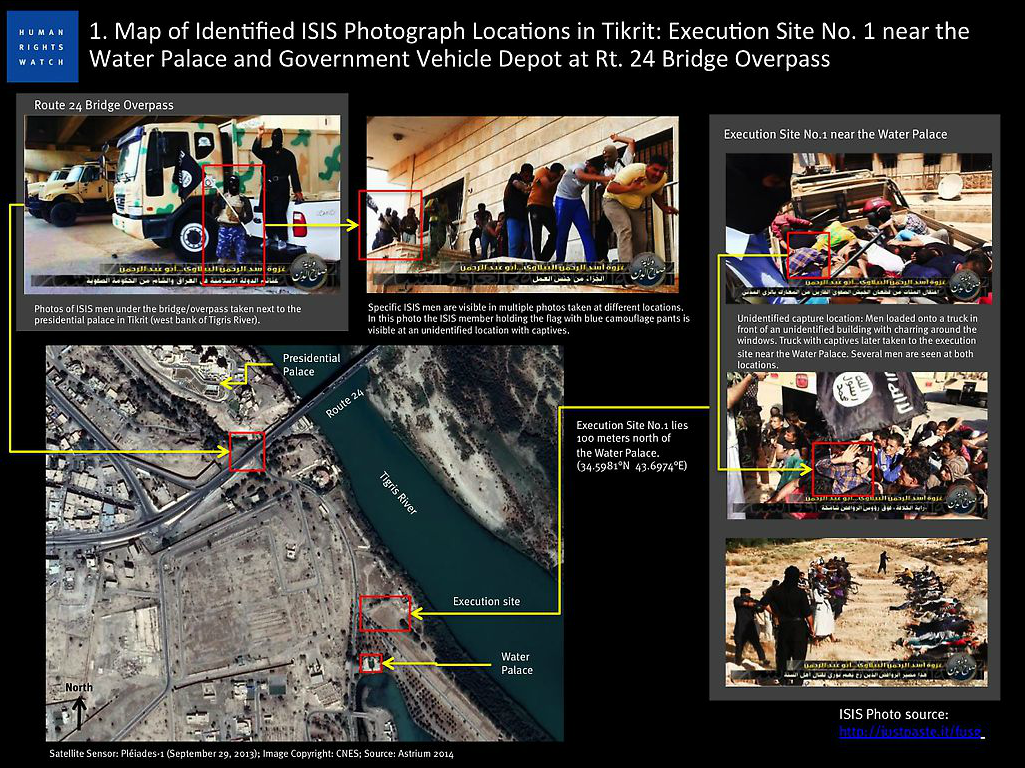
In what Elias Groll calls “an incredible piece of detective work”, Human Rights Watch has partly verified ISIS’s grisly claim from earlier this month that it had killed over 1,700 people during its campaign through northern and western Iraq:

In a report released Friday, Human Rights Watch pinpointed the exact location in which the images were taken. Corresponding satellite images show ground disturbance that apparently matches what the area would look like if mass graves had been dug and heavy vehicles — as seen in images posted by ISIS — had been driven there there.

Human Rights Watch determined that the photographs were taken a stone’s throw from the Tigris River and a former Hussein palace. The group’s analysis picks out individual captives and militants who appear across the photographs, seemingly bolstering the photos’ authenticity. The analysis suggests that between 160 and 190 men were killed between June 11 and June 14, though the actual death toll from ISIS executions in Tikrit could be significantly higher. The slides documenting the analysis are reproduced at the bottom of this post.

Meanwhile, Mona Mahmood and Mark Tran report, ISIS isn’t the only militia that has Iraqis scared for their lives:

[A]trocities are also being carried out by Shia militias, who have been summoned by the highest Shia authority in the land, Ayatollah Ali al-Sistani, to defend Shia holy shrines. The old Mahdi army, rebranded as Peace Brigades, can be counted on to stand and fight the insurgents, unlike the military. But their zeal is feared by those they target.

Hani Sa’aeed, 24, disappeared three days ago when he went to a shopping centre with a friend in Mahmoudiya, a town south of Baghdad. “After a few hours, his friend contacted us to say that Hani was taken by the Righteous League militia who are in control of the town,” said Ibrahim Abdul Majid, Hani’s cousin. “The militia were so furious after four explosions rocked the centre of the city during the day and killed many people. They were busy picking up young men based on their IDs. Hani’s friend advised us to act quickly to save him but we did not know what to do.”

Adbul Majid eventually rang the police, who said they had found the body of a young man in a compound near the shopping centre.

A Shocking Number Of Refugees

140620_refugeegraphicrevised

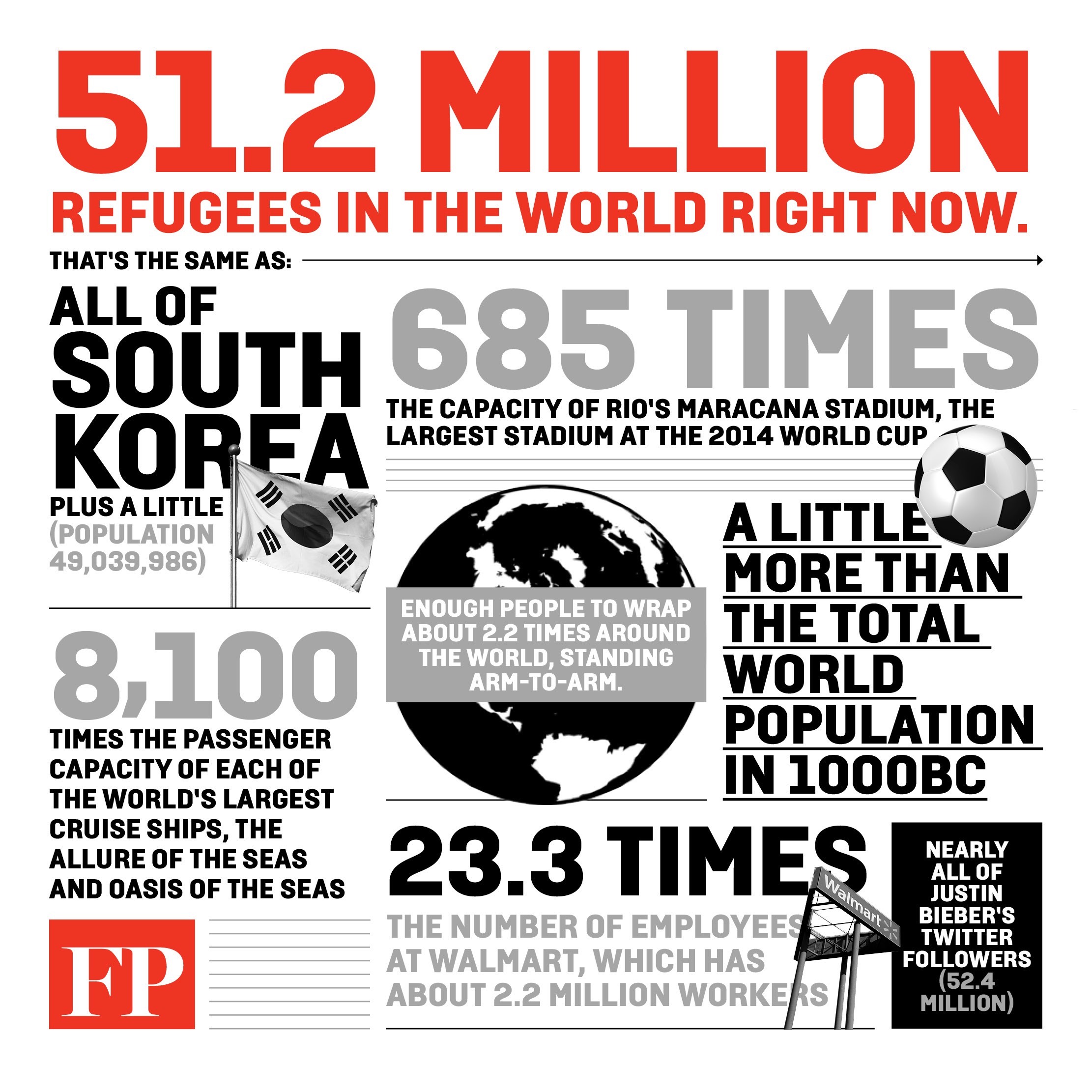
According to a recent report from the UN Refugee Agency, December was the first time since World War II that the number of displaced people climbed over 50 million:

The sharp increase in the total number of refugees was in large part the result of the ongoing Syrian civil war, which has forced 2.5 million to flee the country and resulted in 6.5 million internally displaced people. In total, there were some 51.2 million refugees in the world at the end of 2013, an increase of more than six million on the previous year. On its own, the figure 51.2 million can be somewhat difficult to conceptualize, a figure so large that it’s difficult to imagine the human toll of conflict.

Will Freeman delves into the report, which shows how Iraq is driving the number up even further:

In just over a week, refugees fleeing insurgents battling to create an Islamic state in Iraq have tripled from 500,000 to 1.5 million. The swift takeover of towns such as Mosul and Tikrit by the Iraq Islamic State in Iraq and Greater Syria (ISIS), also known as the Islamic State in Iraq and the Levant (ISIL), has displaced nearly 1 in 30 Iraqis. UNICEF, the United Nation’s children’s agency, recently upgraded the crisis to a level 3 humanitarian disaster— its most severe ranking. … The future is grim for Iraq’s latest wave of displaced people, as only 31 percent of the United Nation’s funding requests have been met. With terrorists continuing to fight their way towards Baghdad, the number of refugees will likely continue to rise.

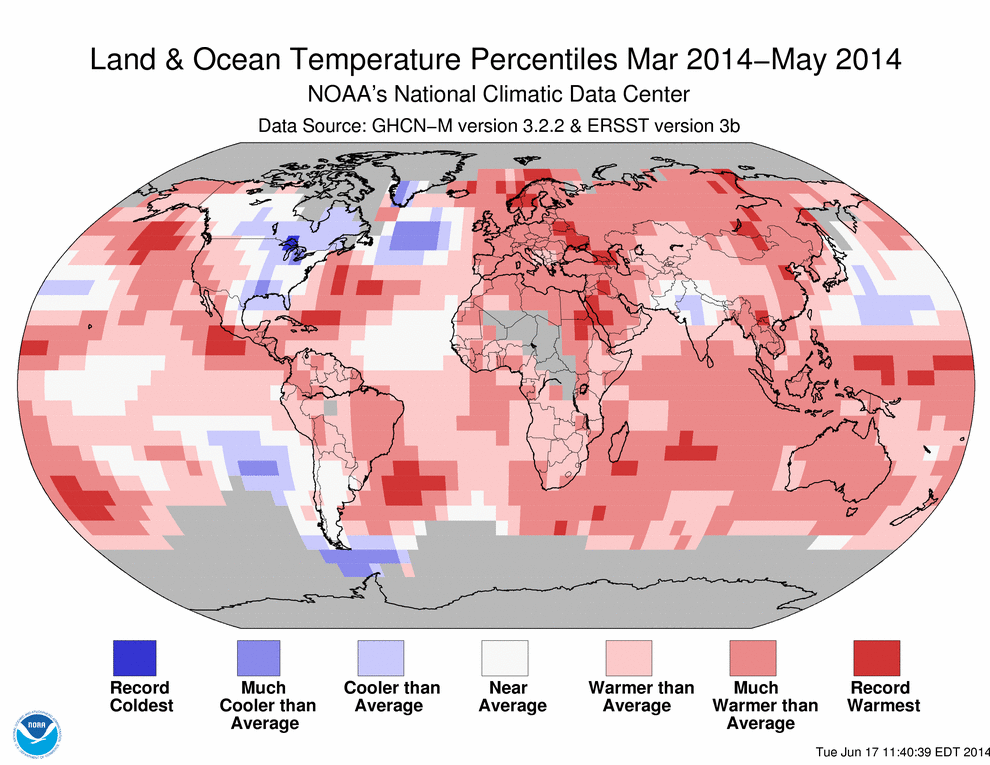
To make matters worse, the record number of refugees are experiencing brutal temperatures:

Temperatures have indeed been much hotter than average in the Middle East this year. According to the US National Oceanic and Atmospheric Administration, just about the entire region was classified as “Much Warmer Than Average” for the March-May period, while much of Iraq and bits of Syria saw record-high temperatures.

1403897449674704

Image: NOAA

In line with global warming’s habit of punishing the most vulnerable populations, other refugee-laden regions saw record heat too, such as the conflict-stressed area near the Golden Triangle, an opium-producing hotbed. Thailand’s border is riddled with refugee camps, where Burmese have sought shelter for decades, after fleeing the violently oppressive ruling junta.

I’ve been to one of those camps, and it was an abject, malarial place. Tens of thousands of people were cramped together in mud-pocked makeshift housing, with limited access to medical treatment, and totally exposed to the elements. Like the heat.

There are 16.7 million refugees in such situations, and 35 million more are displaced. And both trends, displaced people and rising temperatures, are only on track to worsen.

Previous Dish on the Iraqi refugee crisis here and here.

Update: Jay Ulfelder disputes a key talking point of the UN Refugee Agency report:

A lot of the news stories on this report’s release used phrases like “displaced persons highest since World War II,” so I assumed that the U.N. report included the data on which that statement would be based. It turns out, though, that the report only makes a vague (and arguably misleading) reference to “the post-World War II era.” In fact, the U.N. does not have data to make comparisons on numbers of displaced persons prior to 1989. With the data it does have, the most the UNHCR can say is this, from p. 5: “The 2013 levels of forcible displacement were the highest since at least 1989, the first year that comprehensive statistics on global forced displacement existed.” The picture also looks a little different from the press release if we adjust for increases in global population.

Kurdistan’s Moment? Ctd

Steven Cook weighs in on the prospects for Kurdish independence. He’s less bullish than most:

For all the confidence in Erbil, the Kurds have a host of significant problems that seriously complicate the establishment of an independent Kurdistan.  The Kurds have enjoyed something that looks a lot like a state for the past three decades, but they have never actually had the responsibilities of a state.  Even as they railed against Baghdad for routinely bilking them out of large amounts of the 17 percent share of government revenue they were supposed to receive, they were still dependent on the central government.  The answer is obviously oil revenues, which are promising, but it is clear that with legal challenges and capacity issues, it is no panacea.  The Kurds will be living hand-to-mouth for quite some time.

There is a lot of oil and a fair number of Western oil guys hanging around the Divan and Rotana hotels, but beyond that there seems to be very little economic activity in Kurdistan.  Erbil is notable for its half-finished construction sites, including a shell of what is slated to be a JW Marriott and some of those exclusive have-it-all-in-one-place developments that cater to expats and super wealthy locals all around the Middle East.  The Kurds clearly envision Erbil to be the next Dubai, but it is not even Amman yet.  There are shops and some good restaurants, but no real banks to finance development. Other than oil, the Kurds do not produce much of anything.

Previous Dish on the Iraqi Kurds here, here, and here.

From The Annals Of Chutzpah

iraq-parliament-architecture-assemblange

As the country literally falls apart, Iraq is spending $1 billion on a new complex for its parliament:

The well-known London-based, Iraqi-born architect Zaha Hadid has been tapped to design a 2.7-million-square-foot building on the 49-acre site, even though her proposal—which remains secret—came in third in the international architecture competition.

The secretary general of Iraq’s parliament, Ayad Namik Majid, told the Architect’s Journal that the insurgency had caused “no problems” to plans for the complex, despite the fact that many other major developments across the country—including hospitals in Basra, a master plan in Najaf, and an oncology center and a library in the capital—have been put on hold. The site of the future parliamentary complex is near the abandoned Al Muthana airport, and it still has the remains of a colossal mosque that was being constructed at the time of the 2003 US invasion.

(Image: British architecture firm Assemblage’s proposal for the Iraqi parliament, shown here, won the international competition but the parliament decided to go with Hadid’s design instead)

Uh-Oh …

President Obama – in a huge and epic U-turn – wants $500 million to train “moderate” Syrian rebels:

Previously, US aid to the Syrian opposition that is fighting dictator Bashar al-Assad focused on non-lethal provisioning, while the Central Intelligence Agency focused on sending small arms and missiles to what the US calls the “vetted” Syrian moderates. Yet the Gulf Arab states have established an arms pipeline giving a substantive military edge to jihadist groups fighting Assad and one another. … US military training for the Syrians, three-and-a-half years into a conflict that has killed more than 150,000 people and recast the boundaries of the Middle East, is likely to take place in Jordan, where the US military already trains its Iraqi counterparts. It is also in line with Obama’s desired template for counterterrorism, as unveiled at West Point, in which the US trains foreign security forces to assault terrorists themselves.

Lisa Lundquist reviews why this is a terrible idea:

At this point, it is not entirely clear which vetted elements of the Syrian opposition can be relied upon to keep the arms out of the hands of the jihadists groups who dominate the battlefield, including the Islamic State of Iraq and the Sham (ISIS), and al Qaeda’s branch in Syria, the Al Nusrah Front.

As The Long War Journal has documented over the past year at least, in numerous instances previous US efforts to equip ‘moderate’ Syrian rebels have been compromised by the frequent partnering of ‘moderate’ and Islamist forces, as well as by the sheer power of the Islamist forces themselves. [See Threat Matrix report, Arming the ‘moderate’ rebels in the Syrian south.]

It is difficult to see how throwing another $500 million into the Syrian morass will effect a positive outcome. Jihadist forces currently control virtually all of the border crossings into Syria from Turkey and Jordan (not to mention Iraq) through which Western aid would flow. It is a well-known fact that these jihadists determine the distribution of such supplies once they come into Syria.

Also, the FSA’s leadership was apparently just sacked. Aren’t these the ones we’d theoretically be helping? Or maybe it was a precondition:

Syria’s opposition government sacked the military command of the rebel Free Syrian Army late Thursday over corruption allegations, as the White House asked lawmakers for $500 million for moderate insurgents. A statement by the opposition government said its chief Ahmad Tohme “decided to disband the Supreme Military Council and refer its members to the government’s financial and administration committee for investigation”.

The decision came amid widespread reports of corruption within the ranks of the FSA, which is backed by Western and Arab governments in its battle to overthrow the regime of President Bashar al-Assad. The government in exile said it was also sacking FSA chief of staff Brigadier General Abdelilah al-Bashir.

There’s one silver lining. The initiative, as neocon Gary Schmitt argues, “has all the appearances of being a strategy for appearing to do something without actually doing much of anything”:

Five hundred million is a pittance when it comes to these kinds of operations. Much like the one billion for new defense initiatives in Eastern Europe in the wake of the Russian invasion of Ukraine, it amounts to a smidgen here, and a smidgen there.

The truth of the matter is that the Obama team has let things get so out of hand in Syria that they have little interest now in actually removing Assad from power. Indeed, with ISIS on the move in Iraq, Assad, along with Iran, has in effect become an ally in that conflict. At best, this new effort is a campaign to keep the killing going so that no one group is finally successful. But of course conflicts are not like backfires, in which a fire is deliberately set in the path of an oncoming fire with a goal of having the oncoming fire burn itself out. These kinds of “fires” will jump that line and typically increase the conflagration—as we have already seen in the case of Syria over the past three years as the conflict has spread to Lebanon, Iraq and perhaps soon, Jordan.

Schmitt sees that as a bad thing, of course. But then he can write phrases like “the Obama team has let things get so out of hand in Syria” as if this entire crisis is simply a function of whatever America decides – or doesn’t decide – to do. Maybe Obama’s initiative is a way to fob off the hyper-ventilating hegemonists and buy some time. I sure hope so. The last thing we should want is for this kind of meddling to be in any way impactful.

Syria Intervenes

On Wednesday, Jassem Al Salami flagged evidence that Syria, and quite possibly Iran as well, were carrying out airstrikes against ISIS in Iraq:

[Tuesday morning,] unidentified jet fighters bombed a market in the Islamist-held city of Al Qa’im in northwestern Iraq. The city, which recently fell to militants from the Islamic State of Iraq and Syria, is near the Syrian border, so we’re assuming the bombers were Syrian—an eastward extension of Damascus’ brutal air war against rebel forces. At approximately the same time as the market exploded, Iraqi social media users reported contrails over Baghdad heading from west to the east. The contrails didn’t match the usual twin pattern of civilian airliners or military cargo aircraft, indicating fighters.

Four separate air arms are now active over Iraq, which is fighting a desperate battle against invading ISIS militants coming from Syria. Iraq, Syria and—possibly—Iran have bombed ISIS. And the U.S. Navy and Air Force are flying reconnaissance missions. We’re pretty sure the contrails over Baghdad weren’t from American planes.

Maliki confirmed this yesterday, saying that Syrian planes were indeed striking the militants and that he was pretty happy about it. The Syrian government is denying it, but “a Syrian source” provides Mohammad Ballout with a detailed account of what areas the air force is targeting and why:

In the past six days, Syrian warplanes conducted air operations to support Iraqi forces in their moves against ISIS and slowed down the advancement of ISIS to the Jordanian borders. ISIS has already taken over the strategic city of Ratba, which opens the way to the Saudi-Jordanian triangle and Terbil crossing and leads to Jordan.

A Syrian source reported that squadrons of Syrian military aircraft in the eastern regions, especially in Deir ez-Zour and Tabaqa, raided six Iraqi regions in coordination with the Iraqi army, two days after the ISIS attack on Mosul. Moreover, the Syrian warplanes targeted the ISIS locations in Ratba, Qaim, Mosul, al-Waleed, Baaj and al-Ramadi.

The Syrian warplanes intensified their efforts in Raqqa to strike the supporting bases of ISIS. They are also trying to destroy the organization’s main gatherings in al-Shadadi, south of Hasakah, which ISIS had transformed into spots to collect weapons and spoils that it had confiscated in Iraq.

Ian Black connects the airstrikes to Assad’s calculation that ISIS has changed from a useful propaganda tool to a security threat:

When Assad freed hundreds of hardened Salafi fighters, in 2011 and 2012, many of whom had previously been allowed, with the help of the Syrian Mukhabarat intelligence service, to cross into Iraq to fight US forces there, his intention was probably to bolster the narrative that Syria was engaged in a fight against violent extremism. Winning the propaganda war would ward off western help for the moderate opposition and cause damaging divisions in rebel ranks. …

The Syrian National Coalition, the main western-backed opposition group, dismissed those raids as “a ridiculous decoy” designed to rebuild trust with the international community after Assad’s clandestine relationship with Isis was exposed. But a plausible explanation could be that recent developments in Iraq have forced the Syrian president to take Isis more seriously than he has done so far. Tacit cooperation with a dangerous enemy may now be over. If war makes for strange bedfellows, neither party should be too surprised if, when the relationship outlives its usefulness, the other one simply kicks them out.

Along the same lines, Keating posits that Assad has been rehabilitated, at least partially, by dint of an enemy even scarier than himself:

For the most part, Assad tolerated the rise of ISIS in recent months in a bid to divide and stigmatize the rebels. He has now begun bombing them at the exact moment that the U.S. and Europe have become increasingly alarmed about the group’s rise.

A bit less than a year ago, it seemed extremely likely that the U.S. would drop bombs on Assad’s military. Today the U.S. is seriously considering dropping bombs on Assad’s enemies. And Assad has succeeded in this turnaround while continuing the wanton slaughter of Syrian civilians and possibly continuing to use chemical weapons. The Syrian leader’s actions may have plunged an entire region into irreparable chaos, but in terms of pure self-preservation, he looks pretty shrewd right now.

But still, Syria remains a humanitarian catastrophe, a fact for which Assad remains primarily responsible:

It is hard to fathom the humanitarian crisis in Syria getting any worse than it already has. But it is, with the number of Syrian civilians residing mostly beyond the reach of United Nations relief workers swelling from 3.5 million to about 4.7 million, according to new U.N. estimates. Those enduring the brunt of the misery are civilians trapped in rebel-controlled terrain, cut off from life-saving assistance by a dizzying array of bureaucratic regulations and subjected to a relentless barrage of indiscriminate barrel bomb attacks by the Syrian Air Force, according to the internal U.N. data as well as a June 20 report to the U.N. Security Council by U.N. Secretary General Ban Ki-moon. …

Over the past three months, humanitarian relief deliveries to opposition areas throughout the country have fallen by 75 percent compared to the quantities of aid delivered in the first three months of the year. According to Ban, the Syrian government has systematically blocked the delivery of medical supplies — particularly syringes and blood supplies — to civilians in rebel-held areas. Ban said that was “in clear violation of international humanitarian law,” Ban wrote. “Tens of thousands of civilians are being arbitrarily denied urgent and life-saving medical care.”
Jihad 2.0, Ctd

ISIS’s online propaganda machine may be sophisticated, but they aren’t the only Iraqis on Twitter. Anti-ISIS voices are also making themselves heard:

While ISIS’s brutality — and its inclination to display it on every social media platform available — has been well covered, the Iraqi counter-campaign has garnered relatively little attention in Western outlets. But the #No2ISIS hashtag has already surged on Instagram and seems to be doing so on Twitter as well. Anti-ISIS protesters in London began using the hashtag earlier today on posters, while the Iraqi ambassador to the U.S., Lukman Faily, has even appeared in photos holding placards with the hashtag.

The idea is simple: For many Iraqis, the quickest way to counter the ISIS propaganda machine is to make one themselves.

Meanwhile, Jillian York wishes Twitter would stop shutting down the jihadis’ propaganda accounts:

Is there any benefit to Twitter allowing these accounts to thrive? Anna Therese Day, an independent journalist who has been working on the ground in Syria since 2012, believes there is. “As a conflict journalist, the Internet, particularly social media, has been an invaluable tool in identifying and reaching out to sources and interview subjects,” says Day. “In the case of ISIS, I’ve personally used various Internet applications to stay in touch with them as well as other sensitive sources, and their public internet presence has informed a significant part of our understanding about the group’s recruitment, worldview, and motivations as well as how they relate to each other.”

It isn’t just journalists who see Twitter as an important channel for communication with these groups. In 2011, amid calls from Sen. Joseph Lieberman for Twitter to block al-Shabaab’s accounts, Kenyan military spokesman Maj. Emmanuel Chirchir tweeted that “Al Shabaab needs to be engaged positively and twitter is the only avenue.”

Was Sectarian Strife Inevitable? Ctd

A reader grabs the question by the horns:

I am a longtime reader and feel the need to weigh in on this ongoing debate about sectarianism in Iraq. I wrote my dissertation (under the supervision of Juan Cole) about Iraqi anti-colonialism during the era of indirect British rule (1932-1958) and am currently working on a book that expands the project a bit to cover 1914-1963. As of this fall, I will be an assistant professor of history.

In my view, there is something really problematic about the way in which this debate about sectarianism in Iraq is evolving. On one side we have the argument that sectarianism is an inescapable element of a primordial culture, and that the current violence is the inevitable consequence of the (British) colonial myopia that forced Sunnis, Shi’a, and Kurds into an artificial nation-state. On the other side, we have the argument that sectarianism is a fundamentally modern phenomenon, the entirely avoidable outgrowth of an (American) imperial ignorance that insisted on viewing Iraq as a collection of distinct sects and proportioning power and influence along sectarian lines.

Both arguments ignore the basic realities of Iraqi history between 1920 and 2003.

The constructionists, as you have noted, often fail to take seriously the significance of sectarian violence in the aftermath of the Gulf War, either ignoring the brutal suppression of the Shi’a intifada or dismissing it is an act of political brutality that was statistically (but not ideologically) sectarian. The primordialists, though, are guilty of ignoring an earlier period of communal coexistence in the 1940s and 1950s. Fanar Haddad, Reidar Visser, Sinan Antoon and other constructionists are on very solid ground when they point to this period, which was absolutely not an historical mirage or a superficial alliance of collective interests, as the casual observer might assume. It is true that the Kurds were never entirely integrated into this burgeoning sense of Iraqi collectivity, but the Kurdish issue is not exactly what we have in mind when we talk about sectarianism in Iraq.

So what the hell really happened, then? If we can’t simply wave our hand and bemoan the original sins of British colonialism in setting this whole tragedy in motion OR point our finger at the neo-conservatives for making this avoidable bloodshed inevitable, how can we account for what is happening? Fanar Haddad might be a bit reductive in the Vox interview that you cited – though he does explicitly reference the Iranian Revolution and the rebellion of 1991 as part of a “cumulative process” of deepening sectarianism, but his book Sectarianism in Iraq gives far greater attention to the formation of sectarianism before and after 2003.

The language of today’s sectarianism is a gradual and logical outgrowth of the narrative of shu’ubiyya, a reference to Persian Muslims who supposedly worked to undermine Arab cultural and political unity in the ‘Abbasid period. This narrative was heavily utilized during Saddam during the Iran-Iraq War and during the suppression of the 1991 uprising, but its modern usage really dates back to the way that Arab nationalists talked about the Iraqi Communists during the Qasim years (1958-1963). Again, given the concentration of Shi’a in the Iraqi Communist Party, the casual observer might insist that this was surely just primordial sectarianism cast in different ideological terms, but I contend that the historical evidence weighs strongly against that conclusion. Some of the principle proponents of this anti-communist shu’ubiyya discourse were Shi’a, like the famous poet Badr Shakir al-Sayyab. The political violence that followed the 1958 Revolution tended to gradually undermine the secular basis of the dominant political parties and to replace these modern political identities with older loyalties rooted in ethnic and religious ties.

There is obviously a very complex historical argument that lies beneath this brief sketch, but it is really important to note that the tragedy of Iraq ought to be seen as part of the broader trajectory of secularism and socialism in decline. The fact that the decline of ideological and class loyalties in Iraq has given rose to bloody and violent sectarian strife does not necessarily indicate that sectarianism was lurking beneath the surface all along. The failures of British colonialism and Hashemite nation building, the violence of both communist and anti-communist partisans in the early 1960s, the unique depravity of Saddam Hussein, the incompetence and unforgivable ignorance of the American neo-conservatives, the foolish policies pursued by Nuri al-Maliki, the despicable role played by the Saudis, and the grotesque ideology of the Jihadis have all played their own important roles. It would be quite a pity, though, to ignore the historical significance of coexistence in mid-century Iraq and chalk this all up to the primordial hatreds of a backwards civilization.

I do really appreciate and respect you for engaging in this debate at a time when so many Americans simply want to shake their heads.

But Can ISIS Harm Us?

Arguing against intervention in Iraq, Aaron David Miller downplays the threat posed to Americans:

[I]t is unlikely that it will come to rule Syria or Iraq in full, let alone fulfill its fantasy of creating an Islamic caliphate. … Instead, it is likely that ISIS will become a major counterterrorism problem for the region, and perhaps for Europe. As for striking America, that’s a more complicated issue. It didn’t work out so well for al Qaeda’s central operations, as recent history shows. And as my Foreign Policy colleague Micah Zenko reminds us, in 2013 there were 17,800 global fatalities due to terrorism, but only 16 of those were Americans. Although preventing attacks is the most important foreign policy priority, bar none, terrorism — including from ISIS – just isn’t a strategic threat to the homeland right now.

Ambinder thinks Obama is responding to the threat, such as it is, pretty astutely:

ISIS’ anti-American bluster is worth noting, as are its direct ties to lethal insurgents elsewhere. But surely the way to expedite the fermentation of the next wave of Sunni terrorism is for the U.S. to start fighting Sunnis.

Interestingly enough, the central tenet of President Obama’s counter-terrorism policy is NOT to deny terrorists safe havens. Our counter-terrorism policy is mocked by critics as little more than a game of whack-a-mole. And they’re right. A terrorist pops up here; so here is where you send the drone. Mole whacked. …

If all the terrorists in the world found themselves attracted to a caliphate between Syria, Kurdistan and Iraq, they would make the country a ripe target for later, purposeful intervention by the United States. Right now, the threats to the U.S. are bluster. Keeping a response to an intelligence and special operations force surge to Iraq is a good way to make sure that, whatever happens — and really, there is no way of knowing what ISIS will look like in a month, or two — the U.S. will have its eyes and ears on a potential threat.

But Aki Peritz is worried about “bleedout”, especially in Europe, as Western jihadis come home from the fight:

There are troubling signs that bleedout from the Syria conflict might already be occurring. Just this year, an attack on a Jewish center in Brussels that left four people dead was reportedly the handiwork of a Syrian returnee. In Kosovo last November, local authorities arrested several individuals, including two Syria vets, who were plotting an unspecified terrorist attack. More ominously, French authorities busted another Syrian returnee in Cannes for building a one-kilogram bomb filled with the high explosive TATPright out of the al Qaeda playbook.

Multiple investigations remain ongoing to determine whether Syrian extremist groups specifically greenlighted any of these operations. But for a jihadist organization to spare 100 or 200 foreign fighters to return to their home countries to carry out operations, however, doesn’t require a stretch of the imagination.

Maliki Won’t Budge

As the Iraqi president refuses to step down and instead vows to move ahead with forming his own government, Juan Cole sees the crisis deepening:

Al-Maliki rather outrageously accused those who called for him to step down in favor of a government of national unity of de facto allying with ISIS, a would-be al-Qaeda affiliate, and the remnants of the Baath Party that used to rule Iraq in former dictator Saddam Hussein’s day.

Shiite leader Muqtada al-Sadr put forward a 6-point plan for ending the crisis. He urges that the ‘moderate Sunnis’ be separated from ISIS terrorists and called for a government of national unity (exactly what al-Maliki just rejected). He also called on Iraqis to act against any foreign incursions into Iraq.

At the same time, Ali al-Hatim, leader of the Council of Sunni Tribes, rejected the notion of al-Maliki gaining a third term: “He has to go, like it or not.” He characterized al-Maliki’s rule as “rule by Iran.” He also denounced the present constitution as an “occupation constitution.”

But even if Maliki were willing to step down, replacing him wouldn’t be easy:

“There is no chance of the elites coming together to confront the serious threat to the state that ISIS presents with Maliki at the helm,” said Emma Sky, who served as the political advisor to Gen. Ray Odierno during his tenure as the top U.S. general in Iraq. “The best hope is that the elites agree on an alternative — they have the votes to do so.”

Still, finding a replacement acceptable to all of Iraq’s sects and political parties will be an extraordinarily difficult task because of the number of boxes the potential leader must check. He has to be a Shiite, but not one as harshly anti-Sunni as Maliki. He needs the military know-how to repair Iraq’s battered armed forces and oversee a counterattack against ISIS. To top it off, he needs the diplomatic skills to work with both Washington and Tehran, despite the lingering tensions between the United States and Iran.

Reading between the lines of US strategy, Mark Thompson suspects that Obama is trying to save Maliki but force him to compromise:

It’s simple: the U.S. military generally “sends messages” by attacking. Now it is sending messages by not attacking. And its target this time around isn’t the enemy, but its purported ally running the country.

While the Pentagon officially denies it, the U.S, government is dragging its feet when it comes to defending Prime Minister Nouri al-Malaki’s government in Iraq. … Washington is trying to hit the sweet spot: promise to deliver enough help in the form of air strikes and on-the-ground advisers to preserve Maliki’s government, but make sure it arrives slowly enough that he feels compelled to compromise with the Sunnis and Kurds who are now tearing the country apart.