Raging Against Obama – And History

President Obama Delivers Statement On Situation In Iraq

[Re-posted from earlier today]

If you’re looking for a majestically sweeping indictment of everything president Obama has achieved in foreign policy over the last six years, go read Walter Russell Mead’s screed. The rise of an ISIS-led Sunni insurgency in Iraq is, apparently, “a movement that dances on the graveyard of his hopes.” No one wants to take on the emperor with no clothes or “the full and ugly course of the six years of continual failure.” He’s not done yet: “Rarely has any American administration experienced so much ignominious failure, or had its ignorance and miscalculation so brutally exposed.” And on it goes. The Obamaites “have piled up such a disastrous record in the Middle East” that they couldn’t be trusted to “negotiate their way into a used car lot.” And the final denouement:

The President isn’t making America safer at home, he doesn’t have the jihadis on the run, he has no idea how to bring prosperity, democracy, or religious moderation to the Middle East, he can’t pivot away from the region, and he doesn’t know what to do next.

Inevitably, when one reads a piece like this, you expect the author to tell us what he would do next. If the results of specific Obama policies have been so disastrous, then surely he must be able to point to several mistakes, offer an alternative in hindsight, or, heaven forfend, provide a constructive proposal today. But you will, alas, find no such thing in the screed. The most you’ll get it this:

How could the U.S. government have been caught napping by the rise of a new and hostile power in a region of vital concern? What warning signs were missed, what opportunities were lost—and why? What role did the administration’s trademark dithering and hairsplitting over aid to ISIS’s rivals in the Syrian opposition play in the rise of the radicals?

Indeed, I’m sure those questions will be debated by pundits and historians. But Mead has no answers. He supported arming the “moderate” Syrian rebels, sure, but even he acknowledged this could end up in tears. And when you grasp his admiration for ISIS’ strategic chops, it seems quite likely that American arms could have ended up in the Jihadists’ hands. After all, one result of the US’ arming, training and equipping the moderate Iraqi army are the humvees and arms being paraded around Iraq by the Sunni-ISIS insurgency today. Arming any single side in a complex, metastasizing conflict is fraught with unintended consequences and the constant risk of blowback. But even if we’d been able to arm genuinely “moderate” Syrian rebels, does anyone believe they would prevail in an internecine war with the true fanatics?  From the record of the last year or so, almost certainly not.

Mead also manages to blame Obama for the failure of the democratic revolution in Egypt. Quite how the US president could have changed the course of Egyptian politics in a period of massive unrest and revolution is not entirely clear. And that’s really the deepest flaw in the case against the president. There is an assumption – even now! – that the world is controlled by the US and that everything in it is a result of American hegemony. So there are no places on earth where the US is not a factor, and any bad things that happen are ipso facto a consequence of poor foreign policy. The planet is “Obama’s brave new world,” and the actual actors in it, from Moscow to Fallujah, from Qom and Cairo, are denied the real agency they have and keep exercising. And of course, whatever Obama has done has failed. When we don’t intervene, as in Syria, the result is a disaster. When we do intervene, as in Libya, the result is “an unmitigated disaster from which not only Libya but much of north and west Africa still suffers today.” So what does Mead suggest? This is as good as it gets:

The U.S. might do better to try to strengthen the non-ISIS components of the Sunni movements in Syria and Iraq than to look to Tehran and the Kremlin for help.

As they still say in Britain’s Private Eye, er…. that’s it. We should actually be arming the very Sunni forces that are trying to take Baghdad, and somehow hoping they’ll turn around and beat the fanatics if we ask nicely. Well, thank you very much, Mr Mead. How could the administration have ignored your genius for so long?

I think what’s missing from Mead’s harrumph is any sense that the world is, in the end, not about us; that the Arab and Muslim worlds are in a historic convulsion that has been fed by countless tributaries from the past and will forge many unexpected paths in the future; that the generational shifts, the impact of new technology and media, the decay of traditional Islam, the rise of an Internet Islamism, the legacies of the sectarian war in Iraq and the Assad despotism in Syria, and the rise of a new Shiite awareness … all these represent forces we have no way of arresting, let alone controlling, let alone micro-managing, as Mead suggests. Our role, if we are not to become insane, is not to manage the unmanageable; it is to understand that some historical processes have to take place and that some of them will not necessarily be in our interests.

Interventionists, in other words, can become like addicts.

Yes we need the courage to change the things we can change (like our surveillance, security and intelligence apparatus), but also, critically, the serenity to accept the things we cannot change (like the future of the younger Arab and Muslim generations or that of the ancient Sunni-Shia struggle), and the wisdom to know the difference. Interposing ourselves even now as the indispensable overseer and arbiter of the fate of Iraq and Syria and the Middle East is to further engage in the fantasies that still linger from the elysian period of 1989 – 2001. If we haven’t learned from the last decade and a half that our assumption of that control is a self-defeating chimera, then we’re incapable of learning anything.

Even with unlimited resources, a decade of effort and death and suffering on a vast scale, we were unable to change the reality of Iraq: a divided traumatized, sectarian mess, where the Sunnis believe they have a right to rule, the Shia have somehow regained power, and the Kurds could give a shit about either. Maybe it should have occurred to us that there has not been majority Shiite rule in Iraq for so long for a reason. Maybe Maliki’s dictatorial impulses were not some wanton decision to destroy Iraq, but a rational move if you are actually trying to govern Iraq as it is, just as Saddam’s despotism was. What amazes me about critics such as Mead is that they have learned no deeper lessons from this; they still, rather pathetically, cite the surge as a success, when it clearly did nothing but bribe a phony peace into temporary existence in order for us to leave … and the old order of things return. And they still cling to a worldview in which everything is run from Washington.

But it isn’t. Our long-term goal is the emergence of a peaceful, democratic Middle East that does not export terror and medieval fanaticism across the globe. And we’ve seen the first spasms of that process: the ousting of tyrants, the failures of revolutions (with one notable success in Tunisia, one place where we haven’t intervened), and the ructions of a youth movement in Iran. But we have barely seen the next phase – and it will surprise us, I’m sure. The great religious wars in Europe burned (literally for some) for a couple of centuries. And it was only the bitter, collective experience of those endless, brutal, bloody wars that persuaded the majority that they weren’t worth fighting any more. At some point we have to ask: why are we spending lives and treasure and attention to prevent that outcome from coming sooner rather than later?

(Photo: Barack Obama yesterday by Chip Somodevilla/Getty.)
Raging Against Obama – And History, Ctd

A little due diligence on Walter Russell Mead’s sweeping declarations of utter policy “disaster”. He said the same thing in March 2003 about containing Saddam’s Iraq:

We’ve bought the continuing presence of U.S. forces in Saudi Arabia, causing a profound religious offense to a billion Muslims around the world, and accelerating the alarming drift of Saudi religious and political leaders toward ever more extreme forms of anti-Americanism. What we can’t buy is protection from Hussein’s development of weapons of mass destruction. Too many companies and too many states will sell him anything he wants, and Russia and France will continue to sabotage any inspections and sanctions regime.

Morally, politically, financially, containing Iraq is one of the costliest failures in the history of American foreign policy. Containment can be tweaked — made a little less murderous, a little less dangerous, a little less futile — but the basic equations don’t change. Containing Hussein delivers civilians into the hands of a murderous psychopath, destabilizes the whole Middle East and foments anti-American terror — with no end in sight. This is disaster, not policy. It is time for a change.

And we’re all living in its wake, aren’t we?

Reality Check

Screen Shot 2014-06-24 at 12.13.38 PM

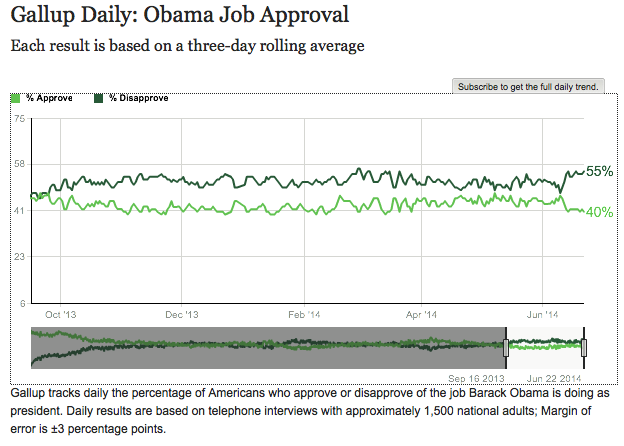
The Gallup daily tracking poll shows a sudden shift in appraisals of the president. On June 8, after a spring in which the gap between approval and disapproval was narrowing slowly, the public was evenly split – 47 – 46. Two weeks later, it’s 55 – 40. That’s one of the more sudden shifts yet in his two terms of office. It puts him close to GWB at this point in his second term:

Screen Shot 2014-06-24 at 12.16.41 PM

The light green line is Obama’s approval ratings; the darker one Bush’s. They look remarkably similar, apart from Bush’s much higher support from Democrats for a long time. That dotted line is the average of all presidents across the years since Truman. On that score, Obama is doing slightly better now than he was for much of his first term, ironically enough. The closest analogy to either of them is Truman’s approval rating (he finished out his presidency at 32 percent), which might give one some hope for a future historical assessment.

Why has this shift occurred so suddenly?

Multi-determined, as my shrink would say. But it has to be Iraq most of all. You can see a fledgling Obama recovery to an even 47-46 split until the Sunni/ISIS insurgency took off. And I think that’s understandable. One of Obama’s great and singular achievements was the withdrawal from Iraq without catastrophe. If that is now in doubt, especially if there is any chance of our getting involved again, then a core step forward looks in hindsight like a chimera. And Iraq is such a nightmare in American minds that any notion that we might be headed back there is abhorrent. Who do you blame for such a situation? The president, of course. What can he do about it? Between a metastasizing, regional sectarian war and US military intervention, it’s a pretty nasty dilemma. But my advice, such as it is, remains: stay out. Let it burn out; let’s see what emerges from the chaos; let’s concentrate on protecting our borders and improving our intelligence. If Obama could muster that message, I think it could resonate. As long as he wrings his hands, and the punditaraiat screams daily about What Must Be Done, and the State Department insists on more and more involvement, he will suffer.

“For Muslims, The Great War Changed Everything”

1024px-Muster_on_the_Plain_of_Esdraelon_1914

That’s Philip Jenkins’ claim in an essay explaining how the radical Islam we know today was a consequence of World War I:

When the war started, the Ottoman Empire was the only remaining Islamic nation that could even loosely claim Great Power status. Its rulers knew, however, that Russia and other European states planned to conquer and partition it. Seizing at a last desperate hope, the Ottomans allied with Germany. When they lost the war in 1918, the Empire dissolved. Crucially, in 1924, the new Turkey abolished the office of the Caliphate, which at that point dated back almost 1,300 years. That marked a trauma that the Islamic world is still fighting to come to terms with.

How could Islam survive without an explicit, material symbol at its heart?

The mere threat of abolition galvanized a previously quiet Islamic population in what was then British India. Previously, Muslims had been content to accept a drift to independence under Gandhi’s Hindu-dominated Congress party. Now, though, the Khilafat (Caliphate) movement demanded Muslim rights, and calls for a Muslim nation were not far off. That agitation was the origin of the schism that led to India’s bloody partition in 1947, and the birth of Pakistan.

How to live without a Caliph? Later Muslim movements sought various ways of living in such a puzzling and barren world, and the solutions they found were very diverse: neo-orthodoxy and neo-fundamentalism, liberal modernization and nationalism, charismatic leadership and millenarianism. All modern Islamist movements stem from these debates, and following intense activism, Egypt’s Muslim Brotherhood was formed in 1928.

(Image: Ottoman forces preparation for an attack on the Suez Canal in 1914, via Wikimedia Commons)

The Neocons Just Don’t Care

Stephen Walt delivers a righteous screed:

One reason neoconservatism survives is that its members don’t care how wrong they’ve been, or even about right and wrong itself. True to their Trotskyite and Straussian roots, neoconservatives have always been willing to play fast and loose with the truth in order to advance political goals.

We know that they were willing to cook the books on intelligence and make outrageously false claims in order to sell the Iraq war, for example, and today they construct equally false narratives that deny their own responsibility for the current mess in Iraq and portray their war as a great success that was squandered by Obama. And the entire movement seems congenitally incapable of admitting error, or apologizing to the thousands of people whose lives they have squandered or damaged irreparably.

Like Richard Nixon or Silvio Berlusconi, in short, the neoconservatives keep staging comebacks because they simply don’t care how often they have been wrong, and because they remain willing to do or say anything to stay in the public eye. They also appear utterly indifferent to the tragic human consequences of their repeated policy failures. Being a neoconservative, it seems, means never having to say you’re sorry.

And never ever taking responsibility for the consequences of their actions. They are the post-modern nihilists they accuse the left of being. Only much more shameless. But it’s worth repeating that they only appear on cable news because the brain-dead producers and editors decide they will. The blame for treating these congenital fantasists, hysterics and war-mongers as experts lies in part with the sheer laziness and cynicism of cable news bookers.

Read my take on the neocons’ unique relationship with the truth here. Other recent Dish on their attempted renaissance here, here, and here.

(Cartoon by Matt Bors)

Was Sectarian Strife Inevitable?

Not necessarily, according to Fanar Haddad, who tells Beauchamp that he’s “right not to buy the ancient hatreds line” about Sunnis and Shiites in Iraq, and that the internecine conflict of the past decade is largely a product of modern history:

The roots of sectarian conflict aren’t that deep in Iraq. In early medieval Baghdad, there were sectarian clashes, but that is extremely different from what you have in the age of the nation state. Come the 20th century and the nation state, we’re all part of this new “Iraq” entity — you feel a sense of belonging, so it becomes a question of how you divide the national pie. And I think that’s the main driver, the main animator behind sectarian competition in Iraq.

That’s a very new one. The state was established in 1921. Not too long after that, you start hearing about how the majority — the Shias — are being neglected, excluded, marginalized, or what you have you. After that, you’ve got the ever-present Arab-Iranian or Iraqi-Iranian rivalry that superimposed itself (not entirely by accident) onto sectarian relations. For whatever political end, people will try to conflate or suggest Iran with Shias. This has been particularly divisive. I’ll skip through the next 80 years of statehood, except to say that throughout them, the default setting was coexistence. Sectarian identity for most of the 20th century was not particularly relevant in political terms. Obviously, this is something that ebbs and flows, but there were other frames of reference that were politically dominant. Come 2003, plenty changes.

Until 2003, “the default setting was coexistence?” The British, when they were occupying, were constantly needing to put down rebellions by the Shi’a and the Kurds. One of the more recent books on Iraq’s bitter history is summarized on Amazon thus:

The authors, one an assistant professor of political science at Wright State University, the other a fellow at the U.K.-based Royal Institute for International Affairs, contend that Saddam Hussein’s regime, far from being an inexplicable evil, was a not-so-surprising result of Iraq’s history. The British, they say, who gained control of the region after the breakup of the Ottoman Empire, more or less made violent governance necessary through two key decisions: first, to attach the Kurdish province of Mosul to Arab Baghdad and Basra, giving the new nation a built-in secessionist movement, and second, to favor the Sunni Muslim minority at the expense of the more numerous Shi’a.

In 1991, the Kurds and the Shia rose up against the Sunni Saddam who had run Iraq with a Sunni elite. The result was the deaths of tens of thousands of people, the relocation of up to two million and the astonishing draining of the Southern marshes as a sectarian form of collective punishment. That was coexistence? Did the invasion and the chaos it spawned make matters a lot, lot worse? Of course, because it removed the only competitive source of loyalty – the Iraqi state.

Did the surge resolve this?

A thousand times no. As this blog repeatedly insisted – see the entire thread “Iraq Surge Fail Update” – it brought about a temporary calm, as the Sunni tribes were persuaded/bribed to take on the Islamist forces they are now – surprise! – allying with again, and as the forms of democratic processes took place. But it never resolved the structural sectarian division or hatred – both of which had obviously grown more intense after wave after wave of sectarian mass murder and the cycle of revenge. The surge never resolved the core political question it was designed to solve. This is not really Petraeus’ fault. An American commander is not an Iraqi political leader. But from the beginning, Maliki acted – understandably – as a Shiite first and as an Iraqi second (just like Saddam but in reverse). And if you see Saddam as a product of Iraq, Maliki’s resort to clumsy and sectarian brute force can be seen as exactly the same thing. Want to know why Kurdistan has been a success story? Because it is not riven with the sectarian hell of the entire country.

I can claim some foresight on this. In the midst of our Iraq Surge Fail thread, in February 2010, I wrote:

I find Biden’s recent premature bragging about Iraq to be as idiotic as Cheney’s once was. History tells us that just as you believe that what Churchill called the “ungrateful volcano” is dormant, it explodes again. And every time we think some crisis has been resolved, it often turns out it wasn’t. The next few months are full of potential explosions and the Beltway’s shallow notion that this is an old story is not reliable. This is not over by any means. And anyone who confidently says so is a fool.

Toby Dodge puts more blame on Maliki personally:

Maliki has done nothing to drive back a tide of corruption that swept across Iraq’s new political elite after 2003. Instead, unfair access to state largesse has become a tool for securing loyalty. Dissatisfaction with state failure, corruption and government incoherence came to a head in the March 2010 elections, when Maliki’s State of Law coalition was out-polled by Ayad Allawi’s Iraqiyya. It was during this election campaign and ever since that Maliki has deployed a divisive sectarian rhetoric to draw attention away from the failings of the state in an attempt to rally the Shia population to his rule. By damning his political opponents first as closet Ba’athists and then simply as terrorists he has sought to demonise Sunni politicians as complicit in the crimes of Saddam and supportive of the shadowy groups that have terrorised Iraq.

But Juan Cole notices that Shiite leaders are keeping it relatively cool for now:

In a statement on Friday, Sistani’s office issued a clarification of the statement of the previous week that called on young men to enlist in the army. The statement said that the call was directed to all Iraqis, not just the Shiites, and that it had not been intended to help the sectarian militias but only the national army. The new statement asked all Iraqis, especially those living in mixed neighborhoods, to avoid any conflict of a sectarian sort. It also apologized for the inability of the army actually to deal with so many volunteers and urged tha latter to get its act together.

On Saturday morning in Baghdad’s eastern district of Sadr City, a militia loyal to Shiite cleric Muqtada al-Sadr was formed and carried out exercises and mounted a spectacle. They called themselves the “Peace Brigades,” and their role is to protect holy sites and houses of worship belonging to all the religious groups of Iraq. Guerrillas of the fundamentalist Islamic State of Iraq and Syria (ISIS) have already destroyed tombs and shrines in Mosul and have threatened to raze Shiite shrines.

Jamie Dettmer puts in a word for Iraq’s Christians, some of whose oldest communities are right in the path of ISIS:

The Nineveh plains, the original Assyrian heartland, where Christians speak Assyrian as their first language and Arabic their second, has been also experienced an exodus despite Christian leaders earmarking the strip of land sandwiched between Mosul and Iraqi Kurdistan as a possible place of refuge when sectarian attacks in Basra and Baghdad mounted after the American invasion. Since 2003, Christian families started to arrive from the south looking to settle on extended family holdings, but many moved on because of the depressed economy, partly a consequence of the Nineveh plains remaining disputed territory between the Iraq government and the Kurds. The Christian exodus, though, started during the Iran-Iraq war because many locals had been trading with Iran and their businesses collapsed during the conflict.

The Christians here are now on high alert, as they are in the nearby towns of Al-Qoush and Bashiqa. Entering Bartilla we are closely questioned at a checkpoint by members of a self-defense force of 500 unpaid part-timers. The force, known as the Church Guards, was formed after simultaneous bombings in August 2004 of six churches in Baghdad and Mosul, the first in a wave of bombings of nearly 30 other churches throughout Iraq.

Previous Dish on the sectarian dimension of the Iraq conflict here and here.

Obama’s Iraq Plan, Ctd

IRAQ-US-DIPLOMACY-KERRY

Noah Feldman understands why the president might have felt he had no choice but to re-intervene in Iraq:

Begin with the baseline: The U.S., its allies and its regional Middle Eastern opponents such as Iran cannot tolerate the existence of a functioning al-Qaeda successor state in large swaths of Iraq and Syria. The Islamic State in Iraq and the Levant wouldn’t be satisfied with a landlocked statelet. By ideological preference and by geostrategy, the ISIL state would have the imperative to expand to the Mediterranean coast, including Sunni-majority areas of Lebanon. [Friday], a dozen ISIL fighters were apparently under siege in a Beirut building – a sign of potential future expansion.

Once the conflict reaches Lebanon, this would probably bring in the Israelis. Nuclear Israel and near-nuclear Iran would then have to figure out whether they hated each other more than they hate Sunni al-Qaeda. If this isn’t a World War III scenario, it’s getting close.

But if these scenarios pan out, they merely make the conflict far more complex, with many more active participants, allowing many more unintended consequences to unfold. And if you want evidence that we don’t really know what’s happening or could happen, look at Washington’s surprise at the demonstrable weakness and incompetence of the Iraqi army. And conceding that we are now intervening directly – what else can Biden’s visit to Baghdad convey – and yet following up with a few hundred military advisers seems to me to give us the taint of meddling with scarcely any real influence on any outcome. Maybe it’s a form of stalling, but as the Sunni/ISIS insurgency sweeps across the Sunni parts of Iraq, it’s obviously the thin end of the wedge.

Kenneth Pollack further unpacks the “known unknowns” of the intervention:

The United States and the Maliki government (and the Iranian regime, for that matter) clearly share an interest in defending Baghdad and the other cities of central and southern Iraq from conquest by the Sunni militant coalition. However, Prime Minister Maliki is also determined to reconquer the rest of the Iraqi territory lost to the ISIS offensive last week.

That would seem to run counter to the Administration’s (entirely correct) insistence that the United States should not choose sides in the Iraqi civil war, nor help either to militarily crush the other (and jeopardize the safety of its civilian populace).

That is why Washington has, again rightly, insisted on a political strategy that would reconcile Iraq’s warring communities and ensure the safety of all. Has the Obama Administration agreed that these American advisors would support Prime Minister Maliki’s objective of retaking all of Iraq? If so, will American advisors advise/lead/accompany Maliki’s forces (ISF and Shi’a militias) if they are able to fulfill the Prime Minister’s goal of counterattacking into the Sunni-populated regions of Iraq where the potential for ethnic cleansing and atrocities against civilians will increase dramatically? If not, does the Iraqi government understand this?

At the same time, the administration says it hopes to broker a political solution to the crisis. But James Traub doesn’t see that happening as long as Maliki “can keep his grip on power while pursuing a ruthlessly sectarian agenda”:

The administration is working with Iraqi leaders to shape the process [of forming a government after April’s elections], as it did in 2010. That is not an altogether hopeful precedent. Last time around, the hope was that Maliki would govern along with Ayad Allawi, the former prime minister whose Iraqiyya party had actually won more seats than Maliki’s State of Law. This time, the White House is cajoling Shiite leaders to jettison Maliki in favor of a less divisive and authoritarian figure. According to reports from Baghdad, Shiite leaders have begun to consider doing just that.

The administration has, however, just agreed to send 300 military advisors to the country without demanding political reform as a quid-pro-quo. Obama probably felt that, with the Visigoths already rattling the gates of the capital, he could not afford to wait for the political jockeying to play out over the coming months.

Ben Van Heuvelen is more sanguine, arguing that we can affect a political reconciliation, but only with Iran’s help:

The central tenet of President Obama’s emerging Iraq strategy is that military action won’t bring stability unless Iraqi leaders can build a government that all Iraqis might be willing to fight for. “As long as those deep [ethno-sectarian] divisions continue or worsen, it’s going to be very hard for an Iraqi central government to direct an Iraqi military to deal with these threats,” he said on Thursday. The only problem with Obama’s formulation is its implicit assumption that Iraqi leaders can simply choose to make up. In aggregate, they have taken hundreds of millions of dollars from Iran, and some are directly affiliated with Iran-backed militias. As a result, only Iran can push Iraqi leaders toward reconciliation.

Ayatollah Khamenei, however, has come out against any US involvement:

“The main dispute in Iraq is between those who want Iraq to join the US camp and those who seek an independent Iraq,” said Khamenei, who has the final say over government policies. “The US aims to bring its own blind followers to power since the US is not happy about the current government in Iraq. ” Khamenei said Iraq’s government and its people, with help of top clerics, would be able to end the “sedition” there, saying extremists are hostile to both Shia and Sunni muslims who seek an independent Iraq.

Earlier on Sunday Iran’s President Hassan Rouhani said some countries “feed terrorists by their petrodollars,” in a veiled reference to the Arab Gulf states, and warned that such support would come back to haunt them. “Rest assured, tomorrow will be your turn. The barbarous terrorists will go after supporters of terrorism in the future,” said Rouhani.

But is Iran the only unsavory partner we need to salvage this mess? Not according to Les Gelb: “There’s only one strategy with a decent chance of winning: forge a military and political coalition with the power to stifle the jihadis in both Iraq and Syria”:

This means partnering with Iran, Russia, and President Assad of Syria. This would be a very tricky arrangement among unfriendly and non-trusting partners, but the overriding point is that they all have common interests. All regard the jihadis as the overwhelming threat, and all would be willing to take tough joint action. And with this fighting arrangement in place, the “partners” could start seriously fixing the underlying political snake pits in Damascus and Baghdad. …

I’m certainly not saying that Assad is a good guy and that we should abandon pursuing his eventual departure, or that we can now trust Russia and Iran. Washington has and will have serious problems with all these countries. And most certainly, the U.S. will have to stay on its guard. But the fact is that there is common ground with Moscow and Tehran to combat the biggest threat to all of us at this moment. Russia frets all the time about the jihadis in the Mideast making joint cause with Muslim extremists in Russia; it’s Moscow’s number one security issue. Iran worries greatly about the Sunni jihadis torturing and killing Shiites in Syria and Iraq. There’s nothing more frightening in the world today than these religious fanatics.

As so often, Gelb adds a dash of realism. If our real problem here is the possibility of fanatical Islamist terror, then the US is only one of many powers with an interest in intervening, and Assad and Iran and Russia are our partners, not our enemies in this endeavor. But even then, there is no solution to this constantly exploding “ungrateful volcano” (as Churchill described Iraq) than a multi-sectarian democratic government and that is, by any reasonable inference of the past decade or so, a non-starter. Throwing arms, humans and money at a project that has never actually worked and that, in the current chasm, cannot work, is a mug’s game. I can see the reasons behind getting better intelligence, but not much more. On this, I stand with Rand Paul.

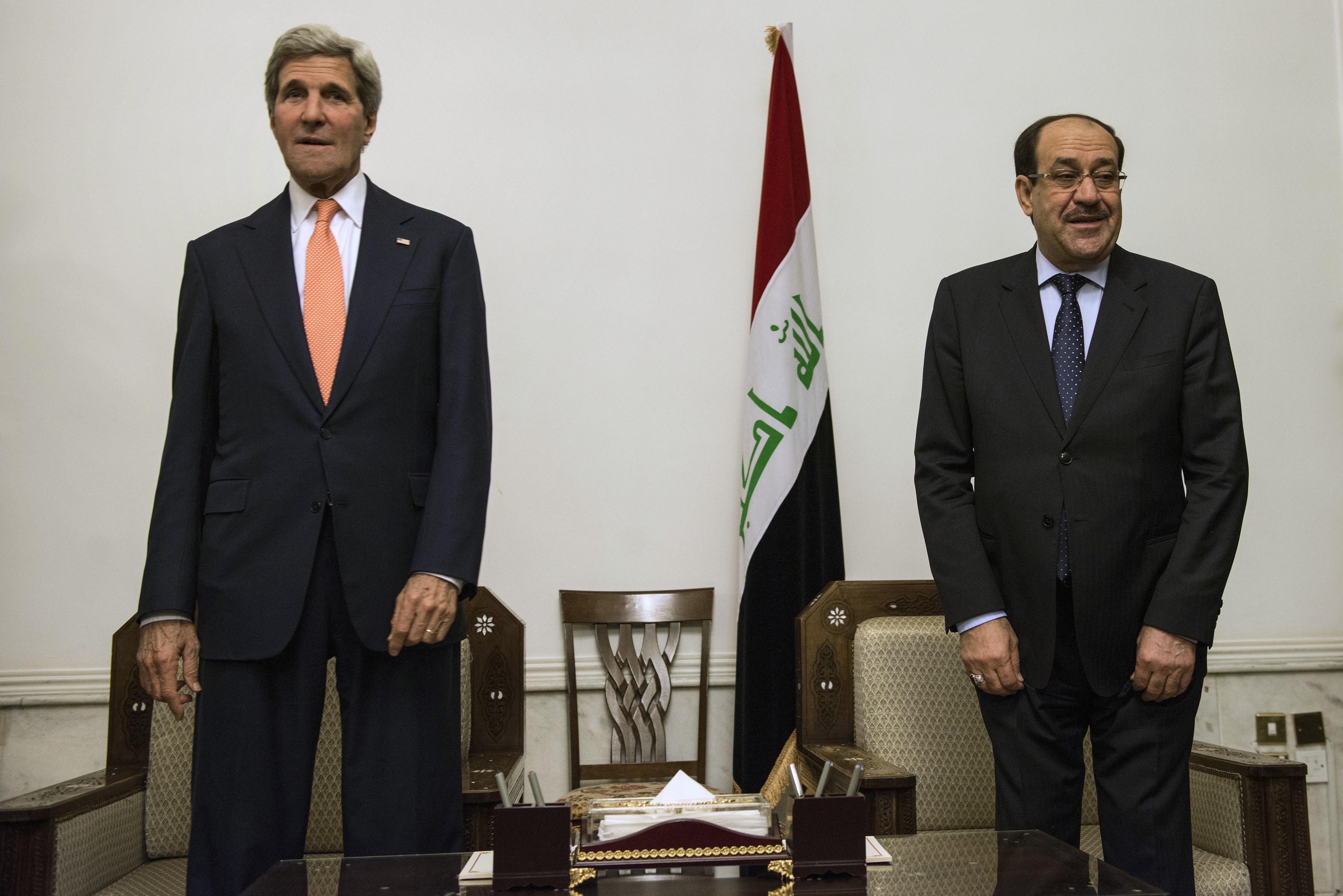
(Photo: Iraqi Prime Minister Nuri al-Maliki and US Secretary of State John Kerry meet at the Prime Minister’s Office in Baghdad on June 23, 2014. Kerry was in Baghdad to push for Iraqi unity and stability, as Sunni militants swept through western towns abandoned by the security forces. By Brendan Smialowski/AFP/Getty Images.)

The Paul We’ve Been Waiting For

https://twitter.com/jetpack/status/480751046952628227

In a WSJ op-ed late last week, Rand Paul finally showed his cards on Iraq, taking the neocons to task and invoking Reagan to make a case for not taking sides in the Iraq conflict. On Meet The Press yesterday, he defended his position, turning Cheney’s unhinged criticism of Obama back on the former vice president himself:

Money quote:

“I think the same questions could be asked of those who supported the Iraq War,” Paul said. “You know, were they right in their predictions? Were there weapons of mass destruction there? That’s what the war was sold on. Was democracy easily achievable? Was the war won in 2005, when many of these people said it was won? They didn’t really, I think, understand the civil war that would break out.”

Matt Welch compares Paul’s positions to those of the Cheneys:

The contrast is striking here not just in policy content but in tone. The Cheneys snarl about “appeasing our enemies,” “abandoning our allies,” and “apologizing for our great nation,” as if it was the 2004 Republican National Convention all over again. Paul, with the exception of one somewhat intemperate paragraph asking “Why should we listen to them again?”, approaches the question with an assumption of personal and national humility, a sense that American knowledge of (and power to shape) fluid events in the Middle East has limitations, as does American appetite for making the kind of commitments that the Cheneys of the world constantly seek … This is a pretty clearly defined fork in the road for GOP foreign policy.

Cheney’s thin retort says a lot in its omissions:

When asked about Paul’s comments, Cheney said his position hasn’t changed: “I was a strong supporter then of going into Iraq, I’m a strong supporter now.” (He was more vague about what exactly the U.S. should be doing in Iraq now, aside from it being the opposite of whatever President Obama is doing.) “If we spend our time debating what happened 11 or 12 years ago, we’re going to miss the threat that is growing and that we do face,” Cheney continued. “Rand Paul, with all due respect, is basically an isolationist. He doesn’t believe we ought to be involved in that part of the world. I think it’s absolutely essential.”

Later, Cheney said he hasn’t decided who he’ll support in 2016, but suggested it won’t be Paul. “Now, Rand Paul and — by my standards, as I look at his — his philosophy, is basically an isolationist,” he said. “That didn’t work in the 1930s, it sure as heck won’t work in the aftermath of 9/11, when 19 guys armed with airline tickets and box cutters came all the way from Afghanistan and killed 3,000 of our citizens.”

Look at the formulae that Cheney recites. He can’t actually address the debate over the Iraq war; he just reiterates his own position then and now. You get the impression he hasn’t actually had a single conversation in person challenging his rigid mindset since the war began. And once again, it’s the One Percent solution. When you posit a threat of apocalyptic devastation far beyond even the horror of 9/11, the cost-benefit analysis will always come down to maximal action everywhere and anywhere. But he hasn’t for a second absorbed that this apocalyptic vision was precisely what was debunked by the Iraq War.

There were no nukes or chemical weapons coming for us. They existed solely in Dick Cheney’s imagination. Thanks to Obama’s deal with Putin, there are also no WMDs left lying around the battlefield for ISIS to pick up and use. The alternative to getting the hell out of a region where we have only sowed chaos and sectarian warfare to no measurable gain is the boogey-man of “isolationism.” You have to conclude that Cheney is intellectually dead. Nothing that happened in the last fourteen years has made even the slightest dent in his terrorized worldview. Sometimes I wonder if Cheney was seriously traumatized by 9/11 in ways even more profound than the rest of us – it occurred on his watch, after all, and he was the recipient of all sorts of terrifying intelligence in the months that followed. But to have reacted by never moving on from his own terror on 9/12 is not a position. It’s a condition.

Meanwhile, Kilgore finds it odd that Paul references Reagan’s defense secretary, Caspar Weinberger:

Cap was less famous for his “doctrine” than for his persistence in securing the highest level of defense spending imaginable. In his endlessly fascinating account of the budget wars of Reagan’s first term, The Triumph of Politics, David Stockman all but calls Weinberger a traitor for his mendacious and successful efforts to trick Ronald Reagan into double-loading defense increases into his seminal 1981 budget proposal. This is one part of the Reagan-Weinberger legacy Paul will probably not want to emulate. And it matters: the most obvious way to convince reflexively belligerent Republicans that he’s kosher despite opposing various past, present and future military engagements would be to insist on arming America to the teeth. But Paul’s government-shrinking visions would make that sort of gambit very difficult. And try as he might, it will be very difficult for Paul to make a credible claim Ronald Reagan stood tall for taming the Pentagon.

The hawks are having a field day, of course. Here’s Rubin:

Understand that he doesn’t merely say we shouldn’t put boots on the ground; he argues that we don’t have an interest in the outcome. He manages to get through an entire op-ed without recognizing that a state dominated by the Islamic State of Iraq and Syria (ISIS) would represent a bigger threat to the United States than Afghanistan did pre-9/11. Paul observes that the Iraq war was harder than anticipated but ignores the success of the surge and the peaceful, stable state in which the George W. Bush administration left Iraq. He also borrows President Obama’s false talking point that we couldn’t leave forces there. (Paul incidentally doesn’t understand or is deliberately misleading readers when he says our actions in Syria contribute to the rise of ISIS there; in fact, had we swiftly pushed out Syrian President Bashar al-Assad, there would have been no – zero – ISIS fighters there.)

Kurdistan’s Moment? Ctd

Dov Zakheim pushes Washington to recognize the Kurdish claim to independence, but he doubts the administration will go for it:

The pro-Western, anti-Islamist Kurds are America’s natural allies. During the nineties, they were the focus of American support while Saddam Hussein was in power. Yet the 450px-Flag_of_Kurdistan.svgadministration remains reluctant to exert itself on their behalf, and, in particular, to help modernize their military equipment.

For their part, however, the Kurds, having seized Kirkuk, their historic capital, are determined both to control that city and their long-term fate. They will press for independence if the sectarian fighting continues to rage south of their border. The Obama administration, which quickly recognized a far less stable South Sudan, should recognize the new Kurdish state. Given its willingness to work even with Iran in order to prop up the central government in Baghdad, however, it is unlikely to do so, prompting Kurdish resentment that will not easily be mollified.

But the case for Kurdistan isn’t as clear-cut as Zakheim wants it to be. The Bloomberg editors make the opposing argument:

U.S. President Barack Obama [last] week explained why keeping Iraq whole and stable is a U.S. national security interest. Kurdistan’s secession would make an extended and destabilizing sectarian war to redraw the borders of the Middle East, from Jordan to Iran, more likely.

So what can officials in Baghdad and Washington do to persuade Kurds to remain part of Iraq?

They might start by noting how difficult it can be for internationally unrecognized states to thrive. Iran and — depending on the response of Turkey’s Kurdish minority — Turkey could turn on a self-proclaimed Kurdish state, making for a tough and lonely existence.

Iraq’s central government, encouraged by the U.S., should also demonstrate that it accepts the new reality that has emerged since the collapse of the army in Mosul. The Kurds will not walk away from oil-rich Kirkuk, and that should be reflected in Iraq’s internal borders. Nor should they be expected to continue to submit to an arrangement for sharing oil revenues, enshrined in the Iraqi constitution, that centralizes all control and payments in Baghdad.

Meanwhile, the newly assertive Kurds seem to be doing whatever the heck they want, such as delivering oil to Israel:

In a step that cements the impression of a de facto independent Kurdistan, a million barrels of Kurdish oil were delivered to a client in Israel today, despite threats by Baghdad to sue anyone buying it. The US government, fearing another blow to embattled Baghdad, had also worked to prevent anyone from buying the oil.

Reuters broke the story in a scoop, followed a few hours later by a statement on the Kurdish government website. “We are proud of this milestone achievement, which was accomplished despite almost three weeks of intimidation and baseless interferences from Baghdad against the tanker-ship owners and the related international traders and buyers.”

Josh sounds off on the shipment:

The relationship between the Kurds and Israel is by no means new, though it has never been formal. It also appears that the oil delivered to the Israeli port of Askelon is likely not destined for use locally but rather for storage and eventual shipment elsewhere. For the Israelis, though, it is a key part of a strategy to deepen relations with the Kurds of Iraqi Kurdistan, as well as access new supplies of energy.

For the Kurds of course the implications are potentially profound. The ability to export oil at scale entirely outside the control of the Iraqi central government is a huge step toward de facto independence, whether or not the Kurds took the step of formally severing ties with Iraq.

Previous Dish on the Kurds here, here, here, and here.

(Flag of Kurdistan via Wiki)

The Ever-Expanding ISIS

Adam Chandler tracks their gains this weekend:

As the Associated Press reports, by wresting control of Rutba, ISIS now runs a strip of a major highway, “a key artery for passengers and goods” heading to and from neighboring Jordan. The capture of al-Qaim, as we noted earlier, has already given ISIS control of a vital border crossing post between Iraq and Syria. ISIS also took the towns of Rawah and Anah, which some fear will lead to the capture of Haditha, home to an important dam that, if destroyed, could cause massive flooding and damage the country’s electrical grid.

Juan Cole sees the fall of Qaim as a potentially explosive development:

The first thing that occurred to me on the fall of Qa’im is that Iran no longer has its land bridge to Lebanon. I suppose it could get much of the way there through Kurdish territory, but ISIS could ambush the convoys when they came into Arab Syria. Since Iran has expended a good deal of treasure and blood to keep Bashar al-Assad in power so as to maintain that land bridge, it surely will not easily accept being blocked by ISIS. Without Iranian shipments of rockets and other munitions, Lebanon’s Hizbullah would rapidly decline in importance, and south Lebanon would be open again to potential Israeli occupation. I’d say, we can expect a Shiite counter-strike to maintain the truck routes to Damascus.

Mona Mahmood relays an account of life in Mosul under ISIS rule:

People are scared an air strike might be launched by Maliki’s forces against Mosul at any moment.

Most of the people who have enough money are heading towards Kurdistan. The situation is secure and calm inside Mosul. The rebels – some of them are masked, others are not – are guarding all the official buildings, including hospitals and banks. You can see the flag of the Islamic State in Iraq and the Levant (Isis) flying on most of the buildings in Mosul. There is no Iraqi flag at all.

Ba’athists are in charge now of running the city facilities and official institutions like hospitals, directorates and banks. The new mayor, Hafidh al-Jamas, a former military commander in the time of Saddam Hussein, was installed by the Ba’athists and he is doing his best to make life easy for the people in Mosul by providing fuel, food and by keeping prices low as much as possible. A commander was also installed for Mosul who was a former navy commander in the time of Saddam. His name is Khalid al-Jabin. He was in Syria for many years.

People in the city are circulating rumours that we should be careful of smoking in public, wearing jeans or letting women get out without a veil. But the reality is totally different. You can do and wear whatever you want, the rebels are busy now with their liberation of Iraq, and they do not care what people are doing or wearing.

Another dispatch from the occupied city finds the people happy to have Baghdad off their backs, but leery of what their Jihadist rulers have in store for them:

Mosul’s people still seem reluctant to live as they normally do. Everyone is cautious. A group of people I know arranged to meet in the same café they normally do; it was the first time they had all met up since the city was taken over by the extremists. Although everyone likes football, nobody was talking about the World Cup in Brazil. It was clear that everyone had the same thing on their minds: The city, its unpredictable future and how they would find safe places for their families. They all know things cannot remain the same in Mosul after what has happened here and their conversation was carried on in whispers.

“Let’s smoke a shisha [water pipe] because this may be the last time we can,” one of the friends said. He had heard that ISIS would ban shisha smoking and cigarettes as well as many other things.

Reading similar reports, Max Fisher sees a popular support base forming around ISIS:

Mosul residents told the Financial Times that ISIS sacked alcohol shops and tore down a church that was under construction, but that otherwise personal freedoms have been unchanged. Their one complaint was the lack of electricity, which they blamed on the central Iraqi government, and said they were cheering on ISIS to seize a nearby refinery to fix the issue.

The trick that ISIS has pulled off here is seizing Mosul but not ruling it directly. The group appears to have handed authority for the large city over to local, tribal, Sunni armed groups. Those groups share ISIS’s hatred of the Iraqi national government, so they’re happy to help oust the Iraqi army, but unlike ISIS they are not as fixated on imposing extremist Islamism. “There is no ISIS in Mosul,” a 58-year-old Mosul resident told the Financial Times. “The ones controlling city are now the clans. The power is with the tribes.”

Meanwhile, in Baghdad, support for Maliki weakens:

Mr Maliki seems to want to fight Isis without help from the Sunnis, tarring all of them with the same brush of complicity. That there has been some complicity is clear. Some rump Ba’athists and some tribal leaders joined Isis, or at least stepped aside. Sunnis have been provoked but they also have a lot of explaining to do. But this is still a deeply counter-productive approach. The Iraqi prime minister should be seeking to get more Sunni Arabs and Kurds on the government side on the battlefield.

Yet the frigid line up earlier this week when Shia and Sunni political leaders gathered to make a joint call for Iraqi unity told another story. After the photocall, the prime minister and the Sunnis drifted off without a word to each other.

To make matters worse for Maliki, Ayatollah Ali al-Sistani, the country’s leading Shia authority, is calling for a new government:

Although he avoided directly criticising the Iraqi prime minister, Sistani’s call is far short of the resounding support Maliki needs to overcome rising unease at home over his leadership as well as rapidly shrinking international support.

Sistani also renewed a demand he made last week for his followers, who comprise the majority of Iraq’s dominant Shia sect, to fight the jihadist group Isis and its insurgency that continues to ravage north and central Iraq. “They must be fought and expelled from Iraq, [or] everyone will regret it tomorrow, when regret has no meaning,” Sistani’s spokesman announced during Friday prayers in Najaf.

With ISIS bearing down on Baghdad, Martin Chulov observes the rearming of the city and the re-emergence of the notorious Mahdi army:

Up to 20,000 men, many of whom quit jobs last week to join the militia, responded to the call to arms from al-Sadr and [Sistani]. … On Baghdad’s streets, battered pickups shuttled weapons from depots to mosques where the rapid rearming has transformed the already militarised capital into a war zone in waiting. With the mobilisation complete, the now battle-ready militia presented itself to Iraqis once more on Saturday, staging a series of parades in Baghdad and the south that made an emphatic statement of its readiness and intentions.

One of the most feared names in Iraq was back in business, even if it was fighting under a different banner. This time around, the Mahdi army will be called the Peace Brigades, after its leader, Moqtada al-Sadr, decided that a rebranding might shake it free from its infamous past.

But military marches are hardly peace offerings. And the rally through the Sadrist heartland of Sadr City was no different. Columns of fighters carrying rifles, trucks laden with rockets and men in white wearing mock suicide vests were on the move through the former slum-turned-battlefield soon after sunrise in a futile attempt to beat the blazing midsummer heat.