The Battle Over Iraq’s Oil, Ctd

David Unger checks up on the battle over the Baiji oil refinery, Iraq’s largest:

An Iraqi government spokesman told Reuters midday Thursday that the refinery was in their “complete control,” but other reports cite witnesses and refinery employees as saying Sunni rebels remain in command. The jihadists, led by the Islamic State of Iraq and the Levant (ISIS), likely aim long term to use revenue from fuel sales to finance terror operations across the region.

The Baiji refinery supplies motor fuel for northern Iraq and can process around 310,000 barrels a day, fed by oil fields in the autonomous Kurdistan region. It also fuels a nearby power plant that provides electricity for Baghdad, which already suffers from outages. … The flow of oil to the refinery is already off-line, according to Thamir Uqaili, an oil and gas consultant who worked in Iraq for the Iraq National Oil Co. and Iraq’s Ministry of Oil for over 40 years. If it remains damaged or off-line, it will create a shortage of products that cannot be replaced quickly, Mr. Uqaili writes via e-mail.

Frank Verrastro and Sarah Ladislaw look at what the Iraq crisis, in combination with other world events, means for world oil markets:

At present, the combination of the loss of Libyan, Nigerian, Venezuelan and Iranian oil production for various reasons, the uncertainty surrounding Russia’s gambit in Ukraine and the prospects for further reductions (seasonal maintenance, hurricanes, etc.) as we enter the second half of the year point to potentially tighter markets and higher prices (EIA’s Short term energy outlook for  June identified some 2.6 mmb/d of unplanned supply disruptions from OPEC sources and an additional 720 mmb/d of non-OPEC volumes).

Further, since Iraq was expected to contribute a large portion of near term incremental OPEC increases, sustained or enhanced violence would undoubtedly limit investment and volumes going forward.   And while Saudi Arabia still maintains over a million barrels per day of spare capacity and could offset some of the loss of larger Iraqi volumes, a complete loss of Iraqi exports would require more drastic measures – like the release of strategic stocks – in order to prevent prices from spiking.

From Steve LeVine’s viewpoint, it means a return to Saudi oil:

Until a couple of years ago, some Saudis spoke of adding yet another 2.5 million barrels a day of capacity, giving them 15 million in all. But if there ever were such plans officially, they have been shelved since the recent US shale revolution added millions of barrels a day to US production. In April, the US produced 11.2 million barrels (paywall) of oil and gas liquids a day, the most since 1970. It has been said that, four decades after the Arab oil embargoes, the US will soon become an oil exporter and no longer beholden to the Persian Gulf, and specifically Riyadh.

But a series of geopolitical disruptions including in Libya and Nigeria have canceled out those gains. And after the upheaval in Iraq analysts now believe that such disruptions will remain a factor for many years. If that is the case, Saudi Arabia’s oil will again be central to the global economy. Specifically, the world may need Riyadh to invest the billions necessary to increase its production capacity to 15 million barrels a day.

James West notes that the US is much less dependent on Iraqi oil than it was a decade ago:

But the U.S. is still tied to global oil markets, and that means what happens in Iraq can have an economic impact here. One thing every expert I spoke to agreed on is this: Even with decreasing oil imports, the U.S. is inextricably linked to world markets. That means that if the situation in Iraq continues to deteriorate, the U.S. economy may not be immune.

“The cost to the United States of a big oil shock … will be lower than they were [in the past],” [John] Duffield said. “Our main vulnerability is not so much the direct impact on oil, but the impact on the rest of the world’s economy, if there’s a big oil supply disruption.” He added that “as long as the world oil market is pretty highly integrated, the U.S. is vulnerable to an oil supply disruption in the Middle East or the Persian Gulf, regardless of the amount of oil it imports from the region.”
The Inept Iraqi Military

Jassem Al Salami surveys the fruits of all that American aid and training:

The Iraqis’ aerial tactics are sloppy. Instead of orbiting a target area at a safe distance in order to gain full awareness before attacking, Iraqi pilots tend to fly straight in firing rockets and guns at close range. The absence of zooming optical gear might explain that reckless pattern. These tactics not only compromise the aircraft’s effect on the battlefield, they also expose Iraqi pilots to ISIS ambushes. The Iraqi army has already lost at least one helicopter west of Baghdad.

Iraqi armored units are no better than the air force and army aviation. ISIS rides mostly in “technical” armed pickups, whereas the Iraqi army possesses modern M-1A1 main battle tanks and BTR-4 armored fighting vehicles plus older T-72 and T-55 tanks and BMP fighting vehicles. ISIS cannot match their firepower. But almost no Iraqi armor has even appeared on the battlefields in Mosul, Tal Afar and Kirkuk—except in videos depicting ISIS fighters destroying abandoned vehicles. Perversely, the only tanks that we can confirm have taken part in the fighting are the six T-55s now belonging to ISIS.

Dividing the military with sectarian meddling, in Zaid al-Ali’s words, was just one of many ways in which Nouri al-Maliki has squandered his country’s hard-fought security gains over the past few years:

On the day Tikrit fell, Iraq suddenly changed: Violent government-backed militias were suddenly allowed to operate openly in Baghdad and Baquba, manning checkpoints and organizing security without any oversight. Senior Iranian military commanders landed in Baghdad to help organize the city’s defense. Finally, in an effort to rally his base against ISIS, Maliki called for volunteers to take up arms against the militants and extremists — ignoring the fact that the military’s problem was never a lack of manpower. It was the clearest admission of failure possible.

Maliki micromanaged the security forces for years, and in the end he didn’t even trust them, choosing instead to let foreign-backed militias and untrained volunteers defend the capital. Meanwhile, one week after Tikrit’s fall, Baghdad had done nothing to free it from ISIS, abandoning its citizens to their fate and allowing the militants to reinforce their positions free from interference.

This was no accident, Keating suggests:

I’ve written about this a bit in reference to Qaddafi’s rule in Libya, but authoritarian rulers—and Maliki is clearly at least headed in that direction—often prefer not to have a strong and professionally organized military. As Hosni Mubarak learned a few years ago, strong militaries can turn on you when the going gets tough. But such “coup-proofing” obviously comes at the expense of the military’s preparedness for outside threats. Maliki made it abundantly clear to U.S. officials that one of his primary concerns was the possibility of a military coup organized by Saddam Hussein’s former officers. The best protection against such a scenario is not a large, well-trained, multiethnic military but a small elite fighting force selected on the basis of loyalty.

Even so, Kirk Sowell expects the Iraqi army to beat ISIS in direct fighting:

In Tal Afar this week, ISIS was initially able to gain some ground there because it’s out in the west, harder to resupply. But after the government sent more units out, they were able to regain the initiative. ISIS has around 10,000 fighters, and the Iraqi army still has 200,000. ISIS doesn’t have an unlimited supply of personnel, so these direct fights – like in Tal Afar – just drain them.

Syria has a much greater impact on Iraq than Iraq has on Syria. Having this rear base in Raqqa has been great for ISIS – it’s what allowed them to organize and recruit and train their fighters. If you take parts of Anbar and Nineveh, in Iraq, and Deir Ezzor and Raqqa and parts of Hassakeh, in Syria, that’s the so-called Islamic state. But these aren’t areas they totally control, and once Baghdad sends high-quality [military] units up to Mosul, ISIS is not going to be able to hold its ground or form an administration or anything like that.

But Zack Beauchamp points out ISIS’s skill advantage over the Iraqi forces:

[Nathaniel] Rosenblatt and [Yasser] Abbas [of private research firm Caerus] say there’s been an influx of skilled Saddam-era military leaders and soldiers into ISIS’ ranks. “When you look at some of the reports about the leadership under [ISIS commander Abu Bakr] al-Baghdadi,” Rosenblatt said,  “those second-in-command guys have very strong ties to Saddam’s army.” Acquiring lots of weapons, money, and experience over the course of the Syrian war allowed them to translate that new training into real military effectiveness.

It’s hard to overstate how much of advantage this training and professionalism gives the Islamist group. “ISIS knows how to use smaller units” effectively against larger forces, says [researcher Phillip] Smyth. They’re “very efficient, and you have to deal with that.”

This matters greatly. An undisciplined force, one whose movements aren’t well coordinated or can’t deploy proper tactics for taking city blocks, can be beaten by a much smaller opponent that knows what it’s doing.

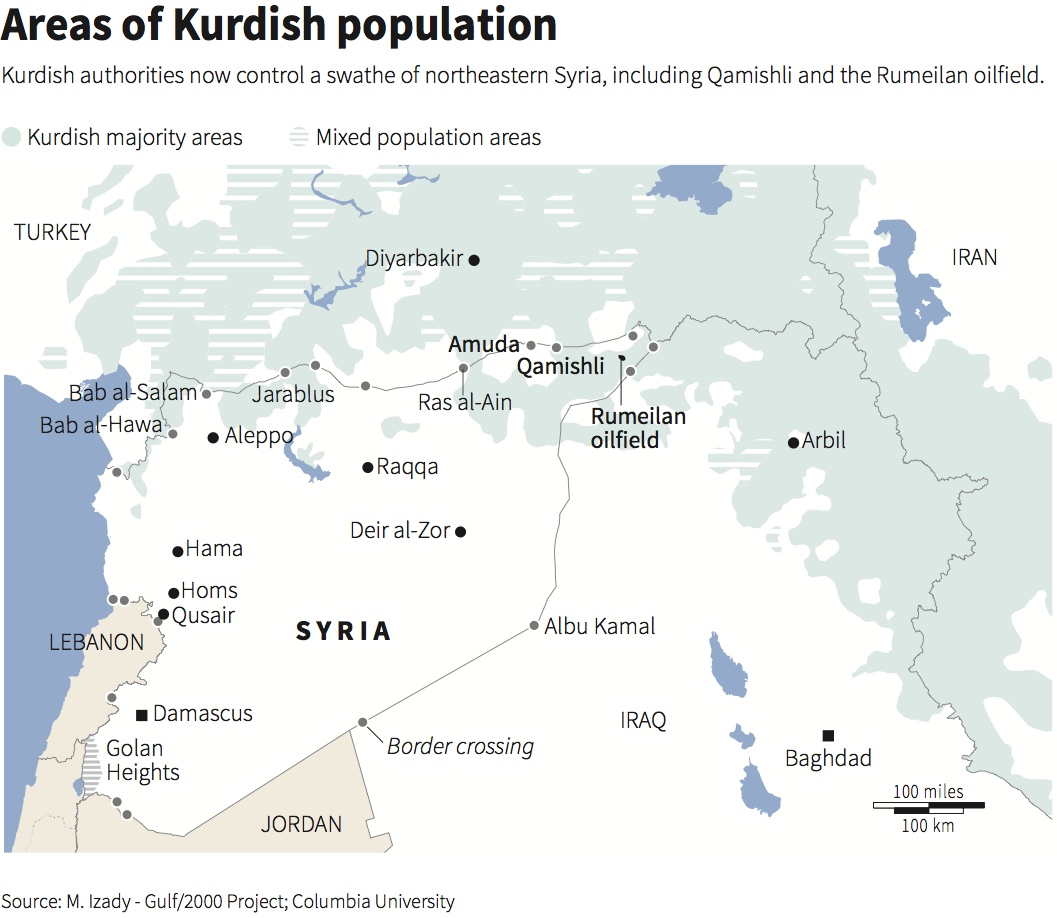
Kurdistan’s Moment? Ctd

kurdish-populations-map

Iraqi Kurdish leaders are reportedly hinting that they’re on board with partitioning Iraq. That’s not surprising, as they’d get their own state out of such an arrangement:

Kurdistan Democratic Party figure Abdul Salam Berwari said in a phone interview with Al-Hayat, “The Kurdish political leadership sees since the 1990s that the only solution for the survival of a unified Iraq is to transform the structure of the state to reflect the population distribution of Iraqis. The basic components are the Sunnis, Shiites and Kurds, and the experience of the last 10 years supports what has always believed. … There is no solution except by establishing three regions for Iraq’s main components.” …

Pointing to the worsening differences between Erbil and Baghdad, Nechirvan [Barzani, prime minister of the Kurdistan Regional Government] told the BBC that Iraq can never return to the period before ISIS’s expansion and called on “Maliki to step down from office after the completion of the current phase,” [saying] “an independent Sunni region” is the “best solution to rule the country.”

Reporting on the Kurdish fight against ISIS in the north, Jaime Dettmer relays the peshmerga’s scorn for Maliki and his soldiers who abandoned their posts to the Jihadist advance:

Convoys of trucks carrying peshmerga, who flash thumbs-up signs when locals wave, have been scurrying along the highways of Iraqi Kurdistan strengthening positions in readiness to block jihadists and their Sunni militant allies from gaining any territory. But stopping jihadist infiltration will be no easy feat and the Kurds are relying on sympathizers among the Sunni tribes around Mosul and to the south of Kirkuk to alert them to ISIS movements.

The Kurds have no faith in the Iraqi military rallying and the confident note struck on Wednesday by beleaguered Iraqi Prime Minister Nouri al-Maliki only prompted peshmerga derision. In a televised address announcing that a fight-back had begun, he promised government forces would retake Mosul. But the Kurds don’t see al-Maliki as the man who can save Iraq: they blame his exclusionary Shiite politics for the disaster that has befallen the country. Like the Americans they want al-Maliki’s Shiite-dominated government to be replaced by one able to reach out to Sunni Muslims and start a process of reconciliation to undercut the jihadist exploitation of Sunni resentment.

Meanwhile, Marsha Cohen explores Israel’s longstanding, complicated relationship with the Kurds:

For decades, Israel has been a silent stakeholder in northern Iraq, training and arming its restive Kurds. Massimiliano Fiore, a fellow at the Department of War Studies at King’s College London, cites a CIA document found in the US Embassy in Tehran and subsequently published, which reportedly attested that the Kurds aided Israel’s military in the June 1967 (Six Day) War by launching a major offensive against the Iraqi Army. This kept Iraq from joining the other Arab armies in Israel, in return for which, “after the war, massive quantities of Soviet equipment captured from the Egyptians and Syrians were transferred to the Kurds.”

So what stake does Israel have in Kurdish fortunes today?

Less than a year ago, Lazar Berman of the Times of Israel, under the optimistic headline, “Is a Free Kurdistan, and a New Israeli Ally, Upon Us?” quoted Kurdish journalist Ayub Nuri who argued that Kurds were “deeply sympathetic to Israel and an independent Kurdistan will be beneficial to Israel.” Fast forward a year later to Neriah’s article titled, “The fall of Mosul could become the beginning of Kurdish quest for independence,” where he says nothing about the stakes for Israel. Would an increasingly independent Kurdistan continue to look to Israel as its patron?

Or will Kurdistan fully join an anti-ISIS Iraqi alliance, backed jointly, if discreetly, by Iran, with the approval of the US? Any scenario in which Iran is part of the solution, rather than the underlying problem, is a nightmare for Israel.

Previous Dish on the Kurds here, here, and here.

(Map via Jeremy Bender)

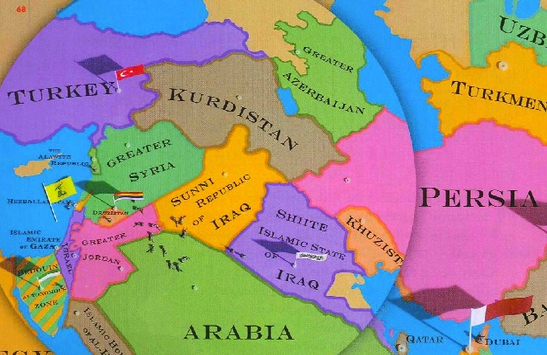
Is it Time To Abolish Iraq? Ctd

Jeffrey Goldberg – now back full time (yay!) at the Atlantic – rightly claims some prescience. In 2007, he sketched a slightly fanciful map of the future of the region and it looked like this:

Screen Shot 2014-06-20 at 10.38.31 AM

His bottom line:

One of the reasons I don’t find myself overly exercised by the apparent collapse of Iraq (and one of the reasons I don’t think it would be wise for the U.S. to rush into Iraq in order to “fix” it) is that I’ve believed for a while that no glue could possibly hold the place together.

The case for Kurdistan is pretty powerful, I’d say, and there are some hints that the Turks may not be quite so hostile. British Tory Daniel Hannan wonders whether partition is such a bad idea after all:

How much disorder, horror, fear and mutiny might have been avoided had Iraq been divided along ethnographic lines in 2003 – or, better yet, in 1920. (If you don’t like the word “ethnographic”, substitute “democratic”: it amounts to the same thing.)

Any mention of partition sends some pundits scurrying to their keyboards. What about Yugoslavia, they say, or Ireland, or India, eh eh? Well, I wonder whether, in each of those cases, an agreed separation beforehand might have left us with something very like today’s borders without the intervening war. We’ll never know, obviously, but it’s worth noting that several partitions happened amicably enough, from Czechoslovakia to the West Indies Federation. More to the point, look at the consequences of non-partition. The civil wars have driven 2.1 million Iraqis and 1.4 million Syrians into exile. How much worse do things have to get before we consider an alternative?

Mordechai Kedar posits that Iraqis’ loyalties are not to “Iraq” anyway:

“The tribe always succeeds against the state,” Kedar emphasized. If one doubts this, one need not look further than the number of Iraqi soldiers that deserted Mosul. If they felt loyal to a country called Iraq, they would have staid and fought against Al Qaeda. However, their loyalties were to their tribes and clans. Why die fighting for something that they don’t believe in? “People are loyal to the tribe rather than to the state,” Kedar noted.

Aside from the tribal issues in Iraq, Kedar explained that the country is also full of religious tension, as Iraq is the home to 10 different religions. Among them are Muslims, Christians, Zoroastrians, Alawis, Druze, Bahais, etc. Kedar emphasized, “As we speak, Christians are getting killed and persecuted. Only a third of the Christians that existed in Sadamn Hussein’s Iraq are still in the country.” These tensions don’t even include the Shia-Sunni divide, which has been going on since the advent of Islam even though the Caliphate no longer exists, rendering the question of who his rightful successor should be to be almost irrelevant.

But Mansoor Moaddel collects survey data from the past decade that complicates the narrative that Iraq is hopelessly incoherent:

The Sunnis and Shia converge in defining selves as Iraqi, rather than Muslim or Arab, above all. This support rose from 22% in 2004 to 80% in 2008, and then dropped to 60% among the Sunnis. Among the Shia, it was 28% in 2004, increased to 72% in 2007, and then dropped to 62% in 2013. There is not much support for Iraqi identity among the Kurds. Among the Kurds, on the other hand, there has been a shift from predominantly Kurdish identity to religion.

Reinforcing attachment to the nation rather than to the religion of Islam in politics is the fact that both the Sunnis and Shia (1) prefer politicians who are committed to the national interests over politicians who have strong religious convictions by at least a factor of 4 to 1, and (2) consider a good government one that makes laws according to the wishes of the people over the one that implements only the sharia by at least a factor of 3 to 1.

And Jocelyne Cesari has faith in reconciliation, provided anyone is willing to try and make it happen:

In sum, the main reason for the rise of ISIS is the growing disillusion of the Iraqi Sunnis with the government of Al Malki who has marginalized Sunni in different areas of politics and public life. In other words, the main issue that fuels the influence of ISIS is not religion, even if the war is couched in religious terms, but the unbalance in the distribution of power between Shia and Sunni. Although ISIS aims to establish a Caliphate across Iraq, Syria and beyond, it is not the main goal of the Sunni population of Iraq. In fact the political violence of Sunnis in Iraq is governed primarily by tactical and strategic choices rather than by religious motivations. No doubt that communal antagonism plays a significant role but is the outcome, not the cause, of the discriminatory political mechanisms in Iraq.

Successful conflict regulation requires the recognition and accommodation of the core cause ‐ in this case effective power sharing ‐ rather than a containment of the violent symptoms of the conflict. In this case, defeating ISIS is certainly necessary but not sufficient. It is imperative for the Iraqi rulers to create the conditions for a national reconciliation between Sunni, Shia and Kurds and devise a constitutional compromise which offers each community sufficient protection which eliminates the resort to violence. It is probably easier said than done, especially in the current regional environment and the transnational ideology of ISIS. But its is where the international community, including the US, could positively influence Iraqi protagonists: all of them.

Meanwhile, Andrew Lee Butters cautions that the states that would emerge from partition might not be viable:

It’s not just the mass executions that are going to leave a bad taste. In the chain-smoking Arab world, the days are numbered for a regime whose interpretation of Islamic law is so severe that it bans cigarettes. And an ISIL regime in northern Iraq can’t exactly put oil on the international market, or get Baiji‘s barely functioning gasoline refineries and pipelines up and running at full speed. The billions of dollars in U.S.-donated war material that ISIL is now capturing from the Iraqi army can’t really be put to effective use without substantial maintenance, training and support capability that ISIL lacks.

Substantial checks also remain on the nationalist impulses of both Kurds in the north and Shias in the South. The southern city of Basra may have a ton of oil and access to the Persian Gulf, but if it broke away from the rest of Iraq with a Shia sectarian agenda, it could find itself dangerously isolated or becoming a battle ground for Iran and Saudi Arabia. The Kurdish leadership in the north has consistently shown more interest in consolidating control and the economic viability of the Kurdish region than in national independence. For all their success at boosting trade and relations with their neighbors — particularly Turkey and Iran, each of which has large Kurdish minorities with national aspirations of their own — the old rules still apply. The Kurdish Regional Government (KRG) has power, and the support of these key neighbors, as long as they are bringing stability to their part of a weak Iraqi state. They make enemies if they declare statehood.

“The World’s Biggest Hegelians”

Matt Steinglass identifies a big problem with the way the US conducts foreign policy, particularly in the Middle East. Namely, we always seem to be looking for an ethically sound position that often doesn’t exist:

Over and over in the wars America conducts we attempt to create political entities that meet our ideological criteria, but have no natural constituency in the countries themselves. Maliki, Karzai, Diem: we become infuriated at the leaders we install when they fail Hegel_portrait_by_Schlesinger_1831to carry out our vision of progress. We are the world’s biggest Hegelians, analysing every conflict as a clash between two opposing principles that need to be resolved, and then trying to create that synthesis.

We have the same longing in domestic politics, for that matter. If only some great moderate could bridge the gap between the two parties, and bring us all together towards the reasonable consensus! We cannot seem to understand that if there were a constituency for that middle position, someone would be occupying that space; if there is no one in that space, it is because the middle position has no constituency. We keep trying to create a third force that does not exist. We need to stop it. The forces on the ground are the forces on the ground. If we support one side, we should back that side, and if not, not. If the two sides want peace, we can help them reach peace. If they want to fight, they will.

That’s a bit of a stretch from Hegel, but I take the point. We constantly seem to forget that the supremely smart and moral choices today can become deeply problematic tomorrow. So the CIA’s coup in Iran in 1953 seemed like a good idea at the time – until you realize the astonishing cost over the long run. Funding the mujahideen in Afghanistan as a gambit against the Soviets also seemed like an inspired way to win the Cold War without risking a global nuclear clash. But there’s a straight line from that decision to September 11, 2001.

What we don’t seem to be able to grasp is that there are realities in the world we cannot change, and some of them are not going to be completely beneficial for the United States or the West. But that doesn’t mean we have to fix them or indeed can fix them. We might try as an alternative to live with them, until they sometimes resolve themselves. It seems to me, for example, as if the West’s interventions in the Middle East – often well-intentioned – have done very little but slow or scramble that region’s natural historical development. Leaving alone, while guarding our own security, may lead to occasional bad results. But constant meddling only guarantees them – in an endless, fruitless and draining cycle.

Along those line, Chase Carter makes the case against continuing to support any Syrian rebels against Bashar al-Assad:

American idealism frequently clouds the judgment of our policy makers. We want to promote democracy everywhere, and we have a seemingly nonnegotiable aversion to dictators. But sometimes there simply isn’t a better alternative—toppling a despotic regime often creates more problems than it solves.

The United States is certainly creating more problems for itself in Syria by working against Assad. Obama said the United States needs to support moderates in Syria because they are fighting terrorists “who find safe haven in the chaos,” but arming the opposition to topple Assad is only prolonging the chaotic power vacuum that allows those terrorists to thrive.

Pointing to Pew’s most recent survey of the Middle East, Bruce Stokes adds that such meddling is not well received, even among those who would like to see Assad go:

[D]espite their fear of extremism spreading and their distaste for Assad, Middle Eastern publics voice no support for aiding those attempting to oust the Assad government. People in the region have seen the results of Western intervention in Iraq. And they may not relish the idea of other Arab states acquiring a taste for interfering in the domestic affairs of their neighbors. There was little support for aid to anti-government forces battling the Damascus regime in 2013, and there is even less backing in 2014.

Roughly three-quarters of Lebanese (78 percent), Tunisians (77 percent), and Turks (73 percent) are against Western nations sending arms and military supplies to the insurgents. (Respondents were not asked to differentiate between rebel groups.) And about two-thirds of Palestinians (68 percent), Egyptians (67 percent), and Jordanians (66 percent) agree.

Can we begin to listen to them for a change?

(Painting: G W Hegel, by Jakob Schlesinger.)

Obama’s Iraq Plan

In a press conference yesterday, Obama announced a limited American response to the Iraq crisis, including the deployment of additional intelligence assets and a team of up to 300 military advisers to help train the country’s security forces:

The troops, drawn from US special operations forces, will assist the Iraqi military to develop and execute a counter-offensive against the Islamic State of Iraq and the Levant (Isis). Their mission is likely to spread to the selection of targets for any future air strikes, but Obama stopped short of accepting a plea from Baghdad to order US air power into the skies over Iraq immediately. Instead, Obama said the option of air strikes would be held in reserve. Any such strikes would be “targeted” and “precise”, Obama said, warning that the fate of the country “hangs in the balance”. …

Obama said the US had “significantly increased” its intelligence, surveillance and reconnaissance in areas of Iraq taken by Isis. However, his decision not to authorise immediate air strikes will disappoint the Iraqi government, which has formally requested that the US provide Iraq with the air power it lacks. The Obama administration has said military involvement by US forces would not involve combat troops, and would be contingent on the Iraqi government making a concerted effort to bridge the sectarian divides threatening the breakup of the country.

Anthony Cordesman praises the plan as prudent:

It gives the United States the kind of direct contact with Iraqi forces that allows them to judge their strengths and weaknesses, and act as a check on sectarian abuses, as well as help funnel U.S. aid to the units that will use it against ISIL and other extremist forces, rather than encourage sectarian attacks and Civil war. It keeps up the right kind of pressure on Maliki and any successor, and still helps Iraq deal with an all too real threat of extremism. With the right kind of quiet dialogue, it will also assure Jordan, Saudi Arabia, and the UAE that the United States is not giving Maliki a blank check.

Saletan’s take:

What emerges from Obama’s remarks is a portrait of cold-blood realism. He thinks our invasion was reckless. He thinks we gave too many lives and spent too much money. He sees ISIS as a threat to regional stability, our oil supply, and our security from terrorism. He’s willing to use force, but only to the extent necessary to quash that threat. Beyond that, he’ll leave the restoration of Iraq to Iraqis. And if that means replacing Maliki, Obama won’t shed any tears.

He also saw Obama’s speech as a strong rebuke to the neocons:

Obama isn’t going to tolerate [the narrative that he has squandered Bush’s victory]. His view is that the neocons wrecked Iraq and that the latest crisis is just another mess he has to clean up. And he’s increasingly willing to say so, now that polls show strong public opposition to the war.

The trick is to do this without saying Americans died in vain. During the Q&A, Obama said one of his goals is “vindicating the enormous effort and sacrifice that was made by our troops in giving [Iraq] an opportunity to build a stable, inclusive society.” So he accepts some responsibility to protect the war’s gains. But he barely concealed his contempt for the decision to invade. He even implied that Iran ought to learn from our mistake: If the Iranians go into Iraq, he suggested, “they could find themselves fighting in a whole lot of places, and that’s probably not good for the Iranian economy or the Iranian people over the longer term, either.”

But Max Boot worries that Obama is treating the sovereign government of Iraq too much like, well, a sovereign government:

Sending in 300 military personnel to work with the Iraqi Security Forces will enhance American awareness of Iraqi military operations and could potentially help honest officers to resist sectarian orders from Nouri al-Maliki’s henchmen. But there is a danger in embedding U.S. forces only with the Iraqi military when it has become so heavily politicized by Shiite operatives. It is vital that the U.S. not be seen as taking a side in this sectarian conflict and that we not become an enabler of Maliki’s sectarian agenda.

For this reason it is imperative that U.S. personnel work closely not only with the Iraqi military but also with the Kurdish peshmerga and whatever anti-ISIS forces can be cobbled together among the Sunnis–call it the Son of the Sons of Iraq (as the Anbar Awakening militia was known). Moreover, it is imperative that the U.S. not forget about the “S”–Syria”–in ISIS. We need to hit ISIS on both sides of the Syria-Iraq border, which will require doing much more to train and equip the Free Syrian Army and possibly support their operations with air power.

Juan Cole believes that airstrikes, which he expects will be carried out by drones, are a mistake if their end purpose is to prop up Maliki:

To the extent that Obama is likely paving the way to US drone strikes on ISIS in Iraq, he is mysteriously failing to take his own advice. He has already admitted that the Iraq crisis is political and not military, and said that there are no military solutions. The Sunni Iraqis of Mosul, Tikrit and other towns of the west and north of the country have risen up and thrown off the government and the army of Shiite Prime Minister Nouri al-Maliki. The uprising was coordinated with ISIS, but was made up of many groups and to some extent was the spontaneous act of townspeople. Droning some ISIS commanders to death isn’t going to change the situation in Mosul, a city of 2 million that is done out with the Maliki government.

For Obama to associate himself with an attempt to crush this uprising in favor the the highly sectarian ruling Da’wa Party (Shiite ‘Call’ or ‘Mission’), which is allied with Iran is most unwise. If it had to be done, it should have been done as a covert operation and never spoken of publicly.

Daniel Byman also hopes we don’t go ahead with airstrikes:

If the Iraqi Army withers and runs when attacked, limited airstrikes will ultimately do little to push ISIS back. Air power can’t conquer territory by itself. Even in the best circumstances, airstrikes must be sustained to have a strategic effect. And strikes must work in tandem with advances on the ground, so Iraqi forces can move in and occupy any territory from which ISIS withdraws. If strikes are limited in duration, ISIS can simply lie low, camouflaging its forces among the civilian population and avoiding the offensive until the spotlight moves off Iraq, as it inevitably will. If its forces are hit in one area, it can simply reoccupy the territory when the bombing ends. The United States must be prepared to strike often and repeatedly if it is going to play a major role in pushing ISIS back. This could take months even if all goes well.

Davidson thinks that focusing on military tactics is misguided:

[T]he idea that local forces who engaged in intractable battles just need to learn how to fight properly can be a trap. Mass desertion, of the sort that led to the fall of Mosul, is a political question, not a matter of learning how to drill. Training can sometimes mean telling the Army you’re working with not to engage in abuses; the proper verb, then, might be restraining, which some have argued is America’s proper job when it comes to Iraq, and why we ought to have left a residual force there. Under this theory, we should give the Shiite-dominated Maliki government guns, and then stand by them, because if we don’t they will point the guns at the wrong people—at members of the Sunni community. How does a mission like that end?

Judis feels for Obama, noting the thorny position he’s in and that he doesn’t really have any good options:

He is suffering from political cross pressures. On the one hand, there is next to zero public support for any military intervention in Iraq or anywhere else. In an April NBC/Wall Street Journal poll, 47 percent thought the United States should become “less active” in world affairs; only 19 percent thought it should become “more active.” At the same time, when the press reports chaos overseas, and when the President’s opponents in Washington accuse him of being weak for not ending the chaos, public support for the president plummets. In this month’s NBC/Wall Street Journal poll, only 37 percent of the public approved and 57 percent disapproved of the President’s handling of foreign policy. That’s an all time low for Obama.

Charges of weakness from McCain or The Weekly Standard are often reinforced by hyped reporting meant to keep viewers from switching channels. Waiting for Obama to speak today, I heard Christiane Amanpour saying on CNN that ISIL represented a “dire and existential threat” to the United States. Then CNN’s Jake Tapper described ISIL as “approaching closer to Baghdad.” I don’t think either of these statements were true, but I think the reporters were merely trying to create drama around the President’s speech. They weren’t trying to pressure him for action, but statements like these have exactly that effect and probably led to the president advancing measures today that make it look like he is doing something to hold Iraq together, but that are unlikely, on their own, to succeed.

Amanpour has also described ISIS as a branch of al Qaeda. There seem to be few hyperboles she will not advance to promote the cause of American military intervention in the Middle East. Previous Dish on the possibility of US airstrikes here, here, and here. My own take on the CIA’s ambitions is here.

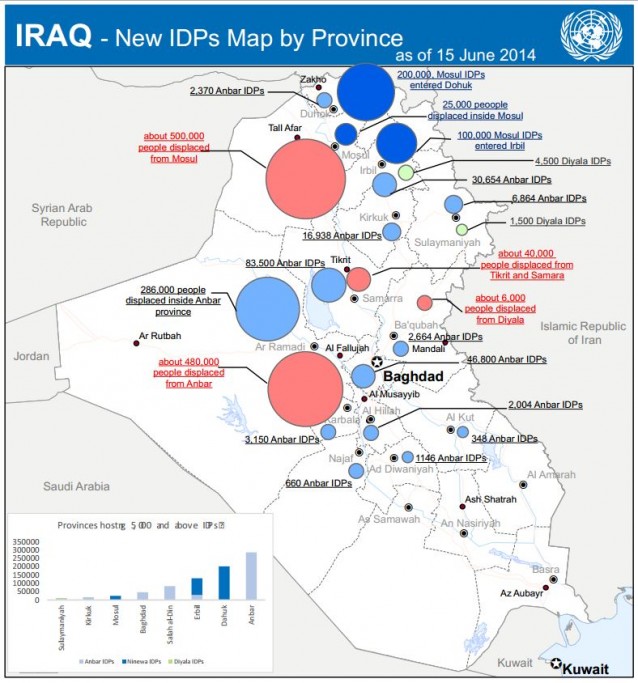
A New Iraqi Refugee Crisis, Ctd

iraq-idps-province-638x683

Hayes Brown provides an update on the escalating emergency:

[T]he United Nations on Wednesday upgraded Iraq’s crisis to a level 3 humanitarian disaster — the most severe rating it has. “Now we’re focused on delivering water, food and essential items,” Colin MacInnes, deputy head of UNICEF in Iraq, told the Washington Post. “Iraq already has a level 3 polio disaster,” MacInnes continued, and as Syria across the border is also in the midst of a level 3 disaster, “that means we have currently three level 3 disasters that are affecting the country.”

“At the present moment, we have a very serious confrontation and we have meaningful levels of internal displacement. We are not yet witnessing a massive refugee outflow and I think it will depend on whether this crisis can be addressed effectively in the near future or whether it will be a protracted conflict,” said U.N. High Commissioner for Refugees Antonio Guterres at a press briefing on Tuesday.

Meanwhile, for neighboring countries like Jordan, refugees from the original Syrian conflict remain a huge burden:

Tensions between Syrians and Jordanians are still a worry. Eighty percent of Syrian refugees live in Jordan’s cities and towns, where, since they are banned from working, they take black market jobs for low wages. The government says this has pushed down pay for Jordanians too. “The potential seeds of conflict are really there,” says Musa Shteiwi, who heads the University of Jordan’s Centre for Strategic Studies. A poll he ran late last year found that 73% of respondents were against hosting more refugees—up from 64% in 2012.

Jordan is asking donors to give it the $1 billion it says it will spend on additional security over the next three years thanks to the refugee influx—about as much as it has asked for education and health services for the refugees. It may also like to see a larger proportion of Syrians in controlled areas such as Azraq. Plans are already underway for a third refugee camp. Current urban dwellers are unlikely to be moved, but newcomers will find it harder to leave the camps.

This Fight Is About More Than ISIS

Marc Lynch explores how Arab supporters of Syria’s rebels see the conflict in Iraq:

The popular Al Jazeera personality Faisal al-Qasim recently observed to his 1.5 million Twitter followers that the Syrian and Iraqi revolutions were examples of “dressing up a popular revolution in terrorist clothes, demonizing it and opening fire on it.” Former Kuwaiti member of parliament Walid al-Tabtabaie, for instance, supports the “Iraqi revolution” while warning that ISIS “has some good people but is penetrated by Iran” and that “the corrupt in Syria can’t be in the interest of Iraq… they will stab you in the back.”

ISIS is a real threat, without question, a savvy and experienced fighting organization with a clear ideology, significant financial resources and a proven ability to attract foreign fighters to its cause. But this Arab counter-narrative shouldn’t be ignored.

The sharp divide between an American debate that focuses exclusively on ISIS and an Arab debate that focuses on a broad Sunni rebellion starkly evokes the similarly skewed discourse in the first few years of the U.S. occupation of Iraq. From 2003 to 2006, U.S. officials and media often reduced the Iraqi insurgency to “al-Qaeda” and regime dead-enders, thus vastly exaggerating the importance of al-Qaeda in Iraq, delegitimating the political grievances of the Sunni community and missing opportunities to divide the insurgency. Heavy-handed, indiscriminate military responses informed by these views helped to fuel the insurgency.

Another major reason this matters:

These Arab narratives about what’s happening in Iraq shouldn’t be taken at face value, but listening carefully to them might help to avoid a counterproductive American foray back into Iraq. Inside Iraq, a broadly based Sunni insurgency, which commands the support of non-ISIS tribes and armed factions, would reinforce the case for why pushing Maliki for serious political accommodation before providing military aid is the right policy (Petraeus, for what it’s worth, agrees).

True, getting rid of him might not solve Iraq’s problems, but the crisis won’t be overcome without significant changes, which he seems highly unlikely to make (and nobody would trust his promises to do so after the crisis has passed). The point is not to appease ISIS, which could care less about such things, but to break the alliance between ISIS and some of its current Iraqi Sunni allies by giving them a reason to opt back into a political system in which they have largely lost faith. On their own, airstrikes and military support of Maliki without the prior delivery of real political change are likely to only push the various strands of the insurgency closer to ISIS. Political reform isn’t a luxury item that can be postponed until the real business of military action has been conducted – it is the key to once again dividing ISIS from those larger and more powerful Sunni forces.

Ali Kheder’s list of “the players actively fighting across Iraq today” further illustrates the folly of viewing the recent bloodshed as merely a fight between the Iraqi government and ISIS.

About That Iraqi Democracy: Forget About It

One might be forgiven for thinking that the catastrophic war in Iraq was designed to bring democracy and sovereignty to that nation after a brutal, foul dictatorship. That, after all, was what we were told from the get-go, along with the alleged threat of non-existent weapons of mass destruction. Many service-members died to bring that democracy about; almost 200,000 Iraqis died in the bloody transition. And they elected a prime minister; and re-elected him in fair elections. And yet now, courtesy of the CIA’s unofficial spokesman, David Ignatius, we hear that Maliki is nonetheless going to be deposed by the US:

President Obama sensibly appears to be leaning toward an alternative policy that would replace Maliki with a less sectarian and polarizing prime minister — and then begin using U.S. military power on behalf of this more broadly based government. The White House is already mulling a list of alternative prime ministers.

So the whole pretext of Iraqi democracy was a sham, and we now know this without a shadow of a doubt. The next leader of Iraq will be IRAQ-UNREST-VOLUNTEERSpicked in Washington, and not by the people of that country. And the right of an elected government to choose its own policies and direct its own governance – for good or ill – has been effectively rendered null and void. There’s never any welfare reform with imperial welfare. They are to be dependents for ever. And, of course, the CIA’s previous regime changes in the Middle East – Iran, anyone? – do not even merit a mention. Just because they have screwed it up every single time doesn’t mean they don’t have the absolute right to screw it up again. Because the residue of their own disasters can be used to justify yet more ones. Just ask Fred Hiatt.

As with most imperial projects – and what other word can be used to describe the embedded assumptions in Ignatius’s column? –  Washington will use local power-brokers to implement its designs. Ignatius is perfectly candid about the rawness of the imperialism involved:

The people who will pull the plug on Maliki are Kurdish leader Massoud Barzani and other Iraqi kingmakers. The United States should push them to signal unmistakably that Maliki is finished. And they must do so in coordination with Iran, which will effectively have a veto on the next Iraqi prime minister, whether we like it or not.

Notice the lack of any subjunctive. The Kurdish leader will do what he is told; the Sunni tribes must cooperate with Iran. This is the mindset of the CIA, a beyond-the-rule-of-law organization that has done more damage to this country’s interests and values than any other organ of state. The contempt of these imperialists (who brought torture into the American bloodstream) for the autonomy of any other country is a striking as their contempt for American values.

So Ignatius admits that this illegal intervention needs “political cover”from other interested parties in the region (all of whom have ulterior motives and almost all of whom have contributed to this burgeoning sectarian warfare). And the goal now is to intervene simultaneously in Syria’s civil war, to the tune of training up to 10,000 “Syrian moderates” (try not to laugh out loud or burst simultaneously into tears).

And the entire point of this exercise is to get another war up and running – and soon – in Syria and Iraq:

Targeting ISIS perhaps could begin with its safe havens and infiltration routes along the Syria-Iraq border, where there’s less chance of hitting Sunni tribesmen. “We know where their base camps and training camps are, which is where we can start — and it’s important to start,” says U.S. Central Command adviser Derek Harvey.

Yes, “it’s important to start”. Sure, we don’t know where any of this could lead – but the one thing we have learned this past decade and a half is to launch a war first and figure out those questions later. Intervening in two sectarian countries just adds to the challenge, I guess. It’s so good to know someone advising Central Command has absorbed the lessons of the past so well.

I’m distressed by the news out of DC and alarmed by Obama’s presser, but I haven’t given up on the president yet.

Ignatius is voicing the CIA’s agenda, as usual, not necessarily the president’s. In his presser today,

Mr. Obama insisted that the United States would not press for Mr. Maliki’s replacement by a new leader. “It’s not our job to choose Iraq’s leaders,” he said. But he added, “Right now, there’s too much suspicion, there’s too much mistrust.”

And yet 300 military “advisers” and the possibility of air-strikes is how wars start. And the president has been woefully supine when it comes to confronting the lawless incompetence of the CIA for the past six years; and once military strikes begin, we’re back to square one, trying to control a country we do not understand and cannot master, taking the bait of all sorts of interested parties, who will use us as they have used us in the past to promote their own agendas. The president also signaled he is leery of Ignatius’ utopian notion of 10,000 “Syrian moderates”:

He cited the difficulties in deciding whether to arm members of the opposition. “If you have former farmers or teachers or pharmacists who now are taking up opposition against a battle-hardened regime,” he said, “how quickly can you get them trained?”

And how do you know that after they’ve been trained and equipped, they won’t turn around on a dime like the Iraqi army just did? This is the Arab Middle East. There is no trust there. And there are no reliable allies.

In my view, this is not a conflict in which you can half-intervene. By some miracle, we extricated ourselves at great loss. And yet the breezy tone in Ignatius’s column and the decision by Obama to send Special Forces advisers to Iraq suggest something more ominous still. So let me reiterate something: in my view, the one thing Obama pledged never to do he must never do. For me, re-entering the Iraq war – which is what US-targeted airstrikes with Special Forces on the ground against ISIS would do – is a deal-breaker. In one move, it could obliterate Obama’s entire foreign policy legacy of deleveraging the empire and effectively treat the American people as irrelevant. It would also instantly make the United States a prime target for these religious fanatics.

So this is truly a test of the president’s mettle. Will he stand up for the American people and follow his own instincts or cave to the CIA and the hyperventilating Beltway? His presser today both reassured but also worried me. I worry because I have learned the hard way that the elites in Washington like to treat the world as a garden to tend, they have never seen a crisis they don’t think they can solve, and they love to imagine themselves in the vanguard of the good and the true, even if all their recent interventions have led to mass murder and lies. This goes for Democrats as well as Republicans. And when the imperial complex sees a new opportunity to enlarge its power and money and relevance, they tend to have their way. Because they always have their way, and until we elect someone with the spine to rescue us from this eternal, corrosive, imperial quicksand, they always will.


UPDATE: A couple of sentences in Ignatius’ piece have been changed. Details here.

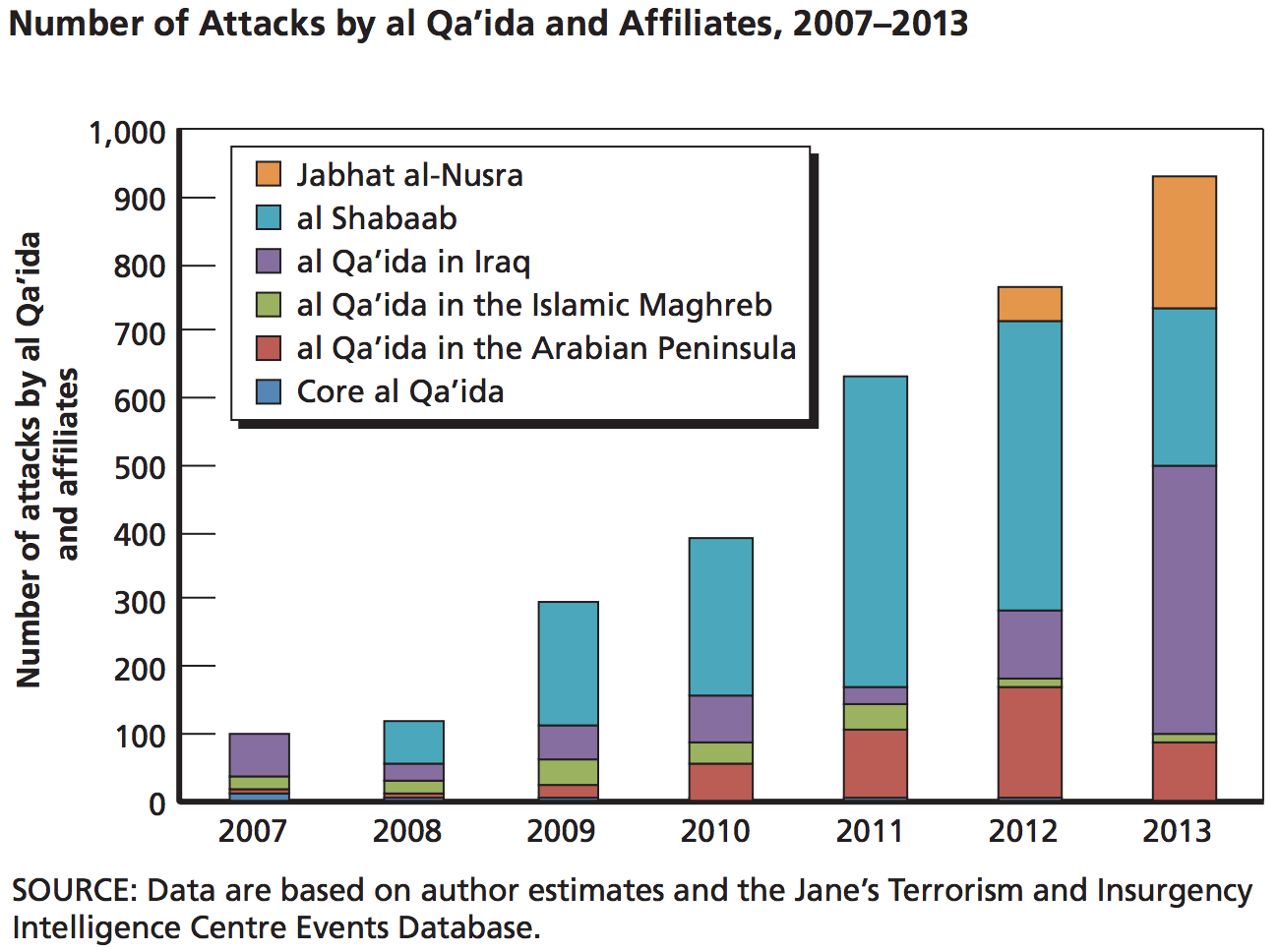
Terror Winning War On Terror

Terror Chart

Ian Bremmer captions the above chart from RAND (pdf):

Since 2007, the number of attacks by al Qaeda and its affiliates has risen nearly tenfold, with violence levels highest in Iraq, Yemen, Syria and Somalia. Unlike a decade ago, core al Qaeda has been involved in very few plots, but its branches have more than made up the difference. Between 2012 and 2013, both al Qaeda in Iraq and the Syria-Civil-War-born Jabhat al-Nusra quadrupled their attacks.

This war is real and metastasizing, as the Arab world continues on its rough road to what might be modernity. And I should reiterate one lesson I draw from this. Our previous tactics – invasion, occupation and torture – clearly failed. Drones have become a two-edged sword in terms of fomenting as much terror as they might destroy. We’re left with domestic security, which means to say the NSA. I worry almost as much as some others about the potential for abuse in this country’s vast intelligence and spying networks. But they exist for a reason; and they are primarily defensive. They exploit our core advantage over Islamist mass-murderers: our technological superiority. In this long war, which will wax and wane as the Arab and Muslim world grows and adapts, a better-monitored and better safe-guarded NSA is our friend and not our enemy.