The Neocons’ Last Stand?

Hillary Clinton Awarded The 2013 Lantos Human Rights Prize

Jacob Heilbrunn suspects so:

Whether the neocons’ audacious attempts to once more guide the debate over foreign policy will succeed is an open question. Kristol, for one, seems to think this is his moment, writing recently, “A war-weary public can be awakened and rallied. Indeed, events are right now doing the awakening. All that’s needed is the rallying.”

Wrong. This is classic neocon bombast, which is to act as though foreign policy is simply a matter of willpower. It isn’t. Foreign policy is not a cheerleading event. A host of other factors—the strength of the economy, our alliances, the growing power of China, climate change and other developments—mean that American cannot simply act with impunity abroad, as the neocons would have it. What’s more, the American people are not ready to rally: A recent Pew poll indicates that 54 percent of the public, a new high, believes that the United States should “mind its own business” internationally. Put simply, Obama is not flouting the will of the public. He is expressing it. It’s the neocons who are out of step with history.

John Nichols spotlights a recent PPP poll on Iraq:

In fact, if there is one thing that unites Americans, it is their skepticism about steering back into Iraq. Eighty-two percent of Democrats oppose sending US troops to Iraq, as do 86 percent of independents. Notably, 57 percent of Republicans are also opposed. Just 28 percent of Republicans favor the ground-troops option.

Overall, just 16 percent of Americans are inclined toward the sort of approach that might satisfy Cheney.

Their main source of hope at this point? Hillary Clinton. Millman notes how far to the neocon right Clinton is among Democrats, when it comes to intervention:

The one thing that distinguishes her from your typical Democrat is that she is substantially more hawkish, having taken the hawkish side in essentially every political debate from Bosnia and Kosovo through Afghanistan and Iraq and into the Obama-era debates over Libya, Syria and Ukraine. If she weren’t Hillary Clinton, that fact would not only make her a long shot; it would probably be disqualifying.

There’s a real risk that she’d drag us back into the Manichean struggle with Iran, cave to the Greater Israel lobby on settlements, and give bleeding heart liberal interventionists another crack at meddling in someone else’s country once again. Her entire career has been about insulating herself from attacks from the right by appeasing them. I see no reason why she would stop now. It’s in her bones.
Maliki Must Go?

IRAQ-POLITICS-DEMO

Max Boot recommends “pressing the Iraqi government for serious political reforms that include embracing Sunni tribes, ending the persecution of Sunni leaders, curbing the prime minister’s authority and weeding out political hacks and sectarian actors from the security services.” To which one can only say: “Good luck with that!” As for the neocon-installed Maliki:

It is unlikely that he would agree to such reforms, so the United States needs to work behind the scenes to ensure that he doesn’t win a third term in office. His State of Law party was the top vote-getter in the April 30 elections, but it needs support from other factions to form a government. The U.S. should take advantage of ISIS’ attacks to press the other political parties to dump Maliki and find a more inclusive figure.

The Economist also speculates that Maliki may be on his way out:

Mr Maliki faces a stark choice. Either he must plunge his forces into a full-scale war of reconquest, at untold cost in lives. Or he must embrace the remaking of Iraq into a looser, genuinely federal state. But his days as Iraq’s leader may be numbered, as the Americans began hinting heavily that they would give extra military help only if he speedily departed.

But Maliki says he won’t quit to facilitate US airstrikes. And no leader in these circumstances is likely to resign. He’s not Sarah Palin. More to the point, deposing Maliki could be extremely dangerous:

There are likely to be months of wrangling before a new PM can be chosen. And maybe it will have to be a minority PM because the parliament is permanently hung. In the meantime, if al-Maliki is deposed, who will command the armed forces? So if you depose al-Maliki, you can’t be sure who will take his place. His successor may be even worse. As in Libya, the the government could also collapse.

One thing I’ve learned from having to study and watch this distant country for the past decade or so: whenever you think the worst has happened in Iraq, you’re wrong.

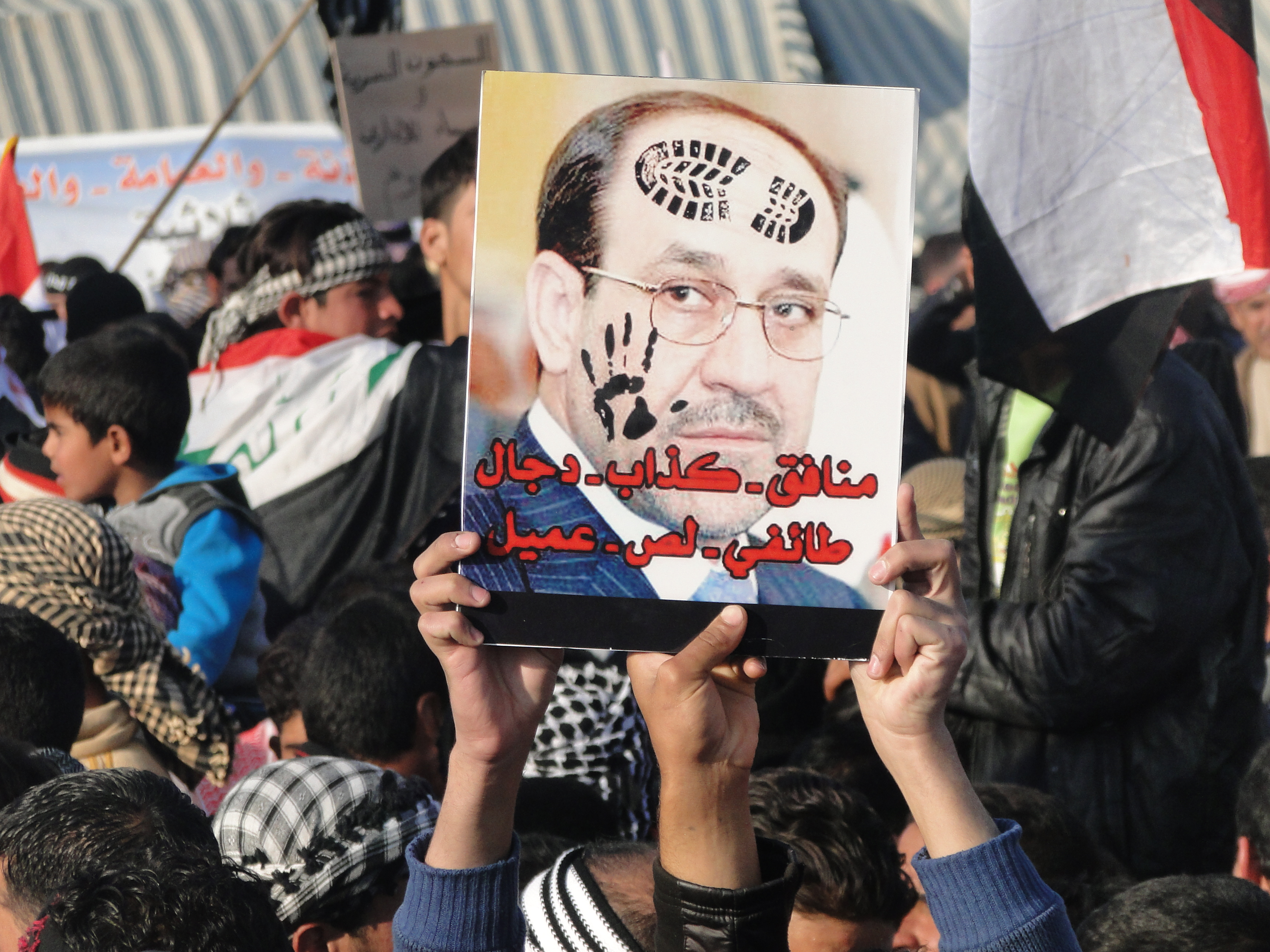
(Photo: Iraqi Sunni protestors hold up a portrait of Prime Minister Nuri al-Maliki with slogans reading in Arabic, “liar…sectarian, thief, collaborator” during a protest against him on the main highway to Syria and Jordan near Ramadi, Anbar’s provincial capital west of Baghdad, on January 4, 2012. By Azher Shallal/AFP/Getty Images)

With Hindsight, Would You Still Invade Iraq?

That’s the question George Will asks the GOP’s presidential hopefuls:

Given the absence of Iraqi weapons of mass destruction, and given that we now know how little we know about “nation-building” and about the promotion of democracy in nations that need to be “built,” and given that Saddam Hussein’s horrific tyranny at least controlled Iraq’s sectarian furies, and given that Iraq under him was Iran’s adversary, and given that ten-year wars make Americans indiscriminately averse to military undertakings—given all this, if you could rewind history to March 2003, would you favor invading Iraq?

It appears that Norman Podhoretz would. He would, in fact, make the occupation as permanent as the Israeli one in the West Bank:

After explaining why and how the al-Qaeda affiliate ISIS has been able to capture city after city in Iraq and is now only about fifty miles from Baghdad, David Pryce-Jones flatly declares that “President George W. Bush is vindicated. The sole way Iraq could have continued was under a permanent American presence that gave and guaranteed state functions. President Obama’s withdrawal of American forces is already a historic error. They alone could have kept the peace. Arabs have a phrase to the effect that some mistake has opened the doors of Hell. President Obama has opened those doors.”

At what point did president George W Bush favor a permanent occupation of Iraq? He was the one who made 2011 the drop-dead date for withdrawal, after all. But it’s good to see the real agenda of the neocons explained: imperialism redux. It’s the only way to keep the forces of entropy under control, you see? If the Iraqis don’t want us? Fuck ’em. Their democracy is only as good as our imperial interests allow.

Should We Just Tune Out The Neocons?

Kristol

Fallows is disgusted that Kagan, Kristol, and company are being allowed to participate the public conversation about Iraq today:

Am I sounding a little testy here? You bet. We all make mistakes. But we are talking about people in public life—writers, politicians, academics—who got the biggest strategic call in many decades completely wrongWrong as a matter of analysis, wrong as a matter of planning, wrong as a matter of execution, wrong in conceiving American interests in the broadest sense.

None of these people did that intentionally, and many of them have honestly reflected and learned. But we now live with (and many, many people have died because of) the consequences of their gross misjudgments a dozen years ago. In the circumstances, they might have the decency to shut the hell up on this particular topic for a while. They helped create the disaster Iraqis and others are now dealing with. They have earned the right not to be listened to.

I hold a somewhat different view, although I feel perhaps even more strongly than Fallows (with no legs to stand on, given my record). As long as these people forthrightly acknowledge they were terribly wrong in the past, they have every right to participate in the current debate. But when they either excise that past from history or even claim they succeeded, my head explodes. Beinart is pretty close to me on this:

Saying that Iraq hawks should have to squirm their way through debate number two [their past] before getting to debate number one is different than saying, as Paul Waldman recently did in The Washington Post, that “On Iraq, let’s ignore those who got it all wrong.” In fact, the two positions are antithetical.

You can either ignore the people who got Iraq wrong or you can ask them tough, searching questions about why they got it wrong. Doing the latter brings past debates to bear on present ones, and helps clarify what our disastrous 2003 intervention can teach us about intervention today. Doing the former offers no such opportunity at all.

Chait agrees, noting that those who would shush the neocons have also made mistakes:

Most Democrats in Congress opposed the Gulf War, warning of Saddam Hussein’s fearsome, World War I–style fortifications and citing 45,000 body bags as an indication of the likely U.S. death toll — predictions that turned out to be wildly incorrect. Why shouldn’t anti-Gulf war Democrats — that is, the vast majority of Democrats — have been excluded from subsequent foreign policy debates? If your answer is “because people died — Iraq,” then then you’re not arguing that pro-war arguments should be ignored because they’re analytically wrong, you’re arguing they should be ignored they’re inherently morally suspect, regardless of accuracy.

When you’re trying to set the terms for a debate, you have to do it in a fair way. … We shouldn’t disregard Dick Cheney’s arguments about Iraq because he’s Dick Cheney. We should disregard them because they’re stupid.

Stupid is too kind. They are the deranged views of a man with a mighty ax to grind and a sense of shame surgically removed. Larison makes an important point:

The Iraq war in particular was the greatest foreign policy blunder in a generation. Surely it must count against someone more to get a major policy decision horribly wrong than to be on the “wrong” side of a more debatable and relatively minor decision.

He follows up:

Chait is mostly wrong that “the ideological fault lines” aren’t the same. He can find some liberals that are pro-intervention now that were against the war, and he has identified a handful of hard-liners that were all for the war and now don’t want a new intervention (albeit for extremely hard-line reasons). Chait is an example of a previously pro-war liberal that now claims to be more skeptical about using force in Iraq. Nonetheless, overall the fault lines are depressingly familiar. Neoconservatives, liberal hawks, and more than a few “centrists” will loudly demand action while the rest of us marvel at how these people still have any influence in the wake of one policy failure after another.

Waldman weighs in:

Is there a bit of over-enthusiasm with which people like me are attacking the return of the Iraq War caucus? Maybe. Part of it comes from the fact that a decade ago, those of us who were right about the whole thing were practically called traitors because we doubted that Iraq would turn out to be a splendid little war. And part of it comes from the fact that the band of morons who sold and executed the worst foreign policy disaster in American history not only didn’t receive the opprobrium they deserved, they all did quite well for themselves.

Paul Wolfowitz became president of the World Bank. Paul Bremer, Tommy Franks, and George Tenet—a trio of incompetents to rival the Three Stooges—each got the Medal of Freedom in honor of their stellar performance. Bill Kristol was rewarded with the single most prestigious perch in the American media, a column in the New York Times. (The drivel he turned out was so appallingly weak that they axed him after a year.) The rest of the war cheerleaders in the media retained their honored positions in the nation’s newspapers and on our TV screens. The worst thing that happened to any of them was getting a cushy sinecure at a conservative think tank.

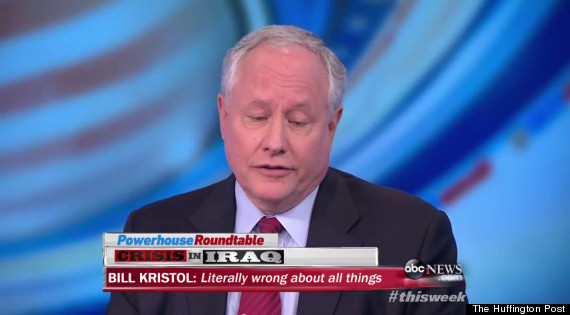
(Image from HuffPo’s “True Chyrons For Bush-Era Iraq War ‘Experts’“)

Baghdad Begs For Bombs

iraq1

The Iraqi government has formally requested US air strikes on ISIS, but our top brass is hesitant to give Maliki what he wants. Karl Mueller asks whether attacking ISIS from the air would be effective:

The military success of any air power intervention in Iraq depends very much on the ground forces fighting against ISIS. Bombing could do a great deal to give Iraqi security forces the upper hand, and it might also provide an important psychological boost to their willingness to stand and fight, which has often been less than impressive. But if they were ultimately unable or unwilling to make effective use of that advantage, such an intervention would be a wasted effort. (Conversely, if the Iraqis can defeat ISIS without such help, there would be little reason to consider intervening.)

And of course, even if ISIS were defeated with the help of Western air power, whether the outcome would ultimately be a strategic success for the United States hinges on what comes next in Iraq. Air power is a potent instrument for changing the course of wars, but as experience in Libya shows, shaping what happens in the wake of the conflict means building influence on the ground and devoting sustained effort to the often difficult problems of postwar stabilization.

Carpenter doesn’t see the point of airstrikes to prop up a loser like Maliki:

U.S. airstrikes could deepen Iraq’s Sunni-Shia divide, they could alienate the Saudis and align us with Iran, they could convert thousands of non-combatant Iraqi Sunnis to violent jihadism against the United States, and perhaps worst of all, they not only could, but would tie us militarily to the region’s most incompetent leader–Nuri al-Maliki. All of which tends to swamp the “good.”

Nonetheless, airstrikes to bolster the Iraqi Army’s morale might indeed be a good thing–other considerations aside–but not as long as Maliki rules. That would be bad. In fact that would be dumb. And President Obama isn’t a dumb president.

But Morrissey is more sanguine:

This is probably an easy call for Obama to make. Air strikes are a lot more antiseptic than putting ground troops in harm’s way, and a lot more practical in terms of politics, logistics, and timing. It gives Obama a chance to take some action that will at least address the deep concerns from allies in the region about the lack of action and direction from Washington these days, too. Air strikes will also provide a positive impact on the situation and give Baghdad some room to maneuver politically and militarily. Plus, Congress is likely to rally around this limited intervention, which would provide Obama with political cover — if he’s smart enough to seek it. He didn’t in Libya and is still paying the political price for high-handing Congress and going it alone.

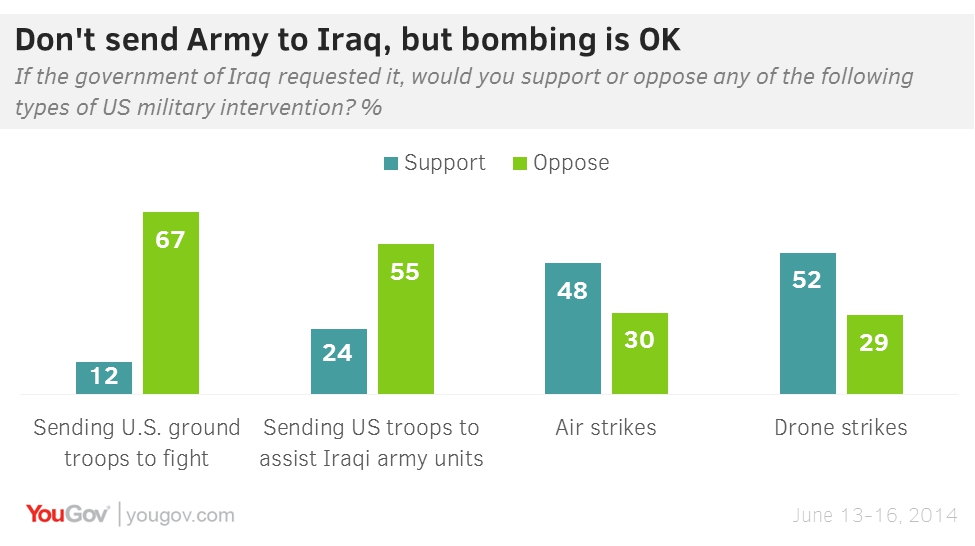
A new poll reveals that Americans don’t much care for bombing Iraq, but as the above chart shows, it’s a good deal more popular than boots on the ground. The public, however, doubts intervention will do any good:

Opposition to sending troops to Iraq may not be entirely due to weariness after nearly thirteen years of war, but also because of doubts over the ability of the US to actually have a positive impact. Only 19% say that US intervention would defeat the insurgents and restore the power of the Iraqi government, while 25% say that the insurgents would be defeated but the Iraqi government would still be ineffectual. 34% think that US intervention would do little to change anything.

Previous Dish on the possibility of US airstrikes on ISIS here and here.

Have The Cheneys Finally Jumped The Shark?

In a video introducing their new 501(c)4, Dick and Liz provide what will surely be SNL’s opening skit this Saturday:

Update from a reader:

I took a look at the Cheney video on YouTube to read some of the comments. And what did I see? Comments have been disabled. Some things never change.

Their astonishing op-ed – a classic in the annals of non-self-awareness – has even prompted Fox’s Megyn Kelly to balk and Byron York’s jaw to drop. Waldman identifies one of many huge holes in the warmongering op-ed from the father-daughter team:

[T]he Cheneys’ op ed is silent on what they would do differently in Iraq today. The op-ed contains nothing even approaching a specific suggestion for what, other than to say that defeating terrorists “will require a strategy — not a fantasy. It will require sustained difficult military, intelligence and diplomatic efforts — not empty misleading rhetoric. It will require rebuilding America’s military capacity — reversing the Obama policies that have weakened our armed forces and reduced our ability to influence events around the world.”

So to recap: we need a strategy, and though they won’t tell us what that strategy might be, it should involve military, intelligence, and diplomatic efforts, and rebuilding the military. Apart from the absurd claim that the armed forces have been “weakened” (we’re still spending over $600 billion a year on the military even with the war in Iraq behind us and Afghanistan winding down), the Cheneys are about as clear on what we should do now as they were on how invading Iraq was supposed to spread peace and democracy across the Middle East.

They know nothing but the fumes of their own ideology and self-regard. Ed Morrissey comments that the Cheneys “are likely whistling into the wind here”:

There hasn’t been much polling on Iraq, but the PPP poll taken over the weekend shows that the neocon policy is even less popular than Obama’s leadership at the moment. Even with the looming disaster facing Baghdad and by extension American policy, and even with the threat that ISIS represents to the region and eventually to the US directly, only 20% want American troops back in Iraq. The majority want a diplomatic “mobilization” to deal with ISIS, which as I wrote yesterday would look pretty strange, since ISIS is an unapologetic terrorist organization.

Jason Zengerle calls the op-ed an opening for Liz Cheney’s next political campaign:

While Obama is the ostensible target of the Cheneys’ op-ed and new group, their real opponent isn’t Obama but Rand Paul and the school of foreign-policy thinking that Paul represents inside the GOP. Liz finally has the proxy war she’s been waiting for.

Even before Liz abandoned her Senate race, people in Wyoming were speculating that she wouldn’t stay in the statethat, win or lose, her family would move back to the home in the Virginia suburbs that they never bothered to sell. But six months later Liz is still in Wyoming (just witness that gorgeous mountain backdrop on the video she recorded for the Alliance for a Strong America) and it seems likely she’ll make another run for office there at some point. If she does, today will have marked the start of that long campaign.

Maybe she could just get a job at NBC for $600,000 a year. I hear the children of shameless nepotists are doing quite well in this economy. Allahpundit also detects a preemptive strike against the young senator from Kentucky:

Really, why would you even need to attack O on foreign policy at this point? His numbers are already in the toilet; Chuck Todd read his political obituary on the air just this morning. He’s the lamest of lame ducks.

The guy whom hawks are worried about is Paul, who could do a lot of damage to the interventionist cause by succeeding with a more dovish foreign policy agenda in the GOP primary. Remember, too, that the Cheneys have a history with Paul: He eagerly endorsed Enzi after Liz announced her primary challenge and offered to campaign personally for him in Wyoming in the name of squashing a famous hawk with the Cheney name. The Cheneys are going to repay the kindness next year by attacking him as a dangerously irresponsible appeaser who’ll build on Obama’s legacy of failure. That’s where the new group comes in, I think. By rolling it out now against Obama, they’re going to build goodwill among righties. Then they’ll put that goodwill to use next year in hammering Paul.

But Tim Mak points out that Paul has been pretty cagey about where he actually stands on Iraq:

Paul has dropped hints here and there about his Iraq stance. He told the Des Moines Register this month that he didn’t oppose helping arm the Iraqi military and said he “would not rule out air strikes.” In a Senate Foreign Relations Committee hearing last week, he said he was “not very excited about” the prospect of sending military service members back into Iraq. But he stopped short of endorsing military intervention in Iraq or ruling it out, and his on-the-fence position hasn’t been clarified.

Boarding a senators-only elevator Tuesday morning with fellow Republican Sen. John McCain, a hawk well known for his foreign policy views, Paul joked that he should just tell reporters he believes “whatever McCain says.”

Paul is not turning out to be a profile in courage, is he?

ISIS Or ISIL?

As regular readers have surely noticed by now, the English-speaking world can’t settle on an acronym for the Islamic State of Iraq and Syria/al-Sham/the Levant. Ishaan Tharoor comments on the distinction:

[I]f we are to interpret “greater Syria” as the equivalent of “the Levant” — which it essentially is — then both designations are basically correct. Neither are as accurate as “DAIISH,” the Arabic shorthand for the group that no one in the English-language press seems to use. ISIS has become part of the English-language media’s common parlance and has something of a ring to it — it’s like the ancient Near Eastern goddess. So switching to ISIL is, if nothing else, a bit jarring.

Most of the time, we deploy acronyms that preserve the wording of non-English languages. Many English-language readers following South Asian politics will know the upstart Pakistan Tehreek-e-Insaf party as the PTI, not the Movement for Justice (which is what Washington Post style dictates). The main ruling party in Algeria is almost always referred to as the FLN — for Front de Libération Nationale – and not by what would be its English equivalent, the NLF. And there are myriad more examples.

The Dish has settled on ISIS primarily because of how it rolls off the tongue, but also, as Hassan Hassan points out, “Bilad al-Sham” is the proper term for the Levant as a whole, whereas “al-Sham” is commonly used to mean Syria alone. In any case, a look at the region’s history leads Nick Danforth to conclude that the group’s dream of uniting “Iraq and al-Sham”, by any definition, is a little quixotic:

Both Iraq and al-Sham are place names with their own historical and political cachet, but it’s telling that ISIS’s leadership couldn’t come up with a single geographical term to describe its current area of operations. Al-Sham — which has sometimes been translated as Syria, though perhaps “Greater Syria” or “the Levant” gives a clearer sense of the geography — was most recently the name of an Ottoman province based in Damascus. Iraq, by contrast, was a geographical term that came into its own with the arrival of the British in the 1920s.

Operating on the sound logic of opportunism, ISIS is claiming to unite two regions that even the first opponents of the European mandate system were content to treat as separate. In the immediate aftermath of World War I, some of the earliest Arab nationalists came together in defense of a state covering the entire Levant. When Faisal, champion of the Arab revolt and later king of Iraq, proclaimed in 1920 a short-lived Arab Kingdom based in Damascus, he imagined its territory stretching from the Taurus Mountains in southern Turkey to the Sinai Peninsula, but not east into Iraq.

Why Doesn’t Turkey Fear ISIS?

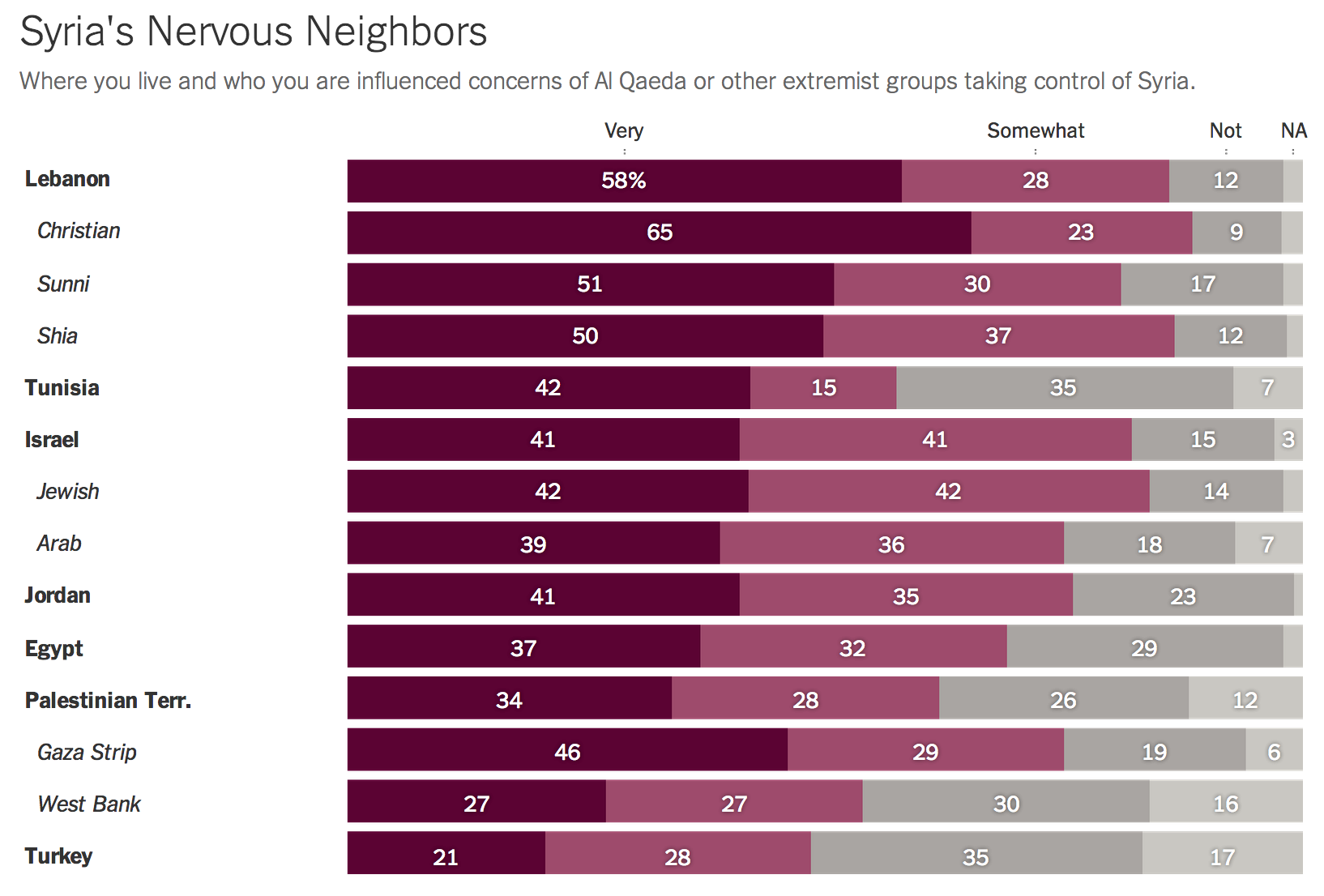
Turkey is less alarmed than its neighbors by Syria’s extremist groups:

Extremist Groups

Mustafa Akyol largely credits conspiracy theories for Turkey’s relative calm:

Many Turkish opinion leaders, especially those in the pro-government media, cannot accept ISIS, or its ilk, as extremist Islamist actors with genuinely held beliefs and self-defined goals. Rather they take it for granted that these terror groups are merely the pawns of a great game designed by none other than the Western powers.

For example, Abdulkadir Selvi, a senior journalist who has been quite vocal in the press and on television generally espousing a pro-government stance, wrote a piece last week titled “Who is ISIS working for?” This was his answer: “Al-Qaeda was a useful instrument for the US. To put it in an analogy, ISIS was born from al-Qaeda’s relationship with [the] CIA. The West gave its manners to al-Qaeda and now it designs our region through the hands of ISIS.” In short, al-Qaeda and its offshoot ISIS are both creations of the US Central Intelligence Agency and serve American interests.

Recent Dish on Turkey’s unsuccessful Syria policy here.

The Battle Over Iraq’s Oil

Iraq’s largest refinery has come under attack:

The refinery accounts for more than a quarter of the country’s entire refining capacity, all of which goes toward domestic consumption – petrol, cooking oil and fuel for power stations. At the height of the insurgency from 2004 to late 2007, the Baiji refinery was under the control of Sunni militants who used to siphon off crude and petroleum products to finance their operations. Isis has used its control of oilfields in Syria to boost its coffers.

Any lengthy disruption at Baiji risks long lines at the petrol pump and electricity shortages, putting further pressure on the Shia-led government of the prime minister, Nouri al-Maliki.

Ari Phillips checks in on the Iraqi oil intended for export:

“Most of the oil fields in the region are around Basra between Iran and Kuwait, so they aren’t really under threat right now and I doubt they will be,” Peter Juul, a policy analyst specializing in the Middle East at American Progress, told ThinkProgress. “Unless somehow ISIS runs the table and takes over the entire country, which would lead to general chaos — but I don’t think that will happen.”

Rob Wile explains what a disruption of the southern oil fields would mean:

If the conflict migrates to the South, we could be looking at $160 a barrel, [Bank of America Merrill Lynch] says.

Our commodity research team believes that in the unlikely event ISIS invades the South and the entire 2.6 million b/d of southern oil production is lost, oil prices could face $40-50/bbl upside. Further immediate risks to production seem limited under the base case scenario where oil prices remain around $110/bbl. The bulk of Iraq’s oil fields are located in the Shia South, far from the conflict zones.

The Guardian assesses the situation:

Output from Iraq reached an all-time high of 3.5 barrels a day earlier this year and remains at a high level but output is hampered by a lack of export capacity made worse since a northern pipeline was blown up.

The key oilfields in Iraq have largely escaped the real impact of the fighting because they are located in the south of the country. But threats to oil workers of kidnapping, coupled with corruption and equipment shortages, have already hampered their development.

China is already considering its other energy options:

While Iraq has been growing in importance as a source for China’s energy needs, that’s likely to change if the crisis continues much longer. China may instead focus more on tapping oil in Russia, Iran, and Oman, according to Li Li, research and strategy director at ICIS C1 Energy, a Shanghai-based energy information consultancy, English-language China Daily reported.

The Neocons’ Very Own Reality

Simon Jenkins is aghast at the neocons’ push – even now – for more intervention:

It beggars belief that further military intervention by the west in Iraq is now being considered. Yet the yearning to intervene, to bomb someone even if just to “send a message”, shows how thin is the veneer of sanity cloaking great power aggression. War still has the best tunes. How glorious it must seem to certain politicians to somehow turn 10 years of disaster in Iraq into a final victory.

That is why the causes and effects of 2003 must be nailed to the wall, time and again. Trillions of dollars were spent and tens of thousands of people died, for no good reason then and no good reason now. It was a total disgrace.

Torture champion Marc Thiessen’s latest nonsense is a text-book case of creating a reality that can simply erase the record of catastrophe:

First, [Obama] withdrew all U.S. forces from Iraq — allowing the defeated terrorists to regroup and reconstitute themselves.

Second, he failed to support the moderate, pro-Western opposition in neighboring Syria — creating room for ISIS to fill the security vacuum. ISIS took over large swaths of Syrian territory, established a safe haven, used it to recruit and train thousands of jihadists, and prepared their current offensive in Iraq.

The result: When Obama took office, the terrorists had been driven from their safe havens; now they are on threatening to take control of a nation. Iraq is on the cusp of turning into what Afghanistan was in the 1990s — a safe haven from which to plan attacks on America and its allies.

To respond: first, Bush decided that 2011 was the drop-dead date for ending the occupation, Obama refused to keep any troops there without any immunity from prosecution, and the Iraqi government insisted we leave entirely. Second, there was no way to separate out the “moderate” Sunni elements in Syria without possibly empowering far more extreme groups, like ISIS. Look at how easily ISIS has been able to arm itself with US vehicles and weapons from the surrendering Iraqi army. How much easier if we had just given them to their confreres in Syria instead. Third, while there is a danger of a Islamist haven, ISIS is not al Qaeda, has its hands extremely full, and is focused primarily on its own region, not the US. Ezra points his finger at the real culprits behind the continuing disintegration of the country the neocons broke:

The totality of the Bush administration’s failure in Iraq is stunning. It is not simply that they failed to build the liberal democracy they wanted. It’s that they ended up strengthening theocracies they feared.

And it’s not simply that they failed to find the weapons of mass destruction that they worried could one day be passed onto terrorists. It’s that a terrorist organization now controls a territory about the size of Belgium, raising the possibility that America’s invasion and occupation inadvertently trained the fighters and created the vacuum that will lead to al Qaeda’s successor organization.

And all this cost us trillions of dollars and thousands of American lives.

Meanwhile, Saletan compares GOP rhetoric on welfare and foreign policy. He posits that “the principle of self-reliance extends far beyond welfare”:

Republicans say ISIS is filling the “vacuum” left by Obama’s withdrawal. But the vacuum—which is really just another name for how the world works when we’re not there—affects other parties, too. As ISIS advances on Baghdad, Shiite militias are assembling. Iran is stepping in. Turkey may be next. The conflict could explode into sectarian civil war, though some Shiite leaders are trying to avoid that. But what’s striking is how quickly, in our absence, the threatened elements of Iraqi society and the region are mobilizing to stop ISIS. They’re doing it because they have to. If they don’t, nobody else will.

Yes, ISIS is a threat to us. We’ll be safer if it’s crippled. But are we really the best people to do the job? For nearly a decade, we tried to manage Iraq. What we got was dysfunction. Maybe it’s time to let Iraq learn to manage itself.

Surely this is a contribution the Tea Party could make to the national security debate, if they weren’t consumed with Obama-hatred. Isn’t plying a sectarian government with aid and training a way of making them dependent on us, of encouraging them not to take full responsibility for their own country and their own future? When will the Tea Party right begin to see their incoherence on the question of welfare dependency at home and abroad? I guess we’ll see if Rand Paul can gain traction from this moment against the torturers, invaders and micro-managers of the neocon clique. Or if he’s a lot of talk and very few cattle.