The Enemy Of My Enemy Is My Frenemy? Ctd

The US and Iran got to talking about the crisis in Iraq yesterday. The Guardian notes was “the first time the two nations have collaborated over a common security interest in more than a decade”:

John Kerry, the US secretary of state, pointedly declined to rule out military cooperation in an interview with Yahoo News, but US and Iranian officials later stressed that there was no prospect of military cooperation, and none was discussed in Vienna, where the talks were described as short and inconclusive.

“We are open to engaging the Iranians,” said a senior State Department official, who characterised the discussions as brief. “These engagements will not include military coordination or strategic determinations about Iraq’s future over the heads of the Iraqi people,” the US official said, on condition of anonymity. The Iranians confirmed that military cooperation was not on the cards. “The disastrous situation in Iraq was discussed today. No specific outcome was achieved,” a senior Iranian official told Reuters.

The UK, meanwhile, is reopening its embassy in Tehran. Calling Iran “the most stable country in the Middle East right now,” Trita Parsi scrutinizes why cooperation with the US is a good move for the Islamic Republic:

Iran … will pay a price if it clings to an outdated understanding of the regional and global strategic landscape. Contradictory messages have come out of Tehran, with officials telling Reuters that they are open to collaboration with the United States against ISIS, and then having their Foreign Ministry spokesperson strongly oppose U.S. military intervention. Similarly, the U.S. position seems to be shifting, from first denying any plans for talking to Iran about Iraq to signaling a desire to sit down with Tehran.

Iran’s key objective is to be recognized as a stabilizing force. But that is a role it ultimately cannot play if it simultaneously wishes to challenge the United States. Unlike in Afghanistan, any cooperation in Iraq will likely be more public. If Iran plays a constructive role, the world will notice. But changing old patterns require courage, strength, and political will. It remains to be seen if the leadership in Tehran can deliver those — or if Washington will be receptive.

My own preference would be for very light coordination with the Iranians if they are really the only force capable of halting ISIS’s advance on Baghdad, and no US troops anywhere, but for defending key US assets like the embassy.

The neocons will howl as their botched war further empowers their arch-enemy in Tehran – see this classic know-nothing-learn-nothing piece from the Greater Israel fanatic, Elliot Abrams – but I tend to agree with Allahpundit. A shrewd strategy

to “blunt Iran’s rise in the region” would be to force them to fight a two-front war against ISIS in Syria and Iraq without western help, not to start bombing their enemies while sternly warning them not to capitalize once we’re gone.

Then there’s how all of this impacts the delicate negotiations over Iran’s nuclear program – now significantly weakened undr the provisions of the interim agreement. Could mild cooperation in Iraq facilitate a resolution? Again, the neocons are quick to state the opposite. Jonathan Tobin claims that Iran’s negotiating power over the US and Europe at the P5+1  just increased exponentially:

The administration’s zeal for a deal that would end the confrontation over Iran’s nuclear ambitions has been no secret since it concluded an interim pact last November that tacitly recognized Iran’s “right” to enrich uranium and started the unraveling of the economic sanctions that had taken years to enact and enforce. The Iraqi crisis not only strengthens Tehran’s already strong bargaining position in the continuing P5+1 talks; it also gives President Obama one more reason to seek to appease Iran rather than pressure it to make concessions on outstanding issues such as its ballistic missile program or its nuclear military research.

The talks, I presume, will stick to their original agenda, and not include the entire neocon wish-list (which is really a poison pill for any rapprochement). A good omen – and Jennifer Rubin is hyperventilating:

It seems the president will do anything to avoid using U.S. power in the region, even if it means accelerating Iran’s influence in Iraq. Imagine the reaction of our allies in Egypt, Sunni Gulf states and Israel when we let on that we are going to be assisting Iran’s hegemonic vision and thereby bolstering the state sponsor of groups including Hamas and the Muslim Brotherhood. In lieu of strengthening U.S. influence in the Middle East, Obama seems ready to bolster Iran’s. And if he is bent on this course, surely he’ll not challenge Iran and its puppet in Syria. Why, that might “upset” Iran and either wreck a nuclear deal or force Obama to handle Iraq on his own.

But Paul Pillar sticks up for cooperation, calling the ISIS surge “one of the most salient and clearest examples in which U.S. and Iranian interests are congruent”:

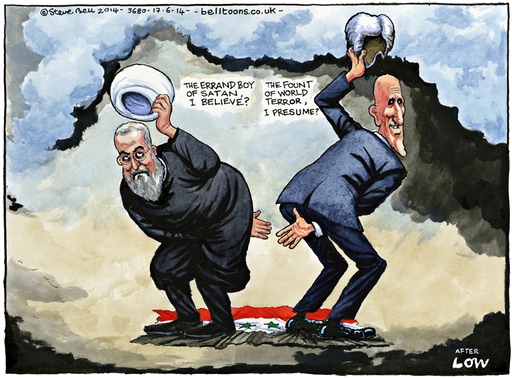
There is right now an excellent opportunity for useful coordination between Washington and Steve Bell 17.06.2014Tehran regarding messages to be sent to, and pressure to be exerted on, Prime Minister Maliki. If both the United States and Iran—the two foreign states on which Maliki’s future most depends—tell him the same thing about the need to move beyond his destructively narrow ways of governing, such pressure might begin to have a beneficial effect. Although the Iranians have been happy to see the Shia majority in Iraq finally get out from under Sunni political domination, they also are smart enough to realize that Maliki’s performance is more a prescription for unending instability and Sunni radicalism, which neither the Iranians nor we want.

The United States and Iran have wisely been concentrating over the past year on the nuclear issue, so as not to complicate the negotiations with a premature broadening of the bilateral agenda. The ISIS offensive may be a reason to move up the broadening a bit.
But maybe we’re not the ones who ought to be talking to Iran. “The real fault,” Bilal Y. Saab writes, “should be assigned to those actors who, despite having tremendous influence and real leverage over the majority of the Iraqi antagonists, have so far decided not to intervene politically. That’s Iran and Saudi Arabia”:

A dialogue between the Iranians and the Saudis is desperately needed not just to stop Iraq’s bleeding and prevent another full-blown civil war, but to extinguish at least the major Sunni-Shi’ite fires throughout the Middle East that are fueling this violence and chaos.

This is not a naive call for putting an end to an old and fierce rivalry between Saudi Arabia and Iran and to an historic feud between the two biggest branches of Islam. That’s just not going to happen. Instead, this is a realistic invitation for two regional heavyweights who, for better or worse, speak for the majority of Sunnis and Shi’ites in the Middle East, to negotiate a path out of this catastrophic situation. Call it arms control, dialogue, or cooperation. The bottom line is that they need to sit down and talk about ways to manage or stabilize their regional competition by agreeing to hard rules that would benefit both, otherwise Arab League chief Amr Moussa’s nightmare scenario of the gates of hell opening in the Middle East will turn into a reality.

Previous Dish on the potential for US-Iran cooperation here, and on Iran’s intervention in Iraq here and here.

(Cartoon by Steve Bell. The analogy is to David Low’s classic cartoon on the Hitler-Stalin pact. Yes, Bell appears to see the US as the equivalent of Stalin’s totalitarian state.)
No, ISIS Is Not Al-Qaeda

Evan Perkoski and Alec Worsnop clear up an important misconception:

[C]ontrary to many media reports, ISIS is not a splinter group of AQ. ISIS wasn’t founded by or ever directly a part of AQ; rather, they were affiliates, two groups with close bonds, with one pledging loyalty to the other though at all times maintaining autonomy. This is an important distinction since labeling ISIS a splinter implies AQ factionalism that in reality never existed. Instead, ISIS’s links with AQ, rather than signaling weakness or factionalism, have played a major role in their development by providing access to resources, strategic and tactical guidance, recruits, and an ideology that helped socialize and bind together individuals from disparate backgrounds.

Benjamin H. Friedman also rejects the comparison in terms of the threat ISIS poses (or rather doesn’t pose) to the US:

The idea that we need to fight ISIS because of its potential to use terrorism against the United States suffers similar flaws [to the logic of the Iraq War]. During the Iraq War, hawks constantly warned that leaving Iraq would allow terrorist havens to form there. Their mental model was 1990s Afghanistan. They ignored the fact that al Qaeda (the original group that attacked Americans) came from particular conflicts, rather than being some kind of plant that grew in failed states. And even in Afghanistan, the problem was more that the government — the Taliban — allied with al Qaeda, rather than the absence of government. And hawks forgot that U.S. gains in drones and surveillance technology since the 1990s had destroyed havens—now those were easy targets.

Today, we are repeatedly told that ISIS is more brutal than al Qaeda and thus a bigger danger to Americans. But that logic confuses an insurgency with a group focused on attacking Americans. ISIS is a nasty organization fond of terrorist violence, radical Islam, and Islamic caliphates, but not an obvious threat to Americans. Conflating morally noxious Islamists with those bent on killing Americans is one of the errors keeping us at endless war.

In fact, Barak Mendelsohn considers ISIS’s ascendency evidence of al-Qaeda’s decline:

[B]eyond raising ISIS’ profile, the terrorist group’s march through Iraq also diminishes al Qaeda’s. Al Qaeda’s greatest achievement was the 9/11 attacks, but that was 13 years ago. Many of today’s jihadis were young children at that time. Moreover, the attack on the United States was only supposed to be a means to an end: the establishment of an Islamic caliphate in the heart of the Middle East. Al Qaeda franchises did manage to gain (and then lose) some territory in Yemen, Somalia, and northern Mali. But these territories are smaller in size and significance than what al Qaeda wanted — and what ISIS controls today. Although al Qaeda may have started the march toward the reestablishment of the Caliphate, it is ISIS that seems to be realizing it. …

Al Qaeda’s appeal relative to ISIS’ is greater when questions of how to run a territory populated by Sunni Muslims who do not subscribe to the Salafi-jihadi radical interpretation of Islam take center stage. When the front stabilizes and the intensity of the fight subsides, such questions will return and the inherent weakness of ISIS will resurface. ISIS is an extremely capable force, but its battle achievements do not make it any more appealing as a government.

The question is whether we can muster the patience and restraint to see it blow itself out.

Mosul Under The Fanatics

Andrew Slater tries to get a sense of what daily life is like there now:

Residents in Mosul seemed very worried about the city being bombed by the Iraqi Air Force and the return of the Iraqi Army from the south, but most did not see this prospect as imminent. But many sounded untroubled by the fearsome reputation of life under ISIS after observing them for a few days as even the foreign fighters appeared to be leaving the people of Mosul alone. New announcements are being broadcast throughout the city from the speakers of mosques, but these primarily concerned people returning to work.

Most said they had not observed or heard of the new ISIS authorities enforcing their announced bans on smoking cigarettes or water pipes, immoderate dress, and public gatherings, but most residents said they have been very careful to comply with the new rules.  A few women had returned to work wearing the hijab, but most are staying home, uncertain of how they would be treated by the ISIS fighters in public. Even low-level government employees who were forced to swear oaths against the government in Baghdad were reportedly allowed to return to work unmolested.

Just wait a while … and the beheadings will surely begin. Meanwhile, Fehim Taştekin talks to Mosul’s governor Atheel Nujaifi, now taking refuge in Kurdistan, about his plans to try and retake the city:

It appears almost impossible for Iraqi actors to develop a joint plan for action against the chaos generated by ISIS. The governor said he is now relying on his own resources and the KRG administration. He is coordinating with Erbil and believes some groups controlling parts of Mosul are ready to fight ISIS. Even if ISIS is ousted from Mosul, however, it will not bring about resolutions to the grievances of the Sunni majority there. It is not enough to treat the matter solely as an issue of terror. Nujaifi had earlier proposed a federalism model for the region, but it was not accepted.

So what is the the real solution to ISIS? Nujaifi offered, “Another course of action is needed to combat ISIS. This issue has to be resolved not by Maliki, but as a Sunni project. We have to struggle against ISIS with our Sunni way. It is not a fight for Shiites or Maliki’s supporters. Maliki cannot fight ISIS. Sunnis can do it because that will prevent ISIS from exploiting sectarian arguments.”

Who Are These ISIS Chappies, Anyway? Ctd

Keating pens a thorough explainer on ISIS leader Abu Bakr al-Baghdadi, tracking his rise from low-level militant to head of his own rogue proto-state:

Baghdadi fought in some capacity with Sunni militant groups after the U.S. invasion of Iraq but was arrested in 2005 and interred by U.S. forces at Camp Bucca, the main U.S. detention facility after the closing of Abu Ghraib. He wasn’t considered much of a threat and was released in 2009. The former commanding officer of Camp Bucca recently told the Daily Beast that when Baghdadi was released, he told his captors, “I’ll see you guys in New York.” (The guards at the prison were from a Long Island-based military police unit.) The commander, Col. Kenneth King, says Baghdadi “was a bad dude, but he wasn’t the worst of the worst” and is surprised he rose to such prominence.

It seems as if Baghdadi became far more hqdefaultinvolved with al-Qaida in Iraq while imprisoned than he had been before, to the point that he took over the group after the deaths of [Abu Ayyub] Masri and the other [Abu Omar] Baghdadi a year later. In 2011 he was designated as a global terrorist by the U.S. State Department with a $10 million bounty. Things really picked up in 2012, when, sensing an opportunity, Baghdadi dispatched some foot soldiers to join the fighting against Bashar al-Assad’s government in Syria. In 2013 he announced that the group was merging with Jabhat al-Nusra, the other al-Qaida affiliate in Syria, to form a new group called the Islamic State in Iraq and al-Sham.

That new group has turned out to be more formidable than anyone expected, in no small part due to its impeccable organization. Martin Chulov passes along what CIA and Iraqi analysts have learned from a massive trove of ISIS intelligence acquired on the eve of the group’s blitzkrieg on Mosul:

Laid bare were a series of staggering numbers that would be the pride of any major enterprise, let alone an organisation that was a startup three years ago.

The group’s leaders had been meticulously chosen. Many of those who reported to the top tier – all battle-hardened veterans of the insurgency against US forces nearly a decade ago – did not know the names of their colleagues. The strategic acumen of ISIS was impressive – so too its attention to detail. “They had itemised everything,” the source said. “Down to the smallest detail.”

Over the past year, foreign intelligence officials had learned that ISIS secured massive cashflows from the oilfields of eastern Syria, which it had commandeered in late 2012, and some of which it had sold back to the Syrian regime. It was also known to have reaped windfalls from smuggling all manner of raw materials pillaged from the crumbling state, as well as priceless antiquities from archaeological digs. But here before them in extraordinary detail were accounts that would have breezed past forensic accountants, giving a full reckoning of a war effort. It soon became clear that in less than three years, Isis had grown from a ragtag band of extremists to perhaps the most cash-rich and capable terror group in the world.

Yochi Dreazen outlines the “mafia tactics” ISIS is using to become financially independent of its benefactors in the Gulf:

The exact amount of money in ISIS’s possession is the subject of intense debate among Western intelligence officials. At the high end, some analysts estimate that the group may have access to at least $500 million in cash drawn from bank robberies, oil smuggling, and old-fashioned extortion and protection rackets. Other analysts believe the number is far lower, with one official putting it at between $100 million and $200 million. Those numbers are moving higher as the group conquers more cities on its seemingly inexorable drive toward Baghdad and is able to loot the local private and government banks. On Monday, ISIS fighters took the strategically important town of Tal Afar, adding to the territory under its direct control. …

ISIS’s success at funding its own operations is indicative of a broader trend. Extremist groups throughout much of the world, particularly Africa, are beginning to reduce their dependence on outside donors.

More background on ISIS here and here.

Why Is Paul Wolfowitz On Television?

A reminder (from David Corn) of the man’s fathomless ignorance about Iraq (as well as the blood of well over 100,000 on his hands). Here’s the intellectual’s assessment of the possibility of sectarian warfare once Iraq had been invaded:

There’s been none of the record in Iraq of ethnic militias fighting one another that produced so much bloodshed and permanent scars in Bosnia along with the requirement for large policing forces to separate those militias. And the horrors of Iraq are very different from the horrific ethnic cleansing of Kosovars by Serbs that took place in Kosovo and left scars that continue to require peacekeeping forces today in Kosovo. The slaughter in Iraq—and it’s been substantial—has unfortunately been the slaughter of people of all ethnic and religious groups by the regime. It is equal opportunity terror.

The tape is here. It’s reminiscent of Bill Kristol’s conviction that sectarianism was a fantasy:

We talk here about Shiites and Sunnis as if they’ve never lived together. Most Arab countries have Shiites and Sunnis, and a lot of them live perfectly well together.

I wish I could feel calm contempt for these people. But it is interwoven with rage.

Don’t Get Too Excited, Neocons …

Obama is deploying troops to Iraq, but only 275 of them, to reinforce security at the embassy. Beauchamp breaks down the move:

[T]his doesn’t mean the US is going to war in Iraq again, or even helping the Iraqis fight theirs. It does, however, say that the US wants some of its embassy personnel out of Baghdad. The reasons why could be safety, or they could be something more subtle (say, to liaise more effectively with the Kurdish authorities). According to the Press Secretary statement, “the US embassy in Baghdad remains open, and a substantial majority of the US Embassy presence in Iraq will remain in place if the embassy will be fully equipped to carry out its national security mission.”

Per this useful Q&A from the AP, the 100 troops currently guarding the embassy are the only US service members in the country. We might also send in Special Forces to help train Iraqi soldiers to fight ISIS. Allahpundit doesn’t see how we’d advance our objectives any other way:

If you want trustworthy intelligence inside Iraq, your only option is American troops. The Special Forces team is probably there mainly for surveillance, to pick up tips on ISIS movements and relay them to American air assets. And of course there’s a third possibility in honor of the McCain/Graham spat, that U.S. troops are on the ground to coordinate with Iranian military elements that are already inside the country and, maybe, to provide a U.S. counterweight to Iran in influencing Maliki’s maneuvering. And if worse comes to worst and ISIS ends up overrunning Baghdad anyway, hey — you’ll have 100 of the best troops in the world right there to help get everyone out of the embassy before the barbarians run wild and start chopping off heads.

Kristol Meth

 
What do you do with near-clinical fanatics who, in their own minds, never make mistakes and whose worldview remains intact even after it has been empirically dismantled in front of their eyes? In real life, you try and get them to get professional help.

In the case of those who only recently sent thousands of American servicemembers to their deaths in a utopian scheme to foment a democracy in a sectarian dictatorship, we have to merely endure their gall in even appearing in front of the cameras. But the extent of their pathology is deeper than one might expect. And so there is actually a seminar this fall, sponsored by the Hertog Foundation, which explores the origins of the terrible decision-making that led us into the worst foreign policy mistake since Vietnam. And the fair and balanced teaching team?

It will be led by Paul D. Wolfowitz, who served during the Persian Gulf War as the Under Secretary of Defense for Policy and as Deputy Secretary of Defense during the first years of the Iraq War, and by Lewis Libby, who served during the first war as Deputy Under Secretary of Defense for Policy and during the Iraq War as Chief of Staff and National Security Adviser to Vice President Dick Cheney.

Next spring: how the Iraq War spread human rights … by Donald Rumsfeld.

Most people are aware that relatively few of the architects of a war have fully acknowledged the extent of their error – let alone express remorse or even shame at the more than a hundred thousands civilian deaths their adventure incurred for a phony reason. No, all this time, they have been giving each other awards, lecturing congressmen and Senators, writing pieces in the Weekly Standard and the New Republic, being fellated by David Gregory, and sucking at the teet of the neocon welfare state, as if they had nothing to answer for, and nothing to explain.

Which, I suppose makes the following paragraph in Bill Kristol’s latest case for war less shocking than it should be:

Now is not the time to re-litigate either the decision to invade Iraq in 2003 or the decision to withdraw from it in 2011. The crisis is urgent, and it would be useful to focus on a path ahead rather than indulge in recriminations. All paths are now fraught with difficulties, including the path we recommend. But the alternatives of permitting a victory for al Qaeda and/or strengthening Iran would be disastrous.

But it is shocking; it is, in fact, an outrage, a shameless, disgusting abdication of all responsibility for the past combined with a sickening argument to do exactly the same fricking thing all over again. And yes, I’m not imagining. This is what these true know-nothing/learn-nothing fanatics want the US to do:

It would mean not merely conducting U.S. air strikes, but also accompanying those strikes with special operators, and perhaps regular U.S. military units, on the ground. This is the only chance we have to persuade Iraq’s Sunni Arabs that they have an alternative to joining up with al Qaeda or being at the mercy of government-backed and Iranian-backed death squads, and that we have not thrown in with the Iranians. It is also the only way to regain influence with the Iraqi government and to stabilize the Iraqi Security Forces on terms that would allow us to demand the demobilization of Shi’a militias and to move to limit Iranian influence and to create bargaining chips with Iran to insist on the withdrawal of their forces if and when the situation stabilizes.

What’s staggering is the maximalism of their goals and the lies they are insinuating into the discourse now, just as they did before.

Last time, you could ascribe it to fathomless ignorance. This time, they have no excuse. ISIS is not al Qaeda; it’s far worse in ways that even al Qaeda has noted undermine its cause rather than strengthen it. It may be strategically way over its head already. And the idea that the US has to fight both ISIS and Iran simultaneously is so unhinged and so self-evidently impossible to contain or control that only these feckless fools would even begin to suggest it. Having empowered Iran by dismantling Iraq, Kristol actually wants the US now to enter a live war against ISIS and the Quds forces. You begin to see how every military catastrophe can be used to justify the next catastrophe. It’s a perfect circle for the neocons’ goal of the unending war.

I don’t know what to say about it really. It shocks in its solipsism; stuns in its surrealism; chills in its callousness and recklessness. So perhaps the only response is to republish what this charlatan was saying in 2003 in a tone utterly unchanged from his tone today, with a certainty which was just as faked then as it is now. Read carefully and remember he has recanted not a word of it:

February 2003 (from his book, “The War Over Iraq“):  According to one estimate, initially as many as 75,000 troops may be required to police the war’s aftermath, at a cost of $16 billion a year. As other countries’ forces arrive, and as Iraq rebuilds its economy and political system, that force could probably be drawn down to several thousand soldiers after a year or two.

February 24, 2003:  “Having defeated and then occupied Iraq, democratizing the country should not be too tall an order for the world’s sole superpower.”

March 5, 2003: “We’ll be vindicated when we discover the weapons of mass destruction.”

April 1 2003: “On this issue of the Shia in Iraq, I think there’s been a certain amount of, frankly, Terry, a kind of pop sociology in America that, you know, somehow the Shia can’t get along with the Sunni and the Shia in Iraq just want to establish some kind of Islamic fundamentalist regime. There’s almost no evidence of that at all. Iraq’s always been very secular.”

Yes, “always been very secular”. Always. Would you buy a used pamphlet from this man – let alone another full scale war in Iraq?

(Thumbnail Photo: Gage Skidmore)

The War Beyond Iraq

Mohammad Ballout examines the effect that ISIS’s blitzkrieg in Iraq is having on the war in Syria:

The results of the “Mosul invasion” will soon change the nature of the battle in the battlefields between the “jihadist” brothers in the Syrian east.

If Mosul is not recovered, ISIS may find more than it needs of land, financial resources and human resources to revive the “rule of the caliphate in Badiyat al-Sham.” Controlling Mosul has doubled ISIS’ ability to recruit thousands of fighters from the new Iraqi human reservoir, after annexing the large Ninevah province. All that depends on tribal alliances stretching from Anbar to Deir ez-Zour. And there are inexhaustible oil resources. The Turkish market will buy looted Syrian oil at the cheapest price across the Tell Abyad crossing, taking advantage of the European Union’s decision to facilitate the sale of Syrian oil to finance the opposition.

On the other hand, Fabrice Balanche considers the rise of ISIS a boon for the Assad regime:

Bashar al-Assad is clearly on the path to victory by way of continuing gains since Qusayr in June 2013. From the spring of 2013, the Syrian army, helped by Hezbollah, has been retaking territories: the southern suburbs of Damascus, the Qalamoun, and most recently, the center of Homs. The Syrian regime is not only massively supported by Iran and Russia (something the insurgency lacks), but Assad also applies a highly effective strategy of counterinsurgency. The rise of Islamists against him provided the ideology that Bashar al-Assad needed, i.e. the fight against Islamist terrorists supported from abroad. By demonstrating his resoluteness, Bashar al-Assad wants to reassure his supporters and win over the silent majority. The latter no longer seek the return of peace, but are falling into line behind the force that can ensure their security and is most likely to win.

But that second “S” in ISIS doesn’t really stand for “Syria” the country, but rather for “al-Sham”, i.e., “greater Syria” or the Levant (hence the alternate acronym ISIL). Dexter Filkins illustrates the conflict’s regional dimension:

The extremist groups dominating the fighting are beginning to take their war beyond the two countries that they now freely traverse. In January, isis carried out a car-bomb attack in Beirut near the offices of Hezbollah, the Lebanese militant group that has been fighting on behalf of Assad. The Nusra front has also carried out attacks in Lebanon. Meanwhile, the number of Syrian refugees who have fled to that nation exceeds twenty per cent of its population, which is not something that a state as weak and as fractious as Lebanon can be expected to sustain. In Jordan, the presence of half a million Syrian refugees is putting an enormous strain on the fragile monarchy.

Taylor Luck reports on ISIS’s plans for Jordan:

Islamist sources claim that the Islamic State is preparing for “expansion into Jordan” as it continues to push westward through Iraq. According to jihadist sources close to ISIL, the former Al Qaeda affiliate opened on Friday an “unofficial” office and branch in Jordan to usher what sources claim as expansion of the Islamic “caliphate”.

Despite having a low-profile presence in Jordan over the past six months, with over 800 Jordanian nationals reportedly serving under the ranks of ISIL, the movement has allegedly been reluctant to open an official branch in Jordan due to its ongoing rivalry with Al Qaeda, which retains larger popularity and support among hard-line Islamists in the country. Senior members of Jordan’s hard-line Salafist movement, which keep strong ties with both Al Qaeda and the Baghdad-based ISIL, had previously mediated “understandings” with the Islamic State to forego expansion into the country in a bid to prevent ongoing jihadist civil war in Syria to spill over into the country.

Who Are These ISIS Chappies, Anyway? Ctd

In a lengthy but essential overview of the dynamics at play in Iraq, Kenneth Pollack cuts through some of the rhetorical bullshit, noting, for instance, that ISIS isn’t just made up of foreign fighters:

This is important because Prime Minister Maliki and his apologists have tried to paint ISIS as a group of foreigners who were waging the Syrian civil war and suddenly decided to launch an invasion of neighboring Iraq. If that narrative were true, it would suggest that a pure (and immediate) military response were warranted since such a group would have a great deal of difficulty holding territory conquered in Iraq. It would obviate the need for far-reaching political changes, which Maliki seeks to avoid.

He also explains how the “terrorist” label obscures the group’s true purpose:

[T]his is a traditional ethno-sectarian militia waging an intercommunal civil war. (They are also not an insurgency.) They are looking to conquer territory. They will do so using guerrilla tactics or conventional tactics—and they have been principally using conventional tactics since the seizure of Fallujah over six months ago. Their entire advance south over the past week has been a conventional, motorized light-infantry offensive; not a terrorist campaign, not a guerrilla warfare campaign. … That is important because defining the Sunni militants as terrorists implies that they need to be attacked immediately and directly by the United States.

Seeing them for what they are, first and foremost a sectarian militia waging a civil war, puts the emphasis on where it needs to be: finding an integrated political-military solution to the internal Iraqi problems that sparked the civil war. And that is a set of problems that is unlikely to be solved by immediate, direct American attacks on the Sunni militants. Indeed, such attacks could easily make the situation worse.

Juan Cole agrees about the terrorist misnomer, at least for now, and he rejects some other popular assertions as well, including that ISIS is somehow popular:

They are not. Opinion polling shows that most Iraqi Sunnis are secular-minded. The ISIS is brutal and fundamentalist. Where the Sunnis have rallied to it, it is because of severe discontents with their situation after the fall of the Baath Party in 2003 with the American invasion. The appearance of video showing ISIS massacring police (most of them Sunnis) in Tikrit will severely detract from such popularity as they enjoyed.

He also contextualizes the idea that “ISIS fighters achieved victory after victory in the Sunni north”:

While this assertion is true, and towns continue to fall to it, it is simplistic. The central government troops, many of them Shiite, in Mosul and in towns of the north, were unpopular because representatives of a sectarian Shiite regime. The populace of Mosul, including town quarters and clan groups (‘tribes’) on the city’s outskirts, appear to have risen up in conjunction with the ISIS advance, as Patrick Cockburn argues. It was a pluralist urban rebellion, with nationalists of a socialist bent (former Baathists) joining in. In some instances locals were suppressed by the fundamentalist guerrillas and there already have been instances of local Sunnis helping the Iraqi army reassert itself in Salahuddin Province and then celebrating the departure of ISIS.

Aaron Zelin tries to figure out how many of the militants came from abroad:

Similar to [al-Qaeda in Iraq’s] original practice of posting official martyrdom notices, ISIS began doing so itself earlier this year, highlighting its comfort in sharing such information. Since early March, the group has released 201 martyrdom notices on its official province-level Twitter accounts for foreign fighters killed in Iraq (most of the notices were also posted on online jihadist forums). Although some of these notices were for individuals who died as far back as September 2012, the vast majority were for deaths that occurred after April 2013.

Since this information is self-reported by ISIS, and because the group continues to release older notices, the actual number of foreigners who have died in Iraq is likely higher. Further, some notices do not name a specific country of origin, instead using phrases such as “al-Shami” (which could denote anyone in the Levant) and “al-Muhajir” (meaning simply “emigrant”). In any case, this year’s jihadist death toll is set to exceed last year’s — if the current pace continues, some 233 foreign fighters will have been killed in Iraq by the end of 2014, or two-and-a-half times more than 2013. And the pace will likely accelerate given the increased fighting.

Josh Rogin traces most of the group’s funding back to wealthy donors in Kuwait, Qatar, and Saudi Arabia:

Gulf donors support ISIS, the Syrian branch of al Qaeda called the al Nusrah Front, and other Islamic groups fighting on the ground in Syria because they feel an obligation to protect Sunnis suffering under the atrocities of the Assad regime. Many of these backers don’t trust or like the American backed moderate opposition, which the West has refused to provide significant arms to. Under significant U.S. pressure, the Arab Gulf governments have belatedly been cracking down on funding to Sunni extremist groups, but Gulf regimes are also under domestic pressure to fight in what many Sunnis see as an unavoidable Shiite-Sunni regional war that is only getting worse by the day.

Previous Dish on ISIS’s origins and objectives here and here.

Iraq: You Broke It, You Bought It? Ctd

Bush Asks Congress For $74.7 Billion In War Aid

Noah Millman responds to me by insisting he does not favor military intervention in what’s left of Iraq, but that my own formulation of “letting go of global hegemony” is too glib and too blithe. As for the US having an indirect responsibility to the people of Iraq, having invaded their country eleven years ago, here’s the money quote:

My definition of “indirect responsibility” is simply to say that once you have positioned yourself as a global hegemon, declared yourself “indispensable” and arrogated to yourself rights that are not granted to any other state, of course you are indirectly responsible for just about everything that happens, to a greater or lesser degree depending on the situation. The madness lies not in my description of reality but in the reality itself. We should seek to change that reality. Perhaps I am overly pessimistic, but I assume that this will be a difficult and lengthy labor, with many setbacks along the way. I am hard-pressed to name another hegemonic power that acceded peacefully to a more multi-polar reality.

And on that point, we can surely agree. There are, indeed, very few empires that “let go” without hanging on indefinitely and then succumbing to a sudden collapse. One wonders what would have happened to the British Empire without the Second World War. But that’s only the case with respect to meddling in other countries’ internal affairs, trying to shape the form of government in other countries, or feeling obliged to prevent evil whenever it emerges. It seems to me perfectly possible for the US, by virtue of its naval and air power to secure the critical shipping lanes for international trade and travel, to bolster democratic allies with trade, intelligence, and mutual security arrangements, while eschewing the kind of global micro-management that was once justified by the Cold War or rationalized by unchallenged unipolar power from 1989 – 2001. Will that mean some regional actors filling the vacuum?

Of course. Hence Russia’s bullying of its near abroad and the Chinese attitude in the Pacific.

But these regional shifts do not, it seems to me, directly injure American national interests – what on earth did meddling in Libya achieve? – and can, in fact, lead to somewhat better outcomes, in as much as they might facilitate a more stable balance of power between countries with a much better grasp of their own neighborhoods than we have. Will this mean unpleasant outcomes for some? Alas, yes. But a foreign policy based on preventing unpleasant outcomes for millions of foreigners is not a foreign policy at all. It is a pretentious posture, underwritten by solipsism and hubris.

So, yes, there will be blood. But given our massive – historically unprecedented – global over-reach, some of this is inevitable as we retrench to saner, more sustainable limits. Is this difficult and nerve-wracking process without risk? Of course not. Is the alternative begging for the sudden collapse so many over-reaching, self-bankrupting empires have experienced? You bet it is.

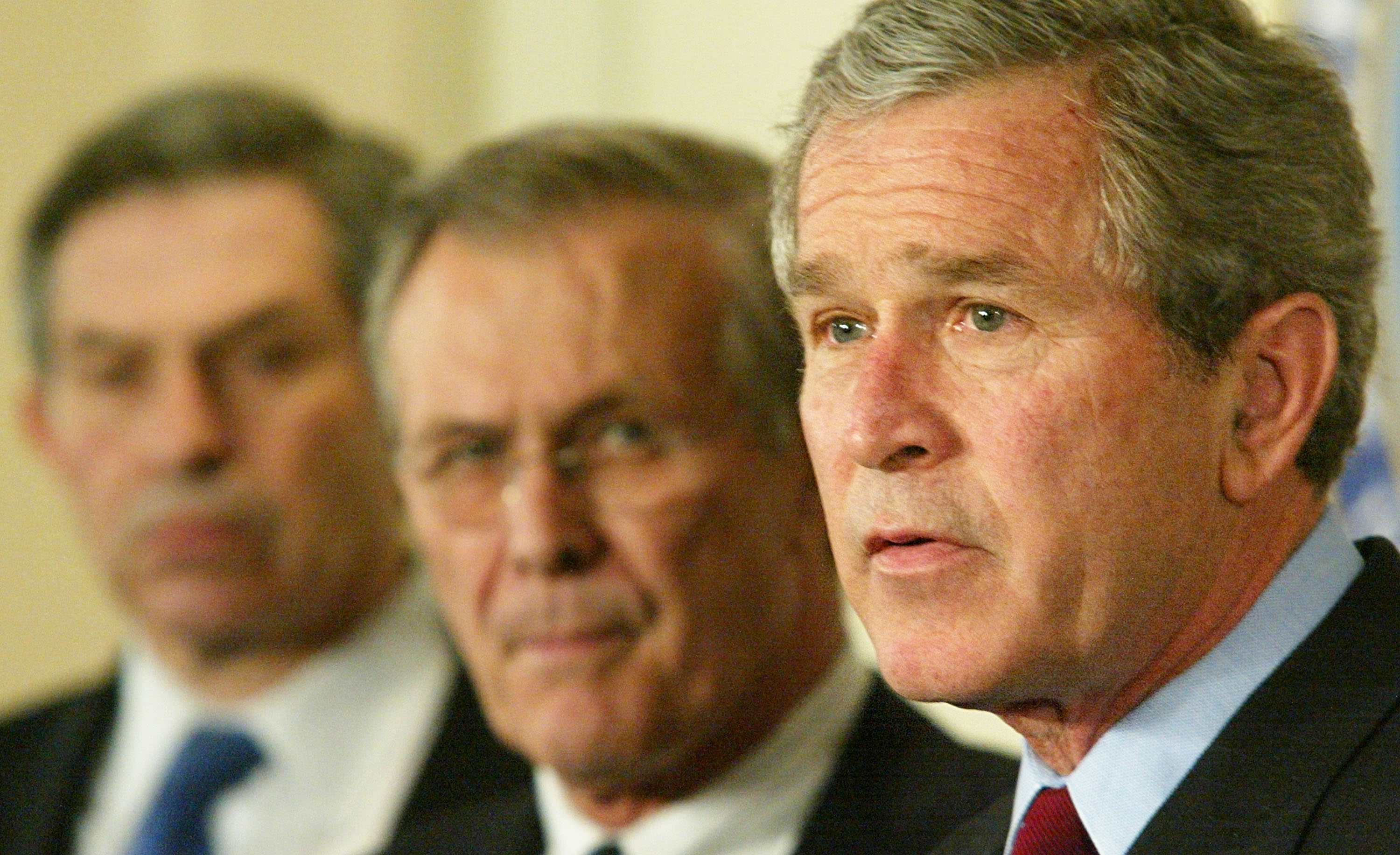
(Photo: three neocon musketeers in 2003, by Alex Wong/Getty.)