The Ever-Imploding Iraq, Ctd


Maliki’s forces may have halted, or at least slowed, ISIS’s advance:

Security sources said Iraqi troops attacked an ISIL [ISIS] formation in the town of al-Mutasim, 22 km (14 miles) southeast of Samarra, driving militants out into the surrounding desert. They said army forces reasserted control over the small town of Ishaqi, also southeast of Samarra, to secure a road that links Baghdad to Samarra and the now ISIL-held cities of Tikrit and Mosul further north. Troops backed by the Shi’ite Asaib Ahl al-Haq militia also retook the town of Muqdadiya northeast of Baghdad, and ISIL was dislodged from Dhuluiya after three hours of fighting with tribesmen, local police and residents, a tribal leader said.

It was far from clear whether government forces could sustain their reported revival against ISIL, given serious weaknesses including poor morale and corruption, and the risk of Iraq sundering into hostile sectarian entities remains high. ISIL insurgents kept up their assaults on some fronts.

Where the current US thinking stands:

The biggest questions center on whether the United States will carry out air strikes, either with warplanes or unmanned drones, against militants of [ISIS], which moved swiftly to seize the northern cities of Mosul and Tikrit this week and now threaten Baghdad. Such attacks, an option the Pentagon described on Friday as “kinetic strikes”, could be launched from aircraft carriers or from the sprawling U.S. air base at Incirlik in Turkey. The carrier USS George H.W. Bush and its strike group are already “in the region,” the Pentagon said on Friday.

Last night, Clinton basically agreed with Obama’s reluctance to get re-involved with Iraq or to further support the Maliki government:

“You’d be fighting for a dysfunctional, unrepresentative, authoritarian government,” she said on Friday at George Washington University. Clinton talked at length about the unfolding crisis in Iraq, where the extremist group, the Islamic State of Iraq and Syria, has moved from Syria, taking hold of cities north of Baghdad. “There’s no reason on earth that I know of that we would ever sacrifice a single American life for that,” Clinton added.

Amen. Meanwhile, Kilgore is not liking the deja vu:

Moqutada al-Sadr and his Mahdi Army, which may be reforming; Grand Ayatollah Ali al-Sistani, who has now called Iraqis to arms to resist the ISIS breakup of the country; the Kurdish Peshmerga militia, which just seized the oil city of Kirkuk that the semi-autonomous Kurdish regional government has long coveted; the “holy sites,” which Shi’a revere but that the ISIS would just as soon destroy as “idolotrous.” And yes, among the bad returning memories is the daily hectoring from John McCain about the need for U.S. troops in Iraq forever—this time, presumably, in a more explicit and highly ironic alliance with Tehran, which many of McCain’s neocon buddies would love to see reduced to radioactive ash.

The Obama administration seems to be treating the Iraq crisis as it would an adverse breakdown in the military balance in Syria, not as some sort of implicit repudiation of the U.S. decision to shut down its part of the Iraq War. That makes sense. But it will be interesting to see how U.S. public opinion reacts to any sort of return engagement with Iraq in all its complexity. The bad memories are just too recent to have faded entirely.

To wit, Aaron Blake notes that if Obama does attack, the US public will likely respond in kind:

[A] Washington Post-ABC News poll last week found his ratings in this area sinking to a new low. Just 41 percent approved of his job on international affairs, down six points in three months and currently five points below his overall approval rating. Layered on top of Obama’s weakness on foreign affairs is the long-standing unpopularity of the war in Iraq. As of March 2013, just 38 percent said the costs of the war were worth the effort and 58 percent said they were not.

Back in Iraq, the government has instituted a social media blackout in an effort to cut down ISIS’s communication network, though as Craig Timberg notes, it’s unclear how effective that will be:

Regions beyond government control often rely on alternative sources, such as satellite links and fiber-optic lines coming from telecommunications providers in Turkey, Iran and Jordan, analysts said. Service in semiautonomous Kurdish regions, for example, appeared to be flowing without a blip.

“It kind of echoes the larger themes in Iraq, of how little the Iraqi government controls in that country,” said Doug Madory, a senior analyst with Renesys, a New Hampshire-based company that tracks Internet performance worldwide.

Read all Dish coverage of ISIS here. Mackey is live-blogging the latest developments.

Iraq: You Broke It, You Bought It?

Isaac Chotiner is willing to consider some sort of response:

[I]t’s not clear what America can or should do, which is why remarks like those from John McCain, who called this “an existential threat” and seems to want some sort of huge response, are alarming. But that doesn’t let the United States off the hook, and certainly not at the rhetorical level. Would Obama say that the Cambodian genocide was ultimately up to the Cambodians to solve, after America bombed and destabilized the country? Was the genocide in the former Yugoslavia a Bosnian problem, even though the West kept an arms embargo on the Bosnians, essentially preventing them from defending themselves?

Wieseltierism really has taken over that magazine, from top to bottom. I’d say eight years of blood and treasure and failure in Iraq is enough. Unless, like Wieseltier, you see the entire planet as a patient and America as the only nurse. Relatedly, Noah Millman declares that people “who think the world will swiftly get more peaceful if we mind our own business may well be just as wrong as the people who think that by sticking our nose into other people’s business we can force the world to be peaceful”:

[W]e are responsible for the situation in Iraq.

We are directly responsible in that we broke the existing arrangement of power and installed ourselves as the occupier. We are also indirectly responsible inasmuch as our overweening hegemonic influence in the region means that inaction is also a kind of action. So, because the Syrian civil war has not resolved, but expanded and become more violent and extreme, and because that civil war and Iraq’s are, with the rise of ISIS, effectively merging, to the extent that we may be “blamed” for not resolving that civil war, we may also be “blamed” indirectly for the deterioration in Iraq.

None of which means we should make feel obliged to do something stupid and counter-productive, but it provides and genuine moral explanation for why we might feel obliged to do something.

I love this formulation: hegemony means inaction is action, so there’s no difference between the two! So let me put this as kindly as I can. We lost 5,000 young Americans trying to keep this centrifugal country in one piece. After eight years, and huge expenses in training and equipping the Iraqi army, we bear no blame and never have for the pathological sectarianism of so many Arab countries, culturally or politically. And it’s time to have enough self-respect to say so. The sanest, wisest way to wriggle out of this trap is precisely to do nothing – again and again – until the pathology of dependence is finished.

If there is something we can do, it should be to ratchet up our ability to monitor these groups – sorry, NSA-haters, but spying is one of our strongest and least disruptive tools in preventing attacks on the homeland – and to provide as much diplomatic and political advice, if asked, as to how to render the situation less volatile. But even there, the limits of our behavior are so much more profound than the potential. If you think Maliki pursued text-book sectarianism out of a whim, or could have been effectively dissuaded by a few American military officials, you are only missing the entire modern history of Iraq. And in sectarian warfare, there is usually very little magnanimity. Just payback – again and again and again.

Leave it alone. And do what we can to protect ourselves. That doesn’t guarantee anything. But intervention guarantees far worse.

Iraq Needs A Political Solution

And Barbara Walter believes it’s a real possibility:

The key to preventing a long and bloody war in Iraq is to create disincentives for Sunnis to fight for complete control over the government. This may not be as hard as it sounds. True, the Sunnis’ number one goal is to regain full control over the government — but Sunnis understand that this is risky and costly. Their second best solution would be to gain a significant voice in government such that Sunnis could ensure that they will not be exploited by the demographically larger Shiite population. This will require a negotiated settlement with al-Maliki and his government that offers real power-sharing guarantees to the Sunni population. A negotiated settlement with moderate Sunnis has the added benefit of undercutting their support for more extreme elements. Studies by Walter 1997 and Harzell and Hodie 2003 have found that civil war combatants are significantly more likely to sign and implement peace settlements that include specific power-sharing guarantees.

But how do you convince al-Maliki to share power when he has shown no inclination to do so to date? As Marc Lynch wrote yesterday, al-Maliki has been urged to build a political accord for a half-decade, but has not done so. The key, I believe, is to make any aid or assistance to him contingent on good behavior. Once it is clear to al-Maliki that he and his army cannot defeat the Sunnis, it will also become clear to him that a deal is his best option.

Walter Russell Mead wonders if Maliki will instead turn towards Iran:

A major thrust of [Obama’s] speech is a political ultimatum to Maliki and his government: we will only help you if you get serious about an inclusive government and system in Iraq that offers real accommodation for the Sunnis.

This means Maliki has a choice. Iran is willing to bolster his government without any requiring any concessions to the Sunnis, having already dispatched two Revolutionary Guard units to protect Baghdad and the Shia holy cities of Karbala and Najaf. So for Maliki, do the advantages of American help offset the concessions he would have to make? If so, he’ll respond positively to Obama and the U.S. will get more deeply engaged in the contest. If not, he will turn to Iran and Iran’s involvement in Iraq will grow exponentially—and in effect the entire war in Syria and Iraq will turn into a war of Iranian expansion.

Peter Van Buren imagines a possible future:

The Kurds are the easy ones; they will keep on doing what they have been doing. They will fight back effectively and keep their oil flowing. They’ll see Baghdad’s influence only in the rear-view mirror.

The Sunnis will at least retain de facto control of western Iraq, maybe more. They are unlikely to be set up to govern in any formal way, but may create some sort of informal structure to collect taxes, enforce parts of the law and chase away as many Shias as they can. Violence will continue, sometimes hot and nasty, sometimes low-level score settling.

The Shias are the big variable. Maliki’s army seems in disarray, but if he only needs it to punish the Sunnis with violence it may prove up to that. Baghdad will not “fall.” The city is a Shia bastion now, and the militias will not give up their homes. A lot of blood may be spilled, but Baghdad will remain Shia-controlled and Maliki will remain in charge in some sort of limited way.


A Well-Oiled Warzone

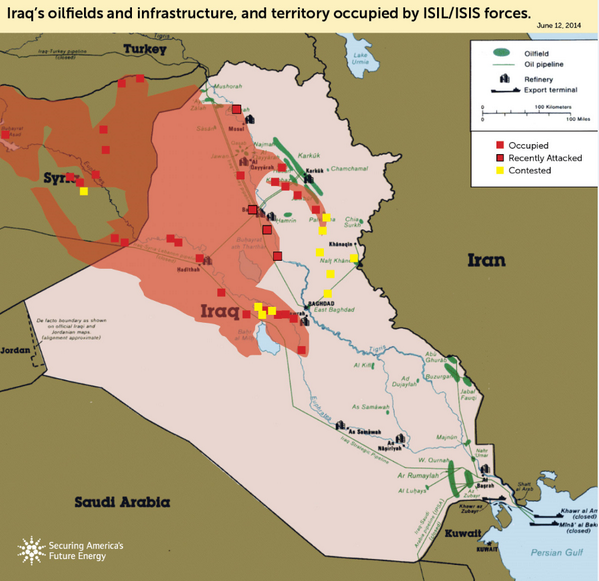
ISIS_control_june_12

Plumer takes a look at a slippery dimension of the Iraq conflict:

Some basics: Iraq has the world’s fifth-largest proven oil reserves. But the country has only very recently begun churning out significant amounts of crude oil again (production dropped sharply during the 2003 US invasion and its bloody aftermath). By April 2014, Iraq was producing an estimated 3.3 million barrels per day — equal to about 4 percent of global supply. And the country was expected to keep ramping up production, with plans to produce at least 5 million barrels per day in the years to come.

Or at least that was the idea. The recent takeover of northwestern Iraq by the Islamic State of Iraq and the Levant (ISIS) has complicated those plans considerably.

True, as the map above shows, ISIS isn’t close to any of the massive oil fields in the southern regions of Iraq, which produce 75 percent of the country’s oil. And ISIS has yet to enter the Kurdish regions in the north, another major oil-producing area. But the fighting has threatened some of Iraq’s other oil infrastructure, including a pipeline that can deliver 600,000 barrels of oil per day from Kirkuk to the Turkish port city of Ceyhan. (That pipeline had been damaged by a 2013 attack and was offline receiving repairs — that work has now been halted.)

In terms of oil as well as land, Iraq’s Kurds stand to benefit from the crisis:

The Kurds have an estimated 45 billion barrels of oil and have a long planned to be exporting 400,000 barrels a day this year, but until now dividends have been limited. Kurdistan and foreign oil companies have managed to export some of the crude, transported first by truck and then tanker, despite the Baghdad government’s declaration that all their activities are illegal. But, although a big export pipeline is now complete and millions of barrels of oil have been shipped through it to the Mediterranean port of Ceyhan, none of these volumes has been actually sold.

Tankers containing 2 million barrels of Kurdish oil are at sea awaiting buyers, who are apprehensive while Baghdad threatens to sue anyone who purchases it. The current offensive by an al-Qaeda affiliate may be the tipping point. Disciplined Kurdish forces now control not only Kurdistan but the disputed, oil-rich region of Kirkuk, which lies just to its west. The region has been autonomous since the first Gulf War in 1991, and its army has steeled itself to defend Kurdistan against Baghdad’s forces.

Previous Dish on the economic angle of the conflict here.

Who Are These ISIS Chappies, Anyway?

In a useful explainer, Margaret Hartmann provides some background on the Islamic State of Iraq and Syria, the jihadist militant group currently overrunning Iraq:

ISIS grew out of Al Qaeda in Iraq, which was founded by Abu Musab al-Zarqawi in 2004 and became one of the most powerful Islamic extremist groups involved in the Iraq War. Shortly after al-Zarqawi was killed by U.S. forces in 2006, Al Qaeda in Iraq merged with several other insurgent groups and became known as the Islamic State of Iraq.

The group was decimated by U.S. forces, but as the last U.S. troops left in 2011, it staged a comeback. Michael Knights, the Lafer Fellow at the Washington Institute for Near East Policy, tells Vox that the group changed its message to focus on Sunni sectarianism, challenging the Shiite majority in Iraq. In an attempt to consolidate power, the Iraqi government persecuted Sunnis and tried to shut down Sunni militias, which “played right into their hands,” according to Knights. He says Iraqi Prime Minister Nouri al-Maliki “made all the ISIS propaganda real, accurate.”

Terrence McCoy profiles the group’s leader, Abu Bakr al-Baghdadi:

Born a Sunni in 1971 in Samarra with the name Awwad Ibrahim Ali al-Badri al-Samarrai, he claims to be a direct descendant of the prophet Muhammad. According to a widely cited biography released by jihadists, “he is a man from a religious family. His brothers and uncles include preachers and professors of Arabic language, rhetoric and logic.” The biography and Arabic-language accounts claim he obtained a doctorate at Islamic University in Baghdad — which is presumably why several of his many aliases include the title “Dr.” Holding degrees in Islamic studies and history, he is believed to have been an Islamic preacher around the time of the 2003 U.S. invasion of Iraq. The chaos of those months drove the 30-something into militancy, and he formed an armed group in eastern Iraq, one that reportedly never rose out of obscurity.

The opacity of his background, analysts say, suggests a broader truth of rising militant Islamists. “The mystery surrounding Abu Bakr al-Baghdadi — at the level of his personality, his movements, or even his relatives, his family, and those close to him — came as a result of what happened to previous leaders, who were killed after their movements were detected,” wrote Mushreq Abbas in al-Monitor. He is the “invisible jihadist,” according to Le Monde.

The CFR follows the money:

Supporters in the region, including those based in Jordan, Syria, and Saudi Arabia, are believed to have provided the bulk of past funding. Iran has also financed AQI, crossing sectarian lines, as Tehran saw an opportunity to challenge the U.S. military presence in the region, according to the U.S. Treasury and documents confiscated in 2006 from Iranian Revolutionary Guards operatives in northern Iraq. In early 2014, Iran offered to join the United States in offering aid to the Iraqi government to counter al-Qaida gains in Anbar province.

The bulk of AQI’s financing, experts say, comes from sources such as smuggling, extortion, and other crime. AQI has relied in recent years on funding and manpower from internal recruits [PDF]. In Mosul, an important AQI stronghold, the group extorts taxes from businesses small and large, netting upwards of $8 million a month, according to some estimates.

Jacob Siegel emphasizes how ISIS relies on allies of convenience in Iraq:

The standoff in Iraq isn’t between a single militant group and the government. There is a broad coalition of Sunni groups—both nationalist and Islamist—who had been plotting against Iraq’s Shia government for years before ISIS’s rise provided the chance to strike. ISIS and its partners are unnatural allies. Maintaining their unity was the key to their early success, and is the only way they can hold the ground they have taken, but that incentive may prove to be weaker than the force of their natural hostilities.

“ISIS control in Mosul is contingent on political alliances they have made with the Baathists and the tribal groups,” said Brian Fishman, a fellow at the New America Foundation, who has been following ISIS since the group’s early days during the Iraq war. “This alliance marching on Baghdad is not a natural one,” Fishman added. “We can understand how it was put together in opposition to the government but what exactly is holding it together, and how sturdy it is, is an open question,” he said.

Michael Weiss also plays up these alliances in a detailed analysis of the group’s strategy:

How did ISIS manage to accomplish so much in a year? Contrary to some media representations, it has had some help in the form of other tenuous Sunni allies, including Jaysh Rijal al-Tariqah al-Naqshabandia, a Ba’ath insurgency that couches its war against Maliki in tribal terms; and Ansar al-Islam, another Sunni Islamist group. The true nature and extent of other actors’ involvement in this conflict has yet to be fully uncovered, but already it seems clear that ISIS is drawing on local support bases. A kind of shadow Awakening is now in evidence, with Sunni tribes, Islamists, and dead-enders of the ancien regime all in league against Iraq’s new Shiite strongman. But what is also clear is that in Syria ISIS has managed to do what other rebel groups have not: effectively if harshly administer municipal facilities, says Pieter Van Ostaeyen, a Belgian analyst of Syrian jihadis. …

ISIS also appears to be drawing on classical “Desert Power” Arab military doctrine that dates back to the 7th century. “The Bedouin army could go out into the Syrian desert and they could strike either the Mediterranean region or the Euphrates valley or what is now Israel-Palestine,” says Col. Joel Rayburn, who served as a strategic analyst for the US military in Iraq. “They could strike at any of the areas on the edge of that desert, as though the desert were an inland sea that they could cross at will. Think of the Jazira [the territory encompassing eastern Syria and western/central Iraq] as the new desert. ISIS can go out there and project Desert Power into the river valleys and settled areas.”

Previous Dish on at ISIS’s strategy and objectives here.

How Did We Not See This Coming?

Shane Harris explains why the US government was caught off guard by Iraq’s sudden implosion:

The CIA maintains a presence at the U.S. Embassy in Baghdad, but the agency has largely stopped running networks of spies inside the country since U.S. forces left Iraq in December 2011, current and former U.S. officials said. That’s in part because the military’s secretive Joint Special Operations Command had actually taken the lead on hunting down Iraq’s militants. With the JSOC commandos gone, the intelligence agencies have been forced to try to track groups like ISIS through satellite imagery and communications intercepts — methods that have proven practically useless because the militants relay messages using human couriers, rather than phone and email conversations, and move around in such small groups that they easily blend into the civilian population.

McCain’s Alternate Reality

McCain ludicrously claims we  had “won” in Iraq before Obama pulled out:

Waldman remembers how frequently McCain has been wrong:

McCain does provide something important to journalists: whatever the issue of the moment is, he can be counted on to offer angry, bitter criticism of the Obama administration, giving the “balance” every story needs. The fact that he has never demonstrated the slightest bit of understanding of Iraq is no bar at all to being the most quoted person on the topic.

For context, here’s a nice roundup of some of the things McCain said when he was pushing to invade Iraq in the first place.

When asked if Iraqis were going to greet us as liberators, he answered, “Absolutely.” He said, “Post-Saddam Hussein Iraq is going to be paid for by the Iraqis” with their oil wealth (the war ended up costing the American taxpayer upwards of $2 trillion). And my favorite: “There is not a history of clashes that are violent between Sunnis and Shias, so I think they can probably get along.”

The conflict between Sunnis and Shiites is the central dynamic of the Iraq conflict, of course. Yet today, the media once again seek out John McCain’s wisdom and insight on Iraq, which is kind of like saying, “Jeez, it looks like we might be lost — we really need to ask Mr. Magoo for directions.”


A Water War In The Desert

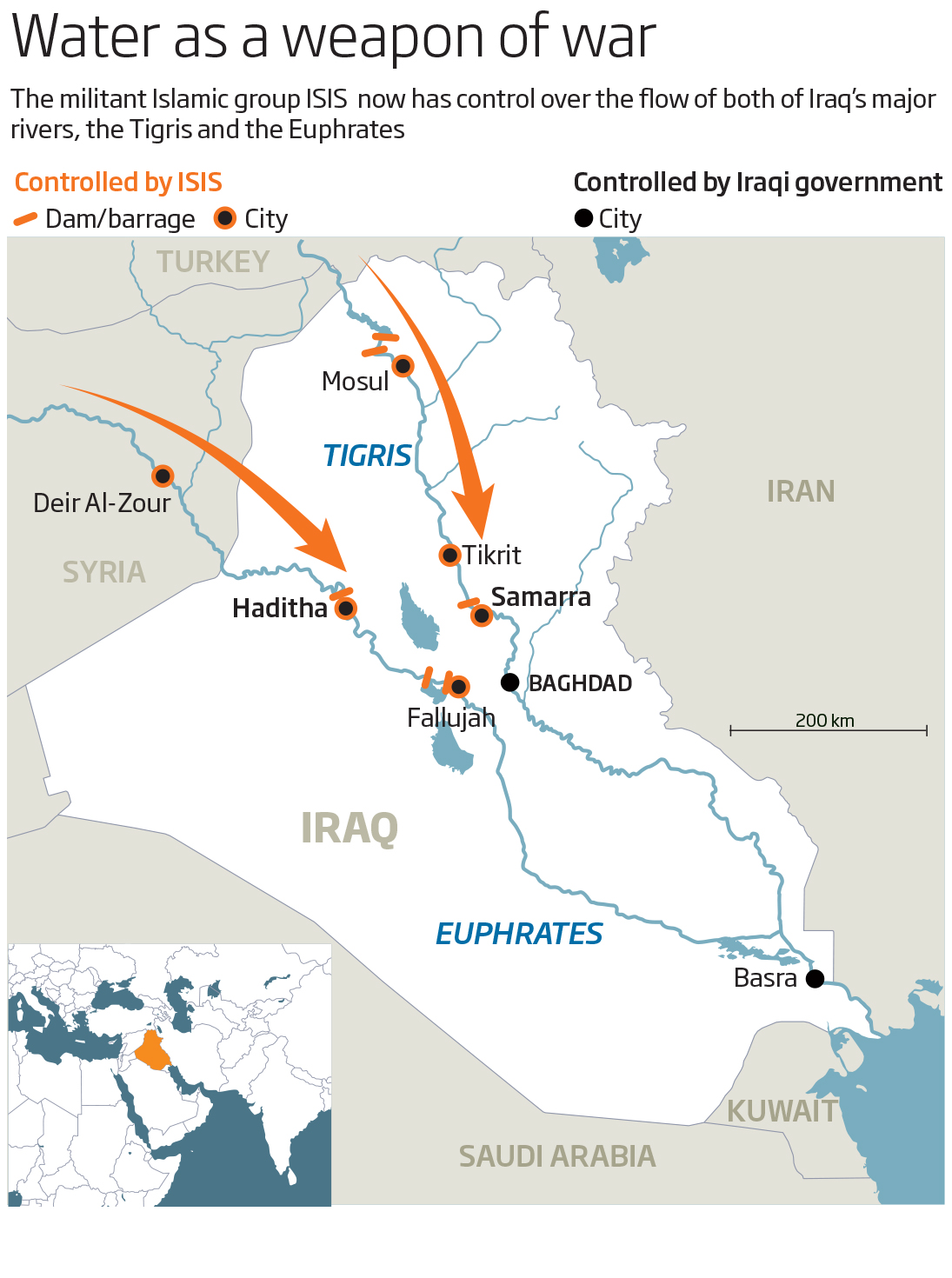
dn25722-4_1095

Debora MacKenzie warns that ISIS’s position on the Tigris and Euphrates rivers gives it the ability to cause unimaginable chaos in Iraq:

ISIS now controls several major dams on the rivers, for instance at Haditha and Samarra. It also holds one 30 kilometres north of Mosul that was built on fragile rock and poses a risk of collapse. It holds at least 8 billion cubic metres of water. In 2003, there were fears Iraqi troops might destroy the dam to wipe out invading forces. US military engineers calculated that the resulting wave would obliterate Mosul and even hit Baghdad.

ISIS has already used water as a weapon, in a smaller way. In late April ISIS stopped flow through the relatively small Nuaimiyah dam on the Euphrates in Fallujah, reportedly with the aim of depriving Baghdad and southern Iraq of water. It could also have been to block military approaches to the town. Instead, the river backed up and poured into an irrigation canal, flooding the town of Abu Ghraib and dozens of surrounding villages over 200 square kilometres. Five people died, and 20,000 to 40,000 families fled to Baghdad.

Will Obama Attack?

Tragically, it seems possible:

President Obama announced on Friday that in the “days ahead” he will decide on a package of military and diplomatic options to halt the rapid advance of the Islamic State of Iraq and the Levant (Isis)as the jihadist army’s march from Syria through Sunni Iraq has upended Obama’s achievement of extricating the US military from the Iraq conflict.

Obama has ruled out sending US soldiers and marines back to the Iraqi streets they patrolled from 2003 to 2011, but signaled a new, reluctant openness to returning the US to war in Iraq. .. Options under discussion include an air campaign, using either or both air force or navy warplanes, the potential duration of which has yet to be determined. Drone strikes remain under consideration, but manned aircraft are said to the preferred option, owing to their superiority against moving and manoeuvrable targets.

Zack Beauchamp calls the following sentence the “most important line from Obama’s Iraq speech”:

The US is not simply going to involve itself in a military action in the absence of a political plan by the Iraqis.

I certainly take some comfort from the president’s strong words of caution. But he’s going to have to withstand an army of bedwetter interventionists in the Beltway. Zack comments:

If this is is true, then Obama has ruled out the most likely scenario for military action in Iraq: a short-term drone campaign designed to help the Iraqi military halt ISIS’ momentum. 

Political reform inside Iraq is really complicated, and would involve serious reform from Nuri al-Maliki’s Shia sectarian government to accommodate Sunni demands. Putting together a credible political reform plan will take a long time, and certainly won’t happen in time for the US to get involved in the immediate fighting.

Throughout his speech, Obama took pains to emphasize the importance of Iraqi political reform and minimize the prospects of US military involvement. While he said he was considering military action, he flatly ruled out deploying US troops. He also repeatedly stressed the need for the Iraqi government to reform itself to deal with the root causes of ISIS’ success, sectarian divisions and poor governance.

Tom Ricks is against air strikes:

The last thing we need is American pilots being held prisoner by the new guys. And where would you base your combat search & rescue helicopters, and what do you do when one of them gets show down? I don’t think Obama faces hard choices in Iraq.

The one interesting suggestion I’ve heard is that the U.S. government make military aid to Iraq dependent on Maliki stepping down. But I think Iran has more say in that than we do.

Hayes Brown sees no good options for the US. How airstrikes could backfire:

Air strikes, while often effective in the short-term, are not a long-term strategy for defeating ISIS. It’s also far more expensive than many realize. There is also still the chance of accidentally killing civilians, which would provide backlash so soon after a decade in which the United States occupied the entirety of Iraq. There’s also the risk that air strikes could lead to mission creep and a full reinsertion into Iraq.

On Not Taking The Neocon Bait

IRAQ-UNREST-MOSUL

David Harsanyi sees few good options for salvaging the outcomes of the Iraq War:

Some will, no doubt, argue that doing nothing (and we might very well be doing something soon) means that more than 4,400 U.S. troops and over $700 billion had been wasted in a war that ended but was not won. Perhaps. But a more important matter is this: would the death of another 4,000, or 400, or four, bring about a preferable outcome or a set of conditions that allow the United States to convincingly declare victory? If a decade of nation building brought us this, what could we possible gain by seriously reengaging? Clearly, to make it work the American people would need to be prepared to make a generational commitment – and polls don’t tell us that we’re in the mood for an open-ended conflict in the Middle East.

These are horrible choices, indeed. While millions of civilians no longer experience life under the regime of Saddam Hussein, and we should not forget the sacrifice thousands of soldiers made to allow that to happen, it gets increasingly difficult to imagine that the United States has gained anything worthwhile from its invasion of Iraq. It’s difficult to understand how spending another five or ten years sorting out a sectarian civil war can possible be in our best interests.

The UK, for one, won’t get involved. Les Gelb zooms out to see the core question. The fundamental American blind spot remains what it was in Vietnam:

What happened in Iraq was history as usual. The U.S. fights in Iraq and Afghanistan and Libya and Vietnam and other places (maybe next in Syria), provides billions of dollars in arms, trains the friendly soldiers, then begins to pull out—and what happens? Our good allies on whom we’ve squandered our sacred lives and our wealth fall apart. That’s what’s happening in Iraq now.

The alternative – staying in those countries for ever – is just a euphemism for empire in a world that emphatically does not want us, and with an America that rightly wants us to focus on the struggles at home. As for the question as to whether around 5,000 Jihadists can threaten the security of the United States, the Israelis seem utterly unruffled – and they live much, much closer to the threat. There’s something awry when a continental superpower thousands of miles away is more jittery than Jews on the front lines. Keating identifies one good reason why the American people, with any luck, will not rise to the neocon bait yet again:

More than a decade ago, the U.S. public and political establishment supported a war in Iraq partly based on the false pretense that it was allied with al-Qaida. Now, largely as a result of that war and its aftermath, a large portion of Iraq is under the control of an al-Qaida splinter group and America seems largely indifferent. …

There were discussions of “Iraq fatigue”—the sense that the American public is simply tired of hearing about the country’s troubles—as far back as 2006. Supplanted since then by crises from Libya, to Egypt, to Syria, I’d guess that fatigue is even more entrenched now and while I expect some criticism of the White House on this, I doubt we’re going to see a groundswell of public demand for a robust response to Iraq’s latest crisis.

Although the elites will do their best to whip it up. Which is why one should be grateful that the Washington Post wields a clout far smaller now than it did to such devastating effect in 2003. Gordon Lubold and John Hudson offer another reason for why military intervention – even air-strikes – are unlikely to work at all:

[D]espite the crisis, there is little likelihood that the American government would consider putting any troops on the ground. That means that airstrikes are the only real option for a potential U.S. military intervention into Iraq as the crisis there continues to grow. That’s not a simple endeavor, however. … The Iraqi security forces don’t have troops capable of relaying detailed targeting information, which would likely require the Pentagon or the CIA to send small numbers of American personnel into Iraq to handle that difficult mission. Without adequate ground intelligence, the United States could run the risk of accidentally killing Iraqi security forces or, even worse, civilians.

In a splendidly sane piece, Fareed Zakaria shoots down the hawks’ fantasy that Obama could have kept troops in the country if he had really wanted to:

I would have preferred to see a small American force in Iraq to try to prevent the country’s collapse. But let’s remember why this force is not there. Maliki refused to provide the guarantees that every other country in the world that hosts U.S. forces offers. Some commentators have blamed the Obama administration for negotiating badly or halfheartedly and perhaps this is true. But here’s what a senior Iraqi politician told me in the days when the U.S. withdrawal was being discussed: “It will not happen. Maliki cannot allow American troops to stay on. Iran has made very clear to Maliki that its No. 1 demand is that there be no American troops remaining in Iraq. And Maliki owes them.” He reminded me that Maliki spent 24 years in exile, most of them in Tehran and Damascus, and his party was funded by Iran for most of its existence. And in fact, Maliki’s government has followed policies that have been pro-Iranian and pro-Syrian.

And Larison, echoing Marc Lynch’s insight from last night, is at a loss for why we’d want to double down on the mistake of propping up Maliki:

Maliki was already governing in a sectarian and semi-authoritarian manner when the U.S. had a major military presence in the country, so it seems clear that retaining a smaller presence would have had no effect on him and his allies. It is even more doubtful that the U.S. would use this leverage if it had it. This is the trouble with trying to condition future aid on improvements in Maliki’s behavior: when push comes to shove, the U.S. usually refuses to cut off aid because it doesn’t want to “abandon” its client. …

Intervening militarily to prevent further advances by ISIS would commit the U.S. to acting as Maliki’s protector indefinitely, and the more resources that the U.S. commits to this the harder it will be to pull the plug at some point in the future.

Drum simply marvels at those who still think the US can solve problems like these with brute force:

If we committed US troops to every major trouble spot in the Mideast, we’d have troops in Libya, Lebanon, Syria, Afghanistan, and Iraq. Lots of troops. The hawks won’t admit this outright, but that’s what their rhetoric implies. They simply refuse to believe the obvious: that America doesn’t have that much leverage over what’s happening in the region. Small commitments of trainers and arms won’t make more than a speck of difference. Big commitments are unsustainable. And the US military still doesn’t know how to successfully fight a counterinsurgency. (That’s no knock on the Pentagon, really. No one else knows how to fight a counterinsurgency either.)

This is painfully hard for Americans to accept, but sometimes you can’t just send in the Marines.

There are, after all, other options. Instead of a bombing campaign, Nussaibah Younis argues for a political and diplomatic intervention:

The United States must use its assistance as leverage to prevent Mr. Maliki from becoming, in effect, a dictator. Many young Iraqis who join the Sunni militants already see the government as a sectarian oppressor. The Maliki government has targeted senior Sunni politicians, and failed to respond to Sunni demands for reform. Its exclusionary approach has helped enable extremism, and the United States must ensure that Mr. Maliki does not use the new outbreak of fighting to shore up his authority.

Moreover, the United States must compel the Iraqi Army to adopt a sensitive, population-centered approach to reversing the militants’ conquests. If the Iraqi Army sends Shiite militant groups or Kurdish forces to the heart of Sunni-dominated Mosul, or if it carpet-bombs the city and arbitrarily arrests or kills groups, it will alienate the hearts and minds essential to winning this battle.

Henri J. Barkey argues that the spiraling conflict means that now we really have to do something about Syria, but that does not necessarily mean to go in with guns blazing. He suggests we take advantage of the suddenly aligned interests of Iran and its rivals:

Coincidentally, the fall of Mosul occurred during Iranian President Rouhani’s visit to Turkey. Despite the fact that they are deeply engaged on opposite sides of the Syrian conflict, the two countries have agreed to disagree. The reason is simple: They have other important shared interests, such as oil and gas trade and political support for the Iranian nuclear program. Considering Syria’s importance to both regimes, perhaps Turkish-Iranian pragmatism can be bent in the direction of agreement to construct a transitional arrangement for Syria? Both now need face-saving policy options. The trick is to come up with an interim deal that includes Assad’s departure, though perhaps not immediately, in exchange for the safeguarding of some core Iranian interests in a future Syrian political system.

This may sound improbable, and it is. Nonetheless, the fall of Mosul shows that the Syria crisis, which was almost from the beginning an Iraqi crisis as well, requires a regional solution. The Obama Administration was right not to intervene directly in Syria with military force, but wrong to construe its options as either war-making or what amounts to passivity. The perception of Washington policymaking in Syria as dithering and less-than-professional has arguably spread throughout the region. The Administration can begin to reverse this image if it is willing to encourage the region to come up with its own solution. That effort would have to start in consultation with Turkey and Saudi Arabia, and it would have to include Iran as well in the end

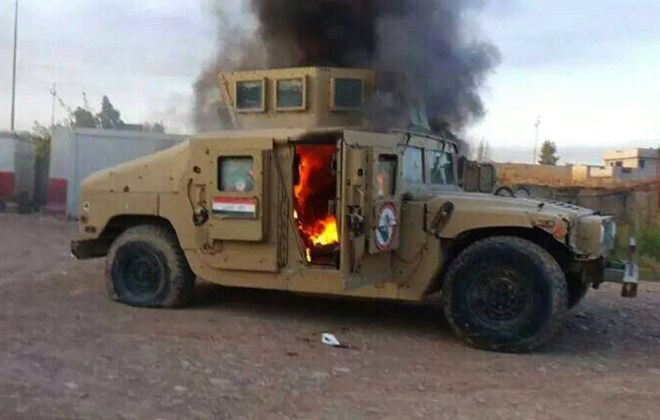
(Photo: A picture taken with a mobile phone shows an armoured vehicle belonging to Iraqi security forces in flames on June 10, 2014, after hundreds of militants from the Islamic State of Iraq and the Levant (ISIL) launched a major assault on the security forces in Mosul. By STR/AFP/Getty Images)