When Fighting Back Means Tweeting Back

Heads up that this video from the State Department contains some really graphic stuff:

Zenon Evans has details:

Playing catchup to ISIL’s spread throughout social media, the U.S. government is also posting daily on the Facebook and Twitter. The campaign is called “Think Again, [Turn] Away” and it’s geared at English-speakers who are tempted to join the terrorist organization. Britain recently raised an alarm because its defense department believe around 600 citizens have taken up arms for ISIL, though some estimate as many as 1,500 have. There are also an estimated 100 American citizens and a sum total of 3,000 Westerners who have joined the fight to establish a Caliphate throughout much of the Middle East. America’s information front focuses a lot on kids: ISIL isn’t letting kids go to school, ISIL is eating meat while children eat bread, ISIL is killing children and using them as suicide bombers. It also features on individuals who became jihadists but are now disillusioned with the fight, as well as Muslims who denounce ISIL as hypocritical and unfaithful to the religion’s teachings.

Alex Altman measures what the US is up against in this battle:

Much of the terrorist group’s work has taken place on Twitter. “2013 was the year of Twitter for Al-Qaeda and ISIS,” [Center for Strategic Counterterrorism Communications coordinator Alberto] Fernandez says. Since May, more than 60,000 Twitter accounts have been set up to herald the group, including 27,000 since the murder of Foley last month, according to an analysis conducted by Recorded Future, a web analytics firm, for the British media outlet Sky News. ISIS has used the platform both to spread grotesque photos of decapitated heads and bloodied bodies—”jihad porn,” as government officials call it—and to recruit potential conscripts. As Twitter cracked down on some of the gory imagery, an ISIS adherent even called for themurder of the site’s employees.

In the meantime, many of the group’s members have fled the site, terrorism analysts say, for more obscure social-media platforms like Friendica, Diaspora and VK (a Russian social-networking site used by the Boston bombers). The U.S. still finds itself outmatched as it tries to suss out and rebut all this activity.

Two Critical Passages

Here are two passages from a released preview of the president’s imminent speech (stay tuned for live coverage):

So tonight, with a new Iraqi government in place, and following consultations with allies abroad and Congress at home, I can announce that America will lead a broad coalition to roll back this terrorist threat. Our objective is clear: we will degrade, and ultimately destroy, ISIL through a comprehensive and sustained counter-terrorism strategy.

Ultimately destroy.” Softened but still clearly putting the US on the hook if ISIS endures, as it surely will. And notice the thin reed of a “new Iraqi government” – with still critical posts to be filled, no real unity among the various sects and factions, and an army that dissolves into sectarianism or total capitulation when ISIS attacks. Then this:

I want the American people to understand how this effort will be different from the wars in Iraq and Afghanistan. It will not involve American combat troops fighting on foreign soil. This counter-terrorism campaign will be waged through a steady, relentless effort to take out ISIL wherever they exist using our air power and our support for partner forces on the ground. This strategy of taking out terrorists who threaten us, while supporting partners on the front lines, is one that we have successfully pursued in Yemen and Somalia for years.

“Partner forces” on the ground? I sure hope he names them – and how many troops they will bring to bear. That’s a pretty important factor right there, isn’t it?

Here’s one thing the American people also need to understand. Anything we do over there will win us no friends and make us infinitely more enemies than we now have. Let’s have no illusions about that. We cannot “win” in Iraq; we cannot destroy sectarian or Salafist militias from the air; we can only lose to a greater or lesser extent. Before we jump into any new war, we should ask: Are we prepared to lose indefinitely – and keep creating as many terrorists as we kill? Are we really ready for a forever war across the world? Because we’re just re-starting one in earnest – in the vortex of what’s left of Iraq and Syria.

Quote For The Day II

“[It is] easy for us to provoke and bait this administration. All that we have to do is to send two mujahidin to the furthest point east to raise a piece of cloth on which is written al-Qaeda, in order to make the generals race there and cause America to suffer human, economic, and political losses. … This is in addition to our having experience in using guerrilla warfare and the war of attrition to fight tyrannical superpowers, as we, alongside the mujahidin, bled Russia for 10 years, until it went bankrupt and was forced to withdraw in defeat,” – Osama bin Laden, 2004.

Face Of The Day

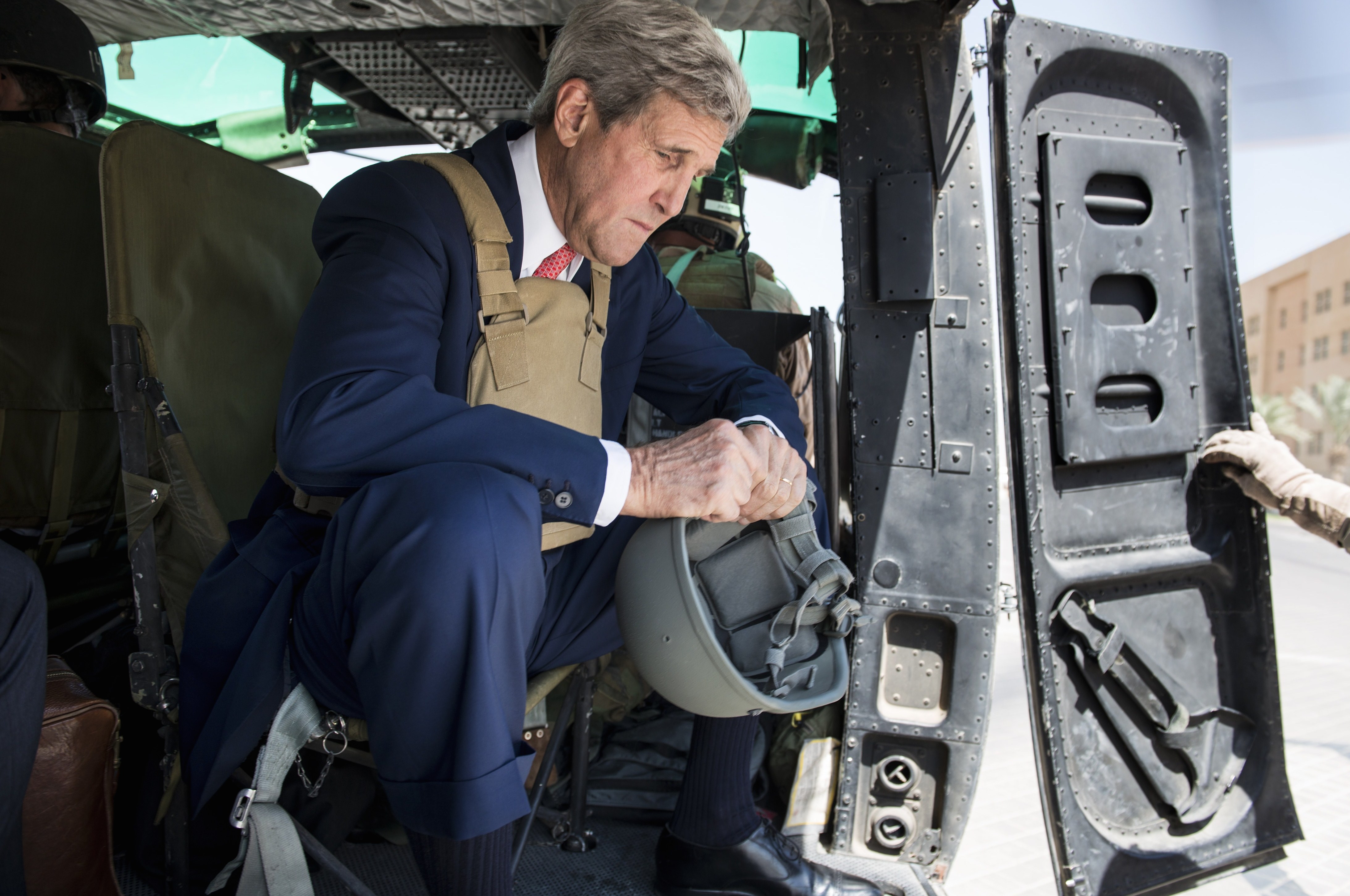
IRAQ-US-DIPLOMACY-KERRY

US Secretary of State John Kerry waits in a helicopter in Baghdad on September 10, 2014. Kerry flew into Iraq today for talks with its new leaders on their role in a long-awaited new strategy against Islamic State jihadists to be unveiled by President Barack Obama tonight. By Brendan Smialowski/AFP/Getty Images.

In Rush To War, No Time For The Law, Ctd

Allahpundit despairs at how many members of Congress are eager to sidestep a vote on a war with ISIS. If they don’t exert some control over this process now, he warns, they’re not any more likely to do so if and when our military commitment starts to snowball:

What’s important is keeping Congress as politically comfortable as possible, and the less power they retain, the easier that becomes. Some members justify their deference to O in terms of the assets he plans to use: Bernie Sanders told the NYT he’s okay with letting Obama bomb who he wants as long as ground troops aren’t sent in, the key distinction being … I don’t know. I guess the president has inherent authority to put airmen’s lives at risk but not infantry’s? Does that make any sense? … They’re not going to cut the money off once men are in harm’s way. And they’re certainly not going to vote on an AUMF later, as Sanders’s airstrikes-yes-infantry-no formulation seems to imagine. Once they’ve allowed Obama to wage war unilaterally from the air, it’s the easiest thing in the world to let him wage war unilaterally on the ground too. If anything, Congress will be even more eager to have its fingerprints off of ground operations.

Cody Poplin compares the several proposed AUMFs currently being circulated on Capitol Hill. But their authors might just be wasting paper, as Obama is signaling that he already has all the permission he needs. Matt Welch cuts him no slack for flouting the Constitution:

In last year’s run-up to what once seemed like inevitable war against Syria, the president made what can be interpreted as an incoherent claim: that he had enough legal cover to start bombing Syria, but that he would nonetheless seek congressional approval. When that approval was not forthcoming, the president decided on a diplomatic solution instead. But note how he treated the congressional-authorization question one year ago today:

[E]ven though I possess the authority to order military strikes, I believed it was right, in the absence of a direct or imminent threat to our security, to take this debate to Congress. I believe our democracy is stronger when the President acts with the support of Congress. And I believe that America acts more effectively abroad when we stand together.

So either the president no longer believes these things, or he finds such beliefs to be an untenable hindrance in the waging of his latest war. At any rate, as in his more blatant nose-thumbing of Congress over U.S.-led regime change in Libya, Obama’s position on the constitutionality of war is essentially the opposite of what it was when he first sought the presidency.

But of course, as Steven Mihm points out, the American tradition of presidents going to war without explicit Congressional authorization goes all the way back to George Washington:

Washington sought “buy in” to go after the Indian tribes that began attacking white settlers on the western frontier in the late 1780s. Like the Islamic State today, they posed a threat that was at once amorphous, hard to reach, and even harder to combat. The Miami and Shawnee tribes of the Ohio River Valley had scalped and murdered settlers, stolen livestock and taken civilians captive. In 1789, Washington dutifully went to Congress, and warned lawmakers that it might be necessary to “punish aggressors” on the western frontier. Congress, preoccupied by other matters, declared that it wouldn’t “hesitate to concur in such further measures” that Washington had in mind. No formal vote authorizing war was held.

Meanwhile, Josh Rogin and Tim Mak note that the $5 billion Counterterrorism Partnership Fund Obama first proposed in May is back in play:

Several top Democratic and Republican senators told The Daily Beast on Friday that the administration has given Congress zero details about the proposed fund and consultations have been next to nonexistent. But Democrats said that was perfectly fine with them. “I support doing what we need to do to defeat ISIS,” Senate Foreign Relations Committee Chairman Robert Menendez told The Daily Beast when asked about the fund. Senate appropriators are already preparing to hand Obama the $5 billion. The draft of the defense appropriations bill would give the Pentagon $4 billion of the funds. The draft of the State Department and foreign operations appropriations bill contains the other $1 billion. All the money would be classified as war funding in the overseas contingency operations part of the defense budget.

Obama’s Open-Ended, Reckless, ISIS Gamble

President Obama Delivers Statement On Situation In Iraq

Ahead of the president’s major address tonight, word has leaked that Obama is considering airstrikes in Syria as part of the military operation against ISIS:

President Obama is prepared to use U.S. military airstrikes in Syria as part of an expanded campaign to defeat the Islamic State and does not believe he needs formal congressional approval to take that action, according to people who have spoken with the president in recent days.  Obama discussed his plans at a dinner with a bipartisan group of foreign policy experts this week at the White House and made clear his belief that he has the authority to attack the militant Islamist group on both sides of the Iraq-Syria border to protect U.S national security, multiple people who participated in the discussion said. The move to attack in Syria would represent a remarkable escalation in strategy for Obama, who has sought during his presidency to reduce the U.S. military engagement in the Middle East.

I guess entering one failed state’s civil war wasn’t challenging enough! Let’s enter two while we’re at it. Exit strategy? Pshaw. That’ll be up to Obama’s successor. In a more granular must-read analysis of this clusterfuck, Marc Lynch stresses that while a strategy of airstrikes and supporting local ground forces may be able to help restore stability and sovereignty to Iraq, in Syria these options “offer no plausible path to political or strategic success”:

A strategy predicated on the existence of an effective moderate Syrian rebel force is doomed to fail. Instead, the focus should be on shaping the environment in ways which will encourage the emergence of a politically legitimate and more effectively unified opposition. The destructive and radicalizing effects of uncoordinated flows of aid to competing rebel groups from outside states and private actors have long been obvious. The emerging regional strategy offers perhaps the first opportunity to unify these efforts to build rather than divide the Syrian opposition. The new coalition should expand on efforts to shut off funding and support not only for ISIS but also for the other powerful Islamist trends within the Syrian rebellion.

This will take time. The immediate goal in Syria should be the securing of a strategic pause between the rebel forces and the regime in order to focus military efforts on ISIS.  Crucially, this strategic pause does not mean cooperation or alignment with Asad, or a retreat from the Geneva Accord principles of a political transition. It should be understood instead as buying the time to shape an environment in which such a transition could become plausible. … The longer-term goal should be to translate this anti-ISIS tacit accord into an effective agreement by the external backers of both Asad and the rebels on a de-escalation of the conflict.  Rather than a military drive on Damascus, the international community should support the delivery of serious humanitarian relief, security and governance to rebel controlled areas and refugees.

I simply do not believe we are capable of pulling anything like this off. Robert Hunter also complicates the question of whether getting rid of Assad should be among our objectives there:

We continue to talk about “arming moderates,” but no US leader has ever articulated what would come after Assad. There is a basic assumption that, when Assad is gone, all will be rosy. The opposite is more likely true. Added to the ongoing carnage would be the slaughter of the minority Alawites. The risks of a spreading Sunni-Shia civil war would increase dramatically, even more than now. The irony is that many who now worry about ISIS argue that it would not have progressed this far if we had only “armed the moderates” in Syria. But given what would have likely happened if they had succeeded, this argument is nonsense. Yet even now the administration, along with academic and congressional critics, fails to address the consequences of its own rhetoric about getting rid of Assad; that statement has become a mantra, disconnected from any serious process of thought or analysis.

Juan Cole lays out some of the inherent risks in a US military campaign against ISIS:

Obama appears to envisage arming and training the “moderates” of the Free Syrian Army, who have consistently been pushed to the margins by al-Qaeda offshoots and affiliates. Private billionaires in the Gulf will continue to support ISIL or its rival, Jabhat al-Nusra (the Succor Front, which has pledged allegiance to al-Qaeda). Strengthening yet another guerrilla group will, again, likely prolong the fighting. Moreover, in the past two years, Free Syrian Army moderate groups have gone radical and joined Nusrah or ISIL at an alarming rate. Defectors or defeated groups from the FSA will take their skills and arms with them into the al-Qaeda offshoots.

In Iraq, while giving the Kurds and the Iraqi army close air support against ISIL has already borne fruit when the local forces were defending their ethnic enclaves, it hasn’t helped either largely Kurdish forces or the (largely Shiite) Iraqi army take Sunni Arab territory. Several campaigns against Tikrit have failed. The only thing worse than this failure might be success. Success would mean smart phone video making its way to YouTube showing US bombing urban residential buildings full of Sunni Arab families in support for a motley crew of Kurdish (non-Arab) fighters and Shiite troops and militiamen. Helping such forces take Tikrit, the birthplace of Saddam Hussein, would make for a very bad image in the Sunni world.

But we never learn, do we? Robin Wright’s comparison of the best- and worst-case scenarios illustrates how tremendous those risks are:

For the United States, the best possible outcome would be for the militants to withdraw from their illusory state in Iraq to bases in Syria, where they might wither in the face of strengthened Syrian rebels; ideally, the rebels would also bring an end to the Assad regime in Damascus. Iraq and Syria, with their multicultural societies, would then have breathing room to incubate inclusive governments. That’s the goal, anyway. The worst outcome would be another open-ended, treasury-sapping, coffin-producing, and increasingly unpopular war that fails to erase ISIS or resurrect Iraq. It might even, in time, become a symbolic graveyard of American greatness—as it was for the French and the British. The Middle East has a proven record of sucking us in and spitting us out.

Maybe it will take another humiliating, devastating defeat in an unwinnable war to finally get Americans to understand the limits of their military power – and the increasing toxicity of the American brand.

Jack Goldstone pens an explainer on ISIS, including some suggestions for how it might be defeated. He argues that while US or NATO military reprisals may be necessary to “blunt its success and undermine the feeling of invincibility it has given to its converts”, there are much more daunting challenges beyond that:

Second, the civil institutions that provide a power-base for moderate political organizations and their leaders must be rebuilt and given credibility. In Syria, this cannot happen until the Assad regime falls; in Iraq this cannot happen until a post-Maliki government establishes its credibility and effectiveness. … Third, the ongoing Sunni-Shia conflict in the Middle East is fueling every sort of violent group: Hezbollah, Hamas, ISIS, and others. At some point, the global community will have to lean on Iran, Saudi Arabia, and Turkey to cease their proxy wars and come to an agreement similar to that of 1648 in Europe, which ended the Thirty Years War that capped over a century of religious conflicts: every country can control its religious policy within its own borders, but agrees to stop meddling in religious conflicts in other countries and to respect other countries’ full sovereignty. This may be a distant goal (it took nearly a century in Europe) but is vital if the region is ever to know stable peace.

Shane Harris wants Obama to get straight whether he plans to “degrade”, “defeat”, or “destroy” ISIS, the last of which Harris considers an impossible goal:

Even if a combined military-political campaign were successful against the Islamic State, history shows that destroying fundamentalist organizations and terrorist networks is exceptionally difficult. Although Obama claims that the United States has “systematically dismantled” al Qaeda in the tribal regions of Pakistan, counterterrorism experts debate whether that’s true, pointing to the fact that Zawahiri is still alive and giving direction to fighters, as well as forming new al Qaeda affiliates, most recently in India. And nearly 13 years after the 9/11 attacks, a sustained military campaign against the Taliban in Pakistan and Afghanistan has failed to destroy the organization. Israel, for its part, has been unable to destroy Hamas and Hezbollah despite the country’s physical proximity to the decades-old militant groups and its ability to deploy one of the most formidable military and intelligence forces on the planet to the fight. The lesson is clear: Terrorist networks are persistent, and they return to their favored targets again and again.

Remarking on the internal illogic of the case for war, Justin Logan doesn’t see how even a successful military operation will solve any of the underlying problems:

The very same political forces that led to a Sunni insurgency during the aughts have contributed to the rise of ISIS. If those politics don’t change—and I see little reason to believe we can make that happen—then you may make gains against ISIS, but the underlying political disease that’s causing the problem remains untreated, and possibly untreatable. In other words, even if the Islamic State is destroyed, there will be an array of other spoilers endangering a thriving Kurdish minority and a stable, successful Iraqi government that integrates the country’s Sunni minority. In fact, these other problems preexisted and helped lead to the successes of the Islamic State. Are we just supposed to cross that bridge when we get to it?

Michael Brendan Dougherty serves up some sharp criticism, lamenting America’s inability to say “no” to lengthy, expensive experiments at fixing other countries’ security problems:

A three-year commitment is merely a hope that drones and bombs plus time equals a stability that is peaceful enough and liberal enough to make our quarter-century of involvement not look like a total waste. But it dumps all the responsibility for solving Iraq on the United States, and makes us yet again a convenient scapegoat for the whole region’s failure. …

This is all part of a broader pattern of the U.S. making too many promises. We’ve promised Japan and the entirety of Southeast Asia to manage China’s rise peacefully. Even as our NATO allies halved their share of military spending since the end of the Cold War, we’ve extended a security guarantee that a Russian advance on Estonia will be treated no differently from a land invasion of the United States. It’s a promise so risible it practically dares a Russian challenge. In fighting ISIS and propping up Iraq, the president is promising to finally make good on America’s constant failure to manage a millennia of hatreds and radical schools of thought, the politics of about six regional powers, and centuries of imperial hubris.

Lastly, George Packer compares Obama’s current situation to that of Gerald Ford after the fall of Saigon:

[Tonight] is a speech that Obama, even more than Ford, never wanted to give. He ran for reëlection, in part, on having fulfilled a promise to end the war in Iraq—always the previous Administration’s war. His eagerness to be rid of the albatross of Iraq played no small part in clearing the way for ISIS to take a third of the country, including Mosul, and to threaten Baghdad and Erbil.

All the more reason to give the President credit (though his political enemies never will) for his willingness, however reluctant, to turn around and face the catastrophe unfolding in Iraq and Syria. Wednesday’s speech will no doubt nod toward staying out (no boots on the ground, no new “American war”), even as it makes the case for going back in (air strikes, international coalitions, the moral and strategic imperative to defeat ISIS). This is the sort of balancing act that Obama speeches specialize in. But he also needs to tell the country bluntly that there will almost certainly be more American casualties, and that the struggle against ISIS—against radical Islam generally, but especially in this case—will be difficult, with no quick military solution and no end in sight. Otherwise, he’ll have brought the public and Congress on board without levelling with them, a pattern set in Vietnam and repeated in Iraq, with unhappy consequences.

The only way to air this debate properly is a full and robust vote in the Senate, preceding a formal declaration of war. That’s what the Constitution demands. And given the emotional rush to war in the country and Washington, you begin to see the wisdom of the Founders’ judgment.

(Photo: U.S. President Barack Obama speaks about Iraq in the Brady Briefing room of the White House on June 19, 2014 in Washington, DC. Obama spoke about the deteriorating situation as Islamic State in Iraq and Syria (ISIS) militants move toward Baghdad after taking control over northern Iraqi cities. By Chip Somodevilla/Getty Images)
The Jubilation Of The Hegemonists

They’re back in charge in Washington, they will always despise Obama, and they will demand, in the end, ground troops. Wieseltier takes a victory lap:

New varieties of half-heartedness would be disastrous. Shall we not do stupid stuff? Fine, then. Not bombing ISIS in Syria would be stupid stuff. (Where is the border between Syria and Iraq?) Not transforming the Free Syrian Army into a powerful fighting force would be stupid stuff. Not armingand in every other way standing behindthe Kurds would be stupid stuff. Andhere comes the apostasy!not considering the sagacious use of American troops would be stupid stuff.

The obsolescence of the American army is not a conclusion warranted by the war in Iraq. In our determination not to fight the last war, we must not pretend that it was the last war. If the president’s ends in his campaign against ISIS are justified, then he must not deny himself the means. The new government in Baghdad may work out or it may not. Our allies may agree to share the toughest burdens of the campaign or they may not. The outcome of this multilateral effort will depend on the United States. It still comes down to us. Why are we so uneasy with our own moral and historical prominence?

No more half-heartedness! Just go to war in the Middle East again – actually attempt to reconstruct two now-imaginary countries, Iraq and Syria – but with one proviso: we’re all in. No ground troops should be ruled out – which means their involvement becomes inevitable. The multi-sectarian, complex forces and counter-forces in the civil wars of what was once Iraq and what was once Syria can all be mastered by American military power – just like the last Iraq war, remember?

Note this line:

In our determination not to fight the last war, we must not pretend that it was the last war.

But we are going to war in the same place we just left! And we are doing so for the very same reason we were the last time around – because a Sunni insurgency does not trust the Shiite-dominated government that we installed and still support. We have no new capabilities that make all our previous mistakes avoidable again. We are once again trying to control the uncontrollable and manage the unknowable in places we know far less about than our enemies, just as we once did – and without any clear, tangible threat to the US. This “last war” began in 1991, it was extended in 2003, it is now being extended again, after the briefest of lulls, for the indefinite future. America is becoming nothing but a war machine, forever fixing the conflicts we create, supported by a Beltway elite with no accountability for anything they have ever said or written in the past.

For some, a forever war against evil everywhere on earth is what gets them up in the morning. I understand how this is genuine, even admirable in its compassion and care. But it is not prudent; it has been proven a failure already; it has cost us a trillion dollars and countless lives and limbs. To believe it will be different this time is the definition of insanity.

Update from a reader:

You wrote:

For some, a forever war against evil everywhere on earth is what gets them up in the morning. I understand how this is genuine, even admirable in its compassion and care. But it is not prudent; it has been proven a failure already; it has cost us a trillion dollars and countless lives and limbs. To believe it will be different this time is the definition of insanity.

I understand trying to ascribe non-malevolent motive here, but I want to make a point that I am somewhat loathe to make, given how the term is often abused: this is chicken-hawking at its most extreme.  The group of neocons and establishment Washington pols (with the media right behind them) that perpetually agitate for war and “boots on the ground” give up NOTHING by their clockwork bellicosity.  They won’t spend years of their lives living in a tent in the desert, their families won’t feel the stress of multiple deployments, their children won’t be blown up by an IED.  Someone else’s will, and they’ll go on agitating for endless military engagement all around the world, forever.

It is inappropriate to cry “chicken-hawk!” every time America decides it needs to use force.  That would be illegitimate – a country can’t function that way.  But at what point do we need to look perpetual-war agitators in the eye and say, “If you really think evil is taking over the world, if you want America to fight constantly, then it is your turn.  Go enlist.  Bring your son and your daughter with you.  Then come back and tell me if you think we need to fight over there.”

I won’t hold my breath.

“Not Mission Creep; Mission Gallop”

Greenwald is shocked but not surprised at how the notions that ISIS is a grave national security threat and “of course we’re going to war with them” have both become conventional wisdom:

If the goal of terrorist groups is to sow irrational terror, has anything since the 9/11 attack been more successful than those two journalist beheading videos? It’s almost certainly the case that as recently as six months ago, only a minute percentage of the American public (and probably the U.S. media) had even heard of ISIS. Now, two brutal beheadings later, they are convinced that they are lurking in their neighborhoods, that they are a Grave and Unprecedented Threat (worse than al Qaeda!), and that military action against them is needed. It’s as though ISIS and the U.S. media and political class worked in perfect unison to achieve the same goal here when it comes to American public opinion: fully terrorize them.

Larison fumes over the war’s rapidly expanding objectives:

It hasn’t taken very long for last month’s “limited” intervention in Iraq to expand far beyond anything that the administration originally described to the public.

Administration officials were denying that they planned for a “sustained” campaign just a few weeks ago, and now they’re saying the opposite. Obama said that he wouldn’t “allow” the U.S. to be dragged into a new war, and he is now setting out to take the U.S. into that war. What we’re seeing now is not so much mission creep as mission gallop, and it all seems to be happening without any serious consideration of the costs or the potential dangers of such an expansive campaign.

Even if the U.S. does not eventually commit large numbers of ground troops to this campaign, the U.S. will be at war in two countries where it does not need to be fighting. This is every bit as much a war of choice as the earlier wars in Iraq and Libya, and it hasn’t been thought through any better than those were.

Christopher Dickey thinks the ISIS threat is being overhyped, though he worries about lone ISIS-inspired nut-jobs like Mehdi Nemmouche, who killed four people in an attack on a Jewish museum in Brussels in May:

Veteran terrorism expert Brian Jenkins notes the alarmism in Washington has reached such proportions, there’s a kind of “shock and awe in reverse.” Thus, as Jenkins writes, Defense Secretary Chuck Hagel proclaims ISIS is an “imminent threat to every interest we have.”  A congressional staffer argues that it is “highly probable ISIS will…obtain nuclear, chemical, biological or other weapons of mass death…to use in attacks against New York [or] Washington.” Texas Governor Rick Perry claims there is a “very real possibility” that ISIS forces may have crossed the U.S.-Mexican border. Senator James Inhofe asserted, “We are in the most dangerous position we’ve ever been in as a nation,” and retired Marine four-star Gen. John Allen goes so far as to say, “World War III is at hand.”

All this plays to the advantage of the self-proclaimed Caliph Ibrahim, formerly known as Abu Bakr al-Baghdadi, whose ragtag army conquered a huge swathe of Iraq mainly by filling the vacuum left by incompetent Iraqi government military commanders. The conquest—and the reaction to it—have given him an aura of invincibility that holy-warrior wannabes find quite thrilling.

I actually hadn’t absorbed the sheer hysteria in Washington after the beheadings-bait. It’s truly shocking – and utterly insane. My earlier thoughts here.

Iraq’s New Government

Yesterday, the Iraqi parliament approved a new government headed by Prime Minister Haider al-Abadi. While John Kerry calls the swearing-in a “major milestone”, Juan Cole advises us not to get our hopes up:

Although al-Abadi is a more congenial and less paranoid figure than his predecessor, Nouri al-Maliki, he derives from the same fundamentalist Shiite political party, the “Islamic Call” or “Islamic Mission” (al-Dawa al-Islamiya), founded around 1958 with the aim of creating a Shiite state. The Dawa Party did very well in securing cabinet appointments. The cabinet lacks a Minister of the Interior (akin to the US FBI or Homeland Security director) and a Defense Minister, because the parties could not agree on the names that had been put forward. Hadi al-Ameri, the head of the Iran-backed Badr Corps militia, had been bruited as an Interior Minister, but apparently calmer heads prevailed (or perhaps there was severe American pressure). The Badr Corps in the past has been accused of involvement in torture, and it is despised by many of the Sunni Arabs.

Given the revolt of the Iraqi Sunni Arabs this summer, that anyone even considered al-Ameri for such a sensitive position is astonishing. During the first Ibrahim Jaafari government, the Badr Corps was accused of abuse and the extra-judicial jailings of Sunni Arab rebels. If the Iraqi elite were smart they’d put a Sunni Arab in as head of the Department of Defense.

But Jill Carroll asserts that no amount of representation in a failed political system will assuage the fears of Iraq’s Sunni Arab minority. Only autonomy, she argues, will solve the problem that enabled the rise of ISIS:

Sunni trust in the political process and central government is broken beyond repair. Sunnis do not see the Shiite-led government as a political opponent they disagree with. They see it as an existential threat. The local Iraqi players who aid the Islamic State — Sunni tribesman and former Saddam Hussein regime military elements — need to be enticed to turn against the organization. Getting them to “buy back in” will require a powerful incentive, and what this Shiite-dominated government in Baghdad currently has to offer is not enough.

It is time for a bold solution. Baghdad should offer the Sunni tribes some sort of political autonomy, or perhaps even independence in the territory the Islamic State has carved out, on the condition that they ruthlessly eject the jihadists. This new Iraqi Sunni political entity could be a new country, a semi-autonomous regional government like Kurdistan, or a federation of tribal powers under a loose national framework like the United Arab Emirates.

On the other hand, Michael Rubin blames a lack of Sunni leadership for Iraq’s governance problems:

The real problem facing Iraq—and the reason why no amount of military reform or imposed political quotas will succeed—is that the Arab Sunni community is leaderless. Like them or hate them, the Shi‘ite community has established political parties like Da’wa and the Islamic Supreme Council of Iraq and, if political infighting grows too great, the clerical hierarchy will use their offices to kick the Shi‘ite politicians into gear. The Kurdistan Regional Government is far from democratic, but its parties are well established: Kurds may resent their political leadership, but they do not doubt it.

The Iraqi Sunni Arab community has no real leadership. There is no religious structure among Iraqi Sunni Arabs (or Sunnis in general) that approximates what exists in Najaf. Those assisting the U.S. military and diplomats new to the Iraq issue often talk about the importance of tribes, but there is hardly a tribe in Iraq whose leadership is uncontested. Former President Saddam Hussein—and, indeed, almost every leader before him–promoted rivals to tribal sheikhs in order to better control the tribes. The result is often a mess. Make a Dulaim minister of defense? Don’t count on assuaging the Dulaim because chances are few will recognize the individual as legitimate, or will criticize him as coming from the wrong sub-clan.

Recent thoughts on the governance of Iraq here.

In Rush To War, No Time For The Law

Josh Rogin observes that the president isn’t showing much interest in getting Congress’s permission to go to war with ISIS:

The president and his staff have made clear that they don’t feel they need congressional authorization to go after ISIS, but leaders in both parties disagree, and a long list of congressional figures believes the president must come to Congress for explicit authorization within 60 days of when he began striking ISIS in Iraq, on August 8.

But some of the hawks in Congress aren’t eager for a vote, Tim Mak finds:

Hawkish Sen. Lindsey Graham (R-SC) offered the frank assessment Monday that a congressional vote could hinder presidential power at a time when Obama most needs it to counter ISIS, putting him on the same page as senior Sens. Carl Levin (D-MI) and Dianne Feinstein (D-CA), both of whom indicated an interest in deferring to the president on war strategy. The Daily Beast asked Graham if the absence of a vote reflected congressional acquiescence to the president’s will on war strategy. A vote would be nice, he said, but bringing the issue to Congress could mean all sorts of measures that blunt the president’s response. “What if [Obama] comes here and [Congress] can’t pass it? That would be a disaster. And what if you put so many conditions on it that it makes any military operations ineffective? That’s what I worry about,” the senator said. “I think the president has an abundant amount of authority to conduct operations. It would be good to have Congress on board… if Congress doesn’t like what he’s doing, we can cut the money off.”

Still, some Senators are rightly insisting that the new war come to a vote:

On Monday, Sens. Bill Nelson (D-Fla.) and Jim Inhofe (R-Okla.) introduced resolutions to authorize military action in Syria, as did Rep. Frank Wolf (R-Va.). Speaking on the Senate floor, Nelson said he believes Obama already has authority to act, “but there are some who disagree, so rather than quibble about legalities, I have filed this legislation.” Inhofe said that an authorization vote would attract widespread, bipartisan support “because people realize — even [Defense Secretary Chuck] Hagel and others have made the statement — that the threat facing us is unprecedented.”