Obama’s New War: Dumb Dumb Dumb Dumb Dumb

President Obama Addresses The Nation To Outline Strategy On ISIS

As you are by all accounts aware, the US now faces its deadliest foe, its most terrifying enemy – the likes of which we have never seen – in the deserts of Iraq. If we do not send ground troops into that country again, we will all die at home, says Butters. 90 percent of the country think we are directly threatened by the new Caliphate. And far from calming the hysteria, our leaders have fanned it.

Very few people in political leadership have laid out what this group is actually capable of, what the limits of its potential are, or examined the contingent reasons behind its recent sudden advance. It has been framed as an abstract but vital fight against “pure evil” – a rubric the originator of the phrase “axis of evil” knows more about than most. Here’s a must-read on reality:

Despite its territorial gains and mastery of propaganda, the Islamic State’s fundamentals are weak, and it does not have a sustainable endgame. In short, we’re giving it too much credit.

Consider the fall of Mosul, which catapulted the impression that the group is a formidable force able to engage on multiple fronts simultaneously and overpower a U.S.-trained army that dwarfs its size. In reality, it was able to gain such vast territory because it faced an impotent opponent and had the help of the broader Sunni insurgency. The Iraqi army, lacking professionalism and insufficiently motivated to fight and die for Sunni-dominated Mosul, self-destructed and deserted. The militants can be credited with fearlessness and offensive mobility, but they can hardly be said to have defeated the Iraqi army in combat. At the time, Islamic State militants represented less than 10 percent of the overall Sunni insurgency. Many other Sunni groups helped to hold territory and fight off Iraq’s Shiite government and Iranian-backed militia forces …

The Islamic State’s capture of Sinjar in the northern province of Nineveh further added to perceptions of its dominance and helped precipitate Washington’s decision to carry out airstrikes in Iraq. But that episode was also misinterpreted. Kurdish forces were not only taken by surprise, but since they had only recently filled the vacuum in Sinjar left by Iraq’s fleeing army, they were stretched too thin and poorly equipped to sustain a battle outside their home territory. Lacking ammunition and other supplies, they conceded the territorial outpost and retreated within their borders in Iraqi Kurdistan.

Read the whole thing. IS is already over-stretched, and the regional powers who are actually threatened by it, have been slowly mobilizing against it. All of that was happening before Obama decided to Americanize the conflict. Immediately, there is less incentive for the regional actors to do the work themselves, and IS now has a global legitimacy – the US president is now its chief enemy! – it can leverage for further recruits.

Those Sunni recruits are likely to come from the region, especially if Shiite forces from Baghdad, Tehran and Damascus are its foes. But more importantly, this titanic global struggle will create and foster indigenous, Jihadist terror in the US in response to the war. The only terror attacks we have suffered since 9/11 have been these kinds of attacks. And we just incentivized them.

Let me be clear. I have no illusions about Jihadism or the evil of ISIS. I passionately oppose everything they stand for in every single respect. I abhor their brutality, their twisted version of religion, their pathetic neuroses disguised as faith, their inability to cope with the modern world, and their foul theocracy. But everywhere this kind of extremism has flourished in the Middle East – think of al Qaeda’s failed attempt to turn Jordan – has collapsed because the vast majority of Muslims – like anyone anywhere – do not want to be governed by these murderous loons. That’s why al Qaeda distanced itself. Zawahiri knows that the Caliphate’s path is self-defeating in the end.

So we had a chance to allow that process to take place, to see regional actors be forced to confront it, to allow natural alliances – temporary and durable – form in that region. But a couple of videos and we lost our shit. I am not a pacifist. I do not oppose all wars. What I am opposed to is a dumb war. What I am opposed to is a rash war. A war based not on reason but on passion, not on principle but on politics.

If that sounds familiar, you’re not wrong. But that was a different person at a different time. And we will all live with the consequences of his capitulation to panic.

(Photo: U.S. President Barack Obama delivers a prime time address from the Cross Hall of the White House on September 10, 2014.  By Saul Loeb-Pool/Getty Images.)
Desperately Seeking Moderates

Juan Cole complicates the administration’s plans to fight ISIS in Syria by partnering with “moderate” rebel factions:

Obama’s desire to support a “moderate” opposition will lead him to back to the Muslim Brotherhood of Syria. But Saudi Arabia, one of Obama’s major partners, has declared the Muslim Brotherhood as a terrorist organization, and they have the money to make that stick. With Egypt and Saudi Arabia against the National Coalition and the Free Syrian Army (because of their Muslim Brotherhood ties), Obama by allying with them is basically allying with the murky Islamic Front, which has some al-Qaeda elements and now has turned openly anti-democracy and anti-rights for minorities.

Saudi Arabia will provide training camps for the rebels of the “moderate” opposition. But it is rumored that the Saudis are behind the splinter group from the Free Syrian army, the “Islamic Front.” It rejects democratic elections. The Islamic Front is full of people who have continued to have rigid religious views but who are trying to find new allies. The Saudis will be training people, in other words, very much like the Islamic State fighters in their fundamentalism, but who are less hostile to Saudi Arabia and perhaps slightly less openly brutal. That’s a “moderate” Sunni opposition?

Even the NYT editorial board is skeptical of this plan. Jamie Dettmer still wonders who these “moderates” are supposed to be, anyway:

Who in rebel ranks can be trusted not to turn Western-supplied weapons against the West later, or switch sides as we’ve seen in Mali and other countries racked by Islamist rebellions? Who can receive arms that won’t be shared with ISIS or the official al Qaeda affiliate in Syria, Jabhat al-Nusra? Who won’t embarrass the West by engaging in some act of egregious cruelty, torturing prisoners or executing foes?

There were not many moderates around two years ago, as I found in Al Bab then, and there are far fewer now. A year ago the town was overrun by ISIS and many of the young rebels joined the group; others who remained loyal to brigades affiliated with the FSA pulled out. The bulk of those, according to locals, hooked up with the Islamic Front, a coalition of Islamist militias who are the second largest fighting insurgent formation after ISIS. The front has close ties with al-Nusra.

Mark Kukis explains why arming rebel groups is always dangerous, and especially so in a volatile place like Syria:

By definition rebel groups do not answer to authority. They tend to take whatever arms, training and funding they can get from friendly governments and pursue their own agenda. Any rebels backed by Saudi Arabia and America can be expected to do the same. … What goals the rebels might have for themselves will be difficult to know. The fighters who will soon begin arriving at training camps in Saudi Arabia probably will not have a sense themselves of what the future holds beyond the fight against ISIS. But we can all be sure that nothing good will come of the effort apart from any blows these guerrillas manage to land against ISIS. This is because the region as a whole is in such turmoil. Even if the Syrian rebels depart Saudi Arabia as moderates, they will not likely remain so as they wage war in lands where extremism and instability prevail.

The President’s Bullshit Legal Basis For War, Ctd

Ilya Somin takes down John Yoo’s defense of the Obama administration’s argument that the 2001 AUMF grants the president authority to go to war with ISIS:

Yoo claims that the 2001 AUMF [Authorization for Use of Military Force] authorizes preemptive and preventive attacks against any terrorist group that might threaten the United States, because it states that “The President has authority under the Constitution to take action to deter and prevent acts of international terrorism against the United States.” But if that passage really gave the president blanket authority to wage war against “international terrorism,” there would have been no need for the more specific authorization to “use all necessary and appropriate force against those nations, organizations, or persons he determines planned, authorized, committed, or aided the terrorist attacks that occurred on September 11, 2001, or harbored such organizations or persons.” It is a longstanding principle of legal reasoning that we should not interpret laws in such a way as to render large parts of them completely superfluous.

Yes: you read that right. John Yoo and Barack Obama are now in the same camp. But Marty Lederman defends the AUMF argument:

The Administration’s interpretation of the 2001 AUMF … avoids the need even to opine on the scope of the WPR [War Powers Resolution of 1973] and Article II, let alone to blow large holes in them.  The only law that it affects is the interpretation of a single force authorization statute.  And it keeps the ultimate decision-making authority in Congress’s hands.  If Congress disagrees with that understanding of the 2001 AUMF, it could easily say so in the course of enacting a new, more tailored authorization statute for use of force against ISIL.

Whatever one’s views on the merits of the interpretation might be, then, there is a good case to be made that this unexpected maneuver was, at a minimum, much better than the (realistic) alternatives, and perhaps even a masterstroke that deftly threaded the needle without disregarding congressional will. Contrary to Jack Goldsmith’s reaction, then, this is not an “adventure in unilateralism [that] cements an astonishing legacy of expanding presidential war powers.”  It is almost the opposite: the one available move that avoids such an expansion.

Eric Posner responds to Lederman’s contention that Congress somehow remains in control of the course of events:

This is really a political argument, not a legal argument, but it is worth noting that in Lederman’s hand it becomes a precedent that justifies the use of military force when the public and Congress “really” supports it, whether or not Congress acts officially through its voting procedures. Another loophole to be widened in future iterations. What of the claim that Congress can turn around and take away the president’s authority—the great virtue of a statutory approach? But this would mean assembling a veto-proof majority in both Houses—which is not going to happen. Indeed, the opposite is more likely to happen—as has happened before (above all, Kosovo): Congress will be constrained to “support the troops” and vote for the money they need to continue operations.

Andrew Rudalevige puts his finger on the argument’s fatal flaw:

The biggest problem with the chosen rationale is that ISIL broke rather firmly with al-Qaeda, has been repudiated by it (for being too extreme, amazingly), and was not in itself associated with the 9/11 attacks. It is not an “associated force” even under the administration’s earlier definition of same. That ISILists use consistently “heinous tactics” is true, but does not, unfortunately, make them very special. …

There is, in short, a six degrees of separation problem with the current rationale. Using the logic of the old game that tied actor Kevin Bacon to pretty much everyone in the world, one could probably discover AQ connections to most current and future actors with evil intent against the United States.

But Jack Goldsmith finds the argument troubling for another reason:

[M]y objection to the Islamic State AUMF gambit is not that it is illegal in the sense that the use of force is illegal (because Article II remains in the background). The objection is that the President who wanted to cabin the AUMF, and who had the opportunity to put the United States on a more focused and responsible legal path for fighting Islamic terrorists, has instead stretched the AUMF beyond all recognition and probably ensured that it will be the legal basis for war against Islamist terrorists for quite a while to come. (Even if Congress ultimately authorizes force, the interpretation of the AUMF for the interim period will stand as a precedent.)

I have heard from a lot of people that the President would like to receive authorization from Congress but that Congress is too dysfunctional to give it to him. I don’t buy it. When the national security is threatened, Presidents who try hard enough to get the support they need from Congress, even when (as is not really the case here) the use of force is controversial. Indeed, both of the last two uses of force for military action in Iraq – in 1990 and 2002 – were controversial and were made possible only after enormous and risky political efforts by the two Bush White Houses.

So Obama is winging it. If this goes south, as all wars in the Middle East do, we have only the emperor to hold accountable, and he’s outta here in a couple of years. Goldsmith also wonders why the administration keeps switching from one legal argument to another:

Force has been used in Iraq against ISIL for over a month, and yet in the course of a week the administration has floated three different legal theories for the strikes.  In truth, it is possible that all three legal bases – Article II, the 2001 AUMF, and the 2002 AUMF – may support aspects of the operation (though I am most skeptical of the 2001 AUMF basis).  Why not just say that?  The administration needn’t choose, and when all three bases of support are combined, the legal case is strengthened.

The reason, I fear, is that politics and public emotion dictated this decision, and everything since has been an ad hoc attempt to justify and defend a decision that had already been made.

“Jihadi John” Baits Britain

https://twitter.com/neetzan/statuses/510927391485464576

Another video emerged Saturday night showing the beheading of British aid worker David Haines at the hands of the same ISIS headsman who murdered James Foley and Steve Sotloff. Anoosh Chakelian reports on how the British government is reacting:

Cameron has decided to resist pressure to recall parliament to deal with the issue until after the Scottish referendum on Thursday this week. According to the Telegraph, after the vote, he is expected to lay out detailed plans for dealing with the threat from IS. This could include airstrikes, over which he has been prevaricating for weeks. MPs are likely to be recalled to parliament the day after the UN General Assembly in New York next week to make a decision on how to combat Iraq and Syria’s extremists. In the meantime, the Foreign Secretary Philip Hammond is today meeting foreign leaders in Paris to make plans for how to tackle the threat. The BBC reports that this summit is expected to concentrate on US plans to target the militant group by giving Iraq military support, stopping foreign fighters travelling to the Middle East to join the group, and cutting the group’s funding.

Nico Hines expects Cameron to take the bait:

The provocation is likely to end any hesitation in Britain over launching strikes against ISIS in Iraq. Cameron has already begun securing support in Parliament for a vote that would sanction attacks in the coming days.  Writing on Twitter, Cameron underlined his determination to act decisively against the terror group. “The murder of David Haines is an act of pure evil,” he wrote. “We will do everything in out power to hunt down these murderers and ensure they face justice no matter how long it takes.” Last week Foreign Secretary Philip Hammond was publicly overruled by Downing Street when he said strikes in Syria were off the table. The British government insists that all options are available in the quest to destroy ISIS.

But Jaime Dettmer notes that the prime minister’s intentions are still unclear:

While he pledged to confront ISIS in his statement, he also left unsaid whether he would push for strikes such as those the United States has begun carrying out. “Step by step, we must drive back, dismantle and ultimately destroy ISIL and what it stands for,” he said. “We will do so in a calm, deliberate way — but with an iron determination. We will not do so on our own – but by working closely with our allies, not just the United States and in Europe, but also in the region.” He instead listed five steps the UK would take to combat ISIS: Working with the Iraqi and Kurdish governments, working within the U.N. to mobilize efforts against the group, supporting the U.S. in intelligence gathering and logistics, continue its humanitarian efforts in northern Iraq, and beef up the UK’s counter-terrorism efforts at home.

You want to start a global war? All you need is a social media presence and a psychopath and the entire world will stop in its tracks.

And the beat goes on …

Is The Anti-ISIS Coalition Coalescing?

The Obama administration is now saying that “several” Arab countries will participate in an air war against ISIS but won’t say which:

Secretary of State John Kerry, speaking from Paris, declined to say which states had offered to contribute air power, an announcement that White House officials said could await his return to testify in Congress early this week. State Department officials, who asked not to be identified under the agency’s protocol for briefing reporters, said Arab nations could participate in an air campaign against ISIS in other ways without dropping bombs, such as by flying arms to Iraqi or Kurdish forces, conducting reconnaissance flights or providing logistical support and refueling. “I don’t want to leave you with the impression that these Arab members haven’t offered to do airstrikes, because several of them have,” one State Department official said.

Ian Black considers the interests of our likely partners, saying Arab support is symbolically important but might not be that helpful:

Military capability is not a problem: Saudi Arabia, the UAE and Qatar together have hundreds of advanced fighter aircraft, though the six-member Gulf Cooperation Council (GCC) has next to no experience of coordination. Politically, however, fighting with the US would require greater determination than they have yet shown to tackle the jihadis who have sent shockwaves across the region.

Offers of help – most likely from the Emiratis and Saudis – attest to the gravity of the situation. Washington may be cautious given that the Iraqi military has extensive experience of working with the US but none with the Gulf states. The UAE is the most assertive country in the GCC and recently sent jets to Egypt to bomb Islamist targets in Libya. But the more reluctant royals in Riyadh may prefer to be told they can make a more useful contribution in counter-extremism messaging, bankrolling Iraqi tribes or training Syrian rebels.

The administration continues to insist that Iran will not be part of our anti-ISIS coalition, but Jack Goldstone argues that we need them in this fight:

If Iran can be persuaded to adopt a similar role in Syria to the role it is already accepting in Iraq—assent to an inclusive, majority-led but minority-respecting regime, with the United States playing an active role in supporting the military forces of the government—and therefore to withdraw its active support of Assad, Iran can align itself with the broader Sunni coalition that President Obama is seeking to back a political solution in Syria. Creating such an alignment will be incredibly difficult, but it could bring huge benefits to the entire Middle East. Beyond the immediate crisis of ISIL in Syria and Iraq, co-operation between the United States and Iran, and between Iran and Sunni states in the region, in supporting inclusive states in both Syria and Iraq could help to reduce the Sunni-Shia rifts that have kept the region in turmoil.

Khamenei claims we actually did invite Iran into the coalition, but he turned us down:

“Right from the start, the United States asked through its ambassador in Iraq whether we could cooperate against Daesh,” Iran’s supreme leader Ali Khamenei said in a statement on his official website, using the Arabic acronym for IS. “I said no, because they have dirty hands,” said Khamenei, who has the final say on all matters of state in the Islamic Republic. “Secretary of State (John Kerry) personally asked (Iranian counterpart) Mohammad Javad Zarif and he rejected the request,” said Khamenei, who was leaving hospital after what doctors said was successful prostate surgery.

At the same time, Allahpundit doesn’t see how we realistically dismantle ISIS in Syria without Assad’s help:

[I]t’s not Americans who are going to be fighting street to street in ISIS’s Syrian capital, Raqqa. That’s so far afield politically from what Obama promised on Wednesday night, it’s hard to believe voters would ever tolerate the casualties. It’s also hard to believe any “moderate” rebel force will be strong enough within the next, say, five years to do that fighting for us. If anyone’s going to do it, it’s going to be — ta da — Assad’s troops, with Iranian backing. Right? And that assumes that Assad will have the means and motive for reconquering cities in Syria now held by ISIS. If the U.S. can hem ISIS in to a few strongholds like Raqqa, maybe Assad will be content to leave them alone there while he re-consolidates power in the rest of the country. Why, we might even end up with U.S. and Syrian air assets bombing Raqqa in tandem informally. Either way, to truly “destroy” ISIS, there’s bound to be some sort of quiet coordination with Assad at some point.

By way of explaining its reluctance to participate in this war, Adam Taylor takes a look at Turkey’s complicated relationship with ISIS:

Turkey’s entanglement with the Islamic State goes deeper than the hostages, however. Turkey shares a long border with Syria, and some towns in southern Turkey ended up becoming staging grounds for Islamist rebel fighters, including the Islamic State, in the early days of the Syrian war. Ankara tolerated their presence, apparently believing that anything bad for Bashar al-Assad’s Syrian regime was good for Turkey.

They were wrong. As Anthony Faiola and Souad Mekhennet reported for The Post this year, Turkey did eventually crack down on the Islamist fighters, but only after things began to go bad for Turkey: Last year,  the border town of Reyhanlı was hit by a wave of bombings that were blamed on the Islamic State, and there are fears that the extremist group might try further to provoke and destabilize Turkey.

And Rami Khouri is skeptical of the entire coalition-building endeavor:

Announcing a coalition before its members are on board is an amateurish way of operating, because it makes the local players – Arab governments of already mixed legitimacy in this case – look like hapless fools who snap to attention when an American gives the order. Washington is correct to say that a combination of effective local military action and inclusive domestic political systems are required for progress in destroying ISIS, in Iraq especially. I lack confidence in this aspect of the American approach because it is foolhardy to expect that such important requirements can be forged quickly and in the heat of battle – after the U.S. has just spent a full decade and trillions of dollars in Iraq trying but failing to achieve precisely those two important goals. We can even see some counterproductive consequences of the U.S. legacy, such as rampaging ISIS troops taking from the retreating Iraqi security forces the fine arms and equipment that Washington had provided.

The Ideology Of ISIS

Kevin McDonald argues that its origins are not at all medieval, but rather modern, and indeed, even Western:

It needs to be said very clearly: contemporary jihadism is not a return to the past. It is a modern, anti-traditional ideology with a very significant debt to western political history and culture. When he made his speech in July at Mosul’s Great Mosque declaring the creation of an Islamic state with himself as its caliph, Abu Bakr al-Baghdadi quoted at length from the Indian/Pakistani thinker Abul A’la Maududi, the founder of the Jamaat-e-Islami party in 1941 and originator of the contemporary term Islamic state. Maududi’s Islamic state is profoundly shaped by western ideas and concepts. He takes a belief shared between Islam and other religious traditions, namely that God alone is the ultimate judge of a person, and transforms this – reframing God’s possession of judgment into possession of, and ultimately monopoly of, “sovereignty”. Maududi also draws upon understandings of the natural world governed by laws that are expressions of the power of God – ideas at the heart of the 17th-century scientific revolution.

Ella Lipin focuses on its allusions to Islamic eschatology and how ISIS uses the promise of an apocalyptic battle as a recruiting tool:

In July, ISIS released the first two issues of Dabiq, its digital magazine, revealingly named after a Syrian town believed to be the site of the future climactic battle, to be fought between Muslims and Romans, that will lead to Judgment Day.

The use of Dabiq draws from hadith, revered accounts of the Prophet Muhammad’s sayings or practices. The relevant passage states that the end of days won’t come until the battle at Dabiq. After the battle, the triumphant Muslims will go on to conquer the Western world (symbolized by Constantinople). ISIS reprinted this hadith in full in the first issue of its new publication. Herein lies ISIS’s propaganda strategy: employ Islamic apocalyptic tradition – with the West as the modern day Romans – to mobilize followers. Both the organization and its new recruits understand this script, made all the more relevant and compelling by the recent debate about U.S. airstrikes in Syria. …

This interpretation of events is not limited to Sunni extremists; a large number of Muslims believe these events may be imminent. A 2011-2012 Pew survey found that a high percentage of Muslims in the Middle East believe they would witness events leading to the Day of Judgment. In Iraq, where ISIS has recently expanded, 72 percent of respondents expect to experience the coming of the Mahdi, a messianic redeemer who will restore the political and religious purity of Islam. While the figures were lower in other Muslim countries—Tunisia (67 percent), Lebanon (56 percent), Morocco (51 percent), the Palestinian Territories (46 percent), Jordan (41 percent), and Egypt (40 percent)—the apocalyptic tradition clearly resonates deeply throughout the region.

Last week, Laurie A. Brand looked into how ISIS is trying to promote its ideology by rewriting the school curriculum in the areas it controls:

The term “Syrian Arab Republic” is to be removed completely and replaced with “the Islamic State,” and the Syrian national anthem is to be discarded or suppressed. There is to be no teaching of the concepts of national patriotism (wataniyyah) or Arab nationalism (qawmiyyah); rather, students are to be taught that they belong to Islam and its people, to strict monotheism and its adherents, and that the land of the Muslim is the land in which God’s path (shar’ Allah) governs. The words “homeland” (watan), “his homeland,” “my homeland,” or “Syria” are to be replaced wherever they are found with the phrases “the Islamic state,” “his Islamic state,” “land of the Muslims” or the “Sham (or other the Islamic State-governed) Province.” The teacher is instructed to replace any gaps in Arabic language and grammar instructional materials that may result from the suppression of these terms with examples that do not conflict with sharia or the Islamic State. In addition, all pictures that violate sharia are to be removed, as are any examples in mathematics that involve usury, interest, democracy or elections. Finally, in the science curriculum anything that is associated with Darwin’s theory or evolution is to be removed and all creation is to be attributed to God.

Meanwhile, Michael Koplow cautions against conflating the defeat of ISIS with the defeat of the ideas it espouses:

ISIS’s ideology is a revolutionary one seeking to overturn the status quo and to constantly expand, which makes it particularly susceptible to living on beyond the elimination of its primary advocate. Much like Voldemort’s life force after he attempts to kill Harry Potter as a baby, ISIS’s ideology will not die just because its host body is decimated. It will lurk around until another group seizes upon it and resurrects it, and much like ISIS seems to be even worse than al-Qaida, whatever replaces ISIS is likely to be more radical still. The problem with Obama’s speech yesterday was that it set an expectation that cannot be fulfilled. Yes, ISIS itself may be driven from the scene, but the overall problem is not one that is going to go away following airstrikes or even ground forces.

How Do You Solve A Problem Like ISIS?

A military approach alone won’t do the trick, Zack Beauchamp argues, emphasizing the extent to which Obama’s strategy depends on political factors largely outside his control:

Even assuming the Iraqi and Syrian rebel forces can be made strong enough to take on ISIS in purely military terms, there’s a list of everything that needs go right — politically — for Obama’s strategy to work out:

  1. The Iraqi government needs to stop repressing and systematically disenfranchising Sunnis. It also needs to accommodate their demands for positions of power in government in perpetuity, so ISIS doesn’t just pop back up after the US leaves.
  2. The US must avoid sending the signal that it’s coordinating with Iran, which would put it on the Shia side of a sectarian war.
  3. Syrian rebels armed and trained by the US don’t simply take their new weapons and defect to ISIS or Jabhat al-Nusra, the local al-Qaeda affiliate.
  4. US airstrikes and US allied military campaigns need to avoid killing large numbers of civilians, which could cause a pro-ISIS popular backlash.
  5. If the US actually does manage to demolish ISIS’s control on territory, it needs to ensure that neither Syrian President Bashar al-Assad nor al-Qaeda simply take over the land that ISIS has vacated.
  6. The United States has to do all of this without deploying ground troops or otherwise getting caught in a bloody, brutal quagmire.

For the outcome to end well, every single one of these events must go the right way. There’s a reason that one US General told the Washington Post that the new campaign in Syria is “harder than anything we’ve tried to do thus far in Iraq or Afghanistan.” Given how those wars ended up, that’s a pretty ominous comparison.

Deborah Avant also considers ISIS a fundamentally political challenge:

The US has done better at managing crises to roll back attacks in the Middle East. It has not been as successful translating these short-run gains into positive steps toward inclusive governance. Furthermore, US anointment in Iraq and Afghanistan has led to leaders with little legitimacy and little attention to US concerns. The last thing the US wants to do is to intervene in a way that pushes the various anti-government rebels in Iraq (and/or Syria) together with ISIS against perceived US puppets. Though less may not be enough, I agree with Joshua Rovner that less is more when it comes to US presence in the Middle East. A broad strategy involving many others is a good idea. Doing that under the mantle of an American coalition is not. A plan with the US in a supporting, background role has best chance for long run success.

Beyond that, however, what will the US and its allies do about the malaise upon which al-Baghdadi and others have been able to capitalize? … Messages about global citizenship, human security, and an inclusive global politics seemed to evince more hope in the 1990s – perhaps for good reason. The shreds of a hopeful message visible in parts of the Arab Spring have blown into hiding. The US talks more about how to combat extremism than about what might replace it.  Though some audiences in the US believe that America holds the keys to the future, many across the world do not.

The Syrian Quagmire

SYRIA-CONFLICT

Douthat considers Obama’s case for war in Syria specifically and finds it lacking:

Writing in support of our initial northern Iraqi intervention, I argued that it passed tests that other Middle Eastern interventions, real and hypothetical, did not: There was a strong moral case for war and a clear near-term military objective and a tested ally to support and a plausible strategic vision (maintaining Kurdistan as a viable, American-friendly enclave, while possibly giving the government in Baghdad an incentive to get its act together) for what such an intervention could accomplish.

Based on what we’ve heard from the president, an expansion of the war to Syria does not pass enough of those tests to seem obviously wise or necessary or likely to succeed. We have no Kurd-like military partner in that country and we’re relying on Saudi training(!) to basically invent one, there isn’t even the semblance of a legitimate central government, and the actor most likely to profit from U.S. airstrikes is an Iranian-aligned dictator who makes Maliki look like Cincinnatus.

Josh Rogin sympathizes with the Free Syrian Army, whose leaders say that if the US provides them with arms, they will use them to fight Assad as well as ISIS:

[T]he Syrian opposition and the Free Syrian Army aren’t waiting for legal authorization to fight the Damascus regime; they are getting bombarded by Assad’s Syrian Arab Army every day, as it continues to commit mass murder of Syrian civilians through the siege of major cities, the dropping of barrel bombs, and the continued use of chlorine gas to kill innocents, according to international monitors. “The fight against ISIS is one part of a multi-front war in Syria. The brutal rule and poor governance of the Assad regime generated the conditions for ISIS become the global threat that it is today,” Syrian National Coalition President Hadi AlBahra told The Daily Beast on Thursday.

But Allahpundit thinks its crazy to expect the FSA to prevail, even with American backing:

Some dissenting U.S. analysts think there are moderates still in Syria we can work with but good luck picking them out of the gigantic crowd of Sunnis currently fighting Assad. For the sake of my own sanity, I need to assume that this whole “training the moderates” thing is just a big ruse being cooked up by the Pentagon as a pretext for inserting more reliable Sunni forces into the fray in Syria against ISIS. The Saudis have already offered to host the “training”; presumably, a whole bunch of the “Syrians” who end up being sent back onto the battlefield are going to be Saudi, Iraqi, and Jordanian regulars with U.S. special forces support. They could hit ISIS where it lives while posing as locals so as to spare their governments the political headache involved in sending their troops into the Syrian maelstrom. (They’d also suddenly be well positioned to threaten their other enemy, Assad.) If I’m wrong about that and we really are depending upon Syrian non-jihadis to somehow overrun ISIS in the east, hoo boy.

Jessica Schulberg points out that Washington has already been arming the Syrian rebels for a year, albeit covertly:

Obama’s decision to shift the Syrian training operation from the CIA to the Defense Department could also indicate that he sees a longer-term role for U.S. advisers in Syria than he did previously. The CIA’s advantage is that it is capable of carrying out small operations quickly, unencumbered by traditional bureaucratic restraints. The Defense Department, by contrast, requires authorization but is more capable of training a large, conventional fighting force. In this case, however, the $500 million Obama has requested from Congress for the Syrian opposition will likely prove inadequate. The U.S. has already spent over $2 billion in Syria, with little effect. It took more than $2 trillion of U.S. spending in Iraq to restore some semblance of a centralized government and military.

Juan Cole suspects that geopolitical considerations are at play here:

[I]n Iraq the outside great powers are on the same page. But in Syria, the Obama administration is setting up a future proxy war between itself and Russia once ISIL is defeated (if it can be), not so dissimilar from the Reagan proxy war in Afghanistan, which helped created al-Qaeda and led indirectly to the 9/11 attacks on the US. Obama had earlier argued against arming Syrian factions. My guess is that Saudi Arabia and other US allies in the region made tangible backing for the Free Syrian Army on Obama’s part a quid pro quo for joining in the fight against ISIL.

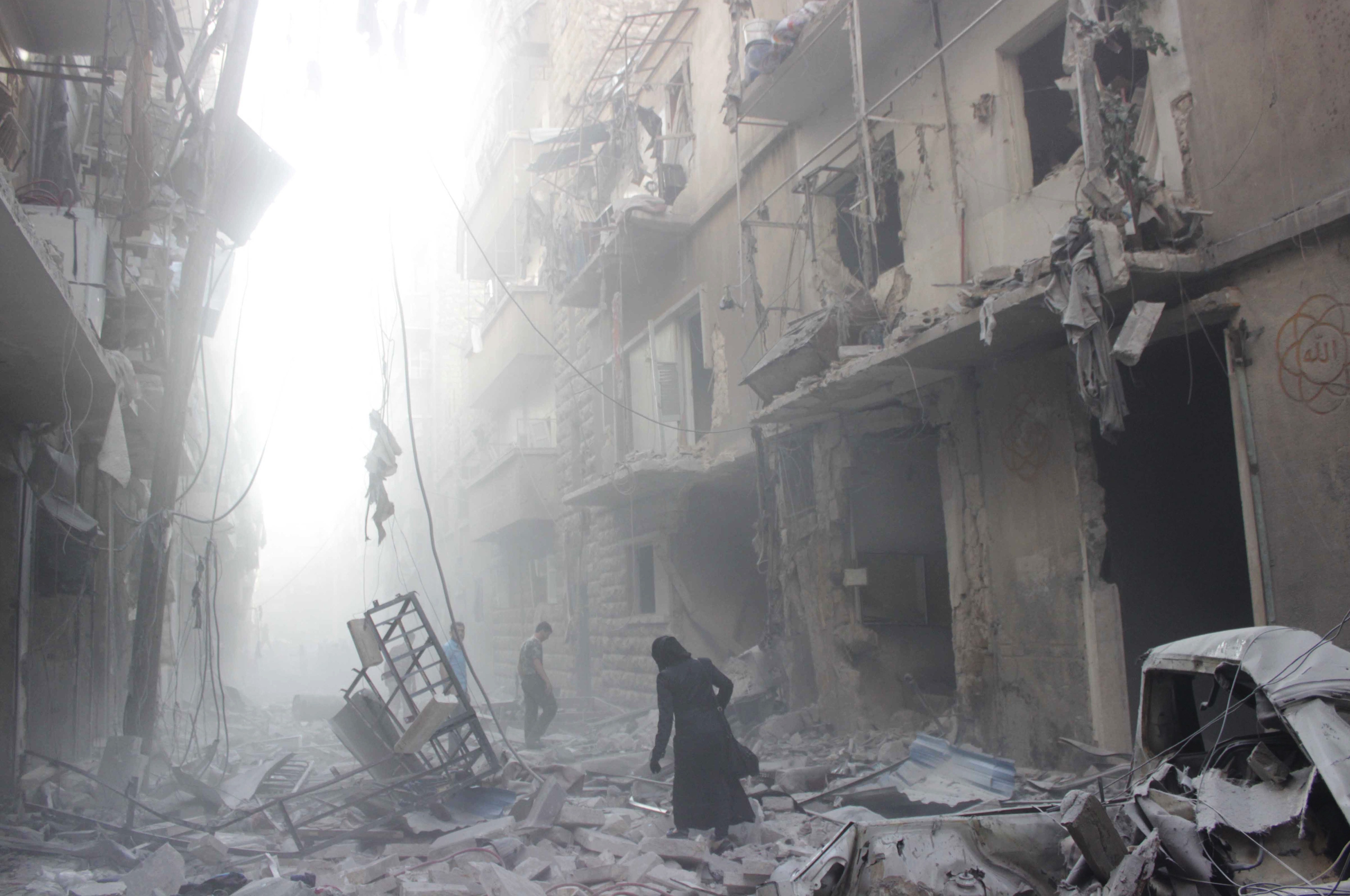
(Photo: A Syrian woman makes her way through debris following a air strike by government forces in the northern city of Aleppo on July 15, 2014. By Karam Al-Masri/AFP/Getty Images.)

Haters Be Calling This War A “War”

How dare we. State Department spokeswoman Marie Harf tries to spin how dropping bombs on two countries to destroy an entity that has yet to attack the US doesn’t count as a preemptive war:

Allahpundit watches the clip:

Preventing a dangerous enemy from hitting the U.S. by hitting him first sounds pretty preemptive-y to me. If I understand her correctly, the reason this isn’t preemptive war a la Bush is because it isn’t war, period. A war is something you engage in against a nation-state; we don’t recognize ISIS’s caliphate, ergo, they’re just a bunch of terrorists and preemptive war against terrorists is simply counterterrorism. I think that’s why you’re seeing such a moronic sustained effort today among White House mouthpieces to avoid using terms like “war” and “victory,” with Harf refusing even to accept “war on terrorism” as a label at the beginning of the video [above]. (Obama himself never once described the new “effort” against ISIS as a “war” [Wednesday] night, by the way.) The parallels here to 2003 — preempting a threat to the U.S. by overthrowing a brutal regime in the heart of Iraq — are too obvious and too politically uncomfortable to adopt Bush-era terms like “war” and “preemption” too. And of course, the more you talk about it as a new “war,” the more the public’s left wondering why an Article I declaration of war by Congress is unnecessary.

Asawin Suebsaeng catches John Kerry making the same claim:

“If somebody wants to think about it as being a war with [ISIS], they can do so, but the fact is that it’s a major counterterrorism operation that will have many different moving parts,” Kerry said Thursday on CNN. “I don’t think people need to get into war fever on this,” he told CBS News’ Margaret Brennan. … It is true that this latest round of airstrikes and other actions against ISIS is not a war in the classic sense. It isn’t as flashy or big-budgeted as past wars, and significantly fewer boots are on the ground. It is not a war in the sense that war has not been declared, but by that standard, the one that Kerry fought in (that disastrous one that served as the basis of three Oliver Stone movies) wasn’t a war, either.

Froomkin interprets the attitude Obama projected in his Wednesday night address:

This was not going to be a huge deal, he indicated. He called it an “effort,” not a war, and stressed that “this effort will be different from the wars in Iraq and Afghanistan. It will not involve American combat troops fighting on foreign soil.” There was no talk of shock and awe; what Obama had in mind was a ”counterterrorism campaign” that “will be waged through a steady, relentless effort.” And Obama’s lack of any specificity regarding the scale of the effort, the timing, goals for partner participation, or any kind of metrics for success was either cover for him not really having a viable plan — or a brilliant rhetorical strategy to keep open the option of ratcheting everything back once the hysteria passes. Or both.

Mary Ellen O’Connell underlines that in international law, the kind of preemptive defensive operation the Obama administration envisions is still illegal:

Late last month, Yale law professor Harold Koh, the former legal adviser in Obama’s State Department, asserted that the United States had the right to attack ISIL under international law to “to avert humanitarian disaster and to protect U.S. nationals and vital interests.” But international law is clear: The right to use force in self-defense arises following a significant armed attack against a country when more such attacks are likely. The use of force in self-defense must target the territory of the state responsible for those attacks. The United States has faced only one such situation under current law: It occurred on Sept. 11, 2001, and led to the war against Afghanistan, which gave safe haven to Osama bin Laden and the al Qaeda forces that orchestrated and carried out the 9/11 attacks. There simply is no right under international law to resort to major military force to avert humanitarian disasters or to protect nationals or “interests.”

Indeed, the administration is trying to claim authority for this operation under the 2001 AUMF that opened the way for the war in Afghanistan. That’s transparently illegal too, but Massimo Calabresi doubts that will make a difference:

If Obama is breaking the law, don’t expect much to come of it in the short term. The consequences of Obama’s legal interpretation, beyond his own discomfort, are not likely very great. The Bush administration showed the bar for legally constraining presidential counterterrorist actions is high, and even when it is surmounted there are little or no penalties. Politically, the president has nothing to fear: no matter how angry they are about the new effort against ISIS, the left wing of Obama’s party isn’t going to impeach him, and the right won’t either, at least not for going after Islamic extremists. In the long term, perhaps Obama’s legal legerdemain will boost those who want to come up with new, clearer legal frameworks for international counterterrorism operations. But for now Obama, like Bush before him, seems determined to act without them.

And that scares the crap out of Jonathan Hafetz:

Going to war against ISIL through the rubric of the AUMF has significant implications. Among them is the deterioration of the levers of democratic accountability for waging armed conflict in an age of global terrorism. It suggests not only the relative ease with which the United States will go to war, but also the way in which new military actions are subsumed under a more generalized war against extremist groups. War is becoming increasingly open-ended, while also more able to avoid democratic checks, as each successive military operation gets subsumed within an existing–and ever growing–conflict. War doesn’t end; it just expands, all without the friction that the separation of powers is designed to provide.

Why Obama Launched Another War

President Obama Marks Anniversary Of September 11th Attacks At The Pentagon

I wish I could say that my fears have abated somewhat since returning from vacation and finding the country in a bout of total hysteria over ISIS. No, I know I have no legs to stand on when it comes to hysteria, and may be over-reacting to Obama as badly as the country seems to have over-reacted to ISIS.

But consider the following facts as they have emerged this week. The key element of any intervention – as argued by the president – is that we have clear regional allies on the ground. We don’t. The Turks are AWOL; the Saudis claim they will train some Sunni forces to fight ISIS (drawing Iran into bolstering its balancing Shiite force); the European allies are not joining the military air campaign; and the Arab world is deeply suspicious – even when faced with a movement almost every government there despises. Even Jordan refuses to say publicly it is in the fight – and Jordan may be one of the most vulnerable Sunni dictatorships out there.

So let’s be clear: we have waded into a war alone. We seem to regard the ISIS problem far more seriously than anyone in the actual region. We are therefore Americanizing this war almost as soon as it begins, which means that almost everyone in the region will be hoping for our defeat. The hatred for America is deeper than the fear of ISIS:

Even in Baghdad and across Syria, where the threat from ISIS is immediate, reactions were mixed. Members of Iraq’s Shiite majority cheered the prospect of American help. But many Sunni Muslims were cynical about battling an organization that evolved from jihadist groups fighting American occupation. “This is all a play,” said Abu Amer, 38, a government employee, who withheld his family name for his safety. “It is applying American political plans.”

So this is almost a text-book example of the dumb war Obama was elected to avoid. It vitiates everything he has said through his candidacy and presidency. Its potential consequences are utterly opaque and we have no exit plan in the wake of our defeat. And yes – there is no war in the Middle East that leads to victory. It is always some kind of version of defeat.

So you have to ask yourself why. This is a calm and smart president who has just launched a war with no provision for its cost, no end-date, no Congressional authorization, no troops on the ground who can really do the work, and no reliable allies. The worst possible reason is an emotional response to the beheadings and enormous political pressure before the mid-terms. If that’s why he acted, he deserves our contempt. But there is another reason that deserves to be taken seriously. Jeffrey Goldberg puts it this way:

The only possible way to slow ISIS’s progress, and to possibly reverse it in some more-than-negligible way, is to provide air cover and intelligence and logistics support to our hapless allies on the ground. A second reason: President Obama was careful not to speak of an imminent or specific ISIS threat to Americans, because none currently exists. But it is not implausible to argue that a Qaeda-inspired group of limitless cruelty and formidable financial resources, one that has an omnibus loathing for “infidels,” and one that has thousands of members who hold passports from countries that participate in the U.S. visa waiver program, poses a non-trivial threat to American civilians.

The first objective – containing it in Iraq – was underway before this new and open-ended war. It had modest success – although it also precipitated the bait of the beheadings, which gave us this new wave of war. See how things evolve? So the second one is the most plausible. Obama is scared that minimalism won’t be enough, that ISIS could grow in strength, that a new Caliphate could be the final result of a war to bring secular democracy to the Middle East.

So he is acting out of fear. He believes that if you hit ISIS more comprehensively now, you can perhaps keep it at bay. No such threat can be left to fester. If you’ve heard of this kind of mindset before, you’re not wrong. It’s Dick Cheney’s one percent doctrine all over again. In abandoning what he said just last year about unwinding the war machine, Obama holds that the United States must be constantly at war, bombing and drone-striking other sovereign nations in order to prevent terrorist enclaves from becoming more dangerous over time – even when they have made no direct threat to the US, even though they are consumed by their own regional conflicts. But even Cheney was forced to go to the Congress to get authorization. Obama will have no truck with that. This new emperor assesses the threat himself, makes decisions later, and informs us that, whatever we believe, we are now at war again. If no-drama Obama has caved to this kind of hysteria and over-reaction, then what future president will ever be able to stand firm and unwind the cycle? If the un-Cheney Obama has just endorsed a Cheney-like idea of what the executive branch can do on its own, he has all but assured us that a future Republican or Clinton will have a solid precedent to conduct war as if they were emperors.

I can’t believe I have to say this in the Obama era:

the only way the blight of this modern-medieval bloodlust can be turned back is if the Muslim world does it. If we do it, it comes back again more potently, fueled by hatred of the distant empire. If we do it, it gains strength. We may bomb it into some kind of submission, but it will only come back, like a virus, mutated and stronger. Why on earth do you think we are confronting ISIS anyway? It’s because we destroyed the country of Iraq, allowed al Qaeda a foothold, and ISIS exploited the shift to Shiite power in Iraq by becoming al Qaeda’s more brutal successor.

In fact, by intervening, we make a possible regional resolution of these centrifugal forces less likely. By meddling, we could postpone a potential resolution of this long, difficult struggle as the Arab Muslim world tries to come to terms with the modern world. We are actually forestalling a possible Arab future by conflating it with a fight against American intervention.

I’m trying not to despair. I know plenty of you will mock me for over-reacting. And maybe I am and this lack-luster, transparently pointless move is just a gesture to reassure a nervous public and Obama will prevent this whole thing from metastasizing. I sure hope so. I sure hope that by some miracle, this will have some effect. I hope that the Iraqis put behind their sectarian hatred and unite against these fanatics. I hope the people subjected to this new Caliphate rebel against its insanity and evil. I hope this new front doesn’t lead to a wider Shiite-Sunni war or to the collapse of the critical nuclear negotiations with Iran. I hope the president hasn’t just put out a sign to ISIS that says: “You want a war? Come and Fight America.”

But this blog was transformed on 9/11, and has been a searching, grueling attempt to find a way out of that terror and out of the huge errors we made thereafter. Obama, for me, was the only man able to get us there. And he has folded – and you can see he knows it by the wan, listless look on his face. His presidency may well now be consumed by this new war and be judged by it – just like his predecessor’s. And all because when Americans are faced with even the slightest possibility of future terror, they shit their pants and run to daddy.

You know a country gets the future it deserves. And ours may have just gotten a lot darker.

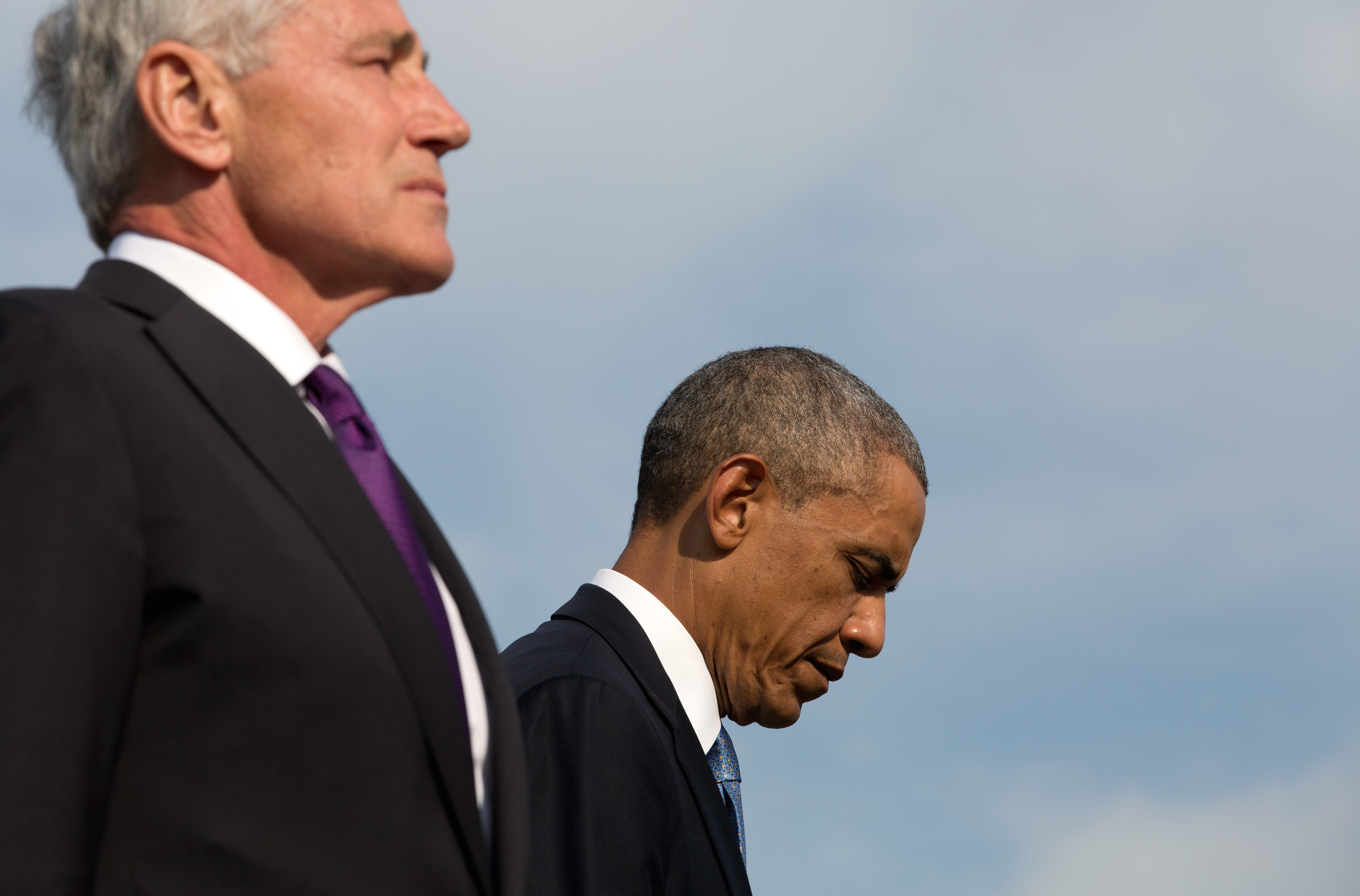
(Photo: U.S. President Barack Obama bows his head, as Defence Secretary Chuck Hagel looks on, during a ceremony to mark the 13th anniversary of the 9/11 terrorists attacks at the Pentagon Memorial on September 11, 2014. By Martin H. Simon-Pool/Getty Images)